KSTK is our partner station in Wrangell. KTOO collaborates with partners across the state to cover important news and to share stories with our audiences.
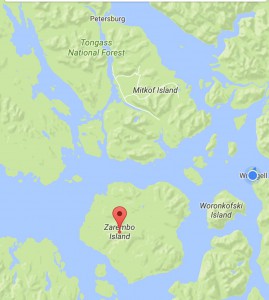
A geological-exploration company based in Wrangell will be taking surface samples on Zarembo Island for the next year. Zarembo Minerals has been exploring the northwest portion of the island for the past 10 years.
Owner, Mark Robinson, said the samples taken from several claims near St. John and Frenchie creeks have shown the area to be geologically similar to the Greens Creek mine near Juneau.
“We’ve been finding zinc, led and gold with minor silver,” said Robinson.
So far, Robinson said it’s been unsuccessful in locating a large enough deposit.
“It’s a tough thing to do, to start from scratch, build a model and try to evaluate that model,” he said. “We’ve been fairly successful. The problem is we’ve found grade, but we’re having a tough time finding tonnage.”
No drilling will take place this year. Robinson says it’s too expensive, and Zarembo is searching for a partner to fund future drilling operations. This year’s exploration will take surface samples, primarily from Frenchie Creek and surrounding surface rock deposits.
Robinson said Zarembo has 54 mining claims on the island.
Both the industry and environmental groups on either side of the Tongass Land Management Plan amendment can agree on one thing: the Forest Service needs to complete a full inventory of young-growth Tongass timber.
But their reasons are fundamentally different.
“We have really been working hard to try to show the Forest Service that there is a quick exit out of old-growth logging on the Tongass,” said Geos Institute chief scientist Dominick DellaSalla.
“Our biggest concern is that we don’t believe that the young growth is big enough right now, nor is there enough acreage of young growth to support a small-log mill,” Owen Gram of the Alaska Forest Association.
Both agree that an inventory of the Tongass’ young growth needs to be completed to better inform the Forest Service’s transition to young-growth timber sales. The management plan amendment does allow some old-growth harvests for specialty products.
DellaSalla has formally submitted an objection to the amendment. He said the institute’s assessments concluded there’s enough young growth to complete the transition in nine years. He said the Tongass could supply 50 million board feet per year in four years.
“You’ve got enough young growth that is going to be a wall of wood by 2020 and you can avoid a wall of litigation by continued old-growth logging. But, unfortunately the agency is slow-walking the transition,” said DellaSalla.
He said by 2025, that number will grow to 95 million board feet per year. The Forest Service plans to offer about half of that projection at the end of its 16-year transition.
The Forest Association is working on an objection. Gram said the amendment won’t allow Southeast timber mills to be competitive with mills in Oregon and Washington that process young growth.
“The sawmill people tell me that the only thing they can produce is the lowest grade of commodity lumber, construction-grade lumber,” said Gram. “And, there’s tons of that being produced down in the Pacific Northwest right now out of young growth logs, and they are 800 miles closer to the market place then we are, so we’re at a big disadvantage.”
Gram said it would take about 350 million board feet to sustain the Southeast timber industry.
He said mills have traditionally gravitated towards old-growth timber because it can be used to produce several different high-quality products, offsetting transportation costs. Gram acknowledges a transition is necessary, but wants to hold off another 30 years.
“You know, I think we would convert over to 100 percent second growth once the trees are mature. That’s always been the plan,” said Gram.
Gram said waiting until young growth stands are about 90 years old, instead of the 60-year benchmark, will allow mills to produce several products and boost volume, making Southeast mills competitive.
DellaSalla said the Geos Institute approached the Forest Service earlier this year about a pilot project that could solve that problem. It would test new saw technology on smaller logs.
“This would have been implemented on Prince of Wales Island at the Dargon point sales – would have been process or at least scanned with new technology that would have at least started the process of how can you process these smaller logs on the Tongass and get profit out of them,” said DellaSalla.
He said Good Faith Lumber in Craig was interested in the project, on the northwest part of the island, but the Forest Service turned it down.
The final Record of Decision is expected before the end of the year. The objection period ends Aug. 29.
Several calls to Tongass Forest Supervisor Earl Stewart were not returned in time for this report. The environmental firm Earth Justice expects other groups to file objections.
Rookie state legislator Rep. Dan Ortiz, who represents District 36, visited Wrangell last weekend for Bearfest to meet with constituents.
Ortiz is up for re-election in November and said Wrangell residents have expressed concern about the $3.5 billion state budget deficit, the ferry system and a restructuring of the permanent fund.
Ortiz said he’s heard plenty of concern from Wrangell residents over the state’s fiscal future.
”And frankly, they want to know what it is that the legislature is going to do about that situation,” Ortiz said.
The legislature didn’t take much action after two special sessions, he said, mainly on Gov. Bill Walker’s fiscal plan, including a restructuring of the permanent fund.
“Some are quite fearful the permanent fund dividend will disappear,” he said.
Walker vetoed half of the money for this year’s dividend along with several other vetoes to education and road projects. Walker also delayed payments for oil and gas tax credits. Ortiz said the governor’s decision wasn’t easy, but he supports a restructuring of the permanent fund.
“So what I’m saying is and what the governor’s office and financial experts are saying is eventually that dividend will not be there for the people of Alaska,” Ortiz said. “When I say eventually, I’m not saying distant, I’m talking three to four years.”
An income tax also is an option that needs to be thoroughly looked at, Ortiz said.
“In fairness to the governor, he’s definitely not a tax-and-spend guy,” he said. “But, he’s looking at the reality that said we’ve cut the budget and yet, even as much as we’ve cut it, we still have about a $3 billion to $3.5 billion deficit. We can’t just continue to have that, and we’ve got to come up with new revenue.”
Ortiz doesn’t support all of Walker’s fiscal plan, particularly a 3 percent state sales tax. He said that increase might deter “buying local” in communities such as Wrangell with a 7 percent sales tax.
Southeast Alaska has seen dramatic cuts to the ferry system over the last few years. Oritz sits on the transportation committee and said he understands businesses’ concerns that rely on the system.
Wrangell could see 22 fewer sailings October through April compared with last year. Leslie Cummings, who owns Grand View Bed and Breakfast in Wrangell, told KSTK in an earlier interview that she receives roughly half of her business from marine highway travelers.
Ortiz said an increase in sailings isn’t likely, but hopes to make the system’s budget stable.
“Really what I would be hopeful for is if we can stop the bleeding, if you will, and basically keep the ferry system on its current operating level, at least for the short term,” he said. “In doing so, creating certainty for businesses, certainty for travelers on the ferry system which I think is important for the overall health of the ferry system.”
Although the state’s fiscal future is uncertain, Ortiz said there were some positives to come out of this year’s session. He said Senate Bill 32, which allows the state to open more of its timber lands to sawmills, was one of the key legislative wins for Southeast. The other is a tax on cruise ship passengers that helps fund refurbishing port facilities. He said that was on the chopping block but was restored.
Ortiz faces two opponents in November, Republican Bob Sivertsen and Constitution party member Ken Shaw.
Ortiz is an independent but caucuses with the Democrats.
A crew member on a fishing vessel west of Wrangell Island was found dead Saturday morning.
Charles Richards, 28, of Seattle was found unresponsive in his bunk by a crew member.
Wrangell Search and Rescue responded to the scene after the Coast Guard was notified about 5:47 am Saturday.
Richards was taken to the Wrangell Medical Center, where he was pronounced dead.
His body was transferred to the state medical examiner’s office in Anchorage for autopsy. The cause of death is not known.
Owner of the Odin, Mark Severson, said his son, Cameron, recently took over operating the boat.
“I just did my stint and my son had taken over for me. And, that was their first outing without me,” Severson said
Richards, who went by Rhett, went to college with Severson’s son.
“That’s how he came to get on the boat. I needed a guy, and he filled in. He was a great hard worker and a happy go-lucky kid,” Severson said.
The vessel was southwest of Wrangell in Anita Bay when the call came in.
“One of the guys came down when Cameron was starting up the machinery and said Rhett was not moving,” Severson said. “So they started doing CPR and called the coast guard right away.”
He said Wrangell search and rescue arrived about 40 minutes after the call.
Wrangell is in a water crisis. Between two fish processors and the public, demand is exceeding the water treatment system’s ability to produce clean water. The assembly and borough manager declared a local emergency disaster Tuesday and are asking the public to cut water consumption 30 to 50 percent.
Water Plant Manager Wayne McHolland said Wrangell’s treatment system was never designed for the community’s water source.
“It’s designed for spotlessly clean water going into it. We don’t have that, we never have. It has never worked since the beginning,” said McHolland.
The system was designed for ground water, which is dramatically cleaner than what’s supplied by Wrangell’s two reservoirs. McHolland said the surface water is too dirty and slows the treatment process.
Sand from a filter at Wrangell’s water plant. (Photo by Aaron Bolton/KSTK)
“Regardless, it comes into the plant and we have inefficiencies in our roughing filter system. It goes through and then all this dirt ends up in the main filters, which clogs them extremely rapidly,” he said.
The public works department has been cleaning the filters every few days, costing the plant valuable production time. The filters are designed to last three months.
“Yea, it takes us about 200,000 gallons to do maintenance on a filter, from the initial loss of dumping a filter, which we can’t recover, which is the major loss,” said McHolland. “Then about another 50,000 to do the maintenance on it.”
The plant can produce up to 1.4 million gallons of water per day and can store about 850,000 gallons at a time. The plant had about 40 percent of that capacity Wednesday morning.
The assembly unanimously voted to declare a local emergency disaster to tap into state resources as well as bypassing procurement codes. Bypassing the codes will allow Borough Manager Jeff Jabusch to quickly pursue any solutions to the crisis.
The borough is moving forward on modifying the system’s filters in hopes of speeding up production. It expects to spend $25,000 on that modification. Plant Manager McHolland is unsure how much it will help speed up water treatment.
Public Works Director Amber Al-Haddad said Wrangell’s two seafood processors, Trident and Sea Level Seafoods, account for little over half of the demand.
Al-Haddad said both processors have been conserving water. But, both Trident and Sea Level say their production has been limited by the borough for about two weeks, costing thousands of dollars.
John Webby is a manager for Trident. He said it has cut water consumption in half and shut down for three days during the last two weeks. He said the plant has diverted about 1.5 million pounds of fish to other Trident locations.
“I cannot manage that plant the way we’re running right now, cannot do it. I can manage the plant with something, but I can’t manage it with nothing,” said Webby.
Webby asked the assembly to find a way to split available water between the two processors.
“I believe that whatever available water there is, whatever it is for the processors, that has to be determined by the council, water department or engineering, I think there should be a fair equitable divide in that water. Because that’s not what’s happening,” he said.
Al-Haddad said her department is looking into a way to evenly split water usage.
Vern Phillips manages Sea Level. He said it has modified the plant’s plumbing to use salt water, reducing its fresh-water intake by about 60 percent. Phillips said Sea Level doesn’t have another location to divert tenders to like Trident, causing the plant to throw out thousands of dollars in product.
“We cooked crab yesterday. Of what we had in the system, there was about 2,000 pounds of crab wasted. That in itself what about $6,600,” said Phillips.
The borough is testing a new type of water treatment later this month in hopes of solving the problem, which has plagued Wrangell for years. The pilot study was funded with grant money earlier this year.
Al-Haddad said if the treatment method proves successful, the department will seek funding to convert Wrangell’s plant. The assembly has added the conversion to the agenda at the next regular meeting July 26. The new system would add about a million gallons of storage capacity, and treat water faster.
The borough has created a webpage to update the public on the water crisis as well as a Q&A.
Close
Update notification options
Subscribe to notifications
Subscribe
Get notifications about news related to the topics you care about. You can unsubscribe anytime.