KSTK is our partner station in Wrangell. KTOO collaborates with partners across the state to cover important news and to share stories with our audiences.
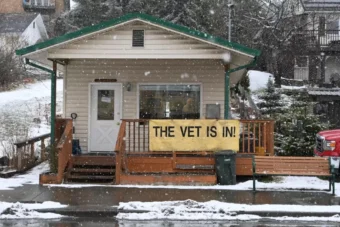
Veterinarian Judge Conniff’s office at Conniff’s Critters in Wrangell. (Colette Czarnecki/KSTK)
The lack of accessible veterinary care when the vet isn’t around has been on many pet owners’ minds in Wrangell. And some have gone through traumatic experiences for end-of-life solutions. This isn’t new in rural Alaska.
Wrangell officials may have found a Band-Aid solution to euthanize pets since the state of Alaska has no regulations for certifying euthanasia technicians. Police Chief Gene Meek said Wrangell’s vet is currently training him when the chance arises.
“Training has been slow because there’s not been a lot of animals put to sleep,” Meek said.
The move follows years of part-time vet care from traveling vet Judge Conniff, who is only in town 10 days a month. Between those visits, there haven’t been many affordable and accessible solutions.
The police department has leftover narcotics from previous police chief Doug McCloskey, who helped euthanize pets until he retired five years ago. But Meek said it’s crucial to get trained because of the harmful chemicals used in euthanasia.
“You don’t want to mess something like that up with somebody’s pet,” Meek said. “Just getting those and the balance of how much to use. I don’t think it’ll take that much time (to start administering alone).”
“I would have got a training session”
Towards the end of December, an officer who had to put down a senior dog used a gun rather than proper medications. Meek said the officer then helped box the dog up and did paperwork to fly it to Ketchikan for cremation.
“Most likely they would have brought the dog to Judge, or Judge would have went there and I would have went there,” he said. “Then I would have got a training session.”
Meek, who was hired on as police chief last summer, said that he would be operating under the Wrangell vet’s licensing.
“Before I took the job, this was one of those topics of discussion, and I was sitting on my couch in Soldotna reading up on the regulations of this and the state, because that training fell apart, they don’t have any new regulations to it,” he said. “They haven’t updated it. It’s out of date, so we’re kind of winging this.”
The state’s recommendations for training included a certification course recommended by the National Animal Care and Control Association. Another recommendation was getting trained by someone who was certified as a trainer by the Humane Society.
A change in the state statute
Since the state statute took place, the National Animal Care and Control Association stopped approving courses. Additionally, the Humane Society doesn’t support or certify trainings anymore.
Another option is at the University of Florida, but sending someone from Wrangell for the training doesn’t seem to be that realistic.
Meek said police euthanasia is specifically for pets who are at the end of their lives. Plus, not everyone has the means to send out their pets for end-of-life services.
“This is about folks who legitimately are watching their animals suffer,” he said. “It’s not because they don’t want their animal. That a personal problem, you need to work through that. Find another place to house your animal.”
Meek said his training will continue until there have been enough euthanasia appointments for him to start administering the narcotics himself. Additionally, Wrangell’s veterinarian is also training his assistant, Trista Robison. It is unknown when they will be fully trained.
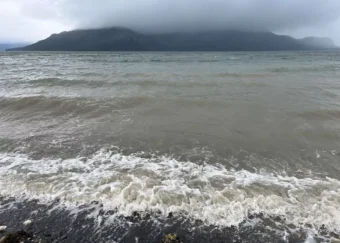
Storm front coming in to Wrangell on August 25, 2024. (Colette Czarnecki/KSTK)
During a phone call on Thursday, U.S. Senator Lisa Murkowski said that Wrangell’s been on her mind one year since the deadly landslide. She said the disaster is something people can’t easily shake if they’ve seen it.
“This summer, when I was there visiting my folks, we went out on the boat and saw it from a further distance and different perspective,” the Republican lawmaker said. “It’s just this very physical reminder of a scar and a wound.”
Coincidentally, Murkowski said she spoke with the Senate Appropriations Committee about disasters and proposed legislation that fiscally supports updated monitoring systems for all natural disasters on Nov. 20, the one year anniversary of the landslide that killed six people.
“To talk about just some of the disasters that we’ve seen in Alaska in this past year – Wrangell and Ketchikan with the landslides, but previously the deadly slides in Haines and Sitka, and the floods up north,” she said.
The talk was mostly about the need for better weather forecasting through additional sensors. She said she’s been working on a bill with Democratic Sen. Alex Padilla from California for several months.
If passed, the Improving Atmospheric River Forecasts Act would direct the National Oceanic and Atmospheric Administration to create an accurate forecast system to better predict the timing and predictability of atmospheric river storms. Atmospheric rivers are known as “rivers in the sky” and can vary in size and shape. They can cause excessive rain, floods and landslides, like in Wrangell last year. State geologists found excessive rain in a short time was a major contributor to that event.
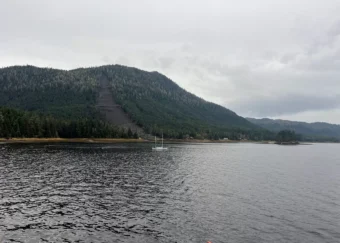
“Because we just introduced it right at the end of this year, it’s at the point where we’re not having hearings on new bills,” Murkowski said. “What we wanted to do was get it out there in the public for consideration.”
She said they’ll reintroduce it when the new Congress convenes in January.
This support would also improve monitoring systems for other natural disasters throughout the nation, like a bill introduced earlier this year on earthquake hazards mitigation.
“So it’s drought, it’s floods, it’s hurricanes,” Murkowski said. “It is tornadoes, it’s landslides, it’s fires – fires are everywhere.”
She said the legislation is sparking conversation and feedback.
“As we work to advance this next year, we will be reaching out to communities that have been impacted that know and understand in real time, why this would be beneficial,” Murkowski said. “So it goes both ways. They can contact us, but we’ll also be reaching out to them.”
She said she’ll be able to talk about this with Wrangell’s Borough Manager Mason Villarma when he’s in Washington D.C. on Dec. 3.
Wrangell’s landslide 11 months after on Oct. 13, 2024. (Colette Czarnecki/KSTK)
Jamie Roberts was home when she heard the landslide come down, but through luck, its deadly pathway just missed her house. Since Nov. 20, 2023, she hasn’t stayed in her home on Zimovia Highway.
“The event was so sensory-overwhelming, that I knew for myself I would have a hard time being there and feel relaxed and have it be my refuge,” she said.
Over the past year, she and her husband, Greg, decided to leave town, not only because of feeling unsafe in their home but also because of the housing crisis that Wrangell faces.
“I have a lot of mixed feelings about it, but yeah, it will be good,” she said.
She’s lived in Wrangell for about 26 years. She said that’s half her life and the community has shaped her into who she is.
“I came here for a summer job,” Roberts said. “I call it one of the happy detours in life.”
Even though the landslide happened 11 miles south of town a year ago, it was detrimental to the community. The six lives lost were beloved community members.
The response was immediate the night of the slide. Search and Rescue and their canines searched for bodies and the State Department of Transportation cleared up and fixed the road – although it ultimately took weeks. The Wrangell community also went into action in the following days, boating residents from the south side of the slide into town. Rooms at Wrangell’s lodgings were made available to anyone who didn’t feel safe and community members gathered donations to help those in need.
Roberts and her husband raised their children in Wrangell, and she said she has always felt it was a safe place for her family. But over the year, since the landslide, she’s kind of been in autopilot mode.
Roberts said that they’ve moved five different times because the housing has been temporary.
“If people offered us a place for a month, we took it and then just looked for the next thing,” she said, adding that it’s been a lot of packing up, unpacking, renesting, trying to settle into life before it was time to pick up and do it all over again.
“I feel like I’ve really been in just fast forward motion,” Roberts said.
She said emotionally processing what happened has been slow.
“When I finally take time to slow down, I’m sure I’ll be able to, you know, have some healing happen over the last year,” Roberts said. “Definitely some compiled losses. But I don’t know, it’s a good thing I guess, I’ve had something to really keep me busy and keep me focused on being of service.”
She said being of service has helped her healing process, though. She’s a swim coach and recently has been substituting as a teacher at the school. Over the years she’s also served as a volunteer firefighter, EMT Search and Rescue and a coach of almost all sports.
Roberts and her husband decided to buy a house just outside of Eugene, Oregon. But she wanted to stay in Wrangell until the end of swim season if enough kids signed up. The season just ended this past weekend.
“I thought, ‘well, then I’m so close to the one year anniversary of the slide, so why not stay for that,’ in hopes that maybe there was some kind of community event or a healing circle or something,” she said. “I actually have my flight arranged to leave the day after.”
She said her new place in Oregon is different than Wrangell. For one, there’s a lot of sun. Roberts said that’s always a bonus. Plus, things are probably going to be more accessible, like fresher food at the farmers markets and more nature trails.
“Easier travel to see my family,” she said. “Options to to do some exploring that is more affordable as well.”
She said this move might give her the space to process the past year, but she still imagines she will find ways to be of service in her new community.
“I think my patterns of dealing with either grief or trauma … that it’s going to be ok because I’m going to have time where,” Roberts said. “I mean everything that I’m involved in and that keeps me busy. You know, how many hours a day is just all going to go away.”
Another Wrangellite that the landslide severely impacted is Christina Florschutz. She was the only survivor and lost her husband and house during the catastrophic event. Rescuers found her near the slide debris the following day. Florschutz left Wrangell just a few weeks ago to live in Kodiak with her son.
She wasn’t available for a recorded interview, but through an email she said that the compassion Wrangellites gave her helped her tremendously in her healing process. And like Roberts, being of service also helped her. Florschutz returned to working at the school, which brought her joy and satisfaction.
In addition, she said she’s coped with the loss by the care and counsel of other widows.
Florschutz wrote that they have taught her that “God’s timing is perfect,” even if it’s not something she would have chosen.
Another form of self-care that has helped Florschutz over the past year is getting enough exercise, like riding her bike. She said it helps her sleep at night. Additionally, reading has helped, especially reading about science. She said that this taught her that actions can influence feelings. One example is purposefully smiling, which has brought her feelings of happiness.
She doesn’t know what’s in her long-term agenda moving forward, but she suspects more business with cleaning up the past year’s mess.
As for Kodiak, she said it reminds her of Sitka because of the U.S. Coast Guard base, commercial fishing fleet and windy weather. But one thing is different, the bear problems are worse in Kodiak than in Wrangell. She said to never leave groceries in the car.
Florschutz created a website to share her story and wants others to share their stories too.
As for the community of Wrangell, Borough Manager Mason Villarma said that without the grit and support of local residents, we wouldn’t be where we are today.
“What makes this community so remarkable is everybody supports each other and we get through tough times and build back better,” he said. “And we did exactly that over this last year. It’s an emotional time coming up on the one year mark, obviously the scar is still in the mountainside when we all go past it.”
He said the borough has done a lot in public safety that corresponded to the landslide, like actively updating its Emergency Operation Plan.
Villarma said that the Nixle enrollment, which signals registered users, has significantly expanded. That can be found on the borough’s website.
As Wrangellites reflect over the past year since the landslide, the community has shown its resiliency to carry on.
The U.S. Capitol Christmas Tree in front of Wrangell’s Nolan Center during its Harvest Festival on Oct. 26, 2024. (Colette Czarnecki/KSTK)
As early voters in the Southeast Alaska community of Wrangell helped choose Alaska’s next U.S. representative, local workers were preparing to send a Sitka spruce to the nation’s Capitol.
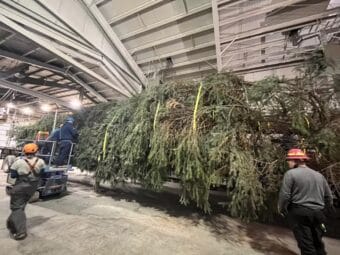
In the run-up to the Oct. 26 Harvest Festival celebrating this year’s chosen U.S. Capitol Christmas Tree, everyone was busy inside Wrangell’s state Department of Transportation warehouse, with sounds of a shop vacuum and constant chatter. It was almost like Santa’s workshop — but instead of toys, people tended to a very large tree.
Workers wore hard hats and some people wrapped up the tree, which was harvested from Alaska’s Tongass National Forest, securing it before it headed to Washington, D.C. But it couldn’t leave without a final farewell and blessing in Wrangell.
“It smells like Christmas,” said Chugach National Forest Service employee Brandon Raile, one of the leads for this year’s Capitol Christmas Tree project. “It smells like the only thing missing is the gingerbread cookies. That smell that reminds you of what it’s like to be a little kid at Christmas.”
The tree laid on an 85-foot custom-built trailer that gets used every year to transport each Capitol Christmas Tree.
Wooden walls about six to seven feet tall were lined up against the warehouse. They enclose the tree on its journey across the Lower 48.
Raile said Plexiglas will protect the upper half of the tree that lays at the last 20 feet of the trailer. Lights and some of the 14,000 Alaskan made ornaments will decorate that part of the tree.
“At night when it’s rolling down the road, you’ll be able to look in and see the decorated Christmas tree,” he said.
But the 74-foot tree from Zarembo Island, about 20 miles west of Wrangell, would die before the holidays without water.
High school tech club created a misting system to keep tree alive
Because of this and a new project by Wrangell’s High School tech club, T3 Alliance, excavators dug out the tree.
Wrangell’s T3 Alliance students created the Capitol Christmas Tree watering system to help preserve the tree on it’s 4,000 mile trek to Washington, D.C. From left: Ander Edens, Andrei Bardin-Siekawitch and Anika Herman. (Colette Czarnecki/KSTK)
“We hook a large crane to the top of the tree and we began to excavate the root system,” Tom Roland, one of the 2024 Capitol Christmas Tree team leads, said. “Once the root system was coming loose, we used an excavator in the crane to lift it out of the ground; then we turned it horizontally and we started getting it down on the trailer. It’s a pretty long process. Took a full day to get it positioned on the trailer.”
And then it took another full day to tie the branches down secure enough so they can transport it. But the crew lucked out that weekend – the weather was mostly sunny, which is rare for a Southeast Alaska fall.
‘Why can’t we transplant this tree?’
“One of the questions that we’ve received many times is, ‘Why can’t we transplant this tree?’ And that’s because we had to take the anchor roots out to fit it on the truck,” Roland said. “So while we did get the vast majority of the fine root mass, we weren’t able to save the anchor roots, making this tree impossible to transplant.”
To keep the tree alive for as long as possible, the local high school tech club created a watering system for the tree during transport.
Misters, which look like small polyvinyl chloride or PVC pipes, are set up as a large rectangular cube that encloses the root wad. There’s about 20 mister nozzles on the whole contraption. When turned on, a battery powers the pump to cycle water through the system.
Back in the garage, the workers vacuumed out water from the root area. Then, they reintroduced the 200 gallons of water. Basically a tray on the bottom collects the water as it drips off of the root wad, and then it recycles back through the system with pumps.
National Forest Service employees wrap up the Capitol Christmas Tree on Oct. 22, 2024 in Wrangell. It took three days for the tree to be secured on the trailer that will head to Washington, D.C. (Colette Czarnecki/KSTK)
“This is just so cool to me,” Raile said. “The local school kids were able to have their print on the U.S. Capitol Christmas Tree that’s going to travel the entire country. That’s just so exciting.”
Each side of the truck’s designs represent the Tongass and Chugach National Forests
Raile said the Kenworth truck that will haul the Capitol Christmas Tree is a new vehicle donated by the company each year. Each truck has its own design, like this one that represents the Tongass and Chugach National Forests – one side for each forest. The truck’s blue color is intentional as well because it matches the Alaska flag.
“Come around to the scenes,” Raile said. “These are super exciting because the longer you look at it, the more you see. So all of our iconic wildlife is hidden throughout the scenes.”
The wildlife that’s hidden includes a salmon, fox, eagle, a bear and wolves. But that’s just a few. There’s also formline art on the truck, designed by Wrangellite Mike Aak’wtaatseen Hoyt. It represents the Eagle and the Raven clans, symbolizing unity and balance.
The truck will make its way across the Lower 48 on a whistle-stop tour, visiting 11 other communities. Raile said everybody will have the opportunity to sign the giant banner on the truck.”
“By the time this thing gets to D.C., it’s just covered with signatures from all across the country,” he said. “It’s really cool to see.”
After about three days of wrapping the tree and getting it ready for its long trek, many Wrangellites celebrated it at the Harvest Festival at The Nolan Center.
“I’m gonna go out and touch the truck, because I want to touch the truck before it leaves,” Don McConachie said.
‘I see a small American town getting together…’
Not everyone here is from Wrangell though.
“I see a small American town getting together, enjoying the festivities of Halloween and Christmas and local traditions all together in one,” said Nevada resident Duncan Leao. He came out to help with the tree for the last two weeks.
When Wrangell Cooperative Association Tribal President Ed Rilatos said it was time to bless the tree, people brought out a large bear skin that lies between the dancers and everyone else — including the tree outside.
“It’s been a hard job, hard work to get this done,” he said. “A lot of people put a lot of time in, but we need to bless the tree. It came from our land, and we have our dancers here, and I hope you enjoy our ceremony as we send our mighty spruce tree off to Washington, D.C. It’s called the People’s Tree, but when it’s set right there (in front of The Nolan Center), it’s a Wrangell tree right now.”
U.S. Forest Service employees construct the watering system for the journey to Washington, D.C. (Colette Czarnecki/KSTK)
Tribal Administrator Esther Aaltséen Reese spoke to the large crowd. She said this tree is part of their culture, which represents balance.
“We are so honored that this tree is going to Washington, D.C. This tree is literally our connection to our ancestors,” she said. “It sheltered our ancestors, and now we are proud to gift it to Washington, D.C. for their celebration.”
Soon after the tribal members spoke, a drum could be heard.
The tribe then began to sing and dance, starting with the Welcome Song to welcome the tree and the people.
After the blessing, Wrangell’s city officials spoke to the crowd, including Borough Manager Mason Villarma. He thanked U.S. Sen. Lisa Murkowski for her help during Wrangell’s deadly landslide last year.
“About a year ago, a really bad, bad thing happened here in Wrangell and a lot of us went over to D.C. to ask for some help through Lisa,” he said. “She was there and she had mentioned that the sun’s going to come up tomorrow. I know it’s not out today, but it did come up tomorrow, and we really have rebuilt ourselves. And that’s just characteristic of our community.”
Whistle-stop tour brings people together
The tree’s official photographer and storyteller, James Edward Mills from Wisconsin, travels with the tree to document its tour. He said he’s had the role for the last 10 years.
“It’s perhaps the greatest honor of my life,” he said. “I’ve been doing this since 2015. The very first tree I did came from Alaska, and so this is kind of coming full circle on a fabulous journey that has taken me to 10 regions in the U.S. Forest Service.”
He said tree transporters typically go to very small towns and rural communities, where everyone comes out.
“It turns into just a fabulous celebration of cultural and social unity,” Mills said. “Everyone seems to put their political affiliations aside. It’s very non-partisan and it doesn’t even have much of a religious proclivity, which is great.”
As a band started to play. Wrangellite Alice Rooney also mentioned how non-partisan the event was, especially with the nation’s political polarization.
“We’re all just so excited about the tree coming to the Capitol,” she said. “Our Capitol is not a red Capitol, not blue, it’s just our Capitol. And I’m really excited.”
The day ended shortly after. All that was left was putting the tree on a barge to make its way south to Ketchikan and then Washington, D.C.
The Forest Service invites Alaskans to follow the tree’s journey on its website.
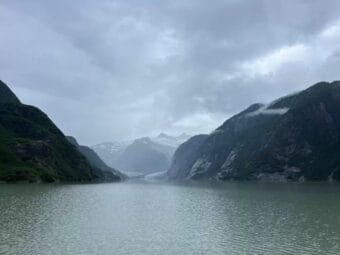
Up the Stikine River near Shakes Glacier on July 19, 2024. (Colette Czarnecki/KSTK)
The Canadian government said in September that it will spend approximately $15 million on a 27-mile road in support of critical minerals at Galore Creek Mine. The road will stretch between two different work camps on the Galore Creek Mine’s property and will bring the copper, silver and gold mine closer to operation.
This news is hard to hear across the border, since the site is very close to the Stikine River headwaters in Southeast Alaska. Some Wrangellites are very concerned about this development near a waterway they depend on.
Tlingit and Tahltan tribal member Christie Dascawah Jamieson was born and raised in Wrangell, located at the mouth of the Stikine River. She said she and her husband fish and hunt as much as they can.
“If this copper and gold mining project comes into play, it’s going to be a huge threat to our way of living,” she said. “Not only to Wrangell, but Petersburg (too), we both share the Stikine River.”
She said she has fond childhood memories going up and down the Stikine.
“It was one of the best times of my life,” Jamieson said. “I just cannot imagine the river being totally devastated by this copper and gold mining project.”
Jamieson said she worries that the mine will destroy the river and surrounding land and that the mine’s owner, Galore Creek Mining Corporation, won’t clean up after extraction.
“(If) they don’t clean up what they have ruined and they leave it for somebody else, it’s just left behind,” she said. “The land and the beauty and the wildlife and the fish are all gone; and it’s so, so sad, because that’s our way of life.”
Galore Creek Mine has been in the planning stages for almost 20 years.
It’s changed investors, been put on hold due to capital costs skyrocketing and has been waiting on negotiations between British Columbia and the Tahltan Nation – the tribe who owns nearby land on the B.C. side of the border.
KSTK contacted Galore Creek Mine by phone and email. An interview was pending at publication time.
Alanah Connie with the B.C.’s Ministry of Energy, Mines and Low Carbon Innovation said the road funding is coming from the federal government and to call the country’s natural resources department.
Marie Martin, senior communications advisor with Natural Resources Canada, also responded the day of publication and said the agency is looking into KSTK’s request.
The Southeast Alaska Indigenous Transboundary Commission is a coalition of 15 tribes on the Alaska side of the border advocating for having a voice in the mining.
The Galore Creek Mine in Canada is 25 miles from the Alaskan border northeast of Wrangell. (Courtesy Galore Creek Mining Corp.)
President Esther Aaltséen Reese said Wrangell will be directly impacted by the mining project. Galore Creek is 25 miles from the border and the entire project drains into the Stikine River.
“We consider that border to be a colonial border,” she said. “It did not exist in the time of our ancestors and we were allowed to care for our lands on both sides of the border. Now, because of that border, the tribes downstream are restricted and we aren’t given rights to have a say in what happens to projects that will directly impact us.”
She said the Stikine is literally the lifeblood for Wrangell, in terms of subsistence foods and recreation.
“There was a young woman at one of the conferences that said in their streams that had been polluted, salmon now only exists in their myths,” Reese said. “That is what we’re fighting against. We want to make sure that we’re protecting our salmon.”
The coalition’s Executive Director Guy Archibald said it’s important to protect salmon because it not only feeds the culture and people, but also the forest. He said that nature is good at balancing itself after an occasional catastrophic impact. But the Galore Creek mine would put consistent stress on the environment.
“Salmon and ecosystems cannot tolerate constant, low-level stress,” he said. “I mean, we know what that does to our immune system, digestive, nervous system. But that’s what’s happening here and we’re losing our salmon. We’re watching an extinction event.”
He said that the British Columbia government is aware of the detrimental outcome the mine would produce.
“The B.C. government has basically declared these upper head waters as a sacrifice zone,” Archibald said. “They know they’re going to be environmentally damaging. They’re willing to take that damage in order to pump up their economy.”
Alanah Connie, communications manager for B.C.’s Ministry of Energy, Mines and Low Carbon Innovation, said the B.C. government does not use the term “sacrifice zone.”
Archibald said the amount of gold, copper and silver that the mine will produce is minimal compared to the waste that will threaten the area.
“The mine talks about it being a copper mine, gold mine, silver mine, critical minerals,” he said. “All the mines are critical minerals. Now it’s just a talking point, but you know, looking at when we talk about a low grade mine, their copper concentration is 0.72% per ton of copper.”
That means the company will get nine pounds of copper when they mine one ton of rock. The amount of gold and silver would be even less. He said this minimal amount doesn’t make it a copper or gold mine, but a hazardous waste mine.
Though Canada is funding the new 27-mile road, Archibald said other roads already exist to access the mine property. He said the company has been actively building the road and bridges over the last three years.
He said that a major concern is the mine waste or tailings that the mine will produce.
“The mines are going to build the tailings’ dams or the tailings’ pile or the water treatment is going to have to exist in perpetuity, forever, and given a forever amount of time, every thing will happen: the world’s largest flood, the world’s largest earthquake,” Archibald said. “It’s all going to happen and Wrangell is directly downstream from this.”
But there could be some hope for sharing these concerns. He said the mine’s plans are changing because the owners want to move the tailings management facility to another location.
Archibald said this change would allow tribal members, Wrangellites and other communities to voice their opinions.
“The good news is it’s considered a major amendment to their mine plan,” he said. “So it will open the environmental assessment back up for public scrutiny and that should give an opportunity for Wrangell and the Southeast tribes to make their voices heard.”
He said the tribal coalition speaks with the British Columbia Environmental Assessment office on a bi-monthly basis and they have been expecting the amendment any day.
As of right now, there’s no definite timeline for when the mine will open.
KSTK attempted to contact the Tahltan Nation but it hasn’t responded.
Tom Roland, Forest Service Silviculturist, evaluates a candidate tree in the Wrangell Ranger District of the Tongass National Forest for potential selection as the 2024 U.S. Capitol Christmas Tree. (Courtesy of U.S. Forest Service)
A tree from Southeast Alaska’s Tongass National Forest has been chosen for this year’s Capitol Christmas Tree near the White House.
Last month, the U.S. Forest Service and D.C. officials met in Wrangell to decide which one will become “The People’s Tree,” gracing the grounds of the Capitol lawn.
Not only will the tree represent Alaska, but it also will symbolize the Tongass’s people, history and culture.
Jim Kaufman, with the Architect of the Capitol, was one of the officials who looked for the perfect tree from Wrangell and surrounding islands. The legislative branch oversees the grounds and landmark buildings of Capitol Hill in Washington, D.C.
He said learning about the temperate rainforest and the people in Southeast Alaska helps him decide on the tree. So he first met some locals.
“Understanding what really makes the local people of the Tongass and the history,” Kaufman said. “It’s a piece of the people that it comes from, the local people, that then get taken to the United States Capitol where people from around the world will learn about these regions that many people won’t be able to ever see.”
Kaufman said it’s a very tedious process picking out the “The People’s Tree” to represent our nation. But one thing is clear – it can’t be small.
“When I picture Alaska, and what the general person thinks of Alaska, is big,” he said. “That’s what these trees are, are big. Big sweeping branches, a full tree.”
The Tongass is expansive – nearly 17 million acres – and remote, with limited roads on the region’s islands. The Forest Service has kept tabs on certain “supreme” tree candidates to help Kaufman’s task be more manageable.
“I’m able to look at the candidate trees and really start to see, ‘is it the right height?’ So is it somewhere between 50 and 75 feet high?,” he said. “That’s one of the things I start to look at, and then how wide. We really want something in that 25, maybe 30-foot range.”
He said that the tree has to look good from every angle, 360 degrees around. On top of that, they also had to think about logistics, like how the tree will be transported and how it will fit onto the tractor trailer.
They’re looking for a Sitka Spruce because it’s the predominant species of the Tongass. But even each spruce tree is unique. And some characteristics make it more hardy.
“How thick are the branches? So are they three inches thick? How easy and how flexible are they going to be to be transported? But then we still want some stiffness to those branches so that all the handmade ornaments that all the people of Tongass are making can really be secured firmly and hold up,” Kaufman said.
He said all of these factors make his job difficult.
“That’s the fun challenge,” Kaufman said. “It was a little stressful. I know we can’t go wrong because we have such a strong quality pool here of candidates.”
Tom Roland, Forest Service Silviculturist, and Jim Kaufmann, director of capitol grounds and Arboretum at the Architect of the Capitol, evaluate a candidate tree on the Wrangell Ranger District of the Tongass National Forest for potential selection as the 2024 U.S. Capitol Christmas Tree. (Courtesy of U.S. Forest Service)
Tom Roland, a silviculturist in the Chugach National Forest, has been assisting Kaufman. He serves as the tree team lead for the Capitol Christmas Tree. Basically, he manages everything from the selection of candidates to harvest and transportation. He said they had five to six days of touring the selected candidates.
Roland said that the process of selecting trees started about a year ago.
They looked in the Chugach and Tongass, but ended up focusing specifically in the Wrangell district of the Tongass. “The People’s Tree” in 2015 was from the Chugach.
He said that they mainly relied on personnel on the ground to select a tree, but they did use a variety of other technologies.
“We did obtain drone footage of a few of our candidates,” Roland said. “T3 was involved in that effort.”
T3 is an organization for high schoolers that focus on STEM projects, like this one.
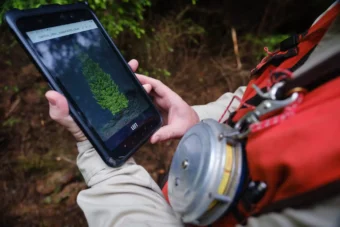
The Forest Service and its partners modeled individual characteristics with aerial-based LIDAR for over 13.5 million trees. The ground based LIDAR allowed them to decide which trees were top candidates.
Roland said selecting a tree from the Tongass was a very unique process.
“This is the first Capitol Christmas Tree effort that involves boats and barges,” he said. “So that’s been a real experience.”
The U.S. Capitol has had a Christmas Tree from a National Forest on its lawn since 1970. “The People’s Tree” rotates between the nation’s nine U.S. Forest Service regions. So it was region 10’s turn here in Alaska. Interestingly, there is no Region 7 because they consolidated it into other regions several years ago.
He said that Kaufman has to select two trees, one being the primary and then a second one in case something happens to the first, like bad weather.
They’ll join the tree for an approximately 20-day whistle stop tour, visiting communities across the Lower 48. They’ll also make sure the tree is healthy enough to make the trip, especially on the barge down to Washington state.
“We’re really having to be innovative in that process as well, trying to keep a tree green and in good shape for that long prior to getting to the Capitol,” Roland said. “Once it’s to the Capitol, it’s on display for close to a month as well. So that’s a long time to keep a tree green and in good shape.”
Even cutting down the tree is complex.
“It’s a very big process,” Roland said. “We want to make sure that the tree isn’t damaged. And so even the act of getting the tree off the landscape is very complex. It usually involves a crane or to some excavators a very large truck and it can take upwards of a day to get the tree from the stump and onto the truck.”
Brandon Raile, who’s also with the Chugach National Forest and taking a lead on the project, said they’ve been in planning mode for the past year with finding candidates and figuring out logistics. But the process is picking up speed now.
“Once the Architect of the Capitol’s office is out here and makes the tree selection, then it’s like, we’re in that roller coaster that’s just crested the top and it’s getting ready to go down faster and faster,” he said. “So this is a really exciting time for us. It’s been a lot of fun.”
Raile said that showing the Tongass to the D.C. folks has been enjoyable time to him.
“Being an Alaskan, I love seeing the looks on people’s faces that aren’t from Alaska when they come to Alaska for the first time,” he said. “So it was very, very cool to see that amazement, that wonder, you know, on our guests faces.”
Raile said that whatever tree that Kaufman picks is going to be amazing. He agreed that each tree has different characteristics.
“Just like people, they each have their own unique little characteristics that make them special,” he said.
He said everyone on his team with the National Forest Service was sizing up each tree they saw. He said because of this experience he’ll probably be super picky about Christmas trees for the rest of his life.
“Apparently I’m not a very good judge of tree height,” Raile said. “So all the ones that I sent in very enthusiastically, like, ‘Hey, what about this candidate?’ They came back and said, ‘No, that’s too small.’”
Kaufman eventually did pick the 2024 “People’s Tree,” though the exact location is top secret. What we do know is that it currently resides on Wrangell Island.
Close
Update notification options
Subscribe to notifications
Subscribe
Get notifications about news related to the topics you care about. You can unsubscribe anytime.