Spirit

Indigenous artists take the mainstage at Juneau’s Rock Aak’w

Juneau’s AirJazz (Arias Hoyle) performs during a closed filming session for Rock Aak’w on Friday, in Juneau. Rock Aak’w is Juneau’s first Indigenous music festival which features artists from across the music industry and around the world. It is airing virtually Nov. 5-6. (Photo by Tripp Crouse/KNBA)

Fourteen musical acts will participate in an international Indigenous music festival based in Juneau. Alaska Native musicians will join several others in the virtual festival called Rock Aak’w. KNBA’s Tripp Crouse talks with one of the festival organizers Qacung Stephen Blanchett about putting together the lineup.

This transcript has been edited for clarity.

Tripp Crouse: Can you give a synopsis of what you’re doing now, but also maybe how you got there?

Qacung Stephen Blanchett: Yeah, sure. I’m one of the members of Pamyua. We’ve been performing almost 30 years now. We’re coming up on 30 years together. One of the things that we’ve really got to realize and notice is that there’s few opportunities for Indigenous artists. We’ve performed at music festivals all around the world, and now a lot of these festivals we’re often put off to the side, right? “Oh, the Indigenous or the world music group will have their own kind of stage off to the corner of the festival.” And that was typically the norm. It was rare that we actually performed on the main stages. And one of the things that we’ve always talked about was the need to just create our own because there aren’t those festivals that really engage with Indigenous artists.

Stephen “Qacung” Blanchett’s experimentation with music began as a kid — when he and his brother, along with some friends tried mixing gospel harmonies with Yup’ik words and rhythms for traditional dance.

Tripp Crouse: It’s being billed as being virtual, but also you’re bringing people into Juneau to actually film stuff for it. So can you talk a little bit about what the make-up is for you?

Qacung Stephen Blanchett: We felt like there was an opening there. Like, things were changing a little bit in July and we had made the decision, OK, let’s do this. It looks like things are changing; the numbers are going down; people are getting vaccined-up and we were all vaccined-up. And so we made the decision to say that we’re going to have an in-person festival. So we went ahead and connected with the folks and bought the tickets and all that. But then as we all know the Delta variant came in and kind of changed things. So we made the decision to go fully virtual, but we had all these tickets bought.

Qacung Stephen Blanchett: We worked up a system where we’re having all these amazing artists flying and we have 10 groups that will be in-person here in Juneau. And we have them scheduled out throughout the day and we have all the virtual hosts. We have 14 different hosts that will be introduced introducing the 14 different bands.

Tripp Crouse: The lineup is a little bit of a mix of Alaskan artists. So there’s Pamyua, there’s Arias Hoyle/AirJazz, Witty Youngman, Byron Nicholai. But then there’s also like a really nice international flavor.

Qacung Stephen Blanchett: Yeah, Snotty Nose Rez Kids, Pura Fé, Supeman, Albino Mbie, Pantayo. One of the things about the festival is that when we look at it in a way of bringing Indigenous peoples together and really doing this intentionally. So we’re opening it up with some protocol from the Aaní here, from the land here of the Áak’w Kwáan, the Aak’w is the name of the Tribe that is from Juneau. And there’s Taku as well. But the Áak’w Kwáan is the folks that will be kind of the main drivers and putting in protocol.

But we also have the vision and the mindset of like those cultures and peoples around the world that many people wouldn’t think of as Indigenous, but those places that have been fighting for their languages, fighting for the traditions and have been colonized, those are people that we’re also going to be inviting. So we have Pantayo, who is an all-female Filipino group who don’t identify as Indigenous, but also but they have their traditions that they’re fighting for and have been influenced by outside colonizers, right? So they really appreciate that we’re doing something like this that brings to light those things that happen around the world.

Witty Youngman performs during a closed filing session for Rock Aak’w on Friday in Juneau. Rock Aak’w is Juneau’s first Indigenous music festival which features artists from across the music industry and around the world. It is airing virtually Nov. 5-6. (Photo by Tripp Crouse/KNBA)

Tripp Crouse: It’s been a really interesting conversation the last few years, seeing that conversation that we’ve been talking about for decades, generations, finally, a global consciousness. But I like to be able to see some of the creativity that comes out of that has been really interesting.

Qacung Stephen Blanchett: Yeah, it’s a beautiful time that we’re in right now. I mean, not just a consciousness and us coming together in the world, right? This world really getting smaller, right? We’re just connecting in many, many ways and more ways. But you know, there’s also this explosion of Indigenous pop culture that’s happening right now. We’re in the midst of something that’s happening. In my 30-year career, this is … it feels different. You know, it really does. You know, we have one of our artists, Ya-Tseen, Yeil Ya-Tseen. He created this beautiful mega installation “Indian Land,” you know? And you know, that thing blew up viral on social media. And it’s — I mean, there’s been so many things happening around that — that space, and it’s just beautiful to just to take that land back, right? And that acknowledgment of Indigenous land.

Quannah Chasinghorse, she was at the Met Gala and, you know, she blew up. I mean, she is like a supermodel now. I mean, you have Sterlin Harjo with “Rez Dogs.” This is … it really feels like there’s just this shift in the consciousness and the recognition of Indigenous peoples. And like, you know, that’s if that’s not this like Hollywood vision of who we are, but we are doing this and we’re on the stage and it’s happening. And it really feels different. And I’m super excited that Rock Aak’w is part of that work.

Tripp Crouse: Where can folks find more information about Rock Aak’w?

Qacung Stephen Blanchett: Oh, it’s definitely on our social media. There’s definitely buzz going on, but it’s Rock Aak’w. And the website is rockaakwfestival.com.

Vigil held for Juneau man who has been missing for a month

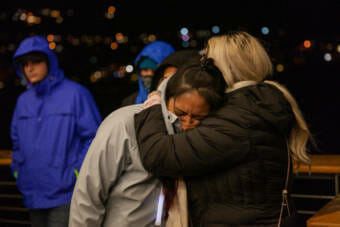
Barbara Charles shares memories of her grandson, Doug Farnsworth, during a vigil for him on Wednesday, Oct. 27, 2021, at Overstreet Park in Juneau, Alaska. Farnsworth has been missing for a month. (Rashah McChesney/KTOO)

Nearly 50 people crowded into a shelter at Overstreet Park at a candlelight vigil for missing Juneau man Doug Farnsworth. Dozens more watched livestreams and left hundreds of comments.

Despite the darkness, rain and biting wind, they spent more than an hour talking about their memories of loving and being loved by Farnsworth. He was last seen more than a month ago walking on a trail near downtown.

No one said it explicitly, but the knowing laughter and the memories people shared with his grandmother on Wednesday evening made it clear that Doug Farnsworth knew how to have a good time.

“I had a lot of crazy times with your grandson,” said one woman who didn’t identify herself. “I won’t say what I did with him — with our friends — but I really appreciate you sharing him with us, cause he was a light.”

Jayme Donahue cries during a vigil for her friend Doug Farnsworth on Oct. 27, 2021, in Juneau. Farnsworth disappeared in late September and has been missing for a month. (Rashah McChesney/KTOO)

Jayme Donahue said it was deeper than just good times.

“You know, I just — I didn’t have like the picture-perfect upbringing, and I was always running from my home,” she said. “His home was always open to me, and he had this kind spirit that I just clung too.”

Donahue said the process of physically searching for his body has been really emotional for her. She said she searched the beach front along Overstreet Park where the group stood overlooking Gastineau Channel. She wiped away tears several times as she asked people at the vigil to remember to reach out to each other. To push past discomfort and social norms and connect with others.

“I just really encourage people to judge less and feel more and be there for those they love,” she said.

She said she didn’t always do that for Doug when he reached out to her, even though they’ve been friends since middle school.

“I would give anything to go back,” she said. “I don’t have our messages, I don’t have our pictures … I’m really ashamed of that, and I’m really broken-hearted over that. I just encourage everybody to not hold back. Tell people you love them, tell people how much they mean to you, how special they are to you. I would give anything to tell Doug how special he is to me. I would give anything to tell him all of the things I love about him, and I can’t.”

About 50 people showed up to a vigil for Juneau man Doug Farnsworth on Oct. 27, 2021, in Juneau. He has been missing for a month. (Rashah McChesney/KTOO)

Farnsworth is a 32-year-old Juneau man whose family reported him missing on Sept. 29. His older sister, Kiersten Farnsworth, says she and other family members believe he is dead. They’re offering a $5,000 reward for anyone who helps them find his body.

Kiersten Farnsworth lives in Arizona and flew up to Juneau to look for him. She has since had to go home. But she has been very active on social media, organizing search efforts and checking in with police and Alaska State Troopers with whatever information she can find. Juneau Police said Thursday that it’s an active case and they’re following up on leads, but they don’t have any updates.

Even though she’s thousands of miles away, she organized the candlelight vigil for her brother. Then she lit a candle of her own and watched from afar, commenting online as each person spoke about him. She said she doesn’t want people to forget that he’s still missing.

Dozens of residents attended a vigil for Juneau man Doug Farnsworth on Oct. 27, 2021, in Juneau. (Rashah McChesney/KTOO)

Barbara Charles, Farnsworth’s grandmother, thanked everyone for coming out and continuing to search for her grandson. She said she misses him running into her home, wrapping his arms around her and telling her she is the most beautiful woman in the world.

Juneau family members carried a large wooden cross and photos to put in the center of the group. They tried to light candles, but the wind didn’t cooperate. Someone else passed around glow sticks for people to hold. There were a lot of hugs and inside jokes.

A woman livestreams a vigil for Juneau man Doug Farnsworth on Oct. 27, 2021, in Juneau. (Rashah McChesney/KTOO)

It’s tricky to piece together exactly where Doug Farnsworth went the night he vanished, but Kiersten Farnsworth has footage of a truck he was driving on Basin Road at around 4:30 a.m. Then someone sent her a screenshot of him walking down the nearby Flume Trail at nearly 7 a.m. She asked that anyone who lives in that area check their game cameras and surveillance videos from Sept. 29 to try and spot him.

Volunteers are trying to organize a group search of the Basin Road area in a Facebook Group called Help Find Doug.

The Farnsworths are Lingít, and they have a lot of extended family in town. As the vigil wound down, one woman stepped forward to tell the crowd that there is no goodbye in the language, only the parting phrase “I will see you again.”

“So tsu yei ikḵwasatéen tsá tsú — until we meet again. That’s how deep that word and phrase is,” she said.

Correction: A previous version of this story misnamed the bridge the crowd gathered near for the vigil, it is the Douglas Bridge. 


Episcopal Diocese of Alaska to investigate the history of church-run boarding schools for Indigenous children

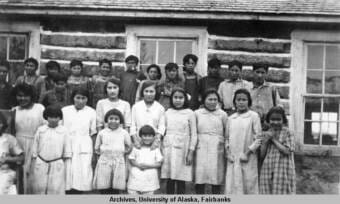
Boarding pupils of St. Mark’s Mission in Nenana in May 1924. It is from the Drane Family Collection, courtesy of the University of Alaska Fairbanks, APRCA (UAF-1991-46-782).

The Episcopal Diocese of Alaska says it will join a national effort to investigate the history of church-operated boarding schools for Indigenous children.

Episcopal Diocese of Alaska Bishop Mark Lattime said the action was prompted by the discovery this summer of unmarked graves where Indigenous children were buried at Canadian boarding schools run by churches.

“We recognize that it opened wounds that have been carried by so many of our Alaska Native brothers and sisters,” he said. “And the fact that the church was involved in this process is something that concerns us.”

The Episcopal Church was among those that ran boarding schools in Alaska and the Lower 48 in the 19th and 20th centuries.

Lattime said the Alaska church must look beyond its own account of history.

“The history that we’ve received is that those missions in schools were operated with care and respect for Indigenous culture and children. You know, we also have to recognize that history is written by one side of the story,” he said.

Lattime said the church in Alaska and nationally must “stand in the light of truth.”

“We might be able to say, ‘This wasn’t an issue in the Episcopal denomination.’ The fact is, if it happened in any church denomination, we, as a Christian body, I think are all responsible,” he said.

Lattime said the church is going through archival records and will work with Alaska Native organizations to hear from former boarding school students and their descendants.

The Episcopal Church hosted a national webinar on Indigenous’ Peoples Day about boarding schools, during which speakers described cultural genocide.

Pearl Chanar, who grew up in the Interior Athabascan village of Minto, recounted attending a boarding school hundreds of miles away.

“And what I remember most is that loneliness, missing my parents,” she said.

Pearl Chanar of Anchorage shares her story of attending a boarding school. (Episcopal News Service)

Chanar said she was denied expression of her culture.

“Not being able to speak my Native language, not being able to enjoy my traditional cultural activities such as my singing, dancing,” she said.

Chanar said she’s heard from other boarding school survivors who were abused. And she cautioned the Episcopal Church to be careful asking people about their experiences.

“That individual is going to tell you a story that happened 70 years ago,” she said. “It might have been traumatic for them. And if it was, then you’re asking them to repeat something that they’ve had buried for a very long time.”

Chanar noted that many boarding school survivors were subsequently lost to alcohol, drugs and suicide.

“And this is part of the truth of the Episcopal Church,” she said. “It’s a part of the history now. It’s not pleasant and it hurts.”

Chanar said the trauma experienced at boarding schools is passed to successive generations.

Bishop Lattime said the church is looking for Native guidance as it pursues “truth and reconciliation.”

“We need to be about listening and hearing and then following the lead of our Alaska Native people on the best way forward, and so really we’re just at the start of this process,” he said.

Lattime said Alaska Natives will be well represented in a state delegation which will attend a national Episcopal Church convention next summer in Baltimore, during which the boarding school issue will be a primary topic.

Labyrinth helps Fairbanks man through chronic pain

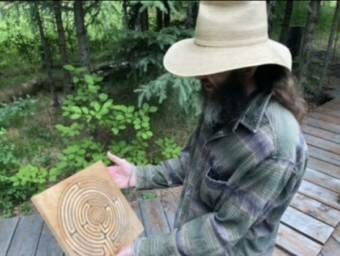
Ramey Wood shows a finger board labyrinth that uses a design similar to the labyrinth on his property. (Dan Bross/KUAC)

The labyrinth constructed on Ramey Wood’s land in West Fairbanks is hidden by willow, alder, birch, grass and wildflowers. It isn’t until you begin walking through it that you see its narrow circular paths were precisely sculpted into the earth or that they’re regularly maintained in concert with the forest.

“It’s work but it’s doing as much as me,” Wood said.

Wood suffers from chronic neurologic pain. He says the labyrinth provides a literal path to calming and focusing the mind.

“The pattern allows one to not have to worry about where one’s going. You can allow yourself to concentrate on whatever it is that you’re thinking about, whatever your intention is — your question, your problem, your concern, what you’re stressing about, what you’re excited about — and then allow yourself to just go through that motion,” he said.

It takes about 20 minutes to walk the medieval-style labyrinth, which spans 66 feet. There’s one path to the center and a different but adjacent path back out. When you walk the labyrinth, you know where you’re going, but the circuitous path to get there requires a certain surrender.

“Trust the pattern, and then do what you can with it,” he said.

Wood stresses that a labyrinth itself isn’t a cure or remedy.

“To make them be something like a prescription, I think that’s goofy,” he said. “I like it. I enjoy it. I’m dependent on it. I love the relationship with it. And at the same time like, it’s only worthwhile in that relationship, it’s only worthwhile in the act of engagement. It isn’t a thing.”

Wood characterizes the labyrinth as a friend of sorts, helping him navigate through pain.
“I know that sounds…whatever it sounds like, you know, to have it as your friend. But I hope more people can find friends like that,” he said.

Wood shares the labyrinth with local people as well as travelers passing through town.

Remembering former Alaska Sen. Mike Gravel

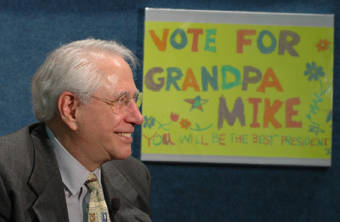
Alaska's former U.S. Sen. Mike Gravel died on Saturday, June 26, 2021, at his home in California. (Photo courtesy Lynne Mosier)
Alaska’s former U.S. Sen. Mike Gravel died on Saturday, June 26, 2021, at his home in California. (Photo courtesy of Lynne Mosier)

Throughout his 12 years as Alaska’s U.S. Senator, Mike Gravel relished stirring controversy, but he died quietly at his home in Seaside, California, on Saturday at the age of 91, surrounded by family.
Gravel, who served from 1969 to 1981 has been described as quixotic, quirky and charismatic.

Gravel made a brief splash in the national headlines when he announced his bid for the U.S. presidency in 2019. He said he entered the race after a couple of teenagers asked him to run.  But, it wasn’t his first bid for the office.  

During his 2006 campaign for the presidency, one of his ads called “Rock” went viral on social media. It featured a stern-faced Gravel, who stood next to a pond and stared silently into the camera for about a minute, picked up a rock, hefted it into the water and then walked away without so much as a word.

“It was a metaphor for human life,” Gravel said in a 2017 interview. “You decide what you want to do in life, then you go ahead and do it. That causes ripples. You go ahead to your demise, and the ripples continue to have an effect on society.”

So, what ripples did Gravel’s political career set in motion?

During his 1968 bid for the U.S. Senate, he changed the way campaigns were run in Alaska forever.

Weeks before the Democratic primary, he rolled out a black-and-white film biography called “Man for Alaska” – a strategic slingshot that knocked out a political Goliath, Sen. Ernest Gruening, who had also served as Alaska’s territorial governor.

Gravel, who had a classic Hollywood “tall, dark, and handsome” magnetism, was filmed traveling across the state, surrounded by Alaska Natives.

In the final weeks of the primary race, the film aired repeatedly on Alaska TV stations — hand-carried by campaign workers, who flew to remote communities across the state. In most cases, the entire village turned out to watch.

“People really enjoyed the film,” said Irene Rowan, one of the campaign staffers who traveled the state. “You have to remember at the time there were no television or radio stations in rural Alaska or movie theaters in the villages.”

Rowan said she was part of a team of women, led by Gravel’s first wife, who went door to door at each stop.

Prior to Gravel, statewide campaigns focused almost exclusively on Alaska’s cities. Gravel was the first to court the state’s rural vote so widely, and the film became a turning point in his campaign. Within days of its release, Gravel, who had lagged in the polls, catapulted into the lead.

It would be the first of many times Gravel would defy conventional wisdom.

“I was very much a maverick,” he would later say of himself. “In my case, it was natural. I really didn’t have to do anything but be myself.”

Gravel said he did things differently, “I did not genuflect to authority. I questioned authority.”

Perhaps the best example of that personality trait: His efforts to put the Pentagon Papers in the congressional record on June 29, 1971. Gravel died just days away from the 50th anniversary of his dramatic midnight reading from top-secret documents, which revealed the U.S. government had systematically lied to the American people about the Vietnam War.

(Photo courtesy U.S. Senate)
(Photo courtesy of U.S. Senate)

After Gravel was shut down for trying to read the Papers on the Senate floor, he used a subcommittee he chaired to make the report public. He intended to read all 4,000 pages of the report. Grainy film of the hearing shows an overwrought Gravel, who wiped his brow with a handkerchief and occasionally choked up in tears. Although he only managed to read a small portion of the report, he did enter the entire document into the record, which made it available to the public and the media.

Gravel said he received the Pentagon Papers from a Washington Post reporter, but there is no mention of him in “The Post,” a recent movie about the newspaper’s efforts to bring them to light.

At the time, Gravel’s actions reinforced his reputation as a showboat among his colleagues. He had also been ridiculed for some of his big ideas – such as a plan to build a domed city near Denali, which Gravel claimed the media distorted. He said his idea was inspired by large tents to shelter crowds at the Winter Olympics, a concept he said was very doable.

“We could cover hundreds of acres at the base of Mt. McKinley,” Gravel said, “by stretching a large, large tent.”

“We could control the climate so that we could truly enjoy a winter wonderland,” he said.

Gravel also proposed a train system to Denali, which used mag-lev, or magnetic levitation technology.

While most of Gravel’s big ideas fell by the wayside, one of them did hit the mark.

Tim Bradner, a longtime Alaska natural resources writer, says it was Gravel who came up with a way to rescue the Trans-Alaska Pipeline from the environmental lawsuits that stalled its construction. He pushed for Congress to pass a law that declared the pipeline in compliance with NEPA, the National Environmental Policy Act.

“Nobody ever thought of doing anything like this before. It’s so out of the box. People thought, here’s another Gravel shoot-from-the-hip, pie-in-the-sky thing,” Bradner said. 

But he said Gravel, who usually sought the political spotlight, ran a stealth campaign to sell his idea to senators. He made effective use of lawyers and energy experts to make his case.

It was not a surprise that Republican Sen. Ted Stevens fought the measure. He and Gravel were often at odds, but Stevens later voted for the legislation.

“Once there were 40 votes behind this strategy, the White House put its support behind it,” Bradner said. “It was quite a dramatic event when it happened. History tells us it was a 50-50 vote in the U.S. Senate. Vice President Spiro Agnew at the request of the White House cast the deciding vote.”

It was what Bradner calls a “classic Gravelian moment,” that eventually faded into history, because Gravel lost his bid for a third term in the Senate and left the state to launch other national political initiatives.

Gravel supporters say he never got credit for legislation that helped to build the state, such as his fight for the Alaska Native Claims Settlement Act, as well as his efforts to secure funding for the Alaska Marine Highway and other infrastructure projects such as early satellite communications.

Gravel’s family says he spent his last years working on what he called a “citizen’s amendment to the Constitution,” which he said was necessary to give the American people more direct legislative power.

Even as a state legislator, Gravel worked to get lawmakers more engaged with their constituents, especially in rural communities.

He served in the State House from 1963 to 1966, and in that short period of time rose to become Speaker of the House.

Bradner, who followed Gravel’s career closely, believes he may have been the first Speaker to conduct field hearings in rural Alaska.

“It was the first time that many urban legislators had been to a rural village,” Bradner said. “It had the effect of energizing rural political awareness.”

Gravel’s last visit to Alaska was in 2017 when he was invited to speak on the 40th anniversary of the pipeline.

Gravel said he hoped he would be remembered for his role in the pipeline, but also as “a person who tried to stir the pot, so people would question authority.”

“And if I have any advice to young people, it’s to question authority, because it may not be the right thing,” Gravel said. “Follow your bliss, if you want to be happy.”

‘I thought my name was my number’: Survivors recount Alaska boarding school experiences

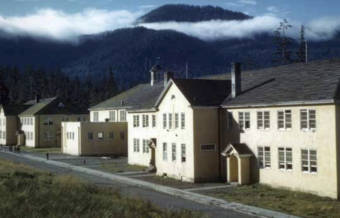
Students stroll the sidewalk behind the Wrangell Institute school and dorms, looking south, probably in the early 1960s. The boys dormitory is at right, the school (with bell-tower) is left of center, and the girls dormitory is at the far left. (National Park Service photo)

The recent discovery of the remains of hundreds of Indigenous children at a residential school in Canada has prompted discussion, grief and memories of past trauma in Alaska. Thousands of Alaska Native children were sent to boarding schools in and outside the state. The effects of forced assimilation continue to impact the lives of Native people.

Cultural expert Paul Ongtooguk and two boarding school survivors, Jim Aqpayuk LaBelle and Fred John Jr., shared their perspectives with Talk of Alaska on the legacy of boarding schools in Alaska.

Here are some highlights of what they shared, edited for length and clarity.

Paul Ongtooguk, former director of UAF’s Alaska Native Studies Department, on the origin of U.S. boarding school policy as labor development

In the early era, one of the strategies that were developed was to end the Indian Wars by ending Indianness. One of the venues for doing that was missionaries — converting people not only to Christianity but away from being Indian. That was not completely successful.

Paul Ongtooguk, a UAA professor of Native Studies at the KSKA studio in 2016 (Wesley Early/Alaska Public Media)

In the summertime, the students were essentially loaned out or sold, leased to members of the white community to serve as labor servants or maids, whatever manual labor that was available for them. So there was a very high attrition rate. There was a very high number of students who died from probably the geographic shift, probably from the population shift and from loneliness, from abuse and from malnutrition. There were also multiple reasons for accidents, given the kind of labor that they were involved in — this was all pre-OSHA.

Boarding school survivor Jim Aqpayuk LaBelle on his memories of being sent to the Wrangell Institute

My mother took us to the airport and our mom in Fairbanks left my younger brother and me there at the hands of the BIA officials. The first thing that they did was they tied us together with other children with ropes at the Fairbanks airport. There were dozens of other children that were already tied there.

I remember this so well, even though it happened 67 years ago. I can still recall some of the younger children as young as five were there. I was eight, my brother was six and we were thrust into just an alien situation where there was a lot of barking of orders. We were given yellow name tags to affix to our clothing that had our names or destination written on it, that kind of thing. And then it took almost a half a day sometimes longer, to get to Wrangell.

Jim LaBelle, his wife Susan LaBelle and Bob Sam at the 2016 Elders and Youth conference in Fairbanks. (Photo by Jennifer Canfield)

The first thing they had us do was to strip completely naked on this receiving room concrete floor. A lot of children did not understand the commands that the directions and oftentimes in frustration a lot of matrons ran over to these little guys and just kind of ripped their clothing off.

We were all told to get in a line to get her haircuts. These were done in a way that was kind of like being sheared — ever see these videos of sheep being sheared off? Well that’s what happened to us.

We were given clothing. The government issued clothing with our numbers. Our number was on our clothing and on our bedding. Children who had difficult names were often referred to only by their number by many matrons. And I can still remember years later as children who were much older, saying “I thought my name was my number.”

215 feathers were placed on the lawn of Sitka’s former residential school, Sheldon Jackson, in remembrance of the 215 children whose remains were discovered at a former residential school in Canada, drawing (KCAW/Tash Kimmell)

Fred John Jr. on the punishment given at Wrangell Institute

My younger sister was five and I was seven when we went. We were there almost seven years.

It was like a military thing…If we do the smallest thing we would get punished. Like our coat be on the floor, or if we were late getting up. On Saturday morning the big kids would line up for spanking with their pants would be around their knees in the barbershop. They get I think 12 swats, I don’t remember now. But it was lots.

The Wrangell Institute in 1938. (National Archives Pacific Alaska Region)

The big kids wouldn’t cry. But as little ones, we get the same amount of spankings and we are all lined up beside them. The big ones could get spanking before the smaller ones. But we’d be crying before when we saw the big guys get their spanking and we watch them.

When it was our turn, the only good thing about that is the big boys could take our place if they wanted to — a lot of them did. They took their second spanking. My brothers would take two spankings for me.

Another one is the gauntlet. They’d strip us down if we behaved like what they call really bad, if we were bad boys. And they would have two lines to line up and down beside the beds. And the guys that tattletale were standing on a bed and watch the whole thing. The boy — they stripped them down naked and let them run down through the complex. The boys on both sides pulled their belt out and hit them with the hard end — the buckle end as he ran. Sometimes they fall down and cry and everything and they’d be really beat up by time they make it to the end.

Whoever don’t hit hard would be stripped down and then run down the gauntlet.

Even though I don’t want to, I even hit my friends. Luke Titus was one of them, my friend from Minto. He was one of them that I ran down that thing and I hit him hard. And he did the same to me. About 60 some years later, we met in Old Minto Recovery Camp. We apologized to each other for hitting each other. We didn’t — we didn’t have any choice.

Paul Ongtooguk on the whether the government has apologized for its role in boarding schools

The short answer is no, nothing that I’m aware of. There have been individual communities that have apologized for their role. Some of the churches have apologized for the role that their boarding schools have played in this, but it’s been very uneven. And there’s certainly nothing on the federal or state level that represents a formal apology or compensation.

Fred John Jr. on how he started telling his story

I got four girls and a son. And I didn’t really talk to them for years. I never talked about my boarding school experience probably for about 15 years. I kept a wall around me — an imaginary wall so I wouldn’t ever get hurt again. So I never talked about it.

I became an alcoholic. My family kept me together. And when I came back from recovery camp, I told my story there the first time, my whole life story, and it took about three weeks before I start feeling this freedom of telling my story. My kids, they cared about my story. And they know my experience and everything.

People ask me what do you tell your children, I tell them, forgive us. Forgive us for not learning how to make sleds. Forgive us for not making snowshoes and boats and canoes, and all those things that our uncle and our aunties taught us.

Lex Treinen contributed to this report.

Site notifications
Update notification options
Subscribe to notifications