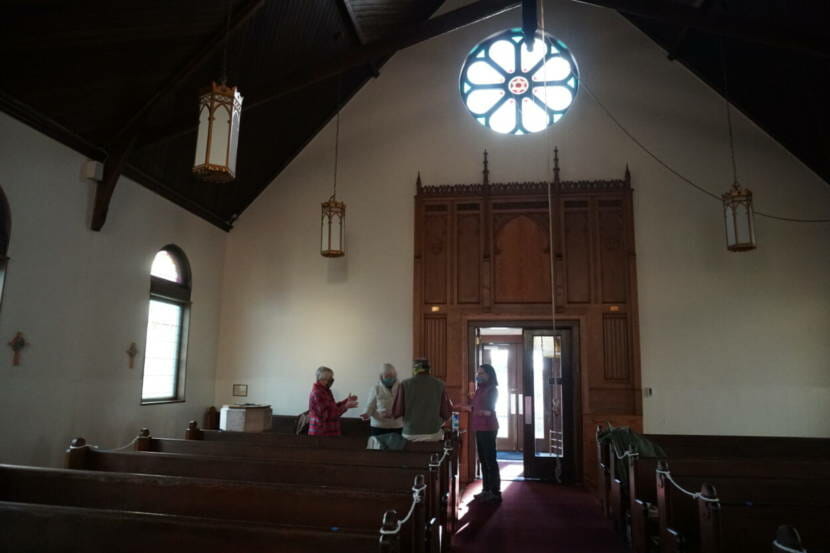
Members of St. Peter’s by the Sea Episcopal Church’s congregation gather for a short prayer after ringing the bell for 300,000 lives lost to COVID-19 (Photo by Erin McKinstry/KCAW)
More than 300,000 Americans have died from the coronavirus since February. In honor of those lives lost, Sitka’s St. Peter’s Episcopal Church joined the National Cathedral, and churches around the country, and rang its bell 300 times.
The bell sounded for 15 minutes on Tuesday: one ring for every 1,000 lives lost. It’s a death toll that’s hard to comprehend, said Steve Gage, who was one of two church members trading off to tug the bell’s heavy rope.
“It made me think that with every nine rings or eight rings or whatever it is, that that’s the entire population of Sitka,” he said. “And we rang 300 times. So it’s real and it’s just kind of hard to take in.”
It’s more than the combined number of Americans killed in World War I (116,516), the Korean War (36,574) and Vietnam (58,220).
“All of these people had a name and a story and a family,” Gage said.
Alaska’s death rate remains one of the lowest in the country, according to the CDC, and Sitka has yet to report a death related to COVID-19. But cases continue to rise. Gage and fellow bell ringer Kit Allgood-Mellema hope this small act will remind Sitkans to remain vigilant by wearing masks, social distancing and washing their hands.
“Well it’s one small thing we can do to honor those people who’ve passed away, and most of them have died in really pretty horrible circumstances,” Allgood-Mellema said.
Church members rang the bell in September 200 times for 200,000 lives lost. And they’ll do it again for 400,000. But both Gage and Allgood-Mellema said they hope they don’t have to.
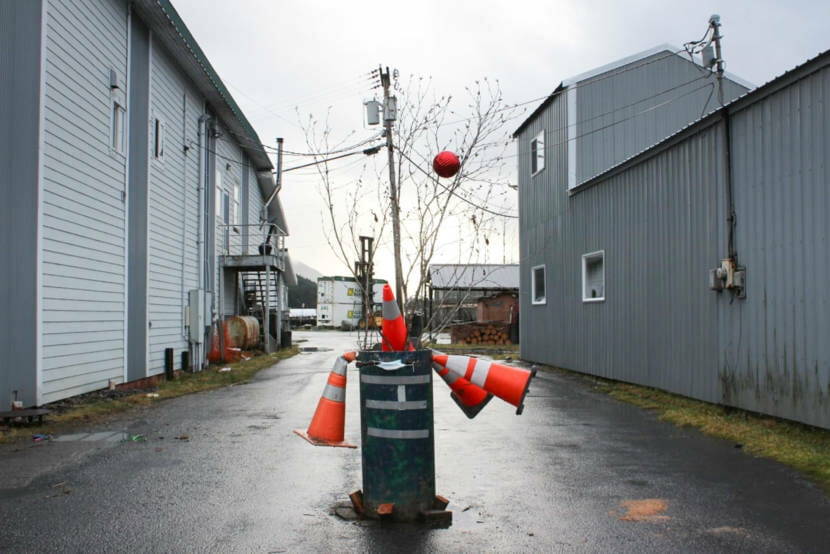
Wrangell’s impromptu Christmas Tree on Dec. 7, 2020. (Sage Smiley/KSTK)
After Wrangell canceled its holiday tree-lighting ceremony last week, some anonymous Wrangellites took it upon themselves to replace it.
Kind of.
Wrangell Municipal Light & Power usually takes care of installing the town’s public Christmas Tree. But with storms knocking down tree after tree and pole after pole last week, the crew just didn’t have the time to get a tree into the usual place of honor, between the Elks Lodge and the gas station.
Then something happened.
It’s not quite a Christmas miracle. In place of the typical towering conifer, a few bare branches stick out of the metal tree-holder. Four safety cones adorn it, three of them sticking haphazardly out of the sides.
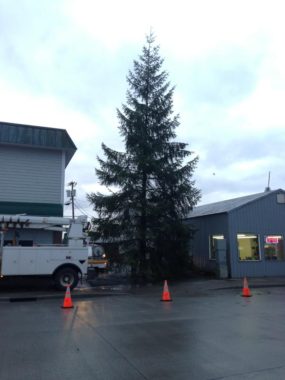
For comparison, a previous year’s tree. (Shady Grove Oliver/KSTK)
“I definitely got a little chuckle out of it,” Wrangell’s public works director Tom Wetor said. “Especially after I saw somebody comment underneath that: ‘Well, pretty much sums up 2020.’ And I thought ‘Yup, that sounds about right.’”
He doesn’t know who’s responsible for its construction, he said. But despite its desultory appearance, the tree has sparked joy.
Andrew Scambler assisted Light & Power with some of last week’s outages. He said he stopped Sunday morning to take a photo — which eventually ended up on Facebook — and send it to the exhausted municipal power crew.
Scambler said he texted the crew, laughing: “I said: ‘Take the day off, guys, it’s all taken care of.’”
And that may be true: The Wrangell Chamber of Commerce hasn’t yet rescheduled its official tree-lighting ceremony.
Chamber director Stephanie Cook said she’s as mystified as anyone when it comes to who might be responsible for the well-meaning prank.
“I heard several people joking about it, but I don’t think that any of them did it,” Cook said Monday evening.
For now, as Wetor said, Wrangell’s holiday tree seems a bit poetic in a year like 2020. It’s small and it’s strange. But with a disposable blue mask and one large, red ball ornament for decorations, it’s brought a little light to its small island town.
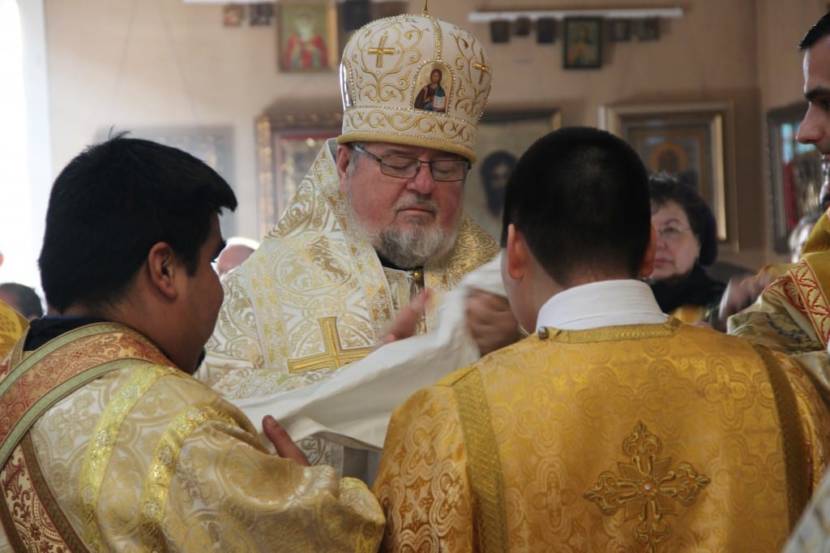
David Mahaffey at his installation ceremony in Sitka in 2014 (KCAW/Emily Forman)
The Archbishop of the Orthodox Dioceses of Alaska, David Mahaffey, died last week. He was installed as the 16th Bishop of the Orthodox Dioceses in Alaska in 2014.
Mahaffey was born in Altoona, Pennsylvania and was raised Methodist. His wife was Orthodox, but it wasn’t until after they’d married that he attended his first Orthodox service.
“I was just like a sponge, I’m absorbing all of this, and I was like ‘Oh man, this is what I want,’” he said.
He converted and later, after years of working in the secular world as a car salesman, became a priest.
After his wife passed away in 2007, Mahaffey told Forman that a door opened — he could make the move from priest to bishop by taking the required monastic vows. But he would have rather had his wife than an open door, he told Forman, saying she was “everything to [him].”
It took years for him to finally say yes to the church, when the Diocese of Sitka and Alaska wanted him for bishop. He was reluctant, but he had a realization when he visited Kodiak on the anniversary of his wife’s death in 2013, during the celebration of St. Herman’s pilgrimage.
“I don’t know if it was St. Herman, or my wife, or God or whoever saying ‘Don’t you get it!?’ You had a beautiful wife who was beautiful inside and out, and she really was,” he said. “So what came to me was this sense that, ‘Look, I’ve replaced your wife’s beauty with the beauty of Alaska. And I replaced her inner beauty with the beauty of the people of Alaska. Isn’t that what you want?’”
Mahaffey passed away on Nov. 27. He was 68 years old. He is survived by his four children and their families.
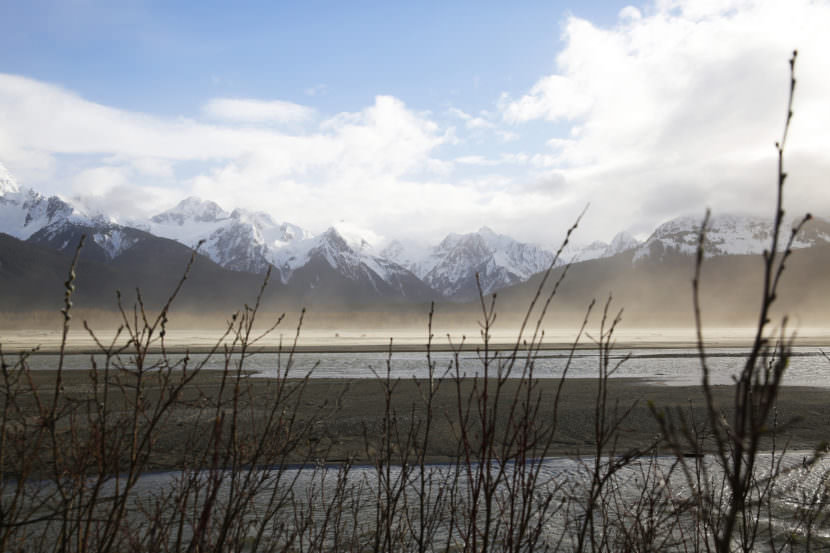
The village of Klukwan has fewer than 100 residents and sits along the Chilkat River. (Elissa Nadworny/NPR)
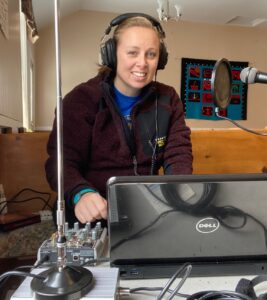
A new community radio station is being developed in Klukwan. The village’s local pastor recently acquired a short range radio transmitter for the community. Klukwan residents can pick up the signal by tuning in to 107.7 FM.
Pastor Jami Campbell said community radio is a new endeavor for her.
She was inspired by another pastor, who purchased a transmitter to host drive-in movies in Petersburg last spring. Residents pulled up to the church parking lot to watch films projected on a screen while listening to the sound of the movie through their radios, in their cars.
Pastor Jami Campbell broadcasts from the Klukwan Assembly of God. (Photo courtesy of Jami Campbell)
“I realized how simple and easy it could be to have a radio broadcast just anything,” Campbell said. “So I thought, ‘Wow, that’s a great idea!’ It opens up so many ways to connect people, even at a distance.”
Campbell decided to purchase her own short range radio transmitter. As pastor of the Klukwan Assembly of God, she already had access to microphones, cables and other audio equipment.
The church is centrally located, so the entire community lies within the mile-wide broadcast range.
“If you’re in your car, you can just pick up the radio station as you drive into town,” Campbell said. “And then the last houses on the other side can pick it up.”
Campbell said she and her husband have already broadcasted a few church services, and they hope the community will use the radio for various purposes.
Campbell has been working with Klukwan’s COVID-19 task force and offered up the radio transmitter as an emergency communication resource. She said she hopes residents will use it to share their music and stories with one another.
“Spoken word, story, song — all of those things have tangible value here, and so I’m hoping that this can be a way for the community to extend who they already are,” Campbell said.
The Chilkat Indian Village purchased 55 solar-powered, portable radios for the community. Those will be distributed to households in the next few days. In the meantime, Campbell is looking for people who are interested in hosting shows and making content.
Vision Maker Media’s First Indigenous Online Film Festival is showcasing three films focused on stories about Alaska Native and First Nations history. The films are part of the festival’s history and environment showcase and are available to watch for a limited time.
Director Christopher Waats’daa Auchter preserves a special moment in the Haida’s recent past with his short documentary “Now Is The Time.”
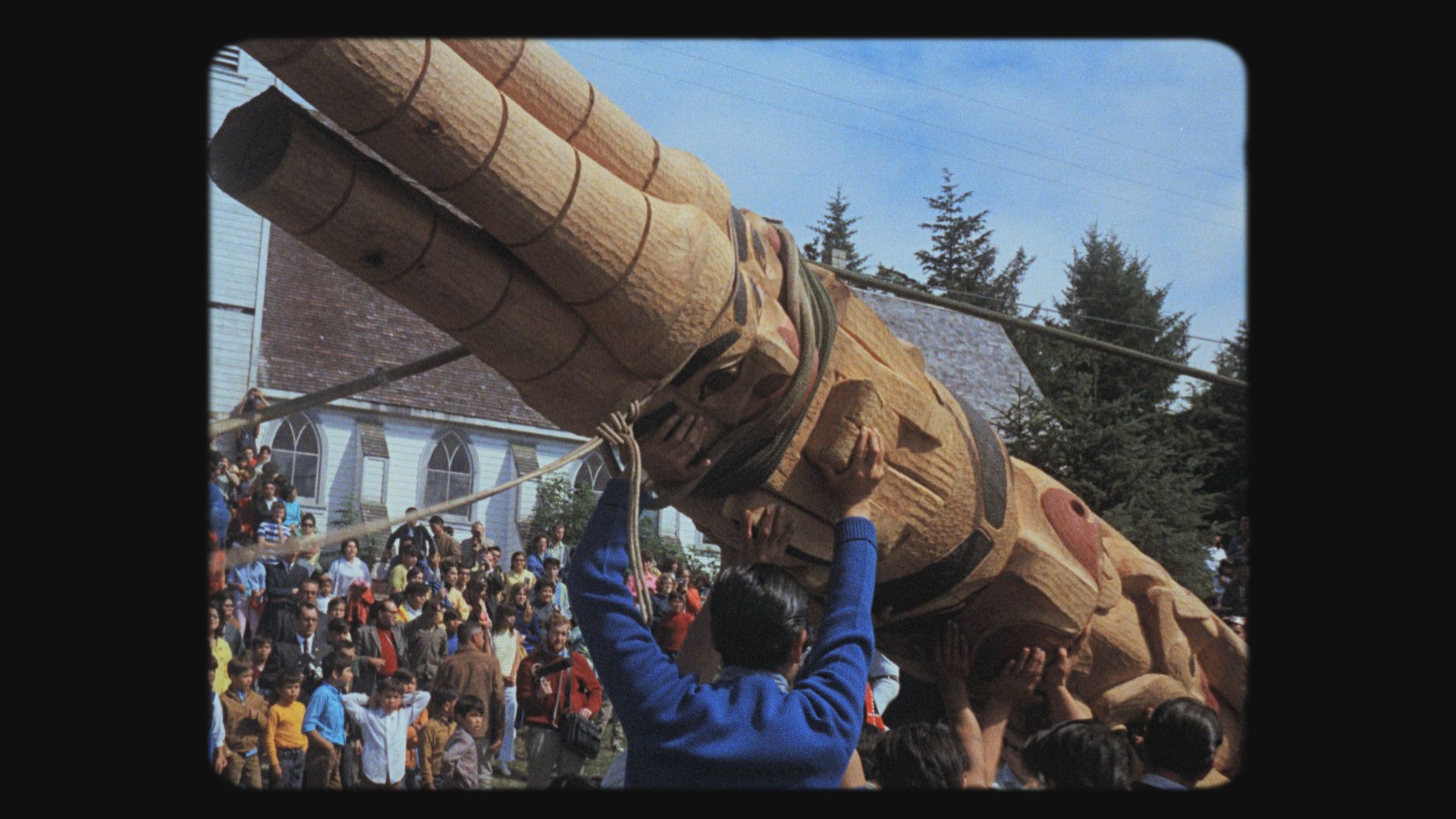
Auchter brings the viewer back to a day in 1969 when a totem pole was raised in the village of Old Masset on Haida Gwaii, just south of the Alaska panhandle. It was the first time a totem pole had been raised there in almost a century after a decades-long ban on First Nations art and culture.
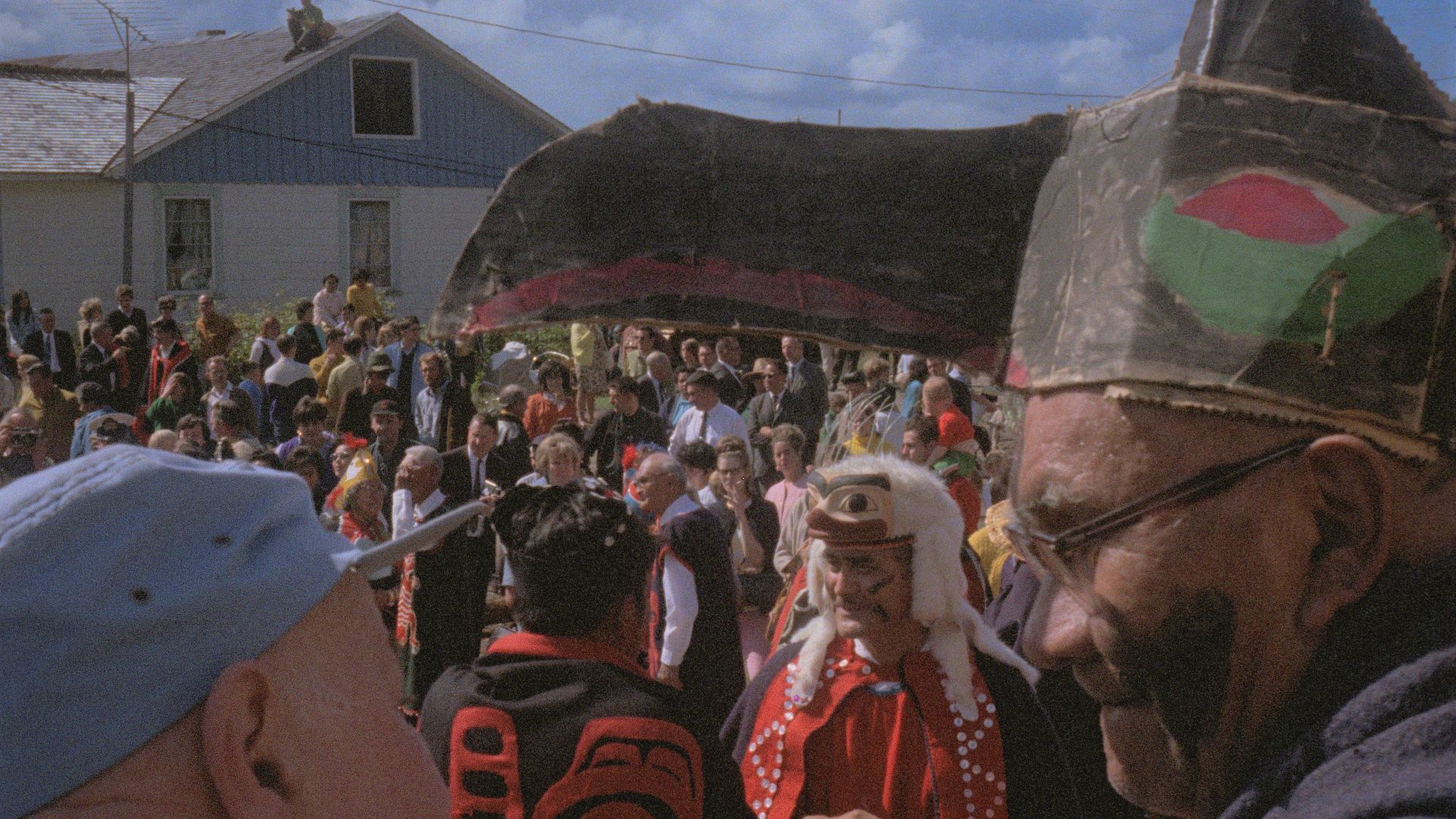
Haida filmmaker Christopher Auchter’s “Now Is the Time” tells the story of internationally renowned Haida carver Robert Davidson who was 22 years old, when he committed to carving the first new totem pole in Old Massett in almost a century. Auchter revisits August 1969, when the entire village gathered to celebrate the event that would signal the rebirth of the Haida spirit.
Auchter weaves archival footage with interviews of community elders who were there that day and with the totem pole’s carvers, Robert and Reg Davidson. In one scene, Auchter uses animation to bring Haida art and language to life.
“Imagine your world without art,” Auchter says in the film. “Now imagine if you were the one to help bring it back.”
Auchter says he was inspired by Barbara Wilson, a community leader who helped bring the National Film Board of Canada to produce a film from the original footage in 1969.
But Wilson was pushed out of the post-production process and didn’t see the film for another 50 years. Auchter says when she finally did see it, she wasn’t happy with the end result.
So he took up the task of directing the new documentary.
“I didn’t know about this story going into it and going ‘oh wow, this happened.’ and then every time I dug into the story a little more, it just became clear that it was such a pivotal moment in our recent history,” Auchter said.
When the totem pole is finally raised, Haida people celebrate with dancing a potlatch. And Auchter says the totem is still there today.
“Yes it is. It’s in marvelous shape,” he said. “I think it puts other 50-year-olds to shame. It looks so good.”
Haida filmmaker Christopher Auchter’s “Now Is the Time,” weaves animation, interviews, and original footage shot by what was then known as the NFB’s Indian Film Crew to tell the story of a totem pole and what it means to the village of Old Masset on Haida Gwaii.
“Now Is The Time” is one of three films focused in and around Alaska showcased in Vision Maker’s First Indigenous Online Film Festival this week.
Directed by Mark Blaine and produced by Torsten Kjellstrand, the films take place on Kodiak Island, where Sven Haakanson Jr. grew up.
“I have a responsibility to make sure that we are able to share this knowledge with communities by bringing it home and giving the knowledge back to our community so that they can have a living context.”
Haakanson is a curator at Burke Museum in Seattle. He’s interviewed in both films about his efforts to preserve the past on Kodiak Island.
In “Lived Knowledge,” Haakanson shares his perspective of building a traditional Alutiiq kayak.
“What do you learn from building a boat? Well you learn patience, you learn that your assumptions are probably wrong and you gain a deep respect for the people that were actually making these boats,” he said.
In “Stories in Stone” he shows what it takes to document the 7,500-year-old petroglyphs carved in the rocks near the village of Akhiok. The ancient carvings are being eroded because of rising sea levels and increasingly strong storms.
And while both documentaries are centered on the old, Haakanson says he also learned something new during one of his visits to Akhiok.
One day, while he was pecking on the rocks where the petroglyphs are carved, a seal popped out of the water.
“I was sitting there pecking and it’s like, ‘oh, my goodness, a seal!’ Like I didn’t think anything of it. And then all of a sudden, it popped up even closer is like “Oh!” And so I tested it out, you know, tested it out again, but at the end of the week and it was like, ‘Wow, that actually worked.’”
All three films are available to watch for free on Vision Maker’s First Indigenous Online Film Festival page until September 14.
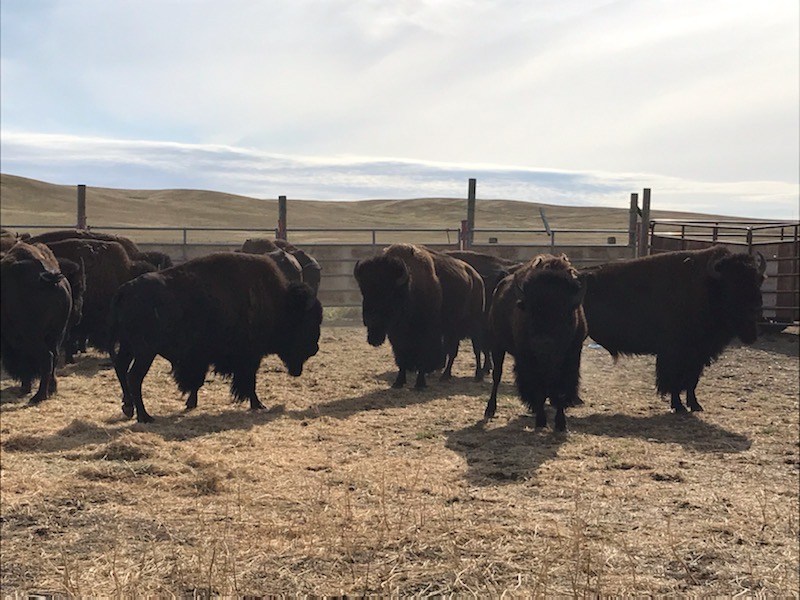
Bison in Montana. (Photo courtesy of the Old Harbor Alliance)
It was a journey that took three bison thousands of miles from a remote Montana Indian reservation. They traveled by land, by air, and then by sea to reach their new home near Old Harbor on Kodiak Island. They finally arrived Thursday night.
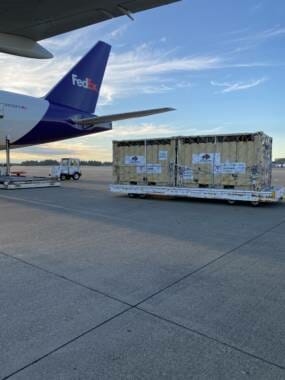
The buffalo left Montana for Alaska on Monday — three hardy bulls, which weigh about a thousand pounds each. They had to be loaded in specially-built shipping containers and trucked to Seattle — then flown to Alaska on a FedEx plane, which landed in Anchorage. And from there, they were driven to Homer, where they set out for Kodiak Island on a 60-foot landing craft.
Their final destination: tiny Sitkadilak Island, right across from Old Harbor.
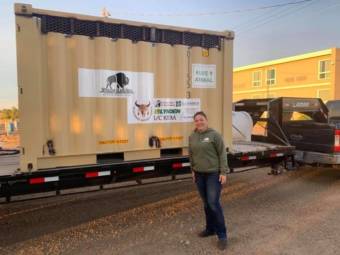
Melissa Berns-Svoboda stands in front of one of the shipping containers the bulls traveled in. She checked on them regularly throughout their journey to Alaska and said they seemed to handle the ride OK. (Photo courtesy of the Old Harbor Alliance)
Melissa Berns-Svoboda manages the herd and kept a watchful eye on the bison from start to finish.
“There was really no signs of stress,” she said. “They clearly wanted to know, like, ‘What are we doing in this container?’”
Berns-Svoboda said they seemed to make the trip just fine.
“They were very calm, laying down and doing what they should have been doing, which was eating and drinking,” Berns-Svobda said.
These are bulls from Yellowstone National Park, brought to Alaska by the Old Harbor Alliance – a group which includes Old Harbor’s Alutiiq Tribe, its Native corporation, and other organizations.
They are to join a herd of about 70 animals, to help improve their health and genetic diversity. When the Sitkalidak herd had its DNA tested, traces of an aggressive gene were found. Three bulls in the current herd will be culled, to allow the new bulls to bring new blood to the group. Researchers say genetic diversity helps the herd adapt to changing conditions and improves survival.
Berns-Svoboda says the move from Montana probably cost about $9,000 per bull, but the money is an investment in Old Harbor’s future — because the buffalo will help feed the community, a place so isolated that groceries have to be flown in, which makes them expensive.
Some of the buffalo have already been harvested — and the meat shared in the community of about 200. One day, the Alliance would like to sell the meat, as well as hunting permits, to bring some income to this cash-poor community. The bulls are key to those dreams.
When the landing craft arrived on the shores of Sitkadilak Island, it dropped its bow and opened the containers. The bison were free to cross the deck and head down a ramp to the beach, but they had to be coaxed to get off the boat.
But eventually, Berns-Svoboda says, they scrambled across a rocky beach, slippery with kelp, and headed right towards a valley, where their new herd was grazing.
“The valley was full of just green, green grasses,” Berns-Svoboda said. “There were alders. It was just beautiful.”
The Old Harbor Alliance bought a small part of that herd three years ago – and so far, they’re holding their own against the bears.
“There is really no conflict. They were kind of doing their own thing. They have their own respective areas. It was really neat to see,” Berns-Svoboda said.
Sitkalidak Island, save for a cabin, is virtually uninhabited, so the bears and the buffalo have the island all to themselves. In the spring, they both enjoy eating the green shoots of plants, that in the summer turn the island to emerald green.
Fed Ex flew the specially-made shipping containers from Seattle to Anchorage. One bull road alone. Two others shared a container. (Photo courtesy of the Old Harbor Alliance)
The InterTribal Buffalo Council helped Old Harbor move the bison from Montana to Seattle. Members from the Blackfeet Nation were hired to assist – and Berns-Svoboda says that created a special bond.
“We built relationships that are lifelong relationships,” she said. “We’re going to have them come down here. They’re going to help us work our animals, then help us get to know them.”
Berns-Svoboda says both the Blackfeet and the Old Harbor Alutiiq see the bison as more than just a source of food. She says the Blackfeet will also teach them how to fully appreciate the role the bison play in tribal culture – how they bring the community together through sharing. Berns-Svoboda says she has also seen how the buffalo can help bridge generation gaps and promote spiritual connectedness.
It took a web of connections from Montana to Alaska to bring the bison here. Some federal COVID-19 money to improve food security was used to pay for their trip. Many community organizations helped to make the move possible.
Lynell Bullshoe, a member of the Blackfeet Nation, had this post on the Sitkadilak Island Herd’s Facebook page, where you can also find short video clips of the bisons’ journey to Alaska.
“So very emotional watching them being loaded,” she wrote, “thinking of history being made and the people/generations that will be positively impacted by this.”
Lois J. Red Elk-Reed, a member of the Fort Peck Sioux, wrote, “What a journey for these Tatanka. There are telling us a story. They are educating us once again, and they will continue blessing us.”
Close
Update notification options
Subscribe to notifications
Subscribe
Get notifications about news related to the topics you care about. You can unsubscribe anytime.