Spirit

Sex abuse victim advocates say Anchorage Archdiocese report leaves questions unanswered

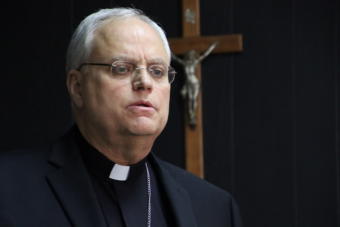
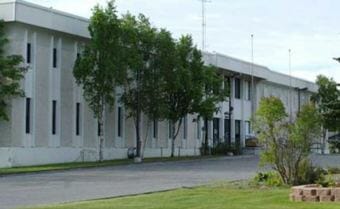
Bishop Andrew E. Bellisario, C.M., the Apostolic administrator of Anchorage, speaks at a press conference Jan. 16, 2020, at the Archdiocese of Anchorage building. (Photo by Valerie Kern/Alaska Public Media)

None of the Catholic priests reported to have been involved in sexual misconduct in a 50-year review of records released last month by the Archdiocese of Anchorage was ever convicted of a crime. There is also no indication the report has prompted any new criminal investigations since its release.

The report, made public Jan. 16, is based on an independent commission’s review of the church’s records. It lists 14 employees of the Archdiocese of Anchorage, 13 of whom it says engaged in sexual misconduct with minors or vulnerable adults, and one who was caught viewing child pornography. The allegations span from 1956 to as recent as 2015.

Ten of the men are alleged to have engaged in misconduct while in Alaska. Four are accused of misconduct elsewhere, after serving in Alaska.

Many dioceses across the country are making similar admissions.

Half of those listed in the Anchorage report have died since the abuse is alleged to have occurred. None of them ever faced criminal charges in Alaska, though at least two were sued along with the Anchorage Archdiocese.

In releasing the report and the men’s names, officials with the Anchorage Archdiocese said they’re doing their best to encourage unknown victims to come forward and to right the wrongs of the past, while still protecting the privacy of the victims. They did not specify whether efforts had been made to report each allegation of abuse to law enforcement at the time the allegation was received.

Critics say the announcement is too little, too late.

Zach Hiner, the executive director of the Survivors Network of those Abused by Priests, said the report is lacking crucial details.

“You know, when were the allegations first received? And what did church officials do in response?” Hiner said. “You know, that kind of information, I think, is pretty critical to understanding exactly what went wrong. And when we know what went wrong, we know how to prevent it in the future, right?”

SNAP, in a statement, also noted two priests missing from the list. Both were employed by the Anchorage Archdiocese and were accused of sexual misconduct after leaving Alaska.

In an interview, officials with the Anchorage Archdiocese said the commission that compiled the report, based on the church’s records, did not determine there was credible evidence of sexual misconduct by either of the two men, and so they were not included in the report.

The Anchorage Archdiocese officials also refused to reveal the sorts of details SNAP said were needed. They also declined to go through the allegations case-by-case to discuss how each of them was handled, though they said there are safeguards in place to prevent abuse now.

At the time of the report’s release in January, the bishop currently in charge of the Anchorage Archdiocese, Andrew Bellisario, apologized to the victims and spoke generally about the report’s contents.

After a request for a follow-up interview, the archdiocese offered its chancellor, John Harmon, who described his role as an operations manager. Harmon was asked about whether law enforcement was ever contacted at the time of any of the allegations

“I’m not sure exactly how each of the different one(s) was handled, but it’s my understanding that everything was handled by the policies and procedures that we had in place at the time,” Harmon said.

Harmon was then asked whether his response meant that the archdiocese’s policies and procedures did not require telling law enforcement at the time: “I think this goes back to sort of what the bishop said in his comments when he had his press release, about how, over time, how situations were handled,” Harmon said. “But again, as it relates to — and he did mention this — that the independent commission was given a standard that they were to look at, as it relates to looking into all of our files, all of our personnel files, and then coming up with a list of recommendations for publication. And those names were published, and again, the files were reviewed, and the report is out there.”

Bellisario, a Juneau bishop overseeing the Anchorage Archdiocese, had said that all of the cases that “needed to be reported” were reported to law enforcement at the time, or in some cases, “much later.”

At this point, it appears unlikely that there will be any criminal charges or convictions related to the archdiocese report on sexual misconduct. A spokesperson for the Alaska Department of Law said the department received the same report that was released publicly and that there is not enough information in it to properly evaluate any particular case.

Department of Law officials declined a request for a recorded interview, but in a written statement, officials with the department’s Criminal Division said new charges would be impossible for some, because many of the accused have long since passed away. Additionally, the statement said prosecutors face time limits on when they can bring forward a case, “even if sufficient evidence exists to take action, which has not yet been determined in any of these matters.”

Anchorage Police Department spokesperson MJ Thim said the department’s detectives are aware of the archdiocese report.

“As with any criminal case, we will always review any new information to see if it can be used in an investigation,” Thim said in a written statement.

Officials with the Anchorage Archdiocese said they have not been contacted by any law enforcement officials seeking additional information since the report’s release.

Alaska Public Media’s Tegan Hanlon contributed reporting to this story.


Wrangell’s cemeteries are running out of space

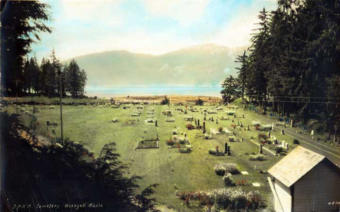
This hand-tinted photograph shows Wrangell's cemetery circa 1930.
This hand-tinted photograph shows a cemetery in Wrangell circa 1930. (Photo by H.A. Ives/Courtesy Alaska State Library, ASL-P345-006)

Wrangell is about the last place anyone would consider crowded — unless you’re no longer among the living. In that case, the town has just about run out of room for you. Wrangell is coping with a shortage of burial space for residents who’d like to remain in the community after death.

In Wrangell, there’s no mortuary. The deceased are sent to Ketchikan for embalming and cremation. Caskets are purchased from a funeral home or retailer off the island.

So pastors like Kem Haggard of Wrangell’s Harbor Light Church don’t just provide the religious services, he often walks families through the final arrangements as well.

“I love our small community, but it really does provide some challenges, especially at a time when we’re all grieving,” he said.

Haggard and the families do manage it — they have to. But those final arrangements now have an added challenge: The city is running out of burial plots. Haggard is aware of this, and it’s why he encourages cremation. But he wouldn’t want any family to have to go against the final wishes of a parent or spouse, if they preferred their body be intact.

“We don’t want to put additional burdens on the family. They’re already dealing with the loss, not on top of, ‘OK we’re going to have to change those wishes of someone we love,’ that can be really difficult,” Haggard said.

There are only five burial plots remaining in Wrangell’s two city-owned cemeteries, according to City Clerk Kim Lane. Once they’re gone, the alternatives are not looking promising.
At Sunset Gardens Cemetery, there’s extra land for up to a dozen plots. But Lane said the land can’t be excavated. Areas have large roots that would be difficult to dig through.

Then there is the older Memorial Cemetery. The city acquired the cemetery in the 1940s, but folks were buried there long before that. When the city went looking for more grave space there, it wound up in an awkward situation.

“When the crew in the past had gone to dig a plot, there were some times when they would find the plots are occupied,” Lane said.

She said plenty of burials don’t have markers in that cemetery. Wooden crosses could have very well deteriorated over the years with no one to replace them.

“So there are quite a few plots that are marked unknown because there was no marker or headstone there before the city took it over,” Lane said.

The city continues to discuss developing other land parcels for more space. The former Wrangell Institute property is at the top of its list, but nothing has been decided on.

Cremation is becoming more common and could ease pressure on Wrangell’s few remaining burial plots. Lane said the last body burial was one year ago. But since the start of the year, seven urns of ashes have already been placed in plots or in the niches of the columbarium, leaving 22 niches available for purchase. Anticipating a shortage there, the city recently bought another columbarium for $50,000. That structure should be available for interment this spring.

While city officials are hopeful that these new facilities will accommodate everyone who wants to remain eternally in this tiny island town, a final answer to Wrangell’s burial problem remains to be seen.

Meet the evangelical climate scientist Katharine Hayhoe

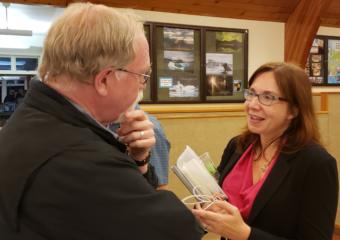
Deacon Charles Rohrbacher of the Catholic Diocese of Juneau talks with climate scientist and Evangelical Christian Katharine Hayhoe at Chapel by the Lake in Juneau on Sept. 13, 2019. Hayhoe, a Texas Tech University professor, said she stacked 29 events around Alaska into her trip.
Deacon Charles Rohrbacher of the Catholic Diocese of Juneau talks with climate scientist and Evangelical Christian Katharine Hayhoe at Chapel by the Lake in Juneau on Sept. 13, 2019. Hayhoe, a Texas Tech University professor, said she stacked 29 events around Alaska into her trip. (Photo by Jeremy Hsieh/KTOO)


National media and mainstream science organizations celebrate the scientist and evangelical Christian Katharine Hayhoe for her ability to reach people who reject mainstream climate science.

In Juneau, about 400 people packed a university lecture hall and a church to hear her speak on Sept. 13. I went to both talks and wanted to find out if she was converting skeptics, or preaching to the choir.

Her first talk was at the University of Alaska Southeast. It was secular, and she talked about combatting climate change silence.

Hayhoe’s second talk was at Chapel by the Lake, an Evangelical Presbyterian church. It had an explicitly Christian angle. Here’s how she introduced herself there:

“So as you know, I am a climate scientist, I’m also a Christian. And people often ask, ‘Well, you know, what comes first the science or the faith?’ And I say, ‘Well, the reason I’m a climate scientist is because I’m a Christian.’”

The Texas Tech University professor illustrates and punctuates her talks with data visualizations, short animations and photos. Think “An Inconvenient Truth.” But with a snappier pacing and without Al Gore’s political baggage.

For the secular crowd, Hayhoe’s talk wasn’t about climate science per se. Rather the science of public opinion about climate science.

In one graph, she highlighted how political identity seems to affect how we perceive temperature. The background is that January 2017 was 8 degrees warmer than average in New Hampshire. In February, a social scientist polled New Hampshire and asked, “Was January warmer than average in New Hampshire, as measured by your own thermometers?”

Four out of five people who voted for Hillary Clinton in the last presidential election thought it was warmer than average. But Donald Trump voters were split 51-49.

“Now, here’s the question: Does a thermometer genuinely give you a different answer, depending on how you vote?” Hayhoe asked, incredulously. Laughter spread through the lecture hall.

“No! It doesn’t! So they were looking at the same numbers. But when we talk about warmer, warmer is associated with global warming, global warming is associated with what? The left-hand side of the political spectrum. And so we can’t say it’s true if it’s counter to who we are.”

The talk at Chapel by the Lake was about equal parts climate science and biblical backstopping for why Christianity and climate action are compatible. She dropped references to a gnostic heresy, Hebrew etymology, Genesis, and Matthew.

“And we’re reminded in Psalm 24: Who does this garden belong to? Who does this Earth belong to? It belongs to the Lord. … Think about the planet. What is the planet? It is our gift from God. Who are we? We are the protectors. We are the keepers. We are the gardeners and stewards.”

By failing to act on climate change, she said Christians “are not just throwing the baby out with the bathwater, we’re throwing everything that the Bible tells us out with the bathwater.”

During Hayhoe’s talks, there weren’t any vocal climate science skeptics in the audience.

There were churchgoers like born-again Christian Sue Badilla, looking for ways to combat skepticism within their home congregations.

“I wanted a little more ammunition for discussing climate change with other Christians and other people,” Badilla said. “So this was good. It helped me to see that there are lots of organizations out there, faith-based organizations that are, are working on finding ways to just help our planet. … I’m definitely going to share what she had to say with other people.”

Loyd Platson came from Sitka for Hayhoe’s talks. He’s active in St. Peter’s by the Sea Episcopal Church.

“I think the information that she shared was kind of eye opening in terms of how to have a conversation, how to start a conversation and why it’s important,” Platson said.

One of his takeaways was to start by finding common ground. He walked through a possible avenue.

“You know, what do we have in common? … Say the salmon is an important industry. And in Alaska, we both believe that. And we’ve seen how the impact of just what’s happened lately in Sitka, the lack of rain affected the lowering of the stream levels, which affected the salmon coming up into the stream. So we both can agree on that. … What are some possible solutions? What are some possible causes that we see? And then we can have the conversation about climate change.”

Platson had a specific relative in mind he wanted to work on. I circled back with him recently. It didn’t go as well as he hoped.

“It was a better discussion than previous,” Platson said. “At least, I kept my side pretty calm. But, like I say — some ingrained thoughts and beliefs that there isn’t climate change going on.”

That said, Hayhoe finishes her talks on hopeful notes.

“The biggest uncertainty in future projections is not the science, it’s not the models we use. The biggest uncertainty is us,” she said. “So when people say it’s too late, I say it is absolutely not too late. We have the ability to make a choice now that will determine our future.”

Hayhoe said she held 29 events around Alaska last month. She stacks up lots of events to make the travel efficient, and she even buys offsets for the greenhouse gases her travel generates.

Bethel welcomes dancers from near and far

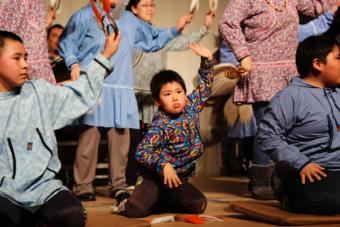
The smallest Kasigluk dancer performs with his community dance group at the Cama-i Dance Festival on March 16, 2018 in Bethel, Alaska. (Photo by Amara Freeman/KYUK)
The smallest Kasigluk dancer performs with his community dance group at the Cama-i Dance Festival on March 16, 2018 in Bethel. (Photo by Amara Freeman/KYUK)

The cultural explosion that is the Cama-i Dance Festival takes place this weekend. The dancing began Friday at 5 p.m. at Bethel Regional High School and will last through the weekend until late Sunday night. Dance groups from across the region, the state, and the lower 48 are gathering to share dance, culture, tradition, and community. Across the Yukon-Kuskokwim Delta, dancers are getting ready to take the stage.
“I’ve had more people say, ‘I’m so busy! I’m just sewing, sewing, sewing,’” said Cama-i co-coordinator Linda Curda. The regional dance festival has propelled a renaissance in the regalia worn by performers.

“Qaspeqs, headdresses, both the beaded and the fur headdresses, mukluks and new dance fans, and the leather belts,” Curda listed.

This year, Cama-i is celebrating its 30-year anniversary.

“Yeah, 30 or 31,” Curda said. “It all depends on how you count.”

Each year, planning for the event begins by choosing a theme.

“When you get goosebumps, you know that it’s the right theme,” Curda explained.

And this year’s theme did just that: “Together We Dance As One.”

“And that,” Curda said, “has resonated with people in ways that I didn’t know would happen.”

Take the logo, for example. It’s carved by Bethel artist Jerry Lieb. It’s a spirit mask, representing the man who brought the region’s tribes together after the division and violence of the Bow and Arrow Wars. The man told the tribes “to put down the bow and arrows and to pick up the drum and dance.”

This year the event will include the Chefornak Dancers. The group cancelled their trip last year after Tribal Council President and Elder drummer Walter Lewis died in a snowmachine accident a few days before the festival. This year, Cama-i will be dedicated to Walter Lewis and his contributions to dance.

“His family will be here [and] his wife. Ossi Kairaiuak, who is with Pamyua, has written some original music to honor Walter Lewis,” Curda said.

That performance is Friday at 8:30 p.m. Soon after, another group that has not been at the festival for over a decade will dance on the Cama-i stage. The Scammon Bay Dancers are returning for the first time since their famous and charismatic leader Maryann Sundown passed away 12 years ago.

“We used to call her ‘The Dance Diva of the Delta,’” remembered Curda.

Sundown used dance as entertainment, as a way to make people laugh. She filled rooms with delight, captivating audiences with her comedic moves and expressive style.

Another regional group this year is the Kwethluk dancers.

“And I reached out to Olga Uttereyuk. She started to talk about what dance meant to her and their community, and she told the story of Joe Ayagarak, from Bethel, going to Kwethluk in 1984 and reviving dancing for Kwethluk,” Curda shared. “And they haven’t stopped dancing since then.”

Joe Ayagarak Jr. is from Chevak, and has lived in Bethel a long time, where he’s led various dance groups. His current group is one of the largest in the region, with more than 40 people. This year, he’s being honored as Cama-i’s “Living Treasure.”

“Living in Bethel, he really has become the Bethel holder of song and drumming and dance,” Curda described.

Other regional groups this year are Kalskag and Tuluksak. Toksook Bay singer and drummer Byron Nicholai from “I am Yup’ik” will perform. Many Bethel groups will also be dancing, including the UAF Kuskokwim Campus Dancers. Last year, beloved campus director Mary Pete died. In her honor, the dancers will be performing a traditional song from Mary Pete’s community of Stebbins.

Beyond dancing, there will be other Cama-i favorites like vendors selling crafts, the Heart of the Drums, the Fur Fashion Show, and the Native Foods Dinner.

The dinner serves about 700 people every year, starting with Elders, moving to dancers, and then to the public.

After assembly prayer ruling, Kenai Peninsula Borough Assembly grapples with path forward

The Kenai Peninsula Borough Assembly is still grappling with a Superior Court judge’s ruling on its current invocation policy. The ruling deemed that the borough’s policy allowing prayer before assembly meetings excluded minority faiths, therefore violating the state Constitution’s Establishment Clause.

The invocation policy only allows leaders of recognized congregations that hold regular meetings in the borough to lead invocations. The assembly implemented the policy back in 2016 after a borough resident ended an invocation in the words “hail Satan.”

Borough Attorney Colette Thompson updated assembly members on their options for responding to the ruling during the Policies and Procedures Committee’s meeting Tuesday, most notably the question of whether to appeal the case.

“That’s up to the assembly to make that decision,” Thompson explained.

The Kenai Peninsula Borough assembly meets in the George A. Navarre Building (Creative Commons photo by Ajohns90 – cropped and lightened from original)

Thompson indicated that assembly member Dale Bagley intends to propose a change to the current policy and to pose the question of whether to appeal the case at a meeting in the near future.

It’s unclear when that may happen, and Bagley could not be reached for comment before deadline. Other assembly members could put forth their own proposals as well.

“I do intend to invite the attorney who represented us in this case here to give information to the assembly for that meeting,” Thompson said. “That may require executive session. I’m not sure, depends on where it goes.”

Assembly member Willy Dunne also questioned whether the borough needed to change the policy immediately.

“I guess I still have questions. It seems like we’re still in violation of the constitution by having this policy, that’s all,” Dunne added.

Thompson explained that the borough has stopped excepting invocation applications and she says the policy has been put on hold.

“The fact that it’s on the books and not being implemented to me is complying with the court order on an interim basis and not actively violating the constitution,” Thompson noted.

Assembly President Wayne Ogle also asked Thompson how much the current policy needs to change in order to comply with the judge’s order.

“One example would be to just delete the paragraph that requires people to be members of associations or chaplains and sign up in advance,” Thompson said. “It could basically be a first-come-first-serve invocation.”

Thompson also explained that the assembly could maintain the current application process, but open invocations to faiths that do not meet the current policy’s standards.

The assembly didn’t discuss either issue related to the invocation case during its regular meeting, but a handful of borough residents commented on the matter.

Alaska Christian College President Keith Hamilton asked the assembly to move forward with an appeal.

“Recently a judge has struck down our policy as it is in its current status,” Hamilton testified.  “Assembly leaders should not let others divert you from what is best for the borough in keeping this policy as is.”

However, others disagreed with the idea of the borough spending any more money on the case, and some like Ed Martin of Cooper Landing encouraged the assembly to accept the ruling.

“I believe that this assembly and many of us that are in this room need prayer,” he said. “Now, there are some in this room that may not welcome it. We as prayer givers should accept the fact that we have to have some tolerance.”

While it’s unclear exactly when the assembly will come to a consensus on how to change the current invocation policy, it will have to decide whether to appeal the case soon. The borough will have 30 days to decide once the judge in the case issues a final judgement, which finalizes the ruling.

The assembly’s next regular meeting is on Nov. 20.

Four churches and a business vandalized overnight

At least four Juneau churches and a business had break-ins or vandalism between Monday night and Tuesday morning, and the Juneau Police Department thinks they may be related.

In a news release, the department says the first report came from the Church of Jesus Christ of Latter-day Saints in the Lemon Creek area on Monday night. They estimate $10,000 in damage was done to 21 windows.

Later that night, police responded to a call about suspicious activity at the Juneau Church of Christ off Mendenhall Loop Road. They found two broken windows.

Police started checking up on other churches and, after midnight, found two more broken windows at the Shepherd of the Valley Lutheran Church. Inside, they found 24-year-old Juneau woman Alesa Abbott and arrested her. She was charged with two felonies and a misdemeanor for burglary, theft and criminal mischief.

On Tuesday morning, more broken window reports came from a business near Hospital Drive and the Juneau Christian Center.

Nathaniel Habeger, an associate pastor there, detailed the damage.

“We came into our offices Tuesday morning to discover that our front – we have four front doors, two sets of double doors, and those doors each have a pane of glass in them and one set of them, both panes of glass, looked like they’d been smashed with a large rock or some kind of a large object,” Habeger said. “They didn’t shatter through, but they were splintered quite extensively.”

Habeger said it’s been duct-taped up for now. He thinks it’ll cost several hundred dollars to repair.

Police noted Abbott had a crowbar on her when she was arrested. She was not charged in four of the five incidents, which are under investigation. But police did call her “a person of interest” in them.

Abbott had a court appearance Wednesday afternoon and bonded out of custody Tuesday. She could not be reached for comment.

Site notifications
Update notification options
Subscribe to notifications