Spirit

Juneau teens rap about Tlingit culture, smoking ‘a fat pound of salmon’ in new bilingual music video

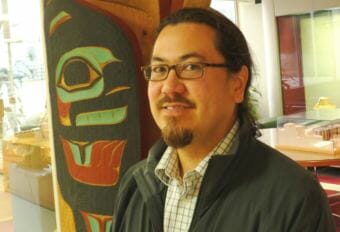
(From left to right) Teenagers Arturo Rodriguez, AJ Hoyle, Keegan Kanan, Bradley Dybdahl, Jacob Brouillette, Marcel Cohen and Kenndra Willard pose with Will Kronick from the Central Council of Tlingit and Haida on July 30, 2018. (Phot by Adelyn Baxter/KTOO)
Teenage music video producers Arturo Rodriguez, AJ Hoyle, Keegan Kanan, Bradley Dybdahl, Jacob Brouillette, Marcel Cohen and Kenndra Willard pose with Will Kronick from the Central Council of Tlingit and Haida. (Photo by Adelyn Baxter/KTOO)

A group of Alaska Native teenagers premiered a bilingual hip-hop video on Monday showcasing Tlingit culture and Southeast Alaska.

Although goofy, the point of the project was to give local youth a chance to take pride in their heritage and the place they come from.

The video is called “Ix̱six̱án, Ax̱ Ḵwáan,” which translates to “I love you, my people.”

Throughout the video, AJ Hoyle blends Tlingit and English lyrics together over a Native drum beat.

Hoyle raps with a hip-hop star’s swagger across scenes from Southeast Alaska, including  the center of a canoe full of paddlers, fields of fireweed and the back deck of a ferry.

But the video and lyrics are fun, silly and, at times, absurd.

Bananas feature prominently, for some reason. They eat them, throw them and dance with them on camera.

Hoyle wrote most of the lyrics himself.

“So I was the rapper, also known as the emcee,” Hoyle said.

He’s written raps before and speaks Tlingit pretty well, but this was his first time rhyming in another language.

That’s why some of the lyrics seem random, even while playing with some familiar hip-hop themes.

“I pick those blueberries / I love my mom / I smoked a fat pound of salmon / Ix̱six̱án, Ax̱ Ḵwáan,” he raps.

He also included a shout out to “This is Angoon,” a Southeast Alaska hip-hop favorite by T.N.T. and Swerv Merv. That video is a couple years old now.

“You gotta shout ‘em out or else they don’t get no publicity no more,” Hoyle said. “And like, if I have to shout out ‘This is Angoon,’ that’s good, because now all of Alaska’s known.”

AJ Hoyle laughs during the premiere of "Ix̱six̱án, Ax̱ Ḵwáan (I Love You, My People)." (Photo by Adelyn Baxter/KTOO)
AJ Hoyle laughs during the premiere of “Ix̱six̱án, Ax̱ Ḵwáan (I Love You, My People).” (Photo by Adelyn Baxter/KTOO)

The video shows the group canoeing on Auke Lake, exploring Haines, riding the ferry, fishing and picking blueberries.

Everything from the video production to ferry tickets and snacks were paid for through grant money promoting health and well-being under a tribal suicide prevention program.

“So when we were doing our storyboard for the lyrics, we wanted to have images that illustrate indigenous life in Southeast,” said Will Kronick, who coordinates the suicide prevention program for the Tlingit & Haida Central Council.

Kronick said the grant was fairly open-ended, so he let the students choose what they wanted to do.

“They decided, ‘Let’s do a music video!’ And all the different scenes came out of that, too, because students wanted to do outdoor things, they wanted to go canoeing, they wanted to go fishing. So really, all of the ideas came from students,” Kronick said.

Kronick, Hoyle and another student, Marcel Cohen, worked on the lyrics for about a month.

Once they had them, it took two days to produce the song with help from Joshua LaBoca, a sound engineer who also helped produce the video. That took about 10 days.

“I didn’t do any micromanaging of them. All I said was do what you do, do what you know and go from there,” LaBoca said. “They weren’t camera shy on each of the days and that’s what made the whole thing smooth, that’s what made it fun.”

The seven students who worked on the video range from 13 to 17.

Most attend high school in Juneau, except for Jacob Brouillette.

He’s from Elim, outside of Nome.

“I was visiting for the summer and I was pretty much loafing around then all of a sudden my Grandma wanted me to get out of the house,” Brouillette said.

Since he’s Yupik and Inuit, he contributed a little bit of his own culture for the video. He demonstrates a broad jump common at events like Native Youth Olympics.

So what did the teenagers take away from the experience?

“New friends and a lot of days without sleep,” said Cohen.

“It’s only OK to say ‘I smoke a fat pound of …’ if ‘salmon’ is at the end,” Hoyle said.

As for their next project, the group already has plans for a music video inspired by Childish Gambino’s “This is America.”

Expect “This is Alaska” to hit the internet sometime in the not-too-distant future.

Watch “Ix̱six̱án, Ax̱ Ḵwáan (I Love You, My People)”: 

Kake tribal government seeks return of items from remote grave site

A Southeast Alaska tribal government hopes to leverage a federal law to secure the return of human remains and burial objects removed from a remote cave more than 50 years ago.

Kake, in central Southeast Alaska, lost three jobs when Sealaska subsidiary Managed Business Solutions closed its satellite office last month. (Courtesy Alaska Community Database)
Kake, in central Southeast Alaska. (Photo courtesy Alaska Community Database)

The Organized Village of Kake seeks to bring back a mummified infant and other items taken in 1961 from a cave on Entrance Island near Hobart Bay, about 70 miles south of Juneau.

“Any items we can get back to the community we’re welcoming back, whether it be human remains or artifacts,” Frank Hughes said.

The identities of the people who took the culturally significant items — now in museums and private collections — are unknown.

The Native American Graves Protection and Repatriation Act, or NAGPRA, requires publishing a notice in the federal register of the intent to return the items.

If no one else comes forward to object, the remains and burial items can be repatriated. The law also provides funding to identify items and return them to Alaska Native tribes and other indigenous peoples.

The infant, 6-9 months in age, was buried inside a painted bentwood box.

The remains have been at the Alaska State Libraries, Archives and Museum since 1961 and the museum doesn’t know their age, but they could date back to first contact with people from outside the area.

Another four burial items from Entrance Island resurfaced just last year, when an unnamed individual from California approached the U.S. Forest Service in 2017 with the intent on returning them.

The Organized Village of Kake also is working to recover other items too.

A shaman’s jawbone was taken sometime before 1910 and now at a museum in St. Joseph, Missouri.

Other artifacts have been found in Portland, Oregon and at George Fox University in Newberg, Oregon.

Hughes notes that Tlingit protocol on who is allowed to handle remains and artifacts is even stricter than federal law.

He said non-burial artifacts could eventually be put on display in Kake, if they are successfully returned.

“We always look forward to bringing them back,” said Hughes. the NAGPRA coordinator for Organized Village of Kake.

Hughes said the tribal government’s intention is to bury these items, just as they were.

“That’s again where the healing begins, when we could actually re-inter the body to where it came from and then put closure to it,” Hughes said. “Ceremonies would be done, songs would sang and again we’d walk away like we did any other time as proud people.”

While Hughes thinks it best to return the infant body to its original burial site, he said that will ultimately depend on the recommendation of Kake’s repatriation committee in consultation with the involved clan.

Repatriating human remains and culturally sensitive artifacts is a process that can take time.

The Entrance Island site is located on what is now national forest land.

“The Forest Service actually got notified that there were objects that a person had collected who now lived in California that he wanted to send back to Alaska,” said Theresa Thibault, heritage program manager for U.S. Forest Service. “You get guilty after a while. He wanted it to end up back in Alaska and he contacted the museum. And then the museum of course recognized that it probably came from forest land so they they contact the Forest Service. And then we initiate the whole tribal consultation process.”

Forest Service determines what tribes had traditional claim to the territory when repatriations take place.

Entrance Island site is within the traditional territory of the Kake people despite being a long way from the current day location of Kake, a community of about 600 people in central Southeast Alaska.

This kind removal of items from burial sites was pretty common before NAGPRA, Thibault said.

“There was a time when it wasn’t OK to collect human remains but it sort of was,” she said. “And so people did it. And they get to a point where I don’t know they have a change of heart, or they’re getting old and they realize that was really dumb and they send them back. Museums get that kinda thing all the time too.”

“They came into the museum long before I was around but there’s no record of them ever being on display,” said Steve Henrikson, the curator of collections at the Alaska State Archives, and Museum. “They were taken in and put into storage,” he added.

It was common for people to give collected artifacts to the museum, Henrikson said.

“I think that the museum has been around for over a hundred years, long before many of the federal agencies had developed capacity for law enforcement or archaeology and so there wasn’t a clear process for people who found artifacts or remains out in the field and wanted to do something with them,” he said. “Of course, the approach that we should take now is not to disturb anything like that but to report it to the agency that owns the land.”

Henrikson said the tribe is in the driver’s seat now, in terms of when and how the items are returned.

“We’re really happy that this is taking place and we’re awaiting instructions from the tribe on how to finalize this.”

Ketchikan pastor, retired teacher charged with sexual abuse of a minor

Recently retired Ketchikan High School teacher and local pastor Doug Edwards has been arrested and charged with three counts of sexual abuse of a minor.

According to the complaint filed in court by police Detective Devin Miller, the charges stem from alleged incidents last fall with a 14-year-old girl. She knew Edwards through his roles as a pastor with First Baptist Church and as a culinary arts teacher at Ketchikan High School.

Police said Edwards admitted to the crimes.

Ketchikan Police Sgt. Andy Berntson said the investigation started in mid-April, when the girl’s father approached police to report that his daughter told him and her mother about the incidents.

“These things do sometimes take some time,” he said. “There are a lot of different investigative techniques you can use. You certainly want as much information available before you present it for prosecution and look at charges.”

The girl also spoke to police, according to the complaint. In her statement, she provided details of multiple encounters. In each, Edwards allegedly reached into the girl’s shirt, under her bra and groped the girl’s chest.

One encounter allegedly happened in the basement of the church when she was alone, playing the piano. Another allegedly happened at Edwards’ home, where she had gone to watch a movie with another girl. A third encounter allegedly took place in the storage area of the high school’s culinary arts room.

According to the complaint, Edwards admitted to police that the encounters took place, and that he had groped the girl’s breast. Police said that Edwards also admitted doing the same thing to another young girl.

Berntson said police are aware of the impact of these kinds of charges to everyone involved, and are careful to make sure they are confident about the allegations.

“In all cases you want to be sure, but certainly there’s a higher level of scrutiny on higher-profile cases and a higher level of crimes, which this is both,” he said. “It’s certainly going to have a big impact on the community as well as the suspect and victim.”

In a news release late Monday, police said the investigation is continuing. Berntson said that’s partly because of the other girl Edwards identified, along with any other information that might come forward as a result of the charges.

Berntson said he can’t say whether the school district was aware of the investigation before this week, but it isn’t common for police to involve anyone else in an investigation like this one.

Edwards had his first court hearing Tuesday morning in Ketchikan Superior Court. He was released on a $10,000 unsecured bond, with conditions that he surrender his passport and remain in his home except for court hearings and to meet with an attorney. Edwards also is not to have contact with girls under 16.

His next hearing is scheduled June 22.

Lawsuit alleges Muslim inmates in Anchorage being starved and fed pork during Ramadan

The Anchorage Correctional Complex is a pretrial and jail facility, where inmates generally stay on a shorter-term basis.
The Anchorage Correctional Complex is a pretrial and jail facility, where inmates generally stay on a shorter-term basis. (Photo courtesy Alaska Department of Corrections)

A national Muslim civil rights and advocacy group has filed a lawsuit against several members of Alaska’s Department of Corrections.

In documents filed Tuesday in Alaska’s U.S. District Court, the Washington D.C.-based Council on American-Islamic Relations claim prisoners in an Anchorage jail are being denied their constitutional rights.

CAIR’s lawsuit pertains to how Muslim inmates are allowed to practice their faith during the Islamic holy month of Ramadan, when observers fast during the day. Alaska DOC has policies to accommodate practitioners, giving them bagged meals to eat in their cells after breaking fast. But according to CAIR, which filed the lawsuit on behalf of two plaintiffs at the Anchorage Correctional Complex, the meals are inadequate.

“They’re literally being starved,” Lena Masri, lead counsel on the case, said during a fundraiser broadcast by CAIR over Facebook Live on Tuesday evening.

The complaint alleges that the bagged meals given to prisoners have less than half the calories that DOC says inmates should be given in a day. On top of that, CAIR says some of the sandwiches were believed to contain meat products with pork in them, violating Muslim dietary rules.

The plaintiffs also say that after they contacted CAIR, correctional officers took the punitive steps of “shaking down” their cells and removing food the men had stashed there, penalizing them further by denying them any more bagged meals.

“The prison retaliated against them by literally confiscating all the food that they had saved up, and so they ate nothing that day,” Masri said.

The lawsuit claims that Muslim prisoners are being subjected to cruel and unusual punishment, as well as disparate treatment from inmates of other faiths. It names 10 individuals within DOC as defendants, from guards all the way up to the commissioner. The plaintiffs are seeking compensation to cover legal costs and suffering associated with malnutrition, discomfort and risks to their health.

Jeremy Hough is the standards administrator for DOC. He could not comment on specific details of ongoing litigation like claims of retaliation, but he said some of the allegations raised in questions from reporters don’t align with general institutional policies. For example, he disputed that the bologna in sandwiches given to Muslim inmates had pork in them.

“Those are non-pork. It’s a turkey bologna,” Hough said by phone on Wednesday. “Matter of fact, ACC is a non-pork facility.”

According to Hough, DOC’s nutrition guidance limits pork at its facilities in the interest of heart health.

Hough said there are 10 inmates at ACC registered to fast during Ramadan. As a pretrial and jail facility where inmates generally stay on a shorter-term basis, it is more difficult to accommodate particular religious practices compared to bigger long-term facilities like Goose Creek, according to Hough. He was not sure of the total calorie count in the bagged lunches, but said the facility has reasonable alternative options like vegan meals for inmates who request them.

The CAIR lawsuit asks for immediate steps to be taken to keep the plaintiffs from suffering from hunger while observing their faith.

According to CAIR’s Carolyn Homer, an Alaska judge had granted an emergency hearing on the case for Thursday at 1:30 p.m.

This year, Ramadan started on May 16 and lasts until June 15.

Sealaska offers burial, cremation assistance to shareholders

Sealaska Board Chairman Joe Nelson poses at corporate headquarters in Juneau after he was elected to the position in June of 2014. Nelson announced a new shareholder burial assistance program May 7. (Photo by Ed Schoenfeld/CoastAlaska News)
Sealaska Board Chairman Joe Nelson poses at corporate headquarters in Juneau after he was elected to the position in June 2014. Nelson announced a new shareholder burial assistance program on Monday. (Photo by Ed Schoenfeld/CoastAlaska News)

Sealaska is helping its shareholders with burial and cremation costs. The Southeast regional Native corporation’s board voted Monday to offer bereavement benefits of up to $1,000.

Losing a loved one is difficult enough on its own. Add the cost of a funeral, burial or cremation and it can be too much to handle.

A thousand dollars isn’t enough to cover all expenses, which can easily top $10,000. But it can help.

Sealaska Board of Directors Chairman Joe Nelson said the corporation’s increased earnings allow it to offer the benefit.

“This is one that’s been out there for a long time and we haven’t been able to get there. But this year, because of our financial performance and our anticipated continued solid performance, that I think everybody in the company’s just excited that we’re able to move on this one this year,” he said.

Survivors will receive $1,000 when an original shareholder dies. That covers those enrolled in the corporation since it formed in the early 1970s.

Descendants of original shareholders, and those who inherited or were given stock, will receive up to that amount. The corporation said payments will be based on the number of voting shares at the time of the shareholder’s death.

Nelson said the board took action now because it has a new source of revenue.

“It’s a function of being in a healthy financial position and then having the specific carbon project where we want to associate that carbon program to a benefit that all shareholders will feel for generations to come,” he said.

That project allows Sealaska to sell carbon offset credits through a program based in California. It’s complicated, but basically, the corporation keeps some of its forests intact, in exchange for payments from polluters.

Shareholder bereavement benefits began May 7, the day Sealaska’s board of directors approved the new program.

“I think this is fantastic news for shareholders,” said Nicole Hallingstad, a former Sealaska corporate secretary who’s running for the board as an independent candidate.

She’s among other candidates and corporate critics who’ve called for bereavement benefits.

“The most important thing about this announcement is that it just proves that when shareholders are united and are persistent in their voice in raising an issue, that we can actually accomplish the change that we’re asking for,” she said.

Nelson said a recent survey showed the benefit among shareholders’ top priorities. It was outranked by scholarships and dividends.

“Whenever we go out in the communities, just in our regular shareholder engagement, it is a regular theme — that a lot of folks could use help with burial assistance. And it’s also part of our cultural values, especially in Southeast, where we come together and support each other during times when someone passes,” he said.

Some other regional Native corporations already provide a similar benefit.

Nelson said the mechanics of payments are being worked out, but applications will be available sometime in June.

Sealaska estimates around 300 shareholders die every year. The corporation has between 22,000 and 23,000 shareholders.

After clients discover backlog, Juneau pet cremation business owner says he’ll make good

Tammy Hunt's family dog, Bob, died in January. She waited two months for her bill from Bridge Pet Services. (Photo courtesy of Tammy Hunt)
Tammy Hunt’s family dog, Bob, died in January. (Photo courtesy Tammy Hunt)

After Tammy Hunt’s boxer died in January, she hired a local pet cremation service to pick up the remains.

In mid-February, when her stepson’s cat died, he called the same company.

But neither of them heard back from the business, Bridge Pet Services, for weeks about their bills.

On a recent weekend, they stopped by the shop and noticed a blue Toyota full of black and white plastic bags.

They took a closer look, and realized the bags were labeled with people’s names, pet names and dates going back weeks. They showed me video of what they saw.

Hunt said they were both horrified to think their own pets might be decomposing in the back the truck.

“You know, if we didn’t care, we’d just take our pets out to the landfill,” she said.

She said seeing those bags brought back the stress of losing her dog all over again.

She decided to post about it on a Juneau Community Collective Facebook thread.

The reaction from other clients of Bridge Pet Services was immediate.

Some said they’d tried calling, emailing, texting and even knocking on the door to talk to someone. Other customers noted bills and pet’s ashes that were overdue by a month or more.

“If the service is offered, then the service should be rendered,” Hunt said. “If the service cannot be rendered, then it should not be offered. I think that ordinances might need to be either enforced or altered to accommodate pet owners a little bit better.”

“It’s just embarrassing and I’m just trying to get this sorted out and get back on track,” said Mike Dziuba, who founded Bridge Pet Services with his now ex-wife in 2007. “My own dog was getting older at the time, and I just didn’t want to ship him to Anchorage and I wasn’t in a place where I was putting roots down where I was going to be at a house where I felt comfortable burying him there.”

When a pet passes away, Juneau residents are required by city ordinance to dispose of the remains immediately.

Before Bridge opened, they could bury the pet on their own property or use the landfill’s disposal service.

“I felt like I was providing an option for town instead of the landfill, of course, although I know there are still people that choose that option,” Dziuba said. “But it wasn’t for me and it’s not for most of my owners.”

Dziuba’s clients can choose an individual cremation to receive their pet’s ashes in an urn afterward, or communal cremation, where multiple pets are cremated together and Bridge disposes of the ashes.

Prices vary based on weight. Home pick-up costs $35.

Dziuba said business tends to pick up in the winter months. He thinks it’s because the ground is too hard to bury pets.

Animals awaiting cremation are usually stored inside in freezers.

It typically takes him up to two weeks to cremate and get ashes back to clients, but acknowledged he’d fallen behind because of some personal issues.

He said he didn’t want to make excuses.

“I don’t necessarily blame anybody for griping. But I’ll talk to anybody individually and try to square it up that way. I think that’s kind of the best route.”

He runs the business alone now and works full-time at Bartlett Regional Hospital during the day, so animals in body bags sometimes sit in his truck until he can return to his shop.

Dziuba said he has time off from work coming up and plans to devote it to getting caught up and making things right with his clients.

In addition to individual owners, he works with the Gastineau Humane Society and local veterinarians, picking up animals that have been put down or found dead on the side of the road and cremating them.

The humane society had a crematorium years ago, but no one working there now remembers when it went away.

City Manager Rorie Watt said the city had received calls from concerned Bridge clients. He said they asked the Gastineau Humane Society to reach out to Dziuba and is hopeful the business will get back on track.

“I do think it’s a service that the public appreciates and the prior method of burying dead pets in the landfill really was not very popular with a lot of people.”

Hunt and her stepson both eventually heard back from Dziuba. She’s still upset about what happened, but said Dziuba waived her bill.

Site notifications
Update notification options
Subscribe to notifications