Spirit

‘Nones’ in Juneau changing religious landscape

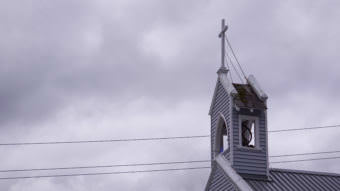
Grass grows in a planter off a window of St. Nicholas Russian Orthodox Church in downtown Juneau on July 15, 2017. The Catholic Cathedral of the Nativity of the Blessed Virgin Mary is in the background. (Photo by Jeremy Hsieh/KTOO)

Today, Alaskans are on average less religious than the rest of the country, and a subset who don’t identify with any particular religion is growing, according to data from the Pew Research Center.

“I grew up fairly religious, went to organized church, and then kept that going probably through the first year of college, and kind of lessened that. Now I don’t practice anything specific,” Chelsea Maller, a Juneau local, said.

Despite this, Maller says she still prays.

“I would say that’s the most consistent thing I keep up with if anything,” Maller said. “Just giving myself a peace even if I don’t necessarily feel like if I need to go worship in a church or anything like that.”

Maller falls into a growing group of the religiously unaffiliated, which can include anyone from atheists to the “spiritual but not religious” types.

The Pew Research Center refers to this group collectively as “nones,” which originates from the “none of the above” option on a religion survey.

In Alaska, about 3 out of 10 people are nones. Nationwide, it’s 2 out of 10. Both have grown since 2007.

A common misconception about nones is they don’t have any beliefs — but like Maller many of them fall into a spiritual gray area.

Elizabeth Drescher, the author of the book, “Choosing our Religion: the Spiritual Lives of America’s Nones” conducted her own research on the subject.

“It turns out that about 70 percent of the religiously unaffiliated, or nones, believe in God or a life force or some kind of higher power,” Drescher said. “They don’t identify with a particular religious tradition, even though they might participate in things that are kind of obviously religious to most of us.”

It’s not uncommon for nones to pray, attend religious services or consider religion important in their lives.

“That package that’s called religion, some of it works for me, but mostly not so much all the time,” Drescher said, voicing  what many nones feel. “I’m happy to take some of those resources, but I don’t belong to that.”

Drescher hasn’t studied nones in Alaska specifically, but she guessed a seasonal workforce and fewer connections within the community could contribute to more nones.

Across the country, religious unaffiliation has increased and in every race, age, gender, education and socioeconomic background.

This concerns some religious leaders, and there are theories why people are leaving traditional religion, such as a more scientific world views, seeking out a more individualized religion and LGBTQ and women’s rights.

Juneau local Rachel Smith grew up Mormon but doesn’t align with that anymore.

“Mormonism is so – it’s very black and white. I just never felt that way, it’s a little, depending on who teaches it, it’s a little bit demeaning towards women,” Smith said.

Pat Casey, a pastor for the Catholic Church here in Juneau, says there are a lot of nones in town, but he also sees a lot of people who mix religious traditions.

“People tell me you know I’m a Christian, I believe in God but I like to do it in my own way,” Casey said. “You know, the yoga movement and other types of meditation.”

He says to say the Catholic Church is shrinking is a misconception. Nationally, immigrants are a major source of growth in the Catholic Church. Catholicism is still really popular in Latin America and the Philippines. But what draws people to Catholicism now?

“I’ve had a number of people come to me who want to talk about the Catholic Church where it is now, versus where it was when they left,” Casey said. “Many of them find that challenging and welcoming.”

In 1966, Time magazine published one of their most iconic covers ever. In bold red against a black background, a single three-word question sparked outrage and backlash.

“Is God Dead?”

Half a century later, the issues the magazine explored may sound familiar: Explaining the divine in an increasingly secular world, how theologians responded, and the move toward individualized religion.

Homer Rotary Club plans peace-based arts program for elementary kids

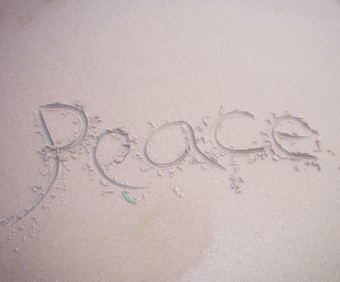
Peace written in sand.
(Flickr photo by Hc_07)

The Rotary Club of Homer is collaborating with a German foundation aimed at cultivating peace through painting. The Together in Peace Foundation has been running its United Paintings program throughout Europe for 21 years.

The initiative aims to educate elementary-aged children about the idea of peace through curriculums in the classroom. At the end of the program, kids express what peace means to them by painting on canvas banners.
The program will now take root right here in Alaska. The founder of the program, Olaf Ring, contacted Homer Rotary Club President Jane Little about implementing the program in the U.S. earlier this month.

Little said she has been looking for a project for some time, and she jumped at the opportunity to work with Ring.

“Right now, he has about three miles of length of banner, and what our goal is to get another three miles in Alaska, the Yukon and the U.S. in the next two, two and a half years,” Little explained, “So we can present this string of banners at the Rotary International Convention in Germany in 2019.”

Little has served as district governor for Rotary clubs in Alaska and Canada, and she said the project will fit the humanitarian organization’s mission. She will be working with the Rotary Club of Fairbanks to design a curriculum for the program.

“What we see this as is not a one-day project, but perhaps several weeks or months of having the curriculum to teach the children about peace,” Little said. “Then at the end of it, have them paint a picture that is peace and also depicts their hometown, their community, their school.”

Painting pictures can seem like such a simple idea, but Little likes the program’s ground-up approach because it cultivates understanding of others and helps broaden understanding of what peace can look like.

“I think that for most of us that are involved in the peace movement of some sorts is that we will see a kinder, gentler world. We’ll see people that are able to get along better and that we’ll have dialogue,” she said. “It’s one person at a time.”

Little explains the topic of peace can be a large one, and she doesn’t know exactly what the U.S.-based program will look like. She plans to work with schools throughout Alaska, the Yukon and the Lower 48. Little hopes to have a timeline for its implementation later this summer.

‘Real Boy’ a journey through transition and acceptance

An award-winning film airing nationally this week over PBS has an Alaska connection.

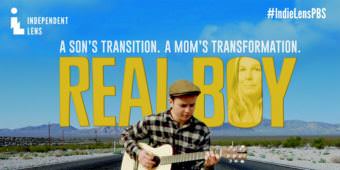
Real Boy” is the story of a trangender youth who is building a career as a musician in the Bay Area of California.

The film was directed by Shaleece Haas, a former news intern at KCAW in Sitka.

It is Haas’s first major independent project after receiving a master’s degree in journalism from the University of California, but not her first time on national television.

Her 2010 thesis film, “Old People Driving,” aired on PBS’s “Newshour,” and also traveled to some film festivals — including a screening in Sitka, where Haas had been an intern in 2009.

Looking for a new project, she became interested in documenting the life of a transgender adult vocalist.

Instead, she discovered the story of a trans boy named Bennett, on a different musical path.

“The central relationship in the film is between a young transgender musician and his mom, who is on her own journey from resistance to acceptance of her trans kid,” Haas said. “While she’s working through all the things she needs to work through, Bennett is taken under the wing of his mentor, an older transgender musician named Joe Stevens, who helps guide him while his family of origin are trying to figure out how to support him.”

The film follows Bennett for four years, from age 19 to 23, and examines his life from many perspectives — not just trans issues, but family and peer support, addiction and recovery, mental health, and the healing arts.

Haas has screened it 150 times in 20 countries — sometimes Joe and Bennett perform afterwards, and often there is deeper interaction with the audience.

Haas finds this part of film making gratifying.

“It’s really a pleasure to share the film with community and to allow people to share their own stories and the way the film resonates for them in their own lives,” Haas said.

“Real Boy” has won a pile of awards and is a huge success for Haas in the world of documentary film, where she said “there are many great films and not enough funding.”

She’s grateful to the Independent Television Service for it’s early support of the project.

“Real Boy” is the season’s final installment in PBS’s Independent Lens series.

Haas spent four years working on the film, and a fifth year marketing it. She’s not looking for another movie of her own right now; instead, she’s hiring out her skills and talents to other projects.

“Real Boy” is far from over. There are more screenings, festivals, and fundraising still to come.

“All of that is carried alongside the responsibility that I feel toward people in the film — and how much I love and care about them and want to honor them in telling their story, but how much responsibility there is to get it right,” Haas said.

“Real Boy” will be rebroadcast June 21 and 25 on PBS stations nationwide. Check your local TV listings for details.

Social worker receives national award for suicide prevention efforts in Y-K Delta

A Lower Kuskokwim School District social worker received a national award this week in Washington D.C. for his work in the Yukon-Kuskokwim Delta on suicide prevention.

James Biela is an itinerant Social Worker for LKSD, frequently traveling out to Newtok, Tununak, Toksook Bay, Nightmute, Mekoryuk, and Nunapitchuk to hold trainings and lectures on suicide prevention.
He received the Sandy Martin Grassroots Award, given out to three members of the National American Foundation for Suicide Prevention, for work in grassroots programs. Beila is a volunteer and the founder of the AFSP Alaska Chapter.

Winning the award was an honor, says Biela, an honor he was not prepared for.

“Actually, I was totally shocked that I’d be receiving this award. I didn’t have anybody giving me a heads up,” said Biela. “I feel it’s an honor, but it was also a sad time because one of my friends out in a village before I got on the plane, died by suicide.”

For Biela, the news underscored his life’s work.

“It gives you more power to do more,” said Biela. “Actually, this year I was very fortunate to have a young man from Newtok, an Alaska Native, come with me to Washington D.C. to talk to the congressional leaders about suicide. But on this one it just makes our work more important. To be the voice about how suicide can be prevented and get the Congressional leaders in D.C. to listen.”

And they did just that. They sat down for twenty-five minutes with Senator Dan Sullivan and Senator Lisa Murkowski, discussing village suicides in the YK Delta.

“I know everybody needs to pitch in with the leadership that they can afford to understand our needs,” said Biela.

That’s especially important now, said Biela, with the ongoing healthcare debate and the possibility that mental health care will be cut out of the budget.

Ashland holds candlelight vigil for good Samaritan killed in Portland hate attack

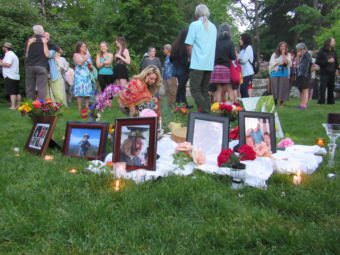
The memorial for Taliesin Nomkai Meche was held in Ashland's Lithia Park on the evening of Saturday, May 27, 2017.
The memorial for Taliesin Nomkai Meche was held in Ashland’s Lithia Park on the evening of Saturday, May 27, 2017. (Photo by Liam Moriarty/Jefferson Public Radio News)

About 200 people gathered in Ashland on Saturday night to celebrate the life of a hometown boy with Juneau ties who died trying to protect a pair of women from anti-Muslim abuse in Portland.

As the sun set on a golden spring day, they gathered in Lithia Park, near a fast-running Ashland Creek. Friends, family and community members held candles and sang songs of peace in honor of 23-year-old Taliesin Myrddin Namkai Meche.

Monique Torok – Namkai Meche’s sister-in-law – said standing up for a stranger was just the kind of man he was.

“I can assure you he was passionate about human rights,” she said. “I can assure you he absolutely did that. It was not like a casual thing or a mistake. This was a person rising to this occasion.”

Born and raised in Ashland, Namkai Meche was one of three men who tried to intervene when a man yelled anti-Muslim slurs at two women on a light rail train in Portland. Police allege 35-year-old Jeremy Joseph Christian stabbed all three men. Namkai Meche and 53-year-old Ricky John Best of Happy Valley, Oregon, died. The third man – 21-year-old Micah David-Cole Fletcher – is recovering from his injuries in a Portland hospital.

Christian has a violent criminal record. His Facebook page is littered with white supremacist posts and he was filmed at a recent Portland rally shouting racial epithets and displaying Nazi salutes.

But for the stunned and grieving community at Lithia Park, the hate or mental illness  that caused the pain that brought them together was not the point.

Norma Burton is a family friend and minister at Unity in Ashland. She told the gathering the loss of Taliesin – and the manner of his death – was a challenge to the community to rise above anger.
“And we know we are being called to a time when we’re going to have to love more deeply, in a different way, than we have ever yet loved,” she said.

Family friend Mera Gagnon had watched Taliesin grow up. She called him a being of light.

“And he’s a light of this community,” she said. “He’s absorbed it. It’s a part of his beingness. And he was here on a mission. And he just used his light to teach an unbelievable lesson.”

18-year-old Ashland resident Gabriel Ruiz said Taliesin’s sacrifice made him think about the heroes of the past.

“People who had the guts — but more importantly, they had the heart – to see something wrong and say, ‘No. I will not let this go.’”

Gabriel’s father, Grant Ruiz, said like many in the community, he felt drawn to be here this evening.

“People feel like they need to come together for the family,” he said. “I feel that this is everybody coming together for whatever reason they had, in the same spirit. That feels important.”

As darkness fell and the mourners dispersed, they left dozens of candles flickering in honor of a promising young man – one of their own – who had stood up for the values they hold dear – and had paid with his life.

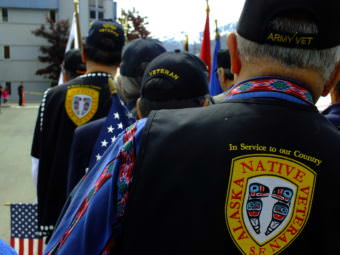
Photos: Fallen service members remembered in Juneau

Juneau residents remembered those who made the ultimate sacrifice during three separate Memorial Day observances on Monday.

The Veterans of Foreign Wars Taku Post 5559 hosted an event at Evergreen Cemetery as the American Legion Auke Bay Post 25 had a ceremony at Alaskan Memorial Park.

Alaska Native veterans also hosted a ceremony at Southeast Alaska Native Veterans Memorial Park downtown.

Site notifications
Update notification options
Subscribe to notifications