Spirit

Native groups install totem pole at Gastineau Elementary, lost cemetery

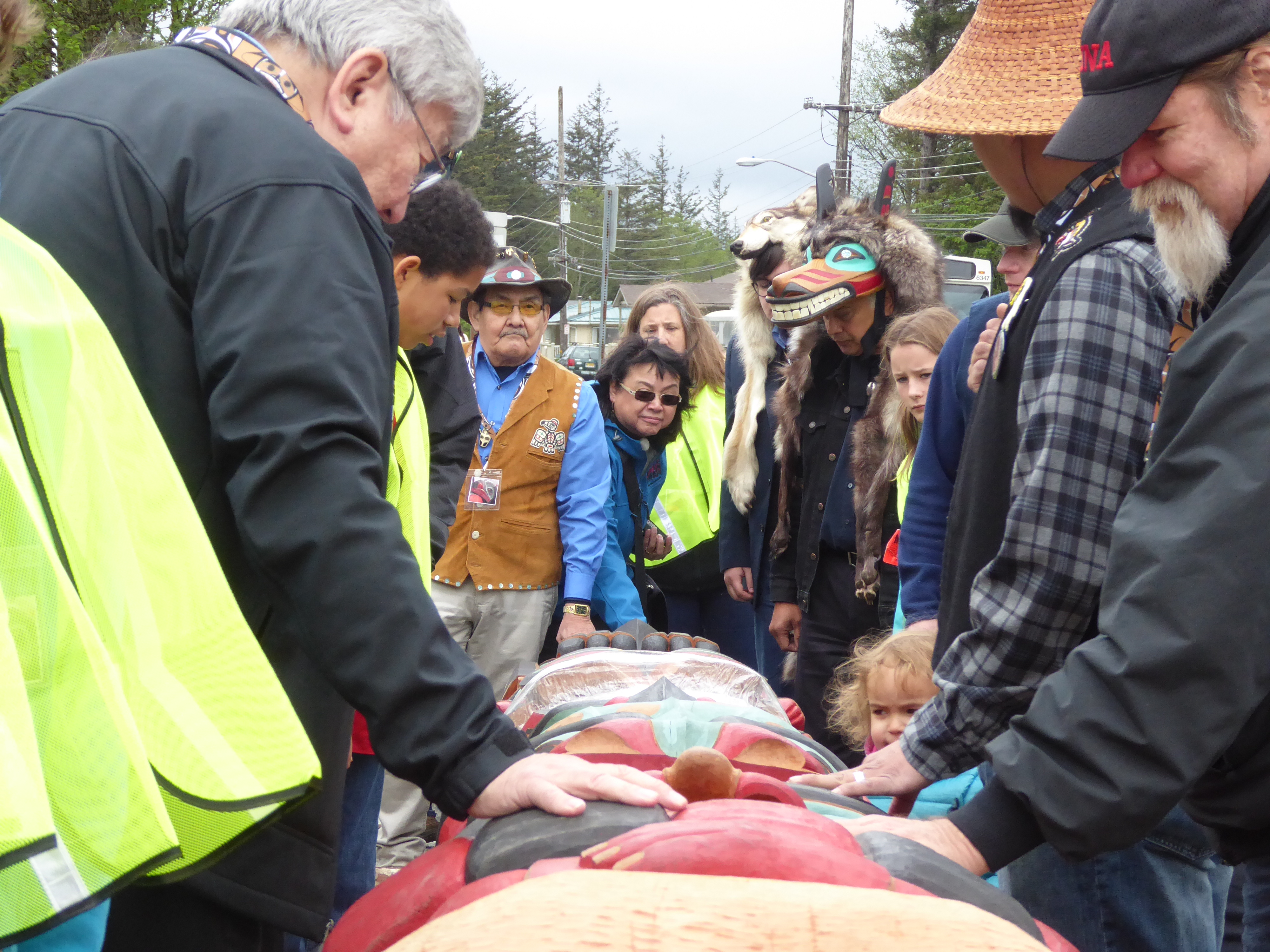
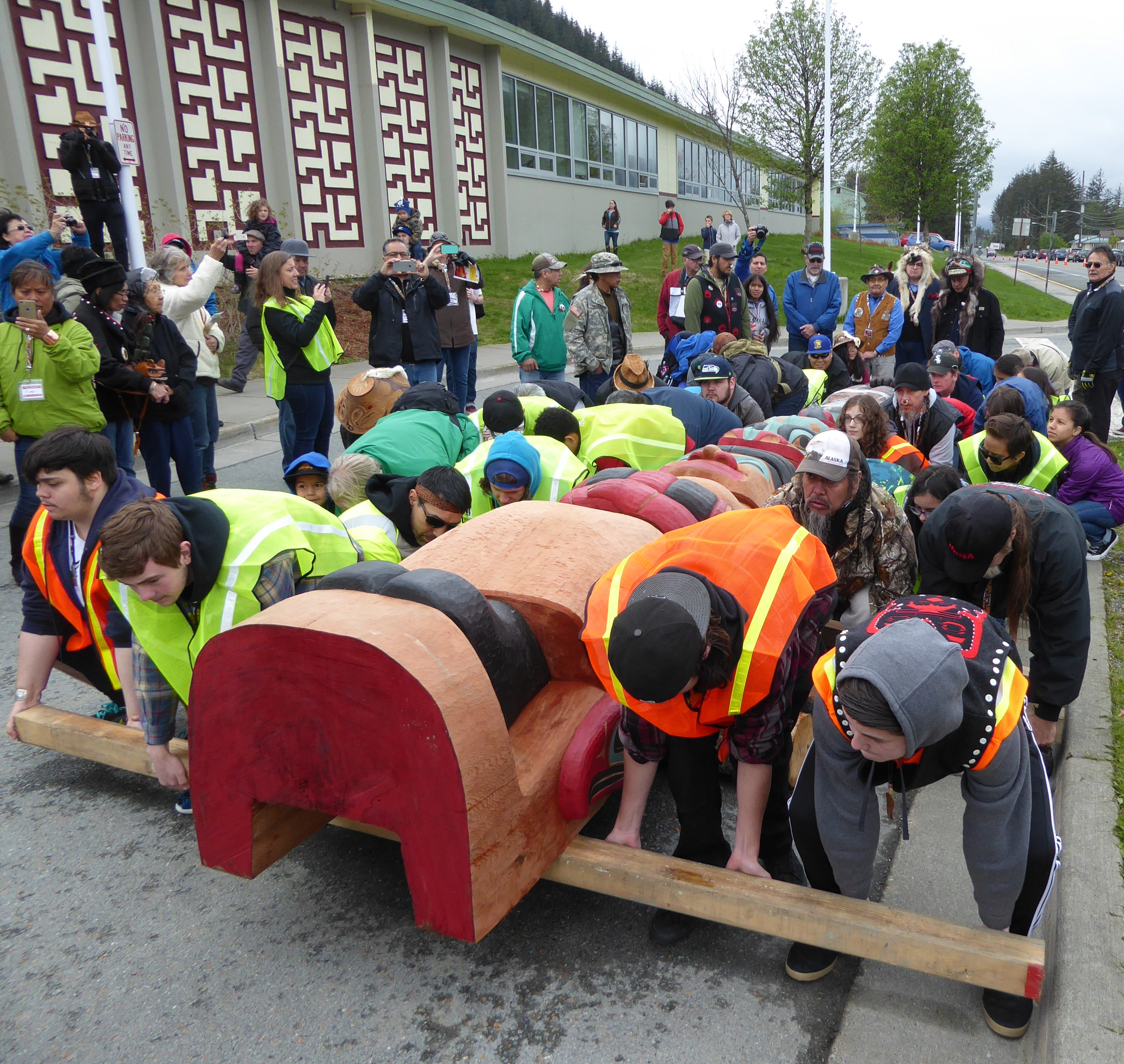
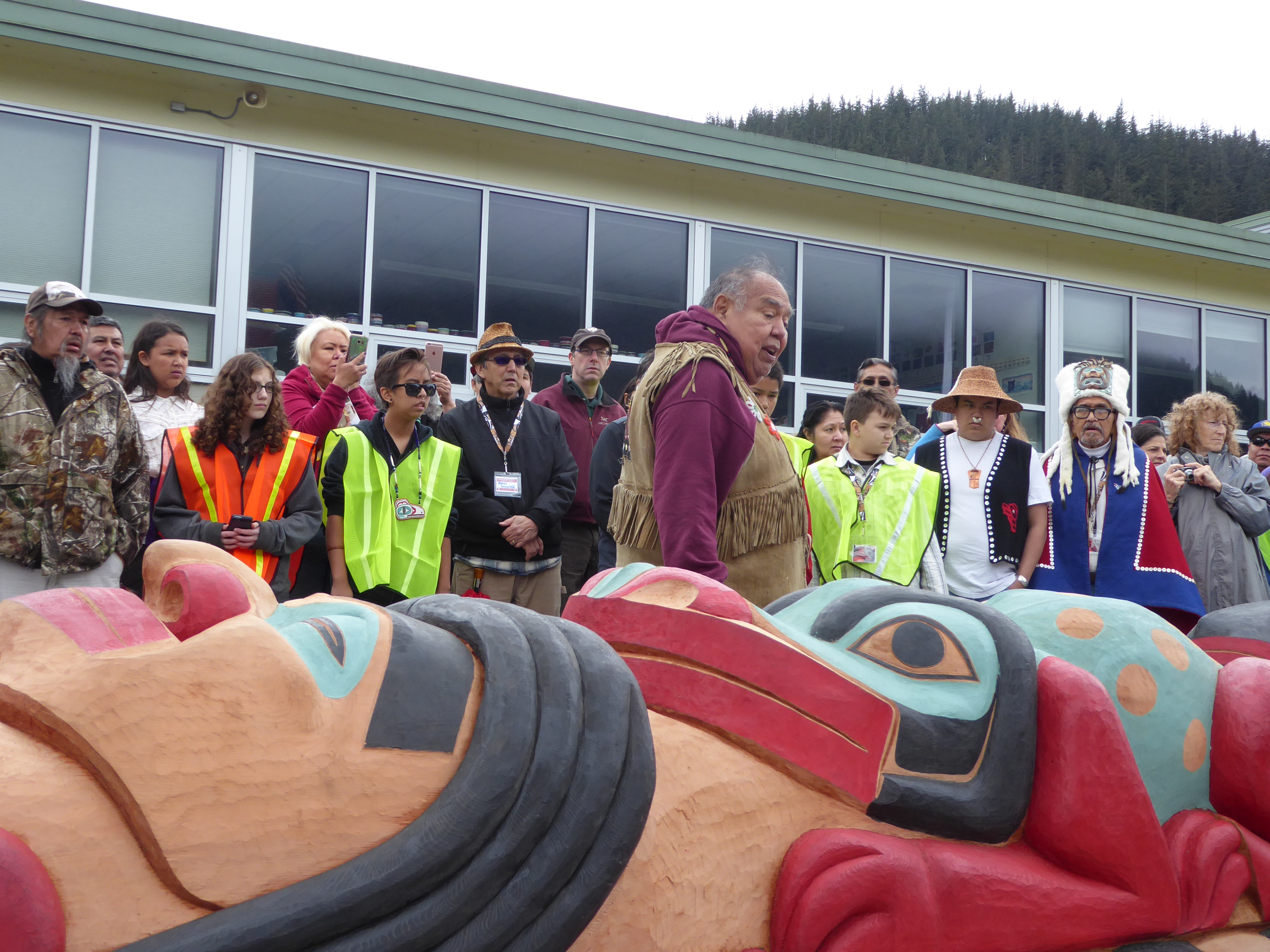
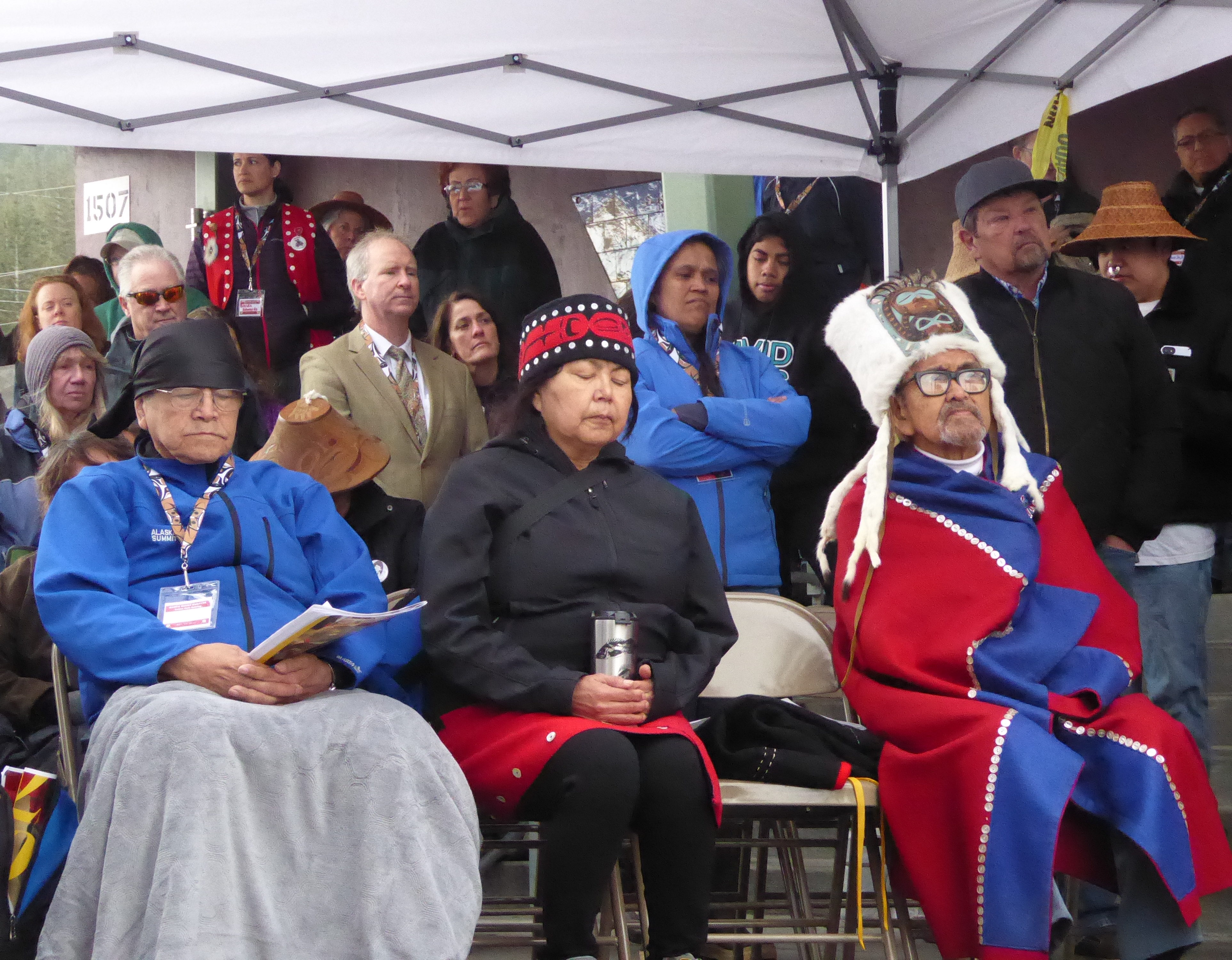
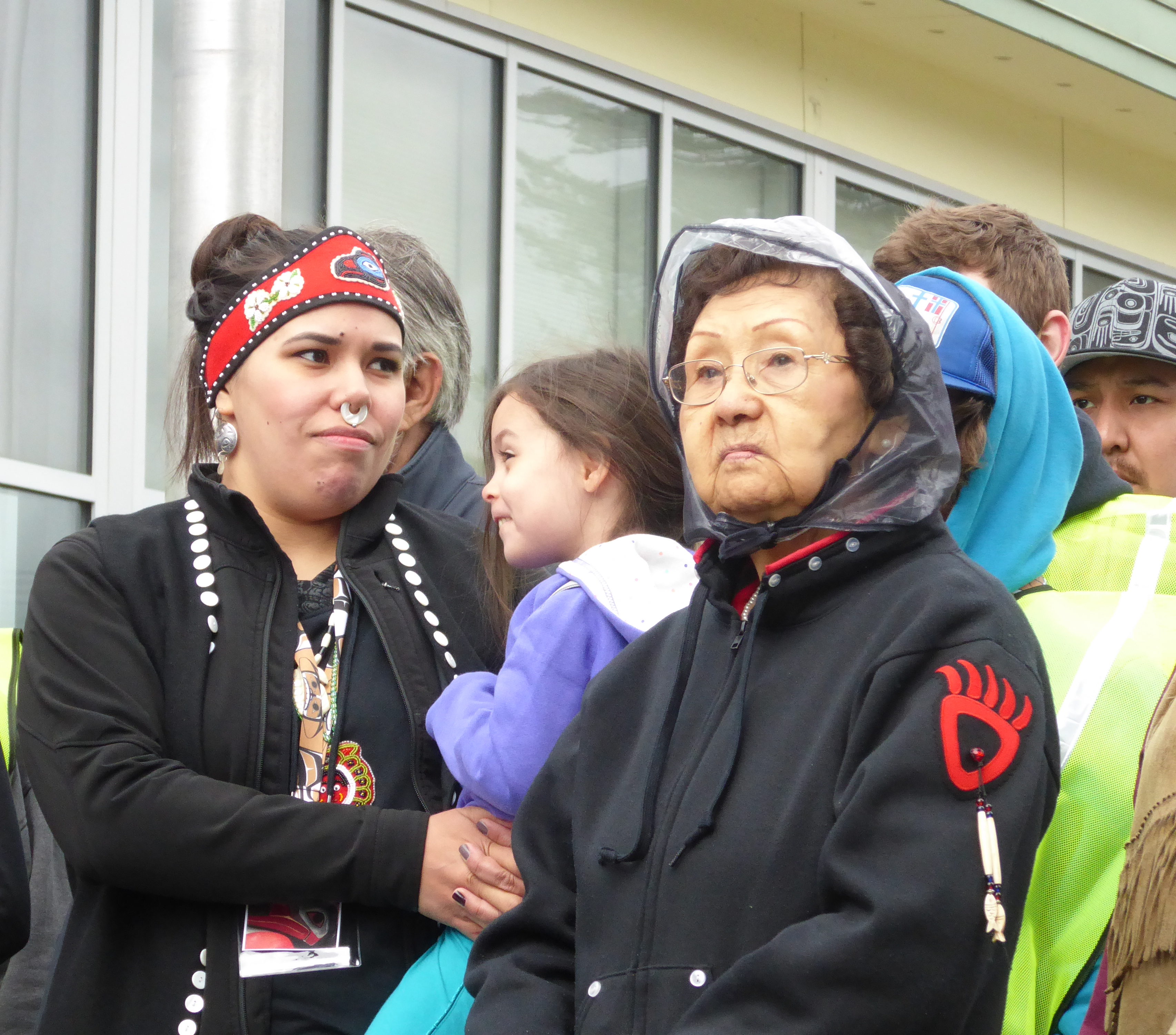
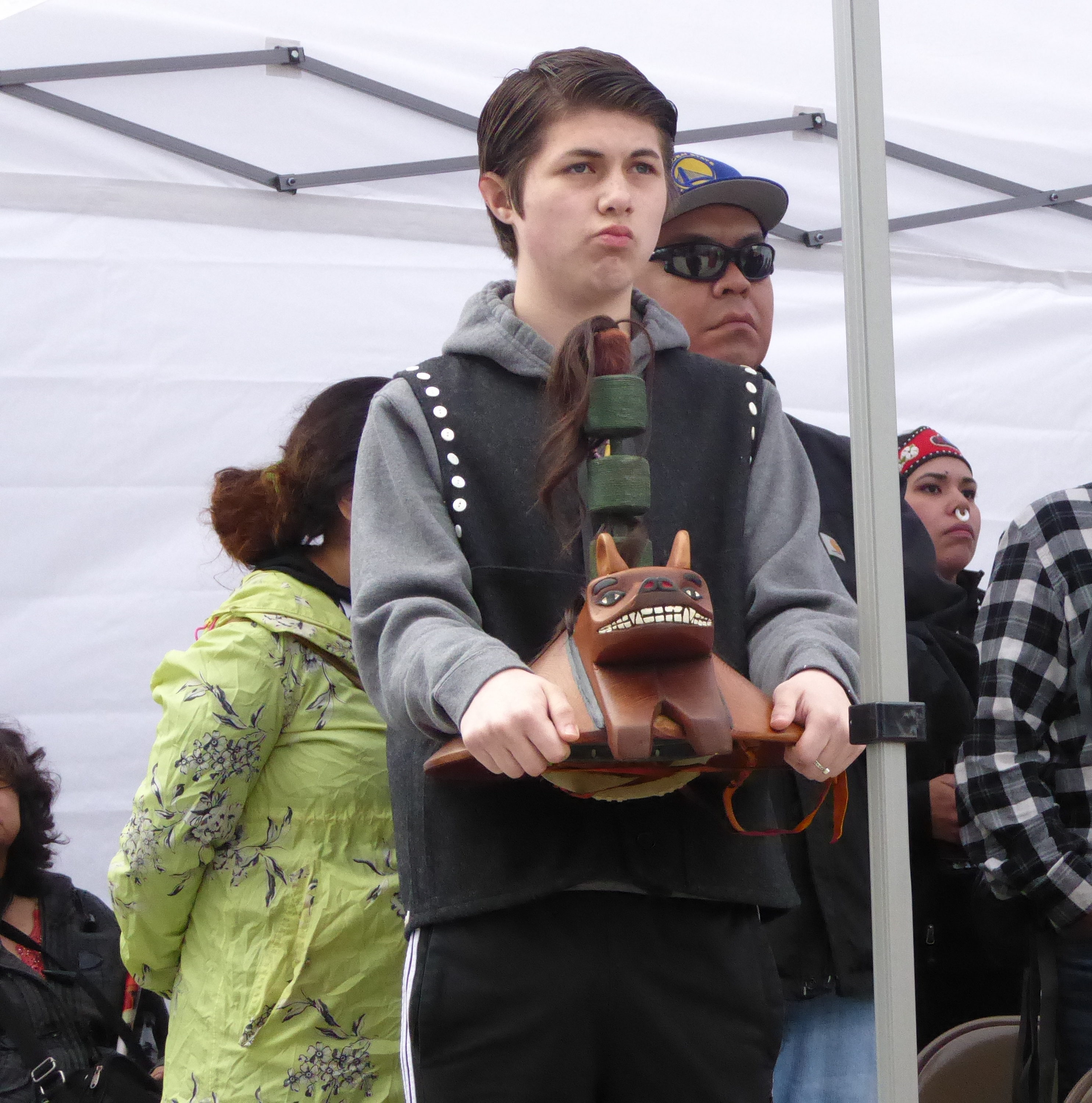
The T’aaku Kwáan of Douglas Island raised a totem pole in front of an elementary school Saturday to mark the site of a disturbed graveyard. The pole symbolizes the pain of historical trauma and a need to heal.

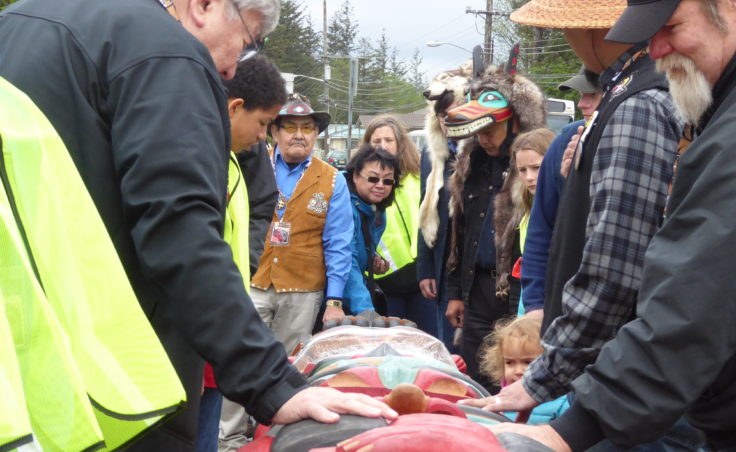
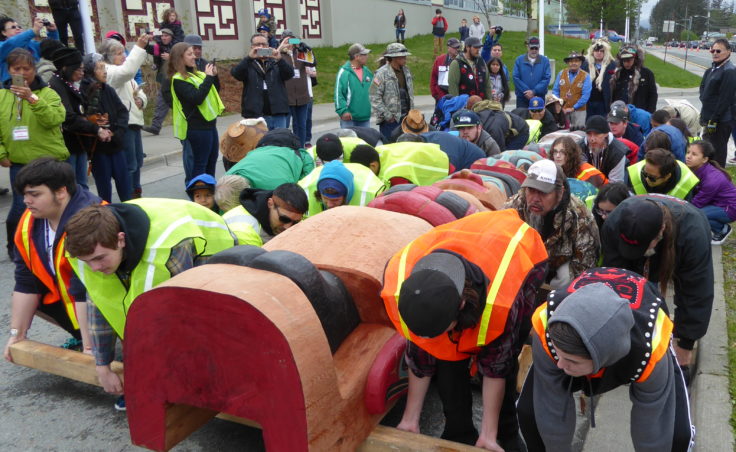
A couple dozen volunteers prepared to bend their knees and backs to grab wooden beams underneath a 26-foot, solid wood, Raven totem pole laying on its back. Like pallbearers, they lifted the pole and slowly carried it toward a crane waiting to lift and place it on a metal base sitting in front of Gastineau Elementary School.

Event organizers warned them to call for help if they felt like the weight was too much.

“For those of you on the sides, we’re going to need you to switch out if somebody says help. We don’t want anybody getting hurt trying to move this,” one man ordered.

Sixty-one years ago, Gastineau Elementary School was built on top of a graveyard for the Tlingit T’aaku Kwáan.

Goldbelt Heritage Foundation, the Douglas Indian Association and the Juneau School District organized the totem pole raising and a ceremony to reflect on “social injustices” inflicted on the T’aaku Kwáan.
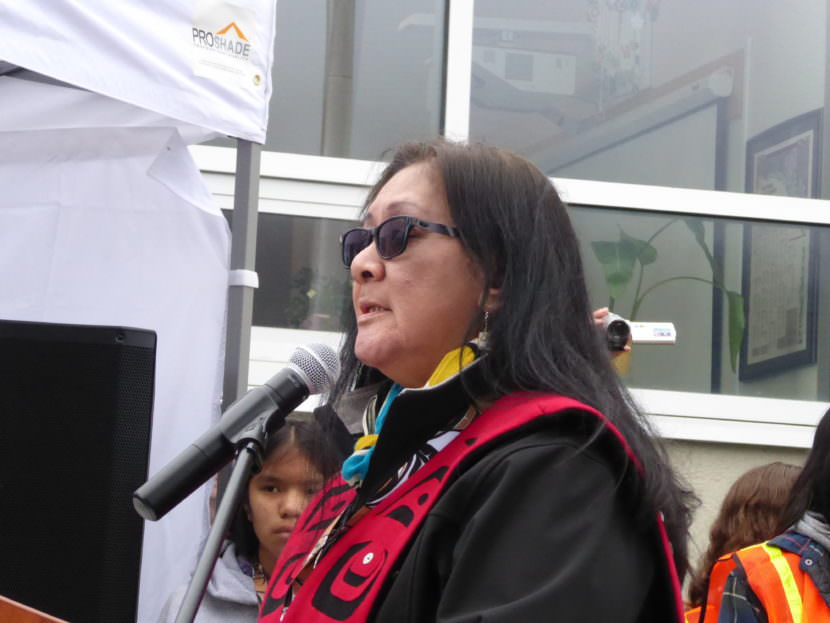
Andrea Cadiente -- Laiti speaks at the totem pole raising ceremony on Saturday.
Andrea Cadiente-Laiti speaks at the totem pole raising ceremony on Saturday. (Photo by Quinton Chandler/KTOO)

Andrea Cadiente-Laiti was the keynote speaker at the ceremony. She sits on the Goldbelt Heritage Foundation’s board and she’s also the tribal administrator for the Douglas Indian Association.

She said construction workers accidentally unearthed three burial sites on the school property in 2012. Five people were in the graves.

“One was a young woman and it was determined by the archaeologist that she died in childbirth,” Cadiente-Laiti said. “So, that leads us to assume that the remains were not just that of the young mom, but that of her infant.”

She said another man was buried with what might have been his prized gun collection.

Cadiente-Laiti likened building Gastineau Elementary over the cemetery to someone building “an office building over Evergreen Cemetery,” a 9-acre memorial in Juneau that the city estimates over 8,000 Juneau residents have been buried in.

Cadiente-Laiti and other speakers also recalled the impacts of the city of Douglas’ intentional burning of Douglas Indian Village in 1962, decisions to build roads over graveyards, property loss, the loss of fishing rights and the suppression of the Tlingit language.

Cadiente-Laiti said those actions had powerful effects that were passed down to today’s generations.

“We don’t necessarily feel it, or see it, or taste it, but somehow through our parents we know it’s there. We see their sadness,” Cadiente-Laiti said.

The Raven totem pole after being placed on its base on Saturday.
The Raven totem pole after being placed on its base on Saturday. (Photo by Quinton Chandler/KTOO)

It is hoped that raising the Raven totem pole will pay respect to the grievances of the past, restore the T’aaku Kwáan’s ancestral connection to the land, and signal their desire to heal and move forward, culture intact.

The organizers plan to raise a second totem pole at Savikko Park next spring. The second pole will recognize the Yanyeidì clan and the 1962 burning of Douglas Indian Village.

Correction: A previous version of this story misstated that five construction workers unearthed the burial sites discovered in 2012. The orthography of “T’aaku Kwáan” has also been corrected. 

Pope Francis announces two new saints on 100-year anniversary of their vision

Hundreds of thousands of pilgrims gathered in Fatima, Portugal Saturday, where Pope Francis canonized two new saints. Jacinta and Francisco Marto were children 100 years ago when their visions of the Virgin Mary marked this place as an important Catholic shrine.
Paulo Novais/AP

Pope Francis canonized two new saints Saturday at the beginning of a mass in Fátima, Portugal.

Francisco and Jacinta Marto were small children in Fátima on May 13, 1917, when they said they saw a vision of the Virgin Mary while they were tending sheep. The farm town became an important Catholic shrine as a result of the children’s visions, drawing pilgrims from around the world.

Many such visitors were at the mass where the canonization was announced Saturday, and the declaration was met with joyous applause. The Associated Press reports that, according to the Vatican, about 500,000 people watched from the square in front of the shrine’s basilica.

One visitor from Ireland told the Associated Press, “It is amazing. It’s like an answer to prayer, because I felt that always they would be canonized.”

According to the website for the Shrine of Fátima, the children saw a series of apparitions over the course of several months. By the time the Virgin Mary appeared to them for the sixth time, they had been joined by tens of thousands of Catholics who had come to pray with them.

As NPR’s Tom Gjelten has reported, the process of becoming a saint in the Catholic church is extensive.

“Humanitarian work alone, however, is not sufficient for canonization in the Catholic Church. Normally, a candidate must be associated with at least two miracles. The idea is that a person worthy of sainthood must demonstrably be in heaven, actually interceding with God on behalf of those in need of healing.”

The New York Times speculated in March that the Martos might soon be canonized, since the Pope had officially recognized a miracle attributed to them.

The two children were first beatified seventeen years ago, long after their deaths in 1918. Their cousin Lucia, who also is said to have also seen the vision, is now being considered for beatification, the first step towards sainthood. She died in 2005 at the age of 97, having become a nun and written several memoirs about the visions she and the other children saw.

Alison Roberts reported for NPR’s Newscast that Francis is the fourth pope to visit the shrine at Fátima, but the centenary and the canonization of the new saints gives Pope Francis’s visit special significance for Catholics.

Copyright 2017 NPR. To see more, visit http://www.npr.org/.

Delores Churchill honored with Lifetime Achievement Award

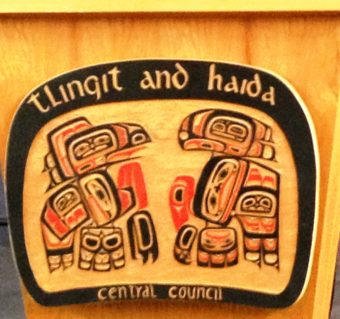
The Central Council of Tlingit and Haida Indian Tribes of Alaska will get about half the BIA settlement funds slated for Southeast tribal governments. (Photo by Ed Schoenfeld/CoastAlaska News)
(Photo by Ed Schoenfeld/CoastAlaska News)

The Central Council of Tlingit and Haida Indian Tribes of Alaska held its 82nd annual meeting last month in Juneau. At the welcoming banquet, Haida master weaver Delores Churchill of Ketchikan received the Lifetime Achievement Award from council president Richard Peterson.

Ninety-nine delegates from throughout Southeast, Anchorage and the Pacific Northwest attended the three-day event.

Before the award was presented to Churchill, Dana Ruaro gave an introduction.

“Ná anii has such an incredible background, but the most amazing about her is her personality, and how loving she is, how funny she is, the situations she puts herself in.”

Ruaro says Churchill is not only a master weaver, but also a master diver. She shared stories of Churchill diving for abalone. Ruaro says Churchill is also an avid hiker, and once was a taxi driver.

“She was telling me this story one time about how this gentleman, a nice looking man, wanted to ride up to Ward Lake. He wanted her to take all these back trails and she refused. She said, ‘I’m not going up there. If I get up there, I’m not going to be able to get back down, so you get out right here, right now!’  She said later on she saw him in the newspaper and he was a serial killer. And I’m not kidding. She really has had an incredible life, given to her by her stubbornness and bluntness.”

Ruaro spoke about the many honors Churchill has received, including an Alaska State Council on the Arts fellowship, and a National Endowment for the Arts National Heritage Fellowship Award for Haida basketry. Ruaro says Churchill studied at the British Museum and relearned the six-strand weave, which she brought back to Alaska.

She says basketry was taught differently in the past, and Churchill’s mother took steps to ensure Delores’ weaving was done properly.

“She spent five years (weaving) until she was actually able to keep one of the baskets that she wove. Because if they weren’t good enough, she would make them throw them in the fire and she’d have to start all over again. And so it made her really learn the technique of weaving, which she shared with other people.”

Churchill was raised in the Haida village of Masset in the Queen Charlotte Islands. In addition to working to continue the tradition of Haida basketry, Churchill also has worked to preserve the language.

Churchill says she is honored to receive the award, but wished it had happened when her mother, Selina Peratrovich, and other master weavers and artists who passed on the tradition were still alive.

“I think of them every time I see hats. And the slippers I’m wearing are ones that Jennie Thlunaut made for me before she died.”

At the ceremony, Churchill wore the same dress she wore in 1978, when her mother won an Alaska Native Brotherhood / Alaska Native Sisterhood lifetime achievement award.

“I also wore her bracelets, because when she was being honored, she also wore her gold bracelet. I very seldom wear them because I’m not a gold bracelet kind of person. Holly (Dolores’ daughter) is. Holly loves her jewelry.”

Before presenting the award, President Richard Peterson read a proclamation.

“…and whereas Delores is a world-renowned Haida master weaver of baskets, hats, robes and other regalia…And whereas Delores has carried her mother’s legacy as a teacher, and has taught and demonstrated basket weaving in many Alaskan communities, nationally, and in countries such as West Germany, Great Britain, Holland, Switzerland, Finland, Sweden and Norway…And whereas Delores is one of the few remaining speakers of Xaad kíl…”

The proclamation also noted that Churchill was appointed to the Governor’s Alaska Language Preservation and Advisory Council, received an honorary doctorate from the University of Alaska Southeast, is a Rasmuson Foundation Distinguished Artist, and received many other honors. Peterson also declared April 19, 2017, as Delores Churchill Day.

Bettors wait for the Kuskokwim Ice Classic Tripod to stop the clock

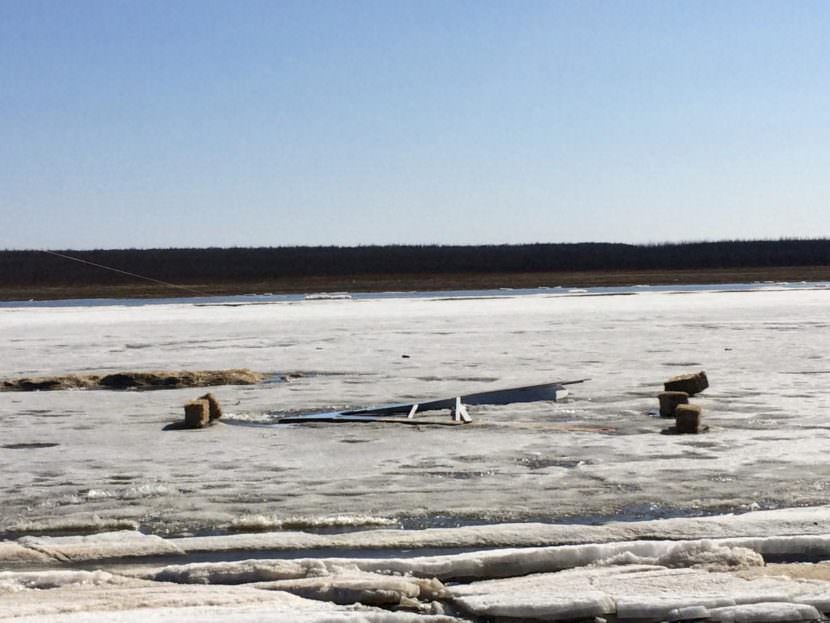
The Kuskokwim Ice Classic tripod fell at 4:40 p.m., Thursday, May 4, 2017. But the clock, counting down to break up and a $12,500 prize, continues to tick.
The Kuskokwim Ice Classic tripod fell at 4:40 p.m., Thursday, May 4, 2017. But the clock, counting down to break up and a $12,500 prize, continues to tick. (Photo by Anna Rose MacArthur/KYUK)

Ice Classic Manager Haley Hanson had just driven to the river when it happened.

“We were just down here, getting stuff ready in the shack, talking about the Breakup Bash, and waiting around, checking out the river, and it just fell over as we were watching it,” she said.

That was at 4:40 p.m. on Thursday. The ice around the tripod is severely rotten and dark. Open water lies a few yards away.

“We’re thinking that leg just punched right through the ice and is now underwater,” said Hanson.

That leg is painted blue and extends 28 feet. The wooden frame is now lying flat on the deteriorating ice. But the water will have to carry the tripod 100 yards downstream to trip the clock.

When it does, $12,500 awaits the lucky winner. Marsha Riley hopes it’s her. She drove to the river after her boss let her off work early to see the fallen frame.

“Ever since I was a little girl,” said Riley, “this has always been a great thing to come and watch and see all the people get excited, join together, talk stories.”

Riley has 15 tickets riding on the tripod, each one guessing a different time when the clock will stop.

If she wins, she says she’ll save for the honeymoon her and her husband of three years have yet to take. Hawaii and Ireland are on her list.

The Kuskokwim Ice Classic sold 7,381 guesses this year, raising more than $32,000. What doesn’t go to the winner goes to youth groups around the Delta who worked to sell tickets.

Local adult ed center outperforms national GED graduation rate

Joyanne Bloom teaches the What's Up? class at The Learning Connection on on Tuesday, April 25, 2017.
Joyanne Bloom teaches the What’s Up? class at The Learning Connection on on Tuesday, April 25, 2017. (Photo by Quinton Chandler/KTOO)

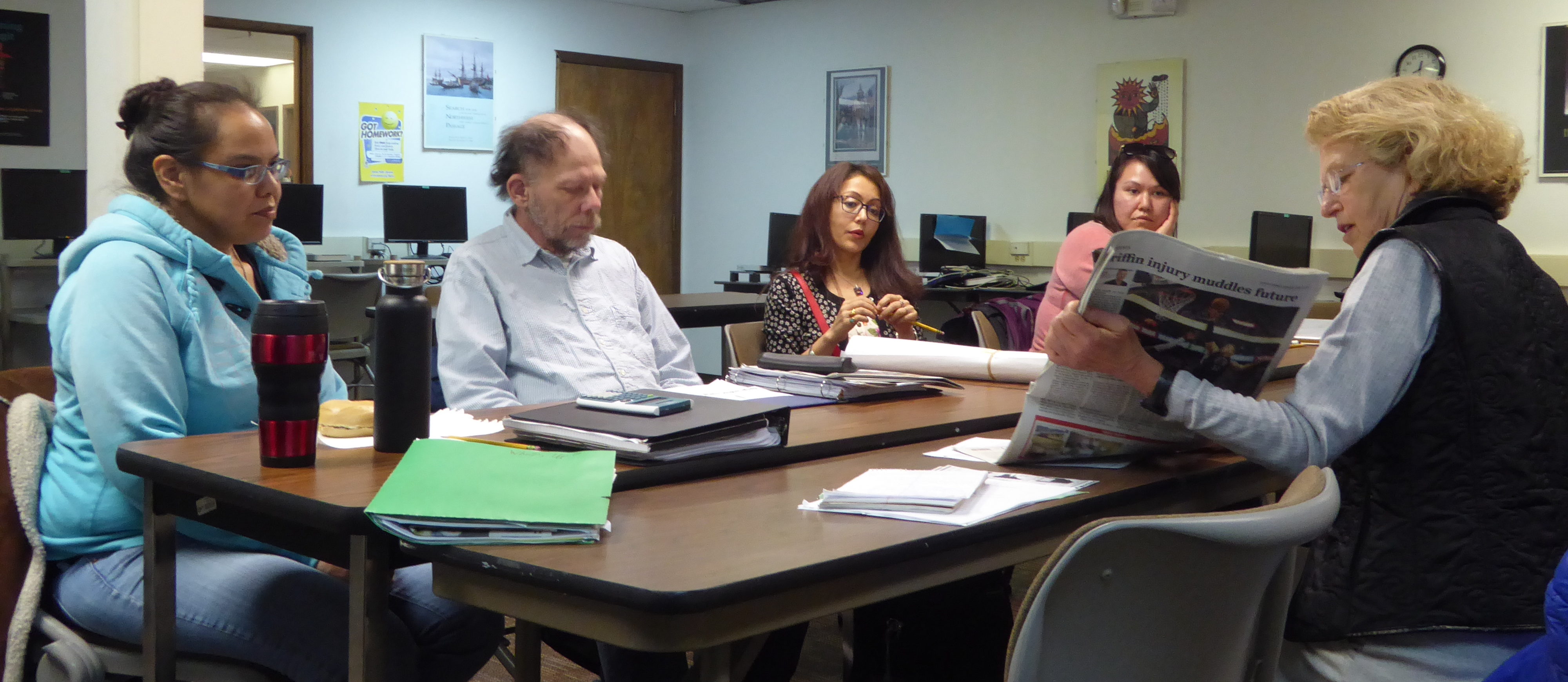
It’s time for What’s Up? a social studies class that focuses on current events. When teacher Joyanne Bloom asks what’s up around Juneau, Kristina Arnold brings up a playground that burned down.

“It was saying last night on the Empire page that it was over $250,000 worth of damage done,” Arnold said.

She is in this free class because she is studying for GED or General Education Development tests.

“I did independent science and language arts. I did those tests already and passed them. I just got two more tests to do and I’ll be done,” Arnold said.

The Learning Connection reports 86 percent of their students who complete all four of the GED tests pass. That’s a passage rate nine points higher than the national rate. The staff believes the higher rate is a result of their relationships with their students.

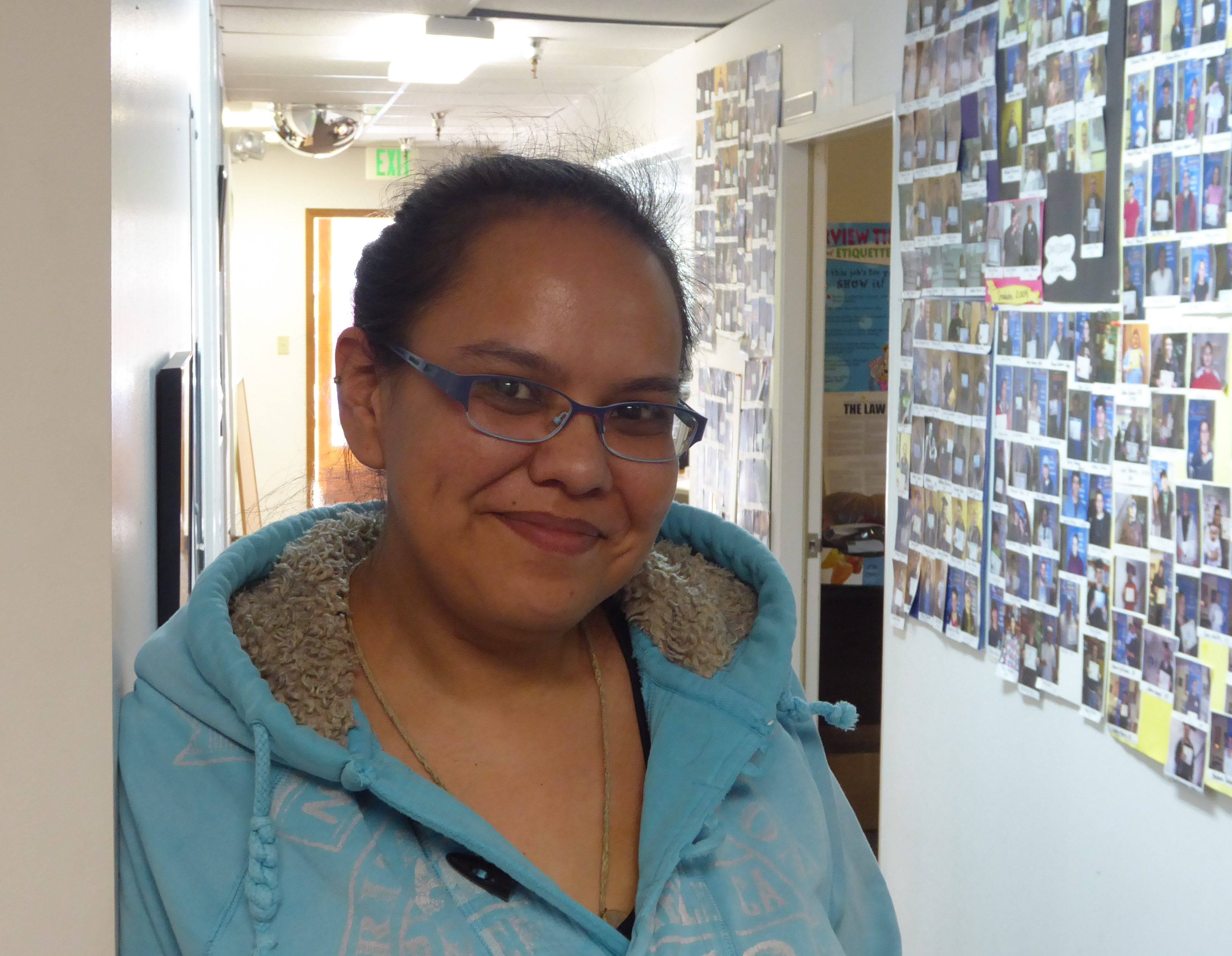
Kristina Arnold at The Learning Connection on Tuesday, April 25, 2017.
Kristina Arnold at The Learning Connection on Tuesday, April 25. (Photo by Quinton Chandler/KTOO)

Arnold is 34 and her goal is to go to college once she has her diploma. She says she was on her own working two jobs 15 years ago. She says she was in “survival mode” and in the second semester of her senior year, she decided to drop out of high school.

“And I’ve kicked my butt the whole entire time. Fifteen years without my high school diploma is 15 years too long in my eyes,” Arnold said.

Eventually, she got married and she has two boys and two

girls. She says setting a good example for them is probably her biggest motivation to pass the GED tests.

The four GED tests cover language arts, science, social studies and math.

Jeff Smith, a teacher at the Learning Connection, believes a combination of things contributes to the higher rate.

He is walking his students through some algebra today. They’re simplifying and solving polynomial equations.

Smith, who is in a Juneau classroom with five other students including Arnold, is also working with students calling in from learning centers around the state.

Some students are just brushing up on their math skills. Most, like Arnold, are preparing for the math test.

I didn’t realize I knew Smith personally until I started this story but we both agreed it wouldn’t be a problem.

“No, I think we can … we can turn on the professionalism,” he laughed.

Smith predicts there will be about 30 Learning Connection graduates by this summer.

He says as soon as a student walks through the door, the staff assesses their strengths. From then on, he says they offer a lot of one-on-one help and he says that one-on-one time contributes to the passage rate.

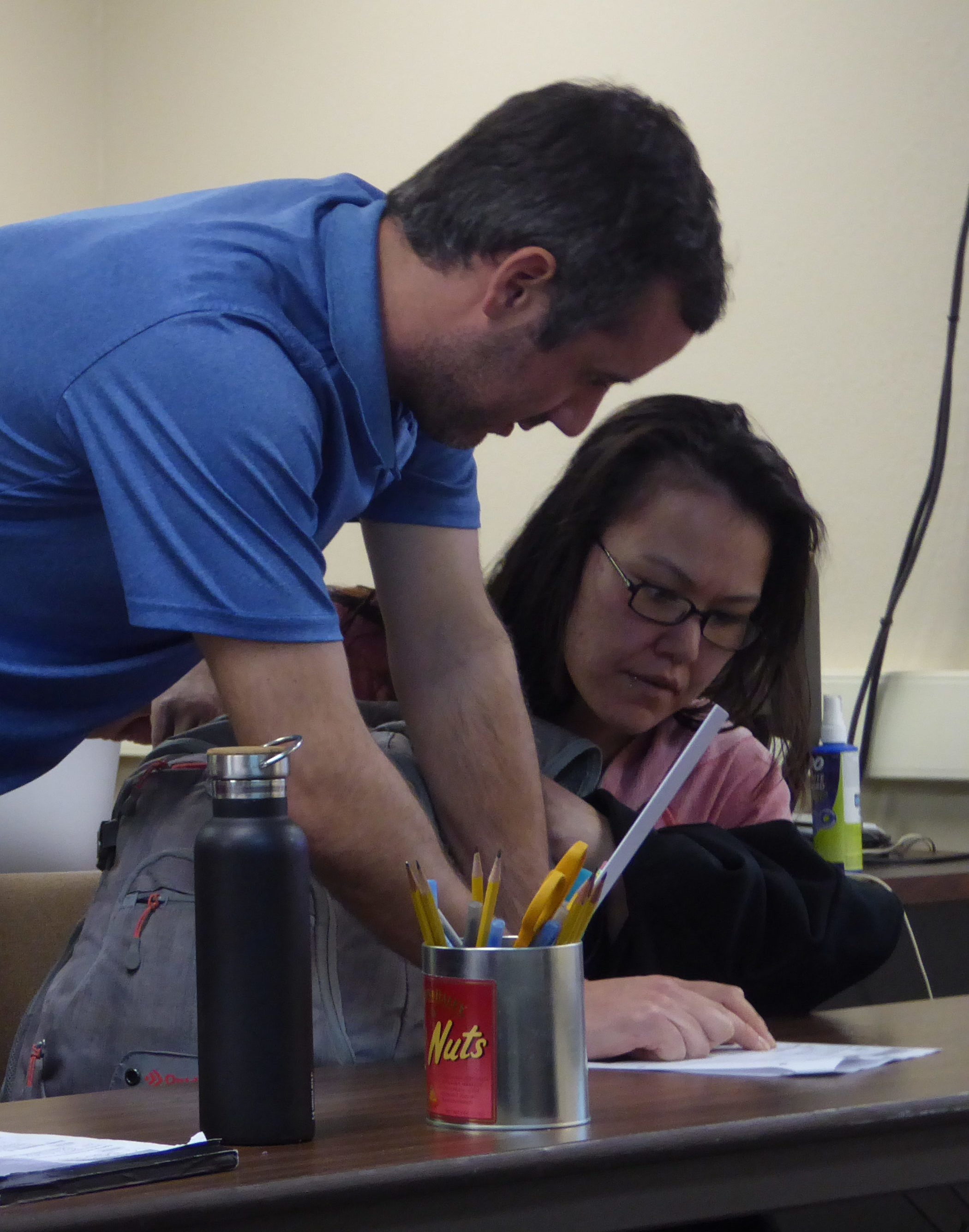
Jeff Smith, middle, helps a student during his math class on Tuesday, May 2, 2017.
Learning Connection teacher Jeff Smith helps a student during a math class on Tuesday. (Photo by Quinton Chandler/KTOO)

The next thing he points to is the activities built around learning subject material.

“When we come back tomorrow, we’re going to look at different application problems,” Smith said. “How does this relate to the workforce? What kind of job out there do you maybe have to use some of these things that we learned today right?”

He says they’ll solve problems with polynomial functions to design their own roller coasters.

The last piece of the equation that Smith says leads to the high passage rate is The Learning Connection’s culture. He says the students are extremely comfortable with their instructors and each other.

“There’s somebody at the center that’s relying on them, that wants them to be here, that’s going to be wondering where they are if they’re not here,” Smith said. “That sense of community that’s built here really keeps people coming back and working towards their goals because they’re not in it alone.”

He stresses that the center is not just for GED testing, they also have a jobs program for ages 16-24, a construction academy, a training program for seniors and there’s an English as a Second Language program. The programs are supported by grants from nonprofits and the state and federal governments.

At the end of the year, students from all these programs are welcomed to a “Celebration of Success.” If Arnold passes her last two tests this month, she will be joining as a graduate.

Juneau funnels March for Science energy into an Earth Day fair

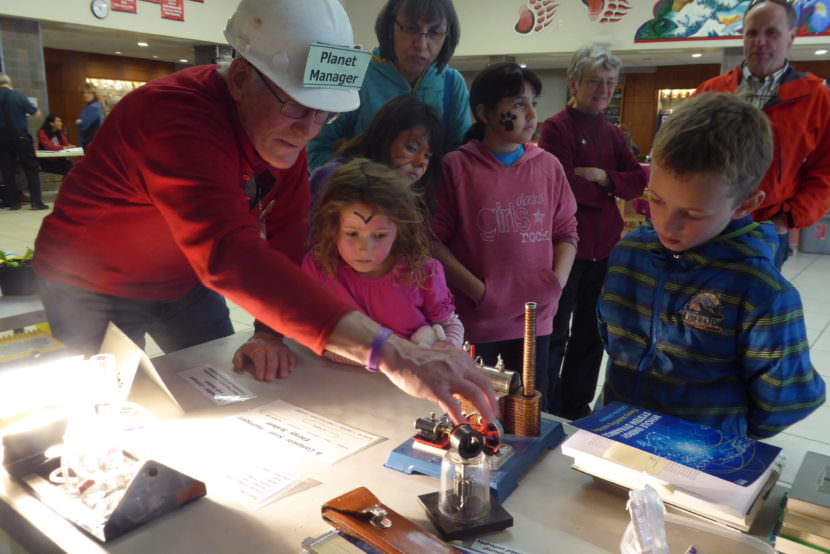
Bill Leighty, the Planet Manager shows a group of kids his model steam engine at the Juneau Renewable Fair in the JDHS commons on Earth Day.
Bill Leighty, the Planet Manager, shows a group of kids his model steam engine at the Juneau Renewable Fair in the Juneau-Douglas High School commons on Earth Day. (Photo by Quinton Chandler/KTOO)

Inside the Juneau-Douglas High School commons, several face painted kids and a couple of adults are engrossed watching electrical engineer Bill Leighty explain the mysteries behind his model energy systems.

Right now, he’s showing off the steam engine.

“OK, flick that big wheel with your fingers,” Leighty directed a boy. “More, flick it harder, harder. Flick it the other direction. Ooh, almost had it go again.”

It takes the boy a few more tries.

“Ooh, try it again,” Leighty encouraged. “There it goes! It’s running!”

This Earth Day, Juneau residents wrapped up their first March for Science with a stop at a fair promoting renewable energy and environmental consciousness.

About 30 different organizations and individuals put the fair together, including environmentalists and wildlife advocates.

Bill Leighty is a director of the Leighty foundation, a local charitable organization.

He has been on a mission for 15 years exploring how to make the jump from fossil fuel to renewable energy without carbon dioxide emissions.

“That’s what I’m demonstrating with the little hydrogen demonstrator here,” he said. “That’s an electrochemical energy system.”

Next, he compared the electrochemical system with the heat engine.

“Heat engines like we have in our cars now and boilers are very inefficient compared to electrochemistry, so that’s why we have the hydrogen system, which is not hot at all,” Leighty said. “There’s no heat in there, except a little byproduct heat. Whenever you convert from one energy form to another, you lose a little energy in inefficiency and it appears as heat.”

Leighty said he wants the kids to think about complete energy systems and how they work, from the source all the way to “turning the wheels on their cars.”

Phillip Moser, left, and Bryn Fluharty are with Southeast Alaska Conservation Council.
Phillip Moser, left, and Bryn Fluharty are with Southeast Alaska Conservation Council. (Photo by Quinton Chandler/KTOO)

A few booths down from Leighty, The Juneau chapter of the Alaska Wildlife Alliance, is handing out flyers against predator control and supporting a buffer zone near Denali National Park and Preserve where wolves would be safe from trapping and hunting.

The Southeast Alaska Conservation Council is promoting their desire for a new baseline study on Hawk Inlet, an Admiralty Island watershed.

SEACC representatives say they want to know whether mining operations in the area are polluting the water and in turn hurting marine life and the people who eat it.

Other organizations at the Renewable Juneau fair include the Alaska Clean Harbors Project, the U.S. Forest Service, Juneau Compost and Juneau District Heating.

Thirty-one groups are sitting behind tables at the fair, according to Danielle Redmond, coordinator for Renewable Juneau.

“They represent all different kinds of things from local food to climate organizing to local schools and school groups, as well as advocacy organizations so it’s been a really good mix,” Redmond said.

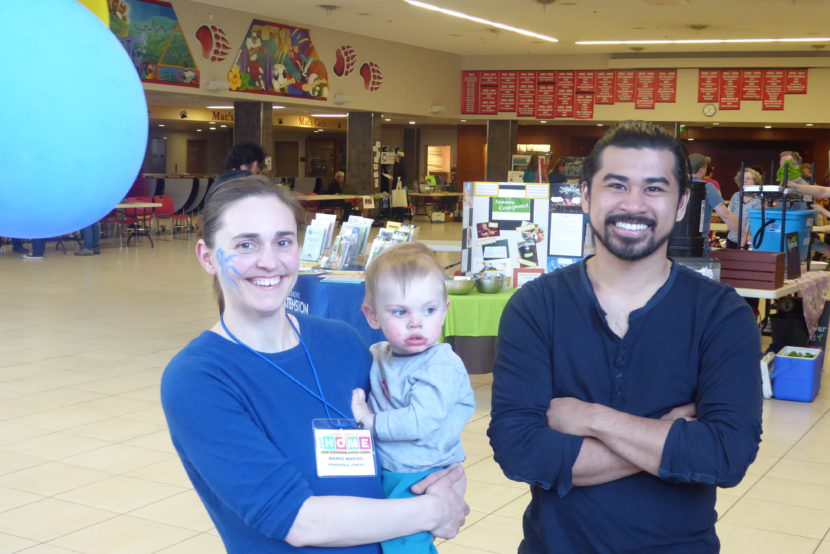
Danielle Redmond, left, is the coordinator for Renewable Juneau. David Abad, right, is one of the organization's volunteers.
Danielle Redmond, left, is the coordinator for Renewable Juneau. David Abad is one of the organization’s volunteers. (Photo by Quinton Chandler/KTOO)

Renewable Juneau is a nonprofit that, like their name suggests, promotes renewable energy and utility regulation in Alaska.

Redmond is sitting cross-legged and holding her baby boy.

She said this is the organization’s first fair and they’re holding it on the same day as Juneau’s March for Science.

“Oftentimes we have these marches, and we build up all this great energy, and we get excited, and we whoop and holler, and it’s important to show that energy and to show that publicly,” she said. “But, it’s just as important to keep that energy going and channel it into productive avenues of both policy and concrete solutions on the day to day level.”

Redmond has no idea how many people cycled through the fair, but she estimates they saw at least a couple of hundred, with a big boost in attendance coming from the protesters who finished their March for Science right outside the fair’s door.

Editor’s Note: Bill Leighty sits on the board of the Leighty Foundation which has helped pay for KTOO’s internship program.

Correction: An earlier version of a photo caption in this story misspelled Renewable Juneau volunteer David Abad’s name. 

Site notifications
Update notification options
Subscribe to notifications