Spirit

Chew on this for Earth Day: How our diets impact the planet

Earth from space
(Public Domain photo courtesy National Aeronautics and Space Administration)

The foods we choose to put on our plates — or toss away – could have more of an ecological impact than many of us realize.

On Earth Day, here are some ways to consider how our diet impacts the planet.

Waste not, want not

You’ve heard the numbers on food waste. More than 30 percent of available food is tossed each year in America. It’s enough to fill Chicago’s 1,450-foot-tall Willis Tower (formerly known as the Sears Tower) 44 times over.

The U.S. has set an official goal to reduce food waste by 50 percent by the year 2030. Universities have begun to chip away at the food waste issue by promoting ugly fruit and vegetables and shifting away from pre-cooked, buffet style food, instead serving more cook-to-order options that can cut down on waste. Food service companies are working with farmers and chefs to get more blemished but edible produce into cafeterias across the country. Even religious groups are getting into the act, raising attention to the problem of food waste among the faithful and connecting with restaurants, retailers and food banks to help redirect food to hungry mouths that might otherwise end up in landfills.

And there are a host of proposed solutions. Check out this report that highlights which solutions are likely to provide most bang for the buck. Among the most cost-effective strategies: educating consumers on food waste – including changes you can make in your own kitchen. (Here are some tips to get you started – like how to tell if eggs are still good past their expiration date.)

Rethink your beef and lamb habit

Everything we eat has an environmental footprint – it takes land, water and energy to grow crops and raise livestock. The folks at the World Resources Institute have calculated the greenhouse gas emissions associated with producing a gram of edible protein of various foods.

Not surprisingly, they found that foods such as beans, fish, nuts and egg have the lowest impact. Poultry, pork, milk and cheese have medium-sized impacts. By far, the biggest impacts, in terms of greenhouse gas emissions, were linked to beef, lamb and goat. (As we’ve reported, that’s partly because the need for pastureland drives deforestation in places like the Brazilian Amazon.)

Why? According to WRI, beef uses 28 times more land per calorie consumed — and two to four times more freshwater — than the average of other livestock categories. What’s more, cows are less efficient than other animals, like pigs and poultry, at converting feed into food.

Still, telling people to go cold turkey with their red meat isn’t likely to inspire real change. But this message might resonate: Even if you don’t give up on red meat consumption entirely, just cutting back can significantly impact your diet’s carbon footprint.

And these days, there are lots of vegan substitutes – like plant burgers that sizzle, smell and even bleed like the real thing — that can deliver the meaty taste you crave as you try to scale back.

Keep an eye out for more ‘plant-based’ dishes on restaurant menus

As interest in plant-centric diets booms, new food businesses have taken root – from the veggie-centric fast-casual chains Beefsteak (from celebrity chef Jose Andres) and Chloe (an all-vegan restaurant) to the vegan meal-kit company Purple Carrot.

Now, a new initiative from the World Resources Institute called the Better Buying Lab is bringing together big companies (including Panera Bread, Sodexo, Google, Unilever and Hilton) to develop and test strategies to nudge consumers towards choosing more sustainable foods. One initiative is to get more plant-based dishes onto menus.

“If you look at menus across the U.S., there tends to be [the same] 25 dishes that are on the majority of menus,” says Daniel Vennard, director of the Better Buying Lab at WRI. Think burgers, chicken dishes, etc. “Not many [plant-based] dishes have scaled to become national favorites,” Vennard says.

His group is working to change that. It’s teaming up with chefs from its member companies to create new recipes likely to have broad appeal. Promising ideas include the concept of “superfood salads” — containing combinations of nuts, seeds, greens, veggies and avocado.

He points to ideas already out there as well, such as burgers that blend meat and mushrooms. As we reported several years ago, some taste-testing has found that diners warmed up to the idea of blended burgers, and in fact many tasters preferred them to all-beef patties. And an ongoing competition from the James Beard Foundation has encouraged chefs around the country to give blended burgers a try on their menus. (Not everyone is a fan, though.)

“What we’re trying to do is shift consumers towards eating more sustainable food, but we’re not advocating for a no-meat diet,” explains Vennard. “We’re saying, ‘Let’s moderate.’ ”

Copyright 2017 NPR. To see more, visit http://www.npr.org/.

Saturday’s march aims to stand up for science

Updated at 1:25 p.m. ET

Enthusiasts say their March for Science on Saturday in communities around the world is intended to “support science for the public good.”

The main event is happening in Washington, D.C., but satellite marches are planned in all 50 states, and at least 610 marches have been registered on the March for Science website across the world on all continents except Antarctica.

While they may not have registered with the main march, a group from the Neumayer Station III in Antarctica gathered on Saturday to support the international efforts.

The idea for the demonstration started after the large Women’s March on Washington that took place in February, one day after President Trump’s inauguration. The Women’s March was, in large part, a response to Trump’s agenda and spurred by statements he made about women.

The March for Science organizers have said their own events are nonpartisan, and the overarching mission is to “[champion] robustly funded and publicly communicated science as a pillar of human freedom and prosperity.”

“I think the profession of science is under attack, and why is that happening? Because we’ve really ceded the floor,” says Lucky Tran, a scientist and organizer of the march. “We haven’t engaged in politics, we’ve left that open for politicians to come in and really hijack and obfuscate science for their own selfish needs.”

But despite these nonpartisan announcements, researchers and scientists in the U.S. have debated if they should participate, as NPR’s Nell Greenfieldboyce reports:

“Some researchers predict that this March for Science will release much needed energy and enthusiasm at a time when science is under threat; others worry it will damage science’s reputation as an unbiased seeker of truth.”

Even though the future of science under the Trump administration has been a concern for many, Tran, in at interview with host Mary Louise Kelly on Weekend Edition, says science has been under attack since long before Trump took office.

“Really, what’s happened is scientists are scared to engage with politics,” Tran says. “They’re worried about looking biased, they’re worried about their funding, but really that’s been a terrible strategy. It’s meant that bad science policy decisions have been made.

“If you look at climate change or public health, they’re under attack from certain groups because they involve regulation or some businesses have an interest in them or there’s some political interest to be gained from them,” he says.

In Washington, along with the demonstrations, those participating can go to “teach-ins.” These events are meant to engage the public on science topics like “sustainable food solutions” and “the physics of superheroes.”

The organizers don’t expect the event to end on Saturday. They’ve planned a week of action for April 23 through 29, and Tran said the group will roll out a policy platform after the march.

Copyright 2017 NPR. To see more, visit http://www.npr.org/.

Boston’s gay veterans will march in St. Patrick’s Day parade

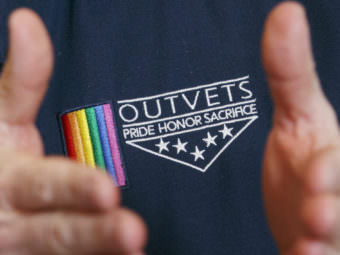
OutVets founder Bryan Bishop wears the logo of his group while speaking in Boston. The group has been invited to participate in the city's privately-run St. Patrick's Day parade. Michael Dwyer/AP
OutVets founder Bryan Bishop wears the logo of his group while speaking in Boston. The group has been invited to participate in the city’s privately-run St. Patrick’s Day parade.
Michael Dwyer/AP

Updated: March 11, 2:46 p.m. ET

According to member station WBUR, the OutVet group has accepted the invitation to march in the parade.

The organizers of the privately run St. Patrick’s Day parade in Boston have reversed course and will invite a group of LGBTQ veterans to participate in this year’s event.

The announcement came in a terse Twitter message. The South Boston Allied War Veterans Council said it had signed an “acceptance letter” to allow OutVets to join the march.

Member station WBUR reports a lawyer for the group announced Friday night that the members had accepted the invitation after reviewing it.

“We are honored and humbled by all the outpouring of support that has been displayed for our LGBTQ veterans — who are one of the most unrepresented demographics in our veterans community,” lawyer Dee Dee Edmondson said in a statement.

As the Two-Way reported, the parade organizers had come under heavy criticism for barring the LGBTQ group this year after the gay veterans had marched in the event the past two years. Organizers had objected to the group’s display of the rainbow flag, the traditional symbol of gay pride.

Many high-profile politicians, including Massachusetts Gov. Charlie Baker and Boston Mayor Marty Walsh, had withdrawn their support from the parade and said they would not march unless the gay vets were included, according to the Boston Globe.

OutVets is not the only veterans group at odds with the parade organizers. A group called Veterans for Peace has been barred from the event for several years.

Copyright 2017 NPR. To see more, visit http://www.npr.org/.

Mike Miller’s life, career centered on social justice, faith

Services are planned for this weekend for Mortimer Michael “Mike” Miller, the travel writer and former lawmaker who represented Juneau in the Legislature just as the new state of Alaska was getting on its feet.

Mike Miller in a 2012 photo.
Mike Miller in a 2012 photo. (Courtesy Miller family)

Mike Miller was the first publicity director for the State Division of Tourism, served on the Juneau Assembly, served a total of 16 years in the state House, and served 10 years on the Department of Corrections’ Parole Board.

Miller was 87 years old when he passed away Feb. 11 in Vancouver, Wash., from complications due to pneumonia.

A memorial service is planned for 1 p.m. Saturday, Feb. 25, at Northern Light United Church.

“He had a real good run,” said his son, Kevin Miller of Juneau.

After Mike Miller graduated with a degree in journalism from Wichita University, he briefly worked for Coleman Company, producing the camping supply manufacturer’s in-house publication.

From the KTOO-TV program “Conversations in 1986, Miller tells Laury Roberts Scandling how getting laid off from Coleman led to he and his wife, Marilyn, moving to Alaska.

“I wrote a letter to lots of people, but including Emory Tobin who was at that time the publisher of the Alaska Sportsman which is now, of course, Alaska magazine. Everything was done in Ketchikan at that time and I came up to be on the staff. It was exciting,” Miller said.

“What a stroke of luck,” Scandling said.

“Oh, terrific luck,” Miller continued. “Yeah. And it was 1954. It was before statehood. As I look back at it now, sort of a prosperous period in a sense, nothing boomish.”

Listen to the broadcast version of the story:


Miller started out in his career writing fiction and then later focused on travel articles.

According to a profile published in the Juneau Empire in 1986, Miller’s stories appeared in publications ranging from the New York Times and Chicago Tribune to Field and Stream magazine, Argosy magazine and Alfred Hitchcock’s Mystery Magazine.

Mike Miller takes a rest while hiking the Chilkoot Trail in this 1967 photo.
Mike Miller takes a rest while hiking the Chilkoot Trail in this 1967 photo. (Courtesy Miller family)

Son Kevin said his parents eventually moved to Juneau so his dad could take the state tourism job.

“I think he just kind of fell in love of the whole idea of promote Alaska, in particular, and travel around to all these exotic places and to write about them,” Kevin Miller said. “Just the niche that he fell into, I suppose.”

Miller continued to work as a freelance writer, even while serving as an Assembly member in Juneau and after being elected to the state House.

“He was just very civic minded and always had a sense of giving to the community and being involved in making the community what he felt was a better place and doing what he could to do that, as opposed to being a passive observer,” Kevin Miller said.

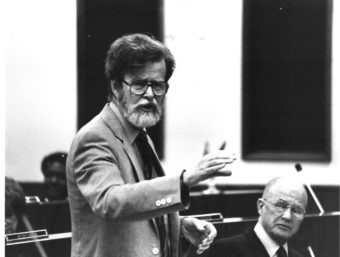
Rep. Mike Miller speaks on the floor of the Alaska House of Representatives in this undated photo.
Rep. Mike Miller speaks on the floor of the Alaska House of Representatives in this undated photo. (Courtesy Miller family)

Longtime friend John Pugh – now retired as University of Alaska Southeast Chancellor – said Miller was a diligent and detail-oriented lawmaker who worked behind the scenes in the Legislature rather than seeking the limelight.

Pugh also said Miller was a key player in the fight against the capital move.

“If he hadn’t been able to work across the aisles, it would’ve been very hard to work with people from rural Alaska as well as from Fairbanks, the Mat-Su, and even Anchorage,” Pugh said. “There were some people who opposed the capital move even in Anchorage.”

Miller twice served as Majority Leader and once as Judiciary Committee chairman while he was in the Legislature from 1971 to 1986. That was a period in which lawmakers were still crafting laws for a young state government that was barely a dozen years old.

Miller would joke with his family about writing the first seat belt law. He also helped with passage of the Public Employees Relations Act, the 1972 law that allows public employees to organize and bargain collectively for wages, hours and most benefits.

“He’d quickly became one of the experts on the Public Employees Relations Act and also just on how to move legislation,” Pugh said. “He was known for his understanding (of) the rules.”

Rep. Mike Miller (counter-clockwise from bottom left) poses with Rep. Jim Duncan, Sen. Bill Ray, Gov. Bill Sheffield and an unidentified man in this photo circa 1980s.
Rep. Mike Miller (counter-clockwise from bottom left) poses with Rep. Jim Duncan, Sen. Bill Ray, Gov. Bill Sheffield and an unidentified man in this photo circa 1980s. (Courtesy Miller family)

In 1981, Juneau’s delegation to the Legislature included Sen. Bill Ray, Rep. Miller, and Rep. Jim Duncan, who was also Speaker of the House.

The legislative session dragged on into early June over budget issues.

The Democrats’ slim majority in the House fell apart during the infamous coup in which Duncan was ousted as speaker and eventually replaced by Anchorage Republican Rep. Joe Hayes.

Dipping into the KTOO-TV archives again, here’s Miller on the House floor addressing the Speaker Pro Tem at the height of the turmoil.

“The people who were supposedly excused from the call of the House were not even notified that you were going to pull this kangaroo shenanigans,” Miller said. “So, this whole session here this afternoon is nothing but a sham and a delusion, and really a very dirty trick to pull on the people of Alaska in this strictly illegal session.”

Gov. Bill Sheffield and Rep. Mike Miller in a 1986 photo.
Gov. Bill Sheffield and Rep. Mike Miller in a 1986 photo. (Courtesy Miller family)

In the 1986 program “Conversations,” Miller noted one of his major accomplishments as a lawmaker included helping establish the Mendenhall Wetlands State Game Refuge.

“If you don’t have some kind of a plan, it just gets nibbled and nibbled and nibbled and all of a sudden somebody looks around one morning and there’s no wetlands left,” Miller said. “We set those wetlands aside and said this was going to be a game refuge. It’s a terrifically productive critter factory for feeding ducks and feeding fish and things like that. It’s fantastic. I just feel real good about that 10 square miles right flat smack in the middle of the borough being set aside and protected from exploitation.”

According to Pugh, Miller had a lot of help from his wife, Marilyn, an ardent conservationist.

Mike Miller stands next to Father Brown's Cross in this 2001 photo.
Mike Miller stands next to Father Brown’s Cross in this 2001 photo. (Courtesy Miller family)

Pugh said Miller’s faith was also important to him and formed the basis of his guiding principles of patience, integrity, kindness and compassion.

“Mike was also very centered as a Christian and had very strong beliefs in terms of social justice,” Pugh said. “In fact, on the service thing that’s coming out, there’s a quote from (Book of) Amos about how justice will roll down like water. That’s going to be on the front because he really believed in social justice.”

Mike and Marilyn Miller on bicycles in front of the Mendenhall Glacier in this 1975 photo.
Mike and Marilyn Miller on bicycles in front of the Mendenhall Glacier in this 1975 photo. (Courtesy Miller family)

Pugh said those beliefs and principles carried over into his work on the Parole Board.

Miller also led Bible study groups and conducted a ministry for inmates at Lemon Creek Correctional Center, and he served as a volunteer and was active in the early formation of the Glory Hole shelter and soup kitchen.

Juneau’s transitional youth home, the Miller House, is named for him.

Miller also was an avid runner and a passionate cyclist, and he was an early advocate for creation of bike trails around the state.

Kevin Miller said he has tons of pictures of his parents on bikes while traveling abroad.

“It didn’t matter where they were, there were on a bicycle in at least some of the pictures in India, in Hawaii, Badlands of North Dakota, or wherever,” said his son.

Mike Miller is survived by his wife, Marilyn, children Gail, Kevin, and Shelly, and five grandchildren.

(Editor’s note: Reporter Matt Miller is unrelated to Mike Miller and his family.)

At Florida rally, Trump restates campaign promises

President Donald Trump pumps his fist to supporters at the conclusion of a campaign rally Saturday in Melbourne, Fla.
President Donald Trump pumps his fist to supporters at the conclusion of a campaign rally Saturday in Melbourne, Fla. (Photo by Chris O’Meara/AP)

A month into his term, President Donald Trump hit the trail Saturday for what a White House spokeswoman called a “campaign rally for America.” At Orlando Melbourne International Airport in Florida, Trump addressed a hangar packed with supporters in an event organized not by the White House but by Trump’s own campaign committee.

“I’m here because I want to be among my friends and among the people,” Trump told the enthusiastic crowd before running through a long list of campaign promises and what he said were his administration’s early accomplishments.

“Jobs are already starting to pour back in,” Trump told the cheering crowd. On Obamacare, he promised a plan to repeal and replace it in “a few weeks.” Of the U.S.’ participation in the controversial Trans-Pacific Partnership, he said, “just terminated.”

Talk of Air Force One cost-saving? Check. Reviving the Keystone pipeline? Check. Criticizing violence in America’s inner cities? Check. Singling out Chicago for its rising murder rate, Trump declared that “safety is a civil right, and we will fight to make America totally safe again.”

On his executive order temporarily banning travel from seven majority-Muslim countries that was put on hold by the Ninth Circuit Court of Appeals, Trump promised “we never give up” and that “we will do something next week. I think you’ll be impressed.” In one of his biggest applause lines, the president talked of doing what it takes “to keep radical Islamic terrorists the hell out of our country.”

The Florida rally stood in stark contrast to the difficult week Trump had in Washington. On Monday, he fired his national security advisor, Michael Flynn, after reports that Flynn had discussed sanctions with Russia’s ambassador before Trump’s inauguration. On Wednesday, Trump’s choice to lead the Department of Labor, fast food executive Andrew Puzder, withdrew his name from consideration after it became clear he lacked the support to survive a Senate confirmation vote.

While the rally may have seemed like an attempt at a fresh start, “I wouldn’t call it a reset,” White House Chief of Staff Reince Priebus told The Washington Post on Saturday, “because we’re quite proud of a lot of the achievements over the past four weeks.”

So, not a reset — but a rousing stump speech meant to take his message directly to the people. Supporter James Evert, who turned out for the rally, also saw it as a chance for Trump’s supporters to give the President a boost.

“Living in Washington and dealing with all the bureaucracy and all the media and a lot of the bias,” Evert told NPR, “you know you probably get berated by all the negativity. And then you come to one of these things, and it’s probably a refreshing moment [for Trump]. He says, ‘Okay, these are the grassroots people. These are hardworking Americans, and they’re here to see me and root me on and encourage me and kind of revive my momentum.’ ”

A smaller group protesting Trump gathered across the road from the hangar, waving signs and chanting.

Trump began the rally by continuing his attacks on the media, telling the crowd he wanted to speak “without the filter of the fake news. The dishonest media which has published one false story after another, with no sources — even though they pretend they have them — they make them up in many cases. They just don’t want to report the truth.”

Trump has stepped up his criticism of the media in the past week. On Thursday, he repeatedly berated reporters and decried their coverage as “fake news” in a contentious, 77-minute news conference. He then tweeted Friday that “The FAKE NEWS media (failing @nytimes, @NBCNews, @ABC, @CBS, @CNN) is not my enemy, it is the enemy of the American People!”

Trump’s suspicion of and animosity toward the press clearly resonated with many in the crowd, including Jim Sava.

“The news media has this concept that they can take Donald Trump down,” Sava said. “There’s nothing they can do to take him down. There’s nothing. The only person that could take Donald Trump down is Donald Trump. If he does not do what he said he was gonna do, that would be what has to happen to lose support from the people. The people are fed up and we just want America to be great again.”

Copyright 2017 NPR. To see more, visit http://www.npr.org/.

Happiness is orange at Hoonah City Schools

Hoonah City Schools Superintendent PJ Ford Slack, right, sits in on the Orange Frog training, Tuesday, Jan. 10, 2017.
Hoonah City Schools Superintendent PJ Ford Slack, right, sits in on the Orange Frog training, Tuesday, Jan. 10, 2017. (Photo by Quinton Chandler/KTOO)

This story starts with Superintendent of Hoonah City Schools, PJ Ford Slack. Hoonah is a small village on Chichagof Island in Southeast Alaska.

Slack came here as an “emergency replacement” for the district’s last superintendent and when she got to work, she noticed something.

“The adults were really not happy. That didn’t mean they actively knew that, but they seemed to be down,” Slack said.

Hoonah’s community does feel a lot of stress.

The isolated town’s commercial fishing and processing industries dried up years ago, the school district is under heavy financial strain and drug and alcohol dependence are growing concerns.

Slack believes a teacher’s attitude has a powerful impact on the kids they teach. So she started researching something called the Happiness Advantage.

It’s an idea based on research that points to a link between a positive mindset and success.

“It seems to make sense that would make a difference if the kids and the adults all learned a little bit about this and learned happiness is a choice,” Slack said.

The district used about $20,000 in grant funding to pay for a training based on the work of author and motivational speaker, Shawn Achor.

It’s called the Orange Frog Project. The project was supposed to teach Hoonah’s high school and middle school students how to choose happiness every day.

The adults went through it months ago and Slack says it has already changed some their lives.

Devin Hughes at the front of the class during the Orange Frog training.
Devin Hughes at the front of the class during the Orange Frog training. (Photo by Quinton Chandler/KTOO)

“Whoo! You’re awesome, bam let (them) know, let’s go,” yelled Devin Hughes, chief inspiration officer for the International Thought Leader Network.

Hughes ordered a round of high fives as he explained that he would teach the room full of high school kids to be outwardly positive even if it means being the weird one.

He said, “my whole mission, my tenet, is to go around and inspire, motivate others to achieve happiness and joy and optimism. It’s pretty cool.”

Hughes used a comic book to jumpstart the training. It’s a story about a bunch of sad green frogs and a happy frog, who slowly turns orange.

A high school student sketches a form line frog based on the main character from the Orange Frog comic book.
A high school student sketches a formline frog based on the main character from the Orange Frog comic book. (Photo by Quinton Chandler/KTOO)

The more the orange frog does to make himself happy, the better he gets at catching flies, and the more orange he turns. Eventually, the other frogs copy him: they get happier, they catch more flies and they start turning orange too.

Hughes said his company travels to corporations around the world and to schools teaching people to be orange.

“So right now, I think schools are probably the fastest growing segment within our business,” Hughes said. “Because if you can get a kid, whether it’s a kid that’s 6 or 16, and start to rewire their brain and doing these things more often and feeling pretty good, behavior issues go down, test scores go up.”

But let’s walk this back. Hughes said he’s being paid to teach people to be happy. Doesn’t anybody question that?

“Oh, all the time. I mean people are like, ‘Really, really,’” Hughes said.

“Because, if you think about it when I ask you the question, ‘Did you have anyone in your life when you were a youngster teach you, give you the secret sauce to happiness, tell you something prescriptive, something actionable that you need to do to work on this, your mojo and your mindset? Universally nobody raises their hand.’”

He said after the initial skepticism, people usually jump in, because, “who doesn’t want to be happy?”

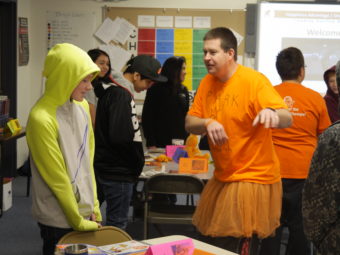
The high schoolers seemed to embrace Hughes’ message. All around the room kids wore bright synthetic orange wigs, frilly orange necklaces; they had streaks of orange marker on their faces — any kind of orange prop or clothing they found, they wore it.

Hughes told the kids to keep it positive. Throughout the day, he had them share the best things happening in their lives with other people.

“First rule (of) Orange Frog, if something good happens you have to talk about it,” he said.

He asked them to run the halls delivering what he called “joy bombs” to people all over the building so the kids gave people unexpected high fives and hugs and told them that they were awesome.

Jerry White III answers a question during the Orange Frog training.
Jerry White III answers a question during the Orange Frog training. (Photo by Quinton Chandler/KTOO)

Hughes told them to think about how to stop their problems from keeping them down.

He told them to think about changing behaviors that affect everyone, things like bullying or ignoring kids they usually don’t hang out with.

At the end, Hughes asked the kids to spend time thinking about how they can remember to keep doing this after he leaves.

Some of the kids said Orange Frog definitely changed their school’s atmosphere, but will it last?

Senior Kelsey Thein isn’t sure.

“I think that only time will tell with that one. I can see that a lot more people are upbeat than normal and if it stays, it stays,” Thein said.

Other kids said optimistically that they can easily turn their school orange in the long term.

Superintendent Slack hopes so too.

“I’m hoping that this will help them as they go through their life know that they can make some choices and that those choices are tough sometimes,” Slack said.

“Life is tough. But, there are ways that we can turn the frown the other way around and make it a smile.”

She doesn’t see this as some kind of silver bullet. She hopes learning about Orange Frog will help them develop better coping skills to handle whatever life throws their way.

Site notifications
Update notification options
Subscribe to notifications