Spirit

Athletes to Adults: MEHS wrestlers learn about healthy relationships

The Mt. Edgecumbe High School wrestling team. Emory Johnson helps hold up the poster. (Emily Russell/KCAW)

This fall, student wrestlers at Mt. Edgecumbe took part in a program called, ‘Coaching Boys into Men.’ The idea is to teach young players how to have healthy relationships even if, in the case of Mt. Edgecumbe, half of them will grow up to be women.

The entire student body of Mt. Edgecumbe, more 400 students from over 100 villages across Alaska, is packed into the school’s gym for a pep rally– a rally that’s about more than just the regional wrestling tourney.

Two student wrestlers sign the poster after completing the ‘Coaching Boys into Men’ program. (Emily Russell/KCAW)

The Mt. Edgecumbe wrestling team is being recognized for completing the ‘Coaching Boys into Men’ program, an effort to promote healthy relationships and reduce abuse and sexual assault.

Emory Johnson, a four-year senior from Bethel is one of the wrestlers.

That’s right, Johnson is a girl. Despite competing in a sport historically geared towards boys, Johnson isn’t shy about her strength.

“My mom never really wanted me to join because she doesn’t like the way the guys beat on the girls. I’m like, ‘Well, it can go both ways,’” Johnson joked.

Johnson is one of more than 20 girls on the team of over 40 wrestlers. Girls have wrestled here for over a decade thanks to their coach, Mike Kimber.

“I’m at teacher at Mt. Edgecumbe,” explained Kimber. “I teach Japanese, English, and a few other classes and I’m the wrestling coach. I’ve been the wrestling coach here for 17 years at Mt. Edgecumbe.”

Mike Kimber has been coaching wrestling at Mt. Edgecumbe High School for 17 years. (Emily Russell/KCAW)

Kimber himself is a graduate of Mt. Edgecumbe. When he was a wrestler, he said his coach worked with the athletes both on and off the mat. It’s that mission, to develop not just a good athlete but a good person, that inspired Kimber to join the ‘Coaching Boys into Men’ program.

Whether you’re a girl or a boy, everybody needs this information,” urged Julia Smith, the prevention director for Sitkans Against Family Violence.

Smith introduced the program to teachers and coaches at Mt. Edgecumbe a year and a half ago.

“And a lot of them asked, ‘I don’t have all boys on my team, can I still use this?’ So, we called the national folks at Futures Without Violence and they said, ‘Yes, go ahead and use it,’” explained Smith.

The program spans an entire season, with one 15-minute lesson each week. The topics include communicating boundaries, digital disrespect, and the importance of consent. The lesson on consent was the only one Coach Kimber chose to teach separately.

“We kept the boys on the mat and the girls went to another room and did that [lesson],” Kimber said.

Mt. Edgecumbe’s wrestling team was the only one in Sitka to take part in the program this year, but Julia Smith said she’s trying to change that. It’s already caught on in other Southeast communities like Juneau.

 “The basketball team in Ketchikan has also used the program,” added Smith. “The basketball team in Kake has used the program, so we’re really trying to build momentum and get this going throughout our state and have all coaches use this as a tool for reiterating the things they’re already teaching.”

There are more than 40 students on the Mt. Edgecumbe wrestling team, half of whom are girls. (Emily Russell/KCAW)

That’s the beauty of the program. The messenger is one that’s usually trusted and the message is one that’s critical for adulthood. Wrestler Emory Johnson gets that.

“Yeah, it’s called “[Coaching] Boys into Men,’ but the questions are still the same. It’s just, ‘What does respect mean to you?’ I mean, respect means respect to everybody,” Johnson said.

And that’s a lesson that every Mt. Edgecumbe wrestler now knows well.

Mt. Edgecumbe will host the Region V wrestling tournament this weekend, with matches on both Friday and Saturday.

Army Corps Denies Easement For Dakota Access Pipeline

Protestors celebrate at Oceti Sakowin Camp earlier today. The Army Corps of Engineers notified the Standing Rock Sioux that the current route for the Dakota Access pipeline will be denied. Jim Watson/AFP/Getty Images
Protestors celebrate at Oceti Sakowin Camp earlier today. The Army Corps of Engineers notified the Standing Rock Sioux that the current route for the Dakota Access pipeline will be denied.
Jim Watson/AFP/Getty Images

The Army Corps of Engineers has decided to deny a permit for the construction of a key section of the Dakota Access Pipeline.

The decision essentially halts the construction on the 1,172-mile oil pipeline about half a mile south of the Standing Rock Sioux Reservation. The decision is also a victory for the thousands of demonstrators across the country who flocked to North Dakota in protest.

“Our prayers have been answered,” National Congress of American Indians President Brian Cladoosby said in a statement. “This isn’t over, but it is enormously good news. All tribal peoples have prayed from the beginning for a peaceful solution, and this puts us back on track.”

Jo-Ellen Darcy, the the Army’s assistant secretary for civil works, said after talking with tribal officials and hearing their concerns that the pipeline could affect the drinking water, it became “clear that there’s more work to do.”

“The best way to complete that work responsibly and expeditiously is to explore alternate routes for the pipeline crossing,” Darcy said in a statement.

A view of the Oceti Sakowin camp, north of the Cannonball River, where people have gathered to protest the Dakota Access oil pipeline. David Goldman/AP
A view of the Oceti Sakowin camp, north of the Cannonball River, where people have gathered to protest the Dakota Access oil pipeline.
David Goldman/AP

The Army Corps says it intends to issue an Environmental Impact Statement with “full public input and analysis.”

In a statement, Standing Rock Sioux Tribal Chairman Dave Archambault II said the tribe welcomed the decision, but he also sounded a note of caution saying he hoped the incoming Donald Trump administration would “respect this decision and understand the complex process that led us to this point.”

Archambault II went on:

“When it comes to infrastructure development in Indian Country and with respect to treaty lands, we must strive to work together to reach decisions that reflect the multifaceted considerations of tribes. Treaties are paramount law and must be respected, and we welcome dialogue on how to continue to honor that moving forward. We are not opposed to energy independence, economic development, or national security concerns but we must ensure that these decisions are made with the considerations of our Indigenous peoples.”

Copyright 2016 NPR. To see more, visit http://www.npr.org/.

Despite Evacuation Orders, Pipeline Protesters Hunker Down For Winter

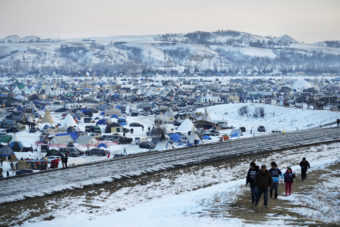
Though emergency evacuation orders have been issued by both the state of North Dakota and the Army Corps of Engineers, the three camps along the Cannonball River, now covered in snow, show no sign of packing up. Celia Talbot Tobin
Though emergency evacuation orders have been issued by both the state of North Dakota and the Army Corps of Engineers, the three camps along the Cannonball River, now covered in snow, show no sign of packing up.
Celia Talbot Tobin

Protesters have been camped for months at the construction site of the Dakota Access Pipeline in North Dakota. Now, winter has arrived, dumping almost 2 feet of snow on the encampment in the last week of November. The winter storm hit just before news that President-elect Donald Trump indicated he supports completion of the pipeline.

The two-day blizzard drove out some of the more fair-weather protesters, but most have been geared up to stay. All are waiting to see what happens on Dec. 5, the deadline set by the Army Corps of Engineers for protesters to leave federal land.

At the camp this week, protesters were busy preparing for more winter weather. Cusi Ballew wrapped insulation around a small wooden structure — more of a little box house — at the Oceti Sakowin Camp near the Standing Rock Reservation. “It’s essentially a glorified tent with a lot less chance caving in with snow,” explained Ballew.

Volunteers wrap insulation around a small box bunkhouse, one of many winterized structures popping up in the three camps along the Cannonball River. Celia Talbot Tobin for NPR
Volunteers wrap insulation around a small box bunkhouse, one of many winterized structures popping up in the three camps along the Cannonball River.
Celia Talbot Tobin for NPR

Ballew is from Ohio, a member of the Pokagon Band of Potawatomi Indians. He said people in the encampment needed this kind of structure. It wasn’t comfortable, he admitted, but said the protesters were not at the camp for comfort.

Ballew is one of several thousand people committed to this protest against the Dakota Access Pipeline. They’re living in three camps along the banks of the Cannonball River. The Oceti Sakowin Camp is the only one on federal land, where authorities say campers are illegally trespassing.

(Left) Flutter-By, a newer arrival, rests in the middle of his school bus, "Mamacita," which sleeps 12 people side-by-side. (Right) Brad Kallio of Michigan and Linus Yellowhorse of Arizona patch roofing on a dwelling at the Oceti Sakowin camp. (Bottom) Protestors from North Carolina brought a "yome," a combination yurt and dome, to erect and leave at the Rosebud camp for whoever needs it. Celia Talbot Tobin for NPR
(Left) Flutter-By, a newer arrival, rests in the middle of his school bus, “Mamacita,” which sleeps 12 people side-by-side. (Right) Brad Kallio of Michigan and Linus Yellowhorse of Arizona patch roofing on a dwelling at the Oceti Sakowin camp. (Bottom) Protestors from North Carolina brought a “yome,” a combination yurt and dome, to erect and leave at the Rosebud camp for whoever needs it.
Celia Talbot Tobin for NPR

The day after Thanksgiving, the U.S. Army Corps of Engineers issued an emergency evacuation order for land it manages near the river. A few days later, North Dakota Gov. Jack Dalrymple issued a similar order, warning that people trying to truck in supplies to the camp could be fined and the state will no longer provide emergency services.

“We will do our best to respond to emergencies,” said Dalyrmple in a press conference earlier in the week, “but in those conditions, we cannot guarantee a response.”

Early reports of the evacuation order described it as a blockade. Dalrymple said blocking food and water into the camps would be a “humanitarian mistake.” But he still believes people should leave for their own safety. He said this emergency order was the same he would issue during an intense flood.

A geodesic dome, which was donated in October, now serves as a community gathering space. It is one of many structures that have been erected in the camp to prepare for the long winter ahead. Celia Talbot Tobin for NPR
A geodesic dome, which was donated in October, now serves as a community gathering space. It is one of many structures that have been erected in the camp to prepare for the long winter ahead.
Celia Talbot Tobin for NPR

“We have not at any time ever contemplated going to the main camp and removing people from that area,” Dalrymple said, “All we’re saying is we encourage you to find a better place to be, and we will continue to do that. We want the entire public to know, this is a not a safe place.”

Some people did leave camp after the storm and governor’s order, but more were digging in for a long winter. Paul Cheokoten Wagner designed and is building a new style of teepee for people preparing to stay and continue protesting the pipeline despite the pair of evacuation orders.

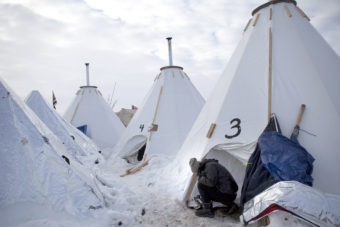
“They have been endeared with the name tarpee,” he said, “they’re kind of like unicorn teepees, because they only have a stovepipe sticking out the top.”

Jacob Brooks makes adjustments to one of the camp's many "tarpees," a winterized teepee made of tarp with a built-in chimney, designed by Paul Cheokoten Wagner. There are roughly 60 tarpees around various camps now, and Wagner has fundraised enough for another 20 more. Celia Talbot Tobin for NPR
Jacob Brooks makes adjustments to one of the camp’s many “tarpees,” a winterized teepee made of tarp with a built-in chimney, designed by Paul Cheokoten Wagner. There are roughly 60 tarpees around various camps now, and Wagner has fundraised enough for another 20 more.
Celia Talbot Tobin for NPR

Wagner is from the Saanich tribe and lives in Washington state. He says he came up with the design after his first trip to Standing Rock in September. He started a GoFundMe site and raised enough money to build 80. They come equipped with a stove, fire extinguisher and carbon monoxide detector.

Closer to the Missouri River, Kareen Lewis is living in Michigan Camp. She’s part of the Little River Band of Ottawa Indians and has been shuttling back and forth between the camp and her house in Michigan for a few months.

“I felt like I was so at home and empowered to be here,” she said.

Kareen Lewis, a member of the Little River Band of Ottawa tribe, has bounced back and forth for months between home, in Hart, Michigan, and the Oceti Sakowin camp. Celia Talbot Tobin for NPR
Kareen Lewis, a member of the Little River Band of Ottawa tribe, has bounced back and forth for months between home, in Hart, Michigan, and the Oceti Sakowin camp.
Celia Talbot Tobin for NPR

Michigan Camp is a cluster of three green canvas sleeping tents, a mess hall, a teepee filled with supplies and a few tents half-buried in snow. Currently, about 50 people live there. Lewis thinks they can make it without grocery runs for about a month. Even though she’s living in the evacuation area, she says she has no plans to leave.

“I don’t want to leave. I want to stay here and see what’s gonna happen,” she said.

Despite the orders to evacuate, more people are arriving every day, including a group of 2,000 veterans who say they plan to act as human shields between protesters and the police.

Protesters head back to camp after an evening ceremony honoring the of veterans making their way to join the ranks. While some have been trickling in throughout the week, up to 2,000 are said to be expected to arrive this weekend. Celia Talbot Tobin for NPR
Protesters head back to camp after an evening ceremony honoring the of veterans making their way to join the ranks. While some have been trickling in throughout the week, up to 2,000 are said to be expected to arrive this weekend.
Celia Talbot Tobin for NPR
Copyright 2016 Montana Public Radio. To see more, visit Montana Public Radio.

Latest effort to revise Kenai Peninsula Borough Assembly invocation policy stalls

Some children took part in the Aug. 23, 2016, protest with their parents. (Photo by Daysha Eaton/KBBI)
Some children took part in an Aug. 23, 2016, protest of the Kenai Peninsula Borough Assembly’s invocation policies with their parents. (Photo by Daysha Eaton/KBBI)

For the past four months, the Kenai Peninsula Borough Assembly has debated whether it should restrict who is allowed to give the invocation, or prayer, that begins each meeting.

The controversy began in early August, when a member of the Satanic Temple gave the invocation. In response, the borough assembly instituted a new policy in which only people or associations on a pre-approved list may give the invocation.

Critics say this restrictive policy may put the Borough at risk of a lawsuit, but efforts to amend it have stalled.

According to a memo released from Borough Mayor Mike Navarre’s office on Nov. 9, the assembly has received “numerous comments challenging the legality” of the invocation policy.

Borough Assembly President Kelly Cooper and assembly member Dale Bagley introduced a resolution on Nov. 22 that would have amended the current policy.

In a statement to the borough assembly, Cooper argued that they should not restrict who is allowed to give the invocation.

“In my opinion, the policy we now have has many problems. The very notion that any belief system would want to exclude another belief is beyond me. We represent every single person in this Borough,” said Cooper.

For nearly an hour, the assembly heard public testimony on the resolution.

Nancy Hendrickson of Kenai expressed frustration about the amount of time the assembly has spent debating the invocation issue.

“That you would even consider spending any more time or money on this issue troubles me. Each of you has a responsibility to uphold the Constitution. I’m charging you with that responsibility this night,” said Hendrickson.

Sterling resident Peggy Peterson asked the assembly to reconsider the idea of replacing the invocation with a moment of silence.

“Having a moment of silence does not prohibit free exercise of religion. Every person here would be free to pray as they saw fit. That would not only protect religious freedom, it would avoid alienating members of the community. An added bonus? It doesn’t violate the Constitution,” said Peterson.

Eric Glatt, staff attorney for the ACLU of Alaska reiterated that the borough should not control who is allowed to give the invocation.

“Tests that control which members of the public may offer invocations before assembly meetings violate core constitutional principles. The ACLU believes the best policy is the simplest policy. Return to the successful practice of allowing anyone in the borough to give an invocation on a first come, first served basis or do without invocations altogether,” said Glatt.

After some debate, the assembly approved an amended version of the resolution in a 5-4 vote, which would have eliminated the invocation policy altogether. Assembly members Blaine Gilman, Wayne Ogle, Dale Bagley and Stan Welles voted against the amended resolution.

But as the meeting came to a close, Gilman gave notice of reconsideration. This temporarily halts any action on the issue and returns the assembly to the current invocation policy.

Any assembly nember can give notice of reconsideration unless a resolution passes by supermajority.

The Kenai Peninsula Borough Assembly now has the option to reconsider the resolution at its next meeting Dec. 6.

Instead of handcuffs, Juneau police bring services to Bergmann Hotel

Brianna McCourt works the front desk at the Bergmann Hotel. Friday, Nov. 4. (Photo by Quinton Chandler/KTOO)
Brianna McCourt works the front desk at the Bergmann Hotel on Friday, Nov. 4. (Photo by Quinton Chandler/KTOO)

Brianna McCourt had a bad feeling when she walked outside the Bergmann Hotel and saw state troopers and police with their mobile command center at her doorstep.

“The mobile command center showed up and we’re like, ‘What’s really going on here,’” said McCourt, who works security at the Bergmann for a company called CPR Services that recently took over building management.

McCourt said when she got word the police were heading to the building, she thought the worst.

“It’s the Bergmann. I mean it’s been known for its riffraff and its drugs,” McCourt said.

Juneau police descended on the downtown housing development last Friday, but they didn’t come to make arrests. They wanted to help.

It’s not unusual for the police to be called to the hotel, but this time was different.

McCourt said the police weren’t alone.

“They came with the Department of Health and Social Services,” she said. “I believe that they had Front Street Clinic, and drug and alcohol treatment (officials to) speak with the residents that lived here.”

Residents got information on programs that could help them find work and opportunities to get counseling for substance abuse and mental health.

Service providers passed out sharps containers for safe disposal of used needles, and they gave her McCourts of Narcan – a medication that reverses the effects of an opioid overdose.

“Having sharp boxes in the bathroom and knowing that we have stuff to help people if we do run into an overdose is very helpful,” she said.

Boxes of Narcan given to employees of the Bergmann Hotel during a Juneau Police Department outreach effort.
Boxes of Narcan given to employees of the Bergmann Hotel during a Juneau Police Department outreach effort on Friday, Nov. 4. (Photo by Quinton Chandler/KTOO)

Lt. Kris Sell with Juneau Police Department said their outreach to the hotel was part of a strategy to, once a month, give special attention to issues they’re especially worried about in Juneau.

“Part of the chief’s instruction for me is once a month he wants to know, ‘OK, what can we go do that’s a focused approach to some area or some problem?’” Sell explained.

The department has gotten a lot of complaints from people in the Bergmann’s neighborhood, Sell said.

“People that lived up there and people that worked up there were unhappy with noise and finding needles in the area,” Sell said.

She said not all of these problems were tied directly to the hotel, but it was the place people most often associated their complaints with.

Lt. Kris Sell, Juneau Police Department
Lt. Kris Sell of the Juneau Police Department speaks on A Juneau Afternoon, April 1, 2016. (Photo by Jeremy Hsieh/KTOO)

So Sell said JPD had a choice. They could have focused on one option: finding lawbreakers and arresting them, but they didn’t want to.

“Really, modern policing is also about, ‘How do you apply positive pressure so that you can work with the people that are having challenges and get them on a more law-abiding path so they can get along with their neighbors?’” Sell explained.

She said most of the residents were suspicious at first.

When they offered one guy help, he hesitated but eventually said he wanted a job.

“He probably asked two or three times before we introduced him with the gentleman from the job service if we were tricking him or if this was some sort of trap,” Sell said.

Some people turned them down flat, but most were receptive after they got over their surprise.

Brianna McCourt said it goes a long way when people from the community show up and say, “We want to help you.”

“I do sympathize with what the police and the community did today, with the outreach program,” she said. “It kind of shows people that there is help out there if you ask for it. A lot of problems a lot of times with being a recovering addict is you’re afraid to ask for that help.”

McCourt knows what she’s talking about.

She is in recovery right now for the second time.

She was sober for eight years before she relapsed. She said her drug of choice was methamphetamine.

She didn’t decide to get clean until she had a near fatal car accident this summer.

“I didn’t want to ask for help. I didn’t want to admit that it was indeed a problem,” McCourt said.

She admitted that it can be hard to help other people, especially addicts because they need to want to help themselves first.

But she said people shouldn’t turn anyone away if they do make the decision to help themselves.

6.6-Magnitude Earthquake Flattens Much Of Historic Basilica In Central Italy

An earthquake has virtually destroyed the basilica of San Benedict in Piaza San Benedetto in Norcia, Italy. Julian Elliott Photography/Getty Images
An earthquake has virtually destroyed the basilica of San Benedict in Piaza San Benedetto in Norcia, Italy.
Julian Elliott Photography/Getty Images

A strong earthquake in Italy’s Umbria region destroyed a centuries-old basilica that was built at the birthplace of Saint Benedict and his twin sister Saint Scholastica early Sunday. No deaths were reported from the quake, which followed a series of smaller temblors.

Images from the scene show firefighters coming to the aid of nuns as they fled one of the buildings in Norcia, which is also commonly called Nursia. One reason for the lack of casualties: many buildings had been declared unsafe after a large quake in August.

“The monks are all safe, but our hearts go immediately to those affected, and the priests of the monastery are searching for any who may need the Last Rites,” reads an announcement from the Benedictine monks of Norcia, who had been working to raise money to repair their historic basilica.

Today, the monks said, “The basilica is destroyed.”

NPR’s Sylvia Poggioli reports for our Newscast unit:

“The quake brought down buildings already damaged by a big tremor in August and two months of aftershocks. Sunday’s earthquake was more powerful than the one that struck Aug. 24 that killed almost 300 people.

“There was extensive damage to buildings but no reports of injuries. Many towns had been evacuated in August, and few people remained. The epicenter was near Norcia in the Umbria region, but tremors were felt as far north as Bolzano in the north near the Austrian border and in the southern Puglia region.

“In the walled town of Norcia, the 14th-century basilica of St. Benedict was devastated, with only the façade still standing. In Rome, the earth shook strongly and at length. Transport authorities shut down the metro to check for damage.

“Italy lies on two fault lines, making it one of Europe’s most seismically active countries.”

Framed by the Sibylline Mountains, the town of Norcia sits in a scenic valley plain that’s named for Scholastica, Benedict’s sister. The quake has ruined months of work to make the basilica safe to use again after August’s earthquake.

In recent months, the monks had been using a fund-raising campaign and revenue from their brewery — which produces Birra Nursia — to help pay for the rebuilding effort. That effort was expected to cost $7.5 million — a figure that will surely be dwarfed by the damages incurred today.

Sunday’s quake is the most powerful of a cluster of temblors to hit central Italy. In the past week, eight quakes, all with magnitudes of more than 4, struck the region, including two that hit Wednesday: one with a magnitude of 5.5, and one with a magnitude of 6.1.

Copyright 2016 NPR. To see more, visit http://www.npr.org/.
Site notifications
Update notification options
Subscribe to notifications