Spirit

Presbyterian Church formally apologizes to North Slope Natives for denouncing culture

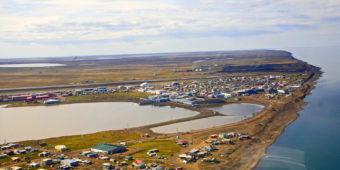
Utqiagvik, the city formally know as Barrow, in 2014. ( Creative Commons photo)

The head of the Presbyterian Church offered
an apology Wednesday to the Alaska Native people of the North Slope at in Utqiagvik.

The idea is to start a process of healing by acknowledging that the Church, however well intended, was wrong, when it denounced the cultures of Native people, both in Alaska and across the nation.

The Rev. Joe Reid is the pastor for the Utqiagvik Presbyterian Church, the oldest on the North Slope and shares the name of the community formerly known as Barrow. Reid said a vote by national church leaders in June was unanimous that an apology was needed.

“I suggested that we ought to invite the stated clerk so that we could be the first to have them come up and do this apology to Alaska Natives,” Reid said.

The stated clerk is the top administrator and spokesperson for the Church.

The Rev. Curt Karns is the executive for the Presbytery of the Yukon, a region that stretches from Anchorage to the north.

Karns gave an apology at Alaska Federation of Natives annual convention last fall. He says the wrong started with a 16th century action called the Doctrine of Discovery, a Manifest Destiny-type document that gave churches the rights to take land from non-Christian people and sell it to other Christians.

Along with land exploitation, came the exploitation of the original people who lived there. He said when the churches came to Alaska, they tried to figure out how to minister in an area so big. Enter Sheldon Jackson, the Presbyterian director for missions in the west.

“He organized a conference of protestant leaders from across the country and they really did, they just divided it up and said Lutherans will go there and Methodists will go here and Covenant Church over there and they just divided it up,” Karns said.

Karns said they wanted to do good things, but they came with the assumption that being Christian meant becoming more European. That superiority attitude is at the heart of the apology, he said.

“That’s the kind of thing that leads to racist attitudes, it leads to cultural paternalism, that’s the kind of thing that we’re apologizing for and there were specific things that happened in terms of teaching people that their language was, they need to learn English, you can’t speak your language, there was one missionary that went so far to say the language was so heathen you couldn’t put Christian thought into it. That kind of thinking is so un-Christian that we have to apologize for it. We still deal with racism, with cultural paternalism, we’re not done with that today.”

During the Presbyterians meeting in June, another historic event took place, in addition to the vote to apology and denounce the concept of the Doctrine of Discovery, the church made the first African-American reverend, the new Stated Clerk Jay Herbert Nelson II was in Utqiagvik to make the apology.

“We are apologizing for what we have done, even with some of the good intentions that those who started schools in Alaska had, we were wrong,” Nelson said. “I think that frees us to some degree but it also frees those who have carried the burdens and who have seen many current day problems particularly with families resulting in some tragic responses to life in this present day.”

Lucy Apatiki is from Gambell on St Lawrence Island, she is a former lay pastor and chokes back tears as she talks about the church doctrine that ripped her community apart.

“We came against resistance from our own people within the church and because of that, we researched why that was. The first Christians in our community were told that our drumming and dancing were evil. It was like they were indoctrinated to believe that the drum and dancing were evil.”

Apatiki said the apology is a huge step toward healing and coming together to respect the integrity of Native cultures within the church.

Pete Kaiser wins third consecutive Kuskokwim 300

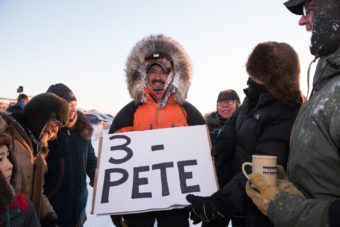
Pete Kaiser won his third consecutive Kuskokwim 300 Sunday morning.
Pete Kaiser won his third consecutive Kuskokwim 300 Sunday morning. (Photo by Katie Basile/KYUK)

His was the team to beat and no one could. Sunday morning for the third year in a row, Pete Kaiser won the 2017 Kuskokwim 300 Sled Dog Race, crossing the finish line in Bethel at 10:37 a.m. to loud cheers from his hometown crowd…  His leader Palmer brought home the nine-dog team, 28 minutes faster than last year.

Sass, last year’s runner up, followed 46 minutes later at 11:23 a.m.

Kaiser left the final upriver checkpoint of Tuluksak with a 20-minute edge over Sass, pulling the snow hook from the river ice at 5:22 a.m. Sunday morning for the final run to Bethel. At the finish line Sunday morning, Kaiser said the dog team signaled early in the run that they could make it home for the prize.

“When we left Tuluksak, they looked really good. We were on step within a few miles, and I could feel the power in the handlebar,” said Kasier.  “I knew at that point that if we could keep that going, he’d [Sass] have a hard time time catching us. As far as knowing that you’re going to win, not until you get here. But he’s a heck of a competitor; I knew he’d be coming after us.”

A 29-year-old member of the next generation of mushers, Kaiser had eight K300 finishes to his name coming into the race and an experienced core team who has raced the past three years. He also brought several “up and coming” two-year-olds into his race team. Kaiser wins the $25,000 top prize from the $150,000 purse.

In a frigid race with temperatures reaching minus 40, Kaiser had to contend with a set of challenges from the cold.

“You put a couple extra layers on — the dogs gets coats. A little extra care makes every task a little more difficult. It was nice to have a cold race with snow. It actually feels like winter here,” said Kaiser.

Brent Sass placed second for the second year in a row in the Kuskokwim 300.
Brent Sass placed second for the second year in a row in the Kuskokwim 300. (Photo by Katie Basile/KYUK)

Thirty-six-year-old Sass, a seasoned Yukon Quest musher based in the interior community of Eureka, was never far behind from Kalskag onward.

Kaiser banked the six hours of rest he was allowed on the 300-mile trail earlier than his closest competitor did. He took four hours in Kalskag on the outbound trail and an hour each in Aniak and on the way back through Kalskag.

Sass took his first three hours in outbound Kalskag and completed the Aniak and Whitefish Lake loop in one big march before taking the next three again in Kalskag. While Sass pushed through Aniak during the day Saturday, Kaiser’s team was able to tack on the advantage he needed to secure the victory.

Aniak musher Richie Diehl earned his highest-ever place in the K300, coming into the Bethel finish in third place.
Aniak musher Richie Diehl earned his highest-ever place in the K300, coming into the Bethel finish in third place. (Photo by Katie Basile/KYUK)

His team built a small lead by running 24-minutes faster than Sass into Aniak and 16 minutes faster into Kalskag. But with the fresh inbound Kalskag rest in his team, Sass began to slash into Kaiser’s buffer, gaining 14 minutes on the trail into Tuluksak for the final rest. That set up a classic final sprint on the 50 miles from Tuluksak to Bethel. The mushers’ rest schedules match last year, when Sass chased Kaiser but was unable to overtake him in the final stretch. Richie Diehl placed third in the K300, his best career finish.

In 2015, Kaiser became the first local musher in nearly three decades to win the Kuskokwim 300. Now he matches Mitch Seavey for the second-most titles with three. Only Jeff King with nine victories has more.

Two days, two Capitol protests and two very different turnouts

An anti-abortion crowd listened to a series of speeches against abortion on Friday. (Photo by Quinton Chandler/KTOO)

Two protests were held on the steps of the state capitol this weekend. The first on Friday, called for an end to abortion. Then Saturday, hundreds came out for the “Women’s March on Juneau” to show support for women’s rights.

The two protests were different in tone, message and especially in size.

On Friday, a little more than a few dozen anti-abortion supporters – including a number of state legislators – lined the Fourth Street sidewalk in front of the Alaska Capitol building.

Then on Saturday, hundreds filled the same street to demand equality for women.

The two protests had very little in common other than it was cold.

“I was worried that it was going to be a lot colder when we came,” said Sid Heidersdorf, president of Alaskans for Life. “It was windy when we first came. That’d be one of the worst things, that cold wind.”

His group and its supporters rallied at noon Friday for their annual protest of the Roe v. Wade Supreme Court decision. Sunday is the anniversary of the case that largely legalized abortion in the U.S.

“We’re basically trying to show that we object to that and that’s wrong, and we’d like to see it changed,” Heidersdorf said.

The event’s handful of speakers echoed Heidersdorf’s feelings. The keynote speaker, Camille Pauley, is president of Healing the Culture, a Washington state anti-abortion nonprofit.

Pauley said anti-abortion advocates would stand up for what is right no matter what, that all human beings are valuable and that abortion can never lead people to happiness.

Ted Deats attended the protest and said he’s been coming with his wife since she was pregnant with their son 30 years ago. He hopes the results of this last election year will mean serious change for U.S. abortion law.

“I think the change we would count on would be Supreme Court justices that believe in the equality of all men — born and unborn, and whatever they are,” Deats said.

Deats and Heidersdorf also hope the state Legislature will pass more anti-abortion laws. Heidersdorf said the courts struck down or severely weakened anti-abortion laws from the past.

On Saturday, the location was the same but the scene had changed completely.

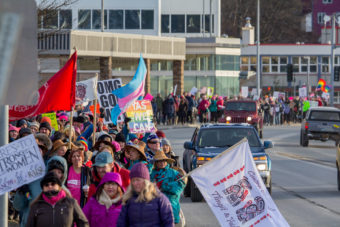
Protesters wave signs at the Alaska State Capitol for the Women's March on Saturday January 21st, 2017 in Juneau. (Photo by Mikko Wilson/KTOO)
Protesters wave signs at the Alaska State Capitol for the Women’s March on Saturday in Juneau. (Photo by Mikko Wilson/KTOO)

Hundreds of protesters carried signs calling for goals like the fair treatment of women, the protection of abortion rights, the protection of the disenfranchised and an end to gender violence.

Mandy Cole, deputy director of AWARE in Juneau, said the idea for the March on Juneau started with an AWARE employee and eventually the entire organization pitched in to help launch it.

AWARE is a women’s advocacy group. Cole said the march was a show of solidarity with other women’s marches around the country and the world.

“Well part of it is just capturing the energy of people who want to do well and want to help all of us live together peacefully and with care for our neighbors,” Cole said.

She was “incredibly pleased” with the turnout, but wasn’t sure how many people showed up.

A panoramic composite image of protesters gathered at the Alaska State Capitol for the Women's March on Saturday, Jan. 21, 2017, in Juneau. The image contains some distortions from combining multiple exposures. (Image by Mikko Wilson /KTOO)
A panoramic composite image of protesters gathered at the Alaska State Capitol for the Women’s March on Saturday in Juneau. The image contains some distortions from combining multiple exposures. (Image by Mikko Wilson/KTOO)

“Maybe 500, 600, I’m not sure.” (I’m) bad with gauging crowd sizes, I think,” Cole said.

According to the march’s Facebook event page, about 840 people said they went, but that number hasn’t been confirmed.

A Juneau police officer said he didn’t know how many people attended either protest. He said organizers for the women’s march estimated 400 people would attend and he guessed they probably met that mark easily.

Theo Houck addresses protesters at the Alaska State Capitol for the Women's March on Saturday January 21st, 2017 in Juneau. (Photo by Mikko Wilson/KTOO)
Theo Houck addresses protesters at the Alaska State Capitol for the Women’s March on Saturday. (Photo by Mikko Wilson/KTOO)

Before the actual march, a handful of supporters gave speeches and one recited a poem about the societal problems they wanted to change and their own visions for the future.

Afterward, the crowd hauled their signs to the Juneau Arts and Humanities Council building where community organizers were waiting.

Cole said they were “community agencies and organizers that are looking for volunteers to help give services, to help recruit others, to continue this type of energy of women’s rights are human rights.”

Marlowe Dunker followed the crowd. She carried a sign that said “Love trumps all” on one side. On the other, she had a list.

“‘Women’s rights, black lives matter, Planned Parenthood, the Muslim community, climate change, equality, our children’s future and not my president.’ And that is why I march,” said Dunker.

She said her sign had a lot on it, but she felt like there was a lot at stake.

That feeling might be the number one thing Friday and Saturday’s protesters had in common.

Women’s March Floods Washington, Kindling Rallies Worldwide

Updated at 12:20 p.m. ET

The National Mall has flooded with pink, as demonstrators descend on the nation’s capital Saturday for the Women’s March on Washington. Just one day after President Trump’s inauguration, marchers from across the country have gathered in the city to protest his agenda and support for women’s rights.

A three-hour rally is opening the event. The march proper is planned for the mid-afternoon, with a path that’s set to extend from a starting position near the U.S. Capitol to its endpoint near the Washington Monument.

The city’s metro system reported 275,000 rides as of 11 a.m. According to metro officials that’s eight times more than a normal Saturday. Reuters adds that the number is also “82,000 more than the 193,000 rides reported at the same point on Friday,” the day of Trump’s inauguration.

Despite the event’s humble origins — a simple Facebook invitation after Election Day — the protest has ballooned into something much more massive. By the time marchers hit the streets Saturday, the Women’s March on Washington had gotten a broad platform of progressive political positions, a slate of celebrity performers and a series of sister marches planned across the world — on all seven continents.

For protester Amy Jackson, though, the matter was simple: She just wanted to “make her voice heard,” she tells NPR’s Marisa Penaloza. Jackson, who traveled to D.C. from Chocowinity, N.C., to be part of the march, said, “It was very important to be here today.”

Among the crowd that gathered for the rally outside the National Museum of the American Indian, NPR’s Sarah McCammon reports signs supporting a wide array of causes — from women’s rights and LGBTQ rights, to Black Lives Matter and excoriations of xenophobia.

One thing seemed to be almost universal, though: The pink knitted caps that have come to be known as “pussyhats” among the marchers, in protest of Trump’s past comments about women.

(Left to right) Melissa Breen, Laura Jamison, Sandy Cuza and Kathryn Wehrmann chat while sporting matching pink hats in support of the march. Becky Harlan/NPR
(Left to right) Melissa Breen, Laura Jamison, Sandy Cuza and Kathryn Wehrmann chat while sporting matching pink hats in support of the march.
Becky Harlan/NPR

Meanwhile, at a nearby metro station, NPR’s Pam Fessler reports the mood among the demonstrators has been more festive than protests Friday. Most of the demonstrators are women, Pam says, but some men have joined the march, as well — including one man carrying a sign reading: “This is what a feminist looks like.”

What began simply as opposition to Trump has developed a wide-ranging list of progressive demands, which organizers published as a platform prior to the march.

But above all, organizers say, is the principle that “Women’s Rights are Human Rights and Human Rights are Women’s Rights.” That statement is pulled directly from a speech Hillary Clinton delivered more than two decades ago in Beijing.

Clinton tweeted her support for the march Saturday, expressing thanks “for standing, speaking & marching for our values.”

Arriving at that platform was not always a smooth process, though. NPR’s Hansi Lo Wang reports there has been disagreement between organizers about how to treat issues of race.

“This march was initially put together by white women, and a lot of women of color felt they weren’t part of the conversation,” Carmen Perez, one of the march’s national organizers, told NPR’s Hansi Lo Wang. “We can’t continue to work in isolation. We can’t continue to be one-dimensional. We have to make sure that we look up, that we begin to really coordinate our efforts.”

(Left to right) Nadia da Rosa, 15, from Providence, R.I.; Anna Maria Evans from Durham, N.C.; and Nicole Monceaux from New York City attend the Women's March on Washington in D.C. Sait Serkan Gurbuz/AP
(Left to right) Nadia da Rosa, 15, from Providence, R.I.; Anna Maria Evans from Durham, N.C.; and Nicole Monceaux from New York City attend the Women’s March on Washington in D.C.
Sait Serkan Gurbuz/AP

For Darcy Sawatzki, a demonstrator attending the march with her daughter, Delia, what matters most is showing up.

“I think showing up and paying attention is sort of one of the bare minimums of citizenship,” Sawatzki told NPR’s Brakkton Booker. It’s not her first march; she has also participated in Black Lives Matter protests.

She says it’s not unease with the new president that inspired her to march.

“I’m not here out of anger or fear, I’m out here for determination, for participation and hope that together we can make a difference.”

The Women’s March on Washington opened with a rally that featured speakers like Gloria Steinem, Angela Davis and Ashley Judd. Janelle Monae also performed, among more than a dozen other musical acts.

Copyright 2017 NPR. To see more, visit http://www.npr.org/.

New alcohol healing center opens in Bethel, renewing hope for recovery

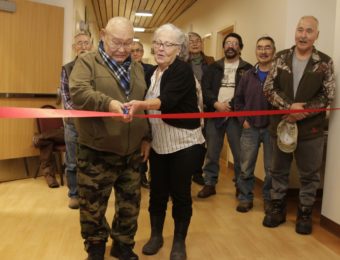
James Charlie Sr., YKHC Honorary Board Member, and Gloria Simeon, YKHC Board Vice Chair, perform the ribbon cutting ceremony at the opening of the Yukon Kuskokwim Ayagnirvik Healing Center on January 11, 2017, surrounded by YKHC board members.
James Charlie Sr., YKHC Honorary Board Member, and Gloria Simeon, YKHC Board Vice Chair, perform the ribbon cutting ceremony at the opening of the Yukon Kuskokwim Ayagnirvik Healing Center on January 11, 2017, surrounded by YKHC board members. (Photo by Dean Swope/KYUK)

Between the two open blades of a pair of scissors stretches a thick red ribbon across the hallway of the new Yukon-Kuskokwim Ayagnirvik Healing Center. Holding the scissors are Gloria Simeon, YKHC Board vice chair, and James Charlie Sr., honorary board member.

The ribbon falls in half with one cut, and the two ends flutter to the new wooden floor of the approximately $12.8 million facility as the crowd applauds and cheers. At one end of the hallway are 16 beds for inpatient alcohol treatment as well as an exercise room, craft rooms, and a kitchen. Down the other end are rooms for outpatient counseling for both alcohol and opioid addiction.

People in the Yukon-Kuskokwim Delta seeking treatment for alcohol addiction now have a newer, more spacious facility to help them. And with the new building, there is renewed hope for treating a disease that has long affected many lives in the region. The Yukon-Kuskokwim Health Corporation celebrated the opening of the Yukon-Kuskokwim Ayagnirvik Healing Center on Wednesday.

The Yukon Kuskokwim Ayagnirvik Healing Center celebrated its opening on January 11, 2017.
The Yukon-Kuskokwim Ayagnirvik Healing Center celebrated its opening on January 11, 2017.
(Photo by Dean Swope/KYUK)

In the middle sits a small gym with a single basketball hoop. Here, dozens of community members and YKHC board members and employees are gathering to commemorate the building’s opening.

Honorary Board Member James Charlie Sr. begins the ceremony with a prayer of thanksgiving.

“Quyana for this opportunity to get together to open this building,” he prayed, “which will help our people who need help in getting rid of alcoholism or other drugs.”

Gratitude and hope for a better future echoes throughout the morning’s speeches. Board members thank those who first began offering alcohol treatment in Bethel in the 1970s. Administrators thank the funders and construction workers who made the building possible. Ray Watson, Director of the Healing Center, thanks the employees filling the room, who every day guide patients toward recovery.

Ray Watson, Director of the Yukon Kuskokwim Ayagnirvik Healing Center, thanks all the employees who help guide patients toward recovery.
Ray Watson, Director of the Yukon Kuskokwim Ayagnirvik Healing Center, thanks all the employees who help guide patients toward recovery. (Photo by Dean Swope/KYUK)

“I always say,” Watson told the crowd, “I have a deep respect for those kind of people who choose this kind of work because it takes a lot of humility and love towards their fellow human beings to help them heal.”

Watson knows this work well: first as a patient in the 1980s, then as a counselor, and now as the center’s director.

“I always say the people who enter into counseling are the lucky ones because there are so many out there who don’t have that, or at this point in time, they’re not there yet,” Watson said.

Many speakers noted that everyone in the Delta knows someone in the region who struggles with alcohol or drugs. They might even one day seek treatment themselves.

The facility actually opened six weeks ago. Watson said the patients were sent on an ‘outing’ for the ribbon cutting to protect their confidentiality. But after the ribbon is thrown away, the cake eaten, and the balloons taken out, those patients will return. They may have to come back repeatedly if they relapse.

This new center, located behind the Bethel post office, was set to open a couple years ago. But in October of 2014, the partially constructed building caught fire and burned to the ground. Construction began again.

Diane Kaplan is the President and CEO of the Rasmuson Foundation, one of the building’s funders. She said that the fire and rebuilding can be seen as a metaphor for recovery.

Diane Kaplan, President and CEO of the Rasmuson Foundation, addresses the crowd at the ribbon cutting ceremony at the Yukon Kuskokwim Ayagnirvik Healing Center on January 11, 2017.
(Photo by Dean Swope/KYUK)

“People who don’t understand a lot about this disease will say, ‘Well how many people went into this facility and got sober?’ Well very often it doesn’t happen the first time,” Kaplan said. “So I think we can look at what happened to this building as there was a great effort to build it, and then something happened, and it fell down, and now it’s been picked up again. And that really is the message for people who struggle with alcohol.”

But as Director Watson said and can attest, recovery, like the new building, is possible.

Pope Francis Offers A Message Of Peace In Annual Christmas Day Blessing

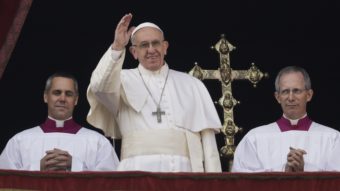
Pope Francis delivered his Christmas day blessing from the main balcony of St. Peter's Basilica at the Vatican Sunday, before a crowd of some 40,000 people. Alessandra Tarantino/AP
Pope Francis delivered his Christmas day blessing from the main balcony of St. Peter’s Basilica at the Vatican Sunday, before a crowd of some 40,000 people.
Alessandra Tarantino/AP

Pope Francis gave the traditional Christmas Day blessing on Sunday, calling for peace in Syria and other countries “scarred by war.”

An estimated 40,000 tourists and Romans gathered in St. Peter’s Square to hear the message, which was delivered from the balcony of St. Peter’s Basilica, “Urbi et Orbi”: to the city and the world.

The pope offered his message of peace to the “war-torn land of Syria, where far too much blood has been spilled.” He said it is time that weapons “be still forever,” so that “civil coexistence” might be restored to the country.

Pope Francis also addressed the people of the Holy Land, saying, “May Israelis and Palestinians have the courage and determination to write a new page of history, where hate and revenge give way to the will to build together a future of mutual understanding and harmony.” He appealed for peace and dialogue in places ranging from South Sudan, the Democratic Republic of the Congo, to Colombia, and the Korean Peninsula.

This message comes at the end of what Pope Francis proclaimed the Holy Year of Mercy. Pope Francis, who turned 80 earlier this month, made six foreign trips this year, and oversaw many events and ceremonies with millions of pilgrims to the Vatican.

NPR’s Sylvia Poggioli reports that the year was marked by the pope’s efforts to heal divisions within the Christian world, and dissension in the Catholic Church.

His efforts have not gone without criticism — four cardinals expressed public outrage after the pope’s meditation on marriage and family seemed to open a crack in the door, allowing some divorced and civilly remarried Catholics to receive sacraments.

As Poggioli notes, when asked about the accusation that he is “Protestantizing” the Catholic Church, the pope replied, “I don’t lose sleep over it.”

Despite the opposition, Pope Francis enjoys overwhelming support among the faithful, she writes. Recently, the pope’s Twitter following grew to more than 32 million followers across his nine accounts.

Copyright 2016 NPR. To see more, visit http://www.npr.org/.
Site notifications
Update notification options
Subscribe to notifications