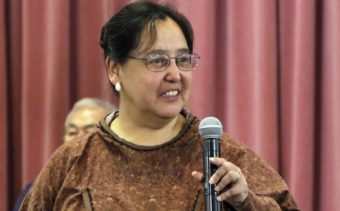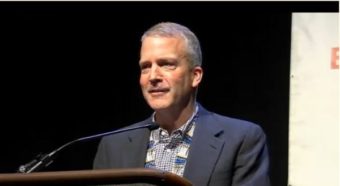
Sen. Dan Sullivan addresses the 2016 AFN on Oct. 21, 2016. (Courtesy of the Alaska Federation of Natives)
U.S. Sen. Dan Sullivan spoke at AFN Friday afternoon about improving water and sewer access in rural Alaska and about helping Alaska Native veterans.
Sullivan said that he is working to raise awareness in Congress about the more than 30 villages that still don’t have running water or sewers.
The federal government will give $1.4 Billion dollars nationwide to build new systems, but Sullivan says they need to start putting the money to work.
“The bottom line is we have to get our federal agencies to stop studying these issues and start helping us build these important infrastructure projects that are going to help our communities.”
Sullivan is also working on a bill addressing military veterans who missed the opportunity to apply for native allotments because they were on active duty. The bill would give the veterans and their families the chance to apply now.
Raven Natkong dances in the spotlight at Rendezvous during Friday's amateur drag show. (Photo by Tripp J Crouse/KTOO)
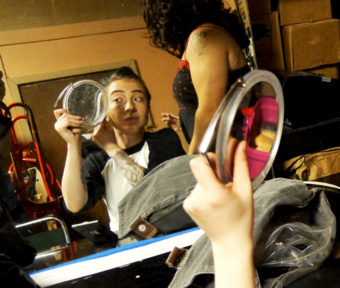
Stephanie Davis applies a stippling makeup effect to her jawline to create the illusion of facial hair stubble. Davis, who portrayed Stevie Smalls, one of the drag kings in the Femme Fatale show Friday at Rendezvous in downtown Juneau. (Photo by Tripp J Crouse/KTOO)
Friday's Femme Fatale emcee Abby O'Brien, left, and Ryan Hicks, who portrays Aquarius Valentine, talk while prepping backstage for the drag show at Rendezvous. (Photo by Tripp J Crouse/KTOO)
Cate Ross applies makeup to her face to transform into Ryder Strong backstage during Friday's Femme Fatale amateur drag show at the Rendezvous. (Photo by Tripp J Crouse/KTOO)
Denise Wiltse applies bobby pins to attach her black wig to her hair. Wiltse performed to Michael Jackson's song "The Way You Make Me Feel" on Friday at Rendezvous. (Photo by Tripp J Crouse/KTOO)
Nathan Buendia portrays drag queen Niza Dia during the Femme Fatale amateur drag contest Friday, September 30, 2016 at Rendezvous. The top voted drag queen and drag king went on to perform Saturday at the Rockwell Ballroom. Buendia won the draq queen portion of Friday's contest. (Tripp J Crouse/KTOO)
James Hoagland, who portrays drag queen GiGi Monroe, helps prep Friday night's lineup backstage at Rendezvous. (Photo by Tripp J Crouse/KTOO)
Ryan Hicks helps a fellow drag queen participant with makeup. Hicks portrayed drag queen Aquarius Valentine in the Friday amateur drag show at Rendezvous. (Photo by Tripp J Crouse/KTOO)
Raven Natkong performs on stage at Rendezvous during Friday's amateur drag show. (Photo by Tripp J Crouse/KTOO)
Stephanie Davis works on her contouring, a makeup process that creates highlights and lowlights, turning Davis' feminine features into a more masculine look. (Photo by Tripp J Crouse/KTOO)
Denise Wiltse applies bobby pins to attach her black wig to her hair. Wiltse performed to Michael Jackson's song "The Way You Make Me Feel" on Friday at Rendezvous. (Photo by Tripp J Crouse/KTOO)
Drag king Stevie Smalls, portrayed by Stephanie Davis, lip-syncs during the Friday amateur drag contest at Rendezvous in downtown Juneau. (Photo by Tripp J Crouse/KTOO)
GiGi Monroe, portrayed by James Hoagland, takes a moment during Friday's amateur drag show to talk about Alaskan AIDS Assistance Association. (Photo by Tripp J Crouse/KTOO)
Drag shows in Juneau have become a major, annual fundraiser for the nonprofit Alaskan AIDS Assistance Association.
Attendance topped 200 after two nights of Femme Fatale shows in Juneau on Sept. 30 and Oct. 1.
At the Rendezvous bar in downtown Juneau, a few people are sipping drinks and early birds are trickling in.
The drag queens and kings aren’t set to take the stage for another hour and a half.
But backstage — a bar store room — it’s cramped.
Makeup palettes, shoes, clothes and mannequin heads with colorful wigs litter the tables.
Five queens and seven kings, each over-the-top representations from either side of the gender spectrum, do their makeup in front of mirrors.
Stephanie Davis’ hair is dyed blue and she has it pulled back into a bun.
And she’s a little nervous.
“Yep, that’s kind of an understatement,” Davis said. “I’m kinda just trying to put on, like, my beard and without shaking too much and making squiggly lines, which I guess would be kind of more organic, but yeah, a little nervous.”
She’s turning into her drag king persona, Stevie Smalls, an extremely confident frat boy.
“I’m kind of like a insecure, shy person, so I chose something completely opposite of that to do,” she said.
The transformation from Stephanie Davis to Stevie Smalls takes patience and practice. Her eyes switch intently between small handheld and large vanity mirrors.
With makeup, Davis stipples on a beard, like the kind teen-heartthrobs grow without shaving for a few days.
Stevie’s beard takes just a few minutes.
It’s a fraction of the preparation the king needs before taking the stage.
“Um, you have to like bind and stuff, just flatten down your chest area and try not to make yourself look too hippy, because I’m naturally super hippy and boys are not often super hippy so I’m trying to straighten it out,” Davis said.
To help mask curves, drag kings use multiple sports bras, Ace bandages and kinesiology tape — the kind athletes use to ease muscle pain.
This is Davis’ first solo performance, though it is her second as a drag king.
“It was really fun. I did the boy band – we were the four D’s – We did One Direction and Backstreet Boys – and you really can’t go wrong with either of those,” she said. “It was fun to choreograph and stuff. But this is a little bit different, because you can’t choreograph too much stuff alone because it just looks weird. Know what I mean? But yeah, it was a lot of fun the first time. And I’m still with Ryder here, so it’s not, not too bad.”
She’s referring to Ryder Strong, another drag king portrayed by Cate Ross.
At a crowded makeup table, Ross, Davis and another king take turns applying highlights and lowlights, using a technique called contouring.
Chiseled jawlines and wider noses emerge from their soft, feminine facial features.
“I’m terrible at contouring, but I want to try and look like a boy, so I’m actually trying my hardest to ‘Oh let me try to make my face less soft, and let me try and flatten my chest as much as possible,’” she said. “So it’s no pain, no gain, but it’s fun to try and make that silhouette look right even though I haven’t mastered it yet.”
Later, it’s Stevie who comes through the curtain and lip-syncs to Zayn’s “TiO (or Take It Off).”
Stevie gyrates with a steamy, masculine charisma while making eyes with the women at the show.
His beard moves as he mouths the words: “I just wanna watch you when you take it off.”
Stevie works the crowd, pausing to dance with some audience members.
“With that attitude, making those scrunchy, smooshy faces and like kind of being super into myself? I have to go above and beyond with the confidence thing because I have zero, so if I’m just way too confident, I think that that’s why I chose that persona,” Davis said.
Each king or queen embodies different personality types and looks. There’s high fashion with glitz and glamour, to flamboyant camp through extravagant makeup and props.
Davis partially credits the rise of drag to reality TV.
“I think that drag in general just got more accepted, and I think that that whole ‘RuPaul’s Drag Race’ thing had really big play in it,” Davis said.
She says the mainstreaming of LGBTQ culture has helped, too.
“Not all drag people are queer, but that whole lifestyle has become more accepted so I think that more and more things are getting accepted,” Davis said. “More drag queens are all over TV and everything like that.”
Davis originally wanted to perform in bio-femme drag, in which female participants perform as drag queens. But bio-femme drag isn’t as recognized as other forms, so Davis works instead toward performing as a drag king.
Between tickets and tips to the performers, the organizers estimate the two-day event raised more than $10,000 for the Alaskan AIDS Assistance Association.
Vivian Korthius, AVCP’s newest CEO. (Photo by Dean Swope/KYUK
The Association of Village Council Presidents has selected its first female CEO: Vivian Johnson Korthuis. The decision comes on the third day of the regional nonprofit corporation’s annual convention, after a year fraught with challenges. Some see this convention, and the change it has brought, as the light at the end of the tunnel.
Vivian Korthuis, AVCP’s first female CEO, said at the end of Thursday’s meeting that she was overwhelmed but confident.
“I think the opportunity exists now to really take AVCP to the next step,” Korthuis said.
When asked how she would grow AVCP, she pointed to changes in the bylaws that led to her appointment.
“Well I think the board of directors has created a path for the company, and my job is to help them do that,” Korthuis said.
Korthuis grew up in the Village of Emmonak and eventually attended Dartmouth College in New Hampshire. She is the first female CEO of a major tribal organization, and also the first to be hired – not elected.
This came about when the executive board asked delegates for control over the process and, in a three-quarters vote, it was granted. Marcy Sherer, vice president of the Native Village of Napaimute approves of the change.
“CEO really should be a hired position so that the executive board has oversight control and can manage the company through the CEO. In that aspect, it’s a very positive move,” Sherer said.
Sherer agrees with her new CEO that this could be a new start for AVCP.
“I think that this is a turn in history, a turn of the page in history,” Sherer said.
But not everyone agrees.
“It’s kind of a strange feeling,” said Mike Williams Sr., who is the alternate delegate for the village of Akiak. He didn’t like the way the vote went down, though he does think Korthuis has strong credentials.
“What we lost is having that direct voice and involvement cut off from the rest of the member tribes,” Williams said.
In the months leading up to the meeting, AVCP’s legal counsel Liz Pederson circulated a letter to the tribes informing them of the proposed changes. Williams and others responded with their own letter, calling the actions illegal under the bylaws. The final voting on the issue, done in a closed meeting on Wednesday, supported AVCP’s recommendations.
The same group raised questions earlier this year about the state of AVCP’s financial health, a topic that took up most of the first day’s meeting. Questions about whether grant funds were spent in compliance with federal regulations went without explanation for some time, and during that period former AVCP president Myron Naneng abruptly resigned.
Regardless of the dissent at this point, the AVCP Executive Board appears to have received the nod from its members to proceed with the recovery plan it laid out during the first day of the meeting.
Jim Wilcox holds up a $100 donation on Saturday. (Photo by Quinton Chandler/KTOO)
The Southeast Alaska Food Bank celebrated an increased capacity during an open house Saturday.
The new addition allows the food bank to give away even more food than before.
Last year, Jim Wilcox was the board president, but he gave that up to head the food bank’s warehouse expansion.
“I couldn’t do both, so I turned the presidency over to one of my buddies,” said Wilcox, who sits on the Southeast Alaska Food Bank’s board of directors.
In the last four years, the number of people asking for food increased by 30 percent to 40 percent, he said, wearing a red cap with the food bank’s logo over his white hair.
That’s why adding space onto the warehouse was paramount.
“We can probably store probably six months of food in here right now,” Wilcox said.
“Before that, it was down in that little end down there and we’d be lucky if we could get a month that we could store. That was piled clear to the ceiling.”
The old warehouse space. (Photo by Quinton Chandler/KTOO)
View of the space added onto the warehouse. (Photo by Quinton Chandler/KTOO)
Wilcox planned for the entire project — a 2,200-square-foot expansion — to take a full three months. Some said it would take double that.
He said they did it in just 52 days.
“And four of them days were half days,” Wilcox said.
“They said it could take up to a year just to get a permit from the Corps of Army Engineers,” he said. “The guy come out here, walked over, dug a couple of holes. He was here about an hour and a half and come and sign the paper off and said, ‘You got it.’ These contractors couldn’t believe it.”
He gave part of the credit for the quick turnaround to a former Juneau contractor who he hired out of Hoonah.
“I asked him if he’d come back to Juneau and be my ramrodder, because he knew all of the contractors and everything too.”
“When the guys were still here cutting the floor, the next contractor to put all the walls up was here laying out the walls before we even had the floor done,” Wilcox said. “And that’s the way we went with the whole job.”
Wilcox gave another round of praise to the businesses who helped build the space and the others that contributed. He estimated a third of them gave their services for free.
“Engineers, surveyors – they were all free. The people who drew the building and drew all the blueprints – they were free. The electricians, 99 percent of the work they did for free,” Wilcox said.
The rest the food bank covered – mostly through donations. Wilcox said it cost them less than $70 per square foot when it should have cost about $250.
Darren Adams is the food bank manager. (Photo by Quinton Chandler/KTOO)
The food bank’s manager Darren Adams said that right before the new and improved warehouse’s open house and ribbon cutting, about 45 people came to collect close to 1,600 pounds of food.
The new space is going to go a long way toward the food bank’s day to day operations, he said. There’s an obvious divide between the old space and the add-on.
Adams pointed out a sharp contrast between the two.
“In years past whenever I’d get a huge food drive, or get a huge food donation, I’d have to make it all fit in here,” he said.
Adams recalled pallets scattered everywhere and food stacked to the ceiling.
“I had to call in a lot of favors and ask people who don’t normally store food for us to store food for us,” he said.
But, not anymore.
“This will help us bring in more food, keep enough back to where we’ve got food for today and for tomorrow, and it will also help us buy food in bulk,” Adams said.
One thing the extra space can’t do is give Adams more manpower. He’s the only full-time employee and said the food bank is always looking for volunteers.
Wilcox left the warehouse in a good mood, but not before insisting on getting a photo of a wall covered in the names of all the organizations that helped make the expansion possible.
One of the warehouse’s walls was dedicated to the organizations that helped make the expansion possible. (Photo by Quinton Chandler/KTOO)
CCFR’s Capt. Todd Cameron and Juneau Police Lt. Kris Sell participate in the 9/11 Memorial Stair Climb on Saturday. (Photo by Matt Miller/KTOO)
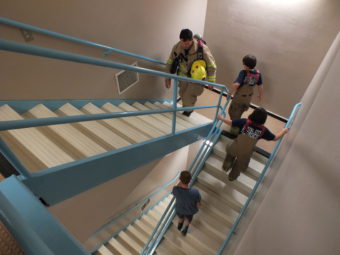
A couple dozen firefighters, law enforcement officers and their family members participated in the annual 9/11 Memorial Stair Climb on Saturday at the Juneau federal building.
Each participant hiked the 10 flights of the building 11 times for a total of 110 floors, the number of floors in the World Trade Center.
Some of the Juneau participants started out the stair climb in full firefighter bunker or turnout gear — helmet, boots, protective coats and self-contained breathing apparatus. Capt. Todd Cameron of Capital City Fire/Rescue said that could add as much as a 100 pounds to a firefighter’s weight.
Cameron said a total of $1,500 raised by the Juneau stair climbers will go to National Fallen Firefighters Foundation. Cameron said an average of 100 firefighters nationally die in the line duty every year, usually after getting lost or trapped in a house fire, getting hit by a vehicle while responding to a highway accident, or other medical conditions.
The 9/11 Memorial Stair Climb is held in honor of the 343 firefighters and 60 police officers who died during the collapse of the World Trade Center towers on Sept. 11, 2001.
Listen to CCFR’s Capt. Todd Cameron describe the purpose of the 9/11 Memorial Stair Climb while hiking up 10 floors of the federal building in Juneau:
Click on any photo to see a slideshow with captions:
Firefighters rest while waiting for the freight elevator on the ninth floor of the federal building. (Photo by Matt Miller/KTOO)
Fresh fruit, towels and plenty of water were available for stair climb participants for extra energy and prevent dehydration. (Photo by Matt Miller/KTOO)
Firefighters and other participants in the stair climb emerge from a freight elevator in the basement of the federal building before ascending the stairs again. A few chose to run up all 110 stories. (Photo by Matt Miller/KTOO)
Firefighters made 11 circuits of ten floors for a total of 110 stories during the 9/11 Memorial Stair Climb on Saturday. (Photo by Matt Miller/KTOO)
Some participated in the 9/11 Memorial Stair Climb without gear. Others wore an air tank and breathing apparatus and full turn-out gear which could add 60 to 80 pounds to a firefighter’s weight. (Photo by Matt Miller/KTOO)
Some firefighters participated in the 9/11 Memorial Stair Climb along with their family. (Photo by Matt Miller/KTOO)
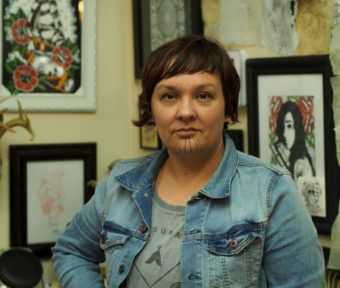
Holly Mititquq Nordlum at Above The Rest tattoo shop in Anchorage, where she’s working to meet the state’s official requirements to be eligible for a tattoo license. (Photo by Zachariah Hughes/Alaska Public Media)
Inside the cramped back room of an Anchorage tattoo parlor filled with colorful masks and sketches, tattoo guns steadily buzzed as artist Holly Mititquq Nordlum scrubbed down a sink.
“I’m doing a little bit of cleaning, just to make sure the space we’re working with is very safe,” she explained.
Nordlum has been at the forefront of the indigenous tattoo revival in Alaska, receiving recognition and support from major cultural institutions, including the Anchorage Museum and the Sundance Institute.
But her work has gone well beyond the boundaries of fine arts: Nordlum turned herself into a piece last year, when Greenlandic tattooist and collaborator Maya Sialuk Jacobsen tattooed her before a public audience in this same shop, stitching a design into her forearm with a needle and thread. Days later, in private, Jacobsen poked six lines down Nordlum’s chin, a design drawn from her home in Kotzebue.
More recently, she’s been preparing a month-long workshop for three Alaska Native women in every aspect of traditional tattooing, from state regulations to the history of designs and practicing on human skin.
The course should set the women up to apply for an official state license. Part of the state’s requirements for licensing tattooists is 150 hours of “practical operations” in a tattoo shop. Nordlum, who is not certified to tattoo, has started putting in that work already. And even though she’s an established artist, she’s by no means exempt from menial chores – hence the scrubbing.
“It counts towards the hours that then count toward your license for the state requirements,” she said, unfazed. “It’s just part of the process.”
Within the international community of indigenous artists and advocates working to revitalize tattooing, seeking official approval is controversial.
Some people reject that governments have any right to regulate indigenous practices that go back thousands of years. But Nordlum is of the mind that in today’s world, getting an official license is just another box to check off to facilitate the larger goal of reviving traditional tattooing as a vibrant cultural process.
“As somebody organizing the program, I feel like I should do everything in my power to be as qualified as I can be,” Norldum said. Though she thinks safety and sanitation standards are a given for serious practitioners, she thinks it builds credibility if she has the state’s seal of approval.
Holly Mititquq Nordlum sits for a tattoo along her wrist from Greenlandic artist Maya Sialuk Jacobsen during a live demonstration of traditional tattooing techniques in 2015. (Photo by Zachariah Hughes/Alaska Public Media)
In spite of these aims, Nordlum was recently admonished by the State of Alaska. In a “non-disciplinary letter of advisement,” a state investigator informed her that last year’s tattoo demonstration violated state statutes; visiting artist Jacobsen’s request for a courtesy license to tattoo in Alaska was deemed incomplete.
Angela Birt, an investigator for the Department of Commerce, Community, and Economic Development, said the letter is not an official sanction. But if the same rule is broken again, Nordlum or Jacobsen could face more serious consequences.
For Nordlum, getting the letter felt like an insult. She said she’d repeatedly asked for clarity on how to meet regulatory requirements, only to be either stonewalled or shrugged off.
“All I’ve been asking for two years is someone to talk to me and work with me, because there’s obviously things that aren’t going to mesh, and there is no response,” Nordlum said.
Missionaries and colonization nearly extinguished the indigenous practice of tattooing among Alaska Natives and Inuit across the circumpolar north. Now, modern advocates and artists see the beginning of a widespread revival.
But revitalization efforts are being threatened by an unanticipated barrier: state bureaucracy.
“I’m really trying to work with the State of Alaska,” she added. “It’s my state, I live here, and I’m being roadblocked every step of the way,” Nordlum said.
But regulators with the state don’t see it that way.
Sara Chambers is with the Division of Corporations, Business, and Professional Licensing, and oversees the 43 different boards that set standards for various industries. Among them is the Board of Barbers and Hairdressers, which includes under its purview body modification and tattooing. According to Chambers, that board has clearly defined protocols to allow traditional tattooing.
The problem was not the process, Chambers said, it was the execution: Nordlum’s application for a courtesy license for Jacobsen last year likely would have been approved, but it wasn’t submitted in time.
Chambers said the division is accustomed to handling nuanced license applications given the unique challenges raised by conditions across much of rural Alaska, and she denied that regulatory requirements for traditional tattooing are unworkable. Even amid a growing number of applications over the last few years, Chambers said the division has enough staff on hand to work through issues with residents.
The state’s rules over tattoos are intended to protect Alaskans from serious risks of blood-borne pathogens and diseases, Chambers said, adding that a successful licensing process depends on applicants being well-informed about regulations.
“The casual hobbyist sometimes has to ask themselves whether they plan to meet the standards required by the legislature,” Chambers said.
Holly Mititquq Nordlum shows off her partially complete tattoo during a live demonstration at Anchorage’s Above The Rest studio. Each horizontal line is 40 individual stitch marks through the first layer of skin. Before starting the stitches, Jacobsen poked the basic design of three bird feet rising from the lines. Nordlum’s Inupiaq name, Mititquq, means ‘a place where birds land,’ and she celebrates big life goals with bird feet tattoos, like the two on her opposite wrist, done with a tattoo gun. (Photo by Zachariah Hughes/Alaska Public Media)
But cultural practices like traditional tattooing are fundamentally different from occupational standards governing, for example, barbers and hairdressers. That’s according to a body of international law that is focused on cases like these, and puts the onus on governments to be flexible in guaranteeing access to cultural rights.
“Unfortunately, this is par for the course,” said Dalee Sambo Dorough, an associate professor of political science at the University of Alaska Anchorage, and an expert member of the United Nation’s Permanent Forum on Indigenous Issues.
According to Dorough, there are numerous provisions under the UN’s Declaration on the Rights of Indigenous Peoples — a non-binding document the U.S. has supported since 2010 — that bolster Nordlum’s position that the state has been unreasonably rigid.
Article 31 spells out that indigenous peoples have a right to “maintain, control, (and) protect” “traditional cultural expressions,” which explicitly includes design and visual arts. Article 36 specifies that indigenous groups separated by international borders, which could include Inuit of the Circumpolar North, have a right to convene for cultural practices. Not only that, but state governments are obligated to help implement this right.
“There should be some openness and willingness on the part of the state government to find a way to work with them, rather than requiring that they conform to the imposed regulatory scheme,” Dorough said by phone from her Anchorage office. In her interpretation, international conventions trump the regulatory requirements laid out by the barbers and hairdressers.
But that conclusion might not be enough for Nordlum, who is still scrambling to finalize logistics, funding, and travel ahead of the upcoming workshop, which begins in October.
She didn’t bother submitting paperwork to the state this time around, because calls to the relevant regulatory bodies didn’t shed any new light on the application process. She said she was curtly directed to get a courtesy license for Jacobsen, just like last year. After spending dozens of hours and hundreds of dollars in 2015, Nordlum said it felt like a pointless waste of time and money.
Nordlum hopes a solution will come from lawmakers or the governor’s office. In the meantime, she doesn’t understand why the state is making it so difficult to bring in a teacher like Jacobsen to share skills that Alaskans are desperate to learn.
“She’s a culture bearer,” Nordlum said. “This is a cultural practice.”
Close
Update notification options
Subscribe to notifications
Subscribe
Get notifications about news related to the topics you care about. You can unsubscribe anytime.