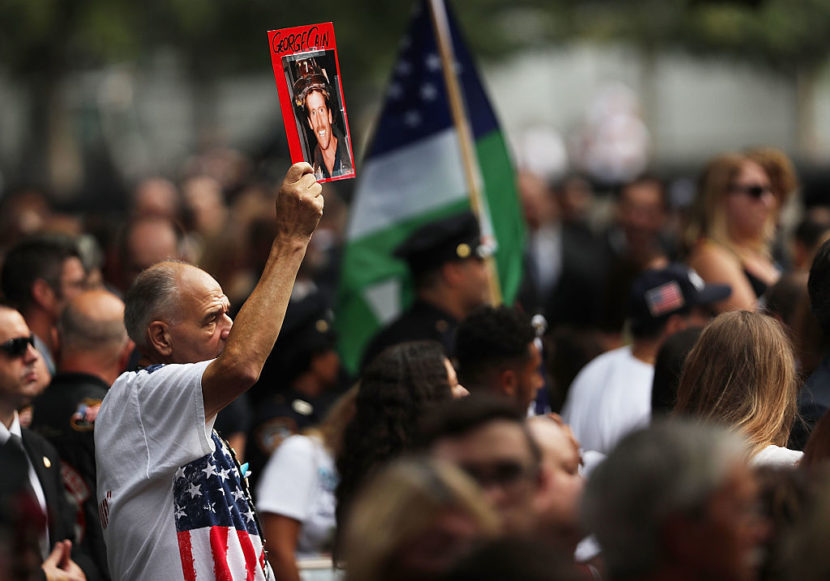
A commemoration ceremony is held for the victims of the Sept. 11 terrorist attacks on Sunday at the National September 11 Memorial and Museum in New York City. Spencer Platt /Getty Images
The names of each of the nearly 3,000 victims of the Sept. 11 attacks were read at a ceremony at the Sept. 11 memorial plaza, at the World Trade Center site in New York City. This marks the 15th anniversary of the attacks.
Family members came forward to name and honor their relatives who died at the World Trade Center, the Pentagon and on Flight 93. The event also commemorated the victims of the 1993 World Trade Center bombings.
As WNYC’s Stephen Nessen told our Newscast unit, family members often included an anecdote or update as well. “I heard one young man say, ‘Dad, I’m starting college this fall.’ One woman said ‘Not a day goes by that I don’t miss you. I want you to know your grandchild was born on your birthday.’ ”
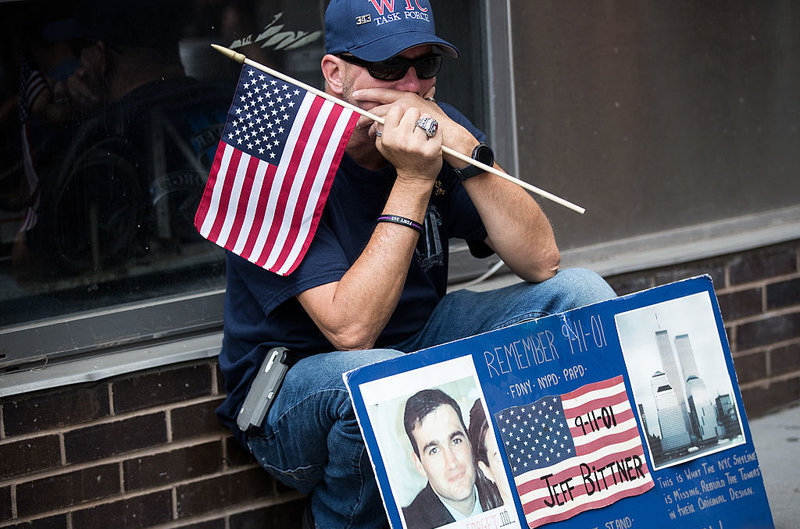
He described the scene: “Some people are holding pictures of their loved ones. Many of them bring these signs out every single year, sort of collage photos. Many people make their own t-shirts to remember the loved one from their family that died.”
A man pauses near the Sept. 11 Memorial site in New York City. Drew Angerer/Getty Images
The ceremony included six moments of silence — to mark the times that the four planes hit the World Trade Center towers, the Pentagon and crashed near Shanksville, Penn., and to observe the time that each tower fell.
Donald Trump and Hillary Clinton both attended the event.
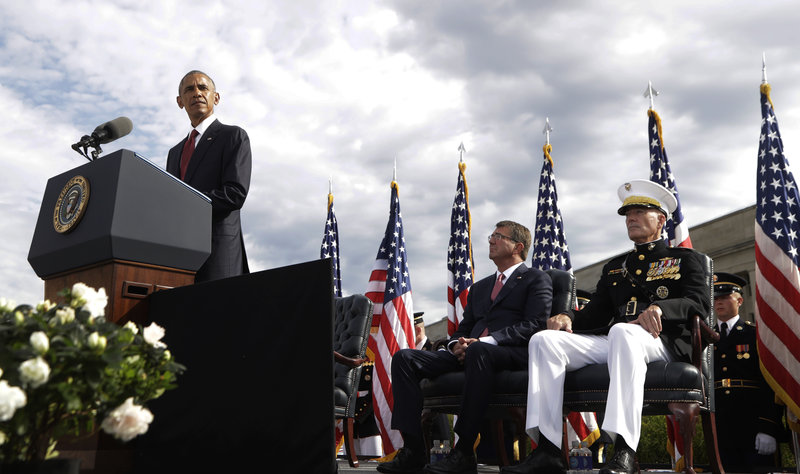
Commemoration events are happening across the country, including at the Pentagon, where President Obama spoke:
“We remember, and we will never forget, the nearly 3,000 lives taken from us so cruelly, including 184 men, women and children here — the youngest just three years old. We honor the courage of those who put themselves in harm’s way to save people they never knew. We come together in prayer, and in gratitude for the strength that has fortified us across these 15 years.”
During his comments, Obama reflected on the changing nature of the fight against extremists. “We stay true to the spirit of this day by defending not only our country, but also our ideals,” he said. “Fifteen years into this fight, the threat has evolved. With our stronger defenses, terrorists often attempt attacks on a smaller, but still deadly scale. Hateful ideologies urge people in their own countries to commit unspeakable violence.”
President Barack Obama speaks at a memorial observance ceremony at the Pentagon on Sunday. Manuel Balce/AP
And that’s why, he said, “it is so important today that we reaffirm our character as a nation of people drawn from every corner of the world, every color, every religion, every background, bound by a creed as old as our founding — E Pluribus Unum — out of many, we are one.”
He added: “In the end, the most enduring memorial to those we lost is ensuring the America that we continue to be. That we stay true to ourselves, that we stay true to what’s best in us. That we do not let others divide us.”
Watch his remarks here:
A ceremony was also held in Shanksville, Pa., where United Airlines Flight 93 crashed into a field after passengers and crew members fought off the attackers.
WITF’s Katie Meyer described the commemoration for our Newscast unit:
“The mood is somber today, the ceremony which is held every year just began. A reading of the names just finished, family members read out the names of those who were lost on the flight, accompanied by the sounding of bells. Behind me you can hear U.S. Secretary of the Interior, Sally Jewell, starting her address to the people here. There’s going to be speeches from a lot of people in the next hour — many from public officials. … It’s cool today, windy and cloud. Now and then the sun breaks through.”
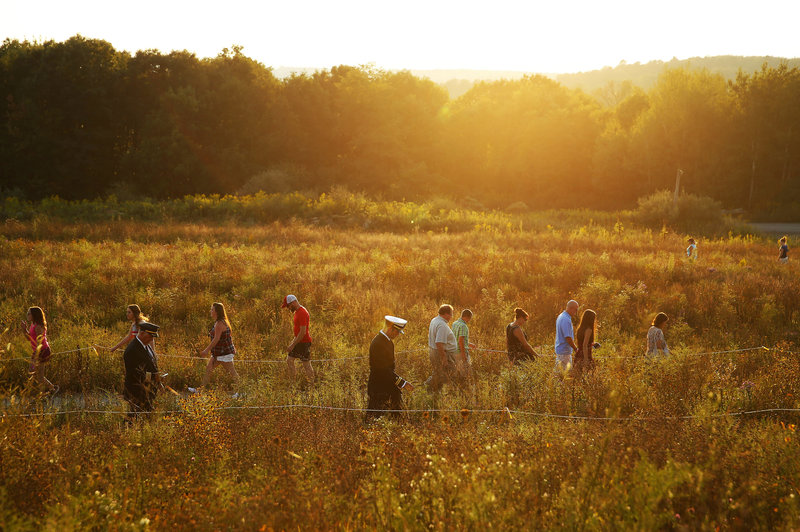
Visitors make their way through the Flight 93 National Memorial before lit candles are carried to the Wall of Names in memory of the passengers and crew of Flight 93, at the Flight 93 National Memorial in Shanksville, Pa. Jared Wickerham/AP
Copyright 2016 NPR. To see more, visit http://www.npr.org/.
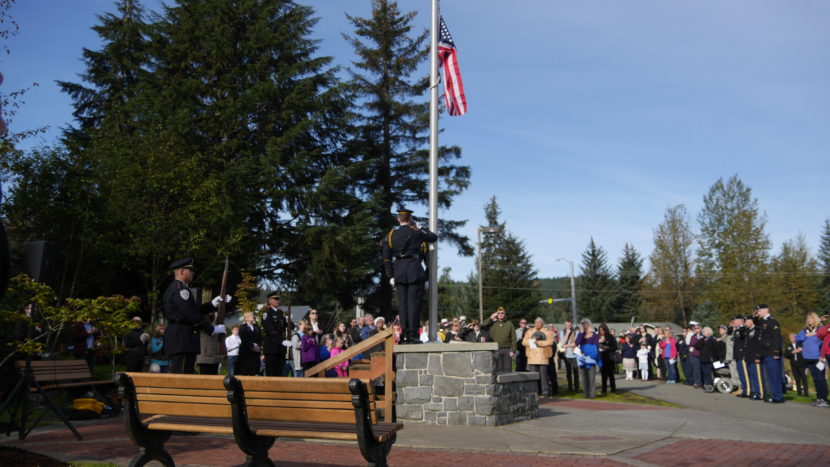
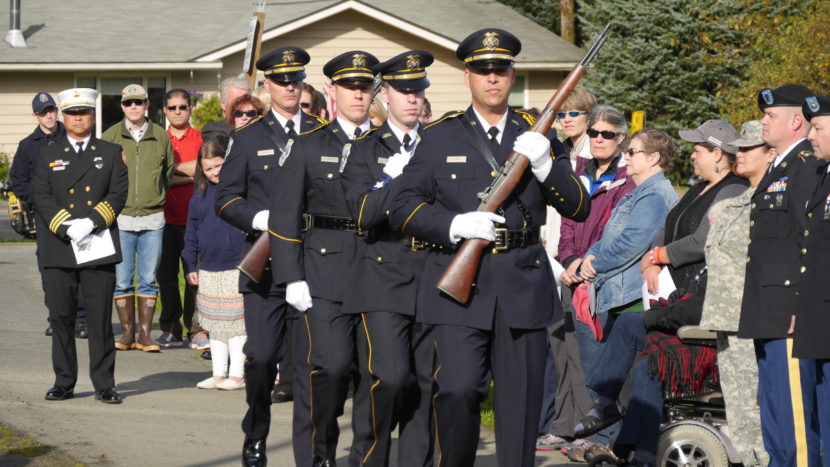
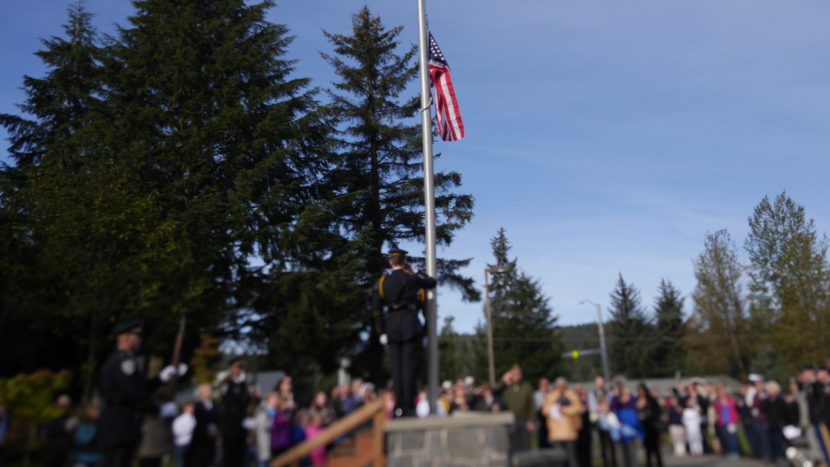
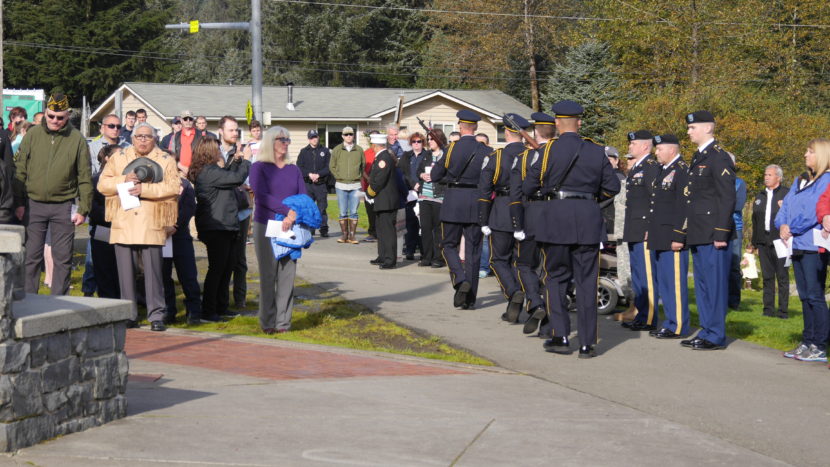
The Juneau Police Department’s honor guard raised the flag to half-staff at the memorial on Sunday. (Photo by Quinton Chandler/KTOO)
Hands covered hearts and veterans saluted as a Juneau Police Department Honor Guard raised the flag to half-staff in concert with a rendition of the Star Spangled Banner.
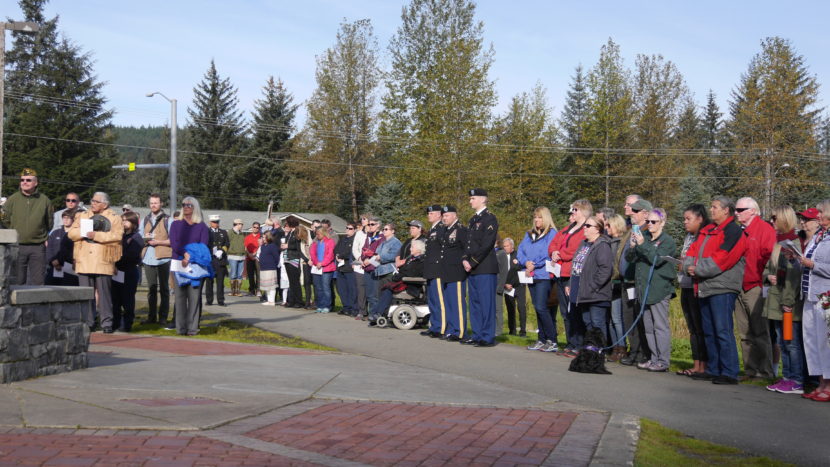
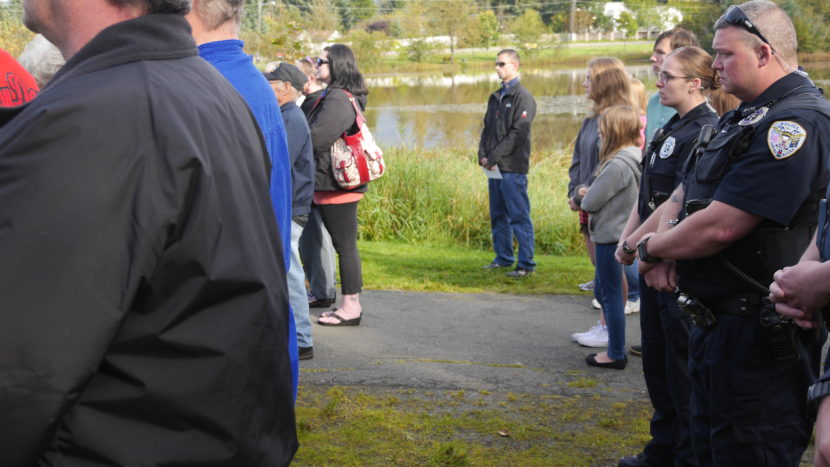
The Juneau Glacier Valley Rotary Club’s annual service, held at the Sept. 11 Memorial in Riverside Rotary Park, followed a pattern similar to past services held since 2002.
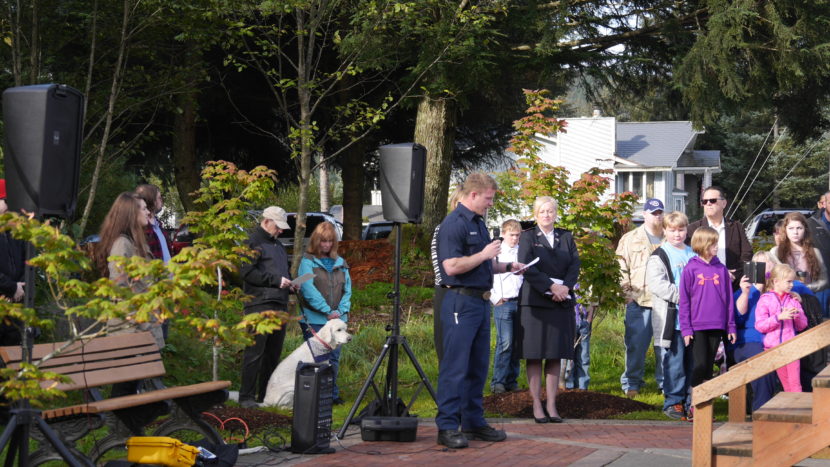
The highlights included Capital City Fire/Rescue firefighter Andrew Bishop’s explanation of the significance behind each piece of the memorial.
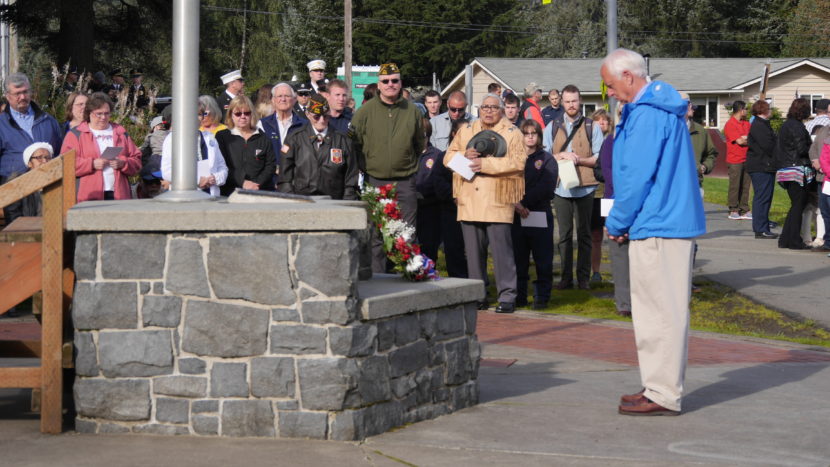
Juneau Mayor Ken Koelsch laid a ceremonial wreath at the memorial’s base while bagpipes played somberly in the background.
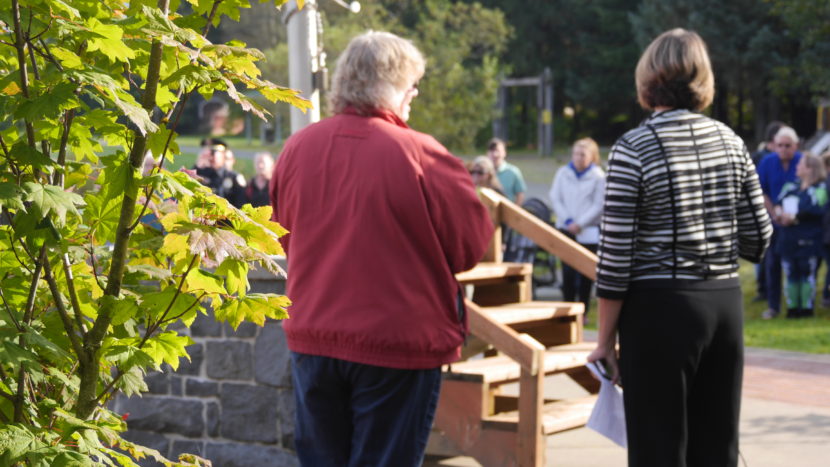
Lieutenant Kris Sell with Juneau Police Department shared her initial thoughts on the repercussions of 9/11 and the lessons learned from the aftermath.
“We came together as a nation 15 years ago and it was beautiful. It’s time to do it again and for the long haul,” Sell said.
She encouraged the crowd to support first responders and U.S. soldiers as “the ultimate way” to honor the lives lost 15 years ago.
Lisa Golisek was at an airport in route to Indiana on 9/11. She says it is especially important to her to pay respects to first responders who lost their lives serving others.
“Also the ones that are living. I am married to a first responder so it’s very important to me,” Golisek said.
She said her husband is a former Juneau police officer.
The entire ceremony took less than an hour. Golisek thought it was “appropriate.”
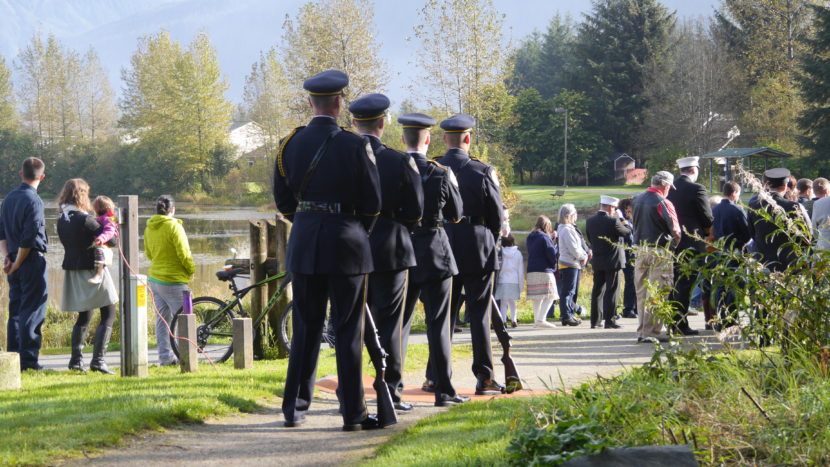
JPD Honor Guard waits to escort the flag to the memorial. (Photo by Quinton Chandler/KTOO)
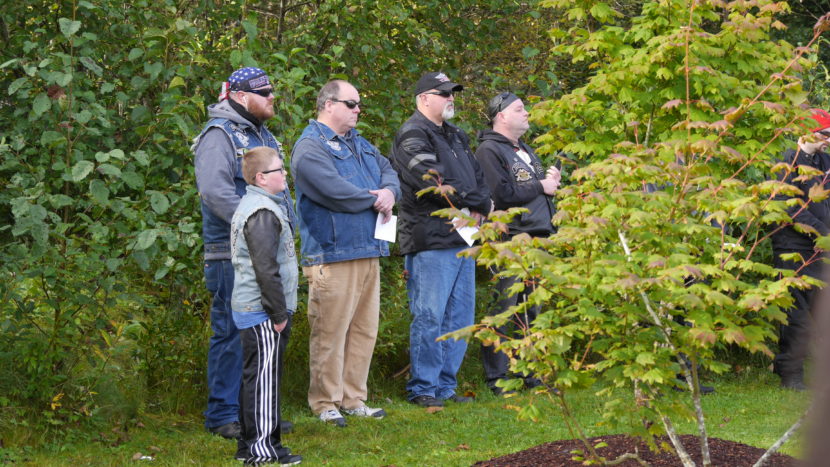
Members of the Southeast Alaska Hog Chapter watch the 9/11 memorial service on Sunday. (Photo by Quinton Chandler/KTOO)
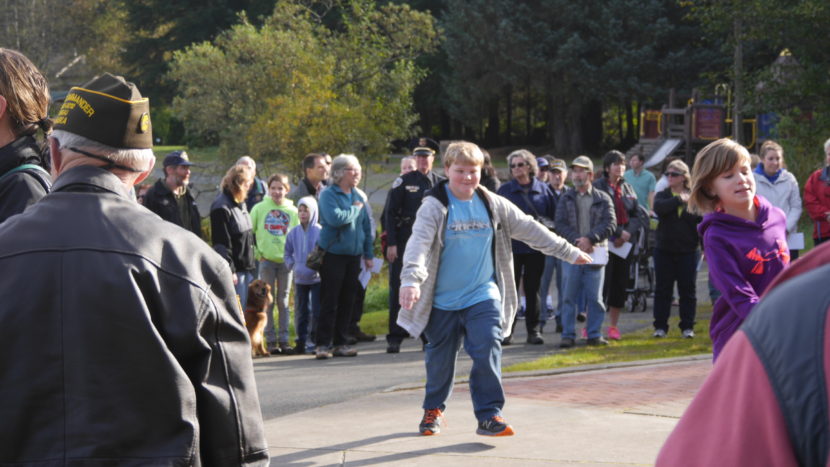
(Photo by Quinton Chandler/KTOO)
JPD Honor Guard marches to the memorial to raise the flag on Sunday. (Photo by Quinton Chandler/KTOO)
Flag flies at half-staff. (Photo by Quinton Chandler/KTOO)
Mayor Ken Koelsch bows his head after laying the ceremonial wreath at the base of the memorial. (Photo by Quinton Chandler/KTOO)
(Photo by Quinton Chandler/KTOO)
JPD Honor Guard returns to position after escorting flag. (Photo by Quinton Chandler/KTOO)
Capital City Fire/Rescue firefighter Andrew Bishop reads about the significance of the September 11 Memorial Monument. (Photo by Quinton Chandler/KTOO)
Catholic nuns attend visitors at the Missionaries of Charity house in Kolkata on Aug. 26. (Photo by Bikas Das/Associated Press)
Hundreds of Catholics have been declared saints in recent decades, but few with the acclaim accorded Mother Teresa, set to be canonized by Pope Francis on Sunday, largely in recognition of her service to the poor in India.
“When I was coming of age, she was the living saint,” says the Most Rev. Robert Barron, the auxiliary bishop of the Archdiocese of Los Angeles. “If you were saying, ‘Who is someone today that would really embody the Christian life?’ you would turn to Mother Teresa of Calcutta.”
Born Agnes Bojaxhiu to an Albanian family in the former Yugoslav republic of Macedonia, Mother Teresa became world-famous for her devotion to the destitute and dying. The religious congregation she established in 1950, the Missionaries of Charity, now counts more than 4,500 religious sisters around the world. In 1979, she was awarded the Nobel Peace Prize for her lifetime of service.
Humanitarian work alone, however, is not sufficient for canonization in the Catholic Church. Normally, a candidate must be associated with at least two miracles. The idea is that a person worthy of sainthood must demonstrably be in heaven, actually interceding with God on behalf of those in need of healing.
In Mother Teresa’s case, a woman in India whose stomach tumor disappeared and a man in Brazil with brain abscesses who awoke from a coma both credited their dramatic recovery to prayers offered to the nun after her death in 1997.
“A saint is someone who has lived a life of great virtue, whom we look to and admire,” says Bishop Barron, a frequent commentator on Catholicism and spirituality. “But if that’s all we emphasize, we flatten out sanctity. The saint is also someone who’s now in heaven, living in this fullness of life with God. And the miracle, to put it bluntly, is the proof of it.”
No other Christian denomination posits this notion of an individual in heaven mediating between God and humanity.
“It’s not a little supernatural, it’s completely supernatural,” says the Rev. James Martin, S.J., whose book, My Life with the Saints, recounts his own spiritual journey. “But that’s the difficulty a lot of people have with religion. The invitation is to say, ‘There’s something more than the rational mind can believe, and are you OK with that?’ ”
Roman Catholic authorities embrace the idea of miracles from heaven with such confidence that they invite skeptics to challenge them. Before candidates qualify for sainthood, the miracles attributed to them must be proven. If someone is suddenly healed after praying to a would-be saint, the Vatican has doctors verify there’s no medical reason for it.
A group advocating sainthood for Marguerite d’Youville, a nun who lived in 18th century Canada, for example, sought an alternative explanation for the sudden recovery of a woman with incurable leukemia who had prayed to the nun 200 years after the nun’s death. The assignment went to Dr. Jacalyn Duffin, a hematologist at Queen’s University in Ontario.
Duffin agreed to do the investigation, but only after warning the group that she was not herself a believer.
“I revealed my atheism to them,” Duffin says. “I told them my husband was a Jew, and I wasn’t sure if they’d still want me. And they were delighted!”
The group reasoned that if Duffin, as an atheist, found there was no scientific reason the woman should have recovered, who could doubt it was a miracle? In fact, after her investigation of the woman’s recovery, Duffin agreed that the woman’s healing was — for lack of a better word — miraculous.
Intrigued by the experience, Duffin investigated hundreds of other miracle stories chronicled in the Vatican archives in Rome. She came away convinced that “miracles” do indeed happen.
“To admit that as a nonbeliever, you don’t have to claim that it was a supernatural entity that did it,” Duffin says. “You have to admit some humility and accept that there are things that science cannot explain.”
A few miracle stories in recent years have involved nonmedical situations, such as when a small pot of rice prepared in a church kitchen in Spain in 1949 proved sufficient to feed nearly 200 hungry people, after the cook prayed to a local saint. More than 95 percent of the cases cited in support of a canonization, however, involve healing from disease.
Hard-core rationalists would not be likely to see such cases as evidence of a “miracle,” even while acknowledging they have no alternative explanation. Devout Catholics, on the other hand, readily attribute such occurrences to God, no matter how mysterious they may be.
“In a sense, it’s a little arrogant of us to say, ‘Before I can believe in God, I need to understand God’s ways,’ ” says Martin. “To me, that’s kind of crazy, that we could fit God into our minds.”
Canonization procedures have undergone a series of reforms in recent years. Pope Francis has instituted changes to make the promotion of a candidate less subject to organized lobbying efforts. In fact, Vatican authorities routinely interview at least a few people who doubt the suitability of someone for sainthood. (Among those contacted during the early stages of Mother Teresa’s review was Christopher Hitchens, who wrote a highly critical assessment of Mother Teresa’s work, calling her “a fanatic, a fundamentalist and a fraud.”)
The miracles requirement has also changed over time. In 1983, John Paul II reduced the number of miracles required for sainthood from three to two, one for the first stage — beatification — and one more for canonization.
Some Catholic leaders have called for the miracles requirement to be dropped altogether, but others argue vigorously against this. Bishop Barron says that without the miracles requirement for sainthood, the Catholic Church would offer only a watered-down Christianity.
“That’s the trouble with a liberal theology,” Barron says. “It tends to domesticate God, make everything a little bit too neat and prim and tidy and rational. I kind of like how the miraculous shakes us out of a too-easy rationalism. We’ll affirm everything great about modernity and the sciences, but I’m not going to affirm that that’s all there is to life.”
In one sense, the sainthood of Mother Teresa may speak to present-day Catholics in a way previous canonizations did not. Martin, editor of the Jesuit magazine America, notes that in a posthumously published collection of her private journals and letters, Mother Teresa: Come Be My Light, the nun so widely revered for her spiritual purity acknowledged that she did not personally feel God’s presence.
“In my soul I feel just that terrible pain of loss,” she wrote, “of God not wanting me, of God not being God, of God not existing.”
Martin says Mother Teresa dealt with such pain by telling God, “Even though I don’t feel you, I believe in you.” That statement of faith, he says, makes her example relevant and meaningful to contemporary Christians who also struggle with doubt.
“Ironically,” he says, “this most traditional saint becomes a saint for modern times.”
Copyright 2016 NPR. To see more, visit http://www.npr.org/.
Poet Max Ritvo who chronicled his long battle with cancer has died. He was 25. Judith Eigen Sarna/AP
Max Ritvo, a poet who chronicled his long battle with cancer in works that were both humorous and searing, has died. He was 25.
Ritvo died Tuesday morning at his home in the Brentwood area of Los Angeles, his mother, Ariella Ritvo-Slifka, said Friday.
Ritvo was diagnosed at 16 with Ewing’s sarcoma, a rare cancer that affects bones and soft tissue in children and young adults.
Treatment brought about a remission that permitted Ritvo to finish high school and attend Yale University, where he performed in an improv comedy group. His teachers included Pulitzer Prize-winning poet Louise Gluck.
Ritvo’s cancer returned in his senior year, but he completed Yale and this year earned a master’s degree from Columbia University.
Ritvo’s battle with the disease informed his works. A June poem in The New Yorker discussed an experiment where cells from his tumors were used in cancer drug treatment experiments with mice.
“I want my mice to be just like me,” Ritvo wrote. “I don’t have any children. I named them all Max. First they were Max 1, Max 2, but now they’re all just Max. No playing favorites.”
Ritvo’s first book of poetry, “Four Reincarnations,” is scheduled to be published this fall.
In radio and podcast interviews, Ritvo spoke about his suffering. But he rejected any idea that he was a victim of the disease – especially a heroic one.
At their wedding last summer, Ritvo and his wife, Victoria, banned words such as “inspirational” from the speeches, his mother said.
“He was about love and compassion, human and animal rights and about writing and sharing himself with the world,” she said. “He didn’t want people to see him as an invalid.”
Ritvo saw humor not as a coping mechanism but as an intrinsic part of dealing with his illness.
“You know, we imagine in our hysteria that it’s disrespectful for the sadness. But when you laugh at something horrible, you’re just illuminating a different side of it that was already there and it’s not a deflection, it makes it deeper and makes it realer,” he said last month in the WNYC Studios podcast “Only Human.”
Ritvo also inspired people with his attitude, his wife said.
“Max said ‘I love you’ to everyone. He hugged everyone. He just wanted there to be more love and laughter,” she said.
Ritvo was writing until several days before his death and had told his family that the end would be near when he was no longer able to write.
The day before his death, he told his mother and wife: “I can’t write anymore, I can’t speak, I can’t breathe … I’m not me … You guys have to be OK with me going,” his mother said.
Copyright 2016 NPR. To see more, visit http://www.npr.org/.
Deacon Herman Madsen plays the bells atop St. Michael’s Cathedral. (Katherine Rose, KCAW)
The bells at St. Michael’s Cathedral in Sitka are ringing again after a temporary hiatus, thanks to a new deacon with musical abilities and no fear of heights.
The bells of the Russian Orthodox church haven’t been played for a while.
That is, until Deacon Herman Madsen showed up.
“I always use the example of the medical field,” Madsen said. “The priest is like a doctor and the deacon is like the nurse to the doctor.”
He and his wife, Mary, moved here at the beginning of the summer to help with tours at the church and assist Father Michael.
It wasn’t always Herman’s plan to work for the Russian Orthodox Church.
“I was a wild child, I grew up with my grandmother,” Madsen said. “My mom and my dad sort of abandoned me. So my grandmother, at 70 took care of me. I nearly ended up in jail, but then my grandfather stuck out his neck for me.”
After spending 11 years at the academy, he debated joining the seminary for quite a while, but didn’t fully commit to the idea until he had an experience at the tomb of St. Herman in Kodiak.
“All of a sudden right next to this tree where St. Herman’s hut used to be,” Madsen explained. “Incense just started pouring out of the ground, and the smell of St. Herman’s relics, surrounded me.”
Deacon Herman said it smelled of roses.
It was unmistakably a religious calling.
“I just hit the deck and said i really need to go to the seminary, I don’t have any choice at this point,” Madsen said.
He’s been in the seminary for three years. Though he has a background in music and performance, playing the bells was a new adventure.
“When I got here there was no one really playing the bells at the time. So I just started taking it up and doing it every day at noon,” Madsen said. “I didn’t take any official classes on bell ringing. Because of my background in singing and playing instruments I had an ear for that kind of thing. I also played the spoons.”
So playing the bells wasn’t too much of a stretch. There are eight bells, a full octave, which makes it easier.
“It’s really nice on sunny days, come up here and read a book,” Madsen said. ‘Whew!”
The bells themselves have an interesting history.
They were made in Holland, and ordered by the Russian American company in St. Innocent. They lasted up to 1966, when an accidental fire broke out and destroyed the cathedral.
“In the fire these bells melted into clumps of metal,” Madsen said. “The men in the community gathered up all the metal, had them resent back to the original foundry, and these bells were recreated from the originals metal.”
The church was rebuilt based on 1961 drawings of the old cathedral, and featured its signature green domes and golden crosses.
Each bell is connected to a thin string, a bit thicker than a strand of yarn. Those strings connect to a podium with holes in it. The two largest bells are attached to two huge wooden pedals.
Madsen plays the bells a little like bongos.
“Instead of pulling the strings, I tap all of the strings, and that’s why I can play it so fast, and in so many different ways. That’s why they sound so awesome,” Madsen said, laughing. “You get some pretty awesome exciting bell ringing that happens that gets you kind of pumped up. It’s really kind of fun.”
Herman and his wife will leave Sitka at the end of the summer with plans to come back next year, and hopefully make Sitka their home.
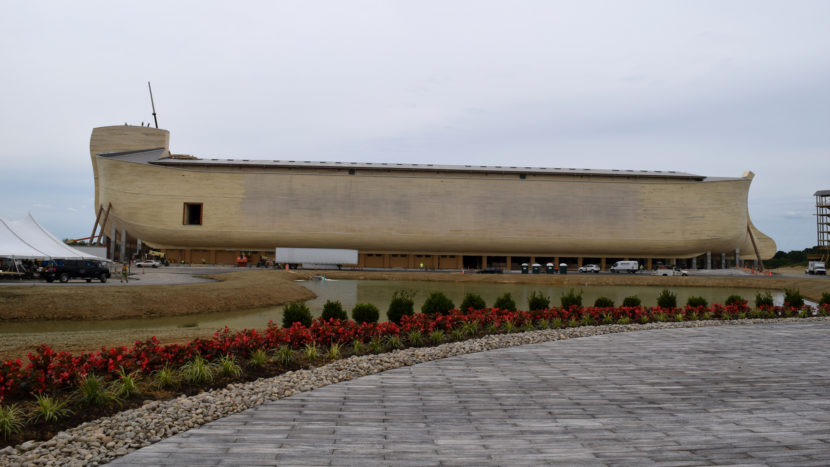
The Ark Encounter is slated to open in Williamstown, Ky., on Thursday, July 7, a nod to Genesis 7:7, which tells the story of Noah and his family entering the ark. (Photo by Ashley Westerman/NPR)
A replica of Noah’s Ark has been built in the rolling hills of northern Kentucky and it is, quite literally, of biblical proportions. The wood structure stands seven stories high and is the length of 1 1/2 football fields.
“The Bible indicates the original Ark was 300 cubits, using the Hebrew royal cubit that calculates in modern-day terms to 510 feet long,” says Mark Looey, a co-founder of Answers in Genesis, the Christian ministry that built the attraction. It’s the same group that opened the Creation Museum in 2007 in Petersburg, Ky., which promotes a literal interpretation of the Bible and other teachings: that planet Earth is only 6,000 years old and that man lived alongside dinosaurs.
The ark attraction has been mired in controversy for years, and though Answers in Genesis promises jobs and increased tourism to a region in desperate need of an economic boost, for many who live there, it’s very much a mixed blessing.
‘After The Flash And Bang’
The ark offers three decks of exhibits so sophisticated, you might think you stepped into Disney World.
There are no live animals on the ark, though. “There’s a zoo out back for them,” Looey says. Instead, the ark will be filled with lifelike models of animals — including dinosaurs and a pair of unicorns — designed by many of the people who also made exhibits for the Creation Museum.
The ark doesn’t float either. Ken Ham, Answers in Genesis and Ark Encounter president and CEO, says it wasn’t built to float. “We built it as a reminder, a reminder in regard to God’s word and the account of Noah and the flood,” he says.
It cost $100 million to build and is expected to draw up to 2 million visitors a year along with millions in tourism revenue, according to what the ministry calls an independent study. Looey says they’ve already hired over 300 staff and hundreds more jobs are on the way when the other phases — including a walled city and a replica of the Tower of Babel — are completed.
Many in Williamstown, Ky., the small town that sits right across Interstate 75 from the attraction, are waiting for it to open with bated breath. The town — the rural seat of Grant County, Ky., — has a population of about 4,000. It’s a middle-class bedroom community right between Cincinnati and Lexington, Kentucky.
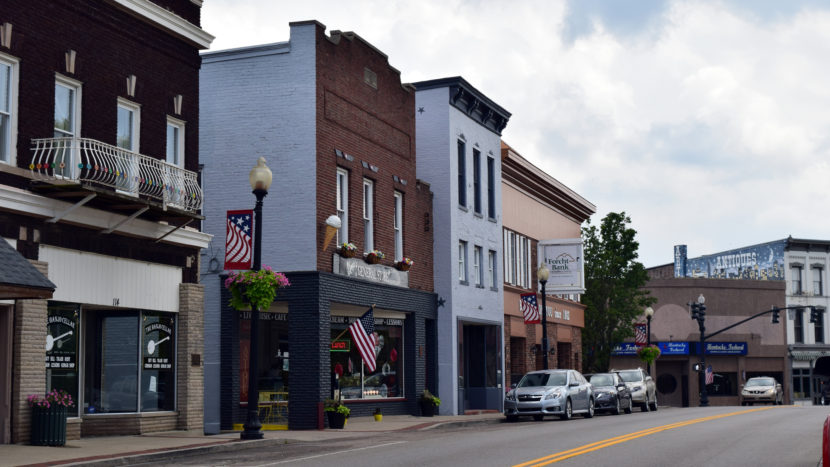
Williamstown Mayor Rick Skinner, an enthusiastic supporter of the attraction, says the town has already upgraded its electricity and built a new water treatment plant. Downtown is also getting a face-lift. On Main Street, many new stores have already opened up while others are in the process of being renovated. Before news of the Ark Encounter coming to town, the old brick buildings that lined Main Street were mostly vacant.
News of the Ark Encounter has sparked a rehab of the old brick buildings on Main Street in Williamstown, Kentuck. (Photo by Ashley Westerman/NPR)
Local lawyer Bill Adkins says when the recession hit Williamstown, it hit hard. He remembers sitting in foreclosure settlements almost every week.
According to the study cited by Answers in Genesis, the ark’s economic impact will be about $4 billion over the next decade. But Adkins is skeptical.
“We’ve not seen the hotels, we’ve not seen the restaurants coming in to support this attraction,” he says. “I think a lot of people are waiting to invest because they want to see if after the flash and bang of the opening, what happens next.”
Answers in Genesis points to the success of the Creation Museum as proof of the ark’s potential. The ministry says the museum gets 300,000 visitors a year and that its generated revenue has exceeded expectations, though they would not provide numbers.
Then there are controversies around the project, provoking debate over separation of church and state. The state withdrew tax incentives it had awarded Answers in Genesis, in part, because the ministry refused to pledge that it would not discriminate on the basis of religion in its hiring. The state said the project had evolved from a tourism attraction to an extension of the ministry.
The tax breaks were later reinstated after Answers in Genesis, which said it had the right to hire on the basis of religion, sued in federal court and won.
Adkins is uncomfortable with the tax breaks worth up to $18 million the ministry is getting from the state. Answers in Genesis is considered a tax-exempt church and critics of the ark project have said that getting tax breaks amounts to “double dipping.”
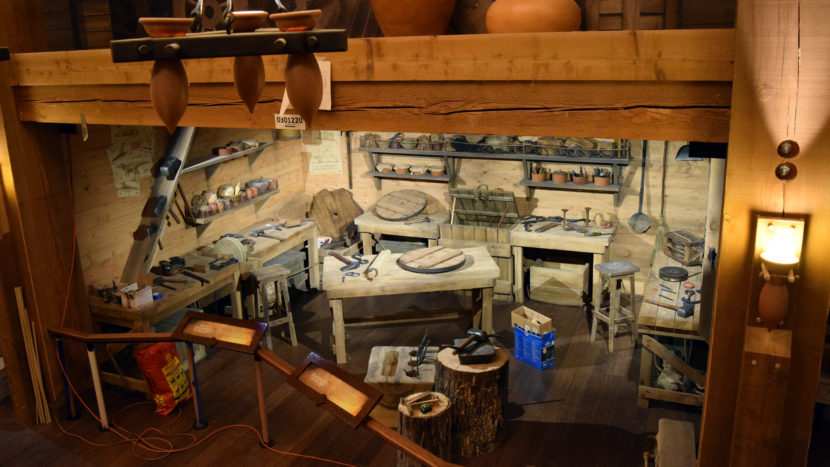
An exhibit showing an ancient workshop inside the Ark Encounter, a replica of Noah’s Ark opening soon in northern Kentucky. (Photo by Ashley Westerman/NPR)
It also just doesn’t sit well with him that job applicants must adhere to the ministry’s rigid moral code and belief system.
“That one would have to subjugate their own beliefs to comply with that of an employer,” he says, “that seems very intrusive and very oppressive to me.
A federal judge earlier this year ruled that Answers in Genesis, as a religious group, has a right to restrict its hiring.
Resident Jay Novarra is irked at local leaders. Along with providing the project with free land, Williamstown also gave Answers in Genesis $62 million in bonds. The ministry says the town will not be on the hook for those.
As a farmer, Novarra is worried about the price of water going up since the town is also providing water to the ark.
“We do have a lot of people who make a living farming and you start adding to the price we have to pay to raise our food, then you’re definitely impacting farmers,” she says. “And I have to ask myself: What is that farmer getting out of it?”
Mayor Skinner says there is no contingency plan. They’re putting all their eggs in one basket — kind of like Noah.
Copyright 2016 NPR. To see more, visit http://www.npr.org/.
Close
Update notification options
Subscribe to notifications
Subscribe
Get notifications about news related to the topics you care about. You can unsubscribe anytime.

9(MDEwMjQ0ODM1MDEzNDk4MTEzNjU3NTRhYg004))
 No other Christian denomination posits this notion of an individual in heaven mediating between God and humanity.
9(MDEwMjQ0ODM1MDEzNDk4MTEzNjU3NTRhYg004))
9(MDEwMjQ0ODM1MDEzNDk4MTEzNjU3NTRhYg004))
9(MDEwMjQ0ODM1MDEzNDk4MTEzNjU3NTRhYg004))