Spirit

Kenai assemblyman drops proposed ordinance to remove prayer from meetings

An ordinance that would have removed the invocation, or prayer, from the start of Kenai Peninsula Borough Assembly meetings proved to be such a hot topic that it was dropped before even being officially taken up.

Assembly President Blaine Gilman said he proposed the ordinance in response to recent complaints from members of the public that prayer as part of a public meeting was inappropriate. And also that the invocation, as practiced, seemed exclusionary to non-Judeo-Christian faiths, since that’s all that is represented.

Gilman, who represents Kenai, said his answer was to open the invocation up to anyone interested.

“I think the direction to go is to be broad-based, respectful of all faiths, and it’s first come, first served. And if there’s Muslims in this community who want to give an invocation, if there are people who are from Frontier Freethinkers, if there’s a Hindu person who wants to give an invocation, we should be open to that,” Gilman said.

Not everyone agreed with that idea, though, and the ordinance drew vehement opposition during public testimony, including from Joan Corr, who lives near Soldotna.

“I wouldn’t want a Muslim here. This country was not founded under Allah. It was founded under lord God almighty Jesus Christ, and so if I want to worship Allah and force that on everybody, I can just go back over to the (Middle East), but this country was founded under God,” Corr said.

The measure was up for introduction at the June 21 meeting. Local Christians spoke out to keep the prayer going.

“Our religious freedom has enabled us to express, not repress, our core religious beliefs,” said Dr. Keith Hamilton, of Soldotna. “… Alaskans in this borough are given the privilege of seeking the help of God, or some people would call a higher power, as we deliberate what is best for us all.”

Hamilton pointed out that the Supreme Court ruled in 2014 that an invocation prayer in a public governmental meeting is constitutional.

Alan Humphries, the pastor of Soldotna Bible Chapel, said he believes that people have a universal need for prayer.

“One of the most hilarious things for me is the most atheistic, liberal, gun-hating American, the first thing when someone breaks (into) their house, the first thing they do is call somebody with a gun, and the second thing they do is pray to God they get there quick enough. Everybody prays. To say we don’t need prayer and we don’t believe in God is an illusion,” Humphries said.

He suggested that the assembly codify a definition of invocation as one invoking a deity that seeks to support the assembly, not do it harm, giving leverage to exclude Satanists, for example.

Albert Weeks, a former military chaplain and pastor of First Baptist Church in Kenai, suggested only allowing invocations from those who are authorized by a larger, recognized organization.

“Yes, open it up to everybody, but they need to be recognized members that are duly ordained by their organization that is vetted in this group,” Weeks said.

Homer Assembly Member Kelly Cooper said the assembly should try to be more inclusive.

“It appears to me — based on the way our language is — that we shouldn’t look how we can narrow that definition and exclude groups, we should be looking at how we can broaden that language,” Cooper said.

South Peninsula Assembly Member Willy Dunne argued for the introduction of the ordinance to allow an official public hearing on the matter.

“I know people have very strong feelings about this and I would urge my fellow assembly member to at least vote for introduction and that gives a chance for more discussion and more public input. We’ve heard from a very small cross-section of the Kenai Peninsula residents tonight,” Dunne said.

He noted that an invocation is not a universal practice. The Homer City Council no longer does one, he said. Neither does the Kenai, Soldotna or Seward city councils.

After spending more than a half-hour on the topic, the assembly voted four to four on introducing the ordinance, meaning it failed.

Statewide, the Kodiak, North Slope, Northwest Arctic and Wrangell borough assemblies incorporate an opening prayer in their meetings, and the Fairbanks North-Star Borough has what it calls a “non-sectarian” invocation. None of the other 13 other borough assemblies in the state open their meetings with a prayer.

Observing the fast of Ramadan in the land of the midnight sun

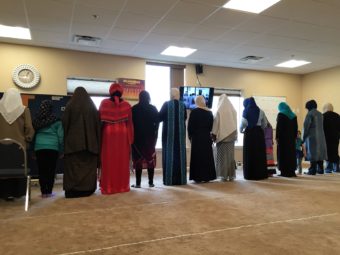
Women pray at the masjid in Anchorage. (Photo by Anne Hillman/KSKA)

The Muslim holy month of Ramadan, when Muslims fast from sun up until sun down, is drawing to a close. Since Islam follows the lunar calendar, the dates of the fast change every year. This time around, it falls on the longest days of summer in Alaska, when the sun hardly sets. But for some local Muslims, that’s not the obstacle they worry about.
As soon as the call to prayer begins at the masjid, or mosque, in Anchorage, Faten Najjar offers me a plate of dates.

“What we keep doing, the first thing, we keep eating dates,” she explains. “And then we drink water, and then we pray.”

We chew on our fruit then head into the small room where the women pray. This evening, Najjar, her daughter and I are alone. They face a TV screen that shows what the religious leader is doing in the men’s room. In Islam, men and women pray separately.

After a few minutes, it’s time to really eat. The table is filled with large dishes of fish, meats and rice, many of which Najjar cooked to share. This is a time of joy for her.

“When I fast, I feel … like rest between me and God. I feel what I’m doing now, cooking, I feel happiness with this.”

We settle down to eat, but here’s the catch. It’s only a little after 7 p.m., and the sun is still up. Youssef Barbour, one of the masjid’s religious leaders, explains that for communities in the far north, with extreme daylight hours, Muslim scholars decided it was OK to follow the sunlight clock for Mecca, Islam’s holiest city. That means fasting for about 15 hours, not 19.

“We like to follow the Prophet Muhammad’s laws [peace be upon him] and everything he does,” he says. “So we find ourselves here in Alaska, in a place that we know that the Prophet Muhammad has never been in such a place, and so to fast until sunset, according to the sun and not according to the tradition is really a guess. What would the Prophet Mohammed do if he really was in such a place?”

Barbour says some people follow local time and others follow Mecca; it depends on what feels right to each person. He says the timing isn’t as important as the fast itself, which helps people become more conscientious of God. And when people fast together as a community during Ramadan, which is also a season of blessing and forgiveness, they are supported through the struggle.

Community members bring food to share during iftar, or the nightly breaking of the fast of Ramadan. (Photo by Anne Hillman/KSKA)

This is Aisha Jackson’s first fast. She just converted to Islam four months ago. “It’s going good. I’m very, very happy. I feel great. Alhamdulillah. Let’s just say it was hard at first, but now I’m OK.”

This year, Jackson decided to fast by Mecca time, but she doesn’t think she will in the future. “I just feel that this, this is good, but I think Allah put you where you are supposed to be and you should be going with where you’re supposed to be but he knows where you are so he wouldn’t do anything too hard for you. So, I think, Insha’Allah [God willing], I’ll do Alaska or local time.”

For Jackson, her biggest challenge isn’t the fast. It’s working up the courage to wear her hijab, or headscarf, in public.

“Yeah, with everything that’s in the world you know…It makes me a little fearful. Insha’Allah, God will make it right.”

Najjar expresses similar concerns. She doesn’t wear her hijab to work because people look at her differently, and she’s scared that she could be fired. Her friends have similar fears and have been harassed for covering their hair. She says she already hears many negative comments about Islam and violence, especially in the wake of the Orlando attack.

“Always ‘Muslim, Muslim, Muslim. Muslim bad.’ What can I do?” she sighs. “I get quite. I get hurt feeling.”

Islam does not condone violence, especially against innocent people.

Another family, who follows local time for the fast, decided not to be part of this story because they also feared community backlash against Muslims.

Despite these feelings of unease in public, Najjar still comes to the masjid every night to break the fast and pray with others.

“I will be so sad when Ramadan over. Because this is the month that God [grants] forgiveness. This is the month that God will give more hasana, more good blessing to the person.”

For Najjar and others, it’s a time for community and connection, when a long summertime fast isn’t a burden, but a blessing.

Conservative Christians Grapple With Whether ‘Religious Freedom’ Includes Muslims

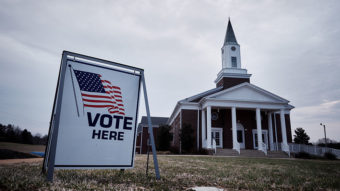
Residents vote in the South Carolina Republican presidential primary election at the Cross Roads Baptist Church in Greer, S.C., on Feb. 20. T.J. Kirkpatrick/Bloomberg via Getty Images
Residents vote in the South Carolina Republican presidential primary election at the Cross Roads Baptist Church in Greer, S.C., on Feb. 20.
T.J. Kirkpatrick/Bloomberg via Getty Images

Religious liberty is a rallying cry for many evangelical voters, and it has been popping up repeatedly throughout this presidential campaign. But in the current political climate, some conservative Christians are struggling with how to apply religious freedom to other faiths — like Islam.

Texas Sen. Ted Cruz made religious freedom a hallmark of his failed campaign for the Republican nomination. Now, presumptive nominee Donald Trump is picking up the theme.

“Religious freedom. The right of people of faith to freely practice their faith. So important,” Trump said in a June 10 speech in Washington, D.C., to members of the Faith and Freedom Coalition.

On June 21, in a room full of evangelical leaders in New York City, Trump again promised to protect religious freedom. The presumptive GOP nominee said if he’s elected, “people are going to say ‘Merry Christmas’ again.”

For decades, fights over religious liberty in the U.S. have mostly been about the religious liberties of Christians. Evangelicals have rallied around issues like prayer in public schools, and more recently, whether conservative Christian vendors should be required by law to provide services for same-sex weddings.

But now, as the nation’s small but growing Muslim population gains a higher profile, other questions are emerging, including debates in several communities over the right to build mosques.

Pastor John Wofford of Armorel Baptist Church in northeast Arkansas raised that question at a national meeting of Southern Baptists this month.

“I would like to know how in the world someone within the Southern Baptist Convention can support the defending of rights for Muslims to construct mosques in the United States when these people threaten our very way of existence as Christians and Americans?” Wofford said. “They are murdering Christians, beheading Christians, imprisoning Christians all over the world.”

It had been just days since a gunman who had pledged loyalty to ISIS shot and killed 49 people at a gay nightclub in Orlando. The gunman was also killed.

In response, Southern Baptist leader Russell Moore warned that letting the government restrict Muslims could lead to restrictions on Christians. He believes Christianity is the only true faith, and people must choose it freely.

“Sometimes we have really hard decisions to make — this isn’t one of those things,” Moore said. “What it means to be a Baptist is to support soul freedom for everybody.”

Moore leads the Southern Baptist Convention’s Ethics and Religious Liberty Commission, which recently signed on to a legal brief supporting the right of a group of Muslims in New Jersey to build a mosque. His answer was met with enthusiastic applause — but he has also faced criticism from some fellow conservatives, including Wofford.

On a recent Sunday morning, after a fire-and-brimstone sermon, Wofford said he believes the U.S. Constitution protects all religions, including Islam. But Wofford doesn’t believe Southern Baptist leaders, who draw their salaries from dues paid by local congregations, should be advocating for the rights of Muslims.

“So what I am actually doing if I support and defend the rights of people to construct places of false worship, I am helping them go to hell. And I do not want to help people go to hell,” Wofford said.

Some Christian groups dedicated to defending religious freedom argue for equal treatment for all faiths, out of the principle that discriminating against one religion could threaten them all.

“It’s a double-edged sword,” said Matt Staver, founder and chairman of Liberty Council, which focuses on religious freedom litigation on behalf of Christians but has also represented at least one Jewish client.

“Religious freedom is for all of us or it’s for none of us,” Staver said. “If we want to pick and choose, what’s the standard? And if it’s only that might makes right, then that means it’s a political struggle and whoever is the ruling class at any particular time, they’re the ones that have their say.”

In a tense presidential election year, such debates have a tendency to become political. After the meeting with Trump in New York last week, several evangelical leaders held a press conference, where they praised Trump’s promise to protect religious liberty.

Asked how that pledge applies to Muslims, conservative columnist Ken Blackwell responded that he favors freedom for all faiths, but his primary concern is the rights of Christians.

“I was more interested in hearing Donald Trump say that he was willing and ready to defend religious liberty not just for Christians, but including for Christians, in the public square,” he said.

Pressed on Trump’s call to temporarily ban Muslim immigration — a proposal that has appeared to shift over time, but which Trump has yet to explain in detail — Blackwell said that issue will be part of an ongoing “conversation” between Trump and evangelical leaders. He said many conservative Christians see the real estate developer as more favorable to their concerns about religious freedom and other issues than his Democratic rival, Hillary Clinton.

“We’re not going to, in fact, throw him overboard” over the Muslim ban issue, Blackwell said.

Copyright 2016 NPR. To see more, visit http://www.npr.org/.

First Buddhist temple in Alaska consecrated in Anchorage

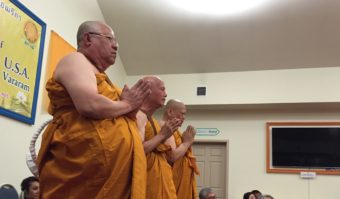
Three new monks wait for questions during the first official Buddhist monk ordination in Alaska. (Photo by Anne Hillman/KSKA)

For the first time in Alaskan history, a Thai Buddhist temple in Anchorage has been fully consecrated or made holy. It was a landmark event for Buddhists from the state and around the world.
A monk from Thailand speaks to the packed small sanctuary over a mic, a massive gold Buddha shining from the wall behind him. People spill out the door, smartphones held high, trying to get photos of the high-ranking monks in their deep orange robes. The crowd responds in unison to his words and actions.

They’re watching the official consecration of the temple when the room on the side of an old log house in midtown Anchorage transforms from a human space for prayer and meditation to a holy space the Buddha can enter. The temple has been there for 20 years, but before it could only be used for limited purposes, like meditation.

During the ceremony nine granite balls called loknimit are buried around the sides and center of the temple to mark the sacred space.

In the hallway by the door, one of the balls is suspended over a hole. It’s covered in bits of gold leaf and coins held on with Vaseline.

Chollada Jarupakorn, who comes to Wat Alaska Yanna Vararam to meditate, says donating to the temple and applying the gold leaf is an honor. “They believe if they do that then next life they will have a good life,” she explains. “Or even this life. You know, you are doing a good deed.”

And it has other perks.

“Because the name of that stone is loknimit, you can always make a wish.” She wished for a happy life.

The ball has been hanging over the hole for more than two years now, waiting for the official consecration.

When it’s finally time, Hukkee Edmonds, from Thailand, approaches the ball with an ornate curved blade and starts hacking away at the thin, dried vines, called rattan, that hold it up. The crowd claps and cheers as she cuts away at the holder, then the ball drops into the hole with a soft thud.

Edmonds’ excitement is palpable; even when the crowd wanders away, she has trouble finishing her sentences.

“I’m so happy. So happy that’s all.”

even men await their ordination as full monks at Wat Alaska Yanna Vararam in Anchorage. (Photo by Anne Hillman/Alaska Public Media)

Edmonds traveled almost 24 hours just for the three-day event. Only one temple is consecrated per year in this sect of Buddhism, and many people say it’s a rare honor to be able to attend. This year it’s in Alaska, next year in Arkansas. The event attracts lay people and monks from around the world.

Edmonds and her friends raised more than $4,300 for the temple and for the honor of releasing the ball. For her, it’s an event of a lifetime.

The ceremony also marked the first time that Buddhist monks could be officially ordained in Alaska.

Seven soon-to-be monks gather in the temple for their ordination, dressed all in white, and join in chants. Before changing into their official orange robes, they must accept the 227 rules of their new lives.

Pensri Boonsuwane, a temple ambassador from North Carolina, says becoming a monk is a great honor for the men and their families – but it’s not easy.
Among the 227 requirements are “Thou shall not kill, not steal, not commit adultery, or in this case no sex. Not lying or talk too much and not use the bad word. And no drinking. Cannot eat after 12. And also cannot sing or dance.”

Many of the new monks are old men who gave up their previous lives, including marriages, in order to be ordained. Two of them will stay in Alaska with the monks who already live at the Wat.

Kiehl proposes ordinance to outlaw LGBT discrimination in Juneau

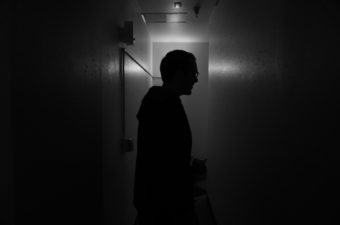
Matt Magnusson silhoutte bw 2016 06 17
Matt Magnusson gives a tour of the Catholic Community Service’s Family Resource Center in a wing of St. Ann’s Center on Friday. He jokes that this hallway is haunted. (Photo by Jeremy Hsieh/KTOO)

In an old hospital cafeteria, voices and footsteps echo off the nearly bare walls and empty offices. Toys and big stuffed animals are strewn about in various states of packing.

Matt Magnusson is showing me around a wing of St. Ann’s Center where Catholic Community Service ran its youth behavioral health program, which is shutting down because grant funding dried up.

Matt Magnusson and Molly McCarville 2016 06 17
Matt Magnusson and Molly McCarville are among the last employees at Catholic Community Service’s Family Resource Center in Juneau. The center is shutting down at the end of the month because grant funding dried up. (Photo by Jeremy Hsieh/KTOO)

It’s where the 20-year-old has worked for about a year and a half. He helped kids with issues like post-traumatic stress disorder, reactive attachment disorder and bipolar disorder.

Catholic doctrine teaches that homosexuality is also a disorder, and acting on it is immoral. As an openly gay man who doesn’t identify with any religion, you’d think Magnusson would have to navigate a minefield of identity politics at work.

Matt Magnusson desk 2016 06 17
(Photo by Jeremy Hsieh/KTOO)

“Through talking with my friends and other gay people, they have a lot of problems sometimes with their jobs,” Magnusson said. “And I’ve never once had a complaint working here when it comes to my sexuality. Which, that’s a really wonderful thing to be able to say as a gay person. A lot of times people have nowhere close to that experience, which is horrible. To come to the place where you spend most of your time during your life and be discriminated against, that’s just an awful thing.”

That’s also in keeping with Catholic doctrine that discourages “unjust discrimination” toward gay people. Vatican bishops advise receiving gay parishioners with respect and sensitivity.

However, Magnusson’s nonprofit, which the bishop of the Catholic Diocese of Juneau can influence through its governing board, would be within its rights to fire him simply for being gay.

The Juneau Assembly wants the public to weigh in on a proposed ordinance that would make that illegal. The equal rights ordinance would outlaw many forms of discrimination, including that based on sexual orientation and gender identity. With a few exceptions, it would apply to public institutions as well as private sector businesses, employers, schools, and housing and lending institutions.

What: Juneau Assembly Committee of the Whole on proposed equal rights ordinance
Where: Assembly Chambers at City Hall, 155 S. Seward Street
When: 6 p.m. Tuesday, June 21

Deputy Mayor Jesse Kiehl introduced the measure last week.

Agencies like the Alaska State Commission for Human Rights enforce anti-discrimination laws based on race, sex, age, religion and other traditionally protected classes.

“But they have a gaping hole when it comes to discrimination based on sexual orientation or on gender identity,” Kiehl said.

The 12-page ordinance he’s proposing would protect those new classes in addition to the ones already covered.

Kiehl2The ordinance would not create a new city agency to handle enforcement, but Kiehl said it would give victims of discrimination the grounds to take an employer, business, landlord, lender or other institution to court where state and federal laws don’t apply.

In the early ‘90s, the Juneau Assembly considered a similar measure. A watered down version eventually passed that was limited to job discrimination within the municipal government.

Kiehl thinks today’s Juneau is ready for broader protections.

“Since then, I think that we live in a world where people now realize that they know gay people,” he said. “Where, 20 some years ago, there was too much risk of physical violence against gay people for them to let it be known who they really are. And ultimately, that’s what we’re talking about, it’s discrimination based on who you really are.”

Magnusson, who grew up in Juneau, said for the most part the community’s been a loving and accepting place to be himself. For the most part.

“I’ve been in the store where I’ve heard people make comments under their breath behind me, and that’s just a part of being gay,” he said. “Whenever I go to Seattle, I can totally let my guard down. Like, I can walk with my boyfriend down the street holding his hand. No problem. Walking down the street in Juneau we won’t do because … we stand out too much. There’s locals that look at us. Even the tourists kind of notice it a little bit because it’s a different thing for Juneau, Alaska. It’s a small town, you don’t see that.”

He said Kiehl’s ordinance is necessary and welcome.

Kiehl said he’s shared the ordinance with faith leaders and thinks he’s crafted it in a way that won’t affect First Amendment religious freedoms. Like other communities that have tried this, he does expect some reluctance.

“There’s a lot of fear — but actually, no problems. So that’s what I suspect will come as we work to pass this,” Kiehl said.

The ordinance must go through the committee process before a final vote by the Juneau Assembly.

Celebration 2016 aims to renew youth engagement in culture

Grand Entrance to Celebration. (Photo by Heather Bryant/KTOO)
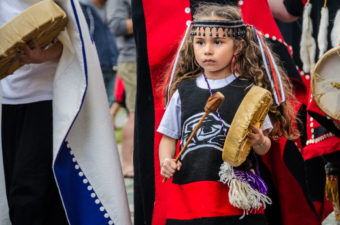
A young drummer at the grand entrance to Celebration 2014. (Photo by Heather Bryant/KTOO)

This year, in addition to Celebration’s core goal to engage Native youth, organizers in Juneau are promoting the convergence of multiple generations and cultures.

Every other year several thousand people travel to the state capital for Celebration, a four day event meant to renew appreciation for the Tlingit, Haida and Tsimshian cultures of Southeast Alaska.

The event is rooted in a desire to pass Southeast Alaska Native culture on to future generations.

Rosita Worl, president of the Sealaska Heritage Institute, said Celebration started with a group of elders who didn’t want their culture to be forgotten by their children.

Rosita Worl is president of the Sealaska Heritage Institute.

“They were so wise in knowing that our children were learning our culture in a very different way, not in a traditional clan house around the fire. They were learning it in schools,” Worl said.

Worl said the elders’ desire to adapt led to the start of Sealaska Heritage Institute and the institute, alongside community elders, held Juneau’s very first Celebration in 1982. The event is a party but Worl said it also teaches important lessons, for example:

“Songs are owned by clans. So we’re teaching about our Tlingit property law. We had a legal system that was very well developed and songs are like property. We own intellectual property. Even though you might be seeing singing and dancing, there’s a lot more that’s going on that’s being taught,” Worl said.

Worl said crests, like the designs on blankets, are also owned by clans. She said the crests, songs and stories teach lessons on Native history.

This year Celebration organizers are renewing their efforts to pass on that history to Native youth. There will be an art exhibit made specifically for young people and, Worl said, Celebration goers will see traditional Native clothes integrated into modern fashion.

“We don’t want our youth to think that our culture is a static culture (and) that it doesn’t change,” Worl said.

Worl is also excited for what she calls a promotion of “cross cultural diversity.” The Juneau Symphony will perform for the event and Worl recently found herself asking:

“’How many Tlingits do you know like Irish music?’” And somebody (said), ‘I do,’” Worl said.

An Irish group from Australia is scheduled to play throughout Celebration. Worl said sharing the event with everyone is an especially important part of the experience.

“I want our people to not only see the diversity within Alaska but also within the world,” Worl said.

Worl also hopes to share Celebration with all sectors of the Juneau community and Southeast Alaska.

Live television coverage of Celebration on 360 North and 360north.org begins at 6 p.m. Wednesday. Celebration coverage continues from 9 a.m. to 10 p.m. through Saturday. For more Celebration news coverage, go to ktoo.org/celebration.

Site notifications
Update notification options
Subscribe to notifications