Spirit

Finding help and hope to avoid suicide

(Photo by Matt Miller/KTOO)

After Monday morning’s incident in which a Juneau woman took her own life at the entrance of the Dimond Courthouse, we talked to local specialists about suicide issues.

James Gallanos is a prevention program coordinator with the Alaska Department of Health and Social Services’ Division of Behavioral Health.

In an interview that aired in three parts on KTOO’s Morning Edition program, Gallanos talked about the Careline Alaska, safe messaging by the media during coverage of a public suicide, how to talk or comfort those who may have witnessed a suicide, and what to listen for if a family member or friend is contemplating suicide.

Safe messaging

Gallanos said safe messaging by the media includes avoiding images which show the method or location of a suicide.

“How can we cover a story while, at the same time, use words and phrases that are less harmful, more hopeful and helpful for people affected by the loss,” Gallanos said.

Listen to part one of the interview about safe messaging:


Making sense of suicide

Gallanos said it’s not uncommon for everyone to experience some degree of shock while responding to a suicide.

“The biggest question we have around suicide is ‘Why? Why would someone take their life?'” Gallanos said. “That makes it difficult because that’s why suicide is such a profound loss. We don’t always have the answers to why someone takes their life.”

Listen to part two of the interview about talking to witnesses of a suicide:

(Since this interview with Gallanos on Tuesday, KTOO was able to determine that a group of children believed to be in the vicinity of the Dimond Courthouse during Monday morning’s incident was too far away to actually see what had happened.)


(Photo by Matt Miller/KTOO)

“Nobody cares about me. I won’t be around any longer to worry about it.”

Gallanos said many of those contemplating suicide are unlikely to say it directly, and many of the indications will come in coded language or messages.

“Maybe it’s important that I invite the question about if they’re experiencing suicidal thoughts or thinking about killing themselves,” Gallanos said. “Very difficult question to ask, but very critical and important question to ask.”

Listen to part three of the interview about talking to those who may be contemplating suicide:

Pope Calls On Christians To Abolish Death Penalty

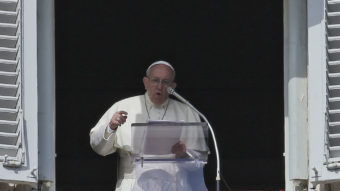
Pope Francis called on "all Christians and people of good will" to work toward abolishing the death penalty, as he addressed a crowd of tourists and pilgrims in St. Peter's Square Sunday. Alessandra Tarantino/AP
Pope Francis called on “all Christians and people of good will” to work toward abolishing the death penalty, as he addressed a crowd of tourists and pilgrims in St. Peter’s Square Sunday.
Alessandra Tarantino/AP

“The commandment, ‘Thou shalt not kill,’ has absolute value, and concerns both the innocent and the guilty,” Pope Francis said Sunday, urging that the death penalty be abolished.

Addressing a crowd of the faithful who were gathered in St. Peter’s Square Sunday, Pope Francis said, “All Christians and people of good will are called today to work not only for the abolition of the death penalty, but also in order to improve prison conditions, in respect for human dignity of persons deprived of liberty.”

Speaking the day before an international convention for the abolition of death penalty is set to begin in Rome, Francis appealed to the conscience of world leaders to work toward an international consensus to abolish capital punishment.

From Rome, NPR’s Sylvia Poggioli reports:

“He also proposed that Catholic politicians make what he called a courageous and exemplary gesture and ensure that no convicted inmate is executed during the church’s Holy Year of Mercy, which ends on Nov. 20.

“Francis has repeatedly stressed the position upheld by his predecessor, Pope John Paul II, that there is no justification in modern society for the death penalty,”

Pope Francis’ remarks about the death penalty and prison conditions came after delivering the Angelus at noon Sunday.

Copyright 2016 NPR. To see more, visit http://www.npr.org/.
Read original article – February 21, 2016 9:04 AM ET

Southcentral village of Nanwalek celebrates Slaviq

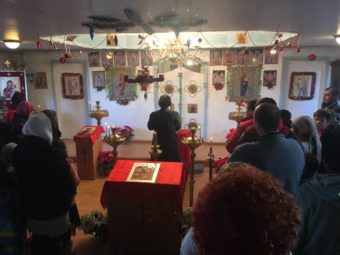
Subdeacon Ephim Moonin leading the Orthodox Christmas Eve celebration at Saint Sergius and Herman church in Nanwalek. (Photo by Daysha Eaton/KBBI)

Orthodox Christians in communities across Alaska celebrated Christmas Jan. 7. In the village of Nanwalek on the southern Kenai Peninsula, people spent Christmas Eve singing at the Saint Sergius and Herman church.

In the community of about 300 people, many of who are of Alutiiq (also known as Sugpiaq) descent, they sing in Slavonic, a liturgical language used by the Orthodox Church in Russia and Eastern Europe. It’s a remnant of the fur trade era and Russian colonialism.

11-year-old Tikhon Kvasnikoff starring at Chief John Kvasnikoff's house in Nanwalek on Orthodox Christmas Eve, Jan. 6th. (Photo by Daysha Eaton/KBBI)
11-year-old Tikhon Kvasnikoff starring at Chief John Kvasnikoff’s house in Nanwalek on Orthodox Christmas Eve, Jan. 6th. (Photo by Daysha Eaton/KBBI)

Starring followed Christmas Eve services Wednesday. Nanwalek resident Sperry Ash says the practice represents the journey of the three wise men.

“Each region in Alaska that practices this style of caroling, what we call Slaviq, they all have variations. But generally they follow a star, a wooden frame that’s decorated with the icon of nativity in the center and that star guides the carolers house to house,” said Ash.

Food and treats are offered to the visitors at each house.

“Starring is really an enjoyable event – to be able to go house-to-house and see each family and greet them. That fellowship is really special at this time of year,” said Ash.

Nanwalek used to be known as English Bay. The village was originally the site of a Russian trading post called Alexandrovski during the fur trade of the 1700s. Locals changed the community name back to the original Native name of Nanwalek, meaning “place by a lagoon.” Nanwalek is situated along Cook Inlet at the southern tip of the Kenai Peninsula.

Starring starts at the chief’s house. Subdeacon Ephim Moonin says a prayer. Then the singing starts in front of an icon on a shelf beside the family Christmas tree.

Chief John Kvasnikoff says the tradition and the story of the nativity are important to preserve in the face of outside influences.

“We got a lot of influences you know, internet and all this new technology. Kids are seeing, you know they see outside. But people can see in here too. And I’m glad they’re still holding onto it. It makes you a better person. It makes you want to help people who need help,” said Kvasnikoff.

Next they’ll star at the houses of newborn babies and elders, like Sally Ash, Sperry’s mother. She’s is the Sugt’stun language teacher in Nanwalek and she says she’s teaching all her grandchildren the language. Ash say she enjoys the Slavonic hymns, but says, in the future, she’d like to see some songs sung in Sugt’stun too.

“The kids, if they don’t know who they are, us being Sugpiaq, and if they don’t know their culture and their religion, they just get lost – just be a lost soul and then they follow what’s on TV. And so I think it’s really important that they know not only Christmas but also Pascha and other major feasts we celebrate throughout the year. It’s very important, yeah,” said Ash.

Pascha is Easter. Some holiday tables will have traditional octopus and chiton, or as the locals call them bidarkis or, in Sugt’stun, Urritaq gathered from the local reef, along with dry fish and seal oil, says Ash.

Food is a big part of the holidays in Nanwalek and the table is a mix of Russian, Sugpiaq and Western influences. She has a pot of turkey soup on the stove she says because the store had to give away defrosting turkeys due to a power outage last week. And having the power out has set everyone behind on their holiday preparations. With the power back on people are out to get what they need, like Adelle Kvasnikoff, the Chief’s niece.

“We have pilot crackers. So we’re going to prepare a traditional pilot cracker with salmon eggs and cream cheese. And my husband loves to use the Nally’s chili and we mix it with fresh cheddar cheese and we melt it together and we get tortilla chips and use it as a dip. And I grabbed a couple of small candies for stocking stuffers for my kids tomorrow,” said Kvasnikoff.

Orthodox Christians celebrate Christmas on January 7th, according to the Julian calendar. Starring will continue for the next several days. The holiday season runs through the Orthodox New Year on January 14th.
The holiday is also celebrated in Anchorage, the Y-K Delta, Southeast, Kodiak and along the Aleutian chain.

Native American Tribe Says Oregon Armed Occupiers Are Desecrating Sacred Land

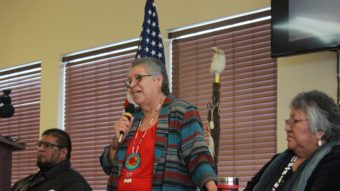
Burns Paiute Tribal Chairperson Charlotte Rodrique talks to reporters about the armed occupation of the Malheur National Wildlife Refuge near Burns, Ore., on Wednesday. Manuel Valdes/AP
Burns Paiute Tribal Chairperson Charlotte Rodrique talks to reporters about the armed occupation of the Malheur National Wildlife Refuge near Burns, Ore., on Wednesday.
Manuel Valdes/AP

With the armed occupation of a federal wildlife refuge in Oregon in its fifth day, a local Native American tribe says the militants are “desecrating sacred property.”

Oregon Public Broadcasting’s Amanda Peacher tells our Newscast unit that Burns Paiute tribal leaders denounced the militants and demanded that they leave. “The 190,000-acre wildlife refuge is within Paiute ancestral lands,” Amanda says.

Tribal Chairperson Charlotte Rodrique says that she is “offended by occupiers’ statements about returning the land to its rightful owners,” Amanda reports.

“You know, who are the rightful owners?” says Rodrique. “It just really rubs me the wrong way that we have a bunch of misinformed people in here — they’re not the original owners.”

According to Paiute story and legend, the tribe has lived in this area since “before the Cascade Mountains were formed.”
Here’s more on the tribe’s long history with the land, from The Oregonian:

“The tribe once occupied a large swath of land that includes the Malheur National Wildlife refuge — archaeological evidence dates back 6,000 years — but they were forced out in the late 1870s. Before settlers arrived, the tribe used it as a wintering ground, said Charlotte Rodrique, the tribal chair.

“In 1868, the tribe signed a treaty with the federal government that requires the government to protect natives’ safety. According to the tribe, the federal government promised to prosecute ‘any crime or injury perpetrated by any white man upon the Indians.’

“Rodrique said the tribe never ceded its rights to the land. It works with the U.S. Bureau of Land Management to preserve archaeological sites.”

Rodrique told Amanda that she sees “the federal refuge managers as partners in helping protect the tribe’s cultural artifacts.”

The anti-federalist militants say they are occupying the building in support of Dwight and Steven Hammond — two ranchers who were convicted of arson on federal lands. Those ranchers have not publicly supported the takeover and turned themselves in to serve their sentences on Monday.

Ryan Bundy, one of the group’s leaders, had said Monday that they would leave if local residents asked them to. But on Tuesday, he reversed that stance to OPB, saying that “the purpose of this whole thing is getting people excited. And [the people in Harney County] are excited that this is taking place.”

Residents actually have mixed opinions about the armed occupation, as we heard on Morning Edition. The county sheriff says he will hold a community meeting to discuss the issue at 4 p.m. local time Wednesday, hoping to find a “peaceful solution.”

Copyright 2016 NPR. To see more, visit http://www.npr.org/.
Read Original Article – January 6, 2016 4:43 PM ET

Bible published in modern Yup’ik writing style

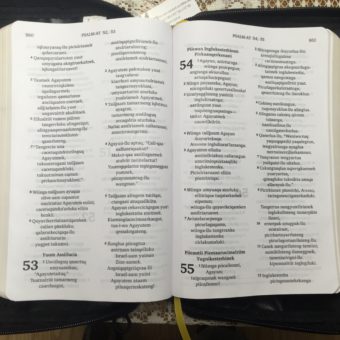
The new Yup’ik Bible, ‘Tanqilriit Igat,’ as it’s displayed at the Bethel Moravian Bookstore. (Photo by Charles Enoch/KYUK)

The Holy Bible is now available in the modern Yup’ik orthography after nearly half a century of work put in by fluent Yup’ik speakers in the area and the American Bible Society.
“Psalms 119:115- Thy word is a lamp unto my feet and a light unto my path. Qaneryararpet kenuratun ciuliqagtaatnga tanqigiluku tumkaqa tamalkuan,” reads Bethel elder Elsie Jimmie.

For the last six years Jimmie, or Iingicaq in Yup’ik, was part of the team that completed the conversion of the Holy Bible, or Tanqilriit Igat, into the newer and much easier to read Yup’ik orthography that was developed by linguist Steven Jacobson in the 1980s.

Jacobson’s Yup’ik textbooks and dictionaries are in use in the Lower Kuskokwim School District schools that teach the Yup’ik language to their students. That was a primary motivator for the elders, says Moravian pastor Jones Anaver of Kwigillingok.

“We wanted the youngest of our generation to be able to read and fully appreciate the Holy Bible,” said Anaver.

Anaver says the first missionaries translated the New Testament into an early form of Yup’ik writing that had no guidelines other than how it would sound using English writing rules. At that time, they did not translate the Old Testament.

The team translated the Old Testament into Yup’ik based off the Revised Standard Version of the Bible, and they rewrote the New Testament using modern Yup’ik Orthography.

Jimmie says the early translations took more learning to read.

“My father taught me to read the bible’s early Yup’ik translations after I learned English. In my experience, the new orthography is much easier to use and learn,” said Jimmie.

Jimmie says before the new bible was available she used to bring an English bible along with her Yup’ik one for reference when going to church events in other villages, in case she had trouble understanding the old Yup’ik one, which was often the case for those who relied on the first translations.

According to a letter to the Delta Discovery by the late Reverend Peter Greene, who died earlier this year, the project started in 1971 with pastors Teddy Brink and Peter Andrews under the guidance of the American Bible Society.

The American Bible Society did not respond to inquiries at the time this story was written.

Jimmie says some elders who participated died, leaving their work unfinished.

“When people pass away, we would keep their translations and others would rise to continue the work. Most recently, Peter Green, Jones Anaver, Jacob Nelson and I made the last push to finish the project,” said Jimmie.

Green and Nelson both died this year. Jimmie says wherever they are, they and the many others who helped can now rest assured with their goals achieved.

“An elderly man who couldn’t read or write called me some time after the project was completed. He was very happy the Bible was converted into the modern Yup’ik style because his grandchildren now fluently read and teach the Old Testament to him,” said Jimmie.

The new Yup’ik Bible was celebrated at the Bethel Moravian Church last October, and it is sold at the Moravian Bookstore in Bethel.

KYUK contacted the Bethel Moravian Church for information but they declined to interview.

Do Christians And Muslims Worship The Same God?

church and mosque
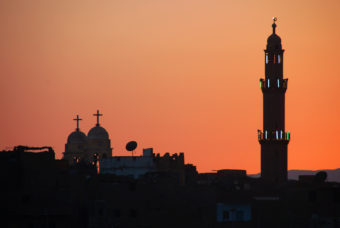
Church domes and a mosque’s minaret. (Creative Commons photo by David Evers)

Larycia Hawkins, a professor at Wheaton College in Illinois, decided to wear a head scarf during the Advent season as a gesture of solidarity with Muslims. In doing so, Hawkins quoted Pope Francis, saying that Christians and Muslims “worship the same God.”

But some evangelical Christians disagree — and Wheaton, a Christian school, responded by putting the political science professor on paid administrative leave. The college says it needs time to review whether her statement puts her at odds with the faith perspective required of those who work there.

The case also raises some big questions of theology.

Most mainstream Muslims would generally agree they worship the same God that Christians — or Jews — worship. Zeki Saritoprak, a professor of Islamic Studies at John Carroll University in Cleveland, points out that in the Quran there’s the Biblical story of Jacob asking his sons whom they’ll worship after his death.

“Jacob’s sons replied, ‘We will worship the God of your fathers’ — Abraham, Ishmael and Isaac. He is the God,” Saritoprak says. “So this God that Jacob worshipped, this God that Abraham, Isaac worshipped, is the same God that Muslims worship today.”

Christians, however, believe in a triune God: God the father, God the son (Jesus Christ) and the Holy Spirit. And many evangelicals will say that means Muslims and Jews do not worship the same god as as Christians.

“The question basically comes down to whether one can reject Jesus Christ as the Son and truly know God the Father,” says Albert Mohler, president of the Southern Baptist Theological Seminary. “And it’s Christ himself who answered that question, most classically in the Gospel of John, and he said that to reject the Son means that one does not know the Father.”

But Christians themselves differ on this question. The Second Vatican Council, speaking to Catholics back in 1964, affirmed that Muslims “together with us adore the one, merciful God.” And Amy Plantinga Pauw, a professor of Christian theology at Louisville Seminary, says Christians can have their own definition of God while still seeing commonality with Muslims and Jews.

“To say that we worship the same God is not the same as insisting that we have an agreed and shared understanding of God,” Pauw says.

One theologian with knowledge of both Christian and Islamic doctrine is Hamza Yusuf, president of Zaytuna College in Berkeley, Calif., the first Muslim liberal arts college in the U.S. Born Mark Hanson, he was raised as a Christian and then converted to Islam. He quotes the Quran as saying that God is immeasurable, so to define God in some particular way is impossible.

“God is much greater than anything we can imagine,” Yusuf says. “The Muslims have a statement in our theology: Whatever you imagine God to be, God is other than that.”

At Louisville Seminary, which is affiliated with the Presbyterian Church, Pauw says she’s preparing her students for Christian ministries that are likely to involve work with people of other faith traditions and she says she’d like them to remember that no religious community can claim God’s favor.

“No one is in a position of saying, ‘Well, we know exactly how God works in the world, and my particular group has a monopoly on that,’ ” Pauw says.

She adds: “There are certainly Muslims who will say that. There are certainly Christians who will say that. But it’s out of my own Christian conviction that I think we have to approach these issues with a kind of humility and kind of generosity toward others, because God’s ways are not our ways.”

In its statement about Professor Hawkins’ view that Muslims and Christians worship the same God, Wheaton College emphasizes its rejection of religious prejudice and its commitment to treat and speak about neighbors with love and respect, as Jesus commanded people to do. But, the statement says, “our compassion must be infused with theological clarity.”

Copyright 2015 NPR. To see more, visit http://www.npr.org/.
Read Original Article –December 20, 2015 2:47 PM ET


Site notifications
Update notification options
Subscribe to notifications