Spirit

Tlingit elders write boarding school history for future generations

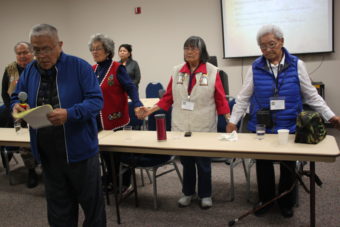
Tlingit elder Della Cheney talks during a panel discussion on boarding schools at the "Sharing Our Knowledge; A Conference of Tlingit Tribes & Clans." In the 1920s and 1930s, Cheney's parents attended Sheldon Jackson School in Sitka. (Photo by Lisa Phu/KTOO)
Tlingit elder Della Cheney talks during a panel discussion on boarding schools at the “Sharing Our Knowledge; A Conference of Tlingit Tribes & Clans.” In the 1920s and 1930s, Cheney’s parents attended Sheldon Jackson School in Sitka. (Photo by Lisa Phu/KTOO)

By talking about boarding school experiences, Tlingit elders in Juneau are turning painful memories into sources of healing – healing for themselves and generations still living with the consequences.

The nonprofit arm of the local urban Native corporation is using those stories to create a K-12 curriculum that will focus on the impacts of colonization on the Tlingit people.

Della Cheney and other elders have been meeting once a month at Goldbelt Heritage Foundation since August.

“We’re helping to write down the story of how boarding schools are affecting us and our families today, so that our children and grandchildren will know the history and realize the changes our families, our people faced,” said Cheney, who’s originally from Kake. She was part of panel of Tlingit elders during the recent clan conference in Juneau.

From the late 1800s to the mid-1900s, the federal government split up families and forced Native children into boarding schools to assimilate. Many were also raised in orphanages.

“That time is still walking with us today,” Cheney said. “The people who were raised with no love or affection in a very hostile environment also raised their children without much nurturing or affection. So today we see some of our families suffering from abuse.”

Cheney said both her parents attended Sheldon Jackson School in Sitka. Her mother was only 10 when she was brought there in 1923.

“It just breaks my heart to think that I was raised in such a loving family and to know that my mother and father weren’t,” Cheney said.

But those who went to boarding schools persevered, Cheney said. In Kake, they fought to make the village a first class city in 1951, allowing the community to operate its own school system.

Emma Shorty is from Teslin, Yukon. She was 4 years old when she was taken away from her home in 1937 to go to residential school in Carcross.

“We were never allowed to go anywhere,” Shorty said. “We had to stay in one yard. They put a fence around the school. They used to lock the fence and when we went to bed, they would lock our doors and there were no bathrooms to go to, so we got into trouble for wetting our beds.”

Shorty said she was molested at the school.

“I learned to forgive. I wasn’t always kind. Residential school just about killed my spirit. Today I forgive them,” Short said.

She fought hard to have her first daughter go to public school, even though she was turned away again and again for being Tlingit.

Tlingit elder John Martin said boarding schools "was a form of prison." (Photo by Lisa Phu/KTOO)
Tlingit elder John Martin said boarding schools “was a form of prison.” (Photo by Lisa Phu/KTOO)

John Martin went to boarding school in Eklutna and then to the St. Pius X Mission in Skagway, “but instead of Christianity, there were some ugly things that went on.” Martin said he would not speak about it.

Martin said many of the elders are still hurt.

“By putting us in boarding schools, it was a form of prison,” Martin said. “They disrupted our learning process of the language. They actually took a way of life from us when our elders were teaching us how to gather food.”

Martin said telling the stories from that time and identifying the hurt is the beginning of healing.

Developing the new Goldbelt Heritage curriculum is a multi-year process. Besides boarding schools, it will also share the history of the Douglas Indian Village burning and the Douglas Indian cemetery relocation.

The curriculum will be used during summer academic programs at Goldbelt Heritage and will be available for the Juneau School District.

What Does the Bible Say About Refugees? Depends Who You Ask

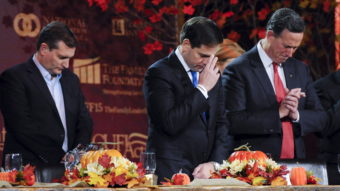
Republican U.S. presidential candidates Ted Cruz, Marco Rubio and Rick Santorum pray at the Presidential Family Forum in Des Moines, Iowa, November 20, 2015. The question of how to treat Syrian refugees has evoked different reactions in political evangelicals. Mark Kauzlarich/Reuters
Republican U.S. presidential candidates Ted Cruz, Marco Rubio and Rick Santorum pray at the Presidential Family Forum in Des Moines, Iowa, November 20, 2015. The question of how to treat Syrian refugees has evoked different reactions in political evangelicals.
Mark Kauzlarich/Reuters

Evangelicals see the Bible as the ultimate source of guidance for every aspect of life. But how exactly to apply to that to difficult moral dilemmas isn’t always clear.

And this week, as the question of what to do about the plight of refugees from Syria and Iraq in the wake of the Paris attacks has become a national political debate, it’s also become a moral question — one evangelicals are divided over.

‘Our Faith Tells Us …’

Speaking to a room of several hundred Iowa conservatives on Friday, Florida Sen. Marco Rubio said Christianity should permeate everything they do.

“You’re called to be a Christian in every aspect of your life – including your work, your home, your business – whatever endeavor you get involved in, including politics for that matter,” Rubio said.

Seven GOP presidential hopefuls were attending the Presidential Family Forum in downtown Des Moines, hosted by the conservative Christian group the Family Leader.

And at another point in the event, moderator Frank Luntz posed the question that many evangelicals are grappling with.

“Common sense tells us that we should keep these refugees out,” Luntz said. “But our faith tells us to help those in genuine need. ”

Luntz had hardly finished his sentence before Texas Sen. Ted Cruz jumped in to say America was already helping. Cruz says the U.S. is spending more than a billion dollars to help refugees.

Cruz has called for blocking Muslim Syrians from entering the U.S., while several of his rivals want to keep out all Syrian refugees.

That’s at odds with the position of several major church groups, including the National Association of Evangelicals.

Matthew Soerens is with the evangelical refugee resettlement agency World Relief. He says refugees go through extensive security screening by the federal government — but that’s not the only thing Christians should consider.

“Our job isn’t just to ask, ‘Is this safe?’ It’s also to ask the question that was asked of Jesus, which is, ‘Who is my neighbor?’ ” Soerens said.

Soerens says the Bible teaches Christians to help their neighbors — even if it means taking a risk.

‘We’ve Got To Get Ourselves Right’

That argument isn’t going over well with some conservatives, like Tim Knapp of Ankeny, Iowa.

“Why would we want to endanger ourselves while trying to help those people? Knapp said.

While acknowledging that many refugees are fleeing terrorism themselves, Knapp referred to a parable from the Bible about a farmer whose enemy sabotages his crops by planting a type of weeds — called tares — among the wheat.

The trouble, he says, is that you can’t tell right away which is which.

“The tares are in with the wheat. We’re gonna have to figure out how to get the tares out of the wheat,” Knapp said.

Beyond security, a bigger worry for Eric South of Urbandale is how to take care of refugees once they’re here.

“One of the main focuses of Christianity is to get yourself right and then help somebody else,” he said.

South said the U.S. should address its own economic problems before doing more for the rest of the world, and referred to another Bible story.

“The parable of, how can you remove the splinter from your friend’s eye if you’ve got a beam in your own eye?” he said. “Which means we’ve got to get ourselves right before we can start helping people in a massive way like they’re talking about.”

Savannah Wood, of Colfax, feels differently.

“I think that it is kind of odd for people to say that they’re going to live according to Christian values and then not let people in,” Wood said.

But she seemed to be in the minority at this gathering of Iowa evangelicals. Don Charleston of Altoona said the argument that the teachings of the Bible mean the United States should open its doors to Syrian refugees is “just PC talk, being politically correct.”

Charleston said those who argue for accepting Syrian refugees are only reading the parts of the Bible they agree with.

“A lot of these people are taking the Bible and stripping it out to segments that they like and they want. They don’t read the entire Scripture for what it’s worth,” he said.

For an emotional question like how to respond to the fear of terrorism, the answer from the Bible may depend on whom you ask.

And evangelicals are getting different answers from their church leaders and their political heroes.

Copyright 2015 NPR. To see more, visit http://www.npr.org/.
Read Original Article – Updated November 21, 2015 8:31 PM ET


Chugach tree fulfills holiday destiny on Capitol lawn

The Chugach tree arrived at the Capitol but winds kept it horizontal all day. (Photo by Liz Ruskin/APRN)
The Chugach tree arrived at the Capitol on Friday, but winds kept it horizontal all day. (Photo by Liz Ruskin/APRN)

A 74-foot tree cut from the Chugach National Forest near Seward nearly a month ago arrived at the U.S. Capitol on Friday. It’s the first time the Capitol Christmas tree has come from the 49th state.

The Lutz spruce tree arrived on a flatbed, resting on wooden cradles. The tree’s 40-gallon hydration bladder and the trailer sidewalls were removed ahead of time for the tree’s grand entrance at the base of Capitol Hill.

Fairbanksan John Schank, a trucker for four decades, drove the whole 4,000-mile journey – other than the ocean part. (The tree went by ship from Anchorage to Tacoma, Wash.)

“Oh the trip was awesome. The help along the way with the law enforcement from the Forest Service… They’ve been with me from Day 1,” Schank said. “Without them clearing the lanes for me to make these turns, it would’ve been a real tough job.”

John Schank, the Fairbanks trucker who brought the tree, looks uncannily like Santa Claus. (Photo by Liz Ruskin/APRN)

The Lynden Transportation driver normally plies the Dalton Highway. He was chosen for this mission in part because of his long, accident-free career. But Schank just happens to have a long white beard and – no kidding — red-apple cheeks and twinkly eyes. He patiently stood for back-to-back media interviews as the tree was detached from the truck and hoisted by crane.

Bruce Ward was part of the tree’s cross-country entourage, which had its own band: Blackwater Railroad Company, of Seward. Ward says the good-natured Alaska trucker was a big hit at the 15 events they held along the tree’s route.

“Couldn’t get him to wear the Santa Claus hat, though,” Ward said. “But he didn’t need it.”

Ward leads a nonprofit called Choose Outdoors that coordinates with the Forest Service to bring a tree to the Capitol from a different national forest each year. The organization raised $650,000 in corporate donations to transport the Alaska tree. Shell, he says, gave the most: $50,000, plus fuel.

Ward said the Lutz is a great specimen, nice and full.

“Last year when we brought it from Minnesota, it really looked a lot more like a Charlie Brown tree,” he said. “This one looks beautiful, by comparison.”

Ward said there were countless special moments on the tree’s journey, starting when they were in the Chugach to fell it. This was after a big search, after the superintendent of the U.S. Capitol Grounds had already flown to Alaska to select it from among the finalists. Ward said on the big day, they asked Kenaitze elder John Ross to bless the harvest.

“An eagle actually circled the tree before it was cut, and he said afterwards he asked the Great Spirit to let him know if it was OK to cut this tree,” Ward recalled. “And the message he got was ‘If the eagle lands on the tree you’re not to cut it.’ And so, I’m kind of praying so he doesn’t land on the tree, right? Because we’ve gone through a lot.”

A crane moved the tree from the truck to the Capitol lawn Friday morning, but it remained horizontal throughout the day due to high winds. Crews hope to set it upright this weekend, weather permitting.

The tree will be lit at a ceremony on Dec. 2 by Soldotna fifth-grader Anna DeVolld, with help from the Speaker of the House.

Tongass supplying DC with ‘companion’ Christmas trees

This year’s National Christmas Tree is a 74-foot spruce from Alaska’s Chugach National Forest. The tree is traveling across the U.S. on its way to Washington, D.C., and as of Sunday, was in Indiana.

In addition to the spruce, which will be placed on the west lawn of the U.S. Capitol, seven smaller “companion” trees have been selected from the Ketchikan-Misty Fiords Ranger District of the Tongass National Forest.

According to a U.S. Forest Service news release, the seven shore pines were found in the Shoal Cove Road area on Revilla Island. They were shipped out on Saturday.

The companion trees will be used to decorate offices of Alaska’s Congressional Delegation and other offices in Washington, D.C.

The tradition of the National Christmas Tree began in 1964, when a live tree was planted on the Capitol lawn. That tree lived three years before succumbing to root damage, according to the Capitol Christmas Tree website.

In 1970, the capitol architect asked the U.S. Forest Service to provide another Christmas tree. Since then, a tree has been donated by a different National Forest each year.

Because this year’s trees are from Alaska, Alaskan children and community organizations have been asked to provide about 4,000 ornaments for all the trees.

‘Nostra Aetate’ Opened Up Catholic, Jewish Relations 50 Years Ago

The façade of church San Gregorio Ai Quattro Capi, with inscription in Hebrew and Latin. The quote comes from the Old Testament Book of Isaiah, complaining about the obstinacy of Jews. By placing that quote there, Catholics distorted the meaning and used it to scold Jews for not converting to Christianity Sylvia Poggioli/NPR
The façade of church San Gregorio Ai Quattro Capi, with inscription in Hebrew and Latin. The quote comes from the Old Testament Book of Isaiah, complaining about the obstinacy of Jews. By placing that quote there, Catholics distorted the meaning and used it to scold Jews for not converting to Christianity
Sylvia Poggioli/NPR

Thursday marked the 50th anniversary of the issuance of the most radical document by the Second Vatican Council.
It’s called Nostra Aetate, or “In Our Times,” and it opened up relations between Catholicism and non-Christian religions.The landmark document repudiated anti-Semitism and the charge that Jews were collectively guilty for the crucifixion of Jesus Christ.

The history of relations between Jews and Christians started in what is today one of Rome’s trendiest neighborhoods, where chic cafés line a pedestrian area and where people can stroll and admire an ancient Roman portico. Restaurant waiters assure tourists that their fried artichokes are the best in town.

This was once Rome’s most shameful neighborhood — a flood-prone area of four cramped blocks where, for more than three centuries, the city’s ruling popes confined the Jews. It’s still called the Ghetto.

“You breathe history here, your hands touch it, and you walk on layer after layer of history under these cobblestones”, says Georges de Canino, painter and Ghetto resident.

Memories of past suffering are still vivid as he points to a church at the end of the street, Sant’Angelo in Pescheria.

“That’s where on Saturdays, friars preached sermons Jews were forced to hear. If you plugged your ears with wax,” says de Canino, “they beat you.

The ancient Roman Portico d'Ottavia. Sylvia Poggioli/NPR
The ancient Roman Portico d’Ottavia.
Sylvia Poggioli/NPR

On the San Gregorio Ai Quattro Capi church, de Canino points out an inscription in Latin and Hebrew about “stubborn Jews.” And pointing toward Santa Maria del Pianto, he says the Ghetto was encircled by churches, “a sign of Catholics’ obsession with trying to get us to convert.”

The Jewish community in Rome is the oldest outside Israel — Jews settled here before Christianity. Their history is illustrated in the Jewish Museum of Rome along the Tiber River. Tour guide Ursula Dattilo says Jews lived relatively well in antiquity.

“[The] trouble starts in 1215, when a pope decided Jews have to be recognized by their way of dressing,” she says. “It’s a special hat for the men with a cone in the middle, and a scarf with blue stripes for the women.”

With the Counter-Reformation, the Church cracked down even more. In 1555, Pope Paul IV locked Roman Jews in the Ghetto. It wasn’t demolished until 1870, when Rome was liberated from papal power. But it was another 100 years before the Church reassessed its relations with Jews.

During World War II, Angelo Roncalli was The Vatican’s ambassador to Turkey. There, he helped many Jews escape the Nazis by issuing false baptismal papers. When he became Pope John XXIII and convened the Second Vatican Council to bring the church into the modern world, he wanted an end to what had been called centuries of “contemptous” church teaching about the Jews.

There was much obstruction — some bishops even handed out anti-Jewish leaflets in St. Peter’s Square. But in 1965, Nostra Aetate was finally issued.

Rabbi David Rosen, inter-religious affairs director for the American Jewish Committee, says it was truly a revolutionary document.

“That took us from a situation where the Jewish people were seen as cursed and rejected by God, and even in league with the devil, to a situation now where popes say it is impossible to be a true Christian and be an anti-Semite, and that the covenant between God and the Jewish people is an eternal covenant, never broken.”

In Nostra Aetate, the Catholic Church acknowledged for the first time that Jesus is the link between Christianity and Judaism, says Church historian Massimo Faggioli.

“In this document, the Catholic Church accepted the idea that Christians don’t own Jesus,” Faggioli says. “That is theologically revolutionary, because in the Catholic mindset, Jesus was a Catholic.”

Father Thomas Reese, senior analyst for The National Catholic Reporter, says Nostra Aetate recognized there are positive elements in other religions, and that through inter-religious dialogue, stereotypes and prejudices can be overcome.

“For us, religious freedom is a matter of church teaching,” he says. “We have to observe it, we have to respect it; whereas before Vatican Two, we were not very respectful of religious freedom.”

At first, inter-religious dialogue was not easy, remembers Lisa Palmieri-Billig, the American Jewish Committee’s representative in Italy and liaison to the Holy See.

“There was so much diffidence on both sides,” Palmieri-Billig says. “On one side, the Christians said, ‘How come you Jews don’t recognize Jesus with all the miracles that he made?’ And the Jews say, ‘All you want to do is convert us.’ And you couldn’t get people really to participate. But gradually it opened up.”

While there’ve been some misunderstandings, great strides have been made in Jewish-Catholic ties. Celebrating the 50th anniversary, Pope Francis said, “From indifference and opposition, we’ve turned to cooperation and goodwill. From enemies and strangers, we’ve become friends and brothers.”

Copyright 2015 NPR. To see more, visit http://www.npr.org/.
Read Original Article – Published NOVEMBER 01, 2015 8:31 AM ET

Biking Behind Bars: Female Inmates Battle Weight Gain

Women incarcerated at the Riverside Correctional Facility in Philadelphia take part in a spinning class run by Gearing Up. Amanda Cortes (second from left) lost 90 pounds in a year. (Photo by Bastiaan Slabbers/NPR)

The gym at Riverside Correctional Facility in Philadelphia is through the metal detector, two heavy doors and down the hall.

There’s a basketball court like one you’d see at any high school, except there’s a corrections officer on guard near the 3-point line.

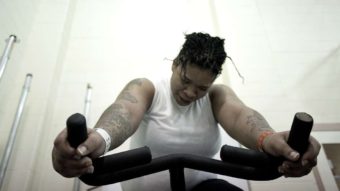
Sixteen stationary bikes are set up in a half-circle in the corner. On bike No. 2, Lakiesha Montgomery, 32, from Philadelphia, is pedaling fast and singing along to the Nicki Minaj song “Fly.”

“I didn’t think I’d be able to keep up; I’m not the skinniest thing in the bunch,” she says.

But she is keeping up.

In 2011, biking advocates from the nonprofit group Gearing Up persuaded prison administrators to let them bring in bikes to teach indoor cycling. Founder Kristin Gavin says before that she had mentored ex-offenders out in the community.

“Over and over I had conversations with women who were saying, ‘While I was incarcerated, I put on 60 pounds, I put on 70 pounds,’ ” she says. Then she would ask them how long they were in prison and she says they’d typically respond, “six months.”

At Riverside, Montgomery spends time in the prison yard most days but doesn’t get much exercise there.

“The outside is not a real outside, it’s like a minigarage. They have a basketball court there, but I don’t play basketball. It’s a lot of people that come out so you don’t have room to really jog or walk. It’s like you sit out to just get some air,” she says.

She has arm tattoos and a sprinkle of freckles across her nose. Her hair is braided back into cornrows. She also has high cholesterol.

Montgomery was charged with assault this year, among other charges, and has been in county jail for about six months.

“First time, last time,” she says. In the meantime, spin class is something to do.

“Keep away frustration being locked up, it helps you get through,” Montgomery says.

The Department of Justice surveyed the health of state and federal inmates in 2012 and found that women are more likely than men to be obese.

A study of prison health in Kentucky found greater weight gain for women compared with men. Women on average gained nearly 11 pounds, men only gained 2.5 pounds.

Gearing Up is working with researchers at Temple University to track the weight and body image of the women who spin at Riverside Correctional. The study was just eight weeks long and small, but they’ve already found small improvements in resting and recovery heart rate — two preliminary measures of heart health.

Gavin says often the women come to class initially to stop gaining weight then later find other reasons to keep coming back.

“I can speak to myself — if I weren’t given the opportunity to be physically active, I’d probably go a little crazy. I probably wouldn’t be able to manage my emotions, my temper, my anger. I think anger management is a huge issue for a lot of women who are in prison; they are victims of trauma and abuse,” Gavin says.

And, of course some of the women have hurt other people.

Leahya Ellis and other spinning class participants use exercise as a way to shake away stress, anger and depression. Photo by Bastiaan Slabbers/NPR)
Leahya Ellis and other spinning class participants use exercise as a way to shake away stress, anger and depression. (Photo by Bastiaan Slabbers/NPR)

Exercise can be a way to release all sorts of emotions. Erica Tibbetts from Gearing Up often leads the spin class. Tibbetts is in bike shorts. Everyone else has on prison blues: long navy pants and a white T-shirt.

“The worst seems to be women don’t have good sports bras in here,” she says.

No one has a water bottle and exercise shorts aren’t allowed. Tibbetts says the women come to class anyway and work with what they have.

Climb on a bike and there’s a sense of freedom, even if you’re not going anywhere.

At the beginning of class, one by one, the women call out their intention for the ride. The ritual is called “clearing.”

Christina wants to leave behind shakedowns. Jean wants to forget “cough and squat.”

Sheik is leaving behind “wrongful mistakes.”

Others want to shake off the past, stress and depression.

In a 2010 survey, women at Riverside gained about 36 pounds in a year, on average. But after some changes at the facility, that weight gain dropped to 26 pounds when the medical team checked again in 2015.

Bruce Herdman, the prison’s chief of medical operations, says weight gain is a problem, but it’s not the most urgent health problem his team is managing.

“The chlamydia rate — 6.6 percent on admission. We’ll treat a thousand people for HIV. The hepatitis C rate here, largely because of intravenous drug use, is 13 percent. Then you have hypertension, diabetes, all the regular things,” he says.

The prison pays Gearing Up to hold spin class three times a week. There’s also an occasional yoga class, but the big change affecting women’s weight was the food. The meals are certified heart healthy by a nutritionist. There’s a lot of it, but portion sizes are smaller now. Last year, the prison cut calories from nearly 2,900 a day to 2,500 for men and women.

That helped, but the facility-provided meals aren’t the only food around. Inmates also make do-it-yourself meals with food from the prison commissary. A favorite is called “chi-chis.”

“It’s where you mix ramen noodles with cheese puffs,” explains Amanda Cortes. “You put it in hot water, you put the meat inside, you can do honey mustard sauce or ranch on top, and you just put in a potato chip bag and you mix it up. It’s actually pretty good.”

Cortes has been in jail for five years and eating that way for most of that time. She’s facing several charges including involuntary manslaughter and is waiting for a court date. She says lots of women use food to cope with boredom and depression.

“Some people get two or three trays, so they get fat like that. They take whole loaves of bread to their room,” Cortes says.

So Cortes cycles to keep the weight off, and on visiting day, her 10-year-old son noticed.

“When he first seen me he was like, ‘Mommy you got skinny!’ So I was excited,” she says, smiling.

During a year, going to three spin classes a week, Cortes dropped 90 pounds.

At the end of the Gearing Up class, just before the goodbyes and sweaty hugs, there’s one last ritual.

The women share what they’ve brought back from the ride.

One women says she’s “bringing sexy back.” She and everyone around the circle has a wish: “I’m Jean, and I’m bringing back my bikini. I’m Ruth, and I’m bringing back faith and confidence.”

This story is part of a reporting partnership with NPR, WHYY and Kaiser Health News.

Copyright 2015 NPR. To see more, visit http://www.npr.org/.
Read Original Article – Published OCTOBER 11, 2015 6:21 AM ET
Copyright 2015 WHYY, Inc.. To see more, visit http://www.whyy.org.
Site notifications
Update notification options
Subscribe to notifications