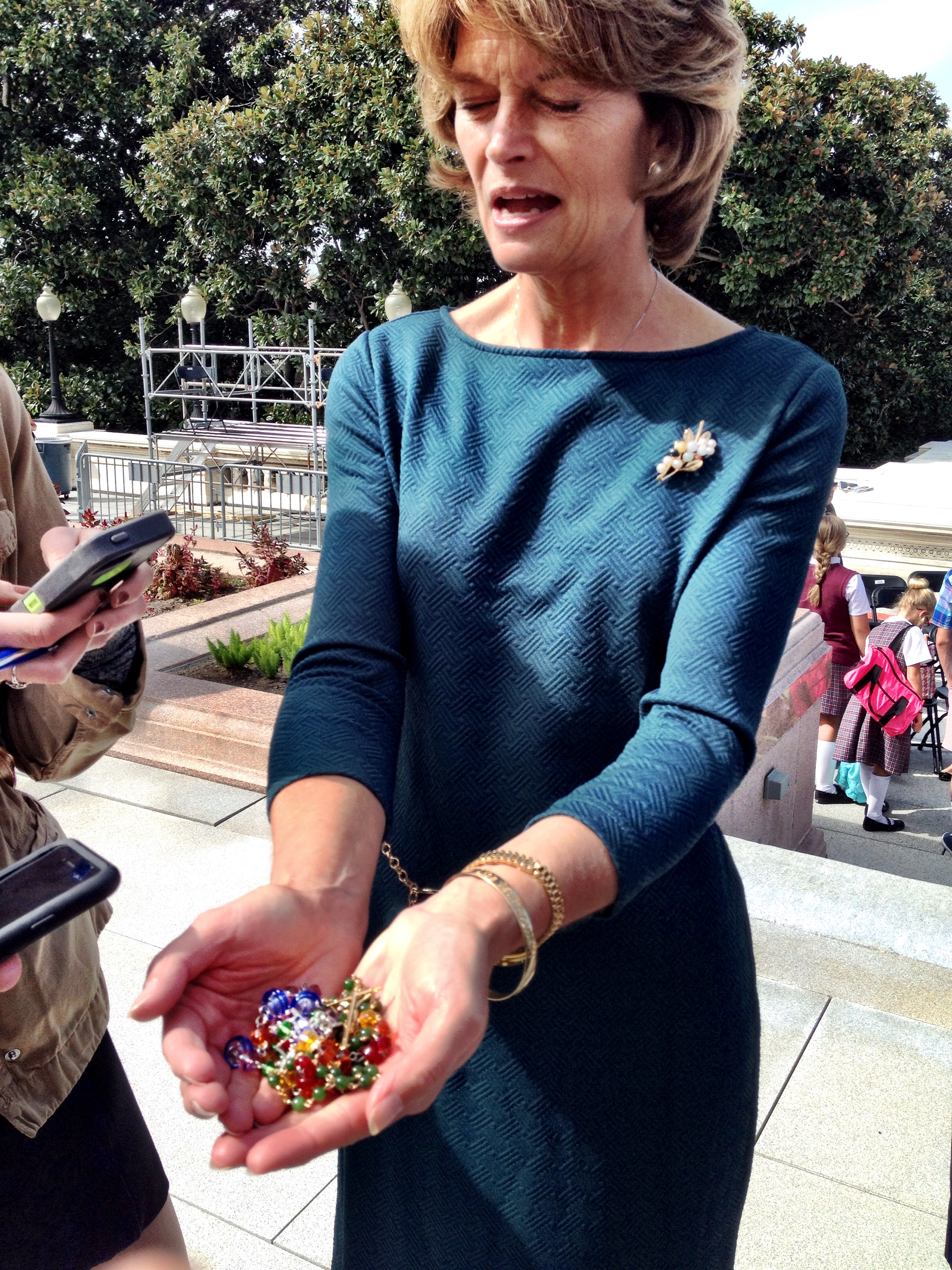
Sen. Lisa Murkowski shows the rosary beads she says prompted a special moment with the pope. (Photo by Liz Ruskin, APRN-Washington)
Alaska’s congressional delegation had an audience with this pope Thursday morning. Actually, all of Congress did, along with the president’s cabinet and the Supreme Court. But Sen. Lisa Murkowski did have a close encounter with Pope Francis, a personal moment that left her awe-struck.
Murkowski was among a group of senators assigned to greet the pope inside the Capitol. She says lawmakers were instructed on decorum beforehand.
“So we were lined up and we were told ‘stand with your feet together and your hands clasped in front of you, and if the pope greets you, then you can greet him back,’” she recounted.
The senator brought two strings of rosary beads with her to the Capitol — one made of Alaska jade that she thinks was a gift for her 25th birthday, and another from Brazil, made of glass beads. Murkowski says she intended to just have them near the pope, in his aura, as she put it.
Then, she says, an impulse came over her.
“I stretched out my cupped hand full of two rosaries,” she said. The pope was making his way down the lines of lawmakers, rather briskly, she says, heading into the House Chamber.
“He looked at me and he looked at the rosaries, and he came over and he put his hand on the pile of rosaries,” she says. “Then he cupped my other hand over it and blessed me.”
Murkowski says she was too overcome to verbally greet the pope. The senator next to her, Republican Susan Collins of Maine, did those honors.
“So she provided the audio because I was absolutely just speechless,” Murkowski said, outside the Capitol after the pope departed. “I still have tingles from being in the immediate presence of His Holiness.”
Both of Alaska’s senators are Catholic, and each had a different perspective on the pope’s address in the minutes afterward. Murkowski says she liked that he encouraged dialog among leaders to solve difficult problems.
Sen. Dan Sullivan noticed that both in the House Chamber and to the crowds waiting on the lawn outside, Francis emphasized the importance of children and families.
“And you could see how sincere he was, particularly when he said it out here,” Sullivan said, speaking on the West Terrace of the Capitol. “But I also think the pope is a wise man, and anytime you start a speech in that chamber with ‘It’s great to be in the land of the free and the home of the brave’ and end it with ‘God bless America,’ you’re going to be well received by everybody.”
Alaska’s lone House member, Don Young, and his wife spent the night before at his congressional office, to avoid getting caught in what was predicted to be a nasty traffic jam getting to the Capitol. Young’s take on the pontiff?
“He made a decent presentation,” Young said, acknowledging it was hard to understand the pope’s heavily accented English. “People were excited to see him. I went and read his speech afterward it didn’t have any earth-shaking statements in it at all, so it was … good.”
Young might sound a little blasé about the experience, but ask his wife, Anne Garland Young, what she made of it.
“Oh, I think it was thrilling and exciting just to be in the same moment and in the same room with such an incredibly wonderful person, who’s very inspirational and obviously very holy, very close to God,” she said. A life-long Catholic, she said the feeling was palpable. “Oh, absolutely! And I think just about everyone in that room really experienced the same thing. It was very beautiful, very moving.”
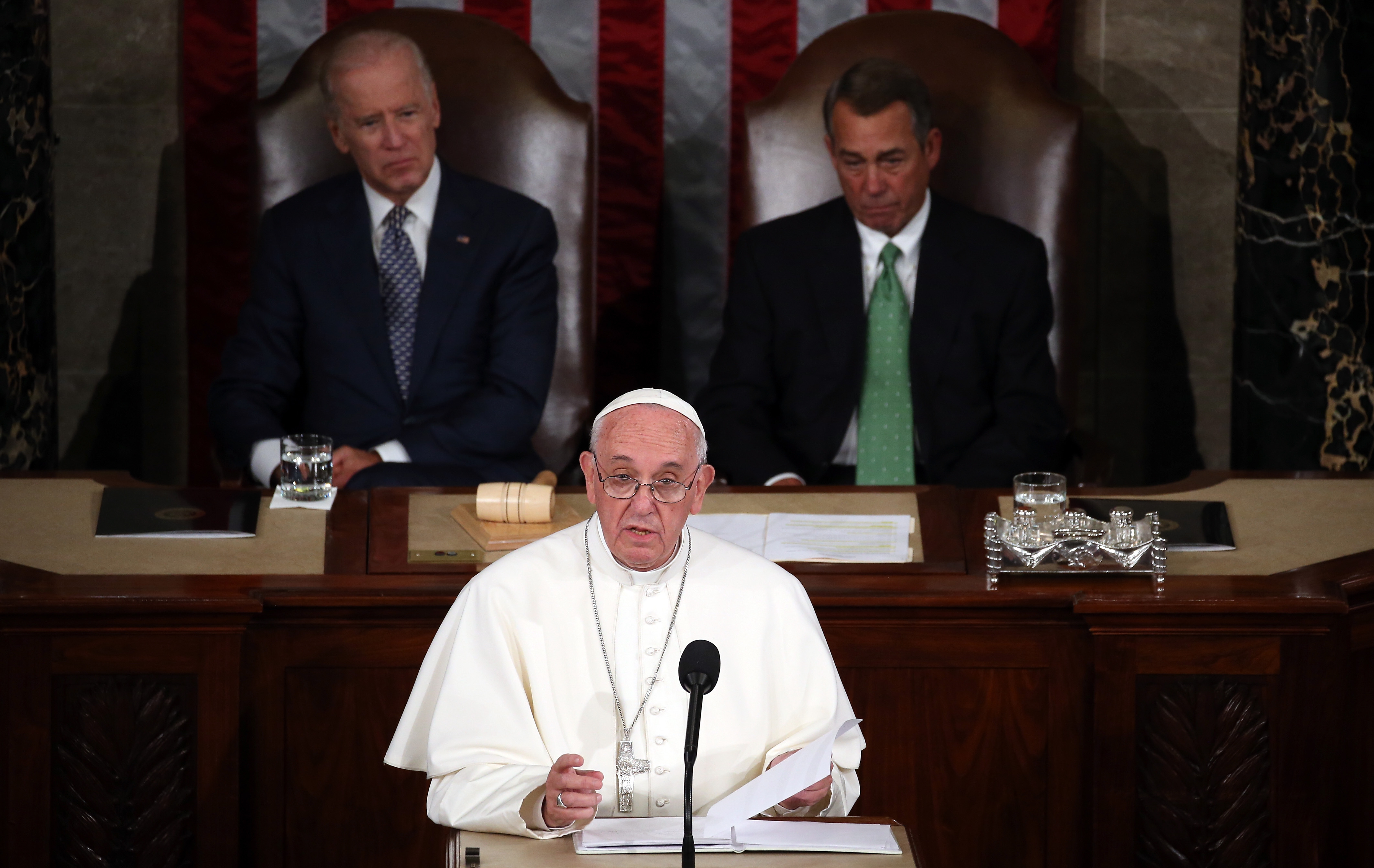
Pope Francis addresses a joint meeting of the U.S. Congress in the House Chamber of the U.S. Capitol Thursday. He is first pope to address a joint meeting of Congress. Mark Wilson/Getty Images
Pope Francis speaks his mind, and he did that again in his address to a joint meeting of Congress Thursday morning. But, in the vein of the best Jesuit teachers, Francis praised America, its rich political history and its ideals before delicately delivering some things its political leaders might, well, want to consider working on.
There were political messages that challenged the orthodoxy of both American political parties, but, in this 51-minute address, there were a lot more points of emphasis Democrats are happy about — and that put some pressure on Republicans.
Here were 10 moments that stood out from his address:
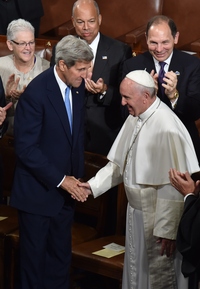
Secretary of State John Kerry’s hand was one of few he shook as he arrived to address the joint meeting of Congress Thursday. Paul J. Richards/AFP/Getty Images
1. Embracing John Kerry: The pope did not shake many hands on his way into the chamber, unlike during presidential State of the Union addresses when presidents seem to embrace everyone in the aisle they can find. But Francis did make a point of going over to Secretary of State John Kerry and shaking his hand. That is a major change from 2004 when church officials then called on denying Kerry communion because of his support for abortion rights when he was the Democratic nominee for president. This pope, by the way, has come out in support of the Iran nuclear deal. Kerry, as secretary of state, was a principal negotiator of the deal.
2. A call to rise above polarization: Francis warned against the “temptation” of “the simplistic reductionism which sees only good or evil; or, if you will, the righteous and sinners. The contemporary world, with its open wounds which affect so many of our brothers and sisters, demands that we confront every form of polarization which would divide it into these two camps.” Later in his speech, he came back to this theme, saying, “A good political leader is one who, with the interests of all in mind, seizes the moment in a spirit of openness and pragmatism. A good political leader always opts to initiate processes rather than possessing spaces.” He also noted one his heroes, American Thomas Merton, a Cisterian monk, who Francis said had “the capacity for dialogue and openness to God.”
3. A call for the country to open its arms to immigrants and refugees: “I think of the march which Martin Luther King led from Selma to Montgomery fifty years ago as part of the campaign to fulfill his ‘dream’ of full civil and political rights for African Americans. That dream continues to inspire us all. I am happy that America continues to be, for many, a land of ‘dreams’. … In recent centuries, millions of people came to this land to pursue their dream of building a future in freedom. We, the people of this continent, are not fearful of foreigners, because most of us were once foreigners. I say this to you as the son of immigrants, knowing that so many of you are also descended from immigrants.” …
“Our world is facing a refugee crisis of a magnitude not seen since the Second World War. This presents us with great challenges and many hard decisions. On this continent, too, thousands of persons are led to travel north in search of a better life for themselves and for their loved ones, in search of greater opportunities. Is this not what we want for our own children? … Let us remember the Golden Rule: ‘Do unto others as you would have them do unto you’. … The yardstick we use for others will be the yardstick which time will use for us.”
His reference to the Golden Rule was Francis’ biggest applause line. Members of Congress didn’t even let him get out the rule itself before giving him a standing ovation.
4. A reminder on abortion: Francis then pivoted and mentioned some about the conservative social issues the church believes in, particularly on abortion: “The Golden Rule also reminds us of our responsibility to protect and defend human life at every stage of its development.”
That received big applause from Republicans, but then Francis immediately went on to the flip side of the Catholic “pro-life” belief.
Pope Francis also strongly advocated for abolishing the death penalty, and called on Congress to act on climate change. Tony Gentile/AP
5. Strongly advocating for abolishing the death penalty: “This conviction has led me, from the beginning of my ministry, to advocate at different levels for the global abolition of the death penalty. I am convinced that this way is the best, since every life is sacred, every human person is endowed with an inalienable dignity, and society can only benefit from the rehabilitation of those convicted of crimes. Recently my brother bishops here in the United States renewed their call for the abolition of the death penalty. Not only do I support them, but I also offer encouragement to all those who are convinced that a just and necessary punishment must never exclude the dimension of hope and the goal of rehabilitation.”
6. Poverty and the necessity of ‘distribution of wealth’: “I would encourage you to keep in mind all those people around us who are trapped in a cycle of poverty. They too need to be given hope. … It goes without saying that part of this great effort is the creation and distribution of wealth.”
7. Business should be about “service to the common good”: “Business is a noble vocation, directed to producing wealth and improving the world. It can be a fruitful source of prosperity for the area in which it operates, especially if it sees the creation of jobs as an essential part of its service to the common good.”
8. Calling on Congress to act on climate change: “This common good also includes the earth … I call for a courageous and responsible effort to redirect our steps, and to avert the most serious effects of the environmental deterioration caused by human activity. I am convinced that we can make a difference and I have no doubt that the United States — and this Congress — have an important role to play. Now is the time for courageous actions and strategies, aimed at implementing a culture of care and an integrated approach to combating poverty, restoring dignity to the excluded, and at the same time protecting nature.”
9. Anti-war message and a call to stop arms trade: “Being at the service of dialogue and peace also means being truly determined to minimize and, in the long term, to end the many armed conflicts throughout our world. Here we have to ask ourselves: Why are deadly weapons being sold to those who plan to inflict untold suffering on individuals and society? Sadly, the answer, as we all know, is simply for money: money that is drenched in blood, often innocent blood. In the face of this shameful and culpable silence, it is our duty to confront the problem and to stop the arms trade.”
10. The importance of family and marriage: “It is my wish that throughout my visit the family should be a recurrent theme. How essential the family has been to the building of this country! And how worthy it remains of our support and encouragement! Yet I cannot hide my concern for the family, which is threatened, perhaps as never before, from within and without. Fundamental relationships are being called into question, as is the very basis of marriage and the family. … At the risk of oversimplifying, we might say that we live in a culture which pressures young people not to start a family, because they lack possibilities for the future. Yet this same culture presents others with so many options that they too are dissuaded from starting a family.”
Copyright 2015 NPR. To see more, visit http://www.npr.org/.
Read Original Article – Published SEPTEMBER 24, 201511:40 AM ET
More and more Inuit women are getting face tattoos.
The traditional practice dates back centuries but was banned by 19th and 20th-century missionaries. Now it’s coming back. Though the techniques and customs were nearly lost, a new generation is using tattoos to reclaim what it means to be a Native woman in the 21st century.
In the backroom of a small Anchorage tattoo parlor, Maya Sialuk Jacobsen uses a thin needle to pull an inky thread through the skin on her friend’s wrist.
“I use the exit hole as the entrance for the next stitch,” Jacobsen explained, bent over her work as a small crowd observed.
The friend is Holly Mititquq Nordlum, organizer of a weeklong series of tattoo-related events called Tupik-Mi. Compared to the sting of a tattoo gun, the stitches hardly register, and Norldum looks unfazed, greeting and bantering with observers cycling in and out of the cramped room.
“It’s loose,” Nordlum said, nodding at the flesh on her arm. “I put on a few pounds so she’d have something to work with.”
“Her skin is so much better than my husband’s skin,” Jacobsen laughed. “She has really lovely skin to tattoo.”
Maya Sialuk Jacobsen of Greenland gives a henna tattoo to a friend’s chin during an event at the Anchorage Museum, part of the Polar Lab’s Tupik-Mi series on traditional tattoos. (Photo by Zachariah Hughes/KSKA)
Jacobsen is one of the few Inuit women who knows how to give tattoos through traditional methods like sewing and poking in dabs of dye. She’s candid about the fact that the equipment has changed. Instead of whale sinew, she uses cotton thread; rather than coloring with soot, she uses tattoo ink. But much like rifle hunting compared to harpooning, she sees her modern tools simply as superior means towards traditional ends: inscribing the skin with meaningful marks.
Jacobsen has spent years cobbling together a body of knowledge about what the practice meant before Danish colonization in her native Greenland almost three centuries ago.
“There is no short answer,” Jacobsen says, adding, “it’s also a very Western, academic way of thinking.”
Jacobsen’s son Benjamin came with her from Greenland, and shows off self-administered henna designs made of different traditional patterns, but reconfigured. (Photo by Zachariah Hughes/ KSKA)
Outsiders have looked at Inuit tattoos as having legible meanings embedded within stable rituals, like clear markers signifying marriage or adulthood. But not only did those cultural foreigners import concepts of their own–like marriage–but also a sense of fixity to a practice Jacobsen says was much more fluid and interpretive. “I can’t tell you a triangle means an iceberg,” she explained dryly. That’s partly because the historical record is unreliable, but also because symbols were not nearly so firm.”
You can’t understand tattooing, she believes, without understanding the lives of Inuit women.
While working as a tattoo artist in Europe, Jacobsen was diagnosed with fibromyalgia, which made it difficult to wield the heavy, vibrating drill that is the trade’s standard instrument. So she started poking, and from there stitching. But as she tried learning more about how Inuit women had traditionally been marked, the few historical accounts all came from European adventurers and missionaries.
“I assure you, they did not really know what tattooing was,” Jacobsen says with a wry smile.
But then came the mummies. A group of 15th century Inuit women discovered during 1972 at the Qilakitsoq (“little sky”) grave-site in Greenland, preserved tattoos and all. Jacobsen found a book about them, studied the designs, and realized the marks on their foreheads, cheeks, and chins were similar to the tight stitches she’d learned as a girl. It was her first primary source.
“I have, like, literature, and then I have, what I call ‘from the horse’s mouth,’” Jacobsen says, “and that is the mummies.”
Tupik-Mi, Jacobson and Norldum’s project, is part of an effort within the Urban Interventions series in the Anchorage Museum’s Polar Lab.
“Tupik means tattoo,” explained Nordlum, who is Inupiaq, “and then ‘mi’ is a shortened version of muit, which means ‘people.’ In Kotzebue, we say ‘Qikiqtaġrumuit’ which means, ‘We’re the people from Kotzebue.’”
Nordlum was introduced to Jacobsen over Facebook after she couldn’t find anyone to give her a traditional tattoo in Alaska. A friendship blossomed, and they arranged the first in what they hope will be yearly Tupik-Mi events.
In addition to a lecture and live tattooing demonstration, the women also hosted a light explanation of traditional tattoos for high schoolers before letting them apply tube after tube of henna to their appendages.
Nordlum squeezed a tight formation of dots and lines onto the back of an 11th grader’s wrist.
“She’s making my initials with the Inuit designs,” says Ben Hunter-Francis.
The West High junior says he has plenty of time to decide whether or not he’ll get a tattoo. But if he does, he’d like it to be attached to his Yup’ik roots in the Lower-Yukon community of Marshall.
“Just to make my heritage proud, and make my family proud,” Hunter-Francis says, “that I’m connected with my heritage in some way.”
Traditionally, tattooing was the province of women. They were the ones who wore them, and exclusively the ones to administer them. But as Nordlum finished Hunter-Francis’s wrist, she explained that the practice isn’t bound in place by history.
“In modern culture, men getting tattoos is not a rarity. We are contemporary people working in modern times, so although it was a rarity traditionally, now it isn’t,” Nordlum says, not letting up her hold on Hunter-Francis’s arm.
“Culture is not a set thing, it is a living breathing thing that changes as time goes, and we’re just adapting … like skin.”
Holly Mititquq Nordlum shows off her partially complete tattoo during a live demonstration at Anchorage’s Above The Rest studio. Each horizontal line is 40 individual stitch marks through the first layer of skin. Before starting the stitches, Jacobsen poked the basic design of three bird feet rising from the lines. Nordlum’s Inupiaq name, Mititquq, means ‘a place where birds land,’ and she celebrates big life goals with bird feet tattoos, like the two on her opposite wrist, done with a tattoo gun. (Photo by Zachariah Hughes/ KSKA)
If plans go ahead, Tupik-Mi will expand next year to train a handful of Alaskans in traditional tattooing methods. By the third year, the hope is to hold workshops in Canada and Greenland, growing tattooing capacity across the high north.
“The idea,” Nordlum explains, “is for Iñupiaq, Inuit, Yup’ik women to feel proud of who they are. To feel strong. To create a sisterhood. To belong to something bigger than yourself, so that you’re safe and you’re supported by all these other women.”
Nordlum was a few days away from getting lines tattooed on her chin, one of the most visible and common styles across a wide array of indigenous Arctic communities. She says more women in Alaska are opting for chin tattoos, to the point where she brushed off the suggestion it was a bold decision to get one
“I don’t feel very brave here because there’s so many of us,” Nordlum says.
Permanence is part of why tattoos carry so much weight, and Nordlum sees the resurgence in women’s chin tattoos as putting forward a permanent, proud Native identity for all to see.
Jacobsen had her own chin lines laid down by her partner just two months ago. Soon after the process began, she felt a visit from her late mother.
“My mind was just wrapped around all of these thousands of fore-mothers I must have had that had tattoos,” Jacobsen says, her words growing softer. “My heart was beating so hard, and I cried, and I was shaking.”
Four thin lines that would have normally taken a few minutes took hours. “It was definitely very, very emotional,” she says.
Jacobsen is sharing that intimate experience with Nordlum, dot-by-dot, as she pokes a tattoo into her friend’s chin.
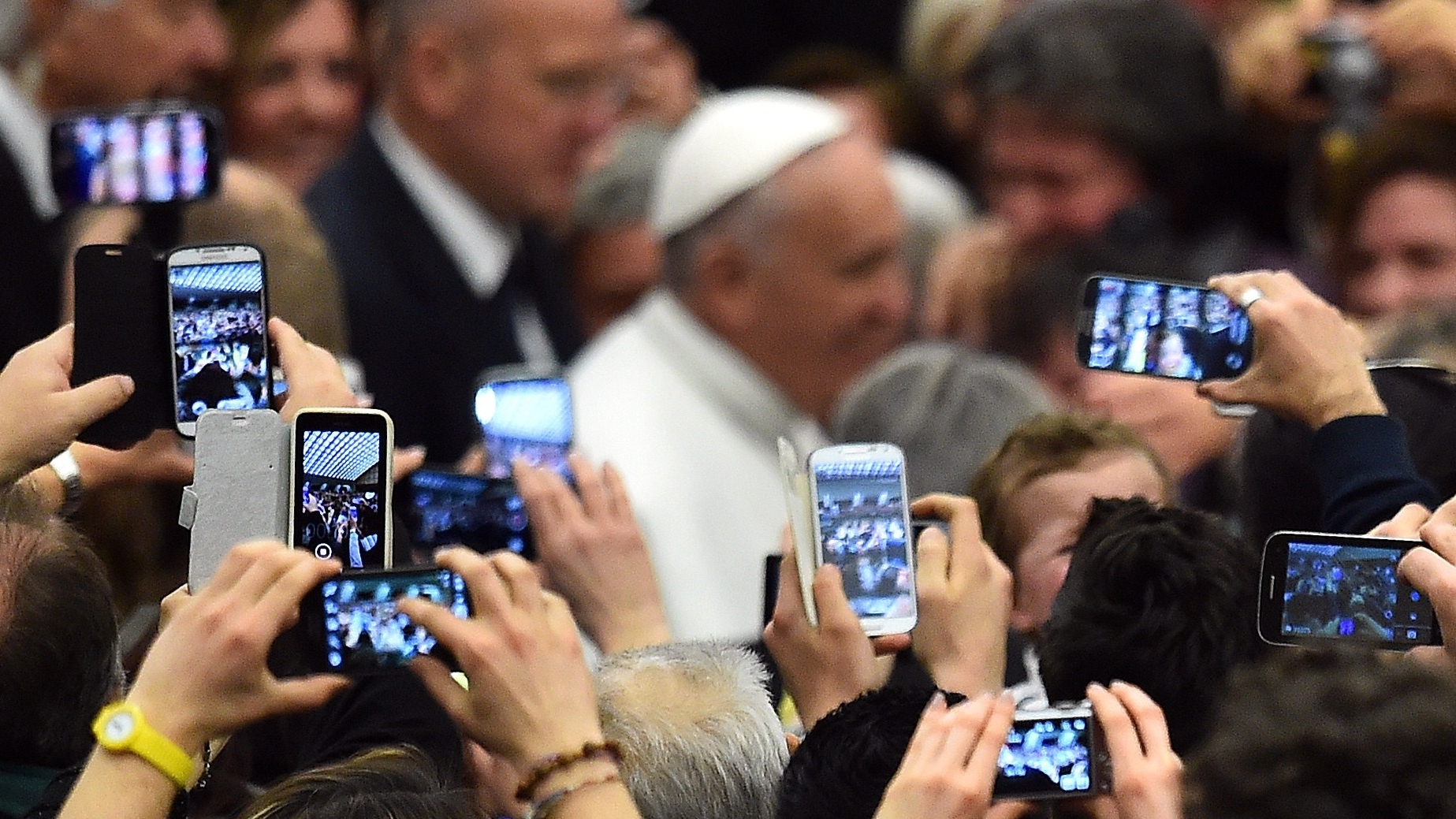
Pope Francis’ embracing of the digital world and social media has given new meaning to the word “followers” for the Catholic Church. Gabriel Bouys/AFP/Getty Images
The Vatican may still announce a new pope with a smoke signal, but when it comes to connecting with his flock, Pope Francis is just a click away.
He’s called the Internet a “gift from God,” participated in Google Hangouts and fully embraced Twitter where every few days he broadcasts messages of mercy and forgiveness in 140 characters or less.
The archbishop who helped launch the Vatican’s Twitter feeds and YouTube channel says that if the church wants to keep up with the modern world – at least in terms of evangelizing – it needs to embrace social media. Archbishop Claudio Celli, head of the Pontifical Council for Social Communications, told journalists in New York last May:
“In our church we are always fishing inside the aquarium,” he said. “The majority of fish are outside the aquarium.” Unless the church engages with digital media, he said, “we will wind up talking to ourselves.”
The Pope App. Launched in 2013 under Pope Benedict, it’s pretty much a one-stop-shop for Vatican news basics. Users can check in on live streaming of papal events and video feeds from the Vatican’s six webcams, follow the pope’s Twitter feeds and read daily homilies and speeches.
Popemoji. Yes, Pope Francis has his own set of keyboard cartoons created in advance of his trip to Washington, D.C., New York and Philadelphia next week. They feature an affable Pope Francis eating a Philly cheese steak, hanging out in a New York taxicab and playing both soccer and American football.
The Popemoji is part of a larger social media effort coordinated by Aleteia USA, a Christian media company, to reach out to younger Catholics during Pope Francis’ U.S. visit. It is a multi-platform approach that goes by the handle @PopeIsHope. From Fortune:
The campaign has enlisted a “digital street team” of 60 digital strategists, content creators and “real time community managers,” 35 of whom will be publishing content on the ground at the Pope’s appearances. The rest will work out of the “Pope is Hope social listening center,” located inside a homeless shelter in Philadelphia.
Using the hashtag #goodiswinning, the team has been posting about acts of mercy and kindness, and it will continue to report dispatches on those themes during the pope’s U.S. visit to the big social media platforms like Instagram, Twitter, Snapchat, Vine, Facebook and Periscope. There will also be an effort to monitor social streams and interact with millennials to see what does and doesn’t resonate – and then report back to the church.
The campaign is led by Kathleen Hessert, who, as head of Sports Media Challenge, counts athletes and entertainers as clients. “Our effort is to reach out to milennials, who are open to listening to the pope and the church like they never have before,” she tells NPR. They’re seeking out what she calls the “unchurched” — and meeting them where they are: online.
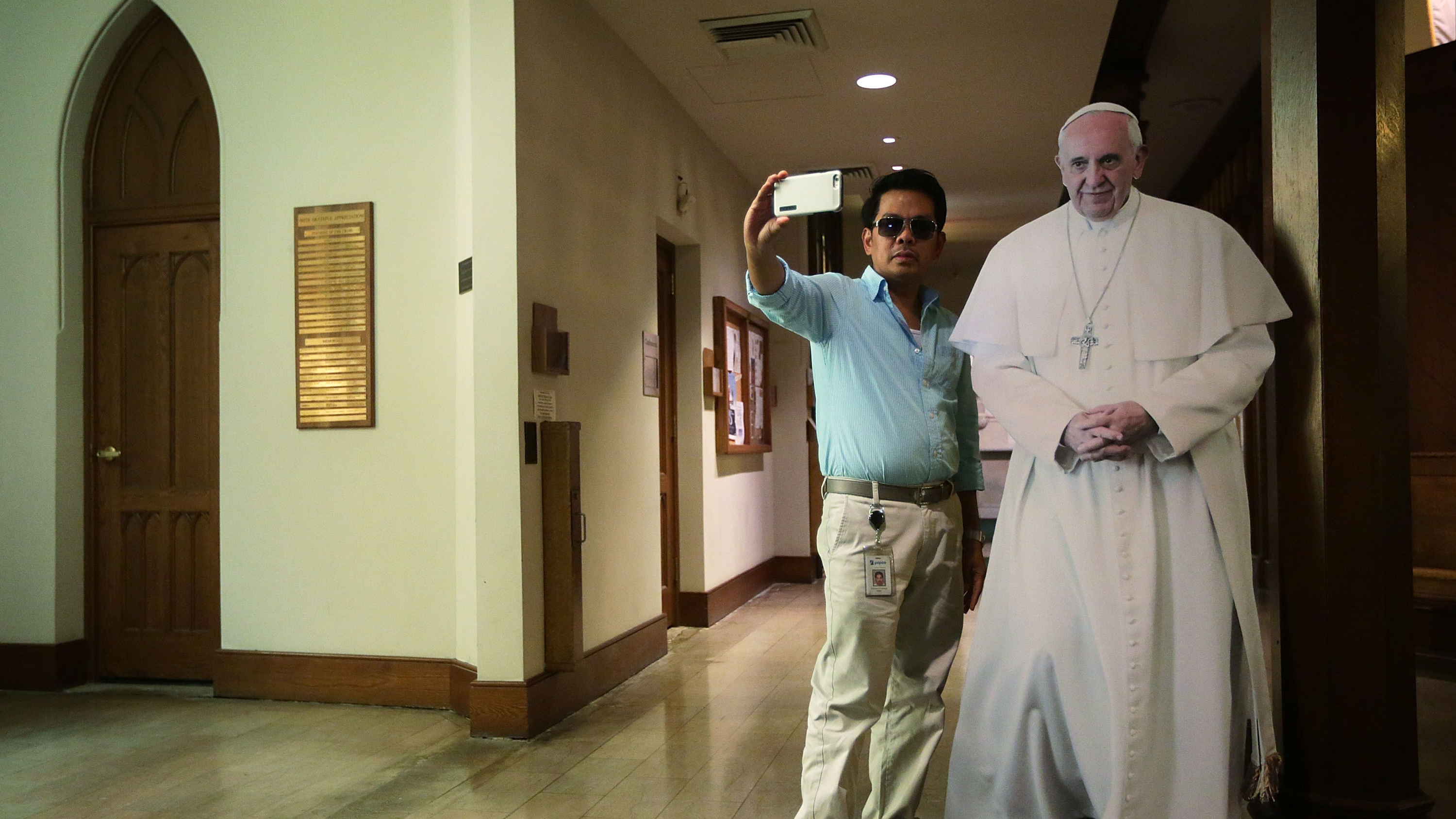
A visitor takes a selfie with a cardboard cutout of Pope Francis at St. Patrick’s Catholic Church in Washington, D.C., on Sept. 16. Alex Wong/Getty Images
“This whole campaign is not about creating buzz. It’s about opening people’s minds and hearts to what Pope Francis has to say and his approach and driving them to act,” she says.
Michael O’Loughlin, author of The Tweetable Pope, explains Pope Francis’ approach in a recent interview with AFP:
He has lent his moral voice to a range of causes, such as campaigns to highlight Christian persecution, efforts to stop wars, calling attention to environmental degradation and more.
The pope waded into the intense debate about inequality with a tweet sent in April 2014 that said simply, “Inequality is the root of social evil.”
When the pope released his encyclical about the environment in June, he was aware that most people won’t dive into a 200-page document. So he used a “Twitterbomb,” tweeting out the highlights every hour for 24 hours. This helped his message reach more people, directly.
Twitter is a tool to get a message out, whether that message is liberal or conservative or somewhere in the middle, and Pope Francis is taking his message to where most people will hear it: online.
His tweets as a whole are complex and surprising, just like the pope himself. Francis speaks in sound-bites, by which I mean he’s able to cut to the heart of the matter and offer complex, inspiring and challenging messages that people will remember and think about.
Ang Pilipinas ay patunay ng kabataan at kasiglahan ng Simbahan.
The pope has more than 23 million followers on nine different language accounts. His Spanish language account has the most, with nearly 10 million followers, followed by the English language version with a little more than 7 million followers. His reach may be long thanks to frequent retweeting, but in terms of followers, he trails President Barack Obama, who has 64 million followers, Justin Bieber, who has 67.5 million followers and Katy Perry, who has the most followers at 75 million.
The pope’s most popular tweets on @pontifex were in Tagalog while he visited the Philippines earlier this year. (Translated to English: The Philippines is proof of youth and vitality of the Church.)
According to O’Loughlin, Pope Francis is involved in crafting the messages, but he’s not actually writing them or tapping the tweet button. In an interview with NPR’s Scott Simon, O’Loughlin says:
“I was told that he has a small handful of advisers who talk to the Pope, Pope Francis tells them which themes and messages he wants communicated on social media, and they write out the messages in either Spanish or English or Italian, and bring those sheets of paper to him and Pope Francis signs off on every tweet.”
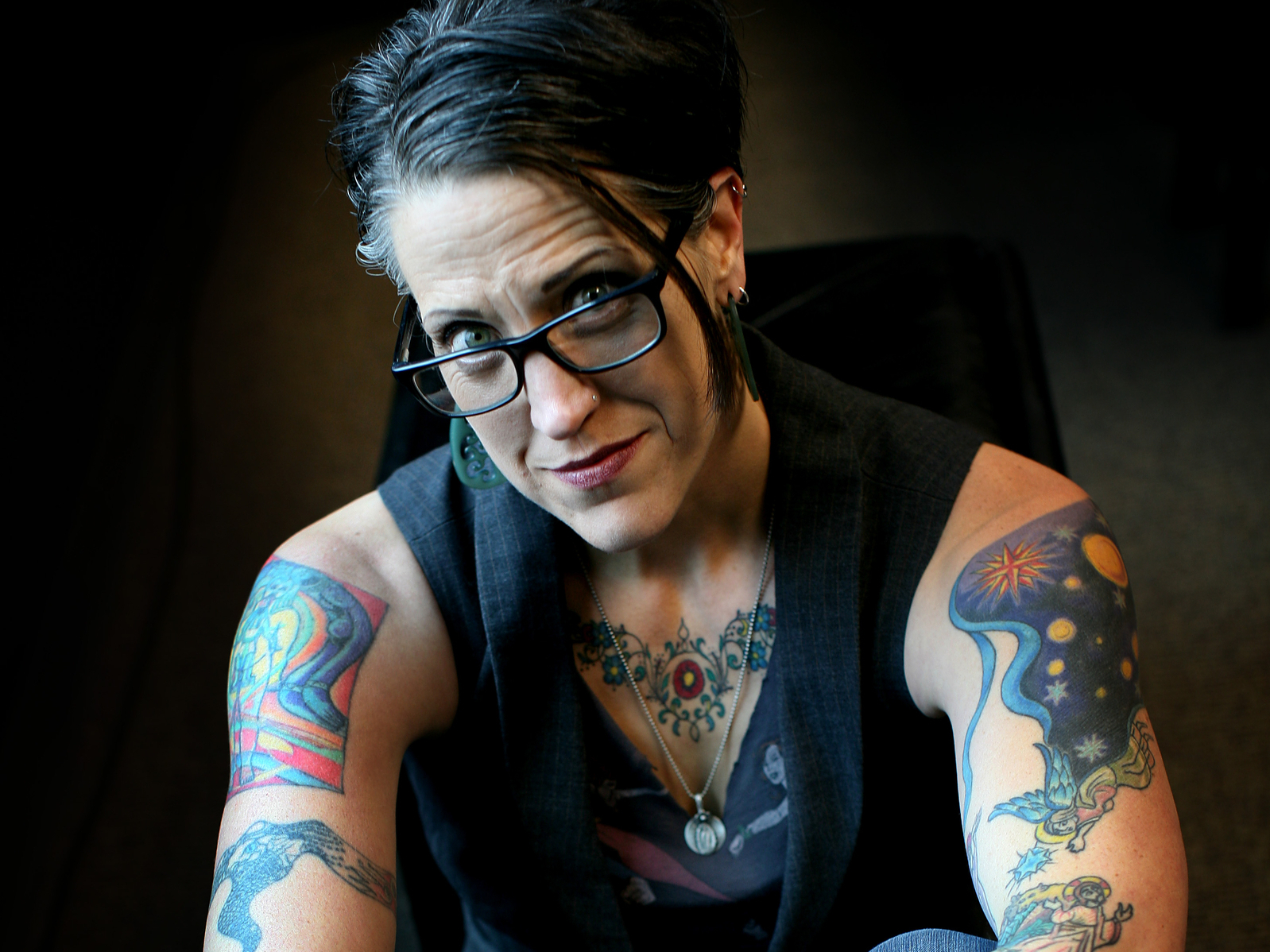
Lutheran Pastor Nadia Bolz-Weber says that all are welcome at her Denver church, The House for All Sinners and Saints. Courtney Perry
Lutheran pastor Nadia Bolz-Weber admits that she does not look — or act — like a typical church leader. Heavily tattooed and with a tendency to swear like a truck driver, Bolz-Weber was once a standup comic with a big drinking problem.
But she was drawn to Lutheran theology, and when a group of friends asked her to give a eulogy for another friend who had committed suicide, Bolz-Weber discovered her calling.
Bolz-Weber tells Fresh Air’s Terry Gross that while addressing the crowd of “academics and queers and comics and recovering alcoholics” at the funeral, she realized: “These people don’t have a pastor, and maybe that’s what I’m supposed to do.”
After going to seminary, Bolz-Weber founded a church in Denver called The House for All Sinners and Saints. She writes about the church, which she describes as “Christo-centric,” in the new memoir Accidental Saints: Finding God in all the Wrong People.
Bolz-Weber’s congregation includes LGBT people, people with addictions, compulsions and depression, and even nonbelievers. “Some churches might have a hard time welcoming junkies and drag queens; we’re fine with that,” she says.
Still, Bolz-Weber admits to feeling uneasy when “bankers in Dockers” started coming to her services: “It threw me into a crisis, because I felt like, ‘Wait, you could go to any mainline Protestant church in this city and see a room full of people who look just like you. Why are you coming and messing up our weird?’ ”
Ultimately, Bolz-Weber says, mixing more traditional newcomers with her church’s original parishioners has been good for her congregation. “I thought it was diluting the weird; now it’s much weirder to have them all together,” she explains.
And regardless of who fills the seats, Bolz-Weber’s message from the pulpit remains the same: “My job is to point to Christ and to preach the Gospel and to remind people that they’re absolutely loved … and all of their mess-ups are not more powerful than God’s mercy and God’s ability to sort of redeem us and to bring good out of bad.”
Interview Highlights
On why people are surprised she’s a pastor
Other than the fact that I tend to swear like a truck driver? … I don’t look like a pastor, I’m very heavily tattooed, I have sleeve tattoos, basically, and very short hair, and I’m, like, 6-feet-1-inch [tall]. I don’t actually act like a pastor either. I don’t have that sweet, nurturing, “come to me; I’ll co-sign on all of your BS problems,” like, I just don’t have that warm, cozy personality, and I’m kind of cranky and a little bit sarcastic, I guess.
Nobody ever meets me and guesses. The best thing is on airplanes. … Eventually if you talk to [people], which I try not to do, but if it has to happen, then they’ll say, “What do you do?” and I’ll invite them to guess, and never once have they guessed. I did get “burlesque dancer” once, which pleased me to no end. If you’re a middle-aged Lutheran pastor and someone guesses you’re a burlesque dancer, that feels like a win for the day.
On starting her own church, The House for All Sinners and Saints
I had to start a church I’d want to show up to, basically. I really love Lutheran theology and I love the ancient liturgy, but I’d look around Lutheran churches, and no one looked like me. … I would have to culturally commute to show up to those churches, and I wasn’t really eager to do that, so I basically became a pastor to my people. My call to ministry was very particular: It was to do this thing, to start a congregation, because I went to my bishop at the time and I was like, “Man, you could, like, put me in some church in the suburbs or in the country, but you and I both know that would be ugly for everyone involved, so let’s just say I start one.” He goes, “Yeah, that sounds better.”
On basing some of her practice on Alcoholics Anonymous
I think a lot of congregations have a situation where there are more people talking about God in the basement during the week; the basement of their church is more full of people talking honestly about their lives and connecting that with some kind of trust in God. I think that happens more frequently in their basements than it does in their sanctuaries. … You know what organization is not really having a problem is AA; it’s doing fine. They’re not in a crisis. There aren’t meetings in AA where they’re like, “How can we get people to start showing up more?” So I think that there’s something about people speaking honestly about their lives, and sometimes, I think, church is more about pretending your life is fine, and, I think, less and less people have time for that.
On initially feeling uncomfortable when more traditional parishioners came to her church following a Denver Post article about her
One of the values my community has always held is this idea of welcoming the stranger. … So having this value — it was really challenged at that point when different people started coming in. …
The Denver Post … ran this big front-page story about me with this terrifying picture of me, and so the next Sunday, tons of people showed up. But the thing is, you know who takes the paper are, like, 60-year-olds in the suburbs. That’s who showed up. So we’re looking around going, “What’s happened? Our weirdness is being diluted.” I called a friend of mine who has a church with a similar demographic in St. Paul, Minn., and I was like, “Dude, have you ever had normal people mess up your church?” and he goes, “Yeah, you guys are really good at welcoming the stranger if it’s a young transgender kid, but sometimes the stranger looks like your mom and dad.” …
That’s what is challenging to me about Christianity is that exact thing — being forced to look at your own stuff and being pushed into a space of grace that’s really, really uncomfortable.
On belief in God
I just don’t think that belief should be the basis of belonging to a community like this, and so we don’t sort of make that the central reason why somebody belongs. So we don’t even talk about belief that often in my church, strangely. It’s not that I don’t care; it’s that I don’t feel responsible for what people believe. I feel very responsible for what they hear, as their preacher, as their pastor. …
We have people who are atheist, agnostic, people who are very evangelical in their faith; somehow it’s a space where people who believe a lot of different things can come together, but that doesn’t mean I’m like a crypto-Unitarian. So I’m not just quoting Thich Nhat Hanh in my sermon; I mean, I’m actually a very orthodox Lutheran theologian, and it’s a very sort of Christo-centric community, but it’s one in which really everyone is welcome to come and participate.
Onreligous leadersmonitoring people’s behavior
I don’t monitor people’s behavior, let’s put it that way. So much of Christianity has become about monitoring behavior, and so far it has just failed to work as a strategy for making people better. For instance, we’re in the middle of this Ashley Madison scandal with all of these clergy, so on some level Christianity became about monitoring people’s behavior, like a sin-management program, and that almost always fails and often backfires. I would actually argue that conservative Christianity’s obsession with controlling sexuality — I mean absolute obsession with it — has in fact created more unhealthy sexual behavior than it has ever prevented. I really believe that.
On giving the sermon at the funeral of a teenage boy who had committed suicide
When I heard about this kid, and I heard about all of these wonderful things about him, and how queer he was, and how he played piano, all this stuff about him — he struggled with just a tiny bit of heroin and mental health problems. When I heard about him, I thought, “That is exactly the kind of guy Jesus would hang out with.” We see the cast of characters Jesus surrounded himself with, people for whom life was hard, and who had some colorful things going on, and rank fishermen, and prostitutes, and tax collectors, and these are the kind of people Jesus chose to surround himself with, and I think that’s important. I have no idea how Christianity went from that to what it is now.
Thick fog enveloped the mountains as about 75 people from Anchorage and the Mat-Su Valley attended workshops and panels on climate and faith.
“Any person who has a devotion to God in any form should think of the Earth as a creation that needs to be protected, needs to be cared for in a proper way,” said panelist Orthodox Bishop David Mahaffey. “So as a human being who knows and loves a creator God, I feel it’s my role to be involved in these things.”
The Bishop said he incorporates protection of the environment in his daily life and sacraments. For him and many of the other speakers at the conference, faith and environmental protection are not just linked; they are inextricably tied together.
And for some leaders, like Dr. Genmyo Zeedyk of the Anchorage Zen Community, that means speaking up about climate change.
But Presbyterian Reverend Dr. Curt Karns said that doesn’t mean climate change is an easy conversation to have with congregations in oil-dependent Alaska.
“In our churches, where we all want to be nice to each other, we often try to dance around important topics. But you need then the prophets who say you’ve got to take a look at this. What we’ve found is that it’s hard to get a congregation up and moving. But there are few folks who get the vision so we try to connect them across congregations.”
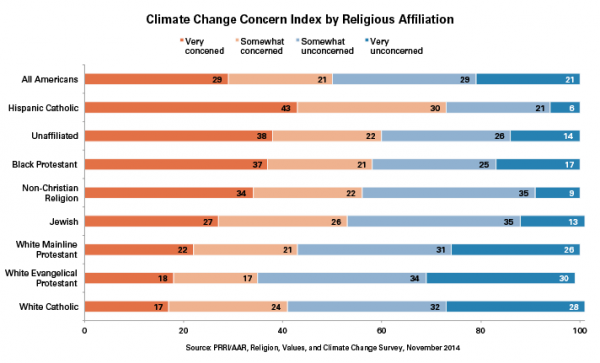
The 2014 survey shows that Hispanic Catholics in the United States are the most likely religious group to be concerned about climate change. White Evangelical Protestants are the least likely. The nation as a whole is split 50-50.
Jamboree attendee Cyrus Hicks says the division among Christians may be because of different interpretations of scripture.
“I think there’s a huge emphasis on personal salvation and how temporary this life is. A lot of times you hear we are supposed to be ‘in’ the world but not ‘of’ it. And there are scriptures that say not to love the ways of the world. But then you have other scriptures that say God so loved the world that he gave his only begotten son.”
But for Bishop David, ultimately that doesn’t matter. “All of us have an obligation to care for the environment. It doesn’t matter what your faith is or your background is. We were put here as the caretakers, the stewards of this. We will answer for what we do or don’t do for the environment.”
The event was hosted by the InterFaith Earth Care Action Network.
Close
Update notification options
Subscribe to notifications
Subscribe
Get notifications about news related to the topics you care about. You can unsubscribe anytime.

9(MDEwMjQ0ODM1MDEzNDk4MTEzNjU3NTRhYg004))
9(MDEwMjQ0ODM1MDEzNDk4MTEzNjU3NTRhYg004))
9(MDEwMjQ0ODM1MDEzNDk4MTEzNjU3NTRhYg004))