Spirit

Religious Freedom, States’ Interests Clash Over Autopsies

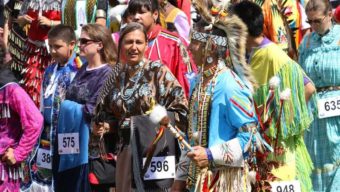
People attend the 45th annual Mille Lacs Band of Ojibwe powwow Saturday, Aug. 20, 2011, at the Iskigamizigan Powwow Grounds in Onamia, Minn. AP

When Tadd Johnson got a call in February that a Native American tribal elder in northern Minnesota had died and authorities were preparing to do an autopsy over his family’s objections, the message was simple.

“They’re going to do an autopsy on Mushkooub, and you need to stop it,” said Johnson, an attorney and chairman of the American Indian studies department at the University of Minnesota’s Duluth campus, a reference to deceased elder Mushkooub Aubid.

It had been years since Johnson, who also is a Native American, had practiced law. But he soon found himself poring over the state’s medical examiner guidelines and religious freedom statutes. He got in touch with Aubid’s family members, who were trailing the medical examiner’s car on its way to Duluth. That’s where the autopsy would be performed within a few hours unless they could stop it.

Johnson and the family obtained a judge’s emergency order halting the autopsy and then went to court to reclaim the body. There, they had to fight a medical examiner who has since been criticized as overzealous at best and insensitive at worst. (The examiner, who has since resigned, did not return calls for comment.) In time, they prevailed in preventing the autopsy and regaining control of Aubid’s body. Along the way, the state’s religious freedom laws were called into question.

Months later, activists and lawmakers in Minnesota say some good came of the episode: It’s being credited with pushing Minnesota to join only a handful of states enacting religious protections for families that object to autopsies, which are often required under state law.

“There really was a disconnect between our statute and a constitutional right,” said Democratic Sen. Tony Lourey, who sponsored the measure that Democratic Gov. Mark Dayton signed in May. “It’s a very emotional conversation. These families were quite upset, and we’re talking about a time when families are really stressed.”

Increasing Attention

Seven states have adopted strong religious protections against autopsies: California, Maryland, New Jersey, New York, Ohio, Rhode Island and, as of July 1, Minnesota.

Members of the medical community, lawmakers and religious rights advocates say the conflict between religious beliefs and a state’s interest in determining a cause of death will likely arise in an increasing number of states because of the diversifying religious makeup of America and a growing sensitivity to religious liberties. A number of groups, including Orthodox Jews, some Muslims and Native Americans, object to autopsies on religious grounds.

“We’re getting more diverse,” said Brian Rusche, executive director of Minnesota’s Joint Religious Legislative Coalition, which backed the autopsy bill there. “We can’t just assume everyone is OK with autopsies anymore.”

But if the trend toward greater discussion of the clash between religious liberties and state autopsy laws is clear, the details and politics remain murky. As illustrated in other states, religious freedom legislation can raise the ire of anyone from church-state separation watchdogs to advocates who fear broad legal protections could be a license to discriminate against lesbian, gay, bisexual and transgender people.

Details Matter

One of the more complicated tasks of handling objections to autopsies is sorting out the specifics of how any measure might work. Even supporters of exemptions acknowledge there must be limits, especially in cases when a death can raise a public health concern or foul play is suspected.

“If your wife is the one that’s deceased, and you have the opportunity to make a religious objection, and you know you had a hand in her death, you might raise a religious objection,” said Robert Small, a retired judge in Minnesota and head of the Minnesota County Attorneys Association, which worked to amend the autopsy bill before it was passed. “There were significant concerns about public safety.”

One of the best ways to deal with those disputes, lawmakers, advocates and medical experts say, is to have a medical examiner work with each family to address their concerns.

That’s how the process typically works in Maryland, said Dr. David Fowler, the state’s chief medical examiner and vice president of the National Association of Medical Examiners. State law explicitly says families have the right to object, and if they do, then officials will discuss the situation with relatives.

“These individuals are obviously at a time when they’ve just lost somebody near and dear to them,” Fowler said. “We will bend over backwards to try to work with the families.”

Fowler said Maryland hasn’t been taken to court over an autopsy objection since 1991. Other states haven’t been as fortunate. And, as the case in Minnesota illustrated, just one dispute between a family and a local medical examiner can shine a spotlight on the shortcomings of state laws.

The Minnesota law, for example, had a contradiction that lawmakers addressed this year. Medical examiners had sole authority to order an autopsy, despite a religious freedom provision in the state constitution. Other states handle the issue differently. In California, for example, people can make their wishes known to the state by submitting a religious objections form.

Yet, even states with existing protection laws aren’t immune from the growing debate.

In New Jersey, Assemblyman Gary S. Schaer, a Democrat and the first Orthodox Jew elected to the Legislature, is sponsoring a bill to amend state law on religious objections. It would require courts to make a determination within 24 hours in any dispute. The timing is especially important in the Orthodox faith, which dictates the dead are to be buried as quickly as possible, Schaer said.

“We don’t want anybody to deal with this at one of the most difficult times of their lives in terms of burying a loved one,” he said.

Schaer’s proposal would also clarify that when a compelling reason for an autopsy must be weighed against a religious objection, the least invasive procedure (such as a “virtual autopsy”) should be used. Any extra costs would be borne by the family.

The measure is awaiting action, and Schaer said he hopes it will move once lawmakers approve a new budget.

Messy Politics

The politics of autopsies can sometimes be messier than the medical or legal details. Georgia is a prime example: Republican lawmakers there failed to pass a broad religious freedom law this year.

The measure said, “Governments should not substantially burden religious exercise without compelling justification.” Supporters said it protected the free expression of religion, while opponents argued it was a thinly veiled attempt to legalize anti-LGBT discrimination.

Supporters invoked autopsy objections in pushing for the measure. They also sought the backing of the Jewish community.

The strategy was initially successful, said Robbie Medwed, assistant director of the advocacy group the Southern Jewish Resource Network for Gender and Sexual Diversity. Lawmakers claimed rabbinical support for the measure as it moved through the Legislature.

But Medwed said LGBT advocates viewed the Jewish community as being used to drum up support for a bill that went beyond autopsy objections.

Medwed and other advocates turned the tide and the Jewish community uniformly opposed the bill, which was then tabled. “They were mostly trying to use this as a trick to get the Jewish community to support this bill,” he said, in reference to the autopsy provision. The bill’s sponsors didn’t respond to requests for comment on the debate.

On the other hand, Minnesota’s autopsy legislation found bipartisan backing. The legislation’s sponsor in the Senate was a Democrat; the House sponsor was a Republican.

Gail Kulick Jackson, a former legislator and lobbyist in Minnesota who helped pass the legislation, said she found the political sweet spot.

“We had the Republicans, who love the idea of religious freedom and religious freedom trumping government action. And on the left, people who liked the fact that it was really respecting of the minority community and their cultures,” Kulick Jackson said. “It made for a very interesting agreement between two very split political parties in Minnesota.”

Read Original Article – June 29, 2015
Religious Freedom, States’ Interests Clash Over Autopsies

A historic Tsimshian symbol of cultural revitalization is restored, donated to Ketchikan museum

From left, conservation intern AnnMarie Guerin and Alaska State Museum Conservationist Ellen Carlee inspect a pole, donated to Ketchikan’s Totem Heritage Center by Tsimshian master carver David Boxley. (Photo by Leila Kheiry/KRBD)

Ketchikan’s Totem Heritage Center has a new pole, relatively speaking. It’s actually 30 years old, but the pole is a new addition to the center’s collection of historic Alaska Native artifacts. Alaska State Museum conservators from Juneau traveled to Ketchikan to help clean and preserve the pole, and to find out what kind of stories might be hidden in the wood.

Ellen Carlee has a tiny lump of metal twisted up in a piece of paper. She’s been trying to find someone who knows what it is.

She shows it to John Radzilowski, a summer guide at the center, who also happens to be a history professor at Ketchikan’s University of Alaska Southeast campus. He doesn’t know either, so she puts it away for the moment.

The Boxley pole where that bit of metal was found is a 30-year-old totem pole, donated to the center by master carver David Boxley.

Ellen Carlee points out a detail on a 30-year-old totem pole, donated to Ketchikan’s Totem Heritage Center by the carver, David Boxley. (Photo by Leila Kheiry/KRBD)

Carlee is based in Juneau and says she got a call last summer from two Heritage Center employees.

“They said, ‘Hey, we’re under a house in Metlakatla looking at this totem pole, it’s covered with lichen, we think it has an infestation problem. David Boxley wants to donate it to the museum. What do you think we should do?’” she says. “I’m like, ‘Well, I’m in Fred Meyer right now, but here’s what I think.’”

A year later, Carlee and two graduate-level conservation interns have flown to Ketchikan to clean the pole and prepare it for display. She says the artist didn’t really want the pole restored, just preserved.

The cleaning process is meticulous. They had to remove the lichen without damaging the paint. As they gently nudged the vegetation away, that’s when they found the imbedded lumps of metal.

“It looked like it may be some sort of pellet,” she says. “Now that we cleaned it, we’ve seen this in a couple of spots. This pole stood outside the Boxley family home for decades, so probably I should send a picture of this to somebody from Metlakatla and say, what is this? What was it doing in the pole? Because that’s part of the story.”

As Carlee continued talking, intern AnnMarie Guerin carefully wielded a bamboo skewer, scraping remaining bits of lichen tendrils from the pole’s many cracks.

AnnMarie Guerin carefully scrapes lichen tendrils from the cracks of an old totem pole. (Photo by Leila Kheiry/KRBD)

“So, I’ll just test it and see if maybe it’s falling off on its own, and if it is, then I keep going, but if it’s stubborn, I just kind of let it be,” Guerin explained. “I would definitely call it meditative. That was one of the reasons I wanted to get into conservation. I knew there was a lot of meticulous and long-term work, and I know I liked doing that kind of thing. So, I could spend hours doing this. It’s great!”

Leaving the Totem Heritage Center, senior curator of programs Anita Maxwell walks up to say that Radzilowski had found out what the metal pellets are.

“It is from a pellet gun,” Maxwell says. “There’s a specific kind of hollow-core lead pellet, and he even has the website to buy some more. Google is amazing.”

The next step was to find out how it got there. A call to the artist revealed BB guns as the culprit.

“Oh, I’m pretty sure that’s where that came from,” Boxley says, laughing. “There’s lots of little neighbor kids without a whole lot of supervision.”

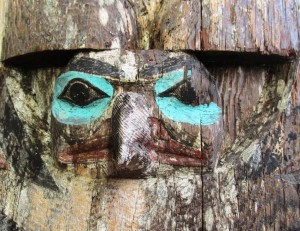
A detail from the historic pole donated to the Totem Heritage Center by its carver, Tsimshian artist David Boxley. (Photo by Leila Kheiry/KRBD)

Boxley says he carved the pole in 1982 to coincide with a potlatch he organized in honor of his grandparents, who raised him. He says it wasn’t the first pole he ever carved, but it was the first large one, for the first potlatch in that community.

“The actual putting on of the potlatch, I didn’t have a lot of help because our people had not had one up ’til then, and I’d never even seen one, been at one. It was all research,” he says. “A few people in my family and a few people from the other clans helped put it together. It was something I had to do.”

While a replacement pole, carved by Boxley and his son, has gone up in the original pole’s place. Boxley says the original is an important part of Tsimshian Native culture and history in Metlakatla.

“It was kind of the symbol of the revitalization of potlatching in Metlakatla,” he says. “It was the first one: first potlatch, first ceremony, first pole-raising.”

Much of the Native culture had been left behind, he says, when the first residents followed missionary Father William Duncan from British Columbia in 1891.

“The education process has been slow, but it’s come a long way,” Boxley says. “I’m pretty proud of my people for everything they’ve done. All the other clans, all the artists who are doing their best.”

With the pole that Boxley donated, the history and significance of an event that began the Tsimshian renaissance will be preserved for generations to come.
East Coast theology school selling off Alaska Native art, feds to investigate

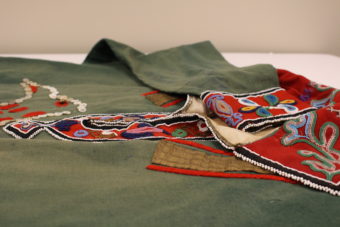
Chuck Smythe unrolls the tunic from storage. (Photo by Elizabeth Jenkins/KTOO)
Chuck Smythe unrolls the tunic from storage. It’s kept this way to avoid damage. (Photo by Elizabeth Jenkins/KTOO)

The country’s oldest theological school is selling off its Native art collection, and Sealaska Heritage Institute is asking the feds to investigate. Tlingit and Haida pieces are among the works–some of which might be sacred.

At Sealaska Heritage Institute, culture and history director Chuck Smythe walks down a flight of cedar steps to the basement, the place where Native artifacts are kept.

Behind a locked door are some of the pieces in the collection.

“We’re going into the conservation room. You hear the freezer going,” he says.

Items that arrive at the institute are cooled to 40 below to kill insects before the pieces go into long-term storage in a temperature controlled room. Smythe shows me a Southeast Native tunic, probably from the 20th century.

“It’s a green tunic with red border and it has flowers and designs.”

It has delicate beading on the sleeves and collar, a raven on the front. But that’s all we know. The tunic was repatriated from a museum in 2007. Information about which tribe and clan it belongs didn’t follow it back home.

“It’s hard. A lot of museums have very generalized identification of objects,” he says. “I used to work at the Smithsonian in the repatriation office and they have hundreds of objects that are just ‘Northwest Coast.’”

SHI is looking for the tribe the tunic belong to. (Photo by Elizabeth Jenkins/KTOO)
Sealaska Heritage Institute is looking for the tribe this tunic belongs to. (Photo by Elizabeth Jenkins/KTOO)

Even harder to track are the Native artifacts that fall into private collectors’ hands. That’s what the Peabody Essex Museum in Massachusetts says could happen to 80 pieces in its care because the owner wants to sell.

The museum has housed the collection since the 1940s; The Andover Newton Theological School is the owner.

Dan Monroe, the museum’s director, says the school informed him a few months ago.

“The 80 works are works that they’ve selected that have the greatest monetary value,” he says.

The college says it’s not an art curator; it’s an educational institution.

Sealaska Heritage Institute is questioning whether the artifacts are sacred–pieces used in ceremony.  A federally supported entity, like a school or museum, is barred from selling those and obligated to return them to the tribes.

Items in storage at Sealaska Heritage Institute. (Photo by Elizabeth Jenkins/KTOO)
Items in storage at Sealaska Heritage Institute. The Andover Newton Theological School’s collection contains works from 52 tribes. (Photo by Elizabeth Jenkins/KTOO)

Rosita Worl, the president the institute, says the spirits of her ancestors are associated with those objects.

She notified the feds that some of the Tlingit and Haida pieces in the theological school’s collection could be subject to repatriation laws–particularly a halibut hook with a wolf crest and shamanic doll.

“We believe that everything has a spirit and that includes animate and inanimate objects,” she says.

Worl is Tlingit of the Eagle moiety and Thunderbird clan. She says she’s been trying to “get over the history” of how the theological school acquired these artifacts in the 19th century.

“We know they were well meaning in terms of trying to Christianize us, but we went through a lot of difficulties with that,” she says. “And I really want to respect all different religions but having the history of that overt suppression of our beliefs was difficult to take again.

The college is estimated to turn a million dollar profit. But Martin Copenhaver, the school’s president, says the pieces for sale are not sacred items. He believes the museum is engaging in an “ugly disinformation campaign.”

“I think the status quo works for them. They have the pieces. They’re able to display them for free. They did not pay for those,” he says. “I think it doesn’t work for them now if those pieces are in other museums.”

He says the school plans to sell to other museums, not private collectors.

“Unless those are ones who intend to then in turn donate them back,” says Copenhaver.

But museum president Dan Monroe says it typically doesn’t go that way.

“I would say it’s fair to summarize the frequency of that happening as highly infrequent,” says Monroe.

Appraisers have already been sent to assess the items but there’s no date for the sale yet. Worl says the willingness to sell the artifacts contradicts the school’s mission statement: “We will strive to be good stewards of the sacred tradition we have inherited.”

“My first wish is that they would say, ‘OK we recognize that Native people have these spiritual relationships to these objects.’ That they are significant,” Worl says. “I would hope that they would recognize that.”

Federal repatriation agents have opened an investigation.

Online cemetery mapping to ensure Juneau always knows where the bodies are buried

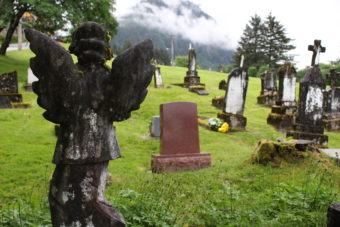
The Evergreen Cemetery is split up into different sections.  This is the "Serbian" part of the grounds. (Photo by Elizabeth Jenkins/KTOO)
The Evergreen Cemetery is split up into different groups. This is the Serbian part of the grounds. (Photo by Elizabeth Jenkins/KTOO)

A grease-smudged stack of 25 fading sheets of paper in a storage shed is one of only two copies of who’s buried where in Evergreen Cemetery. All the burials since 1986 are handwritten, but that’s about to change. The City and Borough of Juneau was recently awarded a grant to map its graves digitally.
Ben Patterson has been overseeing the grounds at Evergreen Cemetery for about 12 years. During that time, he’s been able to reflect on where he’d like to spend his final days.

“I definitely don’t want to be put into the ground, I know that,” he says. “I don’t know if that’s because I’ve spent so much time in the cemetery, but I think I’d rather be spread around a little bit.”

Inside the cemetery storage shed, along with gardening tools and a lawnmower, is an invaluable stack papers.

“Basically 25 pages of maps that show all the plots,” Patterson says.

The other known copy is kept in a separate location to avoid both being destroyed in a fire. More than 8,000 people are buried at Evergreen. The cemetery dates back to the 1880s when it was moved from its original spot on Chicken Hill.

“It was staked as a mining claim for gold. So they had to move everyone that was there,” Patterson says.

Some of the rectangular plots look like they were thrown out like dice, some are orderly. Names collected from a 1986 survey are printed inside some of those rectangles.

“All the handwritten notes are just all the burials that happened since then or were discovered since then,” he says. “And that’s basically the only record of the these locations since the 80s.”

One of only two known records of Evergreen Cemetery. (Photo by Elizabeth Jenkins/KTOO)
One of only two known paper records of Evergreen Cemetery. (Photo by Elizabeth Jenkins/KTOO)

It’s not a great system, though Patterson has almost all the grave sites memorized. He can flip through the 25 pages and find people by name, and he can find them on the ground.

“I was just mowing the other day and someone walked up and asked me where a certain person was and I just happened to have just weed whipped around his headstone and they were joking with me that I had all 8,000 graves memorized,” he says.

With the rise in genealogical databases, like Ancestry.com, Patterson says he’s noticed an increase in these requests. Last week alone, he’s located the graves of five different people. A new system will be a big help.

“It is huge. It’s going to mean that’s it’s going to be way easier for people to find everyone in Evergreen,” he says.

The City and Borough of Juneau was awarded a $17,000 grant in federal funds to put a cemetery map online.

Quinn Tracy is the lead cartographer on the project. (Photo by Elizabeth Jenkins/KTOO)

Outside, city cartographer Quinn Tracy holds a GPS device above the headstone of Joe Juneau to pinpoint the exact geographic location. The device beeps as the site is mapped.

“So when I bring these points into the information geographic names system, I’ll have a point and then name associated with that point,” he says.

Buried at Evergreen are several notable people in Alaska’s history: city co-founders Joe Juneau and Richard Harris, victims of the sinking of the Princess Sophia and civil rights activist Elizabeth Peratrovich.

Tracy only needs two coordinates per grid section to map the entire cemetery–the rest will be overlaid using a digital scan of the 1986 survey. He peels back the moss from a crumbling headstone to uncover a name.

“I don’t know, it’s just kind of sad that some of these you can’t really read,” Tracy says.

Soon family and friends will be able to search for grave sites on the city’s website with the click of a mouse.

“It’ll be similar in concept to Google Maps where you enter an address and it takes you to that location,” he says. “In that case, you’ll enter someone’s name and will take you to their location in Evergreen Cemetery.”

Most of the remaining plots were sold in the 1950s and the site is almost full. Before long, there will be no new burials. Children nearby take turns tumbling down the hill.

Groundskeeper Ben Patterson says he doesn’t mind the historic resting place being treated like a park.

“I don’t find that disrespectful. I think it’s one of the neatest things about our cemetery is that it’s just so peaceful and people like it so much,” Patterson says.

The Evergreen Cemetery map goes online in October.

Alaska’s Orthodox bishop visits Unalaska

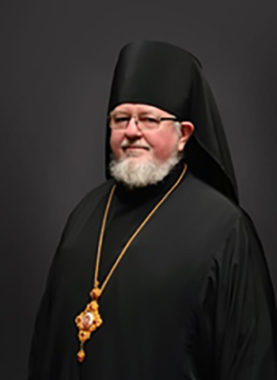
Bishop David, Orthodox Church in America, Diocese of Alaska. (Photo courtesy of GANP/Dimitrios Panagos)

Alaska’s Orthodox Bishop, David Mahaffey was in Unalaska last week. He has held his post in Alaska for just over a year. He said in that time, he’s placed more focus on work with the Regional Alcohol and Drug Abuse Counselor Training Program, or RADACT, to address issues of substance and alcohol abuse and domestic violence.

“They’re doing more with our seminarians so that when they graduate,” he said.  “When they go back to villages, they are better equipped to deal with people with these issues. I have petitioned the governor to have more VPSO’s in the villages.”

But Bishop David said it’s unclear how successful that petition may be in light of cuts to the state’s budget.
Bishop David said there was something particularly special about his visit to the cathedral in Unalaska, one of the oldest in the country.  A chapel in the church is dedicated to St. Innocent, who served as the first Orthodox bishops in the state beginning in 1840.

“When I came here and walked in the doors of this cathedral, the feeling that I had of just the overwhelming presence of St. Innocent and that was to me so spiritually uplifting,” he said. “I would have been happy to not do anything else, but stand in the church all day.  This cathedral has that effect on me.”

Bishop David came to Alaska from Pennsylvania first in 2012.  He still grapples with the distance.

“I heard something the other day… a man was telling a story about a man who wanted to be a missionary but his wife didn’t want to go where he wanted to go and he kept saying ‘well, I either pick her for a wife or I go to this country to be a missionary,’” explained the Bishop.  “He said it wasn’t until her realized he wasn’t picking between the woman and the country, he was picking between the woman and God and I kind of thought ‘yes, that’s what I was doing. I was saying Pennsylvania or Alaska when I should have been saying ‘Pennsylvania or God?’” he said.

Bishop David said he doesn’t regret his decision.  He was in Unalaska to mark the Feast of the Ascension. In Russian Orthodox tradition, the celebration takes place 40 days after Easter.

Bishop David also made visits to other Aleutian chain communities including Adak and Nikolski.


Alaska pastor’s missionary trip to Nepal becomes relief effort

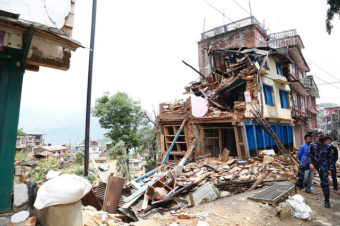
Kathmandu, Nepal after a 7.8 magnitude eartquake in April. (Creative Commons photo by UK Department for International Development)

Last month, a magnitude 7.8 earthquake caused massive destruction and killed more than 8,000 people in Nepal. For one Upper Susitna Valley pastor, the timing meant that his planned mission trip turned into a relief effort.

Mike Sloan is the pastor at the Church on the Rock in Sunshine, Alaska.  On April 25th, Sloan and his group were on a plane from Bangkok to Kathmandu when the earthquake struck.

“We were just on our descent from Bangkok into the landing approach to Kathmandu Airport when they pulled up again and circled for an hour, and the pilot came on and said there had been an earthquake and the airport was closed,” Sloan said.

Sloan and the other men were traveling to Nepal for an eight day trek to a remote village.  After their flight returned to Bangkok, they waited overnight before being able to complete the journey to Kathmandu.  Once there, the eight day trek was cut in half, and they turned their efforts to helping villagers who lost their homes to the devastating earthquake.

“We pooled as much money as we could among the team, and the biggest concern became shelters, tents, and food. And so, that’s what we put our money into to get out to villages,” he said.

Sloan says that a large international effort began quickly to help the people of Nepal, but that much of the focus was on Kathmandu, the country’s largest city.  Sloan and his companions were able to pool together about $9,000, which they used to buy hundreds of tents and large bags of rice. He says that many of those who lost their homes in the villages also lost their stored food.

“Out in the villages, it’s between crops, and what happens is they store all the food they harvested in their houses, which all collapsed.  So, that means they lost all their food,” Sloan said.

On top of that, Mike Sloan says monsoon season is coming, which will mean constant rainfall for most of the time from June to September.  While houses in Nepalese villages tend to be simple structures built from mud and brick, Sloan says the subsistence lifestyle of many villagers means they don’t have time right now to try to rebuild.

“Right now is their monsoon time, coming, which means they’re planting, mostly corn right now. And that corn has to be planted and going before the rains hit, so they just don’t have a lot of spare time,” Sloan said.

Once the supplies were purchased, they had to be delivered.  Sloan says he and his companions partnered with local church leaders in two villages to get the supplies out.

“With those tents and rice, we were able to go to two different villages,” Sloan said. “One you could drive to, near the Tibetan border, and another we had to hire 50 to 60 porters to pack out the rice.”

The porters spent three days on the trail to reach the remote village. Sloan says the efforts of local church leaders helped greatly with making sure the food and tents got to those who needed them.

“When you work with the faith community, like the Nepali churches, a hundred percent goes in and a hundred percent goes out, just like us.”

Sloan, who lived in Nepal as an aid worker in the past, says that working through the government’s layers of bureaucracy can be frustrating.

“When you get all this money coming in, it ends up getting eaten up by this bureaucratic mess, and very [little] goes out.  That’s just the way it is, and Haiti was that way, and that’s the way this one—and these governments are very, basically, corrupt.”

For that reason, Mike Sloan says he will continue to work through the faith community.  He says efforts are continuing to raise funds locally to send to villages in Nepal.  Currently, the fundraising efforts have yielded between $8,000 and $9,000.  Sloan says he will continue his annual trips to the country, and plans an additional visit later this year.

Site notifications
Update notification options
Subscribe to notifications