Spirit

Slideshow: Memorial Day in Juneau


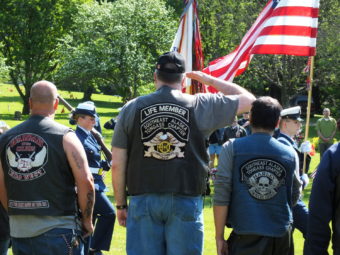
Juneau residents remembered and honored those who made the ultimate sacrifice during Memorial Day observances under sunny skies and breezy conditions in Juneau.

Observances were held at Evergreen Cemetery, Riverside Memorial Park, and the Southeast Alaska Native Veterans Memorial.

Here’s audio from the observance in Evergreen Cemetery:

Tribes, Forest Service partner on climate change research

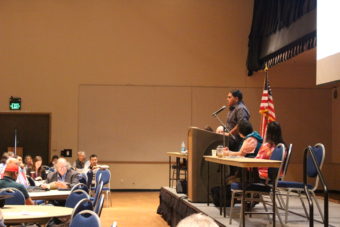
At the Native American Fish and Wildlife Society Conference in Juneau this week, a panel of five discussed climate change and traditional knowledge.
Jay Kazhe is a student at Eastern new Mexico. He represented the Native "youth perspective" at the panel.  (photo by Elizabeth Jenkins/KTOO)
Jay Kazhe is a student at Eastern New Mexico University. He represented the Native “youth perspective” at the panel. (photo by Elizabeth Jenkins/KTOO)

Rick Edwards is the research aquatic ecologist with the U.S. Forest Service. He likened the observations of indigenous people to scientific models.

“If we focus on that part of this integrated body of spirituality, culture and knowledge, and if we focus on observation-based natural history parts of that, then indeed, that looks a lot like science to me,” he said.

In 2010, the Forest Service partnered with tribes nationwide to study the effects of climate change. Alaska Native tribes are also participating.

Ida Hildebrand is the tribal natural resource program director for the Chugach Regional Resource Commission, a nonprofit that oversees the stewardship of natural resources in the Chugach region. Hildebrand cautioned Native people to exercise sovereignty over their traditional knowledge.

“That is your tribal choice. You have that knowledge, you don’t have to share it. Or you can share parts of it and not all of it. There’s sacred knowledge. There’s common everyday knowledge. There’s all kinds of traditional knowledge,” she said.

The research is funded with federal money which means information gathered could become public record. The goal of the project is to preserve tribal culture in the face of changing climate.

Sacred architecture: Walter Soboleff Building opens its doors

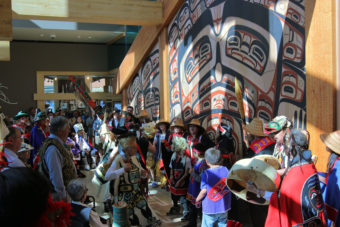
The Sealaska Heritage Institute unveiled its new structure in downtown Juneau today. It’s called the Walter Soboleff Building after the late Tlingit scholar, elder and religious leader. Inside stands a full-sized replica of a traditional red cedar clan house.

At the opening ceremony, the Aangun Yatx’i dance in their regalia in front of the Walter Soboleff building.

The Aangun Yatx’i dance in their regalia in front of the Walter Soboleff building.  (photo by Elizabeth Jenkins/KTOO)
The Aangun Yatx’i dance in front of the Walter Soboleff building. (photo by Elizabeth Jenkins/KTOO)

Davina Cole is the arts assistant here. She clutches her four-month-old baby girl tightly to her chest.

“We’re Yanyeidí from the T’aaku Kwáan area. We’re little wolves. She’s my baby pup,” she says.

Cole says she’s looking forward to what the Soboleff Building will offer her daughter. They’ve already gone to a Baby Raven Reads class before the grand opening. It teaches pre-literacy through Native stories.

“So even right now she’s benefiting from the center because it’s going to be really good for her to be surrounded by that and even have a place to go and learn that,” she says.

The building is a museum for Tlingit, Haida, and Tsimshian artifacts, a space for cultural ceremonies and it houses a gift shop. The building is part of an initiative to turn Juneau into the Northwest Native arts capital. But designing a space that could serve all those functions and reflect the past was difficult.

“When we got the responses, the designs were all very traditional,” Rosita Worl says.

Worl is the president of Sealaska Heritage Institute and a Tlingit from the Eagle moiety. She says the Native artist committee wanted a structure that was more “traditionally inspired.”

“They don’t like the word ‘contemporary,'” she says.

Yellow cedar beams in the entryway of the Walter Sobeloff Building. (photo by Elizabeth Jenkins/KTOO)

SHI sifted through submissions and picked architect Paul Voelckers’. The design was influenced by the form of ceremonial clan houses with chunky beams of yellow cedar. It has an open feel and a wall of glass at the entrance.

“I will tell you that we made the right decision in selecting Paul. It might not have even been the lowest bid. But we all said we got to go with him,” she says.

Voelckers is the president of MRV Architects. The firm’s founder Linn Forrest Sr. specialized in totem pole and clan house reconstruction.

“The firm has sort of tried to maintain that legacy of involvement in the cultural design issues from Southeast ever since,” Voelckers says.

Most recently, MRV worked on a clan house in Kasaan. For the Walter Soboleff Building, Voelckers looked at old photos of clan villages. Some were covered in moss from age.

“But it would have the angles of the house. You know, the big massive beams on the front. And sometimes the old house post inside. That became the essential element that was left in these villages. And so what we tried to do in the new design was capture some of that heavy framework,” he says.

The basement level floor houses the research lab and mechanical room. The whole building is heated using wood pellets.

“It simply flows down like grain or something,” he says.

The building was designed to meet the U.S. Green Building Council’s gold standard for energy efficiency. The wood pellets come mostly from the Sealaska Corp. land on Prince of Wales Island. Rosita Worl says that’s part of keeping the core cultural values in the design.

“Haa Aani: our relationship to the land,” she says.

On the main floor is a full-sized replica of a clan house. It can seat 300 people and fits with tradition: pitched roof, windowless and built with adzed red cedar. The floor is tiered with sunken-in seating. Worl says she knew it would a special place.

The inside of the clan house features a traditional small door to thwart invaders. (Photo by David Purdy/KTOO)

“But what we hadn’t counted on, what I hadn’t thought about was this almost sacred feeling that you get when you go into that clan house.”

Worl says she has a strong connection to her ancestors.

“And it was almost like they were saying to us, ‘Rosita, you know you’re talking about being progressive, you want to move into the 21st century.’ It almost became like their space and they said, ‘This is where we are.’”

At the the Walter Soboleff’s closing ceremony, the clan house was given the name Shuká Hít.

Blessing and remembering Alaska’s commercial fishermen

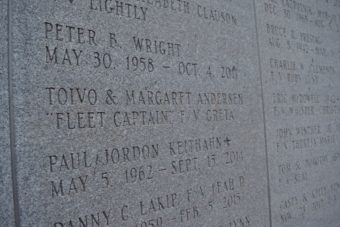
The names of Toivo and Margaret Andersen have been added to the Alaska Commercial Fishermen's Memorial this year. (Photo by Casey Kelly/KTOO)
The names of Toivo and Margaret Andersen have been added to the Alaska Commercial Fishermen’s Memorial this year. (Photo by Casey Kelly/KTOO)

This weekend marks the 25th anniversary of Juneau’s Blessing of the Fleet. The annual tradition honors those who participate in one of the state’s largest industries.
It’s held at the Alaska Commercial Fishermen’s Memorial on the downtown waterfront. Five names have been added to the memorial’s granite wall this year, bringing the count to 203 men and women.

25th Blessing of the Fleet Ceremony
What: Honoring Alaska’s commercial fishermen
Where: Alaska Commercial Fishermen’s Memorial
When: 10 a.m. Saturday, May 2
The Twisted Fish will serve free brunch after the ceremony.

Carl Brodersen stands in the half-moon shaped fishermen’s memorial, pointing out members of his family whose names are etched on the wall. He starts with his grandparents, then his uncle, and finally, his parents:

“John and Elizabeth Clauson are right here, of F/V Lightly. John Eric Clauson is more towards the middle. I always have to try and pick him out. Yeah, there we go. So, yonder with the star, you can kind of see him just past the center point. And my parents are more toward the left here. Right here in the middle, the third panel. Mark and Christine.”

As with all of the names on the wall, each of Brodersen’s family members worked in the commercial fishing industry in some capacity.

He lost both his parents to illness at a young age. His grandparents lived into their 80s and 90s. Though, his grandfather died unexpectedly in a drowning accident. His uncle, whose name is marked with a star, died at sea.

Brodersen says the blessing ceremony every year serves as a reminder of his family’s commercial fishing roots.

“It’s affirming. It’s nice to know that there’s a place where their names can go to be remembered,” Brodersen says. “But also sad of course as well that they’re there in the first place. A lot of people on this wall shouldn’t be. They were entirely too young.”

Brodersen is a board member of the nonprofit that manages the memorial and organizes the annual Blessing of the Fleet.

Commercial fishing is a multibillion dollar industry in Alaska, employing thousands of people. But Brodersen says in some ways the fishing community in the state, like the population of Alaska itself, is rather small.

Carl Brodersen
Carl Brodersen. (Photo by Casey Kelly/KTOO)

“You grow up within the fishing system, you know about people from far and wide,” he says. “And so, you look along this wall and I could probably point out a quarter of the names as people that I’ve at least heard of or recognize in some fashion.”

During the blessing ceremony each name on the wall is read out loud.

This year, the names of Toivo and Margaret Andersen – longtime friends of Brodersen’s grandparents – will be read for the first time.

“They lived in Pelican a long time ago. You know, good proper Fins, very stoic Nordic types,” says Brodersen. “It was often said of Toivo that he was such a good fisherman that he could catch a salmon simply by dragging a herring across a muskeg.”

Besides paying respects to those who’ve died, the ceremony is meant to honor the men and women still fishing. A procession of boats will pass the memorial in Gastineau Channel to receive a blessing, performed this year by Pastor Phil Campbell of Northern Light United Church.

“Fishing is such a central part of the lifeblood of Juneau, and all of Southeast for that matter,” Campbell says.

This’ll be the second time Campbell has performed the blessing. He says it’s kind of like life itself in that you can’t always separate the happiness from the sadness.

“Here’s this excitement and anticipation, and getting ready for the new season, and everybody’s happy, and it’s a party,” he says. “And at the same time, there is somber reflection.”

Campbell says he plans to spend a little time during this year’s ceremony talking about the Spanish word for blessed.

“It’s bienaventurados. So, literally translated in English it means ‘May the adventure go well with,'” Campbell says.

He says he can’t think of a better word to sum up what the Blessing of the Fleet is all about.

Leaning into the fear: As If! The Alaska State Improv Festival is back

As If! or The Alaska State Improv Festival is back in Juneau this weekend for its third year. Some of the troops are local, from places like Sitka and Talkeetna. Other acts are from the lower 48. Mike Descoteaux and Deana Criess are here with Improv Boston.

Descoteaux is now the artistic director for the group. But earlier in his comedic career, he made a Youtube video of a mock protest, holding up the sign: God Hates Figs. It’s a satirical spoof of the Westboro Baptist Church’s anti-gay slogans.

“The idea being humor allows us to address topics we couldn’t otherwise address. So topics that are so heavily loaded that we just have trouble having a rational dialogue with. We know satire can disarm the audience,” he says.

Subversive humor is still something he uses in his act. Improv Boston’s national touring director Deana Criess says she got her start at an early age.

“At three years old I told my family I wanted to be a stand-up comedian. I thought that meant you would stand on a coffee table and tell jokes. So that’s what I would do at family parties,” she says.

Funny people: Mike Descoteaux and Deana Criess
Funny people: Mike Descoteaux and Deana Criess (Photo by Elizabeth Jenkins/KTOO)

Descoteaux and Criess are visiting with six other members of their improv troop, which relies on gusto and spontaneity for performance.

“So unlike traditional theater we are literally making up everything on the spot. We are out there doing adult make-believe,” she says.

Being script-less on stage with sweaty hands and mounting anxiety is how improv comedy gets made.

“It can be paralyzing for people so just knowing that fear is where you wanna be and leaning into that. It’s transformative for people to think about running into the fear instead of away from it,” she says.

Descoteaux says you walk on stage with an array of life experience.

“And all of this is going to lend itself to the performance,” he says.

Both comedians say they were bullied growing up. It’s part of what influences their comedy.

“I didn’t know what to do. I was the kind of kid who was too paralyzed with fear to say anything. So I turned into a very quiet kid who stopped raising their hand in the classroom, who stopped wanting to do things socially with friends. And it wasn’t until I was in high school that I realized, ‘Oh everyone’s got their own thing. We’re all weird in our own way,'” Criess says.

The experience inspired her to create an improv comedy anti-bullying initiative, where they workshop different scenarios for middle school kids.

“The first thing we tell kids to do is tell them that hurt your feelings, which is really hard when you’re a kid. Because you feel like they just hurt my feelings and I don’t want them to know that. But the reality is, if they already said that to you, they want to hurt your feelings and they’re not going to stop,” she says.

Improv Boston is working on similar programs for people suffering from PTSD and drug recovery. They say comedy is good for a laugh but it’s also good for healing.

At this weekend’s performance in Juneau, Improv Boston says there’s only one thing the audience can expect: the unexpected.

Gov. Bill Walker adopted into Tlingit Clan

Gov. Bill Walker dances during a ceremony at a Tlingit Haida Central Council function in Juneau where he was adopted into the Kaagwaantaan Clan, April 17, 2015.  (Creative Commons photo courtesy Alaska Governor's Office)
Gov. Bill Walker dances during a ceremony at a Tlingit Haida Central Council function April 17 where he was adopted into the Kaagwaantaan Clan. (Creative Commons photo courtesy Alaska Governor’s Office)

Gov. Bill Walker was recently adopted into the Tlingit Kaagwaantaan Clan. The ceremony happened during the 80th Assembly of the Central Council of Tlingit and Haida Indian Tribes of Alaska, where Lt. Gov. Byron Mallott was also given a lifetime achievement award.

In a video of Gov. Bill Walker’s adoption ceremony into the Kaagwaantaan Clan, a Tlingit tribal member places a $5 bill on the governor’s forehead to symbolize a payment for the name.

Then the crowd chants the governor’s Kaagwaantaan name four times. He’s now a member of the Eagle’s Nest House within the Kaagwaantaan Clan, which means Wolf Clan. The clan is part of the Eagle moiety. Walker said being adopted by the clan was a complete surprise.

“It was exciting. Something I’d not been a part of before. It was all brand-spanking new to me and was such an honor. … My adopted name now is Gooch Waak,” Walker says.

Leona Santiago is a tribal delegate from the Kaagwaantaan Clan. She says she came up with the name in 2008 for an adopted family member. And now it’s the name given to the governor: Gooch Waak, which means “wolf eyes.”

She says tribal elders wanted to adopt Gov. Walker into the Kaagwaantaan because of the lieutenant governor’s Native roots.

“Because Byron Mallott is Raven and the Tlingit way, Eagle/Raven is a balance,” she says.

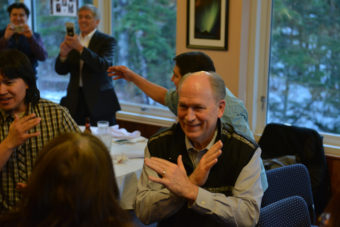
Gov. Bill Walker, Lt. Gov. Byron Mallott, and Tlngit Haida Central Council Richard Peterson at a council function, April 17, 2015. Mallott received a lifetime achievement award.   (Creative Commons photo courtesy Alaska Governor's Office)
Gov. Bill Walker, Lt. Gov. Byron Mallott, and Tlngit Haida Central Council President Richard Peterson at council assembly April 17.  Mallott received a lifetime achievement award. (Creative Commons photo courtesy Alaska Governor’s Office)

This 10,000-year-old tradition creates equal representation for Tlingit families. Few Alaskan leaders have been adopted into Native clans. Lt. Gov. Byron Mallott says it makes the relationship between him and the governor more whole.

“It was special to me. It is special for Tlingit people and I know it’s special for Alaska. The more we can bring those lives across this incredible state together, the stronger we are a state, so it was a good step,” Mallott says.

Recently, Gov. Walker introduced emergency regulations for the Indian Child Welfare Act. It would create lower barriers for extended family or tribal members to adopt Native kids. Essentially, less bureaucracy. Leona Santiago said the timing had nothing to do with adopting Gov. Walker into the Kaagwaantaan clan.

“No, that isn’t what we did. We did it to set the balance because Byron Mallott is a Raven,” Santiago says.

In the video of the ceremony, Gov. Walker dances to a traditional Kaagwaantaan song. He says being governor, you have a lot of one-and-done moments.

“And that wasn’t. That was a life changing moment for me and I knew that,” Walker says.

Gooch Waak or Gov. Bill Walker says he will continue advocating on behalf of all Alaskans.

Site notifications
Update notification options
Subscribe to notifications