Spirit

How Russian Easter bread became an Alaska Native tradition

Easter was last weekend but some Russian Orthodox Christians will observe it this Sunday. That’s where Easter, or what they call Pascha, lands on the Julian calendar. There’s a special treat that goes along with the celebration. It’s not a chocolate bunny. It’s called kulich.

Siouxbee Lindoff has been making Easter bread for over 40 years. It’s what she’s known for.

“I’m in such high demand. I posted on Facebook, ‘I’m only making two batches of bread. I’m only making two batches and no more,'” she says.

In the kitchen of the Juneau Tlingit Haida Community Council Building, she sifts flour and sugar into a large mixing bowl. Adding a dab of salt.

“I will add nutmeg, cinnamon, vanilla, cranberries, raisins, pecans,” Lindoff says.

After mixing in the yeast and cracking eggs, she stirs the dough with a spoon.

“My dream is to invest in a big commercial mixer but everything is still done by hand,” she says.

Lindoff measures all of the ingredients by sight. The whole process, she says, is intuitive. If you want to learn how to make kulich from her, she says it’s a hands-on process.

“People will look and say, ‘Well how can you make something and not measure?’ And I thought, ‘By the feel.’ And I don’t mind sharing, I don’t mind teaching. Cause to me, it’s like, saving our traditions,” she says.

Siouxbee Lindoff heating up yeast to make Easter bread (Elizabeth Jenkins/KTOO)
Siouxbee Lindoff heating up yeast to make Easter bread (Photo by Elizabeth Jenkins/KTOO)

Lindoff grew up in the Russian Orthodox church. Her family split their time between Sitka and Hoonah. Her dad was the only Tlingit priest ordained from St. Herman Theological Seminary in Kodiak. She says being a pastor’s kid could sometimes be a burden.

“My mom used to say, when they look at you they say, ‘There’s that father Michael’s daughter.’ Especially when I was doing bad.”

She says her parents were strict but fair. They tried to protect her from the same discrimination they’d endured growing up. But it came at a cost. They refused to teach the Tlingit language.

“My dad said, ‘You will speak the English language. You will use the correct pronunciation. You will enunciate your words correctly. I don’t want to hear no slang.’ He was adamant about that. He didn’t want us to suffer like they had, ” she says.

Lindoff’s father paid for his high school education. Her mother went to Wrangell Institute, which was a boarding school.

“And of course Tlingit was the first language that was spoken at home and she used to have to sit at the head of the class and have a dunce hat on her head. She died never wearing a hat,” she says.

Although her mom didn’t teach her how to speak Tlingit, she did show her the traditional way to make kulich.

Siouxbee Lindoff mixes the kulich dough by hand (Elizabeth Jenkins/KTOO)
Siouxbee Lindoff mixes the kulich dough by hand (Photo by Elizabeth Jenkins/KTOO)

“My mom tasted my first bread dough and she said yours taste better than mine. She never baked Easter bread again,” Lindoff says.

Russian Orthodox missionaries landed in Kodiak and the Aleutian Islands around 1780. The religion spread to Southeast almost 100 years later.

Sergei Kan, a professor of anthropology and Native American Studies at Dartmouth College, says the Russian Orthodox offered Christianity that was somewhat more tolerant of Native customs and also open to the use of Native languages. He says the Russian Orthodox Church translated the gospel into Native languages, like Tlingit.

“And I think the fact that the orthodox has survived in Alaska means that it was becoming a true Native church,” Sergei says.

After Siouxbee Lindoff incorporates the ingredients for the kulich, she sets the dough aside to let it rise for the next few hours.

“You can get frozen bread dough and you can go to the store but I don’t think you’ll be able to find kulich in the store,” she says.

The finished product: a decorative loaf of kulich (Elizabeth Jenkins/KTOO)
The finished product: a decorative loaf of kulich (Photo by Elizabeth Jenkins/KTOO)

Lindoff compares making the bread to other Native customs, like gathering herring roe. It’s a skill she’s passed down to her children.

“When I do things like this, it makes me feel like it’s part of the healing, like not being able to speak Tlingit because of that era where my mom and dad spoke it fluently and we didn’t and they didn’t want us to. But I feel like this is part of that healing now. This is part of us going forward with the traditional ways and saving what we can,” she says.

She’s excited to teach her great-granddaughter how to make kulich. She’s 5 years old and learning to speak Tlingit in an immersion class.

Rie Muñoz leaves a legacy of delight, joy and laughter

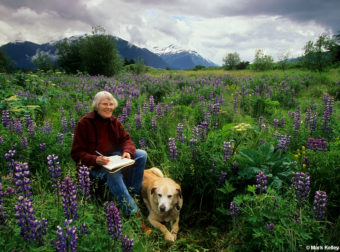
Rie Muñoz with her dog Muncie in the Mendenhall Wetlands, Juneau in 2008. (Photo by Mark Kelley)

Beloved artist Rie Muñoz passed away Monday night at Bartlett Regional Hospital in Juneau after a stroke. She was 93. Muñoz was active until the end, a prolific artist and traveler who drew inspiration from everyday Alaskans.

Rie Muñoz was born in southern California in 1921 as Marie Mounier. Her parents were from Holland and she spent a lot of her childhood there, where Rie was a common nickname.

Daughter-in-law Cathy Muñoz says, as a teenager, Rie and her two brothers were separated from their parents for 4 years. They were on a boat to the United States and their parents were supposed to meet up with them one week later, but World War II broke out.

“It was her brothers and her that went on to California and on their own, they took care of themselves, they got odd jobs, they got a place to stay. After she graduated from high school, then she was reunited with her parents,” Cathy Muñoz says.

Rie Muñoz moved to Juneau in 1950, traveling by steamship up the Inside Passage. In 1951, she and newlywed husband Juan Muñoz Sr. went to teach on King Island, located in the Bering Sea, near Nome. “King Island Christmas” is based on her time there. Muñoz illustrated the children’s book and the late Jean Rogers wrote it.

Rie Muñoz teaching in King Island in 1951. (Photo courtesy Juan Muñoz)

After their time on King Island, Muñoz and her husband later divorced and she raised their son, Juan.

“When he was young, they were often on the road in the summertime. They would load up her van with artwork and they would travel to remote communities and they did what was called a series of clothespin art shows, where they would come into a community and string a line and then hang her paintings for sale,” Cathy Muñoz says.

That built up Rie Muñoz’s following and reputation as an artist. After holding a number of jobs like teacher, journalist and curator at the Alaska State Museum, Muñoz started making a living as an artist in 1972.

Kes Woodward is an artist, art historian and teacher. He met Muñoz in 1977 when he moved to Juneau to be the state museum curator.

He said Muñoz considered her work expressionistic. She was known for her watercolors of Alaska scenes, such as fishermen at work, children at play and life in remote villages. Woodward says Muñoz was the mostly widely traveled Alaskan artist and her art focused on Alaskan people.

“She depicted them enjoying themselves. For her, Alaska is a place that is joyous. It’s a place full of delight and joy and laughter, and I think that’s her real legacy is that she captured that better than anybody else, better than anybody ever has,” Woodward says.

Muñoz described her process in 1985.

“The subjects that I like to paint are people, people doing things. Now that doesn’t mean somebody in an office typing. But people doing things that appeal to me such as working outside in any sort of occupation mostly. And I go to many, many places to sketch and then come back with those sketches and do the paintings from those sketches,” Muñoz said.

Muñoz was speaking in a KTOO-TV series “Conversations.” At the time, she said she was painting up to 85 original works a year.

A Rie Muñoz weaving hangs in the office of daughter-in-law Rep. Cathy Muñoz. (Photo by Skip Gray/360 North)

“I think that art should be creative and honest. And by creative, I mean just that – you have to create something out of yourself. As far as the honesty is concerned, I think that an artist should paint exactly what he or she wants to paint and not ask him or herself, ‘What if I paint this, will this sell?’ It just doesn’t work that way,” Muñoz said.

Her work has been exhibited in numerous museums and galleries in Alaska, Seattle and elsewhere in North America. Her work is also in many homes.

“Well, I find my art in a lot of bathrooms and one reason I do is because I’ve done a number of nudes and, of course, they’re perfect in a bathroom,” she said.

Muñoz’s death was unexpected. She was at Easter Brunch on Sunday. On Friday night, she went to her granddaughter’s first solo art show. As her granddaughter was growing up, they used to spend hours together, sitting side by side, painting and sketching.

Alaska artist Rie Muñoz dies at 93

Rie Munoz
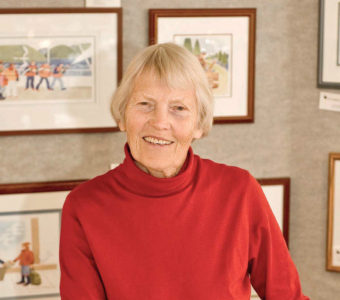
Rie Muñoz. (Photo courtesy Peter Metcalfe)

Alaska artist Rie Muñoz has died. She was 93.

A statement from her family says Muñoz was “active and independent until her last hours.”
She was known for her colorful watercolor paintings of Alaska scenes, such as fishermen at work, children at play and life in remote villages. Her paintings, prints and reproductions are in galleries throughout North America.

Born in Van Nuys, Calif., in 1921, Muñoz first came to Alaska in 1951, traveling by steamship up the Inside Passage. She fell in love with Juneau and decided to make it her home. She held several jobs, including journalist, teacher and museum curator, before devoting herself full-time to art in 1972.

She traveled extensively in Alaska, visiting every community on the road system and several off of it.

Her experience as a teacher on King Island inspired the children’s book “King Island Christmas” by her long-time friend Jean Rogers. Muñoz illustrated the book. Rogers passed away in 2013.

Rie Muñoz is survived by her son Juan, daughter-in-law Cathy, grandchildren Mercedes and Matthew, and her brother Piet Mounier, as well as a niece and two nephews.

A celebration of life will be held from 3 p.m. to 5 p.m. April 23 at Centennial Hall.

New play explores homelessness in Juneau

MK MacNaughton, A Lifetime to Master, homelessness, Juneau
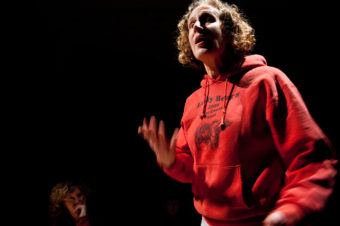
MK MacNaughton as Merry in the play “A Lifetime to Master,” about homelessness in Juneau. Playwright Merry Ellefson (background) interviewed nearly 60 people as research for the play. (Photo courtesy Flordelino Lagundino/Generator Theater Company)

A local playwright has spent the past few years exploring the lives of Juneau’s homeless population and the people who work with them. The result is the new play “A Lifetime to Master,” which debuted this week.

About three years ago, Merry Ellefson was driving home from cross-country skiing with her son near the Mendenhall Glacier, when she turned onto Back Loop Road and noticed a young man staggering down the street. She stopped to help, and found out he was homeless.

“He was maybe 19 or 18, and I just remember he was really intoxicated. He had nowhere to go,” she says. “It wasn’t like, ‘I’m going to do something. I’m on a plan.’ It was just like, ‘I don’t know anything about this.'”

That incident inspired Ellefson to learn more about homelessness in Juneau. Since moving to the city 24 years ago, she’s worked on and written several plays for Perseverance Theatre. “A Lifetime to Master” is based on nearly 60 interviews she did with people about Juneau’s homeless situation.

“People who are or have been homeless,” she says. “People whose lives or jobs intersect with the homeless. A lot of members of our Juneau Coalition on Housing and Homelessness. People in the school district. Friends. I’ve overheard people at coffee shops or on the streets.”

While the play is about Juneau, Ellefson says its themes resonate beyond.

The title comes from the tagline for the board game Othello: “A minute to learn, a lifetime to master.” Ellefson says a pastor she interviewed connected that phrase to the great commandment from the Bible: “Love thy neighbor as thyself.” As she went about trying to understand homelessness in Juneau, she says she kept those two ideas in mind.

“I learned that there’s as many reasons for being homeless as there are people who are homeless,” Ellefson says. “That the issues range from poverty and economics, to family, to community responsibility, to substance abuse, to I think a third of Americans are one paycheck away from homelessness, to domestic violence. There’s a lot of issues that overlap.”

The main character in the play has Ellefson’s name and guides the audience through her interviews.

“It’s really a lot of listening to a lot of stories that are rarely heard in our community, are very hard to hear, as well as some quite uplifting stories of those people whose lives are dedicated to helping people who don’t have homes,” she says.

MK MacNaughton, Jeff Hedges, A Lifetime to Master, homelessness, Juneau
MK MacNaughton and Jeff Hedges rehearse a scene from “A Lifetime to Master,” a play about homelessness in Juneau. (Photo courtesy Flordelino Lagundino/Generator Theater Company)

On a recent evening, the cast of “A Lifetime to Master” runs through lines at rehearsal in McPhetres Hall at the Church of the Holy Trinity in downtown Juneau. The walls are covered with tarps, and actors pop up from lumpy mattresses to say their lines.

Director Shona Strauser has been involved with “A Lifetime to Master” for two years, ever since she read an early draft of the play. She says it’s the most powerful production she’s ever been part of.

“It’s touching and it’s people we know and see,” Strauser says. “You know, you’re going to see people in this play that you would see on the street or at their job.”

The Juneau Coalition on Housing and Homelessness estimates more than 500 residents of the city don’t have a permanent roof over their heads. Strauser says the cast and crew hope the play sparks community discussions about homelessness, and even inspires people to act.

“It’s in your face, this play is in your face,” she says. “And I don’t mean that in a bad way. It’s the idea that you are in this community, and that everybody is around you, and you’ve got to do something, otherwise you’re turning your back on people.”

MK MacNaughton, who plays Merry, says it’s sometimes easier to start conversations about issues like homelessness through art.

“We mostly don’t walk up to people on the street and launch into deep personal stories or ask intimate questions. So art provides that opportunity,” she says.

Michael Patterson lived on the streets from age 9 to 37, and was interviewed by Ellefson during her research. He says the play is just the “tip of the iceberg” for what homeless people go through every day, but it’s full of truth nonetheless.

“I think if we can allow this to really touch all of our hearts and come together closer as a community, you know, then we have a better chance of maybe finding a real working solution to finally do something about this problem,” Patterson says.

Generator Theater Company is producing “A Lifetime to Master.” Ellefson also received support from the Rasmuson Foundation, the Juneau Arts and Humanities Council, the Juneau Community Foundation and several other local businesses and nonprofits.

The play runs through Jan. 25 at McPhetres Hall.

Early study shows surprising optimism among homeless Alaska Natives

Grand Entrance to Celebration. (Photo by Heather Bryant/KTOO)
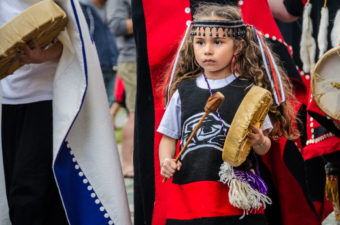
A University of Washington researcher says a strong desire to pass down traditional knowledge may be related to high levels of optimism that he’s found among homeless Alaska Native elders. (Photo by Heather Bryant/KTOO)

A University of Washington professor has found high levels of optimism among homeless Alaska Native elders living in Seattle, and he’s connected the finding to a strong desire to pass on knowledge and experiences to future generations.

As an Aleut who grew up in Naknek, Jordan Lewis knows a little something about Alaska Native culture. Whenever he’s back home, Lewis says he likes to talk to elders and soak up traditional knowledge.

“They tell stories about how Naknek used to be when they were kids, because it’s changing so much now,” he says. “And I think just the fact that they talk to you and share their experiences, and pass on recipes, or how they used to make things, or where they used to pick berries, is this idea that they are hopeful that you’ll take that knowledge and use it to benefit your own life, but then pass it on again.”

Lewis is an assistant professor at the University of Washington’s School of Social Work. His research focuses on Alaska Native communities and generativity, a concept developed by psychologist Erik Erikson. It says that as we grow older, humans tend to want to pass on their experiences and knowledge to future generations.

“The first generative act most people have in their lives is having kids,” Lewis says. “That’s going to secure your future. But as you grow older there’s this need to pass on your legacy, write your memoirs, storytelling for elders, and passing down stories you heard to your grand kids.”

Lewis has studied how generativity helps Alaska Natives age well and become role models, as well as overcome addictions.

He says he became interested in the homeless because it’s an underserved and often overlooked population. Years ago, he says, his family had a relative involved with the Chief Seattle Club, a nonprofit that provides meals, housing assistance and other services to low-income and homeless Alaska Natives and American Indians. That’s where he and a student interviewed 14 Alaska Native elders last year. He says the results surprised even him.

“All of the elders talked about the importance of giving back and teaching others,” he says. “Whether it’s through sharing a sandwich, giving extra change if they had extra change to someone who wasn’t doing as well as they were. Volunteering at the Chief Seattle Club was almost everybody’s response. That’s what made them happy, that’s what got them up every day. And they all said that they did that because it’s going to come back to them in a positive way.”

He says other themes of the interviews included the importance of laughter and religion.

In addition, each of the elders – ages 45 to 70 – filled out surveys to measure generativity and optimism. Lewis says 12 of the 14 individuals scored very high in both.

“That kind of complimented the qualitative interviews. So I could say, you know, 85 percent of the people I interviewed are very optimistic and like to give back and teach the young people, and then here we have specific examples of what they do to do that,” Lewis says.

While he’s excited about the early results, Lewis admits more research is needed to confirm his findings. He’d like to do more than 100 interviews, and has considered expanding to include American Indians.

He’s planning to present his research at the Chief Seattle Club, and ask officials there for ideas on how to do a broader study of Native homelessness.

“How could we either help the people who are homeless, or how do we prevent homelessness, or how do we make their lives more enjoyable from these experiences of what these elders are doing for themselves,” he says.

Lewis also hopes to publish his findings in a peer-reviewed journal. The initial study was part of an online Stanford University program on successful aging that he participated in last year.

Rabbi Dov: Feeding hungry souls via Skype

Rabbi Dov lights the menorah for Hanukkah (Photo by Kayla Desroches/KTOO)
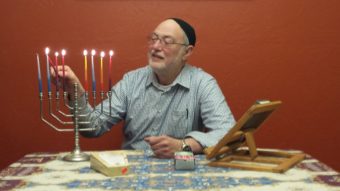
Rabbi Dov Gartenberg lights the menorah for Hanukkah. (Photo by Kayla Desroches/KTOO)

Juneau’s Dov Gartenberg says he’s one of a handful of rabbis in Alaska. He plans to continue his rabbinic work from Seattle when he moves in March–at least through the internet.

He ran a year-long online course called “Engaging Judaism” that ended in September. He has another one planned for 2015.

Cathy Cooley from Ketchikan took Rabbi Dov’s class last year. She says she’d tried another online course before, but it wasn’t a good fit.

It was different with Rabbi Dov, who’d she’d known before the class. He’d assisted in her conversion.

“A big part of Judaism is about community,” Cooley says. “It certainly made sense to be working with a rabbi whose face was familiar to me, who I knew and trusted and respected.”

She says she and 10 other students would read at least one book per month that addressed Jewish thought, culture and belief. Then Rabbi Dov would lead discussions over Skype twice-monthly and answer questions.

Patricia Custard was another student last year. She lives in Eagle River and is in the process of conversion.

And like Cooley, Custard says that being Jewish in places like Juneau, Ketchikan and smaller communities can be a challenge.

“You just don’t have the critical mass available to have offerings that a larger city would,” Custard says. “You have to be able to avail yourself to things like Dov’s class and also be self-initiated. Do a lot of reading on your own and just really seeking out people who will discuss readings with you.”

Rabbi Dov says one of the class’s purposes is to provide students with a background in Judaism they would usually find through traditional means.

“If you live in a place where you can’t even get a minyan, which is a quorum for 10 Jews, how do you learn about prayer? Or there are no ongoing prayer services. I could say ‘Well go to the local synagogue and participate in the services.’ I can’t tell someone to do that.”

The class’s aim is not to replace community.

“What you’re trying to do is to help people create a personal life that’s Jewish, not necessarily a communal life that’s Jewish.”

Rabbi Dov calls Judaism a “textual religion.”

“They have a great literature,” he says. “And the study of those texts is considered a religious act. So what I’m doing with people is giving them skills that they can use to study those texts. And that’s something you can do in Alaska.”

Some of his students have turned to the internet for other religious needs. Gregg Browngoetz lives in Fairbanks, but has spent time in a few small towns in Alaska.

“I’ve participated in some online communities with other congregations outside of Alaska in terms of attending Shabbat service and high holiday services online.

Streamed services and internet classes are not ideal for everyone. For instance, Skype either melds with your learning style, or it doesn’t.

“I learn better when I’m physically in a group of people and can scan and see how people are reacting,” Custard says. “With Skype, you know, you just see one little face at a time. But for what, you know, it was the best that we could do and because of that it is effective.”

In other words, it does the trick.

And Custard says she consumed all the material Rabbi Dov assigned.

“It was like feeding a hungry soul.”

The second year of Rabbi Dov’s class begins in January and will be called “Doing and Being Jewish in Alaska.”

Editor’s Note: A previous version said Rabbi Dov Gartenberg was one of three rabbis in Alaska. KTOO has since learned that there are at least four.

Site notifications
Update notification options
Subscribe to notifications