Longtime Alaska reporter Bob Tkacz will be remembered Thursday at the state capitol for the years he covered the Alaska Legislature.
Tkacz died in May at the age of 61. For years he covered state lawmakers for various Alaska media, most recently the Alaska Legislative Digest and Alaska Journal of Commerce. He also wrote about the commercial fishing and seafood industry in his own subscription newsletter, Laws for the SEA, which he established in 1994.
Tkacz was known for his tenacious style of questions, especially with politicians he was covering.
Fittingly, the House Speaker’s chambers in the state capitol have been reserved at 3 p.m. for a time to share memories of Tkacz. Younger brother Tom Tkacz says it will be followed by a reception at St. Ann’s Hall on Fifth Street, which begins at 6 p.m.
“As Bob wanted, he didn’t want to have a lot of moping around, he wanted to have a party so that’s what we’re going to have,” Tom Tkacz says.
He has been in Juneau to close up his brother’s office stuffed with years of covering the issues and events of Juneau and the state.
He says he’s heard a lot about Bob’s determined journalistic style.
He’s been described as a bull-dog reporter; a tenacious pursuer of honesty and the truth.
But he says his favorite memories of his brother are the times they shared outdoors, including hiking and climbing.
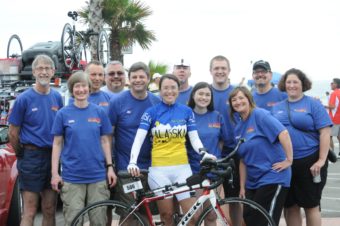
Janice Sheufelt (center) with her crew at the start of the 2014 Race Across America ultra-marathon cycling race. (Photo courtesy Janice Sheufelt)
After more than 3,000 miles on a bicycle in less than two weeks, Juneau’s Janice Sheufelt is back in the capital city with her second consecutive Race Across America title in hand.
Sheufelt won the premier ultra-marathon cycling event last year as part of a two-person mixed-gender team. This year she won the solo female division, finishing June 22 with a time of 11 days, 18 hours and 2 minutes. That’s despite a mid-race setback due to breathing problems.
There isn’t a harder or longer race, so I’m really glad to have won this one,” Sheufelt says.
After jumping out to an early lead in the non-stop bike race from Oceanside, Calif. to Annapolis, Md., Sheufelt started having difficulty breathing in the Rocky Mountains.
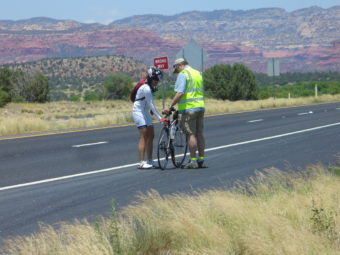
Janice Sheufelt with Dr. James Cusick at Rio Grande Hospital in Del Norte, Colo. Sheufelt developed breathing issues during the 2014 Race Across America that required nebulizer treatments. (Photo courtesy Janice Sheufelt)
“I was coughing and wheezing and the smallest little uphill I could barely get up it, because I couldn’t get any breath,” she says. “The crew said I sounded like a 90-year-old smoker. I just sounded terrible.”
Sheufelt says she’s never had asthma or other breathing issues. She tried using an inhaler, but that didn’t work. So after reaching the time station in South Fork, Colo., Sheufelt and her crew made their way to a local hospital.
Sheufelt is a family physician and was worried she might have fluid building up in her lungs due to the high altitude. Fortunately, a chest X-ray revealed otherwise.
“Because if I had had that, my race would have been over,” she says. “You can’t keep going with that.”
The emergency room doctor told her the breathing problems probably resulted from a combination of the dry desert air in the early stages of the race and too much exercise without giving her body time to recover. The doctor prescribed breathing treatments with a nebulizer and lots of rest.
“I told the doctor I wanted to get back on my bike within a few hours,” Sheufelt says. “And he’s like, ‘Well, you shouldn’t be back on your bike, period. But, you know, if you’re going to do the race, you need to at least give your body like 12 hours.'”
While she was off the bike, Sheufelt fell into third place. She says it was demoralizing and to make matters worse, she still felt terrible when she returned to the race.
At one point in eastern Colorado, you know, I just thought there’s no way I was even going to finish,” she says.
Sheufelt slowly began to regain form, moving into second place in Kansas. She and Canadian cyclist Joan Deitchman were neck-and-neck through most of Missouri, before Sheufelt re-took the lead for good.
She says a lot of back and forth is unusual in the Race Across America, where stronger cyclists tend to build leads and keep them.
“I was like, I really don’t want to be racing in Missouri,” she says with a laugh. “I just want to ride my bike my own pace.”
Janice Sheufelt cools off in a pool at the time station in Congress, Ariz. during the 2014 Race Across America. (Photo courtesy Janice Sheufelt)
Sheufelt says doing RAAM with a teammate last year contributed to the success of her solo race. About half of her 11-member crew this year did the race with her last year as well. Her husband, Jim, served as crew chief. He says even when Janice was feeling down, the crew tried to remain upbeat.
“She thought she was doing horrible. We didn’t feel that way at all,” Jim Sheufelt says. “We were amazed she was riding so well.”
Their daughter Megan was responsible for keeping track of the 8,000 calories a day that Janice ate during the race. Jim says the crew also featured Janice’s brother, Ted, a massage therapist, as well as some of her co-workers from the Ethel Lund Medical Center in Juneau.
“It’s definitely a team effort, because if the riders aren’t getting enough to eat and really being taken care of by the crew, they’re just not going to win,” Jim says. “So it was really nice to get the win from the crew perspective.”
Now that she’s won RAAM two years in row is Sheufelt planning to go for a three-peat?
I really don’t want to do Race Across America again,” she says. “Just because it’s so hard. The training itself is incredibly hard. So I’m just looking forward to riding my bike for fun.”
Her husband says she’ll find another way to challenge herself.
Janice Sheufelt and her husband Jim check on her bike during the 2013 Race Across America. After setting a record with racing partner Joel Sothern in a mixed gender team division last year, Sheufelt won RAAM’s solo female under 50 division this year. (Photo courtesy Peter Apathy)
Eleven days, 18 hours and two minutes. That’s all it took for Juneau’s Janice Sheufelt to claim another title in the Race Across America ultra-marathon cycling event.
Sheufelt won first place in the solo female under 50 division in the race from Oceanside, Calif. to Annapolis, Md., crossing the finish line at 9:43 a.m. Eastern time on Sunday.
Five other solo women cyclists started the race this year. Three did not finish and two were still on the course on Sunday.
Last year, Sheufelt and a partner set the record for fastest time in the event’s 50-59 year-old mixed gender category. She was 46 at the time, but competed in the older age division because the Race Across America uses each team’s average age.
Sheufelt is a family physician and medical director of the Ethel Lund Medical Center in Juneau, part of the Southeast Alaska Regional Health Consortium. She began participating in ultra-marathon cycling events three years ago.
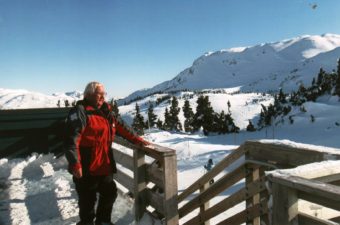
Ron Dippold at Eaglecrest Ski Area. He was a volunteer with the National Ski Patrol and the American Red Cross in Juneau for more than 50 years. (Photo courtesy Elisabeth Dippold)
A celebration of life will be held at Eaglecrest Ski Area this weekend for the guy who probably taught first aid to more people in Juneau than anyone else.
Ron Dippold died in January at the age of 78.
He could tie bandages like nobody’s business,” says Juneau Ski Patrol member Mick Lowry.
He says Dippold could have written a book on first aid.
Dippold was a member of the National Ski Patrol for 52 years and taught first aid to patrollers from the beginning. He also taught first aid and CPR courses for the American Red Cross – not just to students but to instructors.
Ernie Mueller sometimes taught alongside Dippold.
He was kind of a guiding light for all the instructors that worked with him in the Red Cross,” Mueller says.
It’s rare for someone to stick with a volunteer endeavor for half a century, but it became a way of life for Dippold.
He grew up in western New York, attended forestry school, did a stint in the U.S. Navy then got back to the woods with the U.S. Forest Service. He was able to spend much of that forestry career in Juneau.
He also was Southeast Regional Director for the Alaska Division of the Red Cross for several years, but those who knew him best say it was the years he worked without pay that define his legacy.
“The volunteers that we have, they’re a gold mine to us, especially those that stay active for as long as Ron has,” says Red Cross Disaster Response Specialist Roger Rettig. “I don’t think we have anyone that’s close to six decades.”
In 2006, the Red Cross created a Southeast chapter volunteer of the year award and named it after Dippold. He was the first recipient.
“He was intense,” Rettig says. “He was serious about everything he taught, everything he said.”
Mueller says for many years Dippold was the face of the Red Cross in Juneau. He also helped people recover from disasters such as home fires and floods. And when he was teaching, he had a way of reaching them even when they didn’t want to be there.
“You know, you can teach a class and you can tell that this person is here because they have to be here. But when you’re teaching the ski patrol or Red Cross volunteers you’re teaching people who want to be there, because they want to be there for other people,” Mueller says. “I think Ron really responded to both groups.”
Maybe it was easier to teach those classes because he loved to bike, kayak and ski and wanted to be prepared himself.
“I know some of the people that are on the patrol now, he actually pulled them down in sleds when they were younger,” says ski patroller Lowry. When they joined the patrol, it was Dippold who taught them first aid.
Early in his ski patrol career, Dippold received what’s known as a National Appointment for demonstrating leadership and extraordinary service to the skiing public and the National Ski Patrol.
The appointment is for life, but a patroller can lose it. Lowry says Dippold just kept earning it.
“It’s a very prestigious award, there’s not a whole lot of them done. There’s maybe 20 in the whole state of Alaska,” he says.
Throughout his more than 50 years volunteering for the ski patrol and the Red Cross, Dippold had to continually keep up to date on the changing protocols for administering CPR and first aid. He never missed a re-certification.
Mueller believes he knows what drove Ron Dippold to be the ultimate volunteer.
He had an underlying belief that it was important for people to have skills in the event of an emergency, which might require somebody to get first aid treatment, or CPR, or even react to a natural disaster,” Mueller says.
Friends and family will gather at 1:30 p.m. Saturday at Eaglecrest to celebrate Dippold’s contributions to their lives and to Juneau.
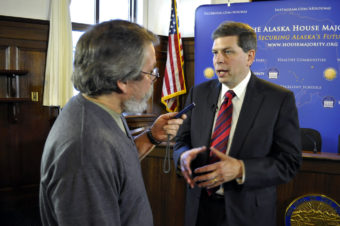
Reporter Bob Tkacz interviews U.S. Sen. Mark Begich following the senator’s annual address to the Alaska Legislature, March 3, 2014. (Photo by Skip Gray/Gavel Alaska)
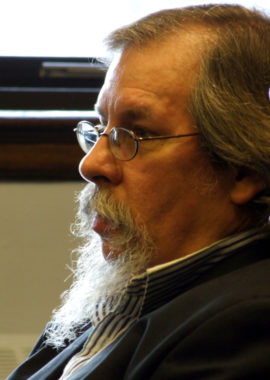
Veteran Alaska journalist Bob Tkacz has died. He was 61.
With his gravelly voice and dogged interviewing style, Tkacz was a fixture in the state capital press corps for more than 20 years.
Tkacz peppered his share of Alaska politicians with a seemingly endless line of questions. Former Administration Commissioner Becky Hultberg was press secretary under former Gov. Frank Murkowski.
“Bob really liked to get under people’s skin if he could, and he’d kind of know when he did and he’d keep poking, keep going,” Hultberg says.
But she says she always respected the job Tkacz was trying to do. She doesn’t remember the issue, but says there was one exchange in particular where she tried to step in to prevent the governor from saying something he might regret.
“Ultimately, I was physically trying to maneuver my body between the governor and the podium to try to get the governor out of the room,” she recalls. “Because Bob had really accomplished what he wanted to accomplish, which was getting the governor riled up, and when people are upset they tend to be very quotable and not always in a good way.”
Former APRN Juneau Correspondent Dave Donaldson began covering the Alaska Legislature about the same time as Tkacz. They worked near each in the Capitol press room for 21 years. Though they were friends, Donaldson says even fellow reporters sometimes got fed up with Tkacz’s aggressive style.
Bob Tkacz. (Photo by Skip Gray/Gavel Alaska)
Bob would not let go, and he would go forever,” Donaldson says. “And yeah, it did get a little annoying every once in a while. But the fact is that he came closer to really doing the job that we all ought to be doing than a lot of people who say, ‘Okay, thank you,’ and hang up.”
In September 1991, Tkacz was beaten and stabbed in an apparent mugging in Juneau. A New York Times story about the incident is still one of the first search results when you Google his name. Donaldson remembers visiting him in the hospital.
“He couldn’t talk, so he was trying to draw notes,” he says. “And he finally got it across to me that the reason I was there was to call his publisher and say that he’d be late for deadline.”
Tkacz worked or freelanced for several Alaska media outlets, including KTOO. In recent years, he wrote for Alaska Legislative Digest and the Alaska Journal of Commerce. His stories also appeared in national and international publications.
In 1994, he started his own subscription news service, Laws for the SEA, about the commercial fishing and seafood industry. Donaldson says that was the endeavor in which Tkacz took the most pride.
“He was kind enough when I retired that he gave me an honorary subscription, so I could keep reading them, and it really was good stuff,” Donaldson says.
In recent years, Tkacz traveled to Asia several times to report on how countries in the region are involved with Alaska’s seafood industry. Legislative Digest co-publisher Tim Bradner says he was passionate about the issue.
“The fact that so many of our seafood exports go to Asia, he just became interested in the market over there and what was happening to it and how that affected Alaska,” Bradner says.
Besides working as a reporter, Tkacz also did maintenance work at Jordan Creek Center, an office building in Juneau. He lived alone on his boat in Aurora Harbor, and often spent his free time at Augustus Brown Swimming Pool. He also was a volunteer DJ on KTOO’s sister station, KRNN, where he did a jazz show.
Juneau police say they responded to a report of a death at Tkacz’s downtown office Tuesday and found his body. The death is not considered suspicious. His body was initially taken to Alaskan Memorial Park Mortuary & Crematory then sent to the state medical examiner’s office in Anchorage for an autopsy.
Tkacz was originally from Ohio, where friends say he still has family. Services are pending.
Original post:
Longtime Alaska freelance journalist Bob Tkacz has died. He was 61.
Juneau police say they responded to a report of a death at Tkacz’s downtown office Tuesday morning and found his body. The death is not considered suspicious. The body was initially taken to Alaskan Memorial Park Mortuary & Crematory then sent to the state medical examiner’s office in Anchorage for an autopsy.
Tkacz was a fixture in the state capital press corps for years. His gravelly voice and dogged interviewing style needled a number of Alaska politicians. He had his own subscription news service, Laws for the SEA, which covered the commercial fishing and seafood industry. He also wrote for Tim and Mike Bradner’s Legislative Digest in recent years. He’d been published in the Alaska Journal of Commerce and once worked for KTOO.
In 1991, Tkacz was stabbed in an apparent mugging in Juneau that was highly publicized. A New York Times story about the incident is one of the top results when you Google his name.
His LinkedIn profile says Tkacz went to Ohio University, where he earned a bachelor’s degree in Newspaper and Magazine Editing. He lived on a boat in Aurora Harbor, and was a volunteer jazz DJ on KTOO’s sister station, KRNN.
Friends say he has family in Ohio. Services are pending.
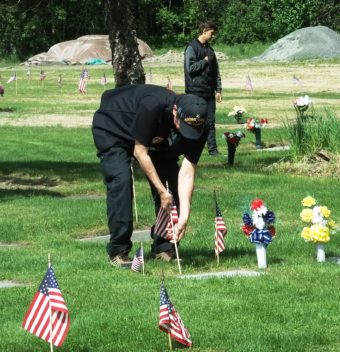
A veteran places a small flag near a grave stone on Memorial Day at Alaskan Memorial Park on Riverside Drive in Juneau. (Photo by Rosemarie Alexander/KTOO)
Amid the barbecues, picnics, annual sales and day off work, Juneau observed Memorial Day at three services designed to honor those who died in the service of their country.
Flags hung at half-staff and promptly at 11 a.m. the commemorations began at Alaskan Memorial Park in the Mendenhall Valley and Evergreen Cemetery in downtown Juneau.
U.S. Coast Guard 17th District Command Center Supervisor, James Armstrong, lamented the way Memorial Day has changed over the years.
“Happy Memorial Day, someone said to me the other day,” he said, noting the word memorial is defined as something designed to preserve the memory of a person or event.
“Nowhere does the definition include the words party or sale. Memorial Day is not a happy occasion; it is not to be celebrated. It is and should be an event to be reflected upon and observed. It is not at all about the beginning of summer, unofficial or otherwise. It is most certainly not a time for merchants to exploit as an excuse for a sale,” Armstrong said.
Armstrong blamed the Uniform Monday Holiday Act for degrading the true meaning of Memorial Day. Since the act took effect in 1971, Memorial Day has always been on the last Monday of May, though the original date of May 30th was set in 1868.
American Legion Auke Bay Post 25 hosted the Mendenhall Valley observance, where poems were read, prayers were given, flower wreaths were hung and taps were played. Families gathered to visit the graves of their loved ones and friends; many of the graves were marked with small American flags and fresh flowers.
Evergreen Cemetery observance
Memorial Day observances at Evergreen Cemetery featured the playing of Taps. (Photo by Matt Miller/KTOO)
The scene was similar at Evergreen Cemetery in downtown Juneau, where Taku Post 5559 of the Veterans of Foreign Wars held the annual commemoration.
Coast Guard Cmdr. Patrick M. Hilbert said he never really understood the importance of Memorial Day until he was stationed in the Netherlands. There he was approached by multiple generations of Dutch residents who still remembered and valued U.S. service members’ efforts during World War II.
Hilbert recalled the words on the Margraten, Netherlands memorial for missing service members at the American Cemetery:
‘Each for his own memorial earn praise that will never die and with it the grandest of all sepulchers. Not that in which his mortal bones are laid, but a home in the minds of men.'”
“With that sentiment in mind, today we mark the sacrifices of those that have passed over the bar in service of our nation,” Hilbert said. “We take stock of what we have to be thankful for. And most of all, we remember and honor those that we have to thank for the opportunities and prosperity we continue to enjoy today.”
Jackets worn by Southeast Alaska Native vets during Monday’s Memorial Day observance. (Photo by Matt Miller/KTOO)
Alaska Native Memorial Day commemoration
Shortly after the Alaskan Memorial Park and Evergreen Cemetery events, another ceremony commemorating Southeast Alaska Native military members was held at the park adjacent to Elizabeth Peratrovich Hall.
As the names were read aloud, American flags were placed at the stones inscribed with the Tlingit, Haida, and Tsimshian words for warrior and courage.
Close
Update notification options
Subscribe to notifications
Subscribe
Get notifications about news related to the topics you care about. You can unsubscribe anytime.