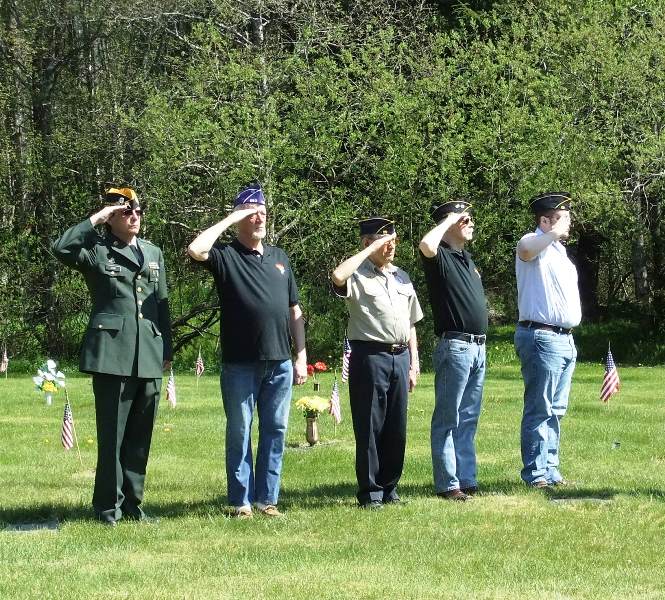
Veterans salute the flag at the 2013 Memorial Day observance at Alaskan Memorial Park. (Photo by Rosemarie Alexander/KTOO)
Two observances are scheduled in Juneau for Memorial Day.
The annual downtown service will be held at 11 a.m. on Monday at Evergreen Cemetery, hosted by Taku Post 5559 of the Veterans of Foreign Wars.
The Mendenhall Valley observance is at Alaskan Memorial Park on Riverside Drive, also at 11 a.m. It will be hosted by Auke Bay Post 25 of the American Legion.
While many people think of Memorial Day as a day off work and the beginning of summer, it was first observed after the American Civil War when families would decorate the graves of their loved ones who died in the war. It was known then as Decoration Day.
It is now an opportunity to remember all of those who have served their country.
On Memorial Day, the American flag should be flown at half-staff until noon then raised to full staff.
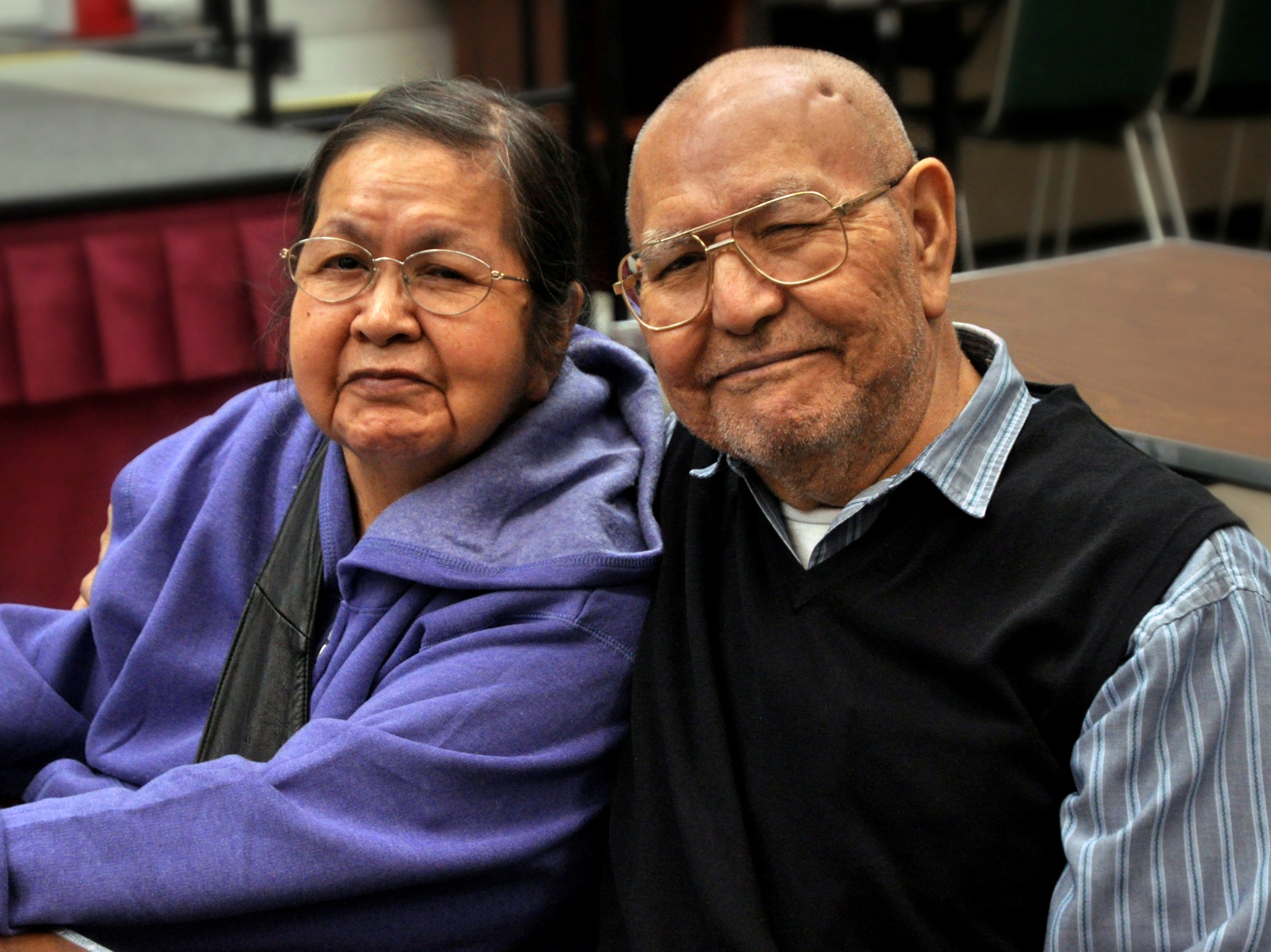
Lillian & Harvey Marvin at a Tlingit-Haida Central Council Native Forum luncheon. (Photo courtesy of Jodi Garrison)
Tlingit elder Harvey B. Marvin, of Juneau, has died at the age of 81.
Marvin grew up in Hoonah, worked for the public health service in Sitka and was the state of Alaska’s first Native auditor.
He was born in 1933 in Excursion Inlet to Lillian Pratt Marvin Smith, who was of the Kaagwaantaan clan, and John Marvin, of the T’ak Dein Taan clan, and a grandchild of the Chookaneidi. He was one of their 12 children.
He went to Mt. Edgecumbe High School, business school in Chicago and served in the U.S. Marine Corps in the Korean War.
Native land claims
Marlene Johnson grew up with Marvin in Hoonah.
“We were of opposite clans. He was an Eagle and I was a Raven, but we were good friends,” she says with a chuckle.
That friendship came in handy during the years they would work together on the Alaska Native Claims Settlement Act.
Marvin and Johnson were among the five members of the Tlingit-Haida Central Council Executive Committee to lobby Congress. When ANCSA passed in 1971, Huna-Totem was created as the Hoonah village corporation.
Marvin was appointed corporation treasurer. Johnson was a board member.
“He was at every meeting and worked with us as we looked at the history, and doing the land claims and other important things for the corporation,” she says.
These were complicated issues. Johnson says Marvin was just the guy to explain them.
“He was very fluent in Tlingit, so he could explain it in Tlingit to the elders that didn’t understand English that well,” Johnson says.
As they met with new shareholders in Hoonah and other parts of Southeast, she says Marvin also listened well, so he could tell the board what Huna-Totem members wanted in their corporation.
Marvin later transitioned from treasurer to board member, serving 19 years. He was a member of the Alaska Native Brotherhood and active with Tlingit and Haida. In 2005, he was named Citizen of the Year by the Central Council for what the organization called his “extreme dedication” to the Alaska Native community.
“He was with and very loyal to Tlingit-Haida Central Council since the ’60s,” says Edward Thomas, who was Central Council president at the time.
Super voters
Lisa Worl keeps the family tree for her large family. She always called Harvey Marvin great grandfather, though he was actually her great uncle.
Worl is on the Juneau School Board. Marvin and his late wife Lillian were there when she was sworn into office.
She can recite the work Marvin has done for his people through Native organizations, as a Sitka Assembly member, and other political involvement.
Harvey and Lillian Marvin were Democrats and “super voters,” she says.
“It was more a matter of civic duty and always making sure the family was aware of the issues and make sure they voted. They never pushed any people but obviously they had their people they were supporting,” Worl says.
Former Juneau Rep. Beth Kerttula was one of them. Kerttula got to know Marvin when her father, Jay Kerttula, was a state senator and chairman of the Legislative Budget and Audit Committee. Marvin was the auditor.
Years later, when Beth Kerttula ran for Juneau’s downtown seat in the state House, Marvin sat her down for a tutorial on the nuts and bolts of Juneau politics.
“He had almost every twist and turn and nuance, and knew the groups I needed to reach out to and knew the people I needed to go talk to,” she recalls.
But it didn’t stop there. Both Marvins worked hard on all five of her campaigns and were in the gallery at the state capitol when she took the oath of office.
Kerttula calls him an astute politician.
“You know I think Harvey would have been governor or U.S. Senator in a different day,” she says. “He just had that kind of talent and ability.”
More importantly, she says, the Marvins set a great example of how to be good human beings.
Lillian Marvin passed away in February, just after the couple celebrated their 59th wedding anniversary.
“The two love birds are back together,” Worl says.
A memorial service for Harvey Marvin is Saturday at 3 p.m. at Alaska Memorial Park on Riverside Drive. A private family viewing is 1 p.m.
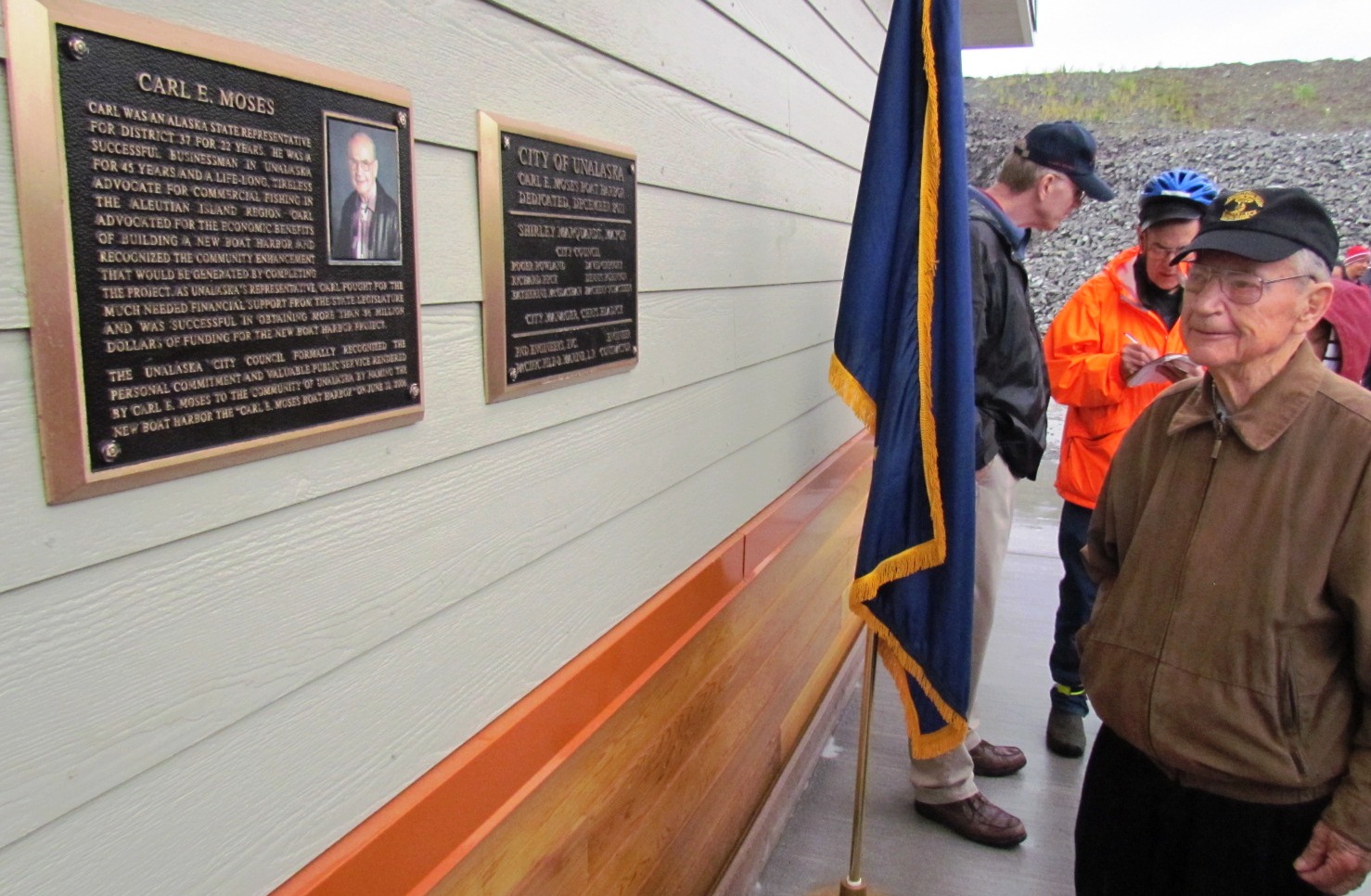
Carl Moses at the dedication of Unalaska’s small boat harbor, named for him two years ago. (Photo courtesy city of Unalaska).
Former state Rep. Carl Moses died Wednesday, according to Unalaska city officials. He was 84.
Moses was the state’s longest-serving member of the state House of Representatives. He represented the Aleutians region for a total of 11 terms — first from 1965 to 1972 and then again from 1992 to 2007.
In that time, he was known as an advocate for Southwest Alaska fisheries and business. He spearheaded the state’s shared fishery resource landing tax, which brings millions of dollars into Aleutian communities and other coastal towns every year.
Moses lived for years in Unalaska and Sand Point.
Two years ago, Unalaska’s newest boat harbor was named for Moses.
In a news release on Wednesday, Unalaska Mayor Shirley Marquardt said Moses’ “commitment to the communities he served and the fisheries that sustain them was rock-solid.”
Gov. Sean Parnell has ordered state flags to be lowered on Friday and raised to full-staff at sunset.
Nobel Peace Prize nominee the Rev. John Dear is in Juneau as part of a national tour for his most recent book, “The Nonviolent Life.”
Dear has written over 30 books and devotes his life to giving lectures and organizing demonstrations.
He has two masters in theology from Graduate Theological Union in California and says nonviolence is at the heart of all world religions.
“You cannot claim to be a Christian or a person of any religion and support violence or war. Period. In other words, to be a Christian and to be Jewish, Muslim, Hindu, and Buddhist is to be a person of nonviolence,” Dear says.
Dear has worked with Mother Teresa to stop capital punishment and was mentored by anti-war activist brothers David and Philip Berrigan. Dear was nominated in 2008 for a Nobel Peace Prize by Archbishop Desmond Tutu.
“But most of all I know thousands and thousands of ordinary American activists who are working to change our country and our cities and move it from militarism and corporate greed toward greater equality and more peaceful attitude toward the world. And it’s those ordinary people who give me the most hope,” Dear says.
Dear wants to reach more ordinary people during his time in Juneau.
Tonight he’ll speak on “Peace Making, Civil Disobedience and Truth Telling in a World of Permanent War.” He’ll talk about how he got involved in the peace and justice movement, his experience in war zones, and spending time in jail.
On Saturday, Dear gives an all day workshop on “Living a Nonviolent Life.”
“How can we become like Gandhi and Dr. King? How can we help Alaska become more nonviolent and the whole country and the whole world become more nonviolent? That’s our only hope and it’s the most crucial question of our time,” he says.
Tonight’s talk is at 7 p.m. @360 and Saturday’s workshop is from 9 a.m. to 4 p.m. at Northern Light United Church.
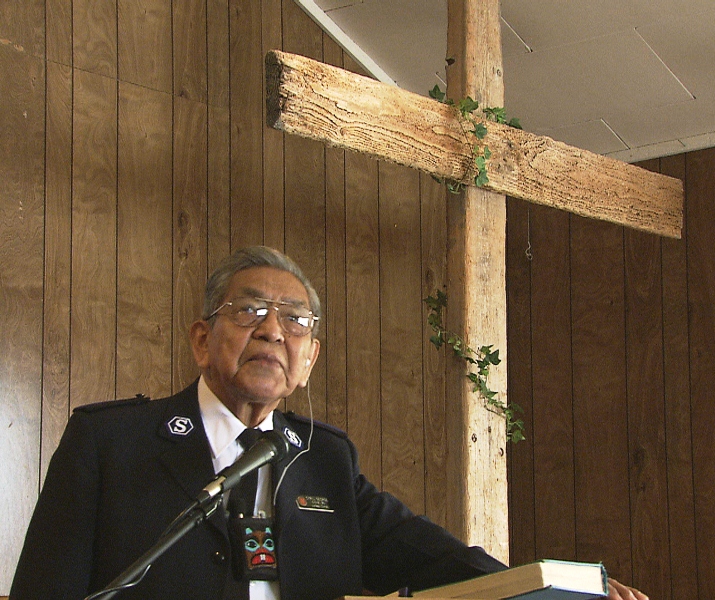
Cyril George Sr. in 2007, speaking at Angoon Presbyterian Church, where his son Joey George is pastor. (Photo by Skip Gray/KTOO)
A memorial service for Cyril George Sr. is Wednesday, 6 p.m., at Elizabeth Peratrovich Hall in Juneau. The Tlingit elder died April 15 at the age of 92.
Over his life, he was a fisherman, boat builder, master storyteller, and man of great faith.
George was of the Deisheetan clan (Raven/Beaver) of Angoon and lived in the Admiralty Island community most of his life. He moved to Juneau in 1975.
One of his five sons, Richard George, recalls his father to be a successful seiner, halibut and herring fisherman.
He also served his community. He was elected to the Angoon City Council and was mayor. He was on the first board of directors of Sealaska, the regional Native corporation for Southeast, from 1972 to 1974, and served as a member of the board for Kootsnoowoo Inc., Angoon’s village corporation.
Richard George remembers his father as a strong man.
He made decisions which always seemed to be the proper decision. That’s what I was impressed with when I was young,” he says.
Cyril George attended Sheldon Jackson high school and college in Sitka in the late 1930s, where he became a machinist and learned to build boats. The Presbyterian school was tasked with helping Tlingit shipwright Andrew Hope build the Princeton Hall, a replacement vessel for the church mission fleet.
“I wasn’t the only one that had this feeling of an enormous undertaking when he started to build this boat,” Cyril George recalled in a 2007 interview with KTOO.
“I could weld, I did everything in the machine shop. I was with him all the way from lining up the motor, the shaft, setting up the electrical,” he said. George also built the shaft.
It took a year to complete the Princeton Hall. Then in 1941, just a few days after the Japanese attack on Pearl Harbor, the boat was to be launched. It had already been conscripted by the U.S. Navy.
George said all the Sheldon Jackson students trooped down to the harbor to watch the launch.
“When the Navy started to tow it away all the kids were crying. I was crying. I don’t think there was anybody that wasn’t crying,” he said.
After the war, the Princeton Hall was returned to the Presbyterians and it traveled Southeast Alaska waters for years, going village to village.
While George helped build it, he had never been on the boat. Many years later, he had a number of cruises on the Princeton Hall after it was purchased by the late Bill Ruddy. Bill and Kathy Ruddy became close friends with Cyril George, the boat builder, the musician, and the Tlingit storyteller.
George gradually began to lose his hearing. For several years, Kathy Ruddy took on the role of stenographer – typing out conversations for him.
“It really helped him to have things written down so he could look over your shoulder and know what people were saying,” she says.
The hearing loss didn’t slow him down. He continued to play his guitar and sing, visit classrooms, churches, and be involved in the community. He was a delegate to the Juneau chapter of Central Council of Tlingit and Haida Indian Tribes of Alaska, which provided a transcriber for George, so he could be actively involved.
“You know for a guitarist and a really excellent musician, hearing loss is a really poignant thing,” Ruddy says. “The fact that he maintained this constant sense of gratitude even as hearing was failing is just a tribute to his character.”
As a fluent Tlingit speaker, George liked to teach his language and often went to Tlingit language classes at the University of Alaska Southeast, taught by Lance Twitchell.
“In Tlingit he’d tell us: ‘I just feel wonderful whenever I’m looking upon your faces and you guys are learning your language.’ He said he felt that it (Tlingit language) was drifting away from us but then just seeing us fills him with hope.”
Son Richard George calls his father a Godly man. In the 2007 interview, Cyril George talked about a battle with alcohol, which he said he finally won through prayer and his faith.
He was a member of the Salvation Army and was a local commissioned officer known as a sergeant major. He often wore his uniform and always wore it to church, says Lt. Lance Walters of the Salvation Army in Juneau.
He explained one day that he put it on to remind him of what he came from and that he wasn’t going back,” Walters says.
George will be buried on Killisnoo Island near Angoon.
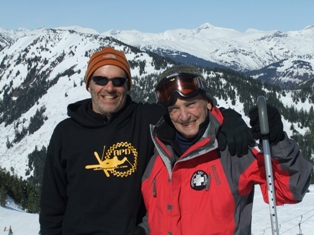
Bob Janes Sr. and son Bill at the top of Black Bear chair in 2010.
A three-year Forest Service assignment to the Tongass National Forest became 49 years in the capital city for the late Robert C. Janes Sr., whose life will be celebrated on Sunday.
He passed away at the Juneau Pioneers’ Home in March at the age of 92.
Ski area reconnaissance
Bob Janes arrived in Juneau in 1965 with the U.S. Forest Service. Used to moving with the agency, he thought it would be another short stint.
At the time, Douglas Ski Bowl – also known as Third Cabin — had a rope tow and snowcat to get Juneau skiers to the top.
Janes had been working in the Sierra Nevada Mountains in California and was soon assigned to help come up with another location for a ski area.
“The regional forester put me to work. (He) said go out with Craig Lindh and find a new ski area. That’s what we tried to do,” Janes said in an interview a few years ago.
Lindh was also with the Forest Service. He had transferred to Juneau to work on the ski area project.
“He was pretty enthusiastic when I first came to Juneau and met him and we chatted about skiing,” Lindh said.
So the two foresters and avid skiers hooked up to find a place with better access than Third Cabin. Lindh said they had lots of input from Juneau skiers and finally settled on the Fish Creek area.
“From the top of Third Cabin area you could look down into the Fish Creek drainage and that’s what got people interested,” he recalled.
The land was taken out of federal ownership and in 1975, Eaglecrest opened with the Ptarmigan lift up the west side. The ski area is owned by the city and borough of Juneau.
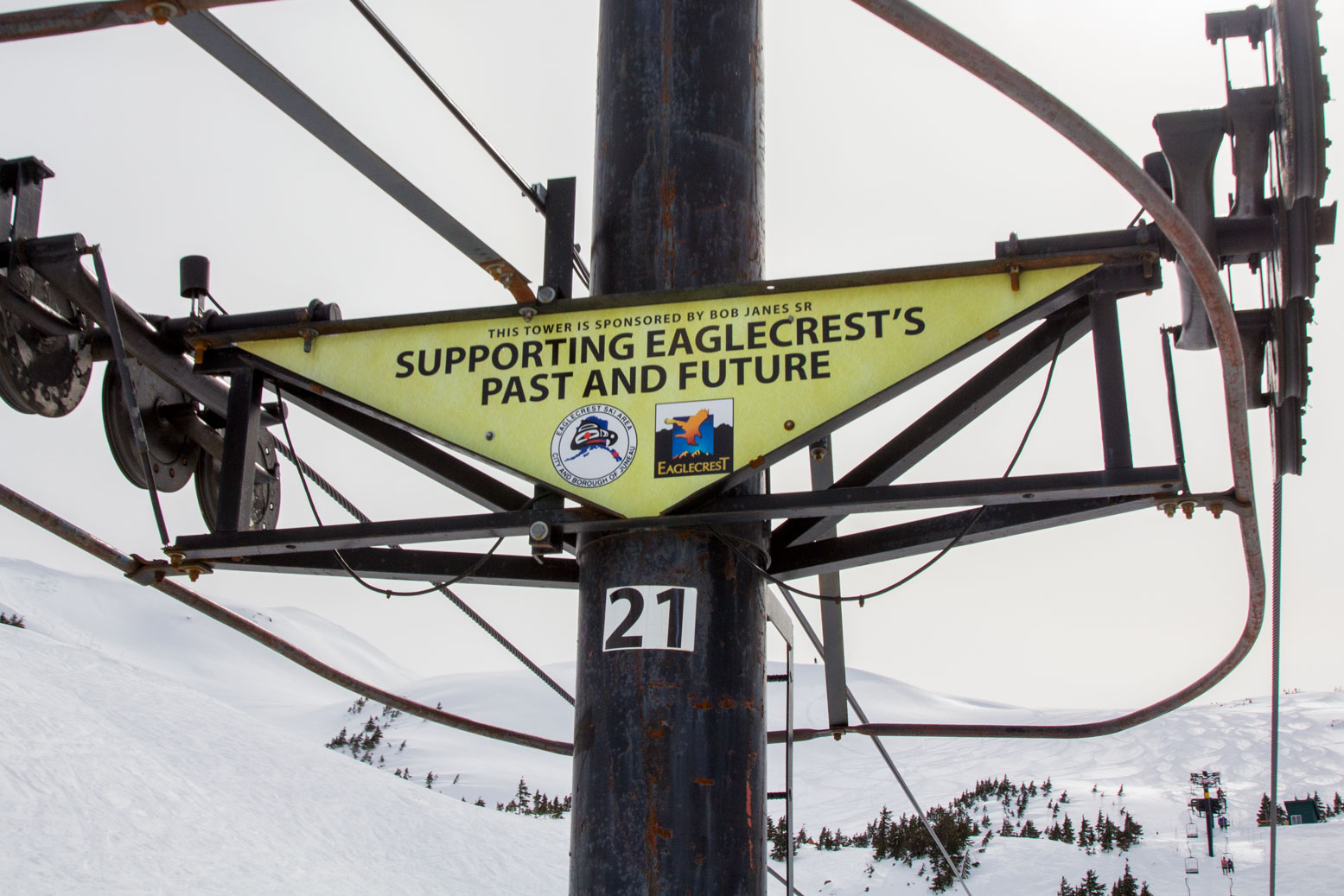
By the 2009 / ’10 season, Eaglecrest had grown to four lifts. Black Bear was installed on the east side with the help of gifts from Eaglecrest users. Bob Janes sponsored tower 21, which reads:
Supporting Eaglecrest’s past and future.”
Tower 21 of the Black Bear chairlift at Eaglecrest is sponsored by Bob Janes Sr. (Mikko Wilson / KTOO)
He was 88 that year and no longer skiing. An Eaglecrest employee took him by snowmobile to Black Bear, so he could ride the lift and see the sign in place.
“It’s nice looking I think. I kind of am proud of that sign,” Janes said later.”There are many other nice signs and people that have contributed. It shows the community spirit.”
He juxtaposed the first Eaglecrest logo with the current logo. The sign reflects Janes’ early reconnaissance work and subsequent years as a skier and a ski patrol volunteer.
A love of snow
Janes grew up in California. His family writes that he could have been a beach bum, but after earning a degree at the University of California Berkeley, he joined the Forest Service and eventually started working in snow.
In the 1950s he trained in avalanche control with Monty Atwater, who was considered the father of avalanche science in the U.S. In 1960, he was part of Atwater’s team of Forest Service snow rangers for the 1960 Winter Olympics at Squaw Valley, Calif.
When Tom Mattice was hired as Juneau’s emergency program manager a few years ago, Janes was on the board of directors for the Southeast Alaska Avalanche Center.
“You know, he was one of the first avalanche mitigation specialists in the nation,” Mattice said. “It’s neat to have that kind of experience in our region.”
Janes brought his expertise to Juneau, and in the 1980s worked to create a statewide avalanche forecasting system, which ended when the state dropped out. He advocated for Juneau’s avalanche advisory program and often shared his knowledge of how certain weather events in Juneau contribute to slides, Mattice said.
“How Taku wind events tend to be some of the events that lead to some of our instabilities in the urban environment, but also some of the dangers that loom in the back country up Douglas and other places,” Mattice said. “He wanted to make sure the public had the information they needed to make educated decisions.”
Lion Bob
Searching the KTOO archives produced tape of Bob Janes, the Lions Club member, selling tickets at the 55th Gold Medal Basketball Tournament.
“What do you see for the future of Gold Medal?” the reporter asked.
“Well, after 55 years, I think it’s going to go on forever, don’t you?” Janes quipped.
He missed Gold Medal this year, which was the 68th annual competition that brings Southeast communities together on the basketball court in Juneau. It’s a major fundraiser for the Juneau Lions Club, part of the international service organization.
“That’s our motto, ‘we serve,’ and that’s where our resources come from. Somebody that wants to join the club and do something for somebody else,” Janes told the reporter.
When Ted Burke joined the Lions Club in 1987, Janes became his mentor. Burke said the education in all things “Lionism” never stopped, even when Janes moved into the Pioneers’ Home.
“That’s when he called me up and told me I had to become the historian of the Juneau Lions Club to relieve him of those duties,” he said, laughing.
Janes took on the job of historian for many of the organizations he joined.
Burke said Janes was always clued into the needs of the community.
“It was Lion Bob that started us in a quest to make sure that whatever we were able to do for our community that youth came first,” he said.
In 1980, Janes was elected as District Governor for Alaska Lions Clubs. That same year, he founded the Lions Club adaptive ski program, which continues today at Eaglecrest, under Southeast Alaska Independent Living, or SAIL. Janes brought Joe Tompkins into the program, who went on to compete in four Winter Paralympic Games with Lions Club support.
The definition of a gentleman
Burke and Mattice and just about everyone you talk to about Bob Janes called him a gentleman. The definition in this case: A man whose conduct conforms to a high standard.
A celebration of life for Bob Janes Sr. will be held Sunday, April 20, at the Juneau Arts and Culture Center at 5:30 p.m.
Close
Update notification options
Subscribe to notifications
Subscribe
Get notifications about news related to the topics you care about. You can unsubscribe anytime.