The City and Borough of Juneau says a transitional living facility for former female inmates may not operate in its planned location.
CBJ officials reviewed the business plan for Haven House while considering a building permit for the proposed facility on Malissa Drive in the Mendenhall Valley.
Community Development Director Hal Hart said zoning for that neighborhood allows for group homes that include health care or rehabilitation from a physical, mental, or emotional disability, but halfway houses are not allowed. Hart said the proposed Haven House fits in more with the CBJ’s definition of a halfway house.
“The community needs these facilities. It’s just the location under code, and there are other locations that code allows for,” said Hart.
The staffed-facility is expected to provide a safe environment for as many as nine women after their parole or release from prison. A private home on Malissa Drive was purchased earlier this month and the facility’s opening was planned for the middle of March.
Hart sent a letter to the Haven House board last Friday explaining why they cannot operate their facility in their currently proposed location. He said the Planning Commission will likely take up an expected appeal of his zoning determination, but it’s still unclear exactly when they will consider the issue.
Haven House boardmembers have declined to return repeated calls from KTOO seeking comment.
A transitional housing facility opening in two months in Juneau will fill an important need for Southeast Alaska. Haven House will provide temporary housing for as many as nine women who’ve just been paroled or released from prison.
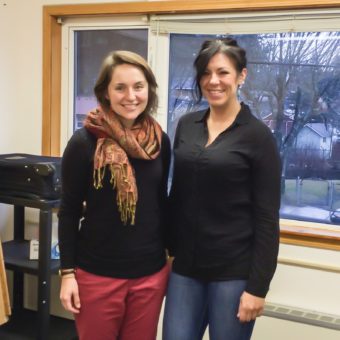
“There are not any transitional living homes in Juneau. It’s going to make a difference for women coming out of jail,” said Katie Chapman who is chair of the Juneau Reentry Coalition, a group of agencies and local social service organizations created to coordinate resources for those who have left the corrections system. Anne Flaherty (left) and Kara Nelson (right) will serve as Co-Directors of Haven House when it opens in March as transitional housing for women just out of prison. Photo courtesy of the Juneau Community Foundation.
Two-thirds of all Alaska inmates return to prison within three-years, according to research done by the Alaska Judicial Council in 2007. Former inmates are especially susceptible to recidivism — or getting stuck in the revolving door of reoffending and returning to prison — sometimes as soon as the first six months after release.
Chapman said there are several factors in a former inmate’s success on the outside:
The housing, finding a job, and finding a safe, pro-social group of people to connect with and establish a good start in their recovery and their integration back into the community. When they don’t have that support, it makes it very difficult for them to stay connected and it’s easy for them to fall back into patterns and whatever survival mechanisms they had in place that got them involved in criminal activity.”
Haven House will operate in a six-bedroom home just purchased in the Mendenhall Valley near Glacier Valley School.
“We’re really excited. We’re finally going to be opening,” said Rachel Sanders of the Haven House board. She said the idea for a transitional home originated many years ago with prison volunteer Ellen Campbell. Sanders said they had the home picked out last month and put down earnest money for a potential purchase. They planned on applying for an Alaska Housing Finance Corporation loan to cover the rest of the purchase price. But an anonymous benefactor stepped in and purchased the residence on Christmas Eve.
Yeah, we were just thrilled!”
The “anonymous angel donor,” as they are being called, will rent it back to the Haven House organization until they can acquire grants to purchase the home outright. Sanders said they just closed on home’s purchase late last week.
The Juneau Community Foundation has offered a matching grant from the Gaguine Fund to raise $10,000 in additional donations for the home’s furnishings and appliances.
“We think that it’s an important project for the community to have housing or transitional housing for women coming out of the correctional facilities,” said Amy Skilbred, executive director of the Foundation.
Women paroled from Lemon Creek Correctional Center in Juneau or Hiland Mountain Correctional Center in Eagle River can apply for one of nine spots in the home.
Haven House’s Rachel Sanders said they will have a structured, faith-based living environment that will include referrals to counseling, life skills training, employment coaching, and connections to substance abuse treatment programs.
It’s the resident’s choice to participate because, of course, we can’t force them to participate given that we’re accepting State monies. So, knowing that there’s going perhaps be Bible studies, or mentors that come into the house and work with the residents on crafts, or whatever, it will definitely be a part of the daily structure.”
Each resident can stay up to two years. They will be expected to find a job, pay rent, and help with household chores.
Haven House’s Kara Nelson will share management duties with co-director Anne Flaherty. As a felon herself, Nelson knows full well all of the challenges that women face when they get out of prison.
With felonies, there’s actually a lifetime ban on getting housing through the State (of Alaska) or other public assistance… As well as just coming out of prison and not having anywhere to go, whether that’s going back to your abusive partner, or family and friends that use (drugs), and not having that safe place to live to really get to the core of the issues and move forward.”
Nelson said she was able to move forward with the support of family, community organizations, and local mentors.
For me, it was having those mentors and getting to a place of self-acceptance where I can then go out into the community and believe that I’m not just a felon, or I’m not just a drug addict, or I’m not putting these labels on myself which is a big stigma. Not just in society, but for us having been in that for so long.”
It is unclear how many women are released in the Juneau area every year. Nelson estimates that it could be several dozen.
She said they just got the keys to the house on Monday and they’re not opening until mid-March, but they’re already taking applications.
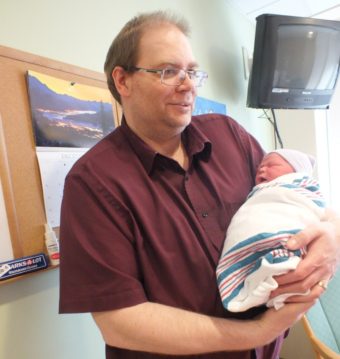
The first Juneau baby of 2014, Jeshua Moreno, with dad John. Photo by Casey Kelly/KTOO.
Jeshua Moreno was born Thursday at Bartlett Regional Hospital to Elizabeth and John Moreno. Photo by Casey Kelly/KTOO.
Juneau’s first baby of 2014 was born about 8:20 a.m. Thursday.
Jeshua Raymond Moreno was delivered by C-section at Bartlett Regional Hospital. He’s the third child of Elizabeth and John Moreno.

“He was 9 pounds, one ounce and a half, 21 and ¾ inches, and he’s a beautiful baby boy,” said the father.
John Moreno says his wife was supposed to go in for the C-section on December 31st, but it was rescheduled for today because of a requirement that the surgery take place after at least 39 weeks of pregnancy.
He says everybody is doing great, but they’re not really sure how to feel about having the first baby born in Juneau this year.
“I think we’re really concentrating on having a new baby instead of the time of the year,” Moreno said. “But it’s good to be a father again.”
Moreno says older brother, John, and older sister, Ina Mae, both had an opportunity to hold Jeshua shortly after he was born, and they both love their new baby brother.
Downtown Juneau Christmas Lights. (Photo by Heather Bryant/KTOO)
In what we hope becomes an annual holiday tradition, we’re proud to bring you a mass reading of “‘Twas the Night Before Christmas,” featuring reporters from throughout the Alaska Public Radio Network.
Actors include:
Dave Bendinger, KDLG
Robert Woosley, KCAW
Casey Kelly, KTOO
Shady Grove Oliver, KSTK
Emily Forman, KCAW
Tony Gorman, KCHU
Rachel Waldholz, KCAW
Brianna Gibbs, KMXT
Shaylon Cochran, KDLL
Rosemarie Alexander, KTOO
Phillip Manning, KTNA
Lisa Phu, KTOO
Ben Matheson, KYUK
Aaron Selbig, KBBI
Emily Schwing, KUAC
Ariel Van Cleve, KBBI
Ed Schoenfeld, Coastalaska
Anna Rose MacArthur, KNOM
Angela Denning-Barnes, KYUK
Jay Barrett, KMXT
Ed Ronco, formerly of KCAW
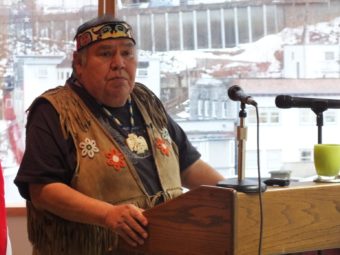
David Katzeek is a Shangukeidí Clan leader. Photo by Casey Kelly/KTOO.
One of the speakers for Forum@360: Living the Language, David Katzeek was the first president of the Sealaska Heritage Foundation, now known as the Sealaska Heritage Institute. (Photo by Casey Kelly/KTOO)
A Shangukeidí Clan Leader says the essence of Tlingit spirituality is this: Everything has a spirit.
David Katzeek spoke Tuesday in the final installment of Sealaska Heritage Institute’s Native American History Month Lecture Series.

“We have words for it,” Katzeek said, speaking the phrase first in Tlingit, then English. “I have the spirit within me.”
In the Tlingit tradition, Katzeek said the words he spoke came not from him, but from his teachers and ancestors.
“Because the spirit of humbleness is acknowledging those who taught you,” he said. “Those who loved you enough to sit with you, and share with you beautiful jewels that you can experience, that you can have, that you can enjoy, that you can use, that you can apply.”
Katzeek was the first president of the Sealaska Heritage Foundation (now the Sealaska Heritage Institute), serving in that job from 1982-1992. He’s a Chilkat Eagle of the Shangukeidí Clan from the Thunderbird House.
Pope Francis on Saturday at the Vatican. Andrew Medichini/AP
Around the world today, the powerful “feed upon the powerless” and too many people are treated as “consumer goods to be used and then discarded,” Pope Francis writes in his first major paper since becoming leader of the Roman Catholic church last May.
— The Idolatry Of Money. “The worship of the ancient golden calf … has returned in a new and ruthless guise in the idolatry of money and the dictatorship of an impersonal economy lacking a truly human purpose.”
— The Economy Of Exclusion. “Just as the commandment ‘Thou shalt not kill’ sets a clear limit in order to safeguard the value of human life, today we also have to say ‘thou shalt not’ to an economy of exclusion and inequality. Such an economy kills. How can it be that it is not a news item when an elderly homeless person dies of exposure, but it is news when the stock market loses two points? This is a case of exclusion. Can we continue to stand by when food is thrown away while people are starving? This is a case of inequality.”
–– Inordinate Consumption. “Today’s economic mechanisms promote inordinate consumption, yet it is evident that unbridled consumerism combined with inequality proves doubly damaging to the social fabric. Inequality eventually engenders a violence which recourse to arms cannot and never will be able to resolve.”
The pope also writes, “I beg the Lord to grant us more politicians who are genuinely disturbed by the state of society, the people, the lives of the poor!”
The Guardian says that “the 84-page document … amounted to an official platform for his papacy, building on views he has aired in sermons and remarks since he became the first non-European pontiff in 1,300 years in March.”
Also on Tuesday, the pope met with Russian President Vladimir Putin. Reuters says they “discussed the Middle East and problems faced by Christians across the world, but did not touch on the strained relationship between the Vatican and the Orthodox Church.”