Spirit

Juneau panel aims to deconstruct racism in Alaska and beyond

A group of Juneau residents are tackling the issue of racism head on.

Their work started earlier this year, and sprang out of the trial of George Zimmerman for killing unarmed Florida teenager Trayvon Martin, as well as a series of local events that had been building up for years.

The group held a panel discussion last Friday at the University of Alaska Southeast called “Deconstructing Racism: Power and Privilege in Our Community.”

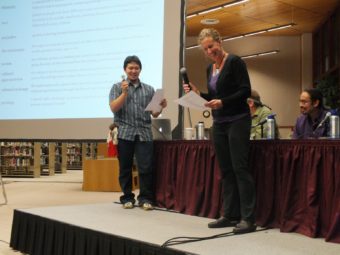
UAS Professor Sol Neely started by setting the scene for a short skit by local writer Christy Namee Eriksen: “Act One: “If Racism Was a Burning Kitchen.” An Asian and a Caucasian are standing in a kitchen. The kitchen is on fire.”

Lance Twitchell and M.K. MacNaughton acted out the scene:

Twitchell: “Whoa! Is the kitchen on fire?”
MacNaughton: “Are you calling me an arsonist? I am not an arsonist.”
Twitchell: “I am literally burning up. I’m pretty sure the kitchen is ON FIRE.”
MacNaughton: “I didn’t build this house, I just live here.”
Twitchell: “Let’s leave and build a new house.”
MacNaughton: “I’m not going anywhere, this is my house.”

Twitchell is a Tlingit speaker and a professor of Alaska Native Languages at UAS. MacNaughton is an artist and social justice activist. They were joined by Neely, Alaska Native storyteller Ishmael Hope, and Northern Light United Church Pastor Phil Campbell.

Twitchell acknowledged many people prefer to avoid talking about race and racism. He said the panel’s discussion was not the beginning of the conversation, nor should it be the end.

“It’s important that this conversation occurs throughout our community on a regular basis,” he said. “So that we can become more aware of the types of things that create oppression.”

Like the Asian character in Eriksen’s play suggesting they leave the burning house and build a new one, the panelists suggested tearing down social systems that create racism. Hope said too often people of color are marginalized.

“And in fact, often get thrown into jail, targeted, not supported for success, put in the area where they are denied access to success, and to power, and to privilege, and any kind of authority,” Hope said.

He pointed to the Alaska Native dropout rate, which is often cited as an example of inherent racism in the education system. According to the National Indian Education Association, Alaska is one of 14 states where the Native American graduation rate is lower than 60 percent.

“There’s something wrong there,” Hope said.

The panelists said an incident last April during the Alaska Folk Festival sparked them to begin talking about racism locally. A group of revelers at the annual bourbon brunch, which is not officially part of Folk Festival, dressed up in Asian-themed garb. Pictures of the event were posted on social media, leading to questions about whether it was racist.

MacNaughton says she found the photos “mildly to wildly offensive.”

“Mostly focused on really sexually demeaning, stereotypical, female images of Asian women,” MacNaughton said.

She decided to speak out after playwright Eriksen was attacked on Facebook for pointing out how the party was offensive. MacNaughton said it can be difficult for white people to admit that something they have done is racist, or to speak out when they witness racism taking place.

“And I don’t mean to pick on other white people,” she said. “I have said racist things naively. I haven’t spoken up every time I’ve heard or seen something racist. Sometimes people take your breath away. Sometimes you just don’t have the words or know how to respond in the moment.”

The Reverend Phil Campbell has taught social justice classes at universities and theology schools. He says white people have work to do when it comes to talking about race.

“We’re not very skilled at understanding ourselves as ‘raced,'” he said. “And therefore, racism is someone else’s problem that we might help with, when, in fact, I would posit it is primarily, in this society, a white problem.”

Toward the end of the discussion an audience member asked the panelists if they were optimistic about the future. Twitchell said he was cautiously optimistic, noting that Alaska Natives still have higher suicide rates, and higher rates of being victims of violent crime than other races.

“But I am optimistic, because we can have these conversations and they occur on a larger level,” said Twitchell.

Sol Neely responded to the question by quoting African American philosopher and activist Cornel West, who said: “I cannot be an optimist but I am a prisoner of hope.”

The conversation about race and racism continues Wednesday at 6:30 p.m. at Northern Light United Church, which has been hosting similar conversations monthly since September.

Worl says shamanism still influential in Tlingit culture today

Rosita Worl SHI lecture series shamanism
Sealaska Heritage Institute President Rosita Worl gives a talk on Tlingit shamanism as part of SHI’s Native American History Month Lecture Series. Photo by Casey Kelly/KTOO.
The Tlingit people of Southeast Alaska no longer practice shamanism, but elements of it still exist in their culture today.

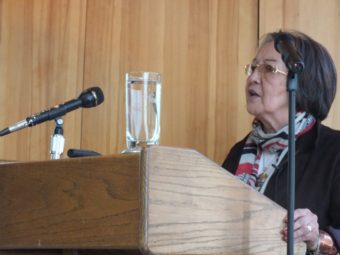
That’s according to Anthropologist and Sealaska Heritage Institute President Rosita Worl, who spoke Monday as part of SHI’s Native American History Month Lecture Series.

Worl says shamanism used to be a major component of Tlingit life. She says every clan had a shaman before Russian and American colonization largely forced the Tlingit people to abandon their traditional religion.

“Shamanism is generally associated with hunting, fishing and gathering societies that often migrate with seasons to follow their food sources,” says Worl. “To bring food, health and protection from evil, shaman seek connections with animal powers through their rituals.”

Worl says the shaman’s responsibilities included maintaining the well-being of the clan; acting as a military advisor; assuring hunting and fishing success; predicting future events; and curing illnesses. To do that they performed rituals designed to ward off hostile and dangerous spirits, and call upon good spirits to support the clans’ welfare.

Worl says Tlingits believed that great shaman traveled in both the physical and spiritual world, and that spirits chose certain people to be shaman.

“The majority of spirits with which the shaman makes his alliances are animals, animal spirits,” she says. “This reflects a widespread belief by cultures that practice shamanism that animals inhabited the world long before human beings and are essential to people because of the unique knowledge that animals possess.”

She says Tlingit clans last practiced traditional shamanism in the 1950s, but she argues it still pervades the rituals and beliefs of Southeast Alaska Natives today. For instance, Worl says Tlingits – including the late-Reverend Dr. Walter Soboleff – still believe that all objects possess some sort of spiritual essence.

“I’ve had meetings here in this room, where people like our spiritual leader, Dr. Soboleff, has pounded on the table and says, ‘Everything has a spirit! Even this table has a spirit!'” Worl says, pounding her own fist on the podium.

About 15 years ago at a clan conference organized by the heritage institute, Worl says several elders attributed modern social problems, such as alcoholism and suicide, to Tlingit societies being out of balance.

“In our society we have a number of practices to ensure both social and spiritual balance, and they were holding that we were out of spiritual and social balance, and this was the cause of the social illnesses that affect our society,” Worl says.

She says that discussion led to some of SHI’s most successful cultural programs.

Worl says the influence of shamanism on modern Tlingit life is perhaps most evident in the use of sacred objects and regalia in ceremonial acts, including memorial celebrations.

“When our ceremonial and sacred objects are brought out and the spirits are addressed or called upon in the same way as they were in earlier times,” she says.

Worl says many Tlingit elders are reluctant to discuss shamanism, perhaps due to the punishment Native people endured at the hands of colonizers for practicing their religion.

She says its unlikely traditional shamanism will ever be completely revitalized, but some Tlingits are looking at ways to incorporate more of the old practices in modern ceremonies.

The next talk in SHI’s Native American History Month Lecture Series happens Tuesday at noon. Professor Alan Boras of Kenai Peninsula College gives a lecture on “Salmon and Indigenized Orthodoxy on the Nushagak River.” The theme of this year’s series is Native spirituality.

Juneau’s Filipino community plans relief efforts for Typhoon Haiyan victims

Filipino Community Inc flag
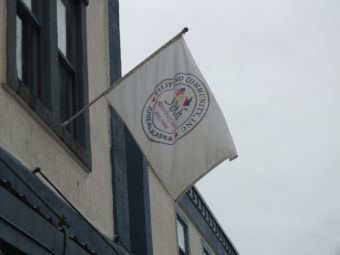
Juneau’s Filipino Community Inc. celebrated its 50th anniversary in 2006. Photo by Casey Kelly/KTOO.

Juneau’s Filipino community is pulling together to help the victims of Super Typhoon Haiyan, which hit the country early Friday morning.

Thousands are feared dead and injured from the storm, one of the most powerful ever recorded. According to news reports, at least 300 people are confirmed dead on Samar Island in the central Philippines. Another 10,000 people are believed to have died in Tacloban city on Leyte Island, near Samar.

The storm knocked out power and communications to much of the central Philippines. Dante Reyes is president of Juneau’s nonprofit Filipino Community Inc. He’s from Aklan province, where close to 10,000 homes were destroyed.

“We’re still waiting for some reports coming in from our relatives and from some of our friends what happened to them, or are they okay, or fine or something like that,” Reyes says. “So, it’s really hard.”

Filipino Community Inc. held a membership meeting on Saturday, where Reyes says they decided to cancel the organization’s free Thanksgiving Day meal. Instead, the group will donate the $3,000 dollars budgeted for the event to relief efforts. In addition, there will be a fundraising dinner on Saturday November 23rd at the Filipino Community Hall downtown on Franklin Street.

“We will be having the traditional American and Filipino dishes,” he says. “So we will have turkey for sure. We will have a Filipino kind of beef steak – we call it Bistek. So we’re planning to have a community-wide fundraiser for the event. And hopefully we can raise money to help the victims of the typhoon.”

He says the meal will cost $15 per single adult, or $25 for a couple, and $5 for children. More details will be available as the event gets closer.

Reyes says anyone who wants to offer to help can contact him on his cell phone at 321-6235.

Elton Engstrom Jr. dies

Elton Engstrom, Jr. Courtesy Alaska Legislature.

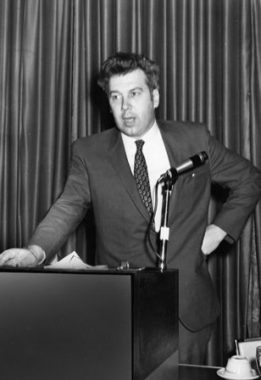
Services are pending for former Juneau legislator Elton Engstrom, Jr., who has died at the age of 78.

Engstrom represented Juneau as a Republican in the legislature from 1965 to 1971.

Politics were in his blood, so to speak, as both his mother and father, Thelma and Elton Engstrom, Sr., were elected to the Alaska Territorial Legislature. In the early 1960s, Engstrom, Sr.  served in the new state’s senate.

The younger Engstrom was a lawyer who served from 1965 to 1967 in the Alaska State House, and from 1967 to 1971 in the  State Senate.

The state was just recovering from the 1964 earthquake that struck Southcentral.  Then in 1967, it was the Fairbanks flood. But it was also a heady time with the discovery of oil in Prudhoe Bay.

Engstrom’s daughter Cathy Munoz has followed in her father’s footsteps and represents Juneau in the Alaska State House.  Her office writes that as a youth Engstrom  worked with his father,  a fish buyer at Juneau Cold Storage, then went into the business and bought fish until 1985.

Engstrom also managed property that he owned, collected books and was an avid writer and known for his columns in the Juneau Empire.  He and his son Allan authored Alexander Baranov and a Pacific Empire,  a book about the first governor of the Russian-America Company.

Elton Engstrom, Jr. died Wednesday at his Juneau home on Chicken Ridge.   He is survived by his wife Sally, his brother Allan, sons Elton and Allan, daughter Cathy Engstrom Muñoz, son-in-law Juan Muñoz, and grandchildren Mercedes and Matthew Muñoz and Katya and Aliosha Engstrom.


Memorial for Beverly Ward is Wednesday

A memorial service will be held Wednesday for long-time Juneau resident Beverly Ward, who died suddenly last week.  She was 67.
Ward came to Alaska in 1968, when she accepted a teaching job in Ketchikan.  Like many transplants, she planned to stay for a year and wound up making Alaska her home.

Over the years, Ward taught school, worked for Alyeska Pipeline Service, and ARCO Alaska as government affairs representative in Juneau.  While traveling the state for the pipeline company, she met and married Robert Ward, who became  lieutenant governor under Terry Miller, and later state transportation commissioner. Bob Ward died in 1997.

Beverly Ward remarried Brian Reeve in 2011.

She was involved in several organizations, including Juneau Rotary, Capital City Republican Women, the Glory Hole, and Catholic Community Services.

She is survived by her husband, a brother, stepchildren and grandchildren in Arizona, Oregon, and Juneau.

Services will be held Wednesday at Chapel by the Lake at 1:30 p.m.


Volunteers and staff continue to give life to the Shrine

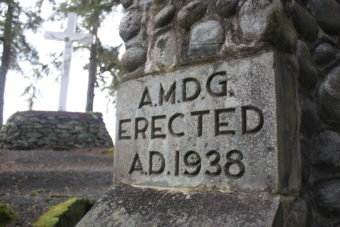
The Shrine of St. Therese has gone through various stages of use and deterioration in its 75-year history. It even closed in 1985 but a small group of Juneau residents gave it another life. Since then, the Shrine has remained open to the public for various activities while undergoing small and large renovations.

The Shrine has only survived and thrived through the hard work of Shrine staff, the generosity of volunteers, and the spirit of St. Therese.

The Shrine of St. Therese is rooted in community support.

Shortly after the cornerstone of the chapel was laid 75 years ago, 83-year-old Albert Shaw attended summer camp at the Shrine. “I remember we helped get the rocks for the causeway, throw them in the dump truck,” he says.

Help came from other groups as well.

“During the depression, during the 30s, fellows would show up here and go up to the church looking for a handout and Father LaVasseur would say, ‘I’ve got something for you to do,’ and ship them out to the Shrine and put them to work,” Shaw recalls.

Over the decades, the Shrine has gone through cycles of high use and deterioration, until 1985 when Thomas Fitterer got involved.

“It was basically closed down for use. There were many buildings that were falling apart. It was in a real slump. It really needed a lot of love and tender care,” he remembers.

Fitterer says he had an inner calling to help the Shrine, “The diocese was even talking about possibly selling it because it was such an expense, but God had another plan.”

Fitterer along with a small group of Juneau residents were passionate about getting the Shrine back to being a place of spiritual retreat.

A board of directors formed in 1986 and Fitterer and his wife Mary were asked to be Shrine directors. “When we took it over, it was in the red,” he says.

With the help of a dedicated board and other volunteers, the Shrine slowly got back on its feet. Within ten years, the Shrine was bringing in its own money.

Throughout his 25-year career as Shrine director, Fitterer says his main job was figuring out how to bring about new infrastructure and new facilities, “A lot of times it was just getting out of the way and allowing the people who had the gifts to bring them forth.”

Improvements included a new road, a bridge, a new water system, new sculptures of the Stations of the Cross, the Columbarium, and the construction of the Jubilee and Little Flower retreat cabins.

“So often I would scratch my head and say, ‘Lord how are we going to do that?’ and somehow or another I could ask somebody or somebody would volunteer,” say Fitterer.

In recent years, that somebody has often been Sam Bertoni. Almost every day for the past 13 years, Bertoni is volunteering at the Shrine doing one job or another.

“We have our own water system, our own septic system, so that takes some attention. Minor carpentry work and electrical work and plumbing work and plowing,” lists Bertoni. “We do our own plowing and sanding, so pretty much, it’s kind of like a little village.”

Bertoni’s hours depend on what project he’s working on.

“I’ve never spent a night here in 13 years, but I’ve been out here in the middle of the night thawing out pipes,” Bertoni says.

The Shrine has a couple dozen volunteers throughout the year. If there’s a bigger project, more will show up. Past work days have brought out more than a hundred people.

The Shrine is named after St. Therese. Born and raised in France, St. Therese became a nun when she was only 15. In 1897, at the age of 24, she died of tuberculosis. Alaska Bishop Joseph Crimont knew her family and when she was canonized, he declared St. Therese Queen and Patroness of Alaska.

St. Therese is also called ‘The Little Flower’ because she knew the importance of small contributions.

Diocese of Juneau Bishop Edward Burns says that’s like the Shrine’s history.

“[St. Therese] spoke in her journal about how even a small smile to a passerby means so much. It’s a connection. So with the little things that we offer, it helps transform society,” says Bishop Burns.

Now, Shrine director Deirdre Darr is introducing the Shrine to a younger generation.

“The whole history of the Shrine is just everyday people in Juneau and outside of Juneau who have just loved it and I think it’d be great to introduce it to another generation so that they can start to step in and take over for those who are getting older who have been loving and caring for the Shrine,” Darr says.

At times, Darr is overwhelmed with being in charge of the Shrine’s future, but knows she’s not alone.

“We can’t forget that we’re not the ones ultimately who are responsible, that hopefully there will be some divine inspiration to help us figure out what the future will be,” she says.

The combination of divine inspiration and human ingenuity is likely to guarantee the Shrine will be around for decades to come.

Site notifications
Update notification options
Subscribe to notifications