Spirit

Juneau remembers 9/11/01

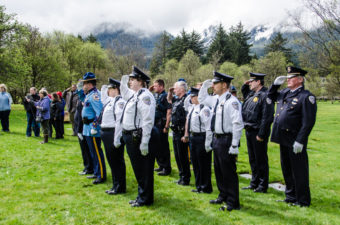
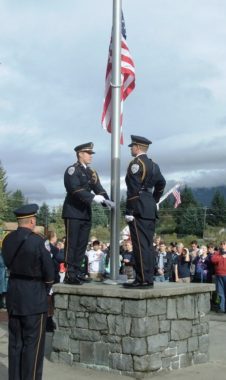
JPD Color Guard raises a U.S. flag to half staff during Wednesday’s 9-11 commemoration.

Juneau paused with the rest of America Wednesday to remember those who died or were forever changed from the September 11, 2001 terrorist attacks on the U.S.

The commemoration is now called Patriots Day.  Juneau’s memorial is hosted by local Rotary clubs at the park they built in the Mendenhall Valley.

Police officers, firefighters and paramedics, National Guardsmen, U.S. Coast Guard and other first responders were greeted by a crowd that included a number of Thunder Mountain High School students.  They were toddlers 12 years ago and know little about the events of that day.

It was the first time sophomores Shane Mielke and Jamie Yaletchko  have attended the memorial.

Mielke said 9/11 meant “help” to him, referring to  first responders. Yaletcho had seen a movie about 9/11.

“I watched the movie and thought it was really cool and then I thought it’d be cool to come and see and hear them talk about it,” she said.

A number of TMHS students attended the ceremony for the first time. They were toddlers in 2012.

But most at the ceremony remembered the day well and the impact it had.

Ed Quinto is an assistant chief for Capital City Fire and Rescue. He told the crowd that 9/11 will always be etched in America’s heart.

“We must never forget the 343 firefighters and 60 fallen law enforcement officers. Never forget the sacrifices that were made that day, the courage of the firefighters and law enforcement offers who rushed into the burning buildings to save thousands of others.”

After the ceremony a large group of Juneau police officers lined up for a photo.  A number of them were on the force 12 years ago, including Lt. Dave Campbell.  His first stop that day was Juneau International Airport, which had been shut down like all U.S. airports.

“We didn’t know what the scope of the attacks were on the morning of 911, so when I started at 6:30 (a.m.)  the airport got shutdown, and we made sure we had a presence at the schools just to kind of reassure people and make sure we had a presence at places that might be considered targets,” Campbell said. 

Twelve years later, Campbell said he finds encouragement from the day as he reflects on the way America and its communities like Juneau came together.

At the end of Juneau’s ceremony, Mayor Merrill Sanford, a retired CCFR chief, placed a wreath in the lake at Rotary Park.

The September 11th memorial at Rotary Park is constructed of concrete and Pennsylvania marble in the shape of a broken pentagon. Each side is four feet in length to represent the four high-jacked airplanes that crashed into the Pentagon, the New York City World Trade Center and a field near Shanksville, Pennsylvania.  Nearly 3-thousand people died that day.


Juneau wildlife guide, advocate Greg Brown passes away

Greg Brown
Juneau wildlife guide and advocate Greg Brown passed away over the weekend. Photo by Casey Kelly/KTOO.

Juneau resident and well-known wildlife guide Greg Brown has died. He was 63.

Brown passed away over the weekend, according to his wife Tina, who says he’d recently been diagnosed with angiosarcoma, a rare and aggressive form of cancer.

The couple realized a longtime dream when they moved to Juneau almost a decade ago.

“Our first trip here it was rainy, and it was cold, and we looked up at the waterfall, and that evening we said, ‘Well, when we retire, we’re going to move to Juneau,'” Brown recalled in a 2010 interview when he was running for Juneau Assembly.

“And when the time came, literally it was a three minute conversation about when are we going to get a flight to Juneau?” he said. “It’s a great spot to live, it has some of the nicest people I’ve ever seen anywhere in the world, and I would stack Juneau up against any city in the world.”

Brown was born in Evanston, Illinois, but grew up in Virginia. He attended Virginia Tech University, where he double majored in mechanical engineering and nuclear engineering.

He was an executive for major international electric companies, including Siemens and Schneider Electric.

In a 2008 Evening at Egan lecture at the University of Alaska Southeast, Brown described himself as “an environmental capitalist.”

“I build things, I’ve done that most of my life – plants all over the world in China, Latin America, Europe. But I always try to do it with the most friendly environmental look at how to build it,” he said.

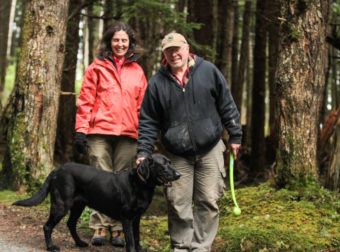
Greg and Tina Brown
Greg and Tina Brown enjoy a walk with their dog, Oscar. Photo courtesy Kerry Howard.

After moving to Juneau, the Browns started a guiding business, Weather Permitting Alaska. But Tina says Greg never considered it a job.

“He loved taking people out to see the whales, because he wanted to teach them about the whales,” Tina Brown said. “He never wanted just to run out there, show them a whale, and run back. He was known to stay up to an hour at no extra charge if the whales were cooperative and the people were enjoying it. Being out on the water and showing people the beauty here and the wildlife was just dear to his heart.”

Tina Brown says she’s not planning a public memorial for her husband. She says Greg didn’t like people making a fuss over him, and never even wanted a birthday cake. But she encourages friends to remember him in their own way.

Groundbreaking held for Walter Soboleff Center

Members of the Yees Ku Oo dance group perform before and during the groundbreaking for the Walter Soboleff Center at Seward and Front Streets in downtown Juneau. Photo by Matt Miller/KTOO News

Local, state, and Native officials, and Native elders donned hard hats and picked up shovels on Thursday afternoon to break ground on a new cultural center planned for downtown Juneau.

The Walter Soboleff Center will be erected at the corner of Seward and Front Streets with Shattuck Way running along the rear of the building.

The 29-thousand square foot space will be devoted to the research and study of the Tlingit, Haida, and Tsimshian cultures. The building will house education, arts and language programs, archives and artifact collections, and offices of the Sealaska Heritage Institute.

Former Juneau mayor and former Sealaska corporation chairman and CEO Byron Mallot heads up the group raising funds for the center’s construction.

This is what ANCSA is all about. To create another giant step in Alaska’s Native peoples contributing their strength and their essence, their beauty, their values, their traditions, and their heritage to all Alaska and even to the nation.”

First Lady Sandy Parnell spoke on behalf of Governor Sean Parnell who attended the event, but who could not speak because of laryngitis.

“Like Dr. Soboleff himself, let this center stand for peace and understanding, for mutual respect and honor, for working together to lift all people up. That, by lifting people up, it will communicate to the world the values of Alaska and the values of Dr. Soboleff.”

Governor Sean Parnell (from left), Sealaska Heritage Institute Trustee Chair Marlene Johnson, Sealaska CEO/President Chris McNeil, and Juneau Mayor Merrill Sanford break ground for the new Walter Soboleff Center in downtown Juneau. An architectural model of the center sits on a table at the far left. Photo by Matt Miller/KTOO News

Dr. Soboleff’s sons Ross, Walter Jr., and Sasha also participated in Thursday’s groundbreaking.

And for those things which we hold dear in our hearts, it is so grateful to have this unfold before us in the name of our dad, Dr. Walter Soboleff.”

Selina Everson, past Grand Camp president, represented the Alaska Native Sisterhood:

We have progressed from our Tlingit box of culture to a building that will carry on Dr. Walter Soboleff’s legacy. We have come a long way. We have a long way to go.”

Everybody gets their digs in. Eagle Clan Leader David Katzeek (from left), Paul Marks of the Raven Clan, and Rosita Worl of the Sealaska Heritage Institute participate in the groundbreaking with their own form of Tlingit hard hats as Sealaska Chairman Albert Kookesh watches in the background. Photo by Matt Miller/KTOO News

Other speakers included Albert Kookesh, Chairman of the Sealaska Board of Directors; Chris McNeil, Sealaska CEO and President; Juneau Mayor Merrill Sanford, Juneau Representative Cathy Munoz; Ed Thomas, President of the Central Council of Tlingit and Haida Indian Tribes of Alaska; Eagle Clan Leader David Katzeek, and Paul Marks who provided the Raven response. A letter from Juneau Representative Beth Kerttula and Juneau Senator Dennis Egan, who could not attend the groundbreaking, was read during the ceremony. The Yees Ku Oo dance group performed before and during the event.

Sealaska Heritage Insititute officials say they have raised about 75-percent of the funds needed for the $20 million project. Some of that money included state and CBJ appropriations, or grants from the Alaska Native Education Program or the Cruise Industry Charitable Foundation.

Completion is expected for the end of 2014.

The center’s proposed site, previously known as “The Pit” or the “Hole in the Ground,” was turned into a temporary park after Sealaska corporation acquired the vacant lot and donated it to the Sealaska Heritage Institute. The space used to be site of the Endicott Building or the Skinner Building which burned down almost exactly nine years ago.

The Reverend Doctor Walter Soboleff was a Presbyterian minister, and spiritual and cultural standard bearer of the Tlingit people. He passed away two years ago at the age of 102.

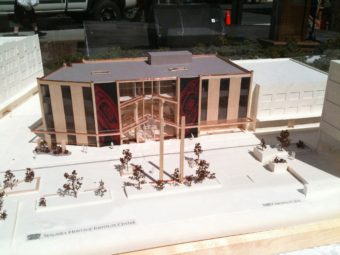
Walter Soboleff Center model
Architectural scale model of the proposed Walter Soboleff Center was on display at Thursday’s groundbreaking ceremony. Photo by Matt Miller/KTOO News

Peace officers remember fallen comrades

Forty-one  peace officers have already died in the line of duty in the United States, including two in Alaska.

Peace officers across the country  celebrated their Memorial Day on Wednesday.  In Juneau, police officers gathered at noon at Evergreen Cemetery to remember fallen officers Richard Adair and Jimmy Kennedy, who died by gunfire in 1979 while responding to a call just up the hill from the cemetery.  The suspect committed suicide.

Adair is buried at Evergreen Cemetery and Juneau public safety officers traditionally lay a wreath at the grave.

Lt. Kris Sell said the wreath is a symbol of the sacrifice of Adair, Kennedy, and other fallen officers.

We stand here today at the equivalent of the Juneau Police Officer Tomb of the Unknown Soldier. That’s a place in (Washington) D.C. that is used to honor soldiers who have lost their lives,” Sell said. “We treat this sacred and honored place of Adair’s final resting place  as our place to come and give our thanks for those sacrifices.”

The Memorial Day commemoration continued last evening at JPD, where State Trooper Lt. Steve Hall remembered Village Public Safety Officer Thomas Madole and Alaska State Trooper Tage Toll, who died in separate incidents in March.

Madole was shot and killed on March 7th in Manokotak, about 25 miles southwest of Dillingham.  Hall says it was clear Madole had established a close connection to the people of the Yup’ik Eskimo village of about 450.

“It’s a hard thing to do to move into a rural community like that and be that accepted,” Hall said.  “You really have to be an exceptional individual to have that kind of relationship that quickly with the close knit community you’re going into. So his service is evident in that by itself.”

Toll was the father of small children who had been a state trooper for about 10 years.  He died March 30th in a helicopter crash, after rescuing a stranded snowmobiler.

“Tage was a real dedicated guy.  He moved around the state a fair bit, worked in different positions so he was known by lots and lots of members of the department,” Hall said.

President Barack Obama issued a proclamation establishing May 15th as Peace Officers Memorial Day. Gov. Sean Parnell has declared May 10 through 17 as Law Enforcement Memorial Week in Alaska.

Decades late, Alaska’s first governor gets his discharge papers

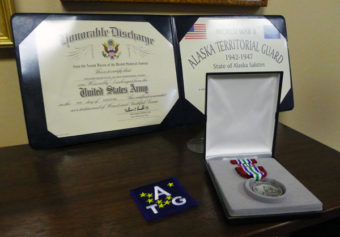
Bill Egan discharge documents
Former Governor Bill Egan’s discharge documents from his days in the Alaska Territorial Guard were just issued some 70 years after World War II. Photo by Alexandra Gutierrez/APRN.

At the onset of World War II, the territory of Alaska was seen as too big, too remote, and too sparsely populated to defend. That is, until it was attacked by Japanese forces.

In response, a few thousand residents came together to form the Alaska Territorial Guard. Once the war was over, the guard disbanded, and those who served went back to their daily lives.

But they were never formally released from duty. Decades later, these guardsmen are now finally getting their discharge papers.

When Dennis Egan opened up some official looking mail before heading into work last week, he wasn’t expecting to find his late father’s discharge papers.

“It was this formal U.S. government, and I’m thinking, ‘Oh my God, I’ve been summoned to jury duty,'” Egan says. “So, I open this box, and there it is. And I just broke down, in fact, I didn’t even come in.”

Egan, a state senator who represents Juneau, knew that his dad Bill was part of the Alaska Territorial Guard. Before serving as delegate to the constitutional convention and then as the state’s first governor, Bill Egan had flown planes during World War II. He even earned a medal for making it through a kamikaze attack. Dennis figured his dad had been released from service when the war ended, and that the papers had just been lost back in 1964.

“I didn’t have a clue,” he says. “I thought all this was just destroyed in the earthquake in their home in Valdez.”

Bill Egan isn’t the only member of the territorial guard not to have his discharge papers. He’s one of 6,000. After the war, the guardsmen were thanked for their help with the war effort, but there was no formal paperwork documenting that their service had come to an end.

“They were busy,” Dennis Egan says. “They weren’t worried about – they were trying to protect us. They weren’t too worried about fancy medals and crap back then. And things were just overlooked.”

Back in 2000, Congress passed a bill to rectify that. It requires the Secretary of Defense to issue discharges to everyone who had served in the Territorial Guard. Those papers let living guardsmen apply for benefits available to every other veteran of World War II, and they also carry a lot of emotional significance for family members of guardsmen who have already passed.

Verdie Bowen directs the Alaska Office of Veterans Affairs, and he’s in charge of the effort. With so much time since the war, it’s been tough tracking down every member of the guard. He says that often, relatives of deceased guardsmen don’t even realize their family members served.

That hit home at one ceremony he was involved in last year.

“What caught me off guard was the crew chief, who was on the Black Hawk helicopter that is currently serving the Alaska National Guard, stood there and did not realize that his grandfather had served in the Alaska Territorial Guard,” Bowen says. “He didn’t know we were presenting that medal to his grandfather when we flew in.”

Dennis Egan
Juneau Democratic State Senator Dennis Egan checks out his dad’s discharge papers with an intern from his staff. Photo by Alexandra Gutierrez/APRN.

Brown says the Territorial Guard was critical to the war effort, and that there’s no reason to treat them differently from veterans in other states. They came from a hundred different communities, stretching from Ketchikan to Barrow, and they served without pay. They picked up downed pilots, they reported on the movements of Japanese ships, and shot down fire balloons.

Dennis Egan wishes he knew more about that history and his father’s time in the Territorial Guard. Bill died in 1984, and he didn’t really talk much about the war when he was alive. That’s part of why it was only this year that Dennis learned his dad had never been discharged.

He says that even though it’s been so long since the war and so long since his father passed, he’s glad to have these papers now and thankful for the connection.

“I had an enormous sense of relief. An enormous sense of closure,” Egan says.

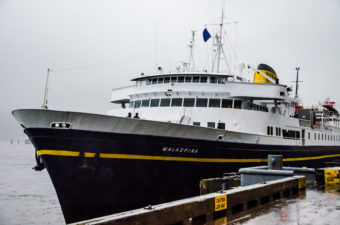
Hundreds gather in Juneau for Malaspina tours, blessing ceremony

Hundreds of Juneau residents flocked to the downtown waterfront Saturday to celebrate two major components of Southeast Alaska’s economy – the Alaska Marine Highway System and the fishing industry.

Alaska Marine Highway ferries haven’t been a regular sight in downtown Juneau for about 30 years. But early Saturday morning, the Malaspina quietly sailed into a rainy Gastineau Channel, and tied up at a downtown dock more likely these days to be hosting a cruise ship.

The unusual trip into the heart of the Capital City was part of the Malaspina’s 50th Anniversary Golden Voyage.

Former Mayor Bruce Botelho was the first passenger to disembark. He recalled being on one of the first Malaspina sailings out of downtown Juneau when he was just 15 years old.

“We got to do a special sailing to Auke Bay as part of an Explorer Scouts color guard,” Botelho said. “And of course, the Malaspina in the years since was the way we connected for sports events, it’s the way we did debate tournaments. It really proved itself to be the marine highway.”

Irene Cadiente was one of the few Juneau residents waiting to greet the Malaspina when it arrived at 6 a.m. Her late husband, Andres, was the vessel’s first cook.

“When the ship landed here, they hired him from the Baranof Hotel and he worked on there until he retired,” said Cadiente. “In fact, he wrote a cookbook and it has a picture of the Malaspina on there.”

Cadiente says she and their children would often join her husband on trips up and down the Inside Passage.

“At the time they had a dining room in there, and they had waiters, and my son – the oldest one – also worked on there, and he was a waiter,” she said. “So, it has a lot of memories for us and we’re happy to see it here.”

By 8 a.m. about 250 Juneau residents lined up to tour the Malaspina, including the bridge and other areas usually off limits to passengers. Another 400 people boarded by 10 a.m. for a special day cruise to Tracy Arm.

On her way to the popular wildlife viewing fjord, the ferry participated in Juneau’s annual Blessing of the Fleet, honoring the Capital City’s commercial fishing boats. Pastor Phil Campbell of Northern Light United Church did the blessing.

“Bless now the ferry Malaspina on this celebratory voyage,” Campbell said. “Bless the crew and passengers and bless our great state that has made the marine highway a reality.”

Seven names were added to the Alaska Commercial Fishermen’s Memorial as part of this year’s ceremony: Charlie Clements, John Winther, Jr., Tom and Dorothy Osborne, brothers Casey and Kelly Newman, and Eric McDowell, who founded the research firm McDowell Group.

McDowell passed away last year at the age of 69 of complications from a staph infection. He joins his son Mark in being honored on the memorial. His other son Chris skippered his father’s boat, the Whisper, during the Blessing ceremony.

“It’s really a nice touch,” Chris McDowell said of having his father’s name added to the memorial. “He loved fishing and did it right up until the end of his life. So, got the boat blessed and got tied up and got up here in time for the reading of the names. So, it’s worked out pretty nicely.”

McDowell says it’s fitting that the Malaspina participated in this year’s Blessing. Over the years, the McDowell Group made a name for itself researching the economic impact of both the commercial fishing industry and the state ferry system.

“My dad was born in Southeast and spent his whole life here,” McDowell said. “It’s kind of part and parcel of being a Southeast resident. Half a century of ferry service and for my dad a little over half a century of fishing – there was kind of a nice parallel there.”

After its Tracy Arm cruise the Malaspina was scheduled to return to downtown Juneau to drop off passengers, then head to the Auke Bay Ferry Terminal. On Sunday she had events planned in Haines and Skagway.

Site notifications
Update notification options
Subscribe to notifications