Spirit

What’s the secret of success? Keep swinging

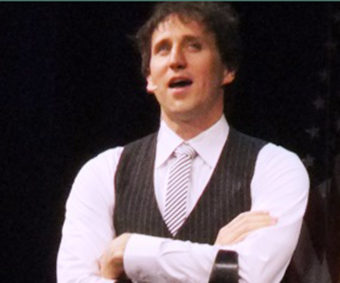
Josh Sundquist was the second speaker of three for the 2013 Pillars of America series.

At 20-something, Josh Sundquist has already written a memoir.  It’s a national best seller with a title that implies some struggles:  Just Don’t Fall.

“We all have some sort of problem, some thing, some disability if you will. I happen to be missing one leg,” he said. “What are you missing?”

Sundquist lost his left leg to cancer when he was 9-years old.  He’s fallen a number of times since then,  but knows how to get up.

“I think we have a choice about the way we want to look at things,” he told an audience of  hundreds of Juneau middle and high school students and Hoonah High School at the Pillars of America luncheon, hosted by area Rotary Clubs.

His choice is to overcome his disability.  In fact, he said it’s because he’s an amputee that he’s gotten to do many things he never would have imagined when he had two legs.

“That’s not to say that  I wouldn’t prefer to have two legs, but that is to say now that I do have one leg, I’m happy to try to look for the good things that come out of this,” he said.

Sundquist uses forearm crutches to get around, but most of the time during his talk they hung from his arms as he stood perfectly balanced on his right leg.  Some of his speech sounded like a comedy routine as he regaled the audience with stories about living with his disability.

He says laughter has helped him deal with many of the issues that come up.

“I would suggest that if I can laugh about having one leg then maybe there are some daily annoyances, some problems in your life that you can laugh about as well,” he said.

Sundquist had a number of somber stories, too, like when he first tried hitting a baseball on one leg.  He was 10-years old.

Each time, he’d strike, lose the bat and fall down.  He was allowed to keep swinging, but on the ninth pitch, the little boy was in tears.

“I would not let my friends see me cry.  So I picked up my crutches again and started to march off the field,” he said.  “And this time my dad called out to me from behind the chain link fence.  He said, ‘You almost had that last one.’”

If the proverbial pin had dropped as he told the story it would have been heard in the silence of the room.

“My dad was my hero and I knew if he were up to bat, he would keep swinging.  So I went back over, took another swing, another strike, another and another. And finally on the 13th pitch I felt the ball bounce off the bat.  I watched it roll up the infield. By the time it reached the short stop’s glove, my friend and designated runner named Tim was already on first base.”

When Sundquist was 16 years old, he started ski racing with the objective of making the U.S. Paralympic Ski Team.

Paralympian Joe Tompkins, of Juneau, gets a hug from some friends after Sundquist’s speech.

It was at the training center in Colorado that he met Juneau’s Paralympian Joe Tompkins. He called him “Big Joe.”

“When you’re starting out in a new endeavor like that, whether it’s a goal, or some adversity you’re trying to overcome, there’s nothing more powerful than having a hero that you can look up to, somebody who’s has already traveled that path that you are pursuing,” he said.

Sundquist made the team and in 2006 competed in the Paralympics in Turino, Italy.  He described himself as a determined, but not decorated racer like Tompkins.

Joe Tompkins was in the audience for Sundquist’s speech.  Like the younger man, he has a story to tell about his paralysis.  After the speech, he said his advice to the audience would have been similar:

“One more swing, never give up.  There’s going to be trials and tribulations that you’re going to go through the rest of your life, and if you’re that young you just don’t ever give up,” Tompkins said.

As Sundquist closed out his speech, he put it this way:

“Keep swinging,” he said. “Those would be the last two words that I would leave with you this afternoon:  To keep swinging.”


Juneau Assembly honors longtime PRAC member Jim King

Jim King honored
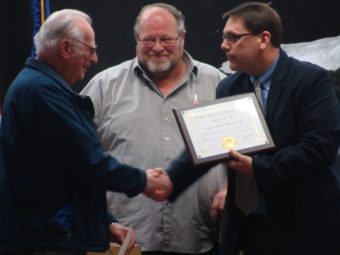
CBJ Parks and Recreation Director Brent Fischer congratulates Jim King on 45 years of service to the city’s Parks and Rec Advisory Committee as Mayor Merrill Sanford looks on. Photo by Casey Kelly/KTOO.

When Jim King was appointed to the City and Borough of Juneau’s first Parks and Recreation Advisory Committee in 1968, the Capital City didn’t even have a Parks and Rec department.
Today, the department is responsible for managing more than 50 parks and trails, two swimming pools, an ice arena, a skate park, and a rifle range. Not to mention the Jensen-Olson Arboretum, the Zach Gordon Youth Center, Centennial Hall, two parking garages, and the Juneau-Douglas City Museum.

King stepped down from the PRAC last month after 45 years. The Juneau Assembly on Monday honored his contributions to recreation in the Capital City and statewide. The proclamation took Mayor Merrill Sanford three minutes to read, and included nine whereas sections.

CBJ Parks and Rec Director Brent Fischer joked it easily could have been longer.

“We could have added more whereases on there until the sun came up tomorrow,” Fischer said. “But I want the Assembly and the public to know just, because of you, what a better place this community is.”

In 1970, King led the PRAC’s effort to compile a comprehensive list of parks and trails in Juneau. He also helped establish the Juneau State Parks Advisory Board, and led the charge to create the Mendenhall Wetlands State Game Refuge.

“I’ve always thought it was a privilege to live in Juneau and to be involved in the community as a volunteer with the Parks and Rec department,” King said. “It’s been wonderful.”

King worked for the U.S. Fish and Wildlife Service for more than 30 years as an enforcement agent, refuge manager and wildlife biologist. His final meeting as a member of the PRAC was in March.

The 85 year old will continue to live in Juneau with his wife, Mary Lou.

Alaska Bishops say new pope is a ‘fresh beginning’

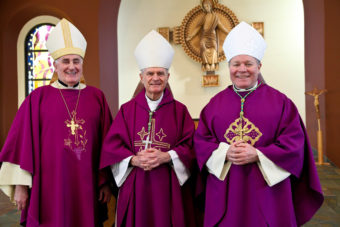
(Photo above) The three Bishops of Alaska pictured while gathered in Anchorage for a recent Alaska Priests’ Convocation. From left to right: Bishop Donald Kettler, Fairbanks; Archbishop Roger Schwietz, Anchorage; Bishop Edward Burns, Juneau. Photo by Ron Nicholl, Anchorage.

Alaska Catholic bishops say the election of a pope from Latin America provides a fresh beginning for the Catholic Church.

As Argentine Cardinal Jorge Mario Bergoglio was elected yesterday (Wednesday), Alaska’s bishops were in Juneau for the annual meeting of the Alaska Conference of Catholic Bishops. They also planned meetings with members of the Parnell administration and legislators.
The mid-morning announcement of a new pope was greeted with the ringing of bells at Juneau’s downtown Cathedral of the Nativity. At noon, Archbishop Roger Schweitz of Anchorage, Bishop Donald Kettler of Fairbanks and Bishop Edward Burns of Juneau held a thanksgiving Mass for the election of Pope Francis.


Twin Lakes cabin honors Juneau resident who loved to skate

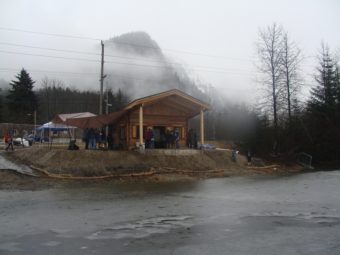
About 200 people attended the dedication of a new warming shelter at Juneau’s Twin Lakes on Saturday.

The 14 x 24 foot cedar cabin was built to honor John Caouette, a longtime Juneau resident who passed away in 2010.
Caouette was an avid skater and hockey player, and Twin Lakes was one of his favorite places to lace up the skates. Friends and family raised the funds and donated time and labor to build the shelter, located on the southern end of Twin Lakes just after you turn in to the parking lot.

Caouette’s mother, Mary Gorzycki, and widow, Rebecca Braun, were among those who spoke at the dedication. Several friends and family members from his home state of Minnesota made the trip to Juneau for the event.

Caouette died in an accidental fall in Minneapolis while visiting family in October 2010. He was just 46 years old.

He moved to Juneau in the early ’90s to work for the U.S. Forest Service. He later worked as a research scientist for the Nature Conservancy, where his studies of the Tongass National Forest were described as “cutting edge” by colleagues.

Fundraiser puts Juneau’s Empty Chair project near goal

Empty Chair Big Check
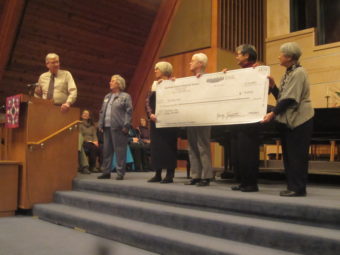
The Gastineau Channel Historical Society presents a $5,000 check to organizers of the Empty Chair project in Juneau. On the far right are sisters Mary Tanaka Abo and Alice Tanaka Hikido, whose brother John inspired the proposed memorial to Juneau’s Japanese American internees. Photo by Casey Kelly/KTOO.

A proposed monument in Juneau to Japanese Americans interned during World War II got a big boost last weekend.
The Gastineau Channel Historical Society donated $5,000 to the Empty Chair Project, and a fundraising concert raised nearly $2,000. Organizers have been collecting funds for about a year and need about $6,000 more to meet their $40,000 goal.

Third generation Japanese American violinist Steve Tada and pianist Nancy Nash performed several compositions, including Michio Miyagi’s “Haru no Umi” at the Empty Chair benefit concert on Saturday.

Sisters Mary Tanaka Abo and Alice Tanaka Hikido sat in the front row as honored guests. Alice Tanaka was nine-years-old in 1942 when the entire family was taken from Juneau and placed into internment camps.

“We were identified with the enemy when we were not the enemy at all,” she said.

Brother John Tanaka, who died several years ago, inspired the Empty Chair project. He was valedictorian of Juneau High School’s class of 1942, but could not attend graduation after the family was taken from the Capital City. The school set up an empty chair at the ceremony to acknowledge that John Tanaka was not there.

The memorial will be a slightly larger than life-size bronze replica of the empty chair at Juneau’s Capital School Park, located next to the old Juneau High School. Project organizer Margie Shackleford has been friends with Mary Tanaka since childhood.

“We can’t always redress everything, but we can at least acknowledge that an injustice occurred,” Shackleford said.

The Tanakas’ father, Shonosuke, operated the City Café in downtown Juneau for more than 50 years. In the early 1940s, the territorial capitol was home to about 6,000 residents, and the restaurant was open 24 hours a day to serve miners, fishermen and other laborers.

Alice recalls that federal agents came for her father just a day after the Japanese attack on Pearl Harbor in December 1941.

“They took all the men, actually. It wasn’t just my father, but all the immigrant-born men,” she said. “Then shortly after that they were taken away from Juneau. We didn’t know where they were going to be taken to, so, there was a lot of unknown.”

While their father was interned in Santa Fe, New Mexico, the Tanaka children and their mother were sent to Camp Minidoka in Idaho, where they would spend the next three years.

“It was a small room that we shared with a pot-bellied stove, and that was our home for the duration of the war,” Alice Tanaka Hikido said.

“And then we had all of our meals in the mess hall, did all of our showering and bathroom needs in what they called the laundry room. So, it was kind of communal living.”

Violinist Tada, whose family lived in the Seattle area, had relatives taken to Camp Minidoka as well.

“They published what was called a ‘Memory Book’ and it has group photos of everybody’s family in front of their barracks,” he said. “And it kind of reads like a school yearbook. They had social clubs, they tried to have dance bands, and morale builders, and they even had Boy Scout troops.”

After the war, the Tanakas returned to Juneau, where Alice says her father re-opened the City Café with community support.

“He had to take a loan out from the bank, and the bank gave him the loan unconditionally,” she remembers. “And suppliers were family friends who told my father that he didn’t have to pay his bills until he had a cash flow that made it possible.”

Seattle artist Peter Reiquam has a design concept for the Empty Chair memorial. Shackleford says it will include the names of all the Japanese Americans taken from Juneau during World War II.

“Plus a Japanese symbol for remembrance and memory, and a text telling a story of the empty chair,” Shackleford said.

With the funds raised at the benefit concert, organizers are confident they’ll be able to dedicate the memorial in the summer of 2014.

Link:
Juneau Empty Chair Project website

Remembering Mackenzie

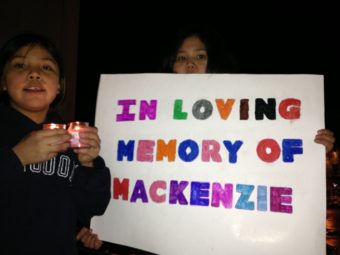
About a hundred people gathered on the steps of Juneau’s Sealaska Plaza Friday evening for one of several candlelight vigils held around the state for Mackenzie Howard.

Alaska State Troopers are investigating the 13-year-old girl’s murder last week in the small Southeast village of Kake.

The vigil included performances of a Tlingit Mourning Song and a Haida Prayer Song.

Paul Marks of Juneau offered a prayer, struggling at times to find the words to describe the sadness and pain felt by those who attended the gathering.

“But looking around at each and every one of your faces today,” Marks said. “I see a love for your family, because she was our family too.”

Mourners also held candlelight vigils Friday in Kake, Sitka, Petersburg, Anchorage, and Fairbanks.

Organizers collected donations for the Howard family at Friday’s event in Juneau. A checking account has also been set up at Wells Fargo Bank. The account number is 5274579043.

Tlingit Mourning Song led by Nancy Barnes:
Haida Prayer Song led by Vicki Soboleff:

Site notifications
Update notification options
Subscribe to notifications