Spirit

Shrine celebrates 75 years of retreats and reflection

The Shrine of St. Therese  kicked off a year-long 75th anniversary celebration on Saturday. The cornerstone of the chapel was laid and blessed by Alaska Bishop Joseph Crimont on October 30, 1938.

The Shrine was originally built as a place to inspire devotion to God. At the time, there were no other spiritual retreat houses in Alaska and Father William LeVasseur saw the need to build one.

But throughout its 75 year life, the Shrine has welcomed people of all beliefs. Residents of Juneau, Southeast Alaskans, and visitors go to the Shrine for all kinds of reasons.

As you drive out Glacier Highway from downtown Juneau, you eventually start winding along the coast with intermittent views of the Chilkat Mountains. Past Tee Harbor, you start driving up. Soon, you descend through a hemlock forest.

Turn left at mile 23 and find “a lot of trees, streams. As you walk down, you see log structures, you see the ocean,” describes Thomas Fitterer, director of the Shrine of St. Therese for almost 25 years. “You see a causeway. On the other side of the causeway is an island, Shrine Island. So you walk over to Shrine Island and suddenly you see a church made out of rock.”

Surrounding the church are the Stations of the Cross, each station depicting a scene of Christ’s final hours on earth and the resurrection.

“Then you look out and the ocean waves are hitting against the rocks, so you have God and nature so prevalent there that you cannot help but be influenced – whether you’re a believer or non-believer – somehow or another, one is touched by the peace, by the gift of natural beauty, and by the spirit,” Fitterer says.

From the beginning, the Shrine has been a place where everyone is welcome, even in the 1940s, Fitterer says, when religious groups tended to stay separate.

“Back then even, people of all denominations or no denomination felt comfortable coming to the Shrine and that’s been the flavor ever since and that’s something that I would never want to see lost,” he says.

The Shrine was built as a place to hold religious retreats, escape normal activities and be with God through prayer and reflection. It’s still a place to retreat, but in many different ways.

“The good thing about the Shrine,” Fitterer says, “is you can do everything from have a picnic on the beach to fish to rock climb to rock find to walk the labyrinth. It fulfills the needs of so many people in so many ways.”

The Shrine has always been seen as a place to escape this busy world full of distractions. “You’ve got your iPhone and you’ve got your tweets and you’ve got whatever else, a lot of people just get caught up into that pattern,” says Fitterer.

Over the years, visitors have told Fitterer about how much they enjoy being at the Shrine. People have talked of experiencing miracles and feeling close to God, even when they didn’t have one.

Fitterer recalls one visitor who have traveled all over the world, but felt a special presence at the Shrine, “She just could feel it, and she said I’ve never seen and felt a more beautiful place on earth.”

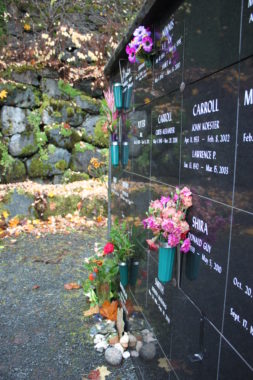
At the Shrine, volunteer Sam Bertoni walks to the outdoor columbarium where the ashes of his mother and another 200 individuals are laid to rest.

“Some people come and visit all the time,” says Bertoni. “I know people that come out here on a regular basis every week to put flowers or to communicate with their loved ones. Some folks come out here many times a week.”

A semi-circle of six black granite walls, each about seven feet tall and 11 feet long face the ocean.

“And it’s a fantastic view. You know I can’t afford beachfront in this life, but maybe in the next life,” Bertoni laughs.

The Shrine offers church services during the summer and other holidays throughout the year. Bertoni remembers one Easter service. “There must have been 100 people and there must have been 150 sea lions out here yelping because of the killer whales, and there was so much commotion, you couldn’t even talk. It was like a hundred dogs barking. It was really something,” Bertoni says.

Over the decades, the Shrine has grown beyond the original structures of the chapel, lodge, caretaker’s house, and the post office. It now offers five separate rental cabins which are used regularly for day use, overnights, weekends, and longer stays.

Caretakers Jack and Jeanne Jordan are in charge of the daily happenings at the Shrine. Besides being used by the Catholic Diocese of Juneau, the units are rented out by many other groups.

“We have other churches, the state of Alaska, the school district, the Coast Guard, different businesses utilize it, we have yoga groups sometimes, women’s retreats and sewing groups, scrapbooking groups, anniversary celebrations, birthday celebrations, family reunions,” says Jeanne Jordan.

It could be as simple as wanting a quiet place to walk around or as complicated as pondering the meaning of life. Jordan says people in search of something often visit the Shrine of St. Therese and find what they’re looking for.

Dispatcher helps deliver baby in Juneau

A couple in Juneau have a police dispatcher to thank for helping bring a new baby boy into their family.

According to a police news release, at about 10:15 Wednesday morning a man called 911 from the Best Western Hotel in the Mendenhall Valley to report his wife was in active labor. The dispatcher guided the couple through the pre-delivery process. By the time Capital City Fire and Rescue arrived on scene about five minutes later, the baby was being born.
According to the release, the mother and baby were doing well and were not transported to Bartlett Regional Hospital.

The couple’s names and the name of the baby were not released.

CBJ Assembly endorses Sister City relationship with Philippine city Kalibo

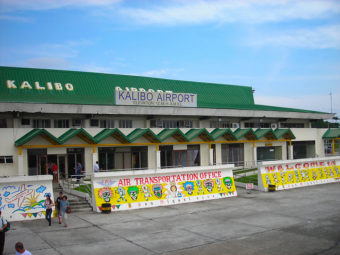
Kalibo Airport
Kalibo Airport. Photo courtesy oasis li/Flickr Creative Commons.

The Juneau Assembly has endorsed a Sister City relationship with the Municipality of Kalibo in the Philippines.

Kalibo is the capital of the Philippine province of Aklan.
After retiring from the U.S. Coast Guard four years ago, Mendenhall Valley resident Larry Snyder says he and his wife, who is Filipino, began living half the year in Kalibo. Snyder says establishing a Sister City relationship could help forge economic ties, especially for Alaska seafood.

“This might be a wonderful opportunity for Southeast Alaska, Juneau in particular, to reach out with some of our products, and some of our knowledge on seafood,” Snyder said. “And I know that Kalibo would be receptive to such ideas.”

Filipino Community, Inc. President Dante Reyes hails from near Kalibo. He also spoke in support of the Assembly’s resolution.

“On behalf of the more than 800 Aklanans in the municipality of Juneau, out of the 3,000 Filipinos, we are in support of the CBJ proclamation,” Reyes said.

Now that the Assembly has adopted the resolution, Juneau’s Sister Cities Committee can proceed with the steps necessary to formalize the Sister City relationship.

Juneau’s other Sister Cities include, Whitehorse, Yukon in Canada, Chia Yi City in Taiwan, Vladivostok in Russia, and Mishan City in China.

Juneau’s Harborview Elementary School is crazy for World Hoop Day

When it comes to hula hooping, 11-year-old Caden Derick says he’s just okay.

“I practice sometimes,” he says. “But usually my dog eats up my hula hoops.”

Caden’s dog would’ve been in hoop heaven at Juneau’s Harborview Elementary School this past month. Students there got to make their own hula hoops out of PVC pipe and other material, all leading up to Saturday’s World Hoop Day.

Caden says he’s not sure what the hype’s all about, but it’s exciting nonetheless.

“Yeah, I think it’s cool that people do it,” he says. “I mean, I don’t know why they have a Hoop Day. But it’s cool that they do it.”

A few dedicated New York City hoopers started World Hoop Day in 2005 as a way of celebrating hoop culture. The exact date has changed every year since, but the idea is pretty simple: Get a bunch of people around the world hula hooping on the same day.

Harborview Gym Teacher Zach Stenson says one of his friends has taken part in past World Hoop Days.

“She gave me the idea a couple years ago, and said ‘Oh, what a neat thing if you could have all the kids do something at the same time that kids all over the world are doing a similar activity,'” he says.

Harborview teachers started a Humanities program this year, and Stenson says they decided to make the hula hoop project their kickoff activity. They hope to hold similar events every month or so, focused on building community.

“Bringing our school a little bit more together,” Stenson says. “Helping the kids make friends, that sort of thing.”

One lesson Stenson hopes the kids take from the hula hoop project is that they don’t always have to buy their toys. With the right materials, they can make them at home.

While teachers and parents use hair dryers to heat up roughly 10-foot sections of plastic pipe, the kids bend them into a circular shape.

Ten-year-old Kiana Potter made the project’s first hula hoop.

“When Mr. Stenson first started talking about it, he asked me to make an example hoop,” she says. “So, I could show the other kids what it was going to be.”

Kiana’s not sure why she was chosen to make the example hoop, but says maybe it’s because she has a lot of hula hooping experience.

“I can do a lot of tricks with a hula hoop,” she says. “I can do it around my neck and my hands and my arms, and I recently figured out how to do it around one foot while hopping up and down.”

Local businesses donated money or materials, and many parents volunteered to help with the project. Harborview PTA President Bruce Franklin says the kids at first have no idea how plastic pipe will turn into a hula hoop. But that changes once they see it start taking shape.

“Then they can’t keep their hands off it, and everybody wants to hula hoop,” Franklin says. “So, it’s kind of a rapid particle accelerator machine of excitement, because they just get super psyched up. And then, you know, we have to kind of keep them from hula hooping each other to death out here.”

[youtube https://www.youtube.com/watch?v=e65hq2hLAIs&w=420&h=315]

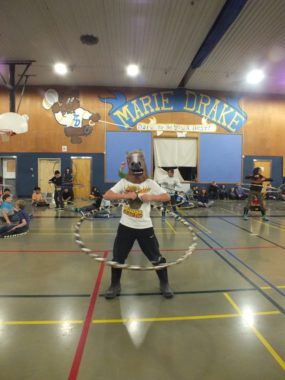
Friday afternoon, the entire school except kindergarten files into the gym at the Marie Drake building for the project’s culmination, a school-wide hoop off.

Each class holds a competition to see who will represent them. Then Mr. Stenson explains how the hoop off will work.

“We have ten minutes for our hoop off,” he says. “That means, be careful not to bump into anybody, and see how long you can hula hoop.”

By the end of ten minutes several kids are still hula hooping, with no sign of letting up. Third grader Florian Wade says he had fun, but he’s exhausted.

“Yeah it was hard,” he says. “My belly hurts.”

Stenson says it’ll be tough to decide who deserves a prize for best hula hooper.

“I think the idea is they all are winners here as a group. They all did a great job. I don’t think we could pick one person.”

Juneau businessman Larry Spencer dies

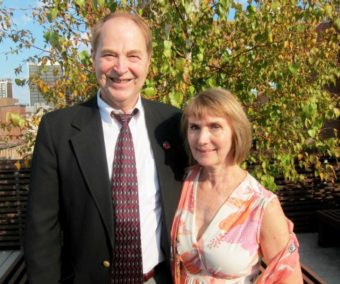
Larry and Carola Spencer. Photo courtesy Facebook.

Well-known Juneau businessman Larry Spencer has died. He was 63.
A former president of the Downtown Business Association, Spencer is described as totally committed to the capital city.

He came to Juneau from Minnesota in the late 1970s and quickly became active in his adopted community.

Business partner Bruce Denton says the two first worked together on a townhouse project in West Juneau.  At that time Denton was looking for a business partner who could run his construction business while he was training and running the Iditarod Sled Dog Race.

They formed Senate Properties and their first project was the renovation of the old Senate Building in downtown Juneau.  They’d taken a big gamble on the building purchase, closing on it the day before a statewide 1982 capital move vote, which failed, sparing the capital city.

Denton says renovating the historical building was Spencer’s idea.

“It was his vision and I think it was really the beginning of the refurbishing or the gentrification of the historic district downtown,” he says.

Spencer also owned Spencer Realty, a real estate and property management company.

Over the years, Spencer and Denton collaborated on a number of projects in the Juneau area, from condominium developments to the first SEARHC Clinic buildings on Hospital Drive to several mini-storage projects.

“He was the developer and I was the builder,”  Denton says.

A lifelong Democrat, Spencer never ran for public office but was recruited in recent years by opposite political camps.  Denton says it was a testament to his ability to balance development and preservation.

“The preservationists and the developers were both recruiting him at the same time to run for the Assembly. And he would have been an incredibly good Assembly person because he just had a brilliant mind and could think really fast on his feet.”

He didn’t have to be in office to be active in his community.  Spencer worked on a number of major Juneau issues, including tourism management and legislative housing.

He loved the arts and was a founder of Perseverance Theatre, serving on the Board of Directors for years.

Spencer died late Thursday at his home in Juneau, surrounded by his family.  He was diagnosed with brain cancer about five years ago.  After he underwent surgery in 2008, Juneau Rotary clubs and local businesses collected baseball caps to send to him as he went through therapy.

He is survived by his wife Carola, daughter Sophie and son Logan.


Update: Bill Council – a “lawyer’s lawyer”

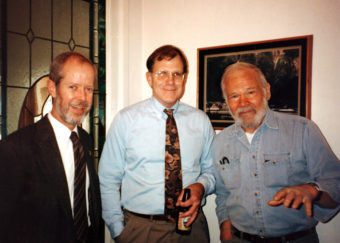
Bill Council, flanked by Art Peterson (left) and former Gov. Jay Hammond (right), at a fundraiser for Alaska Legal Services in the mid-1990s. Photo courtesy Vance Sanders.

Former Juneau resident and attorney Bill Council has died.

Council passed away Sunday in Anchorage at the age of 69.  He had been struggling with Parkinson’s disease.

He is survived by his wife Fran Ulmer and two children, Amy and Louis.

Council was born and raised in North Carolina and got his law degree from University of North Carolina Law School at Chapel Hill in 1969.  He practiced law in New York City before taking a job as an assistant district attorney for the state of Alaska in 1971.

He was a public defender in Ketchikan then moved to Juneau in 1975 to work in the civil litigation section of the Alaska Attorney General’s office. He was the state’s chief civil litigator  during the Hammond Administration.

In 1980, Council started his own law firm and for the next 25 years practiced with other Juneau lawyers, including Walter “Bud” Carpeneti, Vance Sanders, David Crosby and others.

Sanders says Bill Council’s brief writing and analytical ability were “absolutely amazing.”

Sanders describes Council as a “lawyer’s lawyer” and a mentor to many in Alaska’s legal community.

“Young lawyers would call him and ask him how to put together a case; if they were getting ready for trial (they’d ask) how to do this, that, or the other.  He was just incredibly approachable, and loved the law and loved to share his knowledge. That’s what I mean by lawyer’s lawyer.  He was just an amazingly gifted lawyer.”

Council was on the Alaska Judicial Council as well as local boards.  He was an avid tennis player and boater.

Council and Ulmer moved to Anchorage when she was named director of the Institute of Social and Economic Research in 2004. Ulmer also served as Juneau mayor, represented the capital city in the Alaska Legislature, was lieutenant governor in the Knowles’ administration, and is currently chair of the U.S. Arctic Research Commission.


Site notifications
Update notification options
Subscribe to notifications