Soboleff Building History

Sealaska Heritage Institute begins move into Walter Soboleff Center

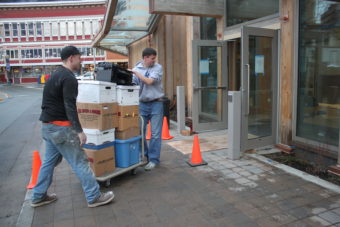
Sealaska Heritage Institute started moving into its new home in the yet-to-be-opened Walter Soboleff Center this week.

Chief Operating Officer Lee Kadinger hopes Sealaska Heritage Institute will be relocated by the end of January. The grand opening of the Walter Soboleff Center is May 15.

“Next door will be our new home,” Kadinger says from his current office at One Sealaska Plaza. “So every time you hear we’re having a Native Lecture Series, it’ll be at Sealaska Heritage. Every time you hear that we’re having weaving classes, it’ll be at Sealaska Heritage. Everything that we do isn’t going to be scattered around in different places or classrooms or meeting rooms; it’ll be at Sealaska Heritage.”

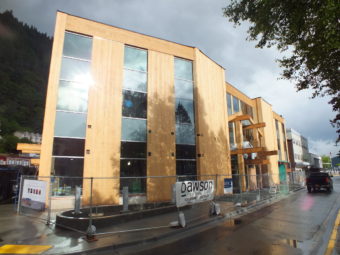
The building will have space for art exhibits, demonstrations and education. The main collections vault will be in the basement, the retail shop on the first floor, Sealaska Heritage offices on the second and office rental space on the third.

In the very center of the building, visible as soon as you enter, is a traditional clan house.

“If we want to have lectures in there, if we want to have presentation in there, if we want to have smaller performances in there – it’s really a flexible space. It’s a multiuse space and it’s an educational space,” Kadinger says.

The clan house front will be carved and painted by Tsimshian artist David A. Boxley. The inside will feature a carved glass house screen and two house posts depicting Eagle and Raven warriors made by Tlingit glass artist Preston Singletary.

Other permanent art work includes 40-foot panels by Haida artist Robert Davidson that will go on the building’s cedar-clad exterior.

Formline design expert Steve Brown created the glass sidewalk awnings that are already installed.

Having raised around $20 million for the construction of the Walter Soboleff Center, Sealaska Heritage continues to fundraise for added artwork and exhibits. Kadinger says more than a thousand individuals, businesses and organizations have already donated.

Family, friends celebrate first annual Walter Soboleff Day

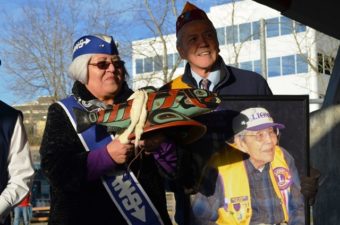
Today was the first annual Dr. Walter Soboleff Day in Alaska, and dozens of the late Tlingit elder’s friends and relatives marked the occasion with a parade through downtown Juneau.

Soboleff’s oldest son, Sasha, says humility and inclusiveness are his dad’s lasting legacy. The Presbyterian minister opened his church to people of all races at a time when Juneau was segregated.

“This man worked well over a hundred years to do things for not only the people of Alaska, but for those who strove to better themselves to do what they need to do,” Sasha Soboleff says. “And what was key to his heart and key to his spirit was the service to his God and Jesus Christ.”

Former state Rep. Bill Thomas remembers hearing Soboleff’s sermons on the radio as a kid growing up in Haines.

“If we didn’t go to Sunday school and we missed church, we had to sit in front of the radio and listen to Rev. Soboleff on the radio,” he says.

Soboleff would’ve been 106 years old today. He died in 2011 at the age of 102.
He was involved with the Alaska Native Brotherhood throughout his life, including during the Native civil rights movement of the 1940s. Later in life he helped launch efforts to revitalize Native languages, as well as traditional art and spiritual practices.

Earlier this year, the Alaska Legislature made 20 indigenous languages official state languages. Soboleff’s daughter, Janet Burke, says that would have made her father proud.

“When we were children we never got to do things like this,” Burke says. “It wasn’t that we weren’t taught how to do this. But we didn’t do things publicly like we’re able to do now.”

Today’s informal parade included about 70 people making their way from Marine Park, through Juneau’s Willoughby District, and to the Salvation Army church.

Ed Thomas is the former president of the Tlingit & Haida Central Council. He says he got to know Soboleff through the Alaska Native Brotherhood.

“He is one of those that started off by writing down Tlingit values,” Thomas says. “So that people can have a starting point on what it meant, what our values meant.”

Thomas says those values include honoring your elders and having a sense of humor.

State lawmakers unanimously approved the bill making Nov. 14 Dr. Walter Soboleff Day. He joins other notable Alaskans like Elizabeth Peratrovich, Jay Hammond and Ted Stevens in having a day named for him.

Archives at the Walter Soboleff building to be named after Native rights attorney, lawmaker

The Sealaska Heritage Institute announced today that it will name the archives facility at the Walter Soboleff Center after a Tlingit Native rights figure.

William L. Paul Sr. was the state’s first Alaska Native attorney and first Alaska Native legislator. He was active in fighting against school segregation, and for the citizenship rights of Natives and their right to vote. Paul was also instrumental in getting the federal government to extend rights granted under the Indian Reorganization Act to Alaska Natives. The act is credited with fundamentally changing the government’s relationship with Native Americans and Alaska Natives.

The Walter Soboleff building is expected to be completed by the end of this year.

Amid modern building construction, Tlingit carver keeps traditional method alive

Sealaska Heritage Institute is incorporating a traditional Native carving method into the building of the Walter Soboleff Center in Juneau.

Wayne Price is a Tlingit carver from Haines. He’s utilizing a tool his ancestors used thousands of years ago, and he’s keeping the tradition alive — one chip at a time.

Like most construction projects, the building site of the Walter Soboleff Center in downtown Juneau is filled with modern power tools.

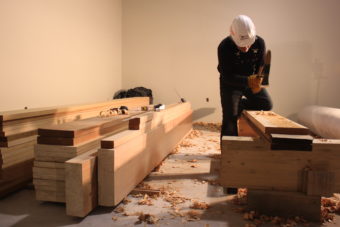
But if you walk to one corner of the building, Tlingit carver Wayne Price has been texturing hundreds of board feet of red cedar using just one tool – an adze. To be more precise, it’s an elbow adze that Price made himself.

“The blade is made from a leaf spring out of a truck and the handle is made from the branch of an alder tree and it’s held together by string and a chunk of leather,” Price says.

The handle is about two feet long and he grips it with both hands as he chips the wood.

Price says the string holding the adze together doesn't have any knots. (Photo by Lisa Phu/KTOO)
Price says the string holding the adze together doesn’t have any knots. (Photo by Lisa Phu/KTOO)

“It’s quite heavy. It’s — I don’t know — three pounds, maybe a little more, so it’s pretty heavy to be swinging all day,” he says.

That’s what Price has been doing. Since the beginning of September, Price has been adzing red cedar board after red cedar board, all day long.

“I’m in pretty good shape right now,” he laughs.

The work he’s doing on the board requires Price to read the wood “and spot the knots and see the grain changes and be able to hit it and turn around and go the other way and keep all the adze rows in a straight line,” Price says.

With each swing, he chips off a little piece of cedar, leaving behind a textured finish, the same seen on traditional Tlingit structures and pieces of art.

“When my ancestors, oh so long ago, were able to make the first adze, that was the foundation that gave them the ability to make all the clan houses, all the totems, all the dugout canoes, all the masks, all the art work,” Price says.

Price says the use of an adze is one of the foundations of Tlingit culture and something he’s trying to keep alive. He started using one as a young man. Taught by master carver Nathan Jackson, Price adzed a clan house floor in Ketchikan.

Tlingit carver and artist Wayne Price (Photo by Lisa Phu/KTOO)

Since then, he’s used the tool on a lot of his work, including 36 totem poles and eight dugout canoes.

“It roughs and shapes and chops and digs and chews all that material out of the way until we get to the hull of the ship,” Price says.

The 680 board feet of red cedar that Price is adzing for the Walter Soboleff Center will be used as columns surrounding the staircases of the four floor building. The heritage, culture and arts center is scheduled to open in May.

“I think if Walter’s looking down, he would be smiling,” Price says. “He would be very supportive of an adventure like this – something that’s old and something that’s new being able to merge together to the benefit of the all the people that are going to come for generations here. They’ll be able to walk up the stairs and be able to see that each one of these marks was made one at a time.”

As he chips away all day long, Price says he’s brought back to the past. He sings Native songs to the beat of the adze, as his ancestors watch over his shoulder making sure he keeps his standards high.

Dr. Walter Soboleff Day bill signed into law

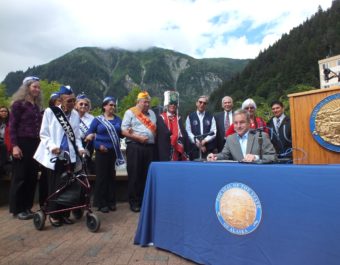
Gov. Sean Parnell has signed legislation making Nov. 14 Dr. Walter Soboleff Day in Alaska.

About 100 of the late Tlingit elder’s family and friends gathered at Juneau’s Marine Park for the bill signing ceremony on Wednesday, where Soboleff was remembered as a man who spread love and good will to all Alaskans.

The idea for a day honoring Soboleff first took off at the 2012 Alaska Native Brotherhood and Sisterhood Grand Camp convention.

“We were in Sitka at our 100th anniversary,” said Peter Naoroz, ANB’s 2nd Grand Vice President.

At the time, Naoroz was ANB grand secretary. He recalled that there were two competing resolutions calling on the legislature to make Soboleff’s birthday a day of remembrance in Alaska. His job was to combine them.

“It was quite an undertaking to try to get all of his accomplishments in a couple of pages,” he said.

Soboleff was born in 1908 in the now abandoned village of Killisnoo, near Angoon.

He was the first Alaska Native pastor in Juneau at a time when the town was segregated. He fought for civil rights alongside Alaska Native Brotherhood and Sisterhood leaders Roy and Elizabeth Peratrovich.

Later in life, Soboleff became the cultural and spiritual standard bearer of the Tlingit people, helping launch efforts to revitalize the language, as well as traditional art and dance.

He passed away in 2011 at the age of 102.

Naoroz said the thing he found most remarkable about Soboleff was his ability to make his fellow Alaska Natives take pride in themselves and their culture.

“He made people who were from this world, from this countryside right here, feel so special about their ability to tell stories, remember stories,” Naoroz said. “The power of the oral tradition and how he made people stand up and feel good about who they were.”

Wednesday’s bill signing ceremony included many similar sentiments. Gov. Parnell said Soboleff was known for his love of all Alaskans.

“And this day will help us remember the love that he had for each of us, as well as for this place,” Parnell said.

One of Soboleff’s four children, Walter junior, said his father would have been humbled by the recognition. He said the family hopes Alaskans will mark the day of remembrance by thinking about Soboleff’s teachings.

“Respect for others, caring, loving, compassion,” Soboleff said.

Walter Soboleff joins Elizabeth Peratrovich, Ted Stevens and Jay Hammond as prominent Alaskans to have a day named for them. Sealaska Heritage Institute’s new cultural center under construction in downtown Juneau will be named for him as well.

Alaska lawmakers file bill to create Dr. Walter Soboleff Day

Walter Soboleff
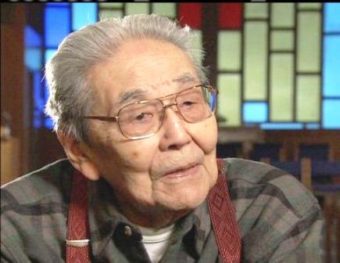
The Rev. Dr. Walter Soboleff. File photo.

November 14th of every year would be Dr. Walter Soboleff Day in Alaska under a bill pre-filed by members of the Alaska House of Representatives on Friday.

It’s one of at least two bills relating to Alaska Native culture and languages that lawmakers will consider during the upcoming legislative session.

“I think it’s wonderful,” said Janet Burke, Soboleff’s oldest child and only daughter.

She says she and her three brothers are thrilled that members of the Alaska Legislature want to honor their late father, who passed away in 2011 at the age of 102.

“It’s hard to believe he’s already going to be gone almost three years, and of course, he was a pretty prominent citizen. So everywhere we go, we know he’s been there,” Burke said.

Rev. Dr. Walter Soboleff with his daughter, Janet Burke in 2010. Photo by Rosemarie Alexander/KTOO.

Soboleff was a cultural and spiritual standard bearer for the Tlingit people. The Presbyterian minister was the first Alaska Native pastor in Juneau. Back when the town was segregated, his church was open to all.

He chaired Sealaska Heritage Institute’s Council of Traditional Scholars, a panel of clan leaders and elders formed to advise the nonprofit’s language and cultural programs. The heritage institute’s new cultural center will be named for Soboleff. It’s under construction in downtown Juneau, and is expected to open a year from now.

At SHI’s 2010 Celebration festival, Dr. Soboleff talked about the strength of Southeast Alaska’s Native people.

“They survived through the ages. And we are here today as descendants of the people of Alaska,” he said to loud cheers.

Burke says the Alaska Native Sisterhood and Brotherhood first floated the idea of a day to honor her father on or near November 14th, which was his birthday. House Bill 217 makes that Dr. Walter Soboleff Day. It was introduced by a bipartisan group of Southeast Alaska lawmakers, including Juneau Representatives Cathy Munoz and Beth Kerttula, Sitka’s Jonathan Kreiss-Tomkins, and Wrangell’s Peggy Wilson.

Munoz says Soboleff was a good friend of her father and grandfather.

“I heard him speak a number of times,” Munoz said. “And every time I heard him speak I was moved by his message of unity, and respect, and love. He was a great leader and we all miss him very much.”

A drawing of the Walter Soboleff Center shows its structure and facade. Image courtesy Sealaska Heritage Institute.

Another bill pre-filed Friday would add 20 Alaska Native languages to the list of official state languages. Tlingit, Haida, and Tsimshian are included from Southeast. Among the others are Alutiiq, two Yup’ik dialects, Eyak, and Inupiaq.

Kreiss-Tomkins is a prime sponsor of the legislation, House Bill 216. The Democrat says it’s largely symbolic, but he hopes meaningful to those in Alaska who are trying to revitalize Native languages.

“It’s a profound loss if a language goes extinct,” Kreiss-Tomkins said. “And this bill is a means of raising the profile of the revitalization movement across Alaska.”

Right now U.S. English is the only official state language.

The bills will be introduced when the legislature gavels in on January 21st.

Site notifications
Update notification options
Subscribe to notifications