Late last week, the future site of the building at Front and Seward Streets in downtown Juneau filled with water from an extreme high tide, stopping work there.
Lee Kadinger is SHI’s Chief Financial Officer and project manager for the center, to be located across the street from Sealaska Plaza. He says the Institute and contractor Dawson Construction anticipated some flooding, since that section of downtown is largely built on fill.
“We’re not, obviously, the first building to be built downtown in this area,” Kadinger says. “When they built Sealaska building they had the same type of issues, so it was fully expected to have tidal influence. We just weren’t certain at what tide it would begin to influence the site.”
Kadinger says the magic number seems to be any tide over 18 feet. Now that they know that, he says they can plan accordingly.
Kadinger also says the building will be constructed with a significant amount of waterproofing and drainage to withstand the periodic extreme high tides.
The $20 million Soboleff Center is expected to be complete in late 2014. The 29,000 square foot facility will house Sealaska Heritage Institute’s education, arts and language programs, as well as offices, archives and collections.
Members of the Yees Ku Oo dance group perform before and during the groundbreaking for the Walter Soboleff Center at Seward and Front Streets in downtown Juneau. Photo by Matt Miller/KTOO News
Local, state, and Native officials, and Native elders donned hard hats and picked up shovels on Thursday afternoon to break ground on a new cultural center planned for downtown Juneau.
Former Juneau mayor and former Sealaska corporation chairman and CEO Byron Mallot heads up the group raising funds for the center’s construction.
This is what ANCSA is all about. To create another giant step in Alaska’s Native peoples contributing their strength and their essence, their beauty, their values, their traditions, and their heritage to all Alaska and even to the nation.”
First Lady Sandy Parnell spoke on behalf of Governor Sean Parnell who attended the event, but who could not speak because of laryngitis.
“Like Dr. Soboleff himself, let this center stand for peace and understanding, for mutual respect and honor, for working together to lift all people up. That, by lifting people up, it will communicate to the world the values of Alaska and the values of Dr. Soboleff.”
Governor Sean Parnell (from left), Sealaska Heritage Institute Trustee Chair Marlene Johnson, Sealaska CEO/President Chris McNeil, and Juneau Mayor Merrill Sanford break ground for the new Walter Soboleff Center in downtown Juneau. An architectural model of the center sits on a table at the far left. Photo by Matt Miller/KTOO News
Dr. Soboleff’s sons Ross, Walter Jr., and Sasha also participated in Thursday’s groundbreaking.
And for those things which we hold dear in our hearts, it is so grateful to have this unfold before us in the name of our dad, Dr. Walter Soboleff.”
Selina Everson, past Grand Camp president, represented the Alaska Native Sisterhood:
We have progressed from our Tlingit box of culture to a building that will carry on Dr. Walter Soboleff’s legacy. We have come a long way. We have a long way to go.”
Everybody gets their digs in. Eagle Clan Leader David Katzeek (from left), Paul Marks of the Raven Clan, and Rosita Worl of the Sealaska Heritage Institute participate in the groundbreaking with their own form of Tlingit hard hats as Sealaska Chairman Albert Kookesh watches in the background. Photo by Matt Miller/KTOO News
Other speakers included Albert Kookesh, Chairman of the Sealaska Board of Directors; Chris McNeil, Sealaska CEO and President; Juneau Mayor Merrill Sanford, Juneau Representative Cathy Munoz; Ed Thomas, President of the Central Council of Tlingit and Haida Indian Tribes of Alaska; Eagle Clan Leader David Katzeek, and Paul Marks who provided the Raven response. A letter from Juneau Representative Beth Kerttula and Juneau Senator Dennis Egan, who could not attend the groundbreaking, was read during the ceremony. The Yees Ku Oo dance group performed before and during the event.
Sealaska Heritage Insititute officials say they have raised about 75-percent of the funds needed for the $20 million project. Some of that money included state and CBJ appropriations, or grants from the Alaska Native Education Program or the Cruise Industry Charitable Foundation.
Completion is expected for the end of 2014.
The center’s proposed site, previously known as “The Pit” or the “Hole in the Ground,” was turned into a temporary park after Sealaska corporation acquired the vacant lot and donated it to the Sealaska Heritage Institute. The space used to be site of the Endicott Building or the Skinner Building which burned down almost exactly nine years ago.
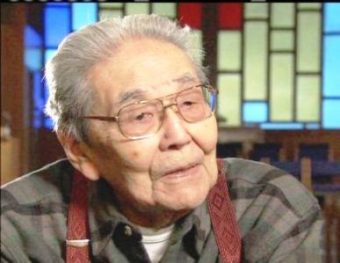
The Reverend Doctor Walter Soboleff was a Presbyterian minister, and spiritual and cultural standard bearer of the Tlingit people. He passed away two years ago at the age of 102.
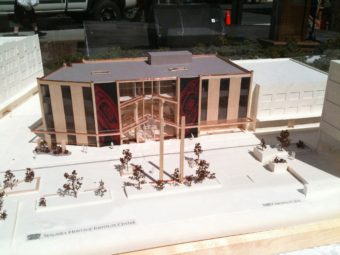
Architectural scale model of the proposed Walter Soboleff Center was on display at Thursday’s groundbreaking ceremony. Photo by Matt Miller/KTOO News
Officials with Sealaska Heritage Institute and the City and Borough of Juneau are working on a deal to let SHI out of the city’s historic district standards for the proposed Walter Soboleff Center.
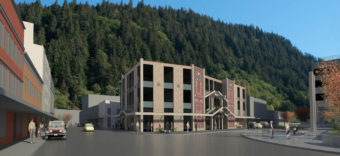
The four-story, 29,000 square foot education and cultural facility will be built on the edge of the downtown district, which celebrates the late 19th and early 20th century architecture of Juneau’s original mining period.
The Soboleff Center will also present a historic look. After all, the history of Southeast Alaska Native architecture goes back over 10,000 years.
Sealaska Heritage Institute Chief Operating Officer Lee Kadinger says the facility at the corner of Front and Seward streets downtown will pay tribute to that history, incorporating elements of traditional Tlingit, Haida and Tsimshian design. It also will take advantage of modern advances in building materials to meet LEED Gold standards.
A glass and cedar façade will give way to an interior that will include exhibits, work and performance space for artists, as well as offices for SHI’s staff, and climate controlled storage for the institute’s collections.
“We just feel that it celebrates the rich cultural diversity of Southeast Alaska,” Kadinger says. “And we feel that it really represents Juneau’s original habitants in a wonderful light.”
Kadinger says SHI is not looking to re-write the city’s historic district code. Rather, the institute would prefer the Juneau Assembly pass an ordinance providing an exception to the property where the center will be built.
“Native culture is part of the history of Alaska, and a non-code exemption would not change the historic district standards in the rest of the district,” he says. “But it would provide for an inclusion of what may have been an oversight.”
The Juneau Assembly this week directed the city law department to draft an ordinance fulfilling SHI’s request.
Mayor Merrill Sanford said the city could put conditions on its exemption. The only suggestion he made would be maintaining the same parking standard.
“The parking standard has been made more flexible in the past five to 10 years,” Sanford said. “And I think we’ve held everybody accountable to that standard within the downtown district that I don’t think that we should step out away from those rules.”
Design drawings for the Soboleff Center show no additional off-street parking. Surface parking would be available at the Sealaska Plaza lot directly across the street.
Other than that, Sanford said he was comfortable changing requirements for building materials, color schemes, architectural style and the like.
“Here we have our Native heritage that has a bright, diversified color scheme to what they do and all their arts and culture,” Sanford said. “They want to build that into this building, and right now that can’t be done.”
SHI’s Kadinger would like to hammer out details of the exemption in the next two months.
Juneau voters in October approved an extension of the city’s temporary one-percent sales tax, which included $3 million for the Soboleff Center. Kadinger says construction is estimated at $20 million, and that SHI has raised about 75 percent.
The facility will be named after the Reverend Doctor Walter Soboleff, a renowned Tlingit elder who passed away in 2011 at the age of 102.
The Rev. Dr. Walter Soboleff has died. He was 102 years old. He passed away Sunday morning at his home in Juneau with his family around him.
The Tlingit Presbyterian has always described his more than 70 years as a pastor and teacher as a “happy ministry.”
He was the first Alaska Native pastor in Juneau during segregation — but his church was open to all.
While Walter Soboleff has often been called the spiritual and cultural standard bearer of the Tlingit people, his influence went well beyond.
“He spoke to the whole world,” said his youngest son, Ross Soboleff. “He happened to be Tlingit, but he really always spoke to the whole world, as selflessly as you can do that.”
Dr. Soboleff is survived by four children and several grandchildren. Services are pending.
He reflected on his life on his 101st and 102nd birthdays.
In his more than a century of life, the Rev. Dr. Walter Soboleff saw two world wars and numerous other military conflicts.
As a boy he watched young Tlingit men leave their families to go off to World War I. As a pastor he nurtured parents whose sons were fighting in other wars. And now it’s the war on terrorism.
“I wish the fathers and mothers would rise up and say, no more wars. We lose our children,” he said on 102nd birthday.
Walter Soboleff was born Nov. 14, 1908 in Killisnoo, a Tlingit-Russian community on Admiralty Island that no longer exists. His family moved to Tenakee, and when his father passed away, he was sent to the Russian Orthodox Bishop School in Sitka then went on to Sheldon Jackson, the Presbyterian mission school.
It was there that he first heard Christian sermons in English, and became a Presbyterian. Years later, on a full scholarship to the University of Dubuque in Iowa, he earned a bachelor’s degree in education and went on to divinity school.
In 1940, he was ordained and became pastor at Memorial Presbyterian in Juneau, a church created by the National Presbyterian denomination to serve a Tlingit congregation. At the time Juneau was a segregated town.
“And early I said to the leaders in the church, ‘wouldn’t it be a good idea to let the world know that this church was not only for the Tlingit people of Juneau?’ And they said, ‘that’s a good idea,’” he recalled. “The word went out and non-Natives started to come. And the church was just growing.”
Memorial Presbyterian was the first racially mixed congregation in town.
Soboleff also had a radio ministry, both in English and Tlingit.
“We had a half an hour, 11:30 to 12. The choir came on and there was a short sermon, not that long, and then a closing hymn and benediction. I often felt people just don’t like long sermons so I made short ones. I cut the baloney in half,” he said, with a laugh.
After 22 years, Memorial Presbyterian Church was closed. Soboleff boarded the Presbyterian Mission boats, the Princeton Hall and Anna Jackman, to take the gospel to remote Southeast Alaska villages, logging camps and Coast Guard light houses.
“I’d go up the dock with a packsack on my back, Bibles, and I’d visit with the Coast Guardsmen – four or five men, remote. Every boat going by never stopped, (but) we did,” Soboleff said. “The fellas liked it. I visited with them and had short devotions. And I gave a Bible to one fella and he said, ‘Now I have time to read the Bible.’ I’ll never forget that. Such good visits, such good visits.”
When he retired from full-time ministry, he created the first Alaska Native studies program at the University of Alaska Fairbanks. While classes were small in those days, Professor Soboleff always had 50 to 60 students enrolled.
“The biggest classes on the campus. It was what the youth wanted,” he said. “What seems to draw them is to appreciate to learn who they are. It seems to have a stabilizing effect.”
Dr. Soboleff bridged more than a century of change. In Alaska, he saw the development of the Alaska Native Brotherhood and Sisterhood, Alaska statehood, the Alaska Native Claims Settlement Act and the creation of Native corporations, as well as the integration of an Alaskan society that once discriminated against his people.
Soboleff said advancements in education were among the most important changes he witnessed in 102 years; he believed aviation and the telephone were the most critical technological changes.
“Part of his legacy comes not from how long he’s been alive, but the different eras he’s lived through,” says the Rev. Dr. David Dobler, pastor of the Presbytery of Alaska. The organization serves Presbyterian churches throughout the Southeast region.
“When I met him in the 1980s, he was due to retire, and was seemingly known and knew everybody in the state and beyond,” Dobler says. “He had this remarkable gift and attitude of holding, I think, every person as though they were in a state of grace. I’ve never heard him be angry with somebody.”
Dr. Soboleff often said his vision for longevity was simple: “Be living and enjoying and sharing, and that’s how God made us to be — sharing the good that he has shared with you.”
His wonderful sense of humor also contributed to that longevity. He never completely retired from the clergy and always described his 70 years in the pastorate as a happy ministry.
He outlived two wives. Genevieve and Walter had four children, who live in Juneau. Genevieve died in 1986. When he was 90, he married Stella, who passed away in 2009.
On his 100th birthday, Dr. Soboleff advised the youth at the convention of the Alaska Federation of Natives.
“I was in the fifth grade and the teacher said, ‘Take care, take care of the old person you’re going to become.’ And I thought what a funny talk to give us. But I never forgot it. It was one of the best messages I’ve ever heard. Take care of the old person you’re going to become. Here I am.”
Close
Update notification options
Subscribe to notifications
Subscribe
Get notifications about news related to the topics you care about. You can unsubscribe anytime.