Jennifer Canfield, KTOO

Central Council, state working to expand tribal court jurisdiction

Southeast’s largest tribal organization will soon be able to offer an alternative to the court system for some criminal cases.

A pending agreement with the state of Alaska will allow the Central Council of Tlingit and Haida Indian Tribes of Alaska to resolve certain criminal cases in tribal court.

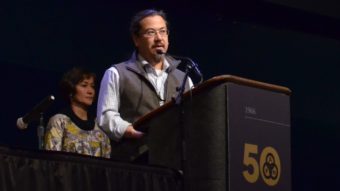
Alaska Attorney General Jahna Lindemuth and Central Council President Chalyee Éesh Richard Peterson at the 2016 Alaska Federation of Natives convention in Fairbanks. (Photo by Jennifer Canfield)

Attorney General Jahna Lindemuth said she has “full faith” the agreement will be solidified soon. Central Council President Chalyee Éesh Richard Peterson said everything else is in place as far as his organization concerned.

“Our tribal court there in Juneau is really ready. We have everything in place, the judge, staff,” Peterson said.

Peterson said Central Council is following the lead of the Tanana Chiefs Conference in Fairbanks, another tribal organization that is also close to sealing a similar deal with the state. He said allowing tribes to take responsibility for certain court cases will be more effective than what’s currently available.

“We want to do some alternative sentencing, things that will help them rebuild who they are and do it in a culturally sensitive way, but in a way where they’re also responsible to the community at large,” Peterson said.

Lindemuth said the new partnership between the state and tribal courts is a work in progress.

“Most likely we’ll start with misdemeanor-type offenses and the tribes can take jurisdiction over those and deal with those within their tribal court system.”

The state signed an agreement on Thursday with the Kenaitze Indian Tribe to establish a therapeutic tribal court that will focus on cases involving alcohol and substance abuse. The Kenaitze agreement is the first of its kind in Alaska. Lindemuth said the state is looking forward to working with more tribes on similar agreements.

Concerns over tribal, corporate affiliation prompt candidate to withdraw AFN leadership bid

Joe Nelson withdrew his candidacy for co-chair of the Alaska Federation of Natives board at the 2016 convention. Behind him is co-chair Ana Hoffman. (Photo by Jennifer Canfield)

Southeast’s Joe Nelson withdrew his bid for a leadership position on the Alaska Federation of Natives board citing concerns from some in the delegation that the spot should go to a tribal representative. 

Nelson took the stage Saturday to explain to the convention his withdrawal, calling it a “very tough decision.”

“There’s a view that this seat is a tribal seat, a very strongly held view by a good contingent of our AFN population. So, in that sense, you could say maybe this election is rigged, since I’m not being viewed as a tribal person for this purpose right now,” Nelson said to laughter from the crowd. “I have such respect for the tribes and faith in the tribes that I am going to respect that and not push this to a vote this afternoon.”

Outgoing co-chair Jerry Isaac announced on the first day of the convention that he would not seek another term. Isaac, according to his bio on the AFN website, is president of the Copper River Native Association, a tribal nonprofit. The other co-chair, Ana Hoffman, is president and CEO of the Bethel Native Corp.

Nelson said he wanted to unify the delegation by supporting Will Mayo, a former president of the Tanana Chiefs Conference in Fairbanks. Mayo thanked Nelson for the withdrawal.

“Those are the comments of a leader and the heart that he brings to this is a very humble heart. I have found that that kind of a heart is the one that people can follow,” Mayo said.

Nelson, who serves on the AFN board, is a Sealaska Corp. board member and vice chancellor of University of Alaska Southeast. He lives in Juneau and is a member of the Yakutat Tlingit Tribe.

Walker describes ‘painful’ PFD decision, highlights new education commissioner

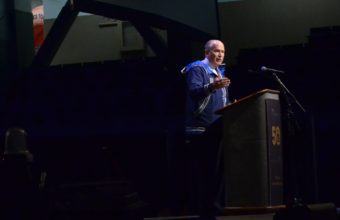
Gov. Bill Walker addresses the 2016 Alaska Federation of Natives convention. (Photo by Jennifer Canfield)
Gov. Bill Walker addresses the 2016 Alaska Federation of Natives convention on Thursday in Fairbanks. (Photo by Jennifer Canfield)

The Alaska Federation of Natives convention is scheduled to take place each year shortly after Permanent Fund Dividends are distributed. And plenty of that money gets spent in Anchorage or Fairbanks, depending on where the convention is held.  
Gov. Bill Walker addressed the convention Thursday morning in Fairbanks. He focused his comments mostly on the State of Alaska’s budget deficit and his decision to cut this year’s dividend by about half. He told the crowd that the state is drawing on its reserves at a rate of $12 million per day.

“I cannot tell you, I cannot describe to you adequately how difficult of time this has been to be serving as governor,” Walker said. “The decisions I have had to make have been so painful, have been so painful, that I cannot adequately describe.”

Walker also made a brief reference to the state’s 10-student threshold for full school funding and pointed to new education commissioner Michael Johnson who was in the audience.

“Most important number in education is one, one student. Every one student deserves the best education in Alaska. Not based upon a number. We’ve got the commissioner of education (who) is going to do that. You’re going to love what he’s going to do in that position,” Walker said.

Walker did not elaborate on what changes may be on the horizon for the Department of Education. More information from the department was not immediately available.

Fairbanks mayor calls for compensation to Fairbanks Four, Alaska Innocence Project director honored

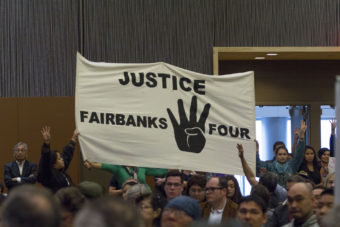
A Fairbanks 4 banner at the Alaska Federation of Natives Conference, Oct. 15, 2015. (Photo by Mikko Wilson/KTOO)
A Fairbanks Four banner at the 2015 Alaska Federation of Natives Conference. (Photo by Mikko Wilson/KTOO)

The Alaska Federation of Natives board and convention attendees made an impassioned plea to Gov. Bill Walker last year for the release of the Fairbanks Four — four men who were imprisoned for 18 years for a murder they say they did not commit. Two months later in December, the three men who were still in jail were released.

In comments to the AFN convention Thursday, Fairbanks Mayor John Eberhart called on the City of Fairbanks and the State of Alaska to compensate the men for wrongful imprisonment.

“There’s serious questions about the case and the truth and I urge the state and the city to consider an ex gratia or voluntary payment to the Fairbanks Four,” Eberhart said.

Eberhart, who previously worked for the Tanana Chiefs Conference, said the city was working with the organization on a Department of Justice process called collaborative reform. The DOJ touts the process as a “holistic strategy that identifies issues within an agency that may affect public trust.”

Bill Oberly is the director of the Alaska Innocence Project and was active in efforts to free the Fairbanks Four. Oberly was one of the recipients of the Denali Award, the highest award given by AFN to a non-Native.

White House rep announces domestic violence, sexual assault helpline

A new resource for Alaska Native and American Indian victims of domestic violence and sexual assault will be available in January.

Tracy Goodluck from the Office of Intergovernmental Affairs at the White House announced the Strong Hearts Helpline on Thursday at the Alaska Federation of Natives convention in Fairbanks.

“The new helpline will provide culturally and linguistically appropriate services by and for Native women and will assist American Indian and Alaska Native survivors of domestic violence and sexual assault with safety planning, emotional support and referrals to local resources,” Goodluck said.

The helpline is a collaboration between the National Indigenous Women’s Resource Center and the National Domestic Violence Hotline. It’s scheduled to launch Jan. 4.

UAS vice chancellor, Sealaska board member nominated for AFN co-chair

Sealaska Board Chairman Joe Nelson
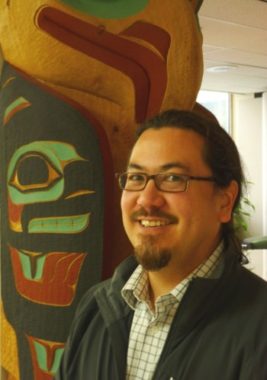
Joe Nelson was nominated for co-chair of the Alaska Federation of Natives. (Photo by Ed Schoenfeld/Coast Alaska News)

Joe Nelson, Sealaska Corp. board member and vice chancellor of University of Alaska Southeast, was nominated by the Southeast regional Native corporation for a leadership position on the Alaska Federation of Natives board.

Co-chair Jerry Isaac announced early on the first day of the 2016 Alaska Federation of Natives convention in Fairbanks that he would not seek another term. AFN delegates are expected to elect a new board co-chair Saturday.

Site notifications
Update notification options
Subscribe to notifications