Jennifer Canfield, KTOO

50th AFN convention begins today in Fairbanks

The 50th Alaska Federation of Natives convention in Fairbanks will open with a healing ceremony from the Alaska Suicide Prevention Council. The observance acknowledges a suicide that took place at the Dena’ina Center in Anchorage during the final hour of the convention last year.

After the ceremony, the agenda for the three-day conference has many of the same elements it features every year. AFN President Julie Kitka will deliver her annual report. Shortly after, Gov. Bill Walker will address the convention, as will Lt. Gov. Byron Mallott.

This year’s keynote address will be given by Emil Notti and Megan Alvanna-Stimpfle. Notti was the first president of AFN when it was created in 1966 and was active in the effort to pass the 1971 Alaska Native Claims Settlement Act. Alvanna-Stimpfle is a former legislative assistant for U.S. Sen. Lisa Murkowski, an elected member of the King Island Traditional Council and was recently named executive director of the Iñuit Arctic Business Alliance.

Items on the convention’s agenda include panels on rethinking indigenous education, land into trust, criminal justice reform and safety for Alaska Native women and families.

Murkowski is scheduled to address the convention Friday, as is Sen. Dan Sullivan, and Rep. Don Young will make his speech Saturday. Murkowski and Young are both up for re-election this year, so they will also participate in the AFN candidates forum Friday afternoon. Candidates for U.S. Senate Margaret Stock, Joe Miller and Ray Metcalfe are scheduled to participate, as is Young opponent Steve Lindbeck.

Delegates will consider convention resolutions Friday morning.

Live convention coverage is available at 360north.org and on 360 North television.

Central Council endorses Murkowski for U.S. Senate

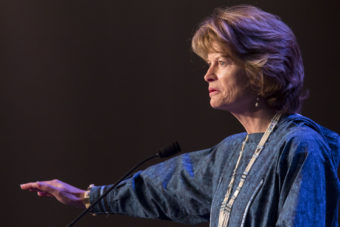
Lisa Murkowski at AFN 2015
Sen. Lisa Murkowski addresses the Alaska Federation of Natives Convention, Oct. 16, 2015. (Photo by Mikko Wilson/KTOO)

The Central Council of Tlingit and Haida Indian Tribes of Alaska has endorsed Sen. Lisa Murkowski for U.S. Senate.

Central Council spokesperson Raeanne Holmes says the organization doesn’t often endorse candidates for political office, though they did endorse Sen. Mark Begich against Dan Sullivan in 2014. Sullivan won. And they supported the so-called Unity Ticket that brought together Bill Walker as candidate for governor and Byron Mallott for lieutenant governor.

Murkowski is running against Margaret Stock, Joe Miller and Ray Metcalfe to keep her seat. She was appointed to the U.S. Senate in 2002 by her father, then-Gov. Frank Murkowski.

The incumbent senator chairs a subcommittee that funds the Bureau of Indian Affairs and the Indian Health Service and serves on the Senate Committee on Indian Affairs.

Murkowski also chairs the Senate Energy and Natural Resources Committee.

The committee has jurisdiction over federal public lands law, including the implementation of the Alaska Native Claims Settlement Act and the Alaska National Interest Lands Conservation Act, two laws that are paramount when considering Alaska Native policy issues.

When asked if the tribal organization would be making other endorsements in the November election, Holmes said she hadn’t heard of any but added, “I could tell you very clearly we’re not going to support Trump.”

Alaska’s largest Native organization endorses Clinton for president

Former Secretary of State Hillary Clinton speaking with supporters at a "Get Out the Caucus" rally at Valley Southwoods Freshman High School in West Des Moines, Iowa. (Creative Commons photo by George Skidmore)
Former Secretary of State Hillary Clinton speaking with supporters at a “Get Out the Caucus” rally at Valley Southwoods Freshman High School in West Des Moines, Iowa, Jan. 24, 2016. (Creative Commons photo by Gage Skidmore)

For the first time in its 50-year history, the Alaska Federation of Natives has endorsed a candidate for president — Hillary Clinton.

The organization laid out the contrast between Clinton and Donald Trump in its news release:

“With only 20 days until the Presidential election on November 8th, the choice we have is this: 1) to elect a president who will continue working with us to achieve further self-determination and legal empowerment as sovereign, self-governing Indigenous peoples, with a firm foothold in the larger economy and strong Native institutions, full of hope and confidence for our children and grandchildren; OR  2) to elect a president who will lead our federal government down the path of marginalizing Native Americans and dramatically weakening the special trust relationship between Native Americans and the federal government, putting at risk all the gains we have achieved in our lifetime.”

The AFN board hasn’t typically issued endorsements in the past. They bucked tradition at the 2014 conference, endorsing Bill Walker for governor over incumbent Sean Parnell, and Mark Begich for U.S. Senate over Dan Sullivan. Walker and Sullivan prevailed in those elections.

In addition to endorsing Parnell’s opponent, AFN President Julie Kitka gave a scathing critique of Parnell’s track record on Native issues while in office.

Getting into the habit of endorsing political candidates is not something all AFN board members are keen on. Some board members abstained from voting on the Clinton endorsement, as did some in 2014.
AFN spokesperson Ben Mallott says the board may make additional endorsements this year after candidate forums Friday afternoon. U.S. Senate candidates Lisa Murkowski, Margaret Stock, Joe Miller and Ray Metcalfe are scheduled to appear at the forum, as are U.S. House candidates Don Young and Steve Lindbeck.

Group working to bring remains of 15 Alaska Natives home from Carlisle

Henry Phillips, originally "Ka-Ka-Ish," was 12 years old in 1887 when he arrived at the Carlisle Industrial Indian School in Pennsylvania. His student file says he arrived from the Presbyterian Mission in Sitka, though both of his parents were still living. He returned to Skagway to work as a printer at the Daily Alaskan newspaper. (Public Domain image from National Archives and Records Administration)
Henry Phillips, originally “Ka-Ka-Ish,” was 12 years old in 1887 when he arrived at the Carlisle Industrial Indian School in Pennsylvania. His student file says he arrived from the Presbyterian Mission in Sitka, though both of his parents were still living. He returned to Skagway to work as a printer at the Daily Alaskan newspaper. (Public Domain image from National Archives and Records Administration)

The remains of 15 Alaska Natives may soon journey home from the Carlisle Industrial Indian School in Pennsylvania. A small group of people working with the U.S. Army and the First Alaskans Institute have authored a resolution they hope to see passed at this year’s Alaska Federation of Natives convention in Fairbanks.

While the resolution is focused on students of the past, there is still concern for potential future boarding school students.

Bob Sam says the Army wants to see the repatriation process completed in less than a year, and they’re going to foot the bill. Sam is confident it can be done, but points out that the Carlisle school is just one of many schools Alaska Natives were sent away to.
“This is just the tip of the iceberg, … Carlisle school is just the beginning,” Sam says. “It’s one of the first boarding home military-type schools in America and all boarding home schools used Carlisle as a model. Chemawa, Haskell, they all have their cemeteries.”

Sam has been helping repatriate human remains for 30 years. From a former tuberculosis sanitarium in Sitka to helping a friend recover his Ainu ancestor’s remains from a university in Japan — Sam has a talent for what he calls “bringing bodies home.” And he’s well-known in Southeast for his dedication to restoring old cemeteries. There was the Russian Orthodox cemetery in Juneau and another one in Sitka.

Sam is working with Nancy Furlow and Jim LaBelle Sr. LaBelle spent 10 years at the Wrangell Institute in Southeast Alaska. He says his time there was traumatic and he’s spent a lifetime working to heal from it.

Handwritten on the back of this image: Pupils from Alaska AS THEY ARRIVED AT CARLISLE IN THE FALL OF 1897 SEE REDMAN, JUNE 1899. (Public Domain image from National Archives and Records Administration)

There is little study on the history and impacts of residential schools on Alaska Native children. In a 2005 study by the Institute for Social and Economic Research at the University of Alaska Anchorage, 61 adults who attended boarding schools from the 1940s through the 1980s were interviewed. Some said they were abused. Others experienced no abuse and enjoyed school. And some said that while they weren’t traumatized by their school, they remember seeing abuse.

Some lawmakers see regional boarding schools, or even virtual schools, as a cheaper solution to education in rural Alaska. Former Gov. Sean Parnell was a strong advocate for regional boarding schools and included increased funding for them in education bills he sent to the legislature.

As time goes on, LaBelle thinks there will be more pressure to consolidate schools and increase support for residential schools.

Jim LaBelle, his wife Susan LaBelle and Bob Sam at the 2016 Elders and Youth conference in Fairbanks. (Photo by Jennifer Canfield)
Jim LaBelle, his wife Susan LaBelle, and Bob Sam at the 2016 Elders and Youth conference in Fairbanks. (Photo by Jennifer Canfield)

“Should this happen, there needs to be a process where communities and families participate at all levels of this discussion,” LaBelle says. “If there is eventually going to be a return to boarding schools in some parts of Alaska, at least it will be done in the way that respects the culture, respects the language, doesn’t provide for an institutional setting.”

And these schools should not be forced on rural communities, he says.

“There’s got to be a full participation process. In the days when I went, we had no choice. If you protested or objected, parents were sent to jail.”

Both LaBelle and Sam say there are a lot of issues for Alaska Native people that need to be resolved. Bringing home the remains of Alaska Native students at the Carlisle school in Pennsylvania is part of the process, Sam says.

“Once we resolve these issues, American Indians and Alaska Natives will go on to be the people that they were intended to be and they will begin to have some sort of forgiveness in resolving. But there’s another side to it,” Sam says. “The non-Native people who have guilt, they will begin to resolve their guilt so that they can go on to become the human beings they were intended to be. And we get to know each other doing these kinds of things together.”

The resolution is expected to be presented to delegates Saturday.

About the Carlisle Industrial Indian School

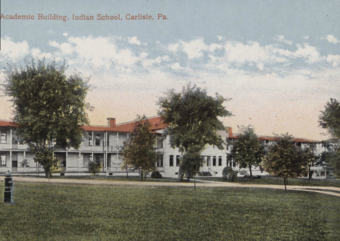
The caption on this artwork reads Academic Building, Indian School, Carlisle, PA. (Public Domain image from National Archives and Records Administration)

The Carlisle Industrial Indian School was founded in 1879 in Pennsylvania by an Army officer who believed that the federal government was holding Native American people back by segregating them.

The word “racism” is believed to have first been uttered by Richard Henry Pratt, who founded the school.

At an annual conference in 1896, Pratt said: “Segregating any class or race of people apart from the rest of the people kills the progress of the segregated people or makes their growth very slow. Association of races and classes is necessary to destroy racism and classism.”

Pratt believed Native people were intended to be inherently equal to European-Americans, they just needed to be civilized.  

“It is a great mistake to think that the Indian is born an inevitable savage. He is born a blank, like all the rest of us,” Pratt said in a speech at an 1892 convention. “Left in the surroundings of savagery, he grows to possess a savage language, superstition, and life. We, left in the surroundings of civilization, grow to possess a civilized language, life, and purpose. Transfer the infant white to the savage surroundings, he will grow to possess a savage language, superstition, and habit. Transfer the savage-born infant to the surroundings of civilization, and he will grow to possess a civilized language and habit.”

Operating throughout the height of the Progressive Era until 1918, more than 10,000 attended the school. The school’s foremost goal was assimilation of its students. English was the only language allowed to be spoken. In the dorms, no two students from the same tribe were allowed to live together. Students were made to pick out new English names. Boys were required to cut their hair. The phrase, “Kill the Indian, save the man” — Pratt coined that, too.

Correction: Earlier versions of this story misstated when the resolution will be presented to the AFN delegates. It’s expected to be presented Saturday.  

Elders and Youth conference kicks off today in Fairbanks

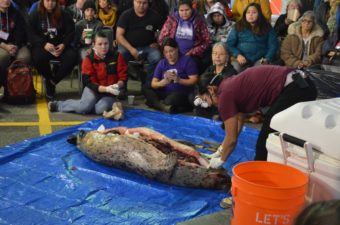
Marjorie Tahbone shows a crowd how to properly butcher a seal during a workshop at the 33rd annual Elders and Youth conference in Fairbanks. (Photo by Jennifer Canfield)

More than a thousand Alaska Natives, young and old, from across the state are met today at the 33rd annual Elders and Youth conference. The event, hosted by the First Alaskans Institute, is usually an opportunity for 13 to 18 year olds to learn about leadership, civic engagement and consensus building alongside their elders.
This year’s conference theme is Ancestral Imperative: Adapt. Unite. Achieve. and it runs through Wednesday morning.

Attendees are encouraged to talk seriously about issues facing their communities, and there are many afternoon workshops focused on language, culture, subsistence and policy. One of the first orders of business requires regional groups to elect new members to the Statewide Elders and Youth Council.

The day began with a welcome and blessing from the Rev. Luke Titus and the Rev. Anna Frank, both are Tanana Athabascan from Interior Alaska. The custom is typical of Alaska Native gatherings in which many of the attendees are not from the surrounding area. When the conference is held in Anchorage, for example, the group is welcomed by representatives from the Dena’ina Athabascan community.

Liz Medicine Crow, president and CEO of First Alaskans Institute, and board chair Willie Hensley give opening remarks at the 33rd annual Elders and Youth conference in Fairbanks. (Photo by Jennifer Canfield)

Liz Medicine Crow, the institute’s president and CEO, addressed the crowd along with former state lawmaker Willie Hensley, who serves as the organization’s board chair.

Hensley talked about how the Elders and Youth conference first started as an opportunity for Alaska Native youth who spent most of the year at boarding school, away from their home communities.

“We didn’t have the opportunity to interface with our parents, aunts and uncles, our communities, we were away from our language, we were away from our stories. There were a lot things about the culture that we missed out on because we were gone for years at a time,” Hensley said.

The conference took on a more solemn tone briefly when Medicine Crow advised the gathering about an ongoing manhunt in Fairbanks. Just after midnight on Sunday, a Fairbanks police officer was shot and seriously injured. The suspect in that shooting is yet to be apprehended. Fairbanks police say they’re looking for an Alaska Native man in his 20s.

Medicine Crow said the organization has talked to Fairbanks police.

“They are aware of all of our visitors coming in and they want to make sure that you have a good experience as well, but it just requires a little more awareness of what’s happening around you when you go out and about,” Medicine Crow said. “Remind our men, remind our brothers to keep their heads up and to be safe.”

Lt. Gov. Byron Mallott is scheduled to address the conference Tuesday afternoon.

Joan Inga Barnowski, 11, gives the youth keynote speech at the 33rd annual Elders and Youth conference in Fairbanks. (Photo by Jennifer Canfield)

This year’s youth keynote address was given by Joan Inga Barnowski, 11, who is Sugpiaq (Alutiiq) from Old Harbor, a city in the Kodiak Island Borough. As part of a science project she worked on earlier this year, the 6th grader tested homes in her community for radon, a known carcinogen. Based on her initial work, potential issues were identified in several homes. In her speech, Barnowski advocated for youth to be aware of the environment and to be good stewards.

Raphael and Vivian Jimmy, both Yup’ik from Mountain Village, will give the elder keynote address Tuesday. The couple now lives in Anchorage where they lead the Kuigpagmiut Dance Group. Raphael is 91 and Vivian is 87.

Some of the workshops listed on the conference agenda include Food Sovereignty: Working on Seal, The Return from Carlisle, Social Justice Issues: An Alaska Native Perspective and Spoken Roots: Writing Ourselves, Our Communities and Our Histories.

This year’s conference theme is Ancestral Imperative: Adapt. Unite. Achieve. The conference is open to people of all ages and backgrounds.

The conference runs through Wednesday morning and will be broadcast live on 360 North.

The meaning of names: The world of social media, part 5

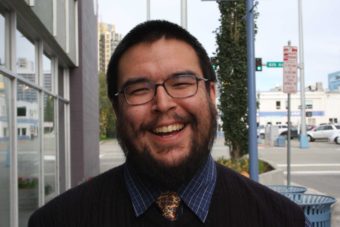
Dlaakaw Éesh Kyle Wark. (Photo courtesy of Dlaakaw Éesh Kyle Wark)
Dlaakaw Éesh Kyle Wark. (Photo courtesy Dlaakaw Éesh Kyle Wark)

With social media, people have the opportunity to project their best selves. We pick and choose what we share and how we share it. For Kyle Wark, that meant placing his Tlingit name in front of his English name on his Facebook profile. That small act translated into real life when people at work started calling him Dlaakaw Éesh.

In this final installment of a five-part series, Wark talks about the meaning of using his Native name online and how people are sometimes hesitant to speak it for fear of mispronouncing it.

Listen to Wark or read transcribed excerpts from his interview below.

Dlaakaw Éesh Kyle Wark

I’m really happy to see the proliferation of Native names in public life. I don’t know exactly how using my Native name in public has changed people’s perceptions of me. I think in a lot of instances, even when I introduce myself in Tlingit at gatherings, very few people call me Dlaakaw Éesh. It’s not the hardest name that I’ve heard of Native names to pronounce, but it’s still, I think, enough of a stumbling block that people don’t want to take the chance and pronounce it wrong or something like that. So most people still call me Kyle.

But Dlaakaw Éesh, it’s a specific incident within my clan. It’s a specific individual who had a particular lived experience and that particular lived experience was recorded as a name that was given to him and that particular experience gets reincarnated down through the generations as that name is passed on and invested in new clan members. There’s a lot more meaning to having the name Dlaakaw Éesh than there is meaning to having the name Kyle Wark.

There’s something that transforms about us when we get a name invested in us. Being able to put that on my Facebook page is somehow giving that part of me room to breathe and giving it acknowledgement in this digital space. I think that there’s something worthwhile about being able to incorporate it into this modern space.

The meaning of names: Indigenizing government, part 1
The meaning of names: A family history, part 2
The meaning of names: A time for change, part 3
The meaning of names: The aftermath of generational trauma, part 4
The meaning of names: The world of social media, part 5

Site notifications
Update notification options
Subscribe to notifications