Mark Canul. (Photo courtesy of Victoria Canul Dunne)
Update | 5:21 p.m.
The family of a former Juneau man has filed a wrongful death lawsuit against the Department of Corrections. It’s the second such lawsuit filed against the department this year.
The lawsuit alleges that the state was negligent in training employees to recognize and respond to the needs of mentally ill prisoners, and that it was negligent in supervising those employees
Janine Canul, one of Mark Canul’s sisters, says seeing the lawsuit filed was painful.
“When I read it, it just ripped open the wounds I have again, and I just sat in my office crying,” Janine Canul said. “I just don’t want anybody else to go through this. It’s horrible. We’re never going to see him again and he died alone. I don’t want that for anybody else.”
Mark Canul had been arrested for failing to leave an Anchorage bus property. The judge found Canul — who was diagnosed as paranoid schizophrenic and nearly deaf — not mentally competent to stand trial. On Dec. 2, a judge ordered him to be admitted to the Alaska Psychiatric Institute “as soon as practicable.”
Meanwhile he stayed at the Anchorage Correctional Complex. On Dec. 11, he was placed in a cell with James Clinton. The family says the state should have known Clinton “struggled with mental illness and was predisposed to violence.”
Clinton attacked Canul, and according to the lawsuit “immediately admitted to killing” him, saying he’d “snapped.” Clinton is currently awaiting trial on murder charges. He was arraigned in court Wednesday.
Victoria Canul Dunne, Mark’s other sister, says James Clinton and her brother should have never shared a cell.
“The person that Mark was in the cell with is the scapegoat and this is good and right that this filing has been made against DOC,” Canul Dunne said. “They need to step up and be accountable for their inaction and their negligence.”
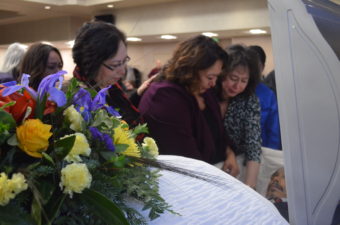
Victoria Canul Dunne (left) and Janine Canul (center) mourn the loss of their brother Mark Canul at his Jan. 26 memorial. (Photo by Jennifer Canfield/KTOO)
The family seeks at least $100,000 in the suit, but Canul Dunne says the suit is not about money.
“I want systemic changes. I want the state and DOC to really make some proactive, intentional changes to the system.”
The Department of Corrections could not be reached for comment. However, in an April interview, Commissioner Dean Williams said he also wants systemic change. He wouldn’t comment on specific cases, but acknowledged the department’s outstanding liabilities related to deaths in jails.
“The worst thing to do is duck and cover and not even acknowledge that there was a problem, or what the incident was about, and talk with the families even before the lawsuits are filed and try to address the issues ” Williams said.
In a November report before he became commissioner, Williams identified 25 deaths in state correctional facilities over 18 months.
Jason Skala, the attorney representing the Canul family, also represents the family of Kellsie Green in another lawsuit against the department. Green also died in custody at the Anchorage jail in January.
Original story
The family of a former Juneau man has filed a wrongful death lawsuit against the Department of Corrections. It’s the second wrongful death lawsuit filed against the department this year.
The lawsuit alleges that the state was negligent in training employees to recognize and respond to the needs of mentally ill prisoners and that it was negligent in supervising those employees.
Mark Canul had been arrested for failing to leave Anchorage bus station property. The judge found Canul — who, according to family, was diagnosed with paranoid schizophrenia and nearly deaf — not mentally competent to stand trial. On December 2, a judge ordered him to be admitted to the Alaska Psychiatric Institute “as soon as practicable.”
Meanwhile, Canul stayed at the Anchorage Correctional Complex. On December 11 he was placed in a cell with James Clinton. The family says the state should have known Clinton “struggled with mental illness and was predisposed to violence.”
Clinton attacked Canul, and according to the lawsuit “immediately admitted to killing” him, saying he’d “snapped.” Clinton is currently awaiting trial on murder charges.
Jason Skala, the attorney representing the Canul family, also represents the family of Kellsie Green in another lawsuit against the department. Green also died while in custody at the Anchorage jail in January.
Canul’s family seeks at least $100,000 in the suit. The Department of Corrections could not be reached for comment.
In an April interview, Commissioner Dean Williams said he couldn’t comment on specific cases, but acknowledged the department’s outstanding liabilities related to deaths in jails.
“The worst thing to do is duck and cover and not even acknowledge that there is a problem,” Williams said.
Williams said he wanted to limit the possibility of future deaths. In a November report before Williams became commissioner, he identified 25 deaths in state correctional facilities over 18 months.
Mark Anthony DeSimone is escorted into courtroom May 17, 2016 to face homicide charges in connection with the death of Tony Rosales. Desimone was indicted May 19. (Photo by Matt Miller/KTOO)
A 53-year-old former Arizona lawmaker accused of shooting a man in Excursion Inlet was indicted Friday by a Juneau grand jury.
Mark Anthony DeSimone is accused of shooting 34-year-old Duilio Antonio “Tony” Rosales twice in the back of the head. Prosecutors allege DeSimone admitted to another man at the scene that he had killed Rosales.
DeSimone was indicted on five charges: first-degree murder, two charges of second-degree murder, manslaughter and criminally negligent homicide.
India Busby, 19, of Juneau was at the Alaska Democratic Convention in Anchorage over the weekend. Last week, India told us about how she evolved in her thinking about politics.
It was a first for the teenaged Bernie Sanders supporter, who was one of the 539 convention delegates. We caught up with her Sunday to see how things went.
This interview has been edited for length and clarity.
KTOO: What did you learn from other people there who were Hillary Clinton supporters that you didn’t know going into the convention?
India Busby, 19, was a delegate at the Alaska Democratic Convention in Anchorage over the weekend. (Photo by Rashah McChesney/KTOO)
Busby: I guess I never really did any research about Hillary. It was more just what I heard, that she was corrupt. … Just talking to people about what her plans are and what she plans on doing — it’s those conversations, especially when you talk calmly about it, that help you see both sides of the candidates.
KTOO: Was there anything you were disappointed in or not so excited about in the whole process?
Busby: I was excited about the whole thing. I’m not disappointed one bit.
KTOO:What did you see in the breakdown of people by age? You were probably among some of the youngest people who were there.
Busby: There are tons of 18- and 19-year-olds that are here. I was really amazed with how many teenagers are here. There’s a lot of college students here as well. … We got to see what kind of supporters both Hillary and Bernie have as a whole. It really opens your eyes to see what the demographics are.
KTOO: What would you do differently next time the convention comes around?
Busby: I would be a little more prepared about how long we’re going to be voting for. We’ve been voting for things for two days straight. We’ve been sitting down a lot and stuck in this gym for hours. I just really hope that more people look into being delegates because this is an incredible experience and I’m so happy to be here.
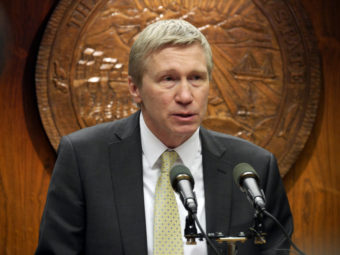
Corrections Commissioner Dean Williams speaks to reporters after Gov. Bill Walker announced his appointment in January. (Photo by Skip Gray/360 North)
Dean Williams’ confirmation as commissioner of the Department of Corrections was no small task.
Williams was one of the authors of a 21-page report that outlined deficiencies in the department. The report was prompted by a series of high profile deaths in Alaska’s jails. In it, Williams and co-author Joe Hanlon found outdated policies, a lack of trust between employees and management, and few consequences for employee misconduct, among other things.
The Alaska Correctional Officers’ Association, which vehemently opposed Williams’ appointment, issued its own report in response. In the 51-page report, the association accused Williams of acting “illegally and improperly” when he released surveillance video of incidents in which prisoners had died.
Williams was also accused of omitting information and doing so “purposefully to garner a negative public reaction.” In a blog post on their website, ACOA called Williams’ appointment “an unmitigated disaster for Correctional Officers.”
Nearly three months later, the association sent a letter to Gov. Bill Walker requesting that he either retract or correct the report.
Some lawmakers were also critical of his appointment. Sen. Bill Wielechowski, D-Anchorage, was one of the most vocal, saying the report “has severely, severely damaged the morale and the public’s impression of our correctional officers.” Wielechowski said things in the report were “seriously taken out of context.”
The ACOA’s business manager, however, was guarded when recently asked for comment on the organization’s developing relationship with the commissioner.
“All I would say is to repeat the commissioner’s own words that his priority is staffing and safety, safety, safety, and we appreciate that,” Brad Wilson said.
Williams said the disagreements are behind him. He had met with the ACOA on his first day after being confirmed and said he was eager to work with them.
Q&A
The transcription of this April 18 interview with Williams has been edited for length and clarity.
KTOO: What kind of things can you move forward with now that you’ve been confirmed?
DW: There are several things that are really critical. One is making sure I secure the right team for the department. There are a lot of things we’re going to start working on more in earnest now that I know I’m in this seat for good — the policy reviews and the improvement of the policies and all those things. The other thing I’m going to move forward on is the standing up of the internal affairs unit — or the professional conduct unit — because that unit is very important in analyzing and investigating when things go wrong, not just catching an employee doing something wrong.
KTOO: Your review of the Department of Corrections back in November seemed, considering the findings, quite restrained and it was interesting to see how the Alaska Correctional Officers Association reacted. Can you speak a little more frankly now about some of the things you found when researching your report with Joe Hanlon, and about how those things will inform the work you’ll be doing?
DW: I’ll answer that with this caveat: I had a job with the governor to do a report. I did it as fair and comprehensively (as I could) with Joe Hanlon. We both knew that this was a review, not an investigation. We weren’t investigating every single incident in that review; we were reviewing how the department was doing the investigations or not (doing them). For me, there has been sort of a misunderstanding of what a review is. You’re not looking at every single case the same way as if you were a police officer investigating them.
With that caveat, let me answer it this way: I was working very closely with the union — side note: the union met with my team today (April 18) to discuss issues going forward. So on Day One, we are starting the work of going forward together. That’s what really matters to me the most.
I can’t explain some of the high pitch that developed over this. I think part of it was that here I was doing the review and now I’ve become the commissioner. When I was doing the review, I had no clue that there was a remote possibility that I was going to be the commissioner. If there was any criticism it was never with the people or personnel — especially the corrections officers doing the work, who are doing a very demanding job. A lot of people who have turned it into that. I regret that, but it wasn’t me and it wasn’t Joe Hanlon. That just comes with the territory.
I was the most sympathetic, in many ways, to staff who were in a very tough situation when we have too many prisoners and not enough staff, when there’s problem in the medical department, when training seems nonexistent, when policies are very outdated — we’ve taken a very difficult job for staff and made it even more difficult. I knew it was going to be a rough road, getting through that, and I think we are. Being highly inclusive of people who are going to help solve the problem, that’s going to be very important.
KTOO: We know that first responders, the people who do the dirty work in our society, they’ve got to stick together. It’s understandable that there would be some outlash, but when you’re talking about the Department of Corrections and what you’ve described in your report, it really just sounds like it needs a change of culture. Would it be fair to say that part of that change could mean that people who feel like they aren’t getting trained up to par or don’t have the tools to do their job feel empowered to speak up?
DW: There are some places — and I have visited many facilities — where things are going amazingly well. But there has been a lot of trauma in this department. I’ve had many discussions with (correctional officers) and many staff, and there was a fear of coming forward and articulating the problems and what wasn’t going right. They were afraid they would get in trouble themselves, (or) that the department or administration would somehow make life difficult for them. Part of going forward is saying, “We’re going to tell the truth to each other.”
I’ve promised legislators unannounced visits to facilities. We’re not doing the things in the past when people are coming and things start looking all squared away and looking like they’re going great. We need to be honest about what’s going well — there are a lot of things going well — but when it’s not going well we need to be real honest about that. We’re not doing anyone any favors by running over that like it’s nothing. Part of that is me and my team setting the example that we’re going to talk about things as they are and give a vision for where we want them to go.
There are very good people in the department, but we have some troubles. Systemically, things have gone down in the last decade. That’s not just my observation — talk to almost any staff. Training has gone down, there’s a shortage of staffing, policies are out of date, people feel like they can’t bring problems to their leadership — that’s not a good recipe.
The thing about the professional conduct unit is it forces the system to acknowledge problems and you start to develop this systemic way of addressing problems. I’ve seen what other states have done with this. I quote Wyoming a lot on this: they have 2,500 prisoners and about 13 investigators and another handful of support staff. The recidivism rate is 25 percent. They do evidence-based programs — we do evidence-based programs. The one thing prominent thing I can see different between them and us is that when it comes to something bad happening in the facility they just document the heck out of it because they want to know what happened, what went wrong. So their prisons are safer. They’ve done something significant there. That’s why I’m looking at what they’re doing, as well as some other states.
KTOO: The department still has some liabilities with some of the recent deaths that have taken place. The Kellsie Green family has come forward with a lawsuit. There are still a few families who, imaginably, could step forward against the Department of Corrections. What are your concerns regarding that possibility? Are there any internal conversations about how to deal with that?
DW: While I can’t comment on specific cases … that shouldn’t mean that we shouldn’t be talking to the families and communicating with them when something goes wrong. I’ve talked to Mr. Green several times. He was very supportive of my confirmation even though he’s filed a lawsuit against us for the death of his daughter. The loss of his daughter is heartbreaking and it’s unacceptable to me and I’m sure it’s unacceptable to the governor. I know the task ahead of me is not easy but there is one thing you can do when bad things happen and that is to get honest about it and to reach out to families. The worst thing to do is duck and cover and not even acknowledge that there is a problem.
I like Mr. Green personally and his case to make sure this doesn’t happen to anyone else, guess what? I agree with him 100 percent. I don’t want it to happen to anybody else either. I think how we handle families even when bad things happen makes a difference and (from) everything I’ve read, even the financial liability for the state goes better. But my concern goes way beyond that. I’m concerned about the financial liability of the state, of course, but my concern is to diminish as much as possible the chance of it happening again.
KTOO: I’m going to ask a personal question, so please let me know if it’s too much. Do you actually know anyone, a close friend or family member, who is involved in the justice system? And if so, how might that inform your work?
DW: I’ve known people who have dabbled in and out of the justice system in a minor way, but I don’t have close, personal relationships with anyone in our jails today. Though I do recognize some individuals from the juvenile system who are now in the adult system. I don’t know that even if I did know (someone), how that would inform me on a personal level.
The governor sent me to visit the family of Larry Kobuk, for example, in Saint Michael. You can’t spend an hour with those folks — and I spent several hours with them talking about what happened, actually showing them the video — you can’t go through that experience and not have it affect you personally.
There are people in jail that are hardcore criminals and they need to be a jail for a long time. Let’s not kid ourselves. There are some bad people in the world and I’m glad they’re locked up. But there’s another group of people who are on the fringe and they’re having a really bad day and they made a really bad decision or they have a really bad addiction, and they’re doing things they wouldn’t normally do if they didn’t have that addiction. Those are the people you can impact and those are the people you can reach. Those are the people you need to give another chance to.
I think of Kellsie Green. Mr. Green has been very honest about the fact that she was a heroin addict, but man, she needed another chance. She needed another chance to clean up and get treatment so she could later be in a spot to apologize and make amends. Our job is to provide opportunities for people to make amends. Some people you’re never going to get to and like I said, they should be locked up for as long as we can keep them locked up because they’re dangerous and they’re not going to change. But there are a whole bunch of people who are getting in trouble who will come out of it.
Certainly there are friends of mine who have been down that road who’ve said, “Man, what I did in my 20s, I can’t believe it. Thank goodness I’m over here now.” Our job is to give people time to get to the place to make the decision where they can do something different. The worst thing we can do is overinvolve (someone) in the system.
KTOO: When you talk about people who don’t need to be overinvolved in the system, perhaps those with mental illness or alcohol and substance abuse problems, to keep those people unnecessarily out of the justice system it would seem that there needs to be some kind of collaboration between the Department of Corrections and perhaps the Department of Health and Social Services.
DW: Making sure the departments are coordinating their efforts is an absolute concern of the governor and it’s a concern of mine. I think cooperation among the departments is hugely important and we meet on this regularly even through Senate Bill 91, we keep talking about how it goes across departments and how are we going to work together. That’s why, quite frankly, I’m really thrilled that Walt Monegan is coming back to be commissioner of (the Department of) Public Safety. I’ve known Walt for years. There’s an opportunity for his department and mine to forge a new relationship.
I also want to be maximally responsive to (communities) and I want them to know that we’re going to do business with them. I’m already starting to push the department in areas of “Who’s doing supervising of our (probationers)? Why are we the only ones doing that? Who else can do that in particular ways?” And it is being done. Some VPSOs are doing supervision. I want to increase the partnerships that we have. If someone can do that work better than us, why wouldn’t we consider that? I agree that partnerships between departments are important but I really want partnerships with local communities, local tribes, Native villages and towns and communities, because there’s some really good work going on.
KTOO: When you look at the national conversation around how we administer justice in this country, and we talk about prisoners who die in jail who perhaps should not have, some of the loudest voices in the conversation are family members of the mentally ill. Often they see jail as a safe place for their mentally ill family member who perhaps could not get services elsewhere because they were hard to find. That’s not necessarily part of your department’s explicit mission or responsibilities, but it’s almost a social expectation. How is the state going to move forward in dealing with mental illness from a corrections point of view?
DW: There are two primary things. I’m in the middle of another effort that we’ve just started to explore, which is how we’re doing mental health services inside the facilities. Part of the problem I’ve identified is also the medical care inside the facilities. I’m looking for national expertise on what medical care and mental health care looks like inside these facilities because prisons have become the de facto psychiatric hospitals in many states, including ours. While (the Alaska Psychiatric Institute) is in existence, there are more people with significant mental health issues than what we have beds for. We’re going to have these folks with all the issues and demands that come from them. Part of the thing is learning from other states and what’s happened elsewhere.
I’ll also answer that question, not directly on point but it kind of is. One of the issues is how do I get this department to be responsive and hear the voices elsewhere? There’s a model in the rest of the country that’s actually designed for law enforcement. There’s an association called the National Association for Civilian Oversight of Law Enforcement. It’s a sort of post-Ferguson group that’s become more prominent to help make sure that law enforcement agencies, but also correctional agencies, provide input and oversight.
You bring them in the door and you help them provide counsel. They look at some of the things going wrong and they provide a link to you and the community. I’m very interested in this model. It could be hugely beneficial to me and the department to have people in the community who have an interest in this area (and) who can help provide oversight. I’m the opposite of a closed-door guy. I want people to know what’s happening — right and wrong inside the system. I don’t think all the good ideas reside in this department. We have very many talented people and I’m looking to add more to the group, but I’m looking outward, not just inward, for solutions and I think that’s the right way to go.
KTOO: Considering some of the strong criticism coming from the legislature regarding your confirmation, do you see those lawmakers hindering efforts you’ll need their cooperation on? How do you see that relationship going forward?
DW: Even the people that didn’t vote for me said this was more me faced with what they thought was an impossible task and while I totally respect it on one hand — they said, “Well, you did the review and now you’re running the department. Don’t you think that’s a problem?” Well, yeah, it kind of is a problem on the one hand, but what’s the alternative? It’s not an ideal set up, but by punting and saying, “Who’s going to take the job now?” — not that I’m so great or anything — but the reality is that I’m here because I think I can actually do something about this. I don’t view anybody who had doubts about that at all, that I’m going to have any problems with that.
Even with the union, yeah, some things happened during the pre-confirmation sting … but I’m about moving forward and moving on. We’ve made progress already. We have one investigator. Two months ago we had zero, and that’s hugely important in helping us solve problems. I’m extremely grateful that the legislature is as engaged and involved in this issue as they are now. I don’t see that as a bad thing at all. It’s a good thing. Even if we disagree about how we should handle it, the fact that people are engaging with it and wrestling with it now the way I’m wrestling with it, that’s good news — nothing but good news.
Correction: A previous version of this story misspelled Kellsie Green’s name.
More than a hundred people gathered at Alaska Commercial Fishermen’s Memorial May 7, 2016 for the Blessing of the Fleet in Juneau. (Photo by Jennifer Canfield/KTOO)
More than a hundred people gathered Saturday at the Alaska Commercial Fishermen’s Memorial Saturday for the Blessing of the Fleet and to pay tribute to the people whose names are engraved on the memorial.
Eight names were added to the memorial — Charlie Polk, Ronald John Jr., William Newman, Gordon Hallum, Walter Baldwin, Joe Bennett Jr., Patrick Venner and Greg Fisk, the former mayor of Juneau who died last fall shortly after taking office. There are now 211 names on the memorial.
More than a hundred people gathered at Alaska Commercial Fishermen’s Memorial May 7, 2016 for the Blessing of the Fleet in Juneau. (Photo by Jennifer Canfield/KTOO)
In an interview, Brodersen said the board is working to mend its relationship with the city and move forward. He said the board’s decision was not an easy one, especially considering that the memorial serves as a kind of gravesite for 47 people whose bodies were lost at sea over the years.
“There is essentially an enormous concrete wall in front of us and so it feels like we’re on the side of a little river as opposed to the ocean,” Brodersen said. “It’s simply not ideal. I recognize that it’s not ideal as opposed to untenable. We’ve made it work today and that’s important, but in terms of the longterm health of the memorial itself I think the best thing is to try to move it.”
Brodersen said the board currently doesn’t have funding or set plans, but they are talking with people working on the Juneau Ocean Center to see if the memorial could be worked into the center’s proposed design.
(Click any picture for a slideshow view)
Juneau Mayor Ken Koelsch speaks at the 2016 Blessing of the Fleet. More than a hundred people gathered at Alaska Commercial Fishermen’s Memorial May 7, 2016 in Juneau. (Photo by Jennifer Canfield/KTOO)
The City of Juneau Pipe Band played throughout the Blessing of the Fleet ceremony at the Alaska Commercial Fishermen’s Memorial in Juneau May 7, 2016. (Photo by Jennifer Canfield/KTOO)
More than a hundred people gathered at Alaska Commercial Fishermen’s Memorial May 7, 2016 for the Blessing of the Fleet in Juneau. (Photo by Jennifer Canfield/KTOO)
A crewmember on the Trinity throws a floral wreath into the water in front of the Alaska Commercial Fishermen’s Memorial. More than a hundred people gathered May 7, 2016 for the Blessing of the Fleet in Juneau. (Photo by Jennifer Canfield/KTOO)
More than a hundred people gathered at Alaska Commercial Fishermen’s Memorial May 7, 2016 for the Blessing of the Fleet in Juneau. (Photo by Jennifer Canfield/KTOO)
“It will take years and honestly I don’t know if it will ever even happen but I would like to see it happen in my lifetime or maybe even much sooner than that. But it is a grave and it’s an extremely emotional and contentious issue, so we just have to proceed carefully and gently,” Brodersen said.
Brodersen said anyone interested in helping the board fundraise or come up with plans for a new site should get in touch with him.
You can listen to an audio postcard of the ceremony here:
The Crown Princess cruise ship arrived unexpectedly in Juneau on Sunday. The ship was scheduled to arrive Tuesday. Kirby Day is manager of port operations for the Holland America Group, which includes Princess Cruises. Day said operations in Vancouver — where the ship’s journey began — were slower than usual.
“There were three ships in Vancouver on Friday and with about 8,500 people the embarkation process just went very slow for all three ships,” Day said. “All three ships sailed late, including the Crown Princess.”
The ship was scheduled to be in Glacier Bay yesterday but because of the late start, it would have arrived there at 9 p.m. — too late for passengers to fully see the area.
Day said the ship will visit Glacier Bay Monday before heading to Skagway and Ketchikan.
Close
Update notification options
Subscribe to notifications
Subscribe
Get notifications about news related to the topics you care about. You can unsubscribe anytime.