Kayla Desroches

Hecla program builds pathway from high school to Greens Creek Mine

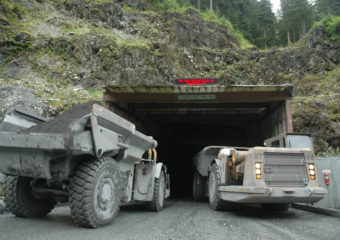
Greens Creek Mine.
Greens Creek Mine (Photo courtesy Hecla Mining Company)

Two graduates of the Hecla Greens Creek “Pathway to Mining Careers” program entered the work-force this summer. The program, which began in 2011, lets juniors and seniors take a three-month introduction to mining class at the University of Alaska Southeast.

Then they can attend a Greens Creek training course for two weeks and shadow a mine employee. That can lead to the UAS mining program for a one-year certificate or a two-year associate degree.

Warren Eckland works underground at the Greens Creek mine. He started this summer.

“They put me on the lube truck, going around, filling up equipment, working on it. I do a lot of hoses,” Eckland says. “And then they started putting me more in the preventative maintenance bay doing oil changes, changing out U-joints, just doing all the scheduled work on equipment

Eckland enrolled in the Pathway program at Juneau-Douglas High School and graduated with an associate degree from the UAS mining program last year.

He says that driving the lube truck was difficult at first.

“Everything looks pretty similar when you’re underground. It’s just… You’re going uphill. That’s pretty much it. In the beginning, I was pretty lost most of the time.”

Eckland says that underground in the mines, there are only a few big spaces, and those are mostly workshops.

“It’s a tunnel pretty much. A big cave.”

Greens Creek Mine
Greens Creek Mine (Photo courtesy Hecla Mining Company)

And the mines weren’t someplace that Eckland imagined himself until senior year of high school.

“I was juggling between a few different ideas that I want to do,” Eckland says. “One of them was aircraft maintenance. Another was diesel… Diesel maintenance. But at that point I hadn’t even really thought about mining yet.”

Until his automotive teacher announced the Pathway program. The class would be after-school two nights a week. The class piqued Eckland’s curiosity enough for him to enroll.

It had also appealed to Hunter Kirkpatrick, a current Greens Creek employee who participated in the Pathway Program at JDHS. Mining had been on his radar before the class.

“I had a few older friends that worked at the mines,” says Kirkpatrick. “And I had a couple of friends that were signed up in the introduction to mining occupations class.”

He’s now a mechanic at Greens Creek. And like Eckland, he works two weeks on, one week off. According to Hecla, entry level mechanics at Greens Creek make between $64,000 and $74,000.

Kirkpatrick says the job took awhile to get used to.

“The first month was tough. Not really knowing anybody, not knowing what I was going to be doing exactly. It was intimidating, but I was lucky that I have a crew that’s pretty friendly and helpful.”

He’s settled in now.

“I wouldn’t change it for anything,” Kirkpatrick says. “I’m super glad that it’s what I did and that I stuck with it.”

The mining program and Pathway have the same goal, according to Mike Bell. Bell recently retired from his position as Director of the UAS Center for Mine Training. But he’s filling in while UAS searches for his replacement. He says both programs provide employment in Alaska, for Alaskans.

“A large number of people working in the mining industry come from out of state,” says Bell. “And we have a lot of people within the state that are not employed. And so we wanted to reverse that trend a bit or at least get more Alaskans to work in the mining industry.”

The Pathway program’s intro to mining class begins again in late January.

‘Catching babies’ is midwife Madi Nolan Grimes’ calling

Portrait of Madi Nolan Grimes (Courtesy of Madi Nolan Grimes)
Madi Nolan Grimes (Photo courtesy Madi Nolan Grimes)

Most people in their early 20s go through a period of adjustment, where they figure out what they want to do for work. But a young Juneau midwife already knows what she wants to be and is doing it. At 23, Madi Nolan Grimes is clinical director at the Juneau Family Health and Birth Center. She’s been practicing midwifery since she was 19.

Madi Grimes says women in labor “roar their babies out.” That wasn’t something she expected when she watched her first birth as a midwifery apprentice.

“I remember sitting on the floor next to the midwife who was getting ready to catch the baby,” says Grimes. “And this woman was just so loud. It’s like ‘OK, this is not something I saw in the birth videos.’”

Grimes says she was surprised at how slow the birth process seemed. Even though, she says, it was probably only 3 minutes.

“I just kept thinking, this is not gonna work,” Grimes says. “There’s just more and more and more coming. And then when the baby came out, it was like it had all been this magic trick.”

Her first experience “catching a baby,” as midwives call it, was with a third-time mother.

“Her baby just kind of ended up sliding out quickly and we dried the baby off and got the baby up on mom’s chest and I remember being like ‘OK, well, that’s not too bad. It’s kind of like grabbing a greased watermelon that’s got handles on it.”

Grimes says her emotional reaction to that delivery was not as strong as when she watched her first birth as an apprentice.

“I think part of that is because I was so engrossed in making sure everybody was still OK.”

The Juneau Family Health and Birth Center offers various spaces and tools to help women through the labor process. That includes bathtubs and birthing stools that use gravity to aid in delivery. Some women choose the toilet or the bed.

A room in the Juneau Family Health and Birth Center (By Kayla Desroches/KTOO)
A room in the Juneau Family Health and Birth Center. (Photo by Kayla Desroches/KTOO)

The Birth Center charges $12,000 for a package that includes prenatal visits, delivery and postpartum care. Most insurance companies pay about 80 percent of that. Medicaid covers the entire amount. Grimes says they get moms and couples from all walks of life.

She says her own mom gave birth to four children at home. But she really became interested in midwifery after seeing the documentary “The Business of Being Born,” which is about modern maternity care in the United States.

“I was really disturbed by the idea that not all women have access to a reliable midwife who’s got good skills and so I was really motivated to become that midwife.”

After high school, she showed up at the Birth Center and asked to speak with then-clinical director Kaye Kanne.

“She was really kind of shocked when I walked in and said ‘I want to be an apprentice and start tomorrow,” says Grimes.

Kanne remembers that day, too.

“And I said, ‘Well maybe it would be a good idea for you to come back when you’re a little bit older,’” Kanne recalls. “And she said, ‘No. I really know that this is what I want to do.’”

Kanne accepted Grimes as an apprentice, and guided her through her course work at the National College of Midwifery in New Mexico.

The two traditional paths to becoming a midwife are to be an apprentice or go to nursing school.

Kanne says Grimes had a strong resolve to be a midwife that never wavered during the apprenticeship.

Grimes obtained her degree and state license in 2013. If she needed any more affirmation that she was on the right path, she found out during her apprenticeship that her grandmother and great-grandmother were both midwives in England.

“In some ways it makes me feel like midwifery is in my blood.”

Rabbi Dov: Feeding hungry souls via Skype

Rabbi Dov lights the menorah for Hanukkah (Photo by Kayla Desroches/KTOO)
Rabbi Dov Gartenberg lights the menorah for Hanukkah. (Photo by Kayla Desroches/KTOO)

Juneau’s Dov Gartenberg says he’s one of a handful of rabbis in Alaska. He plans to continue his rabbinic work from Seattle when he moves in March–at least through the internet.

He ran a year-long online course called “Engaging Judaism” that ended in September. He has another one planned for 2015.
Cathy Cooley from Ketchikan took Rabbi Dov’s class last year. She says she’d tried another online course before, but it wasn’t a good fit.

It was different with Rabbi Dov, who’d she’d known before the class. He’d assisted in her conversion.

“A big part of Judaism is about community,” Cooley says. “It certainly made sense to be working with a rabbi whose face was familiar to me, who I knew and trusted and respected.”

She says she and 10 other students would read at least one book per month that addressed Jewish thought, culture and belief. Then Rabbi Dov would lead discussions over Skype twice-monthly and answer questions.

Patricia Custard was another student last year. She lives in Eagle River and is in the process of conversion.

And like Cooley, Custard says that being Jewish in places like Juneau, Ketchikan and smaller communities can be a challenge.

“You just don’t have the critical mass available to have offerings that a larger city would,” Custard says. “You have to be able to avail yourself to things like Dov’s class and also be self-initiated. Do a lot of reading on your own and just really seeking out people who will discuss readings with you.”

Rabbi Dov says one of the class’s purposes is to provide students with a background in Judaism they would usually find through traditional means.

“If you live in a place where you can’t even get a minyan, which is a quorum for 10 Jews, how do you learn about prayer? Or there are no ongoing prayer services. I could say ‘Well go to the local synagogue and participate in the services.’ I can’t tell someone to do that.”

The class’s aim is not to replace community.

“What you’re trying to do is to help people create a personal life that’s Jewish, not necessarily a communal life that’s Jewish.”

Rabbi Dov calls Judaism a “textual religion.”

“They have a great literature,” he says. “And the study of those texts is considered a religious act. So what I’m doing with people is giving them skills that they can use to study those texts. And that’s something you can do in Alaska.”

Some of his students have turned to the internet for other religious needs. Gregg Browngoetz lives in Fairbanks, but has spent time in a few small towns in Alaska.

“I’ve participated in some online communities with other congregations outside of Alaska in terms of attending Shabbat service and high holiday services online.

Streamed services and internet classes are not ideal for everyone. For instance, Skype either melds with your learning style, or it doesn’t.

“I learn better when I’m physically in a group of people and can scan and see how people are reacting,” Custard says. “With Skype, you know, you just see one little face at a time. But for what, you know, it was the best that we could do and because of that it is effective.”

In other words, it does the trick.

And Custard says she consumed all the material Rabbi Dov assigned.

“It was like feeding a hungry soul.”

The second year of Rabbi Dov’s class begins in January and will be called “Doing and Being Jewish in Alaska.”

Editor’s Note: A previous version said Rabbi Dov Gartenberg was one of three rabbis in Alaska. KTOO has since learned that there are at least four.

Avista Corp. donates $100,000 to Juneau organizations

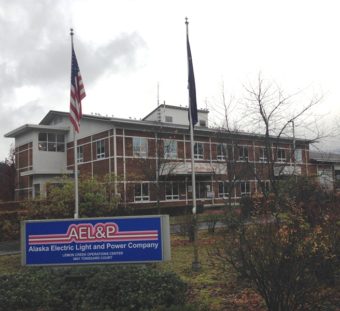
AEL&P headquarters in Lemon Creek. (Photo by Casey Kelly/KTOO)

Alaska Electric Light and Power’s parent company today announced $100,000 in donations to six Juneau organizations.
“Everybody benefits when the community does well, when its citizens do well,” says Jessie Wuerst, a spokesperson for Spokane, Wash.-based Avista Corp., which merged with AEL&P on July 1.

The organizations that received money are the Juneau Arts & Humanities Council, the Salvation Army, the Glory Hole, the United Way of Southeast Alaska, Bartlett Regional Hospital Foundation, and the University of Alaska Southeast.

The $12,000 donation to the Glory Hole comes after a burst water pipe temporarily put the shelter out of commission earlier this month.

United Way President and CEO Wayne Stevens says the organization hasn’t decided where to invest the $12,000 it received, but he says there’s always a need.

“It’s hard to commit to where money’s going until you have the pile collected,” Stevens says. “You can always make sure that contributions are directed to the area of greatest need. And that changes moment to moment almost.”

Wuerst says Avista Corp. representatives will fly to Juneau in January to present checks to each of the organizations.

Avista Corp. donations to Juneau organizations

  • Juneau Arts & Humanities Council – $4,000
  • Juneau Salvation Army – $10,000
  • The Glory Hole – $12,000
  • United Way of Southeast Alaska – $12,000
  • Bartlett Regional Hospital Foundation – $12,000
  • University of Alaska Southeast – $50,000

Meet Juneau’s map and book antiquarian

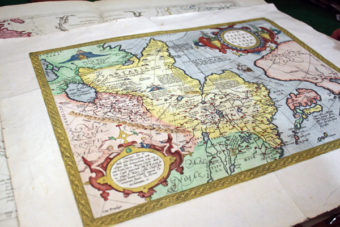
One of Dee Longenbaugh's maps. (Photo by Kayla Desroches/KTOO)
One of Dee Longenbaugh’s maps. (Photo by Kayla Desroches/KTOO)

If you want to find a rare book or unusual map in Juneau, there’s only one place to go–Dee Longenbaugh’s shop. Longenbaugh is the owner of The Observatory: a rare book shop, used bookstore and treasure trove all in one. You can find everything from local cookbooks about how to prepare halibut to maps of the Great White North.

When I arrive, Dee Longenbaugh sits at her computer. Piles of old papers peek out from under her desk. I avoid stepping on them. I don’t want to trample documents that look a hundred years old.

But Longenbaugh says age doesn’t determine the worth of a rare book or a map. For her, it’s not so much about what year the map came from, it’s more a question of what the map reveals.

“Why are these old ones so very different? If you’re curious, you want to find out why,” she says.

“What did they believe at that time? And it’s the only thing I know that shows the world as our ancestors knew it or thought they knew it.”

While her priciest map is $15,000, Longenbaugh stocks inexpensive maps so that anyone can buy them.

“You can have excellent taste and little money and we all know the opposite can be very true. But I also get people hooked on maps. Maybe you’re young, don’t have much money, OK, well here’s a little map for you. And say, five or 10 years go by, well you now you’ve got money, oh yeah, and you love those maps.”

Although Longenbaugh is a business owner, her store began as a passion project when her children had gotten older. She collected around 343 old books about Alaska on trips to San Francisco and New York. Enough to set up her bookstore in 1977. So she rented an old house in Sitka’s downtown area.

“…and my sweet older son built me a very nice bookcase which I still have and I put the books on display and ran a little ad in the paper and people started coming and it was just kind of fun.”

Longenbaugh says that it was the first used bookstore in Southeast.

In 1989, she and The Observatory moved to Santa Fe for a time. But she says she had a longing for Alaska. She flew back to the state to visit with her daughters, who live in Juneau, and stayed.

Longenbaugh originally settled in the Juneau Empire offices. She’s since ended up on the corner of Third and Franklin streets where there’s a bakery in the basement. Sometimes the baker’s music vibrates up through the floors.

Although it’s a little quiet during the off-season, Longenbaugh loves meeting the world travelers during the summer months. Some antique owners keep their rarities behind lock and key, but she believes in inviting guests to see and touch her maps.

Dee Longenbaugh shows a map's plate mark, the indentation left from an old printing press. It's a sign of an antique map's authenticity. (Photo by Kayla Desroches/KTOO)
Dee Longenbaugh shows a map’s plate mark, the indentation old printing presses left. It’s a sign of an antique map’s authenticity. (Photo by Kayla Desroches/KTOO)

She says one way to tell an old map is genuine is to feel for the Gutenberg press plate mark – the raised ridge along the side of the paper. She pulls a circa 1763 map of Alaska and Asia from a drawer, and spreads it across a table in back. The paper is made of linen and is thick and pliable.

“A reproduction’s going to be smooth of course. If it’s real, you feel that plate mark? And you look it over on the other side. There it is. Even stronger. That would not come through of course on a reproduction.”

Logenbaugh also has a group of loyal customers in the community who come for the books. Mary Ellen Frank and her husband have been visiting the shop for 20 years.

Frank crafts figurines and then creates clothing for them that reflects traditional Native dress from around Alaska. Her work has been featured in museum collections and exhibitions.

She says she’s browsed The Observatory for research and that Longenbaugh goes above and beyond.

“When Dee travels, and she’s travels worldwide, she keeps her eyes open for things for you,” says Frank. “Or if she goes into a museum there that is of particular interest to you, she’ll let you know about that, get photographs for you. Really share.”

And Frank can guess why Longenbaugh is so popular in town.

“When you drop by her shop, if there’s somebody else there, in no time at all, you’re all involved in the conversation. She’s just one of those really engaging, charismatic people.”

Longenbaugh has a personal attachment to her maps. She says her favorite is a 1570 depiction of Alaska and Asia recreated in the 1600s. She says that Alaska is almost unrecognizable until you spot the Strait of Anian, the former name for the Bering Strait. However, her favorite maps are usually her newest and she moves around with them.

“I take ‘em home and sometimes I bring ‘em back because I get another one that I like even better,” she says.

While certainly at the traditional retirement age, Longenbaugh is all about her business. She says it gives her the chance to meet interesting people, examine books and maps, and keep on learning. She doesn’t plan to give that up anytime soon.

Will there be a second season of Alaska Robotics News?

U.S. Sen. Mark Begich is Alaska Robotics' highest profile guest to appear on their satirical news show. (Screen capture courtesy Alaska Robotics)
U.S. Sen. Mark Begich is Alaska Robotics’ highest profile guest to appear on their satirical news show. (Screen capture courtesy Alaska Robotics)

Juneau-based video collective Alaska Robotics is once again raising money for its satirical series Alaska Robotics News.

This year, the series poked fun at the Alaska Legislature and the 2014 midterm elections, thanks to more than $8,000 raised on Kickstarter.

But because of Kickstarter’s all-or-nothing fundraising requirement, the second season of Alaska Robotics News might not happen.

Not only do Pat Race and his team design websites, create art, and run a comic shop and gallery on the side – they also make videos.

After years of doing periodic, political comedy videos, Alaska Robotics News debuted during this year’s legislative session.

“We produced over 70 minutes of satire news,” Race says. “It resulted in five episodes and six short episodes that were focused on the election.”

Monday is the Kickstarter deadline for next year’s series, and as of Thursday they were $5,700 short of their $8,000 goal.

“Last year fundraising began a little bit earlier than this year and fundraising this year is not going great and I think it’s maybe because of our timing,” says Race. “But it’s also maybe because it’s the second time we’ve tried to do this, and so maybe the enthusiasm isn’t quite as high.”

The way Kickstarter works is it’s all or nothing when it comes to fundraising.

“You pledge to donate a certain amount and if the overall goal is not met, then no one has to donate anything and the project just doesn’t happen,” Race says.

He hopes Alaska Robotics can still pull it together at the last minute.

“Some of the people who donated last year have donated again and I’ve had a lot of people stop me on the street and be like ‘Oh, your thing’s happening, your fundraising’s going on, I need to contribute to that and I haven’t. I need to sit down and do that,'” says Race. “So we’ve got a lot of those people floating around out there.”

One of those people is Nolan Davis. The Juneau dentist says he was out of town and just got an email about the fundraiser. He donated $1,000 last year and says he’ll wait until the end of the drive to see how close they are to their goal.

“I might be influenced to donate more if they’ve just got a little bit more to go,” Davis says.

He says he likes Alaska Robotics News because it’s fun, but also informative. He says politics can be pretty boring and one way to make it interesting to a younger audience is to make fun of it.

“It’s kind of become the national norm at least for the age groups from say, 19 to 30,” Davis says. “What I’ve read, I think 25 percent of that age group gets their daily political news from shows like The Daily Show and The Colbert Report.”

Race says the series has built an audience around the state, but most of the people who have donated to the Kickstarter campaign live in Juneau. If they don’t make their goal, Race says Alaska Robotics will find another project.

Site notifications
Update notification options
Subscribe to notifications