Kayla Desroches

Juneau nonprofit bridges Spanish language gap

(Creative Commons photo by Cat)
A Latin American immigrant moved to Juneau recently with her boyfriend and met a local man who helped her get settled and find an apartment. She claims he asked to live with her family temporarily, and then things went downhill.

“Tuesday he was a good man, Wednesday he was a good man, Friday he was a good man, but Saturday he was a monster,” the woman says in Spanish.

We’ve omitted her name due to the ongoing nature of her case, which involves accusations of domestic abuse and sexual assault. She claims the local man was often drunk and abusive.

“I was afraid,” she says. “Because, I said, ‘What if he kills me? What do I do?’ Because he said he was going to make me disappear.”

She needed a protective order from the courts, but her English was limited.

“She didn’t know her way around and basically was harassed by this man because of the lack of the language,” says Wanda Peña. “She couldn’t communicate with anybody, so she ended up going to the courthouse and they provided her with our number and she immediately called.”

Peña is a volunteer with Piedra de Ayuda, a national nonprofit that started a Juneau branch last year and now offers Spanish translation and interpretation services. Peña helped the woman fill out paperwork and interpreted for her in court.

New Jersey native Eddy Reyes helped found Piedra de Ayuda, or A Helping Rock. It began as a homeless outreach program on the East Coast and is now based in Florida. After he moved to Juneau, Reyes started a local branch. He says government agencies like the Division of Motor Vehicles had not provided many language services in the capital city.

“Because there’s not maybe an interpreter or they don’t understand the language there to fill out a form, suddenly someone had to walk out of there without a picture ID,” he says. “Cause of course, if you’re gonna try to get a job, you have to identify yourself. Well, how do you do that if you have no ID?”

Reyes says Piedra de Ayuda is made up entirely of volunteers. Since last year, the local branch has added seven board members and helped about 20 different clients.

Although the law requires courts to provide interpretation to people with limited English proficiency, nonprofit and commercial organizations that offer language assistance are rare in Alaska. Neil Nesheim is court administrator for Southeast. He says 60 to 70 percent of interpretation is done over speakerphone, which is not always the best option.

“Obviously it’s more effective to do it in person only because you get to see subtleties such as facial language, hand language, intonation and those sorts of things,” Nesheim says.

About 5 percent of Juneau’s population identifies as Hispanic. Some, like the woman Peña helped, don’t speak English and need help translating official documents and government forms, or navigating the Alaska Court System.

The woman says she’s grateful to Piedra de Ayuda.

“She came to help me so quickly,” the woman says. “They didn’t charge me anything. They were wonderful people.”

Juneau nonprofit hosts National Hispanic Heritage Month event

A nonprofit translation and interpretation organization will hold a celebration for National Hispanic Heritage Month tonight.

Piedra de Ayuda, or A Helping Rock, offers language support for Spanish speakers and assists in everything from filing for photo IDs to assisting on court cases. Volunteer director Eddy Reyes has a nonprofit background and says that he came to Juneau and noted the lack of interpretation and translation services.

“The one incident that really stands out in my mind is the incident of someone walking into (the Division of) Motor Vehicles and having to walk out of there without their ID, because someone there could not understand the information they were providing, such as a birth certificate that was in the Spanish language, or simply they just could not communicate with them,” Reyes says.

Piedra de Ayuda will hold its fundraising event Friday at the Juneau Arts & Culture Center. Drop by at 6 p.m. to eat Latino foods and see traditional dances. Admission is free or by donation.

Holst, O’Brien win school board seats

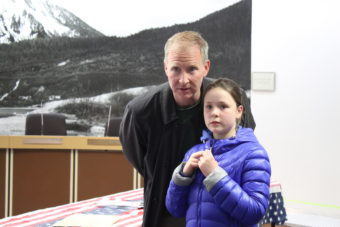
Brian Holst watches results come in at city hall with daughter Jasmin. (Photo by Lisa Phu/KTOO)

Write-in candidate Tom Milliron lost his bid for Juneau School Board to Brian Holst and Sean O’Brien in Tuesday’s election.

Holst won with more than 3,600 votes and is new to the board. O’Brien returns to the board with more than 2,500 votes. Write-ins – likely from Milliron backers – got 1,860 votes.

Sean O'Brien
Sean O’Brien

Holst described how he felt upon seeing the unofficial results:

“Happy to have the opportunity to serve, really appreciate the support that so many people in the community provided for me. Thrilled at the turnout today and from what I can see of the turnout, looks like it was a good turnout and yeah, just really happy right now.”

Although Holst has community board experience and served on a school board when he lived in Serbia with his family, he is mindful of the demands Juneau will have on him.

“I feel a big responsibility. I feel like I’ve spent time learning more, but I recognize that there’s a lot more to learn, so (I’ll) try to use my free time to continue to educate myself about the needs of our school district and the policies and the particulars.”

School Superintendent Mark Miller is a recent transplant from California and has gotten to know both Holst and O’Brien.

“Sean’s been in the last couple of months, a very strong supporting member of the board and I’m looking forward to continuing to work with him. Brian has almost been almost a pseudo board member,” Miller says. “I think he’s going to be a perfect, excellent fit to move the district forward and make Juneau School District an even better district than it is already.”

You can read more about the municipal election results here.

Falltober Fest draws a big crowd

This weekend’s Falltober Fest drew a big crowd to Rockwell Ballroom. Six bands played folk music to an enthusiastic audience, who danced, drank, and generally enjoyed the warm atmosphere.

The Alaska Folk Festival board and KRNN organized the concerts on Friday Oct. 3 and Saturday Oct. 4 to raise money for the annual folk fest.

Falltober Fest concert to raise money for Alaska Folk Festival

The Overby Family Band is one of the acts playing  at this weekend's Falltober Fest. (Photo courtesy of the band)
The Overby Family Band is one of the acts playing at this weekend’s Falltober Fest. (Photo courtesy of the band)

If you’re a fan of folk music and food, Falltober Fest is coming up tonight. The Alaska Folk Festival organized the concert featuring bands from Juneau and around the state. Folk fest board member Sergei Morosan helped set it up.

“For one, it’s just gonna have a real warm feel to it lighting wise and there’s gonna be chairs for people who want to sit,” says Morosan. “And then there’ll be a dance floor as well … which will also be close up to the stage so that there’s that connection of the band to the dancers, which I think is real important.”

Falltober Fest will get under way tonight at 7pm in the Rockwell Ballroom. The opening night acts are Tramwreck, The Overby Family Band, and Honky-Tonk Habit. Saturday night’s line-up features Rumblefish, the Great Alaska Bluegrass Band, and Cold Country, and starts at the same time.

KRNN is co-sponsoring the concert.

Tickets are $20 for one night or $30 for both, with discounts for seniors and students. They can be found at AKfolkfest.org, Hearthside Books, and The JACC. All proceeds benefit the Alaska Folk Festival.

Should management of Juneau swimming pools change hands?

Augustus Brown Swimming Pool downtown is one of two aquatic facilities in Juneau. A proposition on next week's municipal election ballot would let the Assembly create an empowered board to manage both buildings. (Photo by Kayla Desroches/KTOO)
Augustus Brown Swimming Pool downtown is one of two aquatic facilities in Juneau. A proposition on next week’s municipal election ballot would let the Assembly create an empowered board to manage both buildings. (Photo by Kayla Desroches/KTOO)

Juneau voters next week will decide whether management of the city’s two swimming pools can be shifted out from under the city’s Parks and Recreation department.

A proposition on the Oct. 7 municipal election ballot would allow the Juneau Assembly to appoint an empowered board to set budgets and raise revenue for the Augustus Brown Swimming Pool and Dimond Park Aquatic Center.

On a recent afternoon at The Augustus Brown pool, adults do laps and children swim around in the shallows. Opinions about the empowered board are mixed.

Bonnie Chaney recently retired as the city’s budget analyst, and uses the pool two to three times a week.

“City employees, they’ve been tasked with looking for all the efficiencies that they can find in all of the city operations and the city’s open to suggestions from citizens. And if it’s a good idea, the city will implement it,” Chaney says. “So I don’t see where an empowered board is going to improve the efficiencies of running the pools.”

For Eric Peter, the most important thing is to make sure the downtown pool stays open.

“I guess as long as it would, you know, take care of any ideas about closing this place or any kind of fiscal difficulty or trouble the place is in, I guess that would be a good thing,” Peter says.

Built in 1972, Augustus Brown needs significant maintenance. Earlier this year, City Manager Kim Kiefer proposed closing the facility to help address the city’s projected $12 million shortfall over the next two years. The shortfall led to several budget cuts and layoffs, and Kiefer argued the city could save money and figure out how to pay for upgrades while the building was mothballed.

But the Assembly decided to listen to pool supporters, who argued for the empowered board. Max Mertz is with Glacier Swim Club, one of the largest city pool user groups. He says the pools tend to get lost in the shuffle under the current management structure as part of the city’s parks and rec department.

“You have Zach Gordon, The Pipeline, Augustus Brown, Dimond Park, youth (and) adults (sports), Treadwell Arena,” Mertz says. “They’re spread very thin. It gives them very little opportunity to really focus on the pools. And so, some of the decisions that are made don’t necessarily happen within a structure that is clearly defined, transparent and effective.”

Mertz thinks an empowered board could increase usage, much like the board for Eaglecrest Ski Area has increased numbers at the city-owned ski hill.

“Because of the fact that we’re not renting the pool when we can, because of the fact that we’re not marketing the pools the way we could be marketing those pools, the pools really aren’t a destination source for recreation for a lot of Juneau in the way that they should be,” says Mertz. “And we think that that could change with successful marketing, better outreach to the community, things that aren’t happening right now.”

Assemblywoman Kate Troll says the empowered board might provide a much-needed jolt of energy to management of the city’s swimming pools.

“They will kind of lend their expertise and help be creative and try things a little bit different in how to generate revenue so that it’s less of a drain on the city,” Troll says. “We want people that have experience, you know, in management as well as the business community.”

But she says a yes vote on the measure would only be the first step.

“It’s to give the Assembly the authority to go forward in setting up the empowered board,” says Troll. “At the same time, we are asking our city manager and our parks and rec staff to come to us to also present their plan on how they would do things differently to raise revenues.”

Assemblyman Jesse Kiehl says he’s against the empowered board, but voted to put it on the ballot to hear what Juneau residents have to say.

“My concern is that if we give a board a target and say, ‘You will raise this percentage of what it costs to run the pools,’ we’re going to start pricing low income people out of our pools and that’s something the Assembly needs to be accountable for doing or not doing,” says Kiehl.

And, he adds, the Assembly should take the community’s good suggestions and implement them.

Site notifications
Update notification options
Subscribe to notifications