Kayla Desroches

Juneau charities seek to avoid last-minute turkey rush

(Creative Commons photo by Robb & Jessie Stankey)

Every Thanksgiving, Juneau charities reach out to the public with requests for turkeys and other food to feed hungry families. And they say that every year the donations come at the last minute. This year, food drive organizers hope Juneau residents will step up just a little bit earlier.

On a recent afternoon at The Glory Hole, Juneau’s emergency homeless shelter and soup kitchen, the main course for lunch is white rice, salmon and corn.

But for Thanksgiving, you’ll find most patrons at The Hangar on the Wharf for The Salvation Army’s community celebration. Salvation Army Lt. Dana Walters says there’ll be turkey, pie and other holiday staples.

“Sometimes you go to a free meal and it kinda tastes like a free meal,” says Walters. “This is top notch. Everything is freshly made. It’s just an incredible meal.”

The event will go from 11:30 a.m. to 1:30 p.m.on Nov. 27. Other charities will offer Thanksgiving packages for clients to take home. Families sign up for boxes with The Glory Hole and then pick up their orders at the Salvation Army Corps Community Center. This year, their list is already growing.

Less than 20 turkeys alongside other food in The Glory Hole freezer on Nov. 17, 2014. The shelter needs to send out about 200 Thanksgiving packages each with a turkey. (Photo by Kayla Desroches/KTOO)

Mariya Lovishchuk manages The Glory Hole. For Thanksgiving boxes, she says the nonprofit needs turkeys.

“Things show up kind of at the last minute, so we all always feel like we’re going to fall short,” Lovishchuk says. “And then last year things did not show up until, like, the day of distribution. So it would just be really, really helpful to get things a little farther in advance this year.”

Donate 

The Glory Hole Shelter
What: Turkeys
Where: 247 South Franklin St.

St. Vincent de Paul
What: Turkeys
Where: 8617 Teal St.
Call (907) 789-5535 for more information.

The Salvation Army
What: Store-bought pies, store-bought rolls
Where: 439 Willoughby Ave.
Contact Lts. Lance or Dana Walters at (907) 586-2136.

Southeast Alaska Food Bank
What: Food drive
Where: Foodland IGA, 615 West Willoughby Ave.
When: 6 a.m. – 6 p.m. Friday
Or, call (907) 789-6184, or manager Darren Adams at (907) 209-7801. There are also drop boxes at Rainbow Foods and Pavitt Health and Fitness.


St. Vincent de Paul is a shelter in the Mendenhall Valley that also organizes Thanksgiving packages. There are three volunteers on St. Vincent’s holiday team.

“We have been together almost 12 years,” says volunteer Rena Sims. “We started out when St. Vincent only gave out 25 baskets.”

Sims says the charity now gives baskets to over 600 families.

Louise Wertheimer is another volunteer. She credits the community and the participation of young people for their success.

“With all of these kids that come in, we’re more or less able to direct. More so than having to do the physical work like we’ve done in the past,” says Wertheimer.

And Paula Sumdum says the volunteers get a lot from their involvement.

“I’ve seen some really tough kids have tears in their eyes as they help out to the car with turkeys,” she says.

Darren Adams is the Southeast Alaska Food Bank manager. The organization receives most of its donations from supermarkets’ unused stock and provides small nonprofits around Juneau with Thanksgiving products. Adams says they got about 200 turkeys last year, most of which arrived at the last minute.

“It’s kinda nice to be able to go from having no turkeys one day to having four of five freezers full the next. And I’m very thankful for any donation regardless of when they come in,” he says.

One option to avoid high housing costs in Juneau: Live on a boat

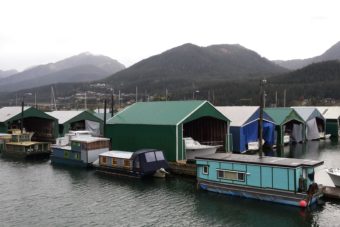
Houseboats Aurora Harbor
Houseboats in Aurora Harbor (Photo by Kayla Desroches/KTOO)

Juneau has some of the highest housing prices in Alaska. According to the  state Department of Labor, the average single family home costs $349,000 dollars in the capital city. A typical rental unit is more than a thousand dollars a month.

One way to combat the high cost of housing is to rent a slip on the docks for a houseboat or a live aboard.

Carrie Warren and her three children live in Aurora Harbor. She’s originally from Washington state, but has lived in Alaska on and off for 20 years. In 2013, she moved to Juneau from Tenakee Springs. As soon as she came to town, she started looking for housing and found a houseboat that suited her needs.

“I chose it because I could actually own it. There are not very many things in Juneau that you can purchase for 50,000 dollars or less.”

Warren says the seller financed the boat for her, and she paid it off in about a year and a half.

She says harbor fees add up to around $200 a month, plus a little extra for utilities. The city’s Docks and Harbors department provides power, water, outhouses and a sewage pump-out. Warren says cooking can be a challenge.

“I have a Dickinson stove that doesn’t work,” she says. “It’s not hooked up. And even if it did, that’s mostly for heat. You can’t bake on it. I mean, you can heat water. I can make a mean pumpkin pie in my toaster oven. I don’t have a microwave. Electricity is hard because you can’t have too many things happening at once. You blow your breaker.”

Warren is a single mother who home-schools her kids and the boat is about 200 square feet. She says sometimes it’s a challenge to make sure the family gets along in such a small area. Warren’s older son plays upright bass and her daughter French horn and they need to arrange individual practice times.

“Our space and boundaries are different than most people’s, and rather than sit around and whine about it, you just suck it up,” Warren says.

Katie Spielberger is Warren’s neighbor. She lives in a houseboat with her partner and a cat.

“A couple of our neighbors have seen the cat and have come by with an extra can of cat food or half a container of kitty litter that they found in the free bin,” she says.

Spielberger works for the state and has been in Juneau for about nine years. She compares living on a boat to the tiny house movement, in which architects design homes that are less than 400 square feet. She says living in a small area has made her more creative.

“It’s kind of nice to have that challenge to simplify things and it feels very rewarding when you actually can live in such a small space and have everything you need,” Spielberger says.

She hangs as much as she can on walls, takes advantage of all available space and rents a storage unit. Spielberger says living on a houseboat provides the best of Juneau at an affordable price.

“It feels very much of this place,” she says. “You don’t feel like you’re living in a house that could be anywhere. The views surrounding a boat in any harbor in Southeast Alaska, I think are gorgeous and hard to beat except at some very nice land property.”

In addition to houseboats, some people in Juneau have live-aboards.

“There’s a live-aboard vessel which is just your normal boat that somebody might live on,” explains Harbormaster Dave Borg. “And then we do have some houseboats designated specifically just as a houseboat. They generally don’t have any mode of power.”

Borg says there are nine houseboats in Aurora, three in Douglas Harbor, two in Harris Harbor, and nearly 140 live-aboards. Monthly moorage fees are $4.20 per foot.

Warren says there are unique problems with houseboats, but they’re mostly in-line with other homeowner concerns.

“When it’s real windy, it’s a little freaky. You know, I worry about things like my canvas blowing away, but you know, I think any homeowner when it’s stormy and yucky has those same kinds of worries. Anybody who’s living in a not super insulated home has those same kinds of worries,” says Warren.

And she says it’s more affordable than other housing alternatives.

Kalibo, Philippines is Juneau’s new sister city

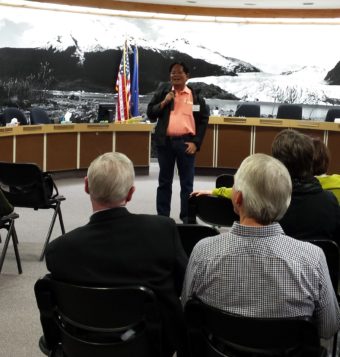
Kalibo Mayor William Lachica (Photo by Kayla Desroches/KTOO)

Juneau gained its fifth sister city this weekend. Representatives from Kalibo in the Aklan Province of the Philippines signed documents Saturday afternoon to formalize the agreement. Juneau and Kalibo are both vibrant tourism centers and regional capital cities. They hope to mutually benefit each other socially and economically as sister cities.

About 3,000 Filipinos live in Juneau and roughly 800 of them are from Aklan. Vicky Roldan is one of them. She’s been in Juneau for 21 years and says family is the reason so many Kalibo residents move here.

“There’s a big number of them here because of intermarriages and all that and they keep bringing family over here.”

Alex Carrillo  was born and raised in Juneau and says the Filipino population has always been a tight-knit community.

“Just growing up in the Filipino Hall around even people who weren’t our relatives. We were so close back then because that’s all we had was one another. The Filipino Hall is a really big part of my life.”

He says Juneau’s bond with Kalibo is more than just a sign of good will toward the Philippines.

“Filipinos are a big part of Juneau, I think. And it just shows that the city of Juneau really appreciates us.”

While in Juneau, the Kalibo delegation did some sightseeing including visits to the Mendenhall Glacier and the Shrine of St. Therese. They also visited local businesses, like the Alaskan Brewing Co.

Many expressed hope that the sister city connection will encourage an exchange of goods, services and information. Dr. Makarius Dela Cruz is Kalibo’s municipal health officer. He says Aklan needs support to provide better health care to its residents.

“Your government could help my government to provide medicines, equipments and also promote nutrition in our town.”

Typhoon Haiyan hit the Philippines last November and damaged buildings in Aklan. Juneau’s Filipino Community Inc., or FilCom, reached out to those affected across the Philippines. Larry Snyder is on the Juneau Sister Cities Committee.

“The FilCom had a fundraising event for relief money to assist Filipinos. And then the state of course donated two cargo planes full of Alaska sea products, salmon, canned salmon.”

Seafood is important to both Southeast Alaska and Aklan. Jenny Gomez Strickler is the Philippines’ honorary consul to Alaska. She wrote to Alaska Airlines to explore the possibility of a direct flight to Manila that could increase the amount of fish exported. She says there are products that people in the Philippines could use that would otherwise go to waste in the United States.

“In Alaska, our fishermen grind up the salmon heads and throw it back in the ocean. I joke that that would be a taboo to Filipinos. Filipinos love making fish-head soup. They call it sinigang.”

John Pugh is the chancellor of the University of Alaska Southeast. He says there could be a trade in education.

“Having the sister city relationship will enable us to work towards maybe some educational exchanges through agreement with Aklan University – for students, for faculty exchanges – and we think that would be a real benefit.”

If the sister city relationship is successful, members of both communities hope it will also spark more tourism.

Why Alaska researchers want to use drones to find hibernating bears

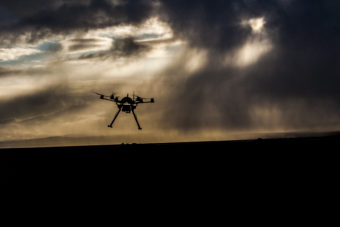
Ptarmigan drone designed by UAF in Selfoss, Iceland. (Photo courtesy Steve Kibler)

For the first time, Alaska researchers plan to use drones with thermal cameras to detect hibernating polar bears and grizzly bears on the North Slope.
The University of Alaska Fairbanks team is working without dedicated funding, but is seeking industry support for the project. For now, they’re relying on UAF resources like the Alaska Center for Unmanned Aircraft Systems Integration.

Federal law requires oil and gas companies to remain one mile away from polar bear dens and a half mile away from grizzly bear dens from November to April. Otherwise, they risk disturbing their hibernation with noise and vibration from vehicles and other off-road operations. Keith Cunningham is a research assistant professor at UAF and has worked on drone data and applications for various organizations.

“On the North Slope right now, there are experts who are trained in chasing off bears that get too close to some of these oil production areas,” says Cunningham. “We call that bear hazing. There might be bean bags or fire crackers that are shot at the bear to scare it away.

Cunningham says the drones will use specialized cameras to detect the bears.

“These infrared cameras basically spot emitted thermal heat. A sleeping bear is actually burning calories and radiating heat. And you can pick that up with a camera.”

The U.S. Fish and Wildlife Service and the Alaska Department of Fish and Game have been experimenting with artificial dens for several years. Part of the upcoming UAF research will involve constructing wooden dens and mimicking body heat using a device set to about 60 watts.

Weather stations outside the dens will measure conditions like wind speed, wind direction and temperature. Another device will measure snow depth and density. As they run trials, that data should tell the researchers how effective their drone is under different conditions.

The goal is to provide this technology and information to oil and gas companies active on the North Slope.

Cunningham says the team is interested in both polar bears and grizzly bears in the field.

“As we get closer to the foothills of the Brooks Range, we’re also interested in the denning activity of grizzly and brown bears because they’ll dig their dens about the same time as the polar bear. The polar bear is digging his den in the snow while the brown bear is going to dig his den in the dirt, like along a creek.”

They will set up their first artificial den on the North Slope in early November. In the first stage, the researchers will test drones only on artificial dens. In the second stage, they’ll test the drones on bears with radio collars that send location data to a satellite.

Cunningham and other researchers have experimented with thermal cameras before, but this is the first time they’ll use cameras and drones together to track bears. They’re examining camera options, and they’ve already decided on the drone they’ll use.

“The university actually builds its own unmanned aircraft systems,” says Cunningham. “And we have one that is designed specifically for research and development. And we call it the ptarmigan. The ptarmigan is the state bird of Alaska. It’s got six propellers, it flies like a helicopter. It takes off vertically, and it lands vertically.”

UAF sent their first drones into Alaska airspace in May with permission from the Federal Aviation Administration. The drone can fly for about 20 minutes before it needs a battery replacement. Cunningham says drones will fly lower and more quietly than manned aircraft.

Wildlife biologist Anthony Crupi works for the Alaska Department of Fish and Game and studies brown bears in Southeast. He and his colleagues use a variety of methods to trace large animals, including GPS collars and manned aircraft. While thermal imaging makes sense in the treeless North Slope, Crupi says it’s not a good fit for finding bear dens in Southeast.

“They’re such a secretive species that they really stick to the forested environment and I think it would be difficult for us to do things like counts on brown bears in Southeast.”

Cunningham says that there is plenty of interest in the bear den project from industry funders. The bear den team hopes to use the drones in the field by 2016. If it’s a success, the researchers will conduct further experimentation to optimize the method.


$10 million Aurora Harbor rebuild underway

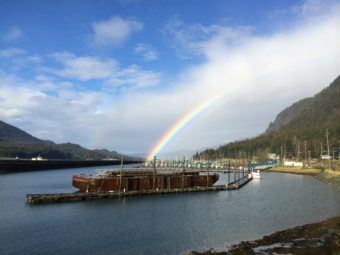
If you passed by Aurora Harbor right now, you’d see rows of empty boat slips and a spot where an excavator has ripped open the asphalt in the parking lot to expose the pipes below. It’s part of a Juneau Docks and Harbors project to replace the aging floats and walkways in the southern section of the harbor.

The dock replacement project began Oct. 1. Erich Schaal is deputy port engineer and oversees construction. He says that it’s the right time for an update.

“It was built by the state back in the ’60s, so it’s outlived its useful life,” Schaal says. “We are seeing floats that are sinking, floats that are twisting. So we are replacing about the southern third of the entire harbor, so it’ll be demolished here soon and new floats will be installed and boats will move back in the spring.”

And they will make more changes by the end of May, the expected wrap-up date.

“We have a new water system going in, upgraded electrical. There is going be a new all-season sewage pump-out facility,” says Schaal. “We want to have good, clean water and good, clean services in the harbor, so we’re going to have a facility that will allow live aboards as well as transient or moving vessels.”

The $10 million project is being paid for from three sources.

“There’s a grant (from) the state,” says Schaal. “There’s some fund balance, some money that docks and harbors has saved in anticipation of this, and then there’s some sales tax money that’s paying for this as well.”

That’s 1 percent sales tax money Juneau voters approved in 2012.

David Borg is the harbormaster. He says construction displaced about 134 boats, including a handful of live aboards. They were moved to Harris Harbor, Douglas Harbor or the other end of the Aurora Harbor.

Docks and Harbors hopes to also repair the northern Aurora Harbor docks if the money becomes available.

Walker campaign releases Spanish-language commercial

Independent candidate for governor Bill Walker released a TV ad last week targeting Spanish speaking voters in Alaska. In a race where every vote counts, the campaign hopes the ad will give them the upper hand.

Screen shot of independent gubernatorial candidate Bill Walker's Spanish-language ad.
Screen shot of independent gubernatorial candidate Bill Walker’s Spanish-language ad.

The ad, airing on Telemundo, features long-time Walker family friends Elena Cedano and Manny Escobedo. Walker makes an appearance toward the end alongside his granddaughter, Mera.

“I’m Bill Walker,” the candidate says in Spanish. “I approve this message.”

“Vote for my grandfather,” Mera adds.

Walker’s daughter, Lindsay Hobson, majored in Spanish during college and enrolled Mera in a bilingual school in Anchorage. Hobson says her father does not speak the language, but spent a lot of time rehearsing his line.

“He genuinely wanted to get it down right,” she says. “And, you know, he did it over and over and over. Everyone was so patient and it was just such a great experience, really.”

Hobson is a spokesperson for her father’s campaign, and believes the Spanish-language commercial taps into an important demographic.

“I think I heard somewhere that one vote in Alaska is worth 55 votes in New York. You know, it really is important because we are all Alaskans and to engage different communities within the state is also in-line with having a more inclusive government.”

Hobson says an account executive with Telemundo told her it’s unique to have a commercial produced in Spanish. Most campaigns simply dub over English-language commercials.

She says the campaign spent $600 to make the ad. It will pay $2,500 to air the spot through election day. The Walker-Mallott ticket has raised more than $500,000 so far this election cycle.

Luke Miller, communications director for Governor Sean Parnell’s campaign, says Parnell has not yet produced any commercials in other languages.

“The governor’s working to get every single Alaskan’s vote. He doesn’t necessarily differentiate between any Alaskan and when he’s across the state in different communities, he’s meeting with people of all races and all colors.”

According to the Alaska Department of Labor, people of Latino heritage made up more than 5 percent of the state’s population in the 2010 U.S. Census. The Census shows the number of Hispanic people in Alaska is growing faster than the same demographic nationwide.

Bill Walker for Gov-Telemundo Alaska from Daniel Hernandez on Vimeo.

*Editor’s Note: Luke Miller’s title has been updated to communications director, not deputy press secretary.

Site notifications
Update notification options
Subscribe to notifications