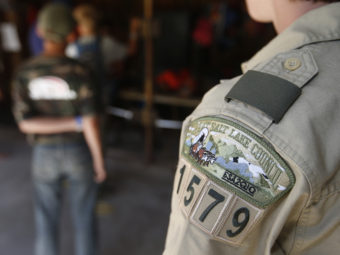
A Boy Scout stands in line to get a canoe at a summer camp outside Payson, Utah. More than 99 percent of Boy Scout troops in Utah are sponsored by the Mormon Church. George Frey/Getty Images
The Mormons, “who are the largest single sponsor of Boy Scout units,” according to The New York Times, initially threatened to leave the Scouts after it decided to allow gay adult leaders.
“The Church of Jesus Christ of Latter-day Saints is deeply troubled by today’s vote by the Boy Scouts of America National Executive Board,” the Church’s statement read. “When the leadership of the Church resumes its regular schedule of meetings in August, the century-long association with Scouting will need to be examined. The Church has always welcomed all boys to its Scouting units regardless of sexual orientation. However, the admission of openly gay leaders is inconsistent with the doctrines of the Church and what have traditionally been the values of the Boy Scouts of America.”
But today, the Mormon Church said in a new statement, it “appreciates the positive contributions Scouting has made over the years to thousands of its young men and boys and to thousands of other youth.” It announced its intention to keep its close connection with the Boy Scouts, as long as it can continue to “appoint Scout leaders according to their religious and moral value.”
“At this time, The Church of Jesus Christ of Latter-day Saints will go forward as a chartering organization of BSA, and as in the past, will appoint Scout leaders and volunteers who uphold and exemplify Church doctrine, values, and standards.”
Copyright 2015 NPR. To see more, visit http://www.npr.org/.
Read Original Article – Published AUGUST 26, 2015 8:59 PM ET
An artist’s rendering of the Huna Tribal House. (Image courtesy National Park Service)
A $3 million Tlingit tribal house is being constructed on the shore of Bartlett Cove in Glacier Bay–likely the first time the National Park Service has funded a tribal house.
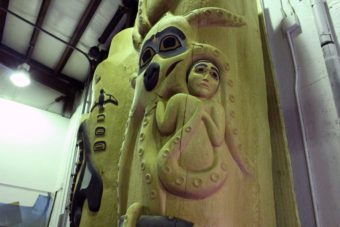
Three carvers are chipping away on an Eagle moiety pole that will go outside the red cedar tribal house with a Raven. The crest of a Wolf, Porpoise, Brown Bear and Thunderbird are starting to form, representing the clans in the area.
Gordon Greenwald, the lead carver, says it’s taken over a month to get this far on the totem and it’ll likely be six more before it’s finished.
“Now we could complete it faster than that if we used some machines. Chainsaws and so forth to do some of the major cutting but we’ve chosen not to do it that way. We’re trying to do it all by hand.”
His team has been carving the pieces to go in the 2,500-square-foot Huna Tribal House for about five years. There’s a constant flood of cruise ship tourists in and out of the shed, asking questions and marveling at the handiwork. But Greenwald says he doesn’t mind.
“For people that are new to this area, it gives them a chance to learn about our people. Going away knowing Tlingit people, knowing what our life was like. And for local people, they can stop and see something is being made in our homeland,” he says.
An interior and exterior screen is already complete. So are the house posts of the four clans that identify Glacier Bay as home: Wooshkeetaan, Chookaneidí, Kaagwaantaan and T’akdeintaan.
The house posts which will go in the Huna Tribal House. (Photo by Elizabeth Jenkins/KTOO)
Tom VandenBerg, the chief of interpretation at Glacier Bay National Park says the clans are an inextricable part of the story of Glacier Bay.
“But there’s no physical sign of their history here unfortunately,” he says.
Bartlett Cove is the site of the new tribal house. It’s where the clans originally resided until an encroaching glacier forced them to relocate hundreds of years ago to what’s now called Hoonah. In 1925, Glacier Bay became a national monument and federal laws limited what the Huna Tlingit could do in their homeland.
“It’s difficult, you know. The parks service represents the stories of our nation. And it seems like some of the Native stories have been missing from some parks.”
VandenBerg says there are places like Sitka National Historic Park with Southeast Native totems, but “there’s not much in the way of Alaska Native stories being told in parks.”
The National Park Service received a request from the Hoonah Indian Association back in 1992 to build the tribal house. VandenBerg is unaware of anything else like it: a ceremonial house paid for by concessioners fees from businesses that operate within Glacier Bay.
Tlingit elder and park management assistant Ken Grant says it’s going to be an emotional day when the tribal house is finished.
The house posts which will go in the Huna Tribal House. (Photo by Elizabeth Jenkins/KTOO)
“Our people really have a strong tie to the homeland. The feeling of being left out has been with our elders for a long time. Like they say in our language: they were buried with a sorrow in their hearts,” Grant says.
He hopes that it’ll provide a space for young Huna Tlingits to learn about their roots and enhance language and cultural preservation.
Gordon Greenwald says it’s been a long time for the project to come fruition.
“But now I’m looking back on it, I’m wondering why this hadn’t happened in all the other parks long ago,” he says.
Back at the shed, carvers Owen James and Herb Sheakley are singing a song about one of the Huna clans.
When Sheakley started this project five years ago, he says he didn’t know all of the stories and he didn’t know how to carve. He’s been practicing at home, making ceremonial hats out of spruce and working on the Eagle pole.
“It’s stuff like this that keeps me going. I can actually create this now,” he says. “Before I could look at this and say, ‘Hmm, I couldn’t do that.’ Making the knives, listening to my boss teaching me the formlines, this is the kind of thing I’m making now.”
Greenwald says he owes teaching to his mentors; passing on the knowledge so it doesn’t stop with him.
“On all of this work, none of us will sign it because none of this work is about us as individuals; it’s about our people,” Greenwald says.
The Huna Tribal House is expected to be dedicated next August.
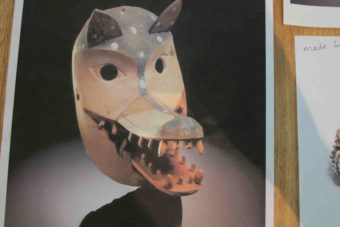
The Vatican officials are seeking to connect with people of Western Alaska through the masks. (Photo by Ben Matheson / KYUK)
A team from the Vatican was in Bethel last week trying to trace the origins of several traditional Yup’ik masks they received nearly a century ago. Museum experts are going through the Vatican’s vast collection and trying to find the people who can explain the art.
There is next to no documentation for the seven masks besides a note that says “from Holy Cross.” The Yukon village was the location of a Jesuit orphanage and mission.
Nicola Mapelli, curator for the Ethnographic Section of the Vatican museum and colleague Katherine Aigner held meetings in Bethel Tuesday at the Cultural Center. They say they contacted people in Holy Cross who believe the masks are from further south. That brought the team to the Lower Kuskokwim to attempt to track down the history of the masks.
The wooden masks are light in tone with orange and blue coloration. They depict animal forms like salmon and birds with expressive faces. The trail from Alaska to the Vatican begins in 1924 when Pope Pius XI wanted to hold an international exhibition of works from far reaches of the earth where his missionaries were based.
The Pope asked for objects from around the world to show the daily and spiritual lives of the people. The Vatican team emphasizes that the masks were gifts, but for the masks, they’re not sure of their origins. Regional experts thought the masks could be from the Goodnews Bay area although there was no formal Catholic mission there at the time.
When the Vatican team traveled to Goodnews Bay, Wednesday, they say one person identified a mask as the style from the area and a carver remembered his grandfather and father making similar masks.
However, there is still no definitive word on the masks’ provenience and they say their detective work will continue. They want to show photos and have conversations with people in the YK Delta and hope that they can learn the story of how the masks got to the Vatican.
The team brought images of the masks that were given to the Pope in 1924. (Photo by Ben Matheson / KYUK)
Of the 100,000 items sent to the Vatican last century, 60,000 were returned and 40,000 stayed to form the core of a collection. The items have not been on display for 40 years, as the museum closed due to preservation concerns.
They’re now reaching out across the world to connect with the communities and bring the items back into public view. They recently did a large exhibit of indigenous Australian art and are hoping to someday do an exhibit on the Americas.
Bethel’s John McIntyre, originally from Eek, is an accomplished mask carver and dancer and has had his work displayed at the Smithsonian. He met with the Vatican team and was eager to lay the groundwork for bringing the masks back to Alaska for an exhibit.
“We need to start looking at bringing back all these artifacts that have been brought out of the region. It’s very important for us to keep our culture and tradition alive. And with the artifacts, we can explain to the younger generation before that information is lost,” said McIntrye.
The team expressed interest in someday showing the masks in Southwest Alaska. The international logistics and funding challenges, however, make it a very slow process.
A team from the Vatican brought images of masks to Alaska as they attempt to trace the history of the masks. (Photo by Ben Matheson / KYUK)
Missionaries were among the first Europeans to live among the Yup’ik people, and not without a troubled history. There are stories of missionaries repressing traditional beliefs and the Yup’ik language.
The team says the objects now are an opportunity for the Vatican to reconnect in a positive way with the indigenous people of Alaska.
Next the representatives from the Vatican will travel to Barrow with more photos of objects from Northern Alaska, including ivory carvings.
Note: Vatican officials did not have permission to be quoted for this online story or to share their high-quality digital photo of the masks.
In a 1958 poll of Americans, only 18 percent of respondents said they would vote for a generally well-qualified presidential candidate nominated by their political party if that person happened to be an atheist. In 2015, that number has jumped to 58 percent.
Yet, even today, 40 percent of respondents say they would not vote for an atheist.
As I wrote in a 2012 post, this seems to boil down to distrust. And that distrust stems from an assumption about the relationship between morality and religious belief. If immoral behavior is only averted by religious belief — the thought goes — then for atheists, anything is permitted.
Many have pointed out that this assumption is deeply problematic. For instance, in a nice article at The New York Times’ philosophical forum, The Stone, philosopher Louise Antony writes:
“Think now about our personal relations — how we love our parents, our children, our life partners, our friends. To say that the moral worth of these individuals depends on the existence of God is to say that these people are, in themselves, worth nothing — that the concern we feel for their well being has no more ethical significance than the concern some people feel for their boats or their cars. It is to say that the historical connections we value, the traits of character and personality that we love — all count for nothing in themselves. Other people warrant our concern only because they are valued by someone else — in this case, God. (Imagine telling a child: “You are not inherently lovable. I love you only because I love your father, and it is my duty to love anything he loves.”)”
After quite a bit more argument and exposition, she concludes: “The capacity to be moved by the moral dimension of things has nothing to do with one’s theological beliefs.”
Philosophical arguments aside, one might wonder about the everyday reality. Are atheists any less trustworthy than believers? Could it even be the reverse — that atheists tend to engage in more ethical behavior than believers? These are, by and large, empirical questions, and they’re questions that some scientists have been rigorously tackling.
For the latest from the scientific front lines, I recommend the two videos below, recorded at a conference earlier this year and just made available to the public.
In the first video, psychologist Azim Shariff, a professor at the University of Oregon at Eugene, takes up the question of whether belief in God makes you good. The answer is more nuanced than you might expect, with evidence that religious people are more prosocial in their behavior than atheists, but only in religious contexts or when their religious identity is otherwise made salient. Importantly, though, God isn’t the only way to be good: Secular institutions can play a similar role, with a variety of non-religious contexts and markers of identity expected to have the same effects.
In the second video, psychologist Will Gervais, a professor at the University of Kentucky, presents research on popular perceptions of atheists and offers compelling (and occasionally shocking) data on the perceived link between atheism and immoral behavior. His research suggests a close connection between atheism and distrust, precisely because people assume we need God to be good.
Putting these pieces together, the story is this: On the one hand, we don’t need God to be good — either as a matter of philosophical foundations, or as a matter of human psychology; on the other hand, many people believe that we do.
The result is distrust of atheists. And unless people correct their assumptions about the relationship between ethical behavior and religious belief, we’re not likely to see an openly atheist presidential candidate make it to the White House anytime soon.
Tania Lombrozo is a psychology professor at the University of California, Berkeley. She writes about psychology, cognitive science and philosophy, with occasional forays into parenting and veganism. You can keep up with more of what she is thinking on Twitter: @TaniaLombrozo
Copyright 2015 NPR. To see more, visit http://www.npr.org/.
Read Original Article – Published AUGUST 10, 2015 8:02 AM ET
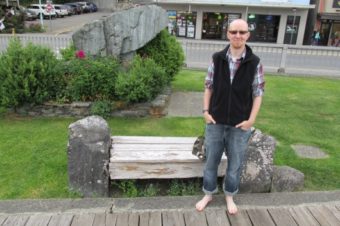
Peter Epler, a pastor at Ketchikan Church of the Nazarene, is going barefoot for a month to raise awareness of the need for shoes in third-world countries. (Photo by Leila Kheiry/KRBD)
A Ketchikan minister is going barefoot for a month, in hopes of raising awareness of the need for shoes among the world’s poor.
While only part way through his monthlong project, Peter Epler has gotten a feel – so to speak – for what many people deal with all the time.
Epler’s bare feet are a little weird in downtown Ketchikan. Most people here and in developed countries around the world don’t think twice about wearing shoes, beyond which pair matches which outfit.
Some places, though, there’s a shortage of affordable shoes, which can be a health and safety hazard.
“(People) walk through dirt roads, sewer systems, manure, sharp rocks,” he said. “Children get cuts on their feet and infections because of what they walk through, so they can lose their feet or die from the infection. So, shoes tend to save lives in third-world countries.”
Epler is a pastor at Ketchikan’s Church of the Nazarene. That church and other Nazarene churches in Alaska are working together to raise money for an international charity that provides special shoes for children in developing countries.
The group is called Because International, and the shoes they provide are made to last five years.
“They grow five sizes in five years, so roughly kindergarten through fifth grade,” he said. “And they’re working on a second pair that will take them up to ninth grade.”
And will they actually last five years?
“Yeah, they’ll last five years,” he said. “The rubber on the bottom is made from the rubber you make street tires from. And then they used high-quality leather and industrial snaps. So, these things are very sturdy … This is the final product they put out. They’ve been working on it for years.”
Many churches involved in the campaign are raising money through their congregations. Epler is taking it a little further in hopes of involving more community members. So, to raise awareness, he’s pledged to go without shoes for a month.

About a week into it, Epler has had some new-to-him tactile experiences.
“I’ve got a blog that I’m kind of keeping track of my own experiences: Things I’ve stepped in that you take for granted with shoes,” he said. “I’ve stepped in unidentifiable wet substances on a hot, sunny day, I’ve stepped in dog poop. I’ve stepped in gum. That was not my favorite. There was a sticky, warm quality to it that was distasteful.”
The point of going barefoot is to attract attention, and hopefully engage people in conversation. Then Epler can talk about the campaign and hand out cards with information about how to donate.
Sometimes it works. Sometimes, not so much.
“Most people give me the once-over stare, like ‘Who’s the crazy guy without the shoes?’” he said.
That was the case as Epler and I walked through downtown Ketchikan. He received a lot of furtive glances.
“Yeah, the glances go from head to toe and they kind of linger, and they look away,” he said. “I tend to wait until someone leans a little in for the conversation before I’m like, ‘Here’s the card and information,’ because I don’t want to creep people out. It’s enough that I’m the barefoot guy.”
Epler said the campaign is, indeed, raising money, although it’s difficult to say how much in total. People in his church have given about $600, but the cards he’s handing out direct people to not only the church’s webpage, but also to Because International’s main site. He said that’s a way to reach more people.
“Some folks might not be religious and might not feel comfortable donating through a church and that’s fine,” he said. “They can still go to theshoesthatgrow.org and donate. “
Epler isn’t the only one going barefoot for the cause. He said a few other people in his church, adults and children are spreading the word, too.
“I think children are the key to this,” he said. “They can relate very much to other children and they have this unashamed ability to buy into an idea and advertise it quite well, because they’re bolder. They can do a lot of good. Children can make a lot of difference. And because this project is for children, I think getting children involved is the best way to go.”
With several weeks left in the campaign, Epler predicts his feet will become sturdier. And, so far, it’s not been a bad experience.
“I’m feeling more connected to the world around me, which I didn’t expect: sticky things, smooth things, soft things, temperature changes, from going inside to outside. These are things I was completely unaware of before,” he said.
So, Epler’s barefoot campaign is raising a different kind of awareness for himself, along with helping the public learn more about a global need.
Russian Orthodox and Old Believer boats lined up in the Dillingham boat harbor. (Photo by Molly Dischner/KDLG)
Even in the midst of an opener, with fish running, many Russian Orthodox crews place faith over fish. The colorful boats with the distinct dark tinted windows of the orthodox fleet are easy to spot in the harbor. They are taking a rest day to celebrate a religious holiday to remember the lives and sacrifice of Saints Peter and Paul.
Dennis Hannon sports the traditionally untrimmed beard most Russian Orthodox men wear. He fishes on the F/V Cruiser. He says in the Orthodox tradition, Sundays and holy days shouldn’t be used to make money.
“There are a lot of people that could use the extra pounds or the extra money but at the same time it will all come back to you in the end if, I guess, you believe,” Hannon says.
Hannon is up from Oregon for the season. Interwoven with the religious reasons is the desire to keep the Orthodox culture strong. He says a lot of the culture is already lost; this is one way to hang on.
“Being in the states you are exposed to so much of a different lifestyle … slowly religion would be lost,” Hannon says.
Most of the Orthodox men fish for Icicle Seafoods. Angela Christensen is the office manager for Icicle in Dillingham. She says the company doesn’t treat the Russians any different then say, the Seventh Day Adventists when they take Saturdays off. She says it just takes a little extra planning.
“We just make sure our tenders are well fueled,” Christensen says. “We usually have an extra, or just have a service tender standing by for just the extra traffic for when they come in and leave.”
Hannon and the rest of the crew on the Cruiser may not fish on religious holidays, but they’ll be ready to get the nets out again at midnight.
“Start the day … catch the fish,” Hannon says.
Close
Update notification options
Subscribe to notifications
Subscribe
Get notifications about news related to the topics you care about. You can unsubscribe anytime.