Pew Charitable Trusts

Why this state thinks engineers can save pedestrians’ lives

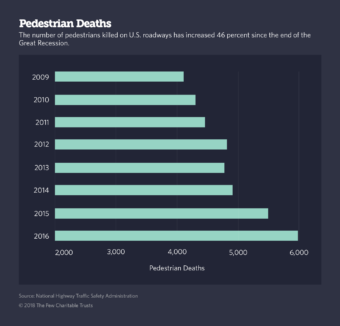
Source: National Highway Traffic Safety Administration (Graphic by Pew Charitable Trusts)

In August 2017, Alexis Dale moved from San Diego to South Florida to attend Florida International University, trading one coastal paradise for another.

Two months later, while crossing an eight-lane road near campus at 3 a.m., she was struck by a car and thrown to the side of the road. Paramedics pronounced her dead at the scene.

Friends and family knew Dale as one of a kind — an ambitious young woman who was eager to pursue a degree in information technology and who loved her dog, Bella. But Dale was one of hundreds of pedestrians who died in Florida that year.

The number of pedestrians killed on U.S. roadways is up — by a lot. Nearly 6,000 pedestrians were killed in 2016, up from 4,100 in 2009 and the highest toll since 1990, according to the Governors Highway Safety Administration. The number of deaths held steady between 2016 and 2017 — but that was cold comfort.

“It leveled off at a 25-year high,” said GHSA’s executive director, Jonathan Adkins. “It’s nothing to celebrate.”

The problem is increasingly concentrated in certain states — and Florida is one of them. Between 2009 and 2016, pedestrian deaths in the state rose by 40 percent, to 652 from 466. To stem the tide, Florida officials increasingly are placing their faith in engineers.

In analyzing trouble spots, the state transportation department now uses mapping software that can identify risk factors such as construction sites, which can divert pedestrian traffic to unsafe routes; land-use patterns, which can then dictate the location of signaled crosswalks; and lighting, which affects pedestrian visibility.

Last month, several of these factors tracked by the agency played a role in a pedestrian fatality in Putnam County. Around 9:30 p.m., a pickup truck struck a man crossing State Road 20 at an intersection with no crosswalk. The state road has minimal lighting, and the Florida Highway Patrol noted visibility was low at the time of the crash. The nearest crosswalk on the high-speed state road was about a mile away.

“Engineering is a proven way to improve safety outcomes,” said Richard Retting, general manager of the firm Sam Schwartz Engineering and author of the pedestrian fatality report released by the Governors Highway Safety Administration. “Florida has some of the best professional planners and engineers working on solving these pedestrian safety problems.”

Safety through engineering?

There is no single cause of the national spike in fatalities, but there are clear patterns.

For example, alcohol consumption by drivers and pedestrians has contributed to about half of pedestrian deaths in recent years, according to federal data.

Another factor is distraction. In 2016, an estimated 562 pedestrians and bicyclists were killed in “distraction-affected” traffic accidents, according to the National Highway Traffic Safety Administration. “Distracted walking” injuries resulting from cellphone use by pedestrians increased by more than a third between 2010 and 2014.

To help address its rising pedestrian fatality rate, Florida is relying on the engineers who design and build roadways and walkways.

“We just have to make sure we identify the right problem for them to solve,” said DeWayne Carver, manager of the state Department of Transportation’s Complete Streets program.

For many years, the department instructed engineers to design roads to handle as much traffic as possible, according to Carver. In recent years, however, it has directed them to prioritize pedestrian safety.

Some of the changes have been subtle, such as changing the standard lane-width on state roads, which had long been 12 feet. Florida narrowed its standard lane width to 11 feet, and to 10 feet in some urban areas.

“Research has shown that narrower roads are more effective for traffic management and safety,” Carver said.

Roads with narrower lanes had lower fatality rates, despite many cities assuming wider lanes are safer, according to an analysis of roadways in cities around the world by the World Resources Institute.

In Florida, Carver said, “If you need a wider lane, you can still ask for it — but you need to show why you need it.”

“Flip-flop” parking, on-street parking that alternates from one side of the road to the other on different blocks, can also improve safety by keeping drivers alert, Carver said. He cites Centre Street in Fernandina Beach, a coastal town near the Georgia border, as a successful example. On Centre Street, stretches of parking spaces alternate from one side to both sides of the street, punctuated by red brick crosswalks.

“It does a great job of using parking to create a chicane effect and keep traffic speeds low,” Carver said.

Engineers are also encouraged to employ “terminated vistas,” in which a large structure is located at the end of a roadway within view of the driver, to “send a message to the driver that they need to be driving slower.”

Florida pedestrian bridge

The year before Alexis Dale died, construction had started on a nearby pedestrian bridge spanning the busy roadway near Florida International University.

Nine months from its completion, the 950-ton bridge collapsed, and the concrete rubble crushed drivers and workers, killing six.

The scope of the project was ambitious: Connecting the FIU campus with the nearby town of Sweetwater, the bridge was designed to serve as a floating public space, with benches, tables, viewing platforms and Wi-Fi.

The bridge was a multifaceted effort: Tallahassee-based FIGG Bridge Engineers designed the bridge, Miami-based Munilla Construction Management was responsible for construction, and the state Department of Transportation provided oversight.

The project reflected the state’s “progressive” engineering strategy, said Retting, the author of the highway safety report.

But the project was not the first of its kind. The engineers behind the pedestrian bridge at FIU used a method called “accelerated bridge construction.” The ABC method is intended to minimize construction time and traffic delays by completing much of the construction off-site and assembling the prefabricated bridge components in a shorter time span.

The ABC method has been implemented in states across the country — one member of the American Society of Civil Engineers estimates that 5 to 10 percent of U.S. bridges are now built using the ABC method. In 2011, Massachusetts replaced 14 bridges in just 10 weeks using the ABC method.

But Retting does not believe the collapse of the FIU pedestrian bridge will dissuade engineers in Florida — or around the country — from pursuing these kinds of ambitious and innovative projects to solve pedestrian safety issues.

“There can be setbacks with progressive infrastructure” projects, Retting said. “But I think setbacks like this are specific to individual projects. This was a one-off.”

Why most states are struggling to regulate Airbnb

Baltimore resident Jeannette Belliveau, who rents a couple of rooms in her historic townhouse to short-term guests, sits with her dog, Copper, in one of the guest suites. States are having a hard time regulating the short-term rental industry. (Photo by Pew Charitable Trusts)

Jeannette Belliveau lives with her dog and two cats in a 19th century house in the Upper Fells Point section of Baltimore, not far from Johns Hopkins Hospital, and rents out a couple of rooms for short-term stays to make a living.

In other parts of the city, Al Hallivis, a real estate investor and single dad, owns a half-dozen houses that he also rents by the night.

A few miles toward the city’s picturesque harbor, a variety of hotels offer traditional overnight stays.

All three models cater to Baltimore visitors, but that’s where the similarity ends.

Belliveau, Hallivis, and hotels have different business models, different perspectives and different agendas. These competing constituencies help account for the difficulty states have had in regulating and taxing the short-term rental industry, even as some cities have taken action to regulate short-term rentals.

“One-size-fits-all state regulation may not always be the most appropriate policy response, and states may therefore choose to allow local governments to regulate,” said Kellen Zale, a law professor at the University of Houston who has done research on the short-term rental market.

Some big cities, such as New York, saw the short-term rentals as a threat to the rental market based on long-term leases, as well as to traditional hotels. New York last year allocated extra funding to enforce a state law restricting rentals for fewer than 30 days unless the host is present and there are no more than two guests.

Other cities saw the short-term rentals as a potential source of income and sought to expand tourist or hotel taxes to the new schemes, with varying success.

The view of downtown Baltimore from the roof of Jeannette Belliveau’s historic townhouse, which she rents to short-term guests. (Photo by Pew Charitable Trusts)

San Francisco this year began limiting the number of nights a year absentee owners can rent their properties through Airbnb or similar platforms.

Owners who live in their residence can rent it out without limit. Owners also must pay a $250 registration fee to the city.

Short-term rentals in San Francisco dropped by 55 percent after the limitations took effect, according to the San Francisco Chronicle and Host Compliance, a company that helps cities keep track of short-term rentals.

In Montgomery County, Maryland, a suburb of Washington, D.C., regulations go into effect in July that will limit the short-term rentals to the homeowner’s primary residence.

Rentals where the homeowner is not present will be limited to 120 nights in a calendar year.

Were Baltimore County to adopt that type of rule, Hallivis said it would kill his business model.

Montgomery County also is collecting hotel taxes on the short-term rental properties. That model, Belliveau said, would make her profit margin, already slim, even tighter.

“I’m opposed to taxing rooms in my house. I’m just Mrs. Murphy,” Belliveau said, referring to the hypothetical elderly widow who has converted a portion of her home into a rental apartment. Under federal housing law, the “Mrs. Murphy’s exemption” provides that if a dwelling has four or fewer units and the owner lives in one of them, that home is exempt from the Fair Housing Act.

Troy Flanagan, vice president of government affairs and industry relations for the American Hotel and Lodging Association, said his group doesn’t oppose “true home sharing” like Belliveau’s — it objects to people who have rental property that they use exclusively for short stays. The industry group has mounted a coordinated attackagainst those multi-dwelling short-term rental owners.

Al Hallivis in a Baltimore property of his, one of half a dozen short-term rental houses he owns. (Photo by Pew Charitable Trusts)
Al Hallivis in a Baltimore property of his, one of half a dozen short-term rental houses he owns. (Photo by Pew Charitable Trusts)

“Increasingly what’s taking place on those platforms is hosts that have dozens of units that are available every day of the year, and that’s a hotel,” Flanagan said. “Home sharing is sharing your home, not sharing your second, third or fourth home.”

Hallivis insists that his houses are not hotels, and that he helps neighborhoods by fixing up vacant houses and turning them into nice-looking properties. By bringing in people with money to spend, he said, he also gives a boost to neighborhood restaurants, mom-and-pop stores and taverns.

Private residences generally are not held to the same safety standards, such as requirements for sprinkler systems or handicapped access, as commercial rentals. Hotels in general must have those, as well as emergency exit directions, emergency lighting and fire doors. Hallivis said his homes have fire extinguishers and smoke detectors.

He noted that in fiscal 2017, about $17 billion was spent in Maryland on hotels and the rest of the tourism industry, and $42 million was spent on short-term rentals from Airbnb. “We don’t hurt the hotel industry at all,” he said. “They want a monopoly.”

In addition to Maryland, about 15 states debated bills to regulate the short-term rental industry this year. Only one, Indiana’s, was signed into law. Nebraska’s governor vetoed a bill approved by that state’s Legislature. A bill to regulate the industry also died in Hawaii.

The Indiana bill protects the ability of homeowners to offer short-term rentals, and prohibits cities from banning rentals of a primary residence, while allowing them to impose fees or taxes. The bill vetoed in Nebraska was similar.

In New Albany, Indiana, just across the Ohio River from Louisville, Ruth Ann Floyd rents out one room in her 1880s-era house. Reached just days before the Kentucky Derby, she said she’s booked solid for Derby week. A 69-year-old retiree from General Electric’s refrigerator manufacturing plant, Floyd is pleased that the state protected her little rental business but concerned about the fees that the city might impose.

“Every bit of money I take in I put back into the house,” she said as grandchildren shrieked in the background. “If the city comes up with a big fee, I’m not going to keep doing it.”

New Albany’s city council president, Al Knable, said he is not in favor of large fees, but collecting the current 4 percent tourist tax — now just assessed on a couple of hotels in the county — might be appropriate. He’d like to see Airbnb and the other platforms collect and remit the tax, not the local homeowners.

The proposal that passed the Indiana Legislature and was signed by Republican Gov. Eric Holcomb in March would not restrict owner-occupied rentals. But it would limit how many days absentee owners can rent their properties and allow for rules on which amenities, such as parking, they must provide. The law also allows for local permitting and taxing.

Maryland state Sen. John Astle, who authored the bill to regulate and tax short-term rentals in his state, said there was stiff resistance to a statewide bill, particularly the part about collecting hotel taxes. Astle is ready to concede that regulations should be left to local jurisdictions. But the tax issue is dependent on the state Legislature.

The Anne Arundel County Democrat said he plans to meet with city officials in his hometown of Annapolis to press his case for local regulation. He said short-term rentals have detracted from his city’s neighborhood feel, and that “if you are going to rent something, you ought to have the health and safety issues that are required in any kind of commercial rental.”

But Matt Kiessling, a vice president at the Travel Technology Association, which represents online platforms, says the travel industry is big enough for a variety of accommodations.

“Hotels are ripping and roaring from a business standpoint, with the highest occupancy rate ever,” he said. “Short-term rentals are exploding. … One isn’t taking away from the other; the pie is just getting bigger. All the internet has done is make that market more efficient by allowing travelers to find a home and homeowners to rent a home.”

Companies in foreign trade zones await more details on Trump tariffs

A crane moves an aluminum replacement cabin made by Homer's Bay Weld Boats. The company is one of a number of Alaska businesses already affected by President Trump's imported metals tariffs.
A crane moves an aluminum replacement cabin made by Homer’s Bay Weld Boats. The company is one of a number of Alaska businesses already affected by President Trump’s imported metals tariffs. (Photo courtesy Bay Weld Boats)

Manufacturers that operate in foreign trade zones may be able to evade President Donald Trump’s new tariffs on steel and aluminum imports, trade experts say. But there are a lot of unanswered questions about how the tariffs — which were justified on rarely-used national security grounds — will be applied in zones.
“This issue is so new and unprecedented that even Customs has not finalized how they are going to handle these transactions,” Tom Gould, senior director for customs and trade at Miami-based law firm Sandler, Travis & Rosenberg, said in an email.

There are close to 200 foreign trade zones in the United States, from the Port of Long Beach to a five-county area in Colorado’s rural Eastern Plains. The federal government created the FTZ program during the Great Depression to help domestic and foreign companies delay or reduce customs duties and fees.

Under most circumstances, manufacturers in foreign trade zones can choose to pay duties on a final product or on its components. For some companies, such as automobile manufacturers, flipping the duty rate can lead to big savings.

But Trump’s tariffs are unusual. They are authorized under a 1962 law that allows the government to limit imports that threaten national security. There’s little to no guidance on how such tariffs will play out in foreign trade zones, Gould said.

Trump has authorized a 25 percent tariff on the value of imported steel articles — such as beams, tubes and wire — and a 10 percent tariff on the value of imported aluminum articles. The tariffs don’t apply to imports from Canada and Mexico and the Trump administration has left the door open to other exceptions.

The federal government has adjusted imports on national security grounds on two other occasions since 1979, according to a 2001 Commerce Department investigationinto iron ore and semi-finished steel imports. The report found no evidence of a national security threat from such imports at the time. Trump’s tariffs are the first national security tariffs imposed since the report was published.

Companies can’t typically use foreign trade zones to avoid other special tariffs, such as antidumping duties. Trump’s tariffs may be applied in a similar way, Erik Autor, president of the National Association of Foreign Trade Zones, an industry association, said in an email.

“Special tariffs imposed through a trade remedy action are subject to different rules,” Autor said. “As a general rule, zone operators may be able to delay, but not avoid payment of these special duties.”

The new steel and aluminum tariffs will apply to products that enter the United States beginning this Friday, March 23.

To prevent suicides and school shootings, more states embrace anonymous tip lines

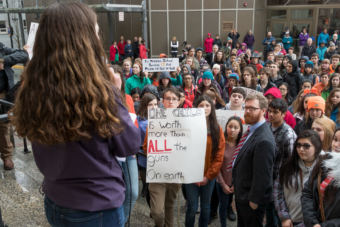
Katie McKenna speaks on the steps of the Alaska State Capitol building in Juneau at a student walkout protest on Wednesday, March 14, 2018. Students and Juneau Rep. Justin Parish, wearing the coat and tie, listen.
Katie McKenna speaks on the steps of the Alaska State Capitol building in Juneau at a student walkout protest Wednesday, March 14, 2018. Students and Juneau Rep. Justin Parish, wearing the coat and tie, listen. (Photo by Mikko Wilson/KTOO)

After a teenage gunman killed 17 people at a Parkland, Florida, high school last month, schools across the country were hit by a wave of copycat threats.

In Colorado, at least two high school students were arrested based on information sent to the state anonymous tip line and mobile app, known as Safe2Tell.

“They had a list, they had weapons, they knew exactly what they wanted to do,” said Colorado Attorney General Cynthia Coffman, whose office administers the program.

States across the country are responding to high-profile school shootings and rising teen suicide rates by creating tip lines modeled on Colorado’s. The programs aim to prevent young people from behaving dangerously, whether that means bullying, using drugs or killing someone.

Coffman said that Safe2Tell has saved lives in Colorado, and that such a system could have prevented the Parkland shooting. Nikolas Cruz, the expelled student who has admitted to shooting his former classmates at Marjory Stoneman Douglas High School, had a long record of disturbing behavior but it didn’t provoke a sufficient response from local authorities. A tipster’s warning to an FBI hotline was never communicated to local law enforcement.

Tips that are sent to Safe2Tell, in contrast, are required to be passed on to school districts and often police departments, and local officials are required to investigate. That might mean setting up a meeting between a student and a school counselor, or it might mean sending a police car straight to a student’s home.

“Something like Safe2Tell would have led to an intervention,” Coffman said of the shooting in Florida. “I feel very confident saying that.”

Tip lines, which are relatively inexpensive and don’t affect gun control laws, are one of the few policy responses to mass shootings that Republicans and Democrats can agree on.

Colorado launched Safe2Tell after Columbine in 1999. Since 2014, Michigan, Nevada, Oregon, Utah and Wyoming have launched similar programs, prompted in part by the Sandy Hook massacre in 2012.

In the wake of the Parkland massacre, the Colorado Safe2Tell office has fielded calls from the Trump administration and interested state and local officials nationwide. “We’re getting calls from all over the country now, it’s crazy,” said Susan Payne, the director of Safe2Tell.

The Colorado Attorney General’s Office is working with its Florida counterpart to potentially set up a tip line there. In Arizona, a bill setting up a similar program is making its way through House and Senate committees. And this week the U.S. House passed legislation that would authorize grants for such programs along with other school safety initiatives.

“Solutions on the state level — including in my home state of Utah — can help show us the way forward,” Republican Sen. Orrin Hatch said in a speech last month announcing the school safety legislation. Utah’s anonymous tip line has investigated 86 credible school attack threats since it launched in 2016, according to University of Utah Health, the health care system that manages the program.

A response to Columbine

Payne came up with the idea for Safe2Tell in the 1990s when she was working as a police detective in Colorado Springs. At the time, youth violence was rising locally, and she found that young people often had valuable information about what was going to happen and needed trusted adults to tell — and a reliable way to do it.

She envisioned a system that would teach children that speaking up was their civic responsibility and doing so didn’t make them a tattletale. Unlike the national tip line Crime Stoppers, there would be no cash reward for providing information. Safe2Tell expanded statewide in Colorado in 2004, initially as a nonprofit.

Today, Colorado state patrol officers respond to tips that reach Safe2Tell by phone, mobile app or website 24/7, and ask tipsters detailed questions to gather information about a potential problem. Alerts are sent out to local officials soon after the interview ends.

John McDonald, head of security for Jefferson County Public Schools, said he’s been woken in the wee hours by his phone buzzing with an incoming alert. Often, he said, young people submit their reports when they’re up late worrying about something.

He has responded to tips about everything from suicidal thoughts to underage keg parties. Sometimes, tips lead to dramatic rescues. He and Coffman both shared the story of a middle-school-aged boy who tried to hang himself in a park. The boy’s teenage brother found him and saved his life after a principal received a tip and called the family in alarm.

Payne says that non-emergency reports are important, too. For instance, a report that a child has been cruel to animals can help a school district intervene and address his violent tendencies early on.

Last school year, more than 9,000 tips were submitted statewide. The most common tip involved a suicide threat. Other common tips involved bullying, drug use, cutting and depression, and about 300 involved planned school attacks. Anyone can use the service, including parents, teachers, college students and other community members.

Social media has made it easier than ever for users to spot and share safety threats. Sometimes tipsters will share pictures students have posted online of themselves wearing body armor and posing with a gun.

To make sure the program is being used, Safe2Tell officials team up with schools and nonprofits to educate students about it. “Just a tip line, by itself, I don’t think is the answer,” Payne said.

Not a magic solution

Yet some acts of violence have slipped through the cracks. In 2013, a student entered a Denver-area high school armed with a shotgun, a hunting knife and three Molotov cocktails. He shot a classmate in the head and then shot himself. Both teenagers died.

Although several students had had concerns about the student’s violent tendencies, nobody called the state tip line. “If just one student or teacher had called Safe2Tell, this tragedy might have been averted,” a report from researchers at the University of Colorado at Boulder and the University of Northern Colorado said about the shooting.

The researchers found that, among other mistakes, the high school never properly taught students and staff about Safe2Tell. The program was advertised on posters in the hallways, and stickers on the back of student identification badges, but students had not been trained to use it.

School districts need a system for keeping track of and addressing worrisome behavior way before a student reaches a crisis point, said William Woodward, one of the report authors and director of training and technical assistance at the Center for the Study and Prevention of Violence at the University of Colorado. The center is working with Colorado schools to improve intervention.

And schools also need the resources to follow up. Nevada, for instance, hired more school social workers before it launched a tip line this year. “We didn’t want tips to come in, and nobody ready to respond,” said Christina McGill, director of the office for a safe and respectful learning environment at the Nevada Department of Education.

“I will kid you not: It is labor intensive,” McDonald said of the Safe2Tell program. Tips can come in at any time of day and might involve a coordinated response from school administration and the police. “You’re waking up a lot of people,” he said.

Coffman said that policymakers and school officials in other states have told her that they’re worried some schools may not have the capacity to adequately respond to a high volume of tips.

The number of tips submitted in Colorado have increased dramatically over the past decade, which Coffman attributes partly to rising awareness of the program and partly to rising incidence of mental illness among young people in Colorado and nationwide. “I think that is an undercurrent through all these statistics,” she said.

States that want to set up a program similar to Safe2Tell should start with legislation that guarantees anonymity for tipsters, Payne said, and they can reach out to Colorado for advice. Safe2Tell cost less than $600,000 to run last year, she estimated.

Payne said she has encouraged the White House to establish a national umbrella to oversee all the state programs, as tips can come in to Colorado’s system that affect other states, and vice versa.

Although the White House has not commented on the umbrella organization idea, President Donald Trump supports school safety legislation passed by the House this week, according to spokeswoman Sarah Huckabee Sanders.

Stalled effort to ban ‘bump stocks’ illustrates challenge of changing state gun laws

In the wake of the Las Vegas concert massacre last fall, lawmakers in at least 30 states introduced legislation to ban “bump stocks,” which convert semiautomatic guns into automatic weapons and which were used by the gunman.

Only two of the bills passed.

President Donald Trump this week said he’ll direct the Department of Justice to outlaw bump stocks nationwide.

But the lack of state action on a device that allowed one man to shoot more than 500 people in a quarter-hour serves as a cautionary tale for those who think the latest tragedy — the killing of 17 at a high school in Florida — might finally prompt states to enact tougher gun laws.

In fact, the Florida House voted not to move ahead on a proposed ban on assault-style weapons just days after the school shooting with an AR-15 – as tearful students from the school looked on from the House gallery.

As Congress continues to resist taking action to restrict firearms – and the National Rifle Association suggests arming more teachers as an answer — some are looking to state legislatures for change. This week, high school students and others in Florida, Georgia, Colorado and North Carolina marched on state capitols to demand more restrictions.

Daniel Webster, director of the Johns Hopkins Center for Gun Policy and Research, said he expects that states will take some action on firearms, perhaps pairing some tighter gun regulations with other measures that make it easier to own a weapon.

Following the 2012 Sandy Hook Elementary School shooting, for example, the state of Oregon closed the gun-show loophole that allowed people to buy guns in private sales or at gun shows without background checks. But it also made it easier for people with concealed-carry permits for guns to prove they have the right to carry them.

“Politicians make deals,” Webster said. “They are appealing to fear. One group feels more comfortable with more regulations and the other feels more comfortable with a gun at their side. I suspect something like that will happen in Florida.”

After the Florida high school shooting, areas of possible action include increasing the age at which residents are allowed to buy semi-automatic weapons and tightening restrictions on gun ownership for those with mental health issues.

But the bump-stock debate over the past few months illustrates how difficult it will be for gun-control advocates to enact other changes state by state. The challenge goes beyond the National Rifle Association, which is among the top outside-money spenders on the federal level and wields significant influence in statehouses. In each state, gun control supporters must navigate labyrinths of special interests, geography and partisan politics in order to succeed.

That was the case in Massachusetts and New Jersey – two Northern, relatively liberal states with Republican governors but Democratic legislatures – that approved bump-stock bans late last year. Outgoing New Jersey Gov. Chris Christie, a Republican, signed the legislation just before he left office, without comment.

In Massachusetts, Gov. Charlie Baker, also a Republican, allowed his lieutenant governor, Karyn Polito, to sign the bill, also with no comment.  The governor’s office later issued a statement that the two leaders support the “Second Amendment to the Constitution and Massachusetts’ strict gun laws.”

Advocates for the bump-stock bans were successful in those two states because the NRA is not particularly strong in either one, said Adam Winkler, author of “Gunfight: The Battle Over the Right to Bear Arms in America,” and a law professor at the University of California at Los Angeles. And, in the case of New Jersey, Christie had nothing to fear from the gun lobby because he was on his way out.

The strength of the NRA and other gun groups, Winkler said, is that its supporters vote on guns as a single issue and turn out to vote. The gun-control community, by contrast, is not as single-minded, he said. He and others suggested that might be changing with the grass-roots movements that are developing after the Florida high school shooting.

“The student involvement is remarkable,” said Kristin Goss, a Duke University professor of public policy and author of “Disarmed: The Missing Movement for Gun Control in America.”

“Their involvement at critical-mass levels,” she said, “and their formal incorporation into national gun control organizations, is probably the most significant development on the pro-regulation side that I’ve seen since I began studying this issue two decades ago.”

Days after high school students demonstrated in his state, Republican Gov. Bill Haslam told Stateline early Friday that he would support a ban on bump stocks. There’s such a bill pending in his state legislature.

Still, political analyst Larry Sabato, director of the University of Virginia Center for Politics, said recent mobilization of high school students is important — but not game-changing — because of the political entrenchment regarding guns.

“The parties are in their foxholes on so many issues, and this is a basic issue,” he said. “People think Republicans will be crawling out of their foxholes, and making their way across the DMZ to visit the Democrats. It’s not going to happen.”

In Virginia, for example, a House subcommittee in late January defeated a bump-stock ban, along with several other gun-control bills, on a party line 4-2 vote with Republicans in the majority, despite testimony from a state resident who had survived October’s Las Vegas shooting.

The subcommittee chairman, Republican Del. Thomas Wright of Amelia County, said that while he was sympathetic to the survivor, he did not think banning bump stocks was the answer.

“Until the evil in people’s hearts changes, the laws we pass cannot fix that,” he told a local news outlet.

Ari Freilich, staff attorney at the Giffords Law Center to Prevent Gun Violence, suggested that Trump’s support for a ban on bump stocks would be “helpful” but not necessarily enough in the states.

A bump-stock ban passed in the Washington state Senate, but it may not pass the House, where opponents argue it amounts to a path to “gun seizure.” Proposed bump-stock bans failed in Mississippi and New Mexico, states with high rates of gun ownership, according to a 2015 analysis published in the journal Injury Prevention. They already were illegal in California before the Las Vegas massacre.

Other states weighing bump-stock bans include Colorado, Connecticut, Delaware, Georgia, Hawaii, Idaho, Illinois, Indiana, Kansas, Maryland, Minnesota, Nebraska, New Hampshire, Ohio, Pennsylvania, Rhode Island, South Carolina and Wisconsin.

Consider Georgia, where Democratic Rep. Mary Margaret Oliver introduced a bill last fall to ban bump stocks. The bill is still pending. Gun regulation supporters marched on the Georgia capitol in recent days, but the outlook for stiffer regulation there is still bleak.

Jerry Henry, executive director of Georgia Carry, the predominant gun-rights group in the state, said he does not believe that there will be changes to gun laws this year.  Henry said group members work to contact every state representative and senator each year to push their issue, demonstrating their single-minded commitment. Henry said they are less about giving money and more about personal contacts, reminding lawmakers of their presence.

Notably, the Pew Research Center (the Pew Charitable Trusts also funds Stateline) found last year that about 21 percent of gun owners have contacted a public official about gun policy, while just 12 percent of non-gun owners have.

“We do represent people who strongly believe in the Second Amendment,” Henry said. “If you start giving up one right, even a portion of a right, you will eventually lose all of them.”

Florida has some of the most lax gun laws in the nation, and legislators resisted efforts to tighten them after earlier shooting tragedies, including the massacre at an Orlando nightclub in 2016. The only laws Florida has passed recently are ones to expand concealed-carry rights or further loosen gun regulations.

Nevertheless, after high school students demonstrated and met with lawmakers in the past few days, the Florida House and Senate are readying a package of gun bills.

Those efforts include raising the minimum age to obtain and buy assault-style rifles from 18 to 21, providing more mental health counselors and security at schools, and enacting a waiting period for semi-automatic weapons purchases.

A bump-stock bill is also pending in the Florida Legislature, but lawmakers have not acted on it.

Overdose deaths fall in 14 states — including Alaska

A woman is loaded into an ambulance in Huntington, West Virginia, following an opioid overdose rescue. Experts say a decline in overdose deaths in 14 states is due in part to increased use of the overdose antidote naloxone. (Photo by Pew Charitable Trusts)

New provisional data released this month by the Centers for Disease Control and Prevention shows that drug overdose deaths declined in 14 states during the 12-month period that ended July 2017, a potentially hopeful sign that policies aimed at curbing the death toll may be working.

In an opioid epidemic that began in the late 1990s, drug deaths have been climbing steadily every year, in nearly every state. A break in that trend, even if limited to just 14 states, has prompted cautious optimism among some public health experts.

“It could be welcome news,” said Caleb Alexander, an epidemiologist and co-director of Johns Hopkins University’s Center for Drug Safety and Effectiveness.

“If we’re truly at a plateau or inflection point, it would be the best news all year,” he said. “But we’re still seeing rates of overdose that are leaps and bounds higher than what we were seeing a decade ago and far beyond any other country in the world.”

The reported drop in overdose deaths occurred in Wyoming, Utah, Washington, Alaska, Montana, Mississippi, Kansas, Rhode Island, Oregon, California, Tennessee, Massachusetts, Arizona and Hawaii. That compares with declines in only three states — Nebraska, Washington and Wyoming — reported for an earlier 12-month period that ended in January 2017.

But even as more states saw a drop in deaths, several saw death spikes of more than 30 percent, most likely due to the increasing presence of the deadly synthetic drug fentanyl in the illicit drug supply, drug experts say. Those are Delaware, Florida, New Jersey, Ohio and Pennsylvania, along with the District of Columbia.

Published monthly since August, the new CDC statistics are a compilation of death certificate data from all 50 states for a rolling 12-month period ending seven months prior to release of each report. The seven-month delay is roughly the amount of time it takes for states to complete death investigations and report causes of death, and for the CDC to compile the data.

Previously, the CDC only made death data available once a year and it was 12 to 14 months behind. In a fast-moving opioid scourge, epidemiologists say the increased frequency of overdose death reporting is a welcome improvement.

Farida Ahmad, a public health expert with the CDC, cautioned that the monthly provisional death numbers are subject to change because as many as 2 percent of death certificates for the time period have not been reported. A final death count for 2017 will not be available until November, she said.

Increased Volatility

In Alaska, where deaths declined more than 11 percent between the 12-month period ending July 2016 and the 12-month period ending July 2017, the state’s public health chief, Jay Butler, said the trend has been cause for some optimism.

The greatest portion of that decline was in prescription opioids, drugs such as OxyContin, Percocet and Vicodin, Butler said.

“And we may be seeing a plateauing, if not a decline, in overdose deaths from heroin,” he added. “The bad news is that we’re seeing more deaths from fentanyl.”

Indeed, fentanyl-related deaths spiked more than 70 percent nationwide in the 12-month period ending July 2017, according to the report.

“Using illicit drugs has always been a game of roulette,” Butler said. “There’s just more bullets in the chamber now.

“When the epidemic was driven primarily by prescription opioids, we saw a smoldering and chronically escalating problem,” he said. “Now we’re seeing outbreaks and clusters of death resulting from bad batches of heroin or counterfeit pills laced with fentanyl.”

Still Rising

The recent drop in opioid deaths in some states might be significant, experts say, but they caution it should be seen in the context of the worst drug death epidemic in U.S. history.

In 2016, the annual overdose death count reached nearly 64,000, more than three times as many as in 1999. It surpassed the number of fatalities from automobile crashes and homicides, becoming the No. 1 cause of death among Americans 50 and younger.

Aside from the 14 states seeing declines, there are few signs of relief ahead.

Nationwide, the death toll is still rising, although possibly at a lower rate than in the past two years. According to the CDC’s current provisional report, the total number of overdose deaths increased 14 percent in the 12-month period ending in July 2017, compared to a 21 percent increase in the 12- month period that ended in January 2017.

One reason could be a decline in the availability of prescription painkillers. Even as overdose deaths spiraled over the last five years, the rate of prescribed opioid consumption began to decline.

That could mean lower rates of heroin use, addiction and overdose deaths in the future, Alexander said. A vast majority — 86 percent — of young, urban injection drug users started misusing prescription opioids before turning to heroin, according to surveys by the National Institute on Drug Abuse.

Another likely reason for a tapering in death counts is the widespread use of the overdose antidote naloxone, public health experts say.

“It’s hard to imagine how high the death toll would be without naloxone,” said Michael Kilkenny, the Cabell-Huntington public health director in West Virginia.

“It’s a little too soon to tell,” he said, “but we may be seeing the beginning of a decline in the number of deaths in Huntington,” a small city that has the highest overdose death rate in West Virginia, the state with the highest overdose death rate in the country.

Site notifications
Update notification options
Subscribe to notifications