Pew Charitable Trusts

New Efforts to Keep the Mentally Ill Out of Jail

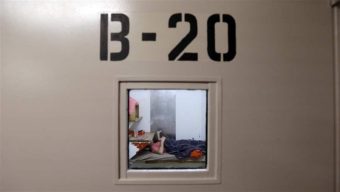
An inmate lies on a bunk reading in the psychiatric unit of the Pierce County Jail in Tacoma, Washington. An estimated 2 million adults with serious mental illnesses are jailed each year. (AP)

Paton Blough has served multiple jail terms as a result of mental illness.

He said his various offenses included brandishing a shotgun, reckless endangerment, destruction of civic property, spitting on a police officer, being a public nuisance and threatening a public official. Never was he charged with being mentally ill. That isn’t a crime, after all. But there was no doubt about why he had ended up in jail.

Blough, 38, has had bipolar disorder since his late teens. At times delusions convinced him of a worldwide conspiracy against him involving police officers, former President George W. Bush and Nazi ghosts.

“Can you imagine if we had two million people locked up for having a heart condition?” Blough, whose last arrest was six years ago, said in a telephone interview last week from his home in Greenville, South Carolina. “Well guess what? We have two million people locked up with a health condition called mental illness.”

In many places, police, judges and elected officials increasingly are pointing out that a high proportion of people in jail are mentally ill, and that in many cases they shouldn’t be there. In recent years, many cities and counties have tried to reduce those numbers by training police to deal with mental health crises, creating mobile mental health units to assist officers, and establishing mental health support centers as an alternative to jail, among other measures.

(Generally, local jails house inmates who are awaiting adjudication or who have short sentences, and they are run by local jurisdictions. State prisons, or penitentiaries, are where inmates serve sentences after conviction. They are the responsibility of the states.)

Earlier this month, a coalition including the Council of State Governments Justice Center, the American Psychiatric Foundation and the National Association of Counties kicked off a national campaign to encourage local jurisdictions to collect data on the jailed mentally ill and adopt strategies to avoid incarceration. In February, the MacArthur Foundation announced it would send a total of $75 million to jurisdictions interested in reducing unnecessary incarceration of people, including the mentally ill.

According to a 2009 study cited by the Council of State Governments Justice Center, an estimated 2 million adults with serious mental illnesses are jailed in the course of a year. Studies, including one from the Urban Institute, say they tend to stay in jail longer than those without mental illnesses, return to jail more often and cost local jurisdictions more money while incarcerated. More frequently than not, they are jailed for minor offenses, such as trespassing, disorderly conduct, disturbing the peace or illicit drug use.

“Today I’m holding 700 inmates and 20 percent are mentally ill,” said Frank Denning, sheriff of Johnson County, Kansas. “Some need to be there because of types of crime, but a higher number would benefit from some other type of intervention, like medication and treatment and so forth.”

Actually, the sheriff was understating the situation in his jail. According to his department’s statistics, in 2014, 22.5 percent of the people jailed in Johnson County were considered sick enough that they were administered psychotropic drugs.

Uncertain Numbers

Across the U.S., jails report that between 20 percent and 80 percent of their inmates are mentally ill. That broad range suggests measurement techniques are far from uniform. A Bureau of Justice Statistics survey found that in 2005, 64 percent of jailed inmates self-reported as having some kind of mental illness.

Many link the problem to the broader issue of a crumbling state and community mental health infrastructure. Without shoring it up, they say, it will be difficult to provide treatment that will keep the mentally ill from coming into conflict with police.

“If there are no other resources and (the mentally ill) have to be in a safe place; that’s still going to be jail,” Denning said.

According to one report, the number of state psychiatric beds in the nation fell from a high of about 550,000 in 1960 to barely 40,000 today. The steep decline began with the movement toward deinstitutionalization of the mentally ill in the 1960s, when scandals over conditions in state-run hospitals caused many to shut down. Now the preferred strategy is to treat mentally ill patients in their own communities.

“It was a good instinct,” said Fred Osher, the director of health systems and services policy for the Council of State Governments Justice Center. “Let’s move people out of these expensive, old, ‘One Flew Over the Cuckoo’s Nest’ facilities. But the problem is that the dollars didn’t flow to the people.”

State spending on mental health services shrunk through the decades. Between 2009 and 2012, states cut back mental health spending by a total of $4.35 billion, according to an often-cited study by the National Association of State Mental Health Program Directors. Although some of that funding has been restored in recent years, it has not been enough to meet the need – with the result that more mentally ill people are ending up in jail.

“It’s been frustrating and tragic that so little has been done to address the problem,” said Ira Burnim, legal director of the Judge David L. Bazelon Center for Mental Health Law. “There’s not a lot of magic in the solution.”

Many are hopeful that the Affordable Care Act’s Medicaid expansion, which extends health benefits to poor, single adults, will enable many to get mental health treatment and avoid the crises that previously landed them in jails. But 21 states have so far resisted expansion.

High Costs

For now, many jails across the country hold more mentally ill people than hospitals do. That is one reason that jail administration has grown to be one of the highest costs for local governments. The mentally ill often require more medical services and surveillance than other inmates.

Even though jails administer psychiatric medicine to many who need it, no one thinks that jails are conducive for recovery from mental illness. Studies, including the Urban Institute report, have found that the mentally ill in jails suffer assaults at far greater rates than those without mental illness. “Jail is jail,” said Toni Carter, a commissioner in Ramsey County, Minnesota, and chairwoman of the Human Services and Education Policy Steering Committee for the National Association of Counties. “It is not a mental health treatment facility… Generally, they come out worse than when they entered.

“We have criminalized mental illness.”

Still, Carter said some cities and counties are employing strategies to keep the mentally ill out of jail that seem to be working. In Miami-Dade County, Florida, for example, police typically respond to 10,000 mental health-related calls a year. A few years ago, that would have led to more than 800 arrests. But after the county trained police in crisis intervention and began diverting the mentally ill to treatment rather than jail, the number of arrests plunged to nine.

Steve Leifman, a Florida judge who heads the Eleventh Judicial Circuit Criminal Mental Health Project, said the average daily jail population in the city of Miami and Miami-Dade County has dropped from 7,800 to 5,000 inmates. The effort has been so successful the county has closed one jail, saving it $12 million a year.

Leifman said the recidivism rate among mentally ill people charged with a misdemeanor has dropped from 75 percent to 20 percent. “Treatment works,” he said. “People with mental illness don’t want to be sick. That’s what most people don’t understand.”

Cook County, Illinois, has found success by using a combination of “supportive” housing (which includes rent subsidies, mental health treatment services), and Assertive Community Treatment (ACT) teams composed of mental health specialists who coordinate treatment and housing and employment support. The strategy has produced an 89 percent reduction in arrests of people with mental illness, and an 86 percent reduction in jail time and 76 percent drop in hospitalizations among participants.

In King County, Washington, a combination of ACT teams, supportive housing and intensive community-based treatments has resulted in a 45 percent reduction in jail and prison bookings among those participating. (See here for these and other examples of successful diversion programs in a report by The ACLU Foundation of Southern California and the Bazelon Center for Mental Health Law.)

According to the Council of State Governments Justice Center, more than 300 cities and counties across the U.S. have established mental health or drug courts, in which the mentally ill and those with substance use disorders are sent to treatment rather than incarcerated. Mental health courts have been established in such diverse locales as the Bronx in New York, Akron, Ohio, and Washoe County, Nevada.

In the majority of Paton Blough’s six arrests, such diversion programs simply were not available.

“They would have liked to have had a place to take me, but there were none,” he said. In jail, he often went without his medication and he found his paranoia deepening. As a result of his illness, Blough said, his first marriage collapsed and he lost his arborist business.

Thankfully, in one of his later arrests, he was sent to mental health court, which led to treatment that has largely kept him stable for six years. “I credit that program,” he said. “I could be dead or in prison if it weren’t for a program like that.”

Today Blough works with National Alliance on Mental Illness helping to promote jail diversion programs.

Read Original Article – May 19, 2015
New Efforts to Keep the Mentally Ill Out of Jail

Keeping the Mentally Ill Out of Hospitals

Inside this unmarked door in lower Manhattan, an experiment is being conducted. People with serious mental illness come to Parachute NYC respite centers to escape pressures in their lives that could lead to a crisis. In most cases, they get the soft landing they were hoping for. (Photo courtesy of Sean Sime Photography)

It is a busy Friday afternoon. Staff members check in guests at the front desk. Other employees lead visitors on tours of the upstairs bedrooms, or field calls from people considering future stays. Aromas of garlic and roasted chicken seep out of the kitchen.

Community Access is not a bed and breakfast, although it feels that way when you walk through its unmarked door off Second Avenue on Manhattan’s Lower East Side. Also known as Parachute NYC, this quiet seven-bedroom facility is one of four publicly funded mental health centers in New York City (located in Manhattan, Brooklyn, Queens and the Bronx) that provide an alternative to hospital stays for people on the verge of a mental health crisis.

Parachute’s respite centers have no medical staff, no medications, no locks or curfews and no mandatory activities. They are secure, welcoming places where people willingly go to escape pressure in their lives and talk to trained “peer professionals” who can relate to what guests are going through because they are recovering from mental illness themselves.

Without places like this, New Yorkers who suffer from serious mental illness would have little choice but to check into a hospital or a hospital-like crisis center when their lives spin out of control. Some people need to be hospitalized for severe psychosis and depression, but many others end up in the hospital because they have no other options.

Relatively rare in the U.S., respite centers like this one cost a fraction of the price of a hospital stay, and can be far more effective at helping people avoid a psychotic break, severe mood swing or suicidal episode.

Community-based mental health services are particularly vital at a time when the number of beds in state psychiatric hospitals has declined sharply. Nationwide, psychiatric hospitals shed 3,222 beds from 2009 to 2012 amid recession-related budget cuts, and the number has continued to decline even as the economy has improved. According to the U.S. Substance Abuse and Mental Health Services Administration, 55 percent of U.S. counties have no practicing behavioral health workers and 77 percent have reported an unmet need.

Launched in 2013 by the city’s public health department, Parachute NYC includes mobile treatment units and phone counseling in addition to the four brick-and-mortar respite centers. A collaboration of city and state mental health agencies, the project received a three-year $17.6 million innovation grant from the U.S. Department of Health and Human Services. Its financial goal is to save $50 million in hospital expenses.

In addition, New York state’s Medicaid agency plans to use a federal waiver to pay for respite services and other community mental health services for 140,000 state residents under a managed care program for people with behavioral health needs. Separately, New York state’s mental health office has invested $60 million since last year on the creation and expansion of community-based services throughout the state, including child and adult respite programs.

“A hospital is the last place you want to be if your life is unraveling,” said Community Access CEO Steve Coe. “They put you in a room, check your blood pressure and walk away and leave you for hours. You need to put your life back together, not be held in a place where you can’t do anything or talk to anyone,” he said.

Nevertheless, there is broad agreement that nonmedical services such as Community Access are not for everyone.

“The caution is that while this approach is good for some people, others really need medication and structure, so it has to be a good match for the person who is coming into it,” said Sita Diehl, director of state policy at the National Alliance on Mental Illness. “The advantage is that you get an expert listener working with you, really delving into who you are, rather than someone slapping a diagnosis on you and handing you a prescription.”

Averting Crisis

Parachute NYC provides a non-threatening environment where people who are coming undone can take a break from their turbulent lives and think through their problems before they reach a crisis point. Many who shun hospitals and crisis stabilization units will voluntarily seek help at respite centers.

In fact, Community Access insists that all prospective guests check in on their own, without coercion from a doctor, friend or family member. They also screen applicants to ensure that respite is their best option.  Some may need medication and more intensive treatment from medical professionals.

“We’re not against medication,” assistant director Keith Aguiar explained. “If they come in with their own medications and they want to take them, that’s fine. But we do not tell them they have to.”

Many guests have full-time jobs and continue working and seeing friends during their stay. They can come and go any time of day or night. Unlike a hospital, Coe stressed, respite centers allow people to maintain their lives and relationships instead of putting everything on hold. Guests can also continue seeing their regular mental health providers during their stay.

The maximum length of stay at Parachute NYC respite centers is 10 days, soon to be shortened to one week under new Medicaid rules.  But guests can return up to three times per year as needed. They also can visit weekly and monthly as “alumni” and take part in group activities and talk to staff.

To qualify for any of Parachute’s respite centers, guests must be New York City residents who are 18 or older.  They must also have a clinical evaluation (within the last 48 hours) and a referral from a mental health provider stating they are not an imminent risk to themselves or others and would benefit from respite care.  Guests also must have stable housing to go back to.

The Guest List

“We have a wide diversity of guests, from a Columbia University professor and an art critic to people who have been chronically homeless much of their lives,” Aguiar said. “We see men and women of all ages and all walks of life.”

In the last month, the guest list at Community Access included a 28-year-old woman who was living in mental health support housing and believed her roommates were practicing witchcraft on her. She was referred by her housing counselor. Another 24-year-old woman with a diagnosis of schizoaffective disorder needed to escape mounting conflicts at home with her brother, who had a diagnosis of schizophrenia. She was referred by a community psychiatric team.

A 70-year-old jazz musician who suffered from drug and alcohol addiction came to get away from his chaotic living situation.  He talked to peers about his struggle with addiction, played his trumpet and napped a lot during his stay. “It was the best sleep I’ve had in years,” he told the center’s director Lauren D’Isselt, who is a psychologist.

Another woman, 25, applied to become a guest without a referral (the center arranged for Parachute’s mobile unit of clinical professionals to provide an assessment.) She’d heard about Community Access from a friend. A native New Yorker who left college because of severe depression, Maggie (not her real name) spoke calmly about her history of mental illness while sitting on a bench on the center’s sunny back courtyard.

“I wanted to finish college,” she said, “but I kept ending up on the tops of buildings.” Diagnosed with depression when she was seven, Maggie has been in psychiatric care most of her life.  She spent the better part of the last six months in hospitals.

Now that she’s back in New York temporarily living with her parents, she said she wants to find the right kind of treatment and get on her feet so she can return to school.  “Living at home is not very comfortable because my parents are the source of my problem. They abused me when I was a child,” Maggie said.  She said she could stay with friends, but they don’t understand what she’s going through.

Five days into her stay, Maggie said it’s been good for her. She’s been able to make plans for future treatment. “It makes a lot of sense,” she said.  “At a typical hospital, they take depressed people and lock them up and away from everyone and expect them to get better. Here you can go out and have coffee with a friend and no one has to go through double-locked doors to see you.”

“When I feel really anxious or sad, I can talk to a peer. Places like this are rare,” Maggie said. “But they shouldn’t be.”

A National Need

One in four adults, about 62 million Americans, experiences some form of mental illness during the course of a year. Of those, about 14 million live with a serious mental illness suchas schizophrenia, major depression or bipolar disorder, according to data from the National Alliance on Mental Illness. More than half of them do not seek treatment, in many cases because they don’t know where to find help.

For those who do seek treatment, the direct medical costs total more than $100 billion per year, according to estimates from the National Institute of Mental Health. Community mental health services such as respite centers may make it possible to reduce those costs and relieve the demand for psychiatric hospital beds, which are in short supply in most communities.

Parachute NYC has so far served about 700 people at its respite centers, 600 through its mobile treatment teams and more than 20,000 through its peer-operated telephone support service. The city’s health department intends to analyze the program to determine whether it has resulted in a reduction in the city’s 100,000 annual psychiatric emergency room visits.

“We don’t perform miracles here,” D’Isselt said. “But we do help people find joy in their lives.” Most guests forge new friendships and leave with a new life plan, she said. “A lot can happen in a week.”

Read Original Article – Published May 15, 2015
Keeping the Mentally Ill Out of Hospitals

Some States Yell “Cut!” on Film Tax Credits

George Clooney plans a shot during the filming of a movie in Cincinnati. Ohio is one of 39 states that offer tax incentives to the film and television industries, but some states are beginning to reconsider whether they are worth the cost. (AP)

Louisiana residents may go gaga over Mark Wahlberg, Kurt Russell and Kate Hudson when they arrive in the state later this year to film a movie about the 2010 Deepwater Horizon oil rig explosion. But Louisiana and some other states are starting to question whether they are giving up too much to attract such star power.

The movie is being made in Louisiana largely because the state offers unlimited tax credits to entice film companies to shoot on location there.  Louisiana was the first state to adopt the credits in 1992. Now, 39 states and Puerto Rico have tax incentives of one kind or another, all aimed at the film and television industries, according to the National Conference of State Legislatures.

Proponents of the incentives point to the many jobs created during filming, from carpenters and electricians to caterers and drivers. But critics say those jobs don’t last. They point to numerous studies (except those commissioned by the film industry) which show that states never recoup the tax revenue they give away with the credits.

Louisiana currently has no limit on the value of the credits it will give out in a given year. But that may change.

Earlier this month, the Louisiana House voted 102-2 to limit film tax credits to $200 million annually. The bill was one of several that sought to put a cap on the credit. With the state facing a $1.6 billion budget shortfall, Louisiana legislators are considering a slew of bills that would reduce or eliminate many tax credits which are draining the treasury. Lawmakers rejected one bill that would have eliminated the incentives. Republican Gov. Bobby Jindal didn’t recommend scaling back the tax credit in his budget, but he may be amenable to doing so.

Other states also are looking at reducing or eliminating film tax credits.

The Alaska Legislature on April 19 approved a bill to kill the state’s film tax credit program, which was scheduled to expire at the end of 2018, in 2016. Independent Gov. Bill Walker also called for a halt to new credits.

Those who supported scrapping the program cited the state’s steep decline in oil and gas revenues. According to a report by the Alaska Department of Commerce, filmmakers received over $38 million in tax credits between June 2009 and June 2013.

In Massachusetts, Republican Gov. Charlie Baker called for scrapping the state’s $80 million film tax credit program and using the funds to partially pay for increasing the earned income tax credit for the working poor. A Massachusetts Department of Revenue report showed that in 2012 only about $50 million of the $304 million in spending by the film industry went to Massachusetts vendors. The House has voted to keep the credit; the Senate has yet to act.

The Michigan Senate voted to spend $12 million on film tax credits after the House voted to scrap them starting Oct. 1. Republican Gov. Rick Snyder sought $50 million for the program in fiscal 2015-16, despite facing a budget deficit. The issue has yet to be resolved.

But other states are doubling down on their film tax incentives.

California, worried about the incentives other states are using to lure Hollywood productions, last year tripled to $330 million the amount available for film tax breaks.

In Pennsylvania, Democratic Lt. Gov. Mike Stack traded footlights for a footrace to raise awareness about what he says is too low a cap on the state’s film tax credit. The program is capped at $60 million a year, and Democratic Gov. Tom Wolf wants keep it at that amount. But Stack, a film actor who still appears in local productions, wants to expand that as much as possible. He ran in the Pittsburgh marathon to raise awareness of the credit issue.

And Maine, which has limited film incentives, now is considering a 25 percent credit for wages paid to residents employed by film productions and a 15 percent credit on wages paid to non-Maine residents. Backers of the bill argue Maine loses production to Massachusetts, which has similar coastal settings.

Bidding Wars

In choosing locations, studios shop for the best tax deals and frequently play off one state against another.

For example, Netflix’s “House of Cards” last year threatened to pull production out of Maryland until the state extended its generous tax credit program, which gave out $62.5 million in credits between fiscal years 2012 and 2016, mostly to “House of Cards” and HBO’s “Veep.”

This year, the Maryland General Assembly tried to rein in the credits, but lawmakers ended up approving a tax credit bill while leaving the specific dollar amount to Republican Gov. Larry Hogan.  Hogan hasn’t yet decided whether he will sign it.

Todd Lewis, unit production manager for the film about the Deepwater Horizon disaster, said tax incentives are almost the first thing movie producers consider when deciding where to shoot. Lewis said Louisiana’s incentives are especially enticing.

“They’ll say to me, ‘Todd, I’ve got a movie, and I want you do to a budget for Louisiana, New Mexico, other states, and we’ll compare them,’” he said. “As long as it’s not location dependent, all of those things have to be taken into account.

“We can’t shoot the Statue of Liberty in L.A. But when you do ‘21 Jump Street’ or the ‘Fantastic Four’ (both of which were shot in Louisiana), you have options. Hollywood wants to go where the best deal is.”

According to the Louisiana Budget Project, a progressive think tank, Louisiana paid $231 million in credits in 2011-12, bringing the state’s total film spending to more than $1 billion in the past decade. The study called the return on that investment “a flop,” saying that taxpayers have paid $60,000 for every job created.

But the Motion Picture Association of America, in its study of the Louisiana program, said that in 2013, production spending associated with the credit supported 10,800 jobs across all industries, generating $471.2 million in personal income and $1.59 billion in economic output in Louisiana. That study called for the unlimited credit to continue.

Vans Stevenson, senior vice president for state government affairs at the Motion Picture Association of America, said states recognize that when they bring in film and television productions, they are “creating employment and investment in a state that wasn’t there before. You are generating additional tax revenue because people who weren’t making money before are spending money on goods and services.”

Robert Tannenwald, a retired Federal Reserve Bank of Boston economist and a lecturer at Brandeis University who authored one of the studies  on the impact of film tax incentives, said the “most careful studies show that you spend an awful lot for every job you create for residents of a state.”

“Film tax credits don’t pay for themselves, so states have to raise taxes or cut expenditures (to make up the difference), Tannenwald said. “Those snuff out jobs as fast as film tax credits create them.”

Tannenwald said the competition among states puts them into “perpetual competitive purgatory. If one state backs out, and the other states keep doing it, the state loses an awful lot of film production.”

He said the benefits of the production are quickly visible – working carpenters and electricians and politicians getting calls from the locals saying it’s fun to watch those films take place. The costs are less visible—and spread out over time.

“People get excited about seeing movie stars in local cafes and walking down the street. You can’t do an anecdotal interview with a commuter who is sitting on a train platform with frozen hands because of the lack of money to upgrade public transportation,” Tannenwald said.

Taking the Long View

Jack Gerbes, director of the Maryland film office, dismissed the negative studies, while not disputing those that have concluded the credits don’t pay for themselves. “This was never about revenue, it was about stimulating the economy, creating jobs and attracting crew members (to Maryland).” He said tourists still come to see the church in tiny Berlin, where the movie “Runaway Bride” was filmed.

Since 2012, Maryland has handed out $62.5 million in tax credits to production companies, according to the state Department of Legislative Services, which concluded that the credit was not worth the cost.

Maryland state Sen. Edward Kasemeyer, a Democrat and longtime backer of the tax credits, said the goal wasn’t to bring in more state revenue, but to create a film industry and“film culture” in Maryland. He said the production companies have spent upwards of $300 million in the state since the credit began.

But Matthew Mitchell of the conservative Mercatus Center at George Mason University said states shouldn’t try to create industries where they haven’t grown up naturally.

“There’s an allure to policymakers, who get irrationally star struck and like the idea of being at a production shoot with Ben Affleck or whoever,” Mitchell said. “With enough incentives, you can grow oranges in Maine. Would it be wise to do so? No.”

Read Original Article – Published May 18, 2015
Some States Yell “Cut!” on Film Tax Credits

Site notifications
Update notification options
Subscribe to notifications