
Trainee Dajaun Alexander preps pizzas with chef instructor Susan Logozzo in an industrial kitchen at Community Servings in Jamaica Plain, Massachusetts. Career training programs like this have been shown to vastly improve a person’s chances of staying clean and sober. (Photo by Amanda Marsden/Community Servings)
JAMAICA PLAIN, Massachusetts – At 52, Dajaun Alexander says he’s looking for a fresh start. He graduated from a cooking course here last week and has been chosen for a paid apprenticeship. His prospects for a full-time job after that are very good, his chef instructor said.
For Alexander, completing Community Servings’ 12-week course represents a rare achievement in a life punctuated by what he calls “bad decisions.” He is a recovering alcoholic with a history of incarcerations, broken relationships and spotty employment. Cooking, he said, “is my passion.”
It may also be his path to sobriety.
The local food preparation facility where Alexander trained is part of a national program known as Access to Recovery (ATR). The voucher program, launched in 2003 and currently funded at $100 million per year, aims to help low-income people in recovery restart their lives and avoid relapse.
Eleven states receive ATR grants for services from addiction treatment to what is called recovery support.
“Treatment is only one aspect of recovery,” said Rebecca Starr, a senior behavioral health consultant at Advocates for Human Potential and ATR project director in Massachusetts. “You’re still in a terrible neighborhood. You still have no money. And you still need a job,” Starr said. “When someone has completed treatment, we don’t want to put them right back in the same situation they came from and expect a different outcome.”
Because most residents have insurance under the state’s 2006 health care reform law, Massachusetts chose not to use its federal grant money to pay for addiction treatment. Instead, those funds go to what Starr calls a safety net for recovery.
In the greater Boston and Springfield areas, ATR serves low-income veterans, women who are pregnant or caring for young children and adults who have recently been released from jail or prison.
ATR programs vary widely by state. But all include vouchers for necessities like interview suits, sets of tools, car repairs and cellphones. Some participants put the money toward driver’s licenses or high school equivalency tests; others use it to set up a checking account.
In addition to the vouchers, each state has developed a set of services and a target population. Michigan, for example, serves only Native Americans and uses tribal healing methods. Illinois and Ohio focus on adolescents in the criminal justice system. North Carolina works with local universities to help college students with addictions.
But Massachusetts’ career building program stands out.
Employment and Addiction
According to the U.S. Substance Abuse and Mental Health Services Administration (SAMHSA), the federal agency that funds the state-run programs, “employment is both an outcome and a core component of recovery.”
Massachusetts began offering career training, the project director said, because extensive research showed that finding and keeping a full-time job was the most important indicator of success in overcoming drug and alcohol addiction.
The state’s own study over the last three years shows that participants who found employment were 40 percent more likely to remain sober, find stable housing, rejoin their families and friends, and avoid incarceration during the six-month program. Studies show that employment improves self-esteem, confidence and morale, and decreases the risk of relapse.
Career training was slow to take off as an alternative to vouchers in Massachusetts, Starr said. Because most people coming into such programs lived in disarray, they couldn’t justify giving up vouchers for critical basic needs to work on the longer-term goal of finding a career.
“Then we had an aha moment,” Starr said of the moment she decided to let everyone have the vouchers (close to $900 per person), and opt into the career program separately. Participants were also given a work-study benefit — $8 an hour for attending classes.
Enrollment soared. In addition to food services, Massachusetts trains workers in construction, commercial cleaning, hospitality services and computers.
Massachusetts set aside a portion of its $8 million ATR grant for training — tuition at Community Servings’ culinary arts program, for example, is $5,000 — and limit the total number of Boston and Springfield residents it could serve.
In its previous grant period, Massachusetts received more than $10 million. Nationwide, more states received grants in 2010 than in the most recent period, which began in September 2014, because SAMHSA has been winding down the ATR grant program and Congress said it would not re-fund it.
But Karen Pressman, planning director at the state Bureau of Substance Abuse Services, says the state will continue the best elements of the program using existing state resources. In addition, state lawmakers may consider appropriating new funds, she said.
Future Possibilities
“ATR has given us a chance to try out some evidence-based practices and incorporate them into our overall systems for recovery,” Pressman said. “For a long time we’ve known that people recover in many different ways. Treatment is one of those ways, but often people recover through other paths. We wanted to make sure we supported people in whatever path they chose to recovery.”
Career training may not be for everyone in recovery, particularly if they don’t have stable housing, Pressman said. But many people need to get a job right away to pay rent or make court-ordered payments. Allowing people to get paid while they learned new skills helped get more people into the program, she said.
Through its ATR grants, Massachusetts has built an infrastructure of providers like Community Servings who have been trained in how to work with people in recovery. They and others can provide services in the future if the state is able to find funding. Other ATR providers include certified addiction coaches, housing specialists and case managers.
For Alexander, a lanky man with expressive eyes and a timid demeanor, the phone call he got from Community Servings’ training director accepting him into the program may have been the break he needed. “I thanked her a hundred times on the phone and a hundred times more when I met her,” he said.
His eyes welled up when he described the first day of class. “We got a chance to meet the CEO and the executive chef and everyone in the kitchen. Each one talked to us. For me it was inspirational,” he said. In addition to the cooking skills, Alexander said the ATR program has given him “a sense of direction.”
Since he left Boston’s South Bay House of Correction in October, Alexander has been living in a nearby homeless shelter. He’s on several waitlists for subsidized housing. For now, he says his goal is to get a job cooking for the elderly in a nursing home or assisted living facility. “My instructor says I should aim higher. But who’s to say? I could do a job cooking for a little while and I might get recognized as someone who could be an executive chef.”
People attend the 45th annual Mille Lacs Band of Ojibwe powwow Saturday, Aug. 20, 2011, at the Iskigamizigan Powwow Grounds in Onamia, Minn. AP
When Tadd Johnson got a call in February that a Native American tribal elder in northern Minnesota had died and authorities were preparing to do an autopsy over his family’s objections, the message was simple.

“They’re going to do an autopsy on Mushkooub, and you need to stop it,” said Johnson, an attorney and chairman of the American Indian studies department at the University of Minnesota’s Duluth campus, a reference to deceased elder Mushkooub Aubid.
It had been years since Johnson, who also is a Native American, had practiced law. But he soon found himself poring over the state’s medical examiner guidelines and religious freedom statutes. He got in touch with Aubid’s family members, who were trailing the medical examiner’s car on its way to Duluth. That’s where the autopsy would be performed within a few hours unless they could stop it.
Johnson and the family obtained a judge’s emergency order halting the autopsy and then went to court to reclaim the body. There, they had to fight a medical examiner who has since been criticized as overzealous at best and insensitive at worst. (The examiner, who has since resigned, did not return calls for comment.) In time, they prevailed in preventing the autopsy and regaining control of Aubid’s body. Along the way, the state’s religious freedom laws were called into question.
Months later, activists and lawmakers in Minnesota say some good came of the episode: It’s being credited with pushing Minnesota to join only a handful of states enacting religious protections for families that object to autopsies, which are often required under state law.
“There really was a disconnect between our statute and a constitutional right,” said Democratic Sen. Tony Lourey, who sponsored the measure that Democratic Gov. Mark Dayton signed in May. “It’s a very emotional conversation. These families were quite upset, and we’re talking about a time when families are really stressed.”
Increasing Attention
Seven states have adopted strong religious protections against autopsies: California, Maryland, New Jersey, New York, Ohio, Rhode Island and, as of July 1, Minnesota.
Members of the medical community, lawmakers and religious rights advocates say the conflict between religious beliefs and a state’s interest in determining a cause of death will likely arise in an increasing number of states because of the diversifying religious makeup of America and a growing sensitivity to religious liberties. A number of groups, including Orthodox Jews, some Muslims and Native Americans, object to autopsies on religious grounds.
“We’re getting more diverse,” said Brian Rusche, executive director of Minnesota’s Joint Religious Legislative Coalition, which backed the autopsy bill there. “We can’t just assume everyone is OK with autopsies anymore.”
But if the trend toward greater discussion of the clash between religious liberties and state autopsy laws is clear, the details and politics remain murky. As illustrated in other states, religious freedom legislation can raise the ire of anyone from church-state separation watchdogs to advocates who fear broad legal protections could be a license to discriminate against lesbian, gay, bisexual and transgender people.
Details Matter
One of the more complicated tasks of handling objections to autopsies is sorting out the specifics of how any measure might work. Even supporters of exemptions acknowledge there must be limits, especially in cases when a death can raise a public health concern or foul play is suspected.
“If your wife is the one that’s deceased, and you have the opportunity to make a religious objection, and you know you had a hand in her death, you might raise a religious objection,” said Robert Small, a retired judge in Minnesota and head of the Minnesota County Attorneys Association, which worked to amend the autopsy bill before it was passed. “There were significant concerns about public safety.”
One of the best ways to deal with those disputes, lawmakers, advocates and medical experts say, is to have a medical examiner work with each family to address their concerns.
That’s how the process typically works in Maryland, said Dr. David Fowler, the state’s chief medical examiner and vice president of the National Association of Medical Examiners. State law explicitly says families have the right to object, and if they do, then officials will discuss the situation with relatives.
“These individuals are obviously at a time when they’ve just lost somebody near and dear to them,” Fowler said. “We will bend over backwards to try to work with the families.”
Fowler said Maryland hasn’t been taken to court over an autopsy objection since 1991. Other states haven’t been as fortunate. And, as the case in Minnesota illustrated, just one dispute between a family and a local medical examiner can shine a spotlight on the shortcomings of state laws.
The Minnesota law, for example, had a contradiction that lawmakers addressed this year. Medical examiners had sole authority to order an autopsy, despite a religious freedom provision in the state constitution. Other states handle the issue differently. In California, for example, people can make their wishes known to the state by submitting a religious objections form.
Yet, even states with existing protection laws aren’t immune from the growing debate.
In New Jersey, Assemblyman Gary S. Schaer, a Democrat and the first Orthodox Jew elected to the Legislature, is sponsoring a bill to amend state law on religious objections. It would require courts to make a determination within 24 hours in any dispute. The timing is especially important in the Orthodox faith, which dictates the dead are to be buried as quickly as possible, Schaer said.
“We don’t want anybody to deal with this at one of the most difficult times of their lives in terms of burying a loved one,” he said.
Schaer’s proposal would also clarify that when a compelling reason for an autopsy must be weighed against a religious objection, the least invasive procedure (such as a “virtual autopsy”) should be used. Any extra costs would be borne by the family.
The measure is awaiting action, and Schaer said he hopes it will move once lawmakers approve a new budget.
Messy Politics
The politics of autopsies can sometimes be messier than the medical or legal details. Georgia is a prime example: Republican lawmakers there failed to pass a broad religious freedom law this year.
The measure said, “Governments should not substantially burden religious exercise without compelling justification.” Supporters said it protected the free expression of religion, while opponents argued it was a thinly veiled attempt to legalize anti-LGBT discrimination.
Supporters invoked autopsy objections in pushing for the measure. They also sought the backing of the Jewish community.
The strategy was initially successful, said Robbie Medwed, assistant director of the advocacy group the Southern Jewish Resource Network for Gender and Sexual Diversity. Lawmakers claimed rabbinical support for the measure as it moved through the Legislature.
But Medwed said LGBT advocates viewed the Jewish community as being used to drum up support for a bill that went beyond autopsy objections.
Medwed and other advocates turned the tide and the Jewish community uniformly opposed the bill, which was then tabled. “They were mostly trying to use this as a trick to get the Jewish community to support this bill,” he said, in reference to the autopsy provision. The bill’s sponsors didn’t respond to requests for comment on the debate.
On the other hand, Minnesota’s autopsy legislation found bipartisan backing. The legislation’s sponsor in the Senate was a Democrat; the House sponsor was a Republican.
Gail Kulick Jackson, a former legislator and lobbyist in Minnesota who helped pass the legislation, said she found the political sweet spot.
“We had the Republicans, who love the idea of religious freedom and religious freedom trumping government action. And on the left, people who liked the fact that it was really respecting of the minority community and their cultures,” Kulick Jackson said. “It made for a very interesting agreement between two very split political parties in Minnesota.”
California’s state Christmas tree shines from 10,000 ultra-low-wattage LED bulbs. State agencies routinely are told to meet energy-saving targets. Whether they do is often hard to determine. AP
When President Barack Obama this spring ordered federal agencies to cut their greenhouse gas emissions over the next decade — to 40 percent below 2008 levels — the concept was hardly novel to state governments. For years, governors and legislatures have set energy conservation targets for state agencies, to save taxpayers money, reduce pollution and set an environmentally friendly example.
States have employed a host of energy-saving programs, green-purchase requirements, building efficiency standards and financial incentive arrangements to meet those goals. So how are they doing in meeting targets they have set for themselves?
A spot check by Stateline found that although some states have made progress, follow through and accountability are mixed. When a new governor is elected, environmental goals and standards can go out the window or be changed. A lack of enforcement can doom good intentions. And poor reporting or bureaucratic tangles can make it nearly impossible for the public to measure progress.
Take Iowa, for example. Republican Gov. Terry Branstad rescinded a 2008 order by his Democratic predecessor, Gov. Chester Culver, establishing a Green Government Initiative that called for a 15 percent cut in state agencies’ overall energy and water use over five years.
Culver’s order, which rescinded an earlier one by Democratic Gov. Tom Vilsack, was deemed to have “created redundancy” in state efforts, said Jimmy Centers, Branstad’s communications director. Centers didn’t have data on whether state agencies had met Culver’s target because “these [executive orders] were signed by previous administrations,” he said. Nonetheless, he said, energy use at the state Capitol complex dropped 21.5 percent between 2008 and 2013.
In Florida, Republican Gov. Rick Scott chose not to continue a 2007 executive order on climate change by his predecessor, then-Republican Gov. Charlie Crist. The order directed state agencies to reduce their greenhouse gas emissions 10 percent by 2012, and 40 percent by 2025. State officials said the quarterly progress reports that Crist ordered are nowhere to be found, nor do they think there was a reporting requirement after he left office.
That priorities change with administrations shouldn’t come as a surprise, said Annie Gilleo, senior policy analyst for the nonprofit American Council for an Energy-Efficient Economy (ACEEE).
“I think it’s common: Over time when you have a change in governor or political party, you see the executive orders tend to lose emphasis,” she said.
Still, Gilleo said, it’s important for states to continue to set an example by establishing specific energy goals.
“The results matter, but it also matters that the government is making public that it thinks energy savings and greenhouse gas savings are important,” she said. “The state is setting an example for the private sector and showing that if it implements policies that affect the public, the state agencies are willing to make the same commitment.”
Progress Not Always Lost
Revoking a previous administration’s goals and standards doesn’t always indicate a lack of progress or abandonment of attempts at measuring achievement.
In New York, Democratic Gov. Andrew Cuomo issued Executive Order 88 in 2012 directing agencies to improve energy efficiency in state buildings 20 percent by 2020, from a 2010 baseline. State government is on track to meet that target. Energy use per square foot dropped by 4.7 percent in the first year, and is projected to fall 6.9 percent after the third year, a 2013 progress report said.
Cuomo’s directive revoked former Republican Gov. George Pataki’s executive order seeking a 35 percent cut in energy consumption below what state buildings used in 1990. State officials now characterize that as a voluntary program, but said that for buildings whose managers provided data, energy consumption dropped 22 percent by Pataki’s 2010 target date.
In Colorado, Democratic Gov. John Hickenlooper is continuing to follow former Democratic Gov. Bill Ritter’s order for state agencies to reduce greenhouse gas emissions 20 percent below 2005 levels by 2020. In 2012, the most recent progress report showed the government was shy of its intermediate target.
As for another Ritter executive order, agencies achieved just a 9 percent reduction in their energy consumption relative to 2006 levels, short of Ritter’s 20 percent goal for 2012. The report stressed that efficiency per square foot had improved 21 percent as state office space expanded.
Hickenlooper is planning new one- and five-year environmental goals, including for reductions in energy and in emissions contributing to global warming, said Karen Phelan, deputy director of energy.
Goals Vary Between States
Over the years, surveys by ACEEE find, energy efficiency policies for state facilities have popped up in all states, varying widely in scope. Some seek an absolute reduction in energy consumption. Others account for growth by requiring efficiency per square foot of state building space — or per gallon in vehicles.
Some policies focus only on state-owned facilities; others include leased space. Some specify cuts in greenhouse gases, by nature involving a greater array of sources than energy reduction mandates. As for fleets, ACEEE found that 33 states have their own fuel efficiency mandates.
Timelines and targets, where they exist, also vary in aggressiveness.
Washington’s Legislature in 2009 issued a sweeping State Agency Climate Leadership Act to curb emissions. Incorporating all 141 state agencies — legislative, administrative, judicial and university branches — it aims to reduce emissions 57.5 percent below 2005 levels by 2050, with detailed online resources describing progress. Ferry boats, state vehicles and heavy equipment, building electricity, so-called fugitive gases that leak from air conditioners and other machinery, and even employee commutes are factored in, said Hedia Adelsman, the Department of Ecology special assistant for climate change.
As of 2014, state agency emissions were 4 percent below the 2005 baseline, and aggressive action — cutting emissions 11 percent below 2013 levels — was needed to reach the next interim target in 2020, a progress report concluded.
“The agencies are plugging along. The beginning was easy, but now we are doing the big things,” like expensive upgrades to insulation, boilers and heating and cooling systems in state buildings, as well as state fleets, Adelsman said. With targets set by law, agencies “can’t just ignore it,” she said. “Some agencies are doing better than others.”
Arizona reported surpassing a more narrowly focused legislative target set in 2003. It sought to cut energy consumption in state buildings 15 percent per square foot by 2011, using a 2002 baseline. The Governor’s Office of Energy Policy reported that key strategies helping to reach 15.8 percent were the replacement of inefficient lighting and cooling equipment; installation of programmable thermostats; more moderate temperatures; and the impact of a reduced state workforce in 2009.
Arizona State University campuses also benefited from so-called performance contracting, which allows agencies to pay for energy efficiency upgrades with the cost savings realized over time. Arizona lawmakers have not set new numeric targets.
Measurement, Data Often Needed
State officials are still working on data to show whether Utah met former Republican Gov. Jon Huntsman’s 2006 order to improve energy efficiency in government 20 percent by 2015. Energy Director John Harrington said his upcoming report will show state buildings have attained the goal. Agency reports so far have emphasized cost savings from ongoing efficiency programs and funding strategies to expand the State Building Energy Efficiency Program.
Incomplete reporting by overburdened bureaucrats can hinder public accountability, even where robust efficiency programs are in place.
In Alabama, staff shortages have made it impossible to know if state agencies met Republican Gov. Robert Bentley’s 2011 goal of dropping energy consumption 30 percent from a 2005 baseline by this year, said Mike Presley, public information manager for the state Department of Economic and Community Affairs.
Without sufficient staff to recover data back to 2005, 2011 became the baseline. Between 2011 and 2014, state-owned buildings reduced their energy consumption 52 percent, Presley said. Key contributors were modernization of infrastructure, new efficient lighting and cooling and heating systems and the Alabama National Guard’s shift to a four-day workweek.
Alabama is one of several states now using an online tool provided by the federal Environmental Protection Agency to assess and track energy use. The EPA urges agencies to “benchmark” their operations, establishing a baseline measure of energy consumption against which changes can be measured.
“It’s a critical first step to improving energy efficiency of buildings. You can’t manage what you don’t measure,” said Mike Zatz, a manager for the EPA Energy Star program.
Transparency and Disclosure
California, known for its aggressive global-warming targets, stands out for easy-to-find public information on the government’s energy efficiency.
A graphics-friendly website tracks each agency’s progress on mandated reduction of energy and water use and greenhouse gas emissions. State agencies as a whole already have surpassed Democratic Gov. Jerry Brown’s 2020 goal to reduce their own emissions 20 percent below 2010 levels, achieving 26 percent as of 2013, according to the California Environmental Protection Agency.
Massachusetts also posts detailed progress reports on its “Leading by Example” green program, launched in 2007 by then-Gov. Deval Patrick, a Democrat.
Mandates cover state executive branch agencies, universities and fleets. And the 2014 reportshows that agencies met Patrick’s 2012 target for reducing greenhouse gas emissions 25 percent, en route to 40 percent by 2020, as well as his goal to increase renewable energy to 15 percent of state government’s consumption. State government fell short of the goal to reduce energy use per square foot by 20 percent, achieving just 3 percent, partly due to dramatic increase in college hours of operation, officials wrote.
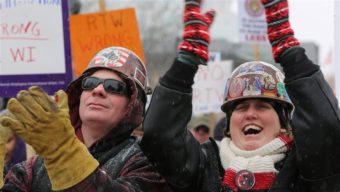
Chris Trapp and Melissa Emerson-Froebe of Iron Workers Local 8 in Milwaukee attend a rally against a Wisconsin right-to-work bill outside the state capitol. The measure passed. About two dozen states took up right-to-work bills or bills to repeal prevailing wage laws this year. AP
Thousands of protesters rallied outside the state capitol in frigid temperatures in February to express their anger before the state Senate voted. The Assembly held a heated all-night debate. But in the end, the Republican-dominated Wisconsin Legislature passed a right-to-work measure this session, making it the 25th state to enact such a law.
Wisconsin was this year’s poster child for labor-related warfare in state capitols. Gov. Scott Walker, who already had whacked collective bargaining rights for most public sector workers in 2011, has rocketed to the top tier of Republican presidential candidates largely because of his anti-labor efforts. His rise is a vivid illustration of how strongly Republicans feel about the issue.
But Wisconsin was only one of about two dozen states where members of Republican-led majorities in one or both chambers introduced either right-to-work bills, aimed at preventing workers from being forced to pay union dues, or measures to roll back prevailing wage laws that establish workers’ pay on public projects.
In the end, right-to-work advocates scored some wins and suffered several defeats. Only two states — Wisconsin and Missouri — passed bills, although Democratic Gov. Jay Nixon vetoed Missouri’s. At least three states — Indiana, Nevada and West Virginia — repealed or scaled back prevailing wage laws.
The battles this year over the legislation — perceived as free-market initiatives by proponents and anti-union by foes — reflect the tremendous power that Republicans have gained in state capitols following November’s elections and the declining political clout of organized labor in many states.
“I think it’s part of a longer-run trend,” said David Macpherson, a labor economist who chairs the economics department at Trinity University in San Antonio. “Republicans have got more control of legislatures and governors than the Democrats do. That’s going to help these laws get passed. It’s the rise of Republicans and the decline of private unions.”
Thirty states have both legislative chambers controlled by Republicans. Twenty-three of them also have Republican governors.
“The growth and excitement we’ve seen on this issue is very positive,” said Patrick Semmens, a spokesman for the National Right to Work Committee. “Unions are a very powerful influence group. They spend a lot of money on politics and lobbying. We see Republicans more willing to take on the issue because they’re not worried about losing the political money support that unions often give to Democrats.”
Labor organizations that oppose such laws say that while a handful of states may have enacted some anti-union bills this session, many rejected them. And, they say, a growing number of Republicans are turning against legislation that would hurt union members.
In Missouri, for example, nearly two-dozen Republicans voted against a right-to-work measure that ultimately passed the legislature. In New Hampshire, 29 Republicans voted against a right-to-work bill that passed the House by a three-vote margin but was defeated in the Senate in a 12-12 deadlock (two Republicans voted no).
“I think there’s a growing awareness amongst many Republican legislators that passing right-to-work bills doesn’t help the struggling middle class. They do just the opposite,” said Brian Weeks, political director for the American Federation of State, County and Municipal Employees (AFSCME), the largest public services employee union in the U.S. with 1.6 million active and retired members. “Attacking the institution of unions and working people is clearly not the answer to helping raise wages in this country.”
Right-to-Work Battles
Some of this legislative session’s most heated battles revolved around right-to-work laws, which prohibit workers from being compelled to pay union fees or dues as a condition of employment.
The struggle over right-to-work has been politically polarizing and bitter. Both sides cite studies showing how such laws affect wages, job growth and state economies.
This session, right-to-work bills were introduced in 16 states, from Colorado to Maine. In some, the measures didn’t even get a hearing. In others, they were debated but couldn’t muster enough votes. In a few, they passed one chamber, but failed in the other.
In New Mexico, for example, a bill supported by Republican Gov. Susana Martinez passed the Republican-dominated House, but was blocked in a committee in the Senate, which is controlled by Democrats.
In Missouri, the Republican-controlled legislature passed a right-to-work measure, but it was vetoed by Nixon, who called it a threat to unionized workers and wages. Supporters will try to override the veto in September, but neither side thinks there will be enough votes.
A 17th state, Virginia, where both chambers have Republican majorities, already has a right-to-work statute. Legislators there went a step further, passing a resolution to add the language to the state constitution. It would need to be approved again by both chambers next session before it could appear on the November 2016 ballot.
Right-to-work proposals also cropped up in other states this year outside of legislatures.
In Ohio, a special commission of legislators and citizens that is reviewing the state’s constitution was asked to consider a proposal that would add right-to-work language. A committee and then the full commission would have to approve an amendment to be forwarded to the legislature, which could then put it on the ballot.
In Oregon, a petition drive to put right-to-work on a ballot initiative was launched but later withdrawn.
And in Illinois, where the legislature is under Democratic control, new Gov. Bruce Rauner, a Republican, has been pushing local governments to adopt “empowerment zones,” in which voters could decide whether workers in their area should have to join a union or pay dues. In Kentucky, not a right-to-work state, some counties have passed such measures. The actions are being challenged in court.
Right-to-work supporters, including business groups such as the Chamber of Commerce, say it’s unfair to workers who don’t want to be part of a union to force them to subsidize it through fees and dues.
“It’s an issue of individual freedom and choice for workers,” said Semmens, of the national right-to-work group. “They know best whether paying union dues is in their interest or not. They should make that decision for themselves.”
Right-to-work boosters, such as the American Legislative Exchange Council (ALEC), a free-market think tank that drafts model legislation, argue that states that have such laws attract more businesses — improving wages and boosting the economy.
“The more states that pass right-to-work, the more pressure on the surrounding states to enact it,” said Michael Hough, a Maryland Republican state senator and director of ALEC’s Center to Restore the Balance of Government. “I think you’re going to see more of these bills. This is a trend.”
Labor organizations and their supporters strongly oppose right-to-work laws, saying that nonunion members benefit equally from negotiations with employers and that cutting off their dues and fees would threaten their very existence.
“Right-to-work just allows the freeloaders not to pay for their share,” said Wisconsin Democratic state Rep. Frederick Kessler, a labor arbitrator and staunch right-to-work opponent.
The groups also say that workers in right-to-work states earn lower wages and have declining incomes, which in turn weakens the economy. “Stronger unions mean a stronger middle class with better pay and better benefits,” said AFSCME’s Weeks.
Union membership has been declining in the U.S. over the years. In 2014, 11 percent of wage and salary workers were union members, according to the U.S. Bureau of Labor Statistics. In 1983, the rate was 20 percent.
“Those who propose these laws are doing it more out of anti-union sentiment than out of their concern for the rights of workers to join or not in general,” said Gary N. Chaison, a professor of industrial relations at Clark University in Worcester, Massachusetts, who believes that workers should be free to make their own decisions about whether to pay union fees. “The attitude is, let’s kick them while they’re down and let’s not let them bounce back now that they’ve fallen so much on their own.”
Wisconsin Fight
In Wisconsin, the road to right-to-work legislation was bitterly partisan. In the Assembly, all 62 Republicans voted for the bill and 35 Democrats voted against. In the Senate, all 14 Democrats voted no, as did one Republican — a former union member.
Democratic state Rep. Chris Taylor, who strongly opposed the measure, said that what happened in her state emanated from a national anti-union agenda being pushed by groups such as ALEC.
“You have a very empowered far-right contingent that has captured the Republican Party in Wisconsin,” Taylor said. “They are on a mission to really gut unions and decimate their political power.
“But we have a wage crisis in our state. We have flat wages,” she added. “The last thing you do is make it harder for people to be part of unions.”
Wisconsin Republican state Rep. Chris Kapenga, who co-authored the right-to-work measure, disagrees, saying it’s not a matter of being pro- or anti-union, but of individual choice.
“Some people love their unions. Others don’t like how things are handled in their unions, how they deal with their employer,” Kapenga said. “This [law] allows them freedom to choose.”
Kapenga said the law makes good economic sense for Wisconsin, as it will attract businesses that, because of union issues, stay out of states that do not have right-to-work.
Those are the same arguments Republican state Rep. Eric Burlison used when he sponsored right-to-work legislation in the Missouri House.
“We are surrounded by states that do have this freedom for employees,” Burlison said. “We’ve watched businesses leave and when they do leave, it has lasting impact. It’s clear that the grass is clearly greener on the other side of the border.”
Prevailing Wage Changes
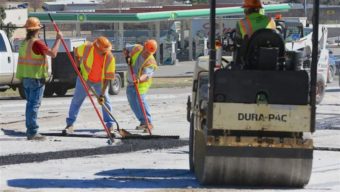
The other hotly contested labor issue was whether to repeal or restrict prevailing wage laws. These laws require that workers on certain types of publicly funded construction projects be paid the going rate in a given area. The rate-setting method varies by state. In some, the numbers are determined through an annual survey of both union and nonunion contractors.
Bills to repeal or scale back prevailing wages were introduced in more than a dozen states. Virginia, in addition to Indiana, Nevada and West Virginia, passed legislation. But Democratic Gov. Terry McAuliffe vetoed the Virginia bill, and the GOP-led Senate couldn’t muster enough votes to override. In Wisconsin, a repeal measure squeaked out of an Assembly committee but did not make it into a budget bill. A bill to pare back the prevailing wage may be taken up separately on the Assembly floor this week.
Supporters say these measures are a sensible way for states to save money.
“Prevailing wage dramatically increases the cost of public construction, whether schools or roads,” said ALEC’s Hough. “Obviously, unions have benefited from it, but it’s been at a great cost to taxpayers.”
Opponents say prevailing wage repeal is just a way to chip away at unions and assail workers’ rights.
In some states, legislators are getting pushback against repeal from contractors who have been paying prevailing wage and don’t want it to disappear.
“The building trades’ employers have highly trained workers — plumbers, ironworkers — who have been getting paid the prevailing wage,” said Wisconsin Democrat Kessler, a prevailing wage supporter. “Companies look at that and say, we don’t want to have somebody whose skills are lacking.”
West Virginia state Senate Minority Leader Jeff Kessler (no relation), a Democrat, said that when his state took up the prevailing wage issue this session, he received an inch-thick stack of letters from businesses urging legislators not to eliminate or change the law.
“They’re getting a skilled workforce, not unskilled laborers who can end up causing cost overruns,” Kessler said. “It was the first time I saw labor and business line up together.”
Rather than repealing the law, the West Virginia Legislature, with a Republican majority in both chambers, passed a compromise that was signed by Democratic Gov. Earl Ray Tomblin. It exempts any publicly funded construction job that is $500,000 or less from the prevailing wage. It also requires that a new methodology be created to calculate the prevailing wage formula.
Republican state Sen. Craig Blair, who sponsored the measure, said that the new legislation will save taxpayers money, create jobs and allow government to do more projects and employ more people.
“The prevailing wage law was unfair to taxpayers. It was an absolute racket,” Blair said. “Someone who works construction six months out of the year makes $40 an hour and benefits under prevailing wage. Someone doing the same job in the private sector makes $20 an hour and works 12 months out of the year. It’s a pretty good gig if you can get it.”
West Virginia is temporarily without a prevailing wage for work on big projects because Republicans didn’t agree with the way a new rate was calculated under the new methodology that the legislature required by July 1.
Blair said that if Republicans were to vote now, they’d go for a full repeal. But Kessler said eliminating the prevailing wage would hurt both workers and businesses.
“It provides employers an opportunity to make a profit and pay our skilled laborers a decent wage and build quality projects on time and on or under budget,” Kessler said.
Kessler, who is running for governor in 2016, said this year’s prevailing wage battle in West Virginia has been a “real wake-up call to the labor unions.”
“Labor has its ears pinned up, and the radar’s on and they’re watching,” he said. “They know there’s an absolute distinction between the policies of the two parties on labor issues. I think you’ll see things will be very different in 2016 when it’s time for the elections.”
A road crew works next to a gas station on U.S. Route 275 in Omaha. Nebraska was one of eight states that increased gasoline taxes this year to pay for roads and bridges. AP
Falling bridges and crumbling roads trumped anti-tax sentiment in more than a half-dozen states during this year’s legislative sessions, prompting them to increase gasoline and other taxes to address infrastructure needs. In some states, the taxes hadn’t gone up in decades.
Tired of waiting for federal transportation dollars, eight states, all but one of them headed by Republican governors, either hiked gas taxes or scaled back a planned cut to bring in more money. They are: Georgia, Idaho, Iowa, Kentucky, Nebraska, North Carolina, South Dakota and Utah. At least four states are putting the final touches on increases or are still considering them. And in California, Democratic Gov. Jerry Brown has called for a special session to determine how to finance $59 billion in freeway and road repairs.
Even in states that debated the issue but declined to act, momentum could carry over into next year’s sessions.
Carl Davis, research director at the Institute on Taxation and Economic Policy, said efforts to raise state taxes to pay for roads and bridges exploded this year. In 2013 and 2014, four states (Massachusetts, New Hampshire, Vermont and Wyoming) increased their gas taxes, while Maryland, Pennsylvania and Rhode Island indexed the gas tax to either inflation or fuel prices. Virginia approved a complicated formula that will allow the tax rate to rise with gas prices in future years.
“A lot of states realized they couldn’t put off this issue any longer,” Davis said. “They saw they couldn’t trust the federal government to raise the gas tax and they had to do something on their own.”
Efforts in Congress to increase or alter the 18.4 cents per gallon federal gasoline tax have fizzled, tied up in a broader debate over a comprehensive transportation bill. Republicans remain opposed to increasing the gas tax, which hasn’t changed since 1993, and President Barack Obama did not include an increase in his long-term plan for the nation’s infrastructure.
A coalition of the business community, the transportation industry and ordinary taxpayers just trying to get to work every day drove the tax increases in the states. A widely circulated report from the American Road & Transportation Builders Association, which listed tens of thousands of “structurally deficient” bridges in each state, helped fuel the efforts.
One of the bridges the report highlighted was the Arlington Memorial Bridge, which links the Lincoln Memorial to Arlington National Cemetery across the Potomac River. Several lanes of the bridge were closed in May, and thousands of tour buses were prohibited from the span because they exceeded the bridge’s new weight limit.
Many state lawmakers around the country are still haunted by the collapse of the I-35W Mississippi River Bridge in Minneapolis in August 2007, which killed 13 people and injured 145. The National Transportation Safety Board found the bridge supports had deteriorated and could not bear the weight of heavier modern vehicles. The same construction is found at thousands of other bridges, the report said.
States with GOP governors and legislatures which raised gasoline taxes include Georgia (Gov. Nathan Deal), Idaho (Gov. C.L. “Butch” Otter), North Carolina (Gov. Pat McCrory), South Dakota (Gov. Dennis Daugaard) and Utah (Gov. Gary Herbert). In Iowa, Republican Gov. Terry Branstad worked with a split legislature to raise the gas tax. Kentucky Gov. Steve Beshear, a Democrat, also collaborated with a split legislature to scale back to 1.6 cents a planned 5.1 cents per gallon gas tax cut triggered by falling gas prices.
In Nebraska, the nonpartisan but conservative legislature overrode Republican Gov. Pete Ricketts’ veto and enacted an increase of 6 cents per gallon, which will be rolled out in stages starting in January 2016.
Georgia Press
Georgia, where Republicans dominate, stands out. Republican Gov. Deal laid the groundwork last year for a tax increase to pay for infrastructure, commissioning a state study on the subject and bringing together the leaders from the House and Senate. At the start of the legislative session, Deal and House and Senate leaders called for a tax hike at the Chamber of Commerce, earning its support. Deal led the way, despite having signed the “no tax” pledge promoted by Washington anti-tax activist Grover Norquist.
Georgia increased its gasoline tax by about 6.7 cents per gallon on July 1. Significantly, future increases will take into account inflation and fuel-efficient cars, two of the biggest problems with the per gallon approach to taxing gasoline. The new Georgia law imposes a $200 annual fee on electric vehicles (to compensate for the minimal amount of fuel they require) and levies an extra $5 a night fee on hotel and motel stays dedicated to transportation needs. It also assesses an annual weight-based fee on trucks that ranges from $50 to $100. The extra taxes are expected to raise $1 billion a year.
“Here in Georgia, we’ve reached the point where current resources are not enough to preserve and maintain the infrastructure that is vital to businesses, current and prospective, and families all over the state,” said Merry Hunter Hipp, a spokeswoman for the governor. “This influx of funds will allow the state to maintain the roads and bridges that we travel on daily to get to our jobs, schools, homes and grocery stores — an investment that the governor feels that we can all support.”
Norquist’s Americans for Tax Reform group railed against the increase. Paul Blair, state affairs manager for the group, said raising taxes “is what legislators and governors do because they don’t have the willpower to cut spending elsewhere.”
“If transportation is a state priority, it should be funded first in the budget, not last,” he said. “Gov. Deal did violate his personal written commitment to Georgia taxpayers in pushing for and signing a gas tax hike on consumers. Those same consumers rejected a sales tax increase for transportation projects back in 2012 by a 61-39 margin, so he should know better.”
But former state Rep. Jay Roberts, a Republican who Deal recently appointed as the planning director for the Georgia Department of Transportation, said voters have learned much since then. Roberts said he doesn’t worry about the tax pledge or Norquist’s group.
“I don’t need somebody in Washington, D.C., telling me what to do in Georgia,” he said. “If he [Norquist] wants to fix something, fix what’s wrong in Washington.”
Roberts gave several reasons why he and the other state leaders were able to sell the tax hike to constituents: The tax hadn’t been raised since 1971; it had diminished in value because it was not indexed to inflation; concern over crumbling roads and bridges was widespread; and business and industry supported the increase.
To make the case to his former colleagues in the legislature, Roberts put together a folder for each one that listed the deficient bridges in his or her district. That blueprint could be used in many other states, according to John Weingart, associate director of the Eagleton Institute of Politics at Rutgers University in New Jersey.
“Transportation is one of the few issues that hit everybody,” Weingart said. “It’s where the work of government is visible to everybody.”
New Jersey discussed transportation needs this year, and officials said the state’s transportation trust fund was “about to go bankrupt,” Weingart said. But that dire prediction was later revised, giving state leaders another year to grapple with the problem.
Inflationary Argument
In several states, pointing out that the gas tax hadn’t been raised in many years proved to be a powerful argument. According to a May survey by the Institute on Taxation and Economic Policy, 20 states have gone a decade or more without an increase in their gas tax rate, 15 states have gone two decades or more, and five states (Alaska, Oklahoma, Mississippi, South Carolina and Tennessee) have not seen an increase since the 1980s or earlier.
In Utah, gas taxes hadn’t been raised in almost 18 years before Gov. Herbert signed a bill in March, passed by the GOP-controlled legislature, which raises the existing 24.5 cents per gallon gas tax by 5 cents. The measure also ties future increases to inflation, with a ceiling of 40 cents per gallon. Despite complaints from opponents that the state has a surplus in its budget and shouldn’t be raising taxes, Herbert successfully argued, as he said in his signing statement, that “a strong transportation infrastructure has played a critical role in our economic growth and it will continue to do so thanks to this bill.”
Marty Carpenter, Herbert’s spokesman, said the tax hike “made the necessary changes needed to invest in a critical component of our state’s economic development.” He said the treasury has enough money for current projects, but would fall $11 billion short of the state’s long-term transportation needs.
In South Dakota, then-Republican candidate Daugaard ran for governor in 2010 on a “no taxes” pledge. But when he ran for re-election in 2014, Daugaard had altered that stance. “If you vote for me again, I’m not committing to not raising taxes in transportation,” he said, noting that the gas tax had not kept up with inflation.
The bill Daugaard signed in March includes a gas tax increase of 6 cents per gallon, a 1 percent increase in motor vehicle excise tax and a 20 percent increase in license plate fees. Perhaps throwing a bone to drivers in the mostly rural state, the bill also increased the speed limit on the state’s interstate highways to 80 mph.
“There has been very, very little unhappiness expressed to me,” Daugaard said. “In fact, there’s been much more mail saying, ‘That’s the right thing to do, we need roads.’ ”
In Iowa, Republican Gov. Branstad signed a bill in February increasing the state’s fuel tax by 10 cents per gallon. Before then, the tax was 21 cents for regular gasoline, 19 cents for ethanol-blended gasoline and 22.5 cents for diesel. State officials said each penny of the hike would raise $23 million annually.
And in Idaho, Republican Gov. Otter signed a bill increasing gas taxes by 7 cents per gallon, even as some GOP lawmakers said 7 cents wasn’t enough and urged a 10 cents hike. Otter said the 7 cent increase would raise about $95 million, allowing the state to begin addressing its backlog of transportation projects. Idaho hadn’t raised gas taxes for almost a decade.
“I think the view here is that nobody likes raising taxes, especially this governor in this state, but as the governor has said on numerous occasions, ‘deferred maintenance is deficit spending,’” Otter spokesman Jon Hanian said.
Still Trying
Some states are still working on increasing taxes to pay for highway and other infrastructure projects, though efforts in other states never made it to the finish line.
In Washington, the legislature just sent Democratic Gov. Jay Inslee a $16.1 billion transportation funding plan that would raise the state’s gas tax by 7 cents per gallon starting Aug. 1 and another 4.9 cents on July 1 of next year, with the bulk of the money going to road construction, repair and maintenance.
In Michigan, voters in May soundly defeated a ballot measure that would have hiked the overall state sales tax one point to 7 percent, removed the general tax from gasoline sales and replaced it with a higher excise tax on fuel to raise about $1.3 billion for road construction.
But Republican Gov. Rick Snyder has not given up on getting a tax bill through the legislature. The House and Senate have passed separate bills that would increase gasoline and diesel taxes to help raise $1.4 billion or more a year. The two bills, which vary considerably, would have to be reconciled later this summer before being sent to Snyder to sign.
In South Carolina, a gas tax increase that was twinned with an income tax cut failed to make it through the session. Lawmakers had said they could possibly find $150 million in the upcoming budget to give to counties in a one-time distribution tagged for road repair. But transportation advocates said that would not have been enough. Republican Gov. Nikki Haley has said she would veto any transportation tax plan that didn’t coincide with a reduction in state income taxes.
In Wisconsin, Republican Gov. Scott Walker’s nascent presidential campaign is coloring transportation tax discussions. Rather than raise taxes and risk being labeled a “tax-and-spend” candidate, Walker has proposed authorizing $1.3 billion in bonds for transportation. But going into debt has not been well-received by Republicans in the legislature. The legislative battles have pushed back Walker’s official candidacy announcement.
In Minnesota, site of the infamous Interstate 35 bridge collapse, the governor and legislature also failed to agree on a transportation and tax bill during the regular legislative session, though the issue could resurface in a special session later this year. Democratic Gov. Mark Dayton had proposed a tax increase.
Stella Dempsey lives in a tent in Fredericksburg, Virginia. She says she’s been homeless for years because of physical and mental health issues. States struggle to help people like Dempsey. (Photo by Rollie Hudson)
At the Micah Ecumenical Ministries, in the center of this quaint colonial town, Stella Dempsey sits in the waiting room, looking dejected. Ministry staffers offered her a bed at a shelter, but she says she can’t bear to go back. Still, she’s feeling desperate.
She is homeless and jobless and sleeps in a tent in the woods. She’s got cirrhosis of the liver, high blood pressure, diabetes and a bad back. Two months ago, she said, she almost died. Now, she’s run out of all her medications, from her bipolar meds to her insulin. She is not eligible for Medicaid under Virginia law.
“I have nothing until they give me disability,” the former waitress said, her eyes welling. “I’m hoping for help. I need food stamps, a clinic for my meds. … People look down on people who are homeless. They think we’re nasty and no good. But some of us can’t help it. If I could help it, trust me, I would.”
At first blush, Dempsey, 43, doesn’t fit the stereotype of the chronically homeless. She’s neatly dressed in flowered capris, her hazel eyes rimmed with eyeliner. But in Fredericksburg, as in other small towns, suburbs and rural corners of the country, the homeless are often hidden, out of sight and mind, hard to reach and hard to help, say people who work with the homeless.
This poses a challenge for states. The causes of homelessness in small towns are the same as in big cities: poverty, mental illness, inadequate housing, domestic violence and the psychological wounds of war, according to the United States Interagency Council on Homelessness. But rural areas are more likely to be poor, with limited transportation, making it that much harder for the homeless to get to a center that can provide counseling, a housing voucher or medical care.
A handful of states are making strides toward tackling the issue, although most of the work is done by nonprofits. Advocates say most states are not doing enough and that a different approach is needed to solve the problem of rural homelessness.
In big cities, you see the homeless virtually everywhere, sleeping under a bridge or in the park, pushing around overflowing shopping carts. The rural homeless live in the woods, in tents or in campers, in barns and ice sheds. They crash on a friend’s couch. Or they’re living in a shack with no heat, electricity or running water—usually not far from where they were born and raised. Many of them are employed or underemployed.
Often, they don’t come forward for help because they are ashamed, advocates say. And because they’re not easily spotted, or they’re not showing up for help at agencies, some advocates for the homeless argue that the rural homeless are being undercounted.
“There’s a lot of poverty in rural areas—and there are a lot of families that don’t have their own homes,” said Wendy Kinnear, regional coordinator for the state of Pennsylvania’s Education for Children and Youth Experiencing Homelessness program (ECYEH).
“My frustration is that this isn’t something that people talk about,” said Kinnear, who works with 10 rural counties in northwestern Pennsylvania to identify and assist homeless children and their families. “We don’t get the same funding and support. People are being undercounted—which means they’re not getting the services and funding that they can be tapping into.”
State Efforts
Some states have tried to find innovative ways to combat rural homelessness.
In Colorado, the Coalition for the Homeless runs a rural initiatives program, collaborating with 14 rural agencies to provide transitional housing, counseling, support, permanent housing and rental assistance.
This July, Virginia, which has a large rural population of nearly 2 million, will launch itsHousing Trust Fund to encourage affordable housing. The $8 million fund (for 2015 and 2016) allocates $1 million for a competitive homeless reduction grant, according to Kathy Robertson, associate director of homeless and special needs housing for the state.
In North Dakota, where homelessness has skyrocketed after the oil boom created a housing shortage, legislators created a Housing Incentive Fund, allocating $35 million in 2013 to encourage the development of affordable housing. But that fund was depleted within five months.
“We need market forces to drive housing costs down,” said Michael Carbone, executive director for the North Dakota Coalition for Homeless People. “But there’s a reluctance on the part of legislators to put money into affordable housing. They’re afraid it’ll overdevelop. But there’s no reason why a small town here should have Manhattan-level rents. It’s crazy.”
Continuum of Care
Most help for the homeless is funded by the U.S. Department of Housing and Urban Development (HUD), which goes to the states and then is distributed to local agencies. Population determines where funds are allocated. In rural areas, there are fewer continuums of care (CoC), local, community-based organizations that are responsible for coordinating aid for the homeless, usually with federal funding distributed by the states. Fewer CoCs means fewer homeless people are being served, Kinnear said.
HUD set aside $30 million for a competitive grant to tackle rural homelessness. But the agency didn’t get enough applicants to send money to rural areas, according to Ann Oliva, director of HUD’s Office of Special Needs Assistance Programs.
Most big cities have a well-developed infrastructure for helping the homeless, with dedicated funding for programs and an extensive network of providers, said Steve Berg, vice president for programs and policy for the National Alliance to End Homelessness. In more rural areas, there might be a program in town or a couple of shelters run by a church. One CoC could be responsible for handling vast swaths of a state, Berg said.
“There’s not really a system for dealing with rural homelessness,” Berg said. “The person at the local food bank might be trying to figure out what to do about homeless people. In some places there are shelters; in others, there are none.”
The bulk of state funding for its homeless populations goes to big cities, advocates say. Andrea Sheesley, of Pennsylvania’s ECYEH program, says that funding for homeless children in the region she serves as coordinator was cut by 75 percent last year, while funding in the big cities like Erie and Pittsburgh increased.
Many homeless people say that even when services are to be had, they are tough to access.
The local homeless agencies haven’t been much help, said “Alan,” who asked not to be identified for fear of being ostracized by the agencies in Fredericksburg. “They only help some people,” Alan said. “They have their favorites.”
He said he’s been homeless for two years, after a judge slapped him with $7,000 in court fees because he failed to make full child support payments after construction jobs dried up. He said he sold his truck and got rid of his apartment to pay the court fees. It was that or jail. “I told the judge, ‘You’ve now made me homeless.’ He said, ‘At least you’ve paid your child support. Don’t ever be late again.’ ”
Alan, 46, who has his own handyman business, said he has worked the whole while, paying $1,049 in child support each month. Because of that, he said, he’s had a hard time saving enough to cobble together the first month’s rent and security deposit needed for an apartment.
For now, he works during the day and sleeps under a church’s stairs at night. The pastor doesn’t mind, he said, as long as he’s gone by morning. “It’s amazing what you get used to,” he said.
A Tough Count
It’s hard to get a handle on just how many homeless people live outside big urban areas. Counting the homeless has always been tricky, and tracking methods vary among federal agencies.
When it comes to counting non-urban homeless populations, HUD bundles suburban and rural populations. By that count, roughly 28 percent of the nation’s homeless live outside big cities, according to HUD’s Oliva. Meanwhile, the National Alliance to End Homelessnessplaces the rural homeless population at 7 percent. It estimates that 14 out of every 10,000 people experiencing homelessness live in the country, compared with 29 out of 10,000 living in the city.
The rural homeless are more likely to be white. More women in rural areas are homeless, about 42 percent of the homeless population compared with 35 percent in cities, according to Oliva. In the country, you’ll see more homeless families than singles, and more youth under 18, she said.
For some of the homeless in the nation’s small towns and suburbs, it’s hard to find a shelter. But once they do, shelters can provide a way out.
Michael sits in the basement of St. George’s Episcopal Church in Fredericksburg, where, every Monday, the doors are thrown open for a “community dinner” where any and all are welcomed to get a hot bite to eat. Other days of the week, other churches in town return the favor.
“I am a disabled vet,” said Michael, 61, who preferred that only his first name be used because of his circumstances.
There was a time when Michael, who said he served in Vietnam, was doing just fine. He said he went back to school on the GI Bill, worked for years as a welder and a mechanic. He even bought a house. But somewhere along the way, he lost the house. He hurt his back, suffered from post-traumatic stress disorder and depression, and fell behind in his child support. His paycheck was garnished and suddenly he didn’t have the money for rent.
“I didn’t sleep under a bridge, in a bus station or in the woods,” Michael said. “I had places to stay.”
But to get the help he needed, to get on disability, he decided to enter the system. First, he signed up to stay at the local shelter so that he could be classified as “chronically homeless” and be eligible for housing assistance. The Micah center in Fredericksburg helped him find an apartment and a landlord who didn’t mind tenants with a history of homelessness, and it paid his first month’s rent and security deposit. Now, he volunteers at Micah, giving back what was given to him.
“Since I was able to establish my own place, I don’t have to be in that [homeless] clique anymore,” Michael said. “But I don’t forget where I come from.”