Spirit

Unbelief As A Belief System: Core Tenet For Christians’ Fight For Religious Rights

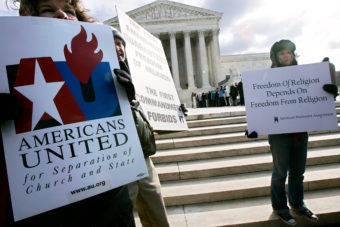
Activists hold posters during a March 2005 rally in front of the U.S. Supreme Court to support separation of church and state. The court heard two cases regarding whether Ten Commandments monuments should be displayed on government properties. Alex Wong/Getty Images
Activists hold posters during a March 2005 rally in front of the U.S. Supreme Court to support separation of church and state. The court heard two cases regarding whether Ten Commandments monuments should be displayed on government properties.
Alex Wong/Getty Images

Christian conservatives who are battling for the right to promote their faith in public or official settings see themselves locked in an epic contest with a rival religion. But that rival isn’t Islam. It’s secularism.

“Secularism and Christianity are distinct, immutable religions,” writes David Lane, founder of the American Renewal Project, a group he organized to promote more political participation by conservative pastors. “Secularism advances the fundamental goodness of human nature, where historic Christianity sets forth a pessimistic view of human nature.”

The notion that secularism can be seen as a religion is ridiculed by many nonreligious people, but Lane and other Christian conservatives have their own Supreme Court hero to back them up: the late Justice Potter Stewart, who served on the court from 1958 to 1981.

The late Justice Potter Stewart, who served on the Supreme Court from 1958 to 1981. Stewart was the lone dissenter in a 1963 decision banning Bible readings in public schools. Charles Tasnadi/AP
The late Justice Potter Stewart, who served on the Supreme Court from 1958 to 1981. Stewart was the lone dissenter in a 1963 decision banning Bible readings in public schools.
Charles Tasnadi/AP

The lone dissenter in School District of Abington Township v. Schempp, a 1963 Supreme Court decision that banned Bible readings in public schools, Stewart argued that prohibiting such religious exercises put religion in “an artificial and state-created disadvantage.” Such a ban, Stewart said, “is seen, not as the realization of state neutrality, but rather as the establishment of a religion of secularism.

Defining Secularism And Its Relation To The State

That view of secularism as a religion has since become a key part of the conservative argument against a strict separation of church and state. It suggests that when government authorities ban prayers or Bible readings or Nativity scenes on public property or in official settings, it isn’t avoiding the appearance of state support for religion, it’s unfairly favoring one faith tradition over another.

In 1984, President Ronald Reagan cited Stewart’s dissent in arguing for a constitutional amendment authorizing school prayer.

A secular viewpoint is normally understood as one that excludes religious references, so Stewart’s claim is controversial, even among some people of faith.

“Secularism is a way you look at the relation between government and religion,” says Barry Lynn, a Christian minister who also directs Americans United for Separation of Church and State. “If you say religion should keep its hands off government and government should keep its hands off religion, that to me is what a secularist is. You can have any or no theological beliefs backing that up.”

Some scholars nevertheless say some advocates of secularism do have their own worldview and belief system. Among them is Robert George, the McCormick Professor of Jurisprudence at Princeton University and a leading lay Catholic intellectual.

“I don’t think there really can be any question that there are forms of secularism, including some that are very prominent today in universities and other elite sectors of our society — belief systems that are comprehensive views — that function in people’s lives the way that religions function in the lives of traditional religious believers,” George says.

Russell Moore, president of the Ethics and Religious Liberty Commission at the Southern Baptist Convention, goes further.

“In some virulent forms of secularism, you have a moral code that is being imposed [that] often comes with the force of penalty of law,” he says. “It acts as a religion in terms of demanding conformity and seeking out heretics.”

Recent polling by the Pew Research Center suggests that secular attitudes are gaining strength in the United States, with fewer Americans saying they pray daily or attend church regularly.

But can secularism really be considered a religion?

Unpacking What It Means To Be Secular

No way, says sociology professor Phil Zuckerman of Pitzer College in Claremont, Calif. He specializes in the study of “nonreligious” people.

“To me, what makes religion religion is the supernatural beliefs,” he says. “So a scientist who is gazing out at the universe and trying to make sense of it by looking at facts, physical properties, material reality, is not engaging in religion. The person who looks out at the universe and thinks there’s a magic deity behind it is engaging in religion.”

Phil Zuckerman speaks to his class at Pitzer College in Claremont, Calif. Zuckerman specializes in the study of "nonreligious" people. Scott Phillips/Courtesy of Pitzer College
Phil Zuckerman speaks to his class at Pitzer College in Claremont, Calif. Zuckerman specializes in the study of “nonreligious” people.
Scott Phillips/Courtesy of Pitzer College

At Pitzer, Zuckerman has founded an academic program in Secular Studies, the first of its kind in the country.

“We need to unpack what it means to be secular,” Zuckerman tells his students in a recent class on the sociology of secularism. “There is so much diversity and so many ways to be secular.”

One of Zuckerman’s students, Chance Kuwar, says in an interview that his “nonreligious” identity stemmed in part from his experience in a Boy Scout troop sponsored by a local Catholic parish in San Diego. As a teenager, Kuwar says, he realized he was gay.

“There was a lot of name-calling and bullying, and I actually got kicked out of the organization,” he says. “That was a very traumatic experience for me, not being welcomed by this religious community because of my sexual orientation. It was certainly a big turnoff for me in terms of religion.”

Finding Acceptance Among The Nonreligious

Not all of Zuckerman’s students are anti-religion, however. April Forrest, a 30-year-old single mother who is finishing her college education, notes during a class discussion that not all Christian churches are as judgmental as they are sometimes portrayed to be.

“You do find ones where it is about love and trying to make the world a better place and being more like God,” she says, “which would be like being as good as you can be.”

In a paper she wrote for Zuckerman, Forrest argued that God should not be blamed for bad things that happen.

“I believe in a loving God,” she wrote. “I know that life isn’t perfect. I watched my mother’s battle with drug addiction and depression. I’ve seen my father in and out of jail … I saw my uncle die of AIDS. … At 23, I was diagnosed with muscular dystrophy. I struggle every day to do regular tasks. But I still believe.”

In a personal note to Zuckerman that she added to the paper, Forrest wrote, “I’m sure you have a lot to say back to this. Actually, I’m a little worried.”

In an interview, she admits to fearing that Zuckerman and her Pitzer classmates might think less of her because of her religious views.

“I guess there was a concern being here, where there is a culture of secularity,” she says. “I am aware that I’m a little different in believing in God.”

But Forrest found Zuckerman to be wholly respectful of her views. In an interview, he says he understands how people with religious convictions may feel out of place in some secular settings.

“I had a Mormon student burst into tears in my own office, saying she felt so alienated, put down, mocked, criticized,” Zuckerman says. “So there’s no question that in really secular enclaves like Pitzer College or Berkeley, if you’re a student of faith, you’re going to be made to feel defensive. You’re going to be made to feel less intelligent, and that’s definitely a problem.”

Secularists Not Dominating Cultural Landscape

Such cultural conflicts are what lead some conservatives to allege the spread of “anti-Christian bigotry” in America. Republican presidential candidate Ben Carson said in a recent speech that “secular progressives” are among those in America “trying to push God out of our lives.”

But Zuckerman, the author of Living the Secular Life: New Answers to Old Questions, vigorously disputes such generalizations.

“I can tell you from my research that in certain parts of this country, nonbelievers are certainly not the ones dominating the cultural landscape,” he says. “If someone is not churchgoing, people are suspicious of them. Prayers are said at the Little League games. I’ve interviewed so many [secular] parents in the Bible Belt whose children are teased on the schoolyard and taunted that they’re going to go to hell.”

Zuckerman has data to back up his assertion that secularists are not a favored group. In a 2014 Pew survey where people were asked to rate 23 possible presidential traits, “atheist” came in dead last. The share of respondents who said they were “less likely” to support an atheist for president had declined by 8 points since 2007, but it remained the least attractive trait a candidate could have, ranking far below using marijuana, having had an extramarital affair or being homosexual.

Copyright 2015 NPR. To see more, visit http://www.npr.org/.
Read Original Article – December 14, 2015 9:38 PM ET


Father Thomas, who served Petersburg, Wrangell and Juneau, dies

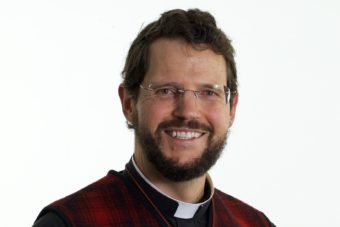
Father Thomas Wiese
Thomas Weise, also known as Father Thomas. (Photo courtesy Brandon Thomas)

A Catholic priest who served in Petersburg, Wrangell and Juneau died Sunday night, 10 days after a heart attack.

The Rev. Thomas Weise, also known as Father Thomas, was pastor of St. Rose of Lima parish in Wrangell, St. Catherine of Siena parish in Petersburg, and served at Juneau’s Cathedral of the Nativity.

The 46-year-old was hospitalized Nov. 25 while visiting family in Southern California. He died in San Luis Obispo on Sunday night surrounded by his family.

Rita Byrer is the Petersburg parish secretary and had known Weise for about 10 years. She said he was loved by the congregation and deeply cared for.

“He was a warm, kind, gentle, very humble, caring person,” Byrer said. “He loved children, he loved people in general. He just always made you feel welcome. He especially loved little children.”

Weise timed flights and ferry trips so he could celebrate mass in both towns on the same Sunday. He was considered an outdoor enthusiast. He had been known to kayak between Petersburg and Wrangell for services.
He was ordained in the diocese in 2002.

Parishioner Kate Kowalski had also known Weise for about 10 years. She said it was a gift to know him and he did great work for the community.

“He did everything 100 percent,” Kowalski said. “He lived his life like that. I mean whether he was kayaking from Wrangell to Petersburg or climbing up Mount Roberts or doing the insulation in the church in Wrangell or the insulation here he did everything 100 percent and with a lot of great spirit.”

Bishop Edward Burns with the Juneau Diocese is traveling to California. Burns calls Weise a true priest and says he loved living out his vocation.

“And he also had a real joy about being a priest, about being a disciple of Jesus Christ,” Burns said. “And he just lived that. At the same time, he always had this desire to help people, to reach out to them, and to invite them.”

A vigil for Weise will take place in San Luis Obispo on Dec. 14. His funeral will follow on Dec. 15. On Dec. 16, there will be a memorial mass in Wrangell. Petersburg will have a memorial service Dec. 17, and a final service in Juneau on Dec. 18.

After vandals strike Sitka cemetery, caretaker receives unexpected help

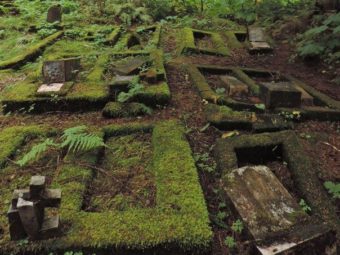
For the third time in the last seven weeks, vandals have pushed over dozens of headstones in Sitka’s Russian Orthodox Cemetery. Sitka Police are investigating. The first incident, pictured here, took place the weekend of September 12th. (Photo courtesy of Bob Sam)
For the third time in the last seven weeks, vandals have pushed over dozens of headstones in Sitka’s Russian Orthodox Cemetery. Sitka Police are investigating. The first incident, pictured here, took place the weekend of Sept. 12. (Photo courtesy Bob Sam)

On a clear night in September, a group of vandals desecrated a 200-year old cemetery in Sitka, tipping over headstones. The caretaker, 61-year old Bob Sam, discovered the damage the next morning. Some of the marble slabs were broken beyond repair.

The cemetery caretaker enlisted the help of local police to protect the rights of the dead.
Bob Sam tends to keep to himself. He always wears jeans, patched with dirt on the knee from the hours spent packing earth. He is a slight man, with the voice of someone who has spent a lot of time with the dead.

“Most humans they think about life,” Sam said. “They don’t think about death so much. But somebody has to do this work.”

The Sitka cemetery in the 1900s. Sam estimates it is the final resting place for 1600 bodies, 400 of which are marked. All are connected with the Russian Orthodox church and many are Tlingit. (Photo courtesy of Bob Sam)
The Sitka cemetery in the 1900s. Sam estimates it is the final resting place for 1,600 bodies, 400 of which are marked. All are connected with the Russian Orthodox church and many are Tlingit. (Photo courtesy Bob Sam)

Sam’s life’s work has been restoring Sitka’s Russian Orthodox Cemetery, which he visited often as a child. One day, when he was 7 years old, he discovered his grandmother sitting solemnly by the family plot.

“My grandmother had kind of a tear coming out of her eye,” Sam said. “There were beer cans all over the place and the brush was overgrown. I just quietly looked at my grandmother and I says, ‘Don’t worry grandma. I’ll fix this place for you.’”

Sam began clearing the cemetery in 1986. The land had become a dumping ground for trash and partying. He found many pounds of beer cases and empty bottles. (Photo courtesy of Bob Sam)
Sam began clearing the cemetery in 1986. The land had become a dumping ground for trash and partying. He found many pounds of beer cases and empty bottles. (Photo courtesy Bob Sam)

It was a promise he kept. Sam returned to Sitka at age 30. He discovered graves desecrated, the headstones buried by mounds of trash, and the clearing claimed by the rainforest. So, he got to work — on the longest day of the year: June 21, 1986. That summer’s cleanup required 30 city dump trucks to haul away the garbage. Community members helped with the heavy lifting. And now?

“There’s something special about this place now,” Sam said. “People can feel it.”

Police plan to install infrared cameras in the cemetery to monitor the activity of the living in the presence of the dead. (Photo courtesy of Bob Sam)
Police plan to install infrared cameras in the cemetery to monitor the activity of the living in the presence of the dead. (Photo courtesy Bob Sam)

The cemetery clearing is pristine – sloping hills dotted with pillars of white marble and bird song.

The first time I visited him there, Sam guided my eyes to the top of an enormous cedar tree.

“That’s a fourth-generation nest of the raven I made friends with 30 years ago,” Sam said.

This summer, he personally washed all the headstones, removing dead pollen and revealing the natural patina of the marble. There are 400 of them and the vast majority mark Tlingit and Aleut graves.

“When you’re washing a headstone, it’s no different from washing somebody’s feet,” Sam said. “And you experience a kind of humility. No matter what they do in life, they should have a respectful death.”

Sam had just finished washing the headstones when, on the morning of Sept. 12, he discovered the cemetery had been desecrated; the biggest headstones knocked flat to the ground.

“My spirit broke,” he said.

Sam hadn’t touched alcohol for decades, but that day, he ordered a beer.

“The beer was sitting in front of me,” he said. “But then I thought about it. I can’t live that life. So I got up and I called the police.”

The officer he got on the phone was Lt. Lance Ewers. Ewers told Sam to meet him at the cemetery and spent the next hour taking pictures of the damage. In Alaska, desecrating a cemetery is a felony.

“We started doing some extra patrols in the area,” Ewers said. “And then I saw Mr. Sam the other day and together we came up with an idea of what it would take to fix these tombstones because some of them are 700 pounds. And he said, ‘You know, it would just take muscle, a lot of muscle.’”

And muscle is exactly what Ewers found. He banded together a dozen recruits from Sitka’s Trooper Academy and they set the headstones upright. There was a heavy downpour that night. Sam watched them work in the mud.

“I always thought that I was the only that cared about this place, which was wrong,” Sam said.

The vandals would strike three more times, Sept. 13, Sept. 22 and Oct. 25. Each time recruits from the academy, Sitka police, and even some firefighters volunteered to lift the headstones out of the dirt and stand them upright.

“And they would assure me every single time, ‘Bob, if you need any help in anything, just give us a call.’ Like a friend would,” Sam said.

Sam gives a presentation at the library. He points to a picture of himself with Tlingit elders who encouraged him to pursue his interest in cemetery caretaking. (Photo courtesy of Bob Sam)
Sam gives a presentation at the library. He points to a picture of himself with Tlingit elders who encouraged him to pursue his interest in cemetery caretaking. (Photo courtesy Bob Sam)

The culprits were eventually caught and police plan to install infrared cameras to permanently monitor the activity of the living, in the presence of the dead.

Sam considered giving up this work entirely. But he changed his mind when seeing how the community took the cemetery under its wing.

“These are Native American graves and to have people from all walks of life come in to do the things that they are doing, and their whole heart and soul is into it, really touches me,” Sam said.

So, Sam continues his work because he believes that one day a generation who wonders who they are will wander into the cemetery and find an answer written in stone.

At Heart Of Refugee-Resettlement Debate, A Rift Between Church And State

church and state
(Creative Commons photo by Ryan Godfrey)

The resettling of Syrian refugees in the U.S. has become a political and religious flashpoint. On Friday, for instance, Texas dropped its request for a federal court to immediately block Syrian refugees from entering the state. A Syrian family, including two young children, is now expected to arrive in Dallas on Monday.

By contrast, in Indiana, Gov. Mike Pence asked the Catholic Archdiocese in Indianapolis to turn down a family of Syrian refugees expecting to settle in that state later this month. At a meeting Wednesday with Indianapolis Archbishop Joseph Tobin, Pence expressed security concerns over the resettlement.

“They had a frank exchange of views,” Miami Archbishop Thomas Wenski tells NPR’s Lynn Neary. Wenski serves on the migration committee of the U.S. Conference of Catholic Bishops.

Wenski explains: “I think the governor was saying, ‘Don’t take these people,’ and the archbishop was saying, ‘Think it over, governor, and don’t stand in the way of a humanitarian and Christian and American solution to the plight of this family.’ ”

Wenski believes that the Indianapolis archdiocese will proceed with its plans to bring the Syrian family into the state.

“I don’t believe the governor has the legal authority to prevent that from happening at this point. But I think the archdiocese of Indianapolis would be happier to have the governor’s OK or approval,” Wenski says.

“Because basically the church has no interest in introducing a family that has already been traumatized, by being uprooted in their own homeland, into a situation where they would find hostility or danger.”

The office of Gov. Pence tells NPR it has not received word on a final decision from Catholic Charities Indianapolis.


Interview Highlights

On his answer to the security concerns of refugee-resettlement opponents

What we’re trying to tell them is to take a deep breath. Because, first of all, to scapegoat these refugees is not very American.

And if ISIS wanted to infiltrate people into the United States, they could do so without using Syrian refugees, especially when the Syrian refugees are undergoing almost a two-year process of vetting that is quite thorough. It is not the NGOs [non-governmental organizations] that are vetting them; it’s the State Department and Homeland Security and whoever they require to help them in doing the vetting process.

On whether the family in Indiana will be accepted elsewhere if blocked from settling in that state

Well, I think that would be the alternative. Certainly we would look through our network … through our dioceses and Catholic charities and find a suitable location for them.

The bishops’ conference, under its program of migration and refugee services, has settled hundreds of thousands of refugees over the past 30 or 40 years. I think some Syrians have probably already come to the United States in the past years.

I know that the archdiocese of Indianapolis wanted to go forward, but as I said earlier, it’s nobody’s interest to introduce traumatized people into an environment that would be hostile to them and perhaps even put them in danger.

Copyright 2015 NPR. To see more, visit http://www.npr.org/.
Read Original Article – December 5, 2015 8:34 PM ET


Southeast priest hospitalized after heart attack

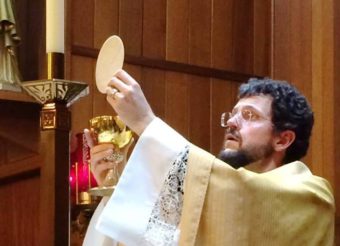
The Rev. Thomas Weise, who serves Catholic churches in Petersburg and Wrangell, celebrates communion during an Easter Vigil. (Photo courtesy Diocese of Juneau)

A Catholic priest who serves parishes in Petersburg and Wrangell has suffered a life-threatening heart attack.

The Rev. Thomas Weise, 46, was hospitalized Nov. 25, the evening before Thanksgiving while visiting family in Southern California.

Michael Monagle is business manager of the Catholic Diocese of Juneau, which includes all of Southeast Alaska.

“He’s currently in the hospital and is undergoing treatment. About the most I can say is his prognosis at this point is guarded, but he is showing some improvement,” Monagle said.

Weise was ordained in the diocese in 2002. He’s served at Juneau’s Cathedral of the Nativity as well as Wrangell’s St. Rose of Lima Parish and Petersburg’s St. Catherine of Siena Parish.

Monagle says Weise timed flights and ferry trips so he could celebrate mass in both towns on the same Sunday. He also drew notice by kayaking between the two small cities.

“He’s a real outdoor enthusiast, hiking [and] kayaking. He really loves serving in those communities and getting out into the outdoors.”

Monagle says Weise also took up carpentry and worked on renovating aging church buildings. Earlier this year, the priest went a month without speaking during his time at a Jesuit retreat center.

The diocese and churches are asking for prayers for Weise, known to many as Father Thomas, and his family. Updates are being posted on the Diocese of Juneau’s Facebook page.

Recovery from addiction led Haines carver to healing art

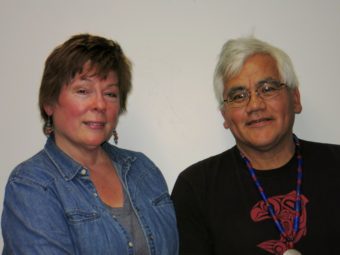
Cherri and Wayne Price. (Courtesy StoryCorps)

“My wife and I, she came into my life right after I sobered up,” Wayne Price said. “And we have dedicated our whole life and business to the creation of monuments.”

Many of those monuments are healing totems or dug-out canoes.

“They became a healing totem as a result of a vision in a sweat lodge that led to my recovery,” Wayne said. “The creator told me I had to do a few things … make a healing dug-out and healing totem.”

He says the healing monuments bring awareness to important subjects. For example, a totem pole he carved in Whitehorse was meant to bring healing to First Nations people who were taken into boarding schools, or residential schools, set up by the government and religious organizations. Similar things happened to indigenous people in the United States, including in Alaska and in Australia.

“These were not very great places,” Wayne said. “The healing totem in the Yukon, we said, ‘this is our past, it is not a good story. This is the present, there is only one race, it’s the human race. We’re all here now, we’re all being aware of each other.’”

Price thinks if there is going to be a wider healing among Natives in America, the U.S. government needs to apologize for the devastating toll the boarding schools took.

“It has to be acknowledged, what happened. It was government-backed, through faith-based religion, for the destruction of First Nation people — colonization. Until that happens, then this wound will never heal.”
He sees the impacts reverberating today.

“A lot of the issues that are in Indian Country now, are a direct result from what happened to them through the boarding schools. It’ll keep coming back. The suicide rate in Alaska is the highest in all the nation, and the majority of that is Native people. There has to be an awakening and an apology. It has to be recognized what really happened, and then a healing can occur.”

Wayne says even if you don’t know the history of the boarding schools, you can sit next to the totem in Whitehorse and ‘feel something.’ He thinks back to the vision that prompted his recovery from alcohol addiction and his focus on healing art.

“The creator told me when you hear the songs of your ancestors coming across the water, you’re done.”

Wayne led a class in the Yukon in which he carved a traditional dug-out canoe with First Nations youth.

“When the kids paddled away singing, I looked at my wife and I said, ‘there it is, I have lived to see my vision complete.’”

The audio interview was produced by KHNS’s Emily Files with the Juneau Public Libraries and StoryCorps in partnership with the Haines Borough Public Library. StoryCorps a national nonprofit whose mission is to provide Americans of all backgrounds and beliefs with the opportunity to record, share and preserve the stories of our lives. More information at storycorps.org.

Site notifications
Update notification options
Subscribe to notifications