Spirit

Tlingit artist protests auction of Native artifacts in Paris

Haida mask. (Photo courtesy of the company Eve)
A Haida mask that went to auction in Paris. (Screenshot)

The Paris auction, orchestrated by the company Eve, wasn’t just about selling old relics. Members of the tribes whose ancestors made these artifacts say they are living beings and the spirits of their ancestors are inside of them.

Crystal Kaakeeyáa Worl was in Paris selling her own artwork when she heard about the auction. Worl, her brother and the owners of the gallery hosting them joined a crowd of about 20 people at the auction house to protest.

Worl said she was allowed to sit in on the auction but was warned she would be removed if she made trouble. She said she wouldn’t and sat down.

“For me to be in that room and see the items, I couldn’t get up close to them, I couldn’t touch them, but to see them from a distance and to let them know that I was there before they went into these private collectors’ homes  — that was meaningful.”

Worl said these sacred objects were made to identify clans and to document their history; they’re still used in special ceremonies today. She believes they are living people.

“Specifically, the Tlingit people, we don’t have a word for art. For our objects that were used for ceremony and objects that were sacred we called at.óow, which is our sacred objects, which the auction was selling a lot of those items,” Worl explained.

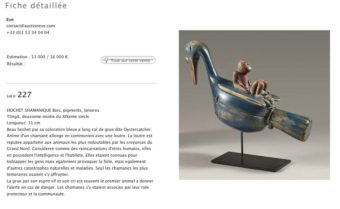
Chuck Smythe is the director of the Culture and History Department at the Sealaska Heritage Institute. He found about 10 Tlingit and Haida artifacts that were put on the auction block. A Tlingit piece was near the top of his stack of printouts. Smythe said it’s a shaman’s rattle.

Tlingit shaman's rattle.
A Tlingit shaman’s rattle that went to auction in Paris. (Screenshot)

“It’s item number 227,” Smythe said. “It was used in the past and continues to be used today as items which brings spirits to ceremonies, particularly helping spirits that benefit people.”

Smythe said, at auction, objects like the rattle typically sell anywhere between tens of thousands and hundreds of thousands of dollars. He’s heard of a war helmet that sold for just under $3 million. These objects may be sacred to Worl and tribes throughout America but, Smythe said, to collectors they’re just pieces of history, and the tribes who made them are dead and gone.

“They’re not aware of the living cultural communities that still use these items and have used them continuously,” Smythe said.

Smythe said, he remembers one instance when a foundation bought a number of Native American artifacts at auction in Paris and then returned them to the tribes. But, he said that was “highly unusual.”

As for international repatriation, he said the United Nations’ Universal Declaration of Human Rights has provisions to protect cultural property. But he said it is weak on enforcement.

In the United States, it’s illegal for federally funded museums, agencies and schools to sell sacred Native American objects. The Native American Graves Protection and Repatriation Act or NAGPRA requires sacred objects be returned to the tribes when they ask for them. The law doesn’t apply to private collectors and it doesn’t mean anything in France.

“What I learned in France is the only way we could withdraw or stall an item from being auctioned is to provide some kind of hard evidence for them that the item was stolen,” Worl said.

Worl said an Acoma Pueblo war shield was proven to have possibly been stolen and it was removed from the auction. As for the Tlingit at.óow, the fact they were in Paris was all the proof she needed.

Acoma Pueblo war shield.
An Acoma Pueblo war shield that may have been stolen was pulled from the Paris auction. (Photo courtesy of the company Eve)

“We would never sell an object like that. That is evidence that these were stolen items,” Worl said.

But that argument probably wouldn’t fly in French court. Worl said the auction house never responded to requests from around the U.S. to halt the auction and it didn’t acknowledge the protesters.

She believes the best way to prevent more Native artifacts from being sold abroad is to teach people about Native culture and explain how important their sacred objects are to them. She said that’s one of the reasons she protested.

“Maybe one of the buyers that was there that saw us, maybe they will decide to return the item they bought to the right community,” Worl said.


The Sacred Glacier Is Melting But The Festival Goes On

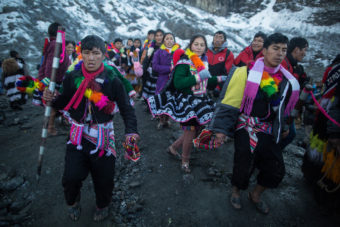
The yearly festival is called Qoyllur Riti — Snow Star in the Quechua language. Wearing traditional garb as well as special outfits made for the event, worshipers travel many miles by truck, then face a steep six-hour hike to get to the site. Sebastian Castañeda Vita
The yearly festival is called Qoyllur Riti — Snow Star in the Quechua language. Wearing traditional garb as well as special outfits made for the event, worshipers travel many miles by truck, then face a steep six-hour hike to get to the site.
Sebastian Castañeda Vita

On Sunday, May 22, over 100,000 Peruvians are expected to arrive at a site in the Andean highlands near the peak of Ausungate, in the southeastern region of Cusco. They may have traveled hundreds of miles to get there. At an altitude of 16,500 feet, they’ll camp out, sing, dance and pray at the holiest — and one of the biggest — religious festivals in the Andes mountain chain. It’s called Qoyllur Riti, which means “snow star” in the local Quechua language.

These days, the festival is an example of how climate change is affecting far more than daily life and agriculture. The mountains here are considered sacred by the worshippers and known as “apus,” or mountain spirits, gods. The tradition is for each province represented at the festival to carve out heavy chunks of ice from the glacier — symbolic of water and life — to bring back to their communities.

But things have changed.

“We can’t take snow down from the glacier anymore,” says Walter Mamami, a participant from the Canchis province. “The glacier is getting smaller. We now stop at the foot of the glacier.”

Each province represented at the festival used to carve out heavy chunks of ice from the glacier — symbol of water and life — to bring back to their communities. Sebastian Castañeda Vita
Each province represented at the festival used to carve out heavy chunks of ice from the glacier — symbol of water and life — to bring back to their communities.
Sebastian Castañeda Vita

The festival itself is a combination of native and Catholic traditions. It celebrates the reappearance of the Pleiades constellation in the night sky, marking the start of the Andean new year and the harvest season. There’s a Christian context as well: According to a legend, in 1780, a fair-skinned boy appeared to a young shepherd who lived in the mountains, then turned to stone when suspicious villagers came after him. The belief is that the boy was Jesus.

That was a time of tension between the local peoples and Spain, which ruled Peru from the 16th century until the 1820s. Spain tried to quash the Indian language and culture. But in the case of the festival, the two cultures, Spanish and Andean, became intertwined.

I visited the festival last year, following a group of official guardians of the Qoyllus Riti tradition, known as pablitos in Spanish or ukukos in the local language.

The pilgrimage itself is a test of endurance, a penitence of sorts. It takes days to arrive as villagers travel in open trucks most of the way, stopping in every village along the way to pray, dance and sing. There’s lots of coca-leaf chewing and nonstop music to keep the deeply devoted pilgrims going with little or no rest. Worshippers disembark in Mahauyani, the furthest trucks can go, before hiking another six hours to cover the final steep 6 miles to their destination.

The festival has both native and Catholic traditions. Sebastian Castañeda Vita
The festival has both native and Catholic traditions.
Sebastian Castañeda Vita

On the vast plain in the glacial basin of Sinakara, surrounded by snow-covered peaks, a cacophony of round-the-clock music and prayers blares from loudspeakers at the chapel on the site. People come wearing their community’s traditional dress as well as special outfits made for the festival. “Hairy” woolen robes worn by the ukukos are a reminder of a mythical bear, believed to live in the surrounding mountains. Meanwhile colorfully dressed male dancers bounce around carrying what looks like a stuffed baby llama on their backs.

“The glacier receded a lot,” Jaime Rios Farfan, from the Acomayo province, told me after he returned from the main ritual at the foot of the glacier — 1,500 vertical feet higher than the camp site — held at sunrise. “We prayed and asked Apu Qollqupunko [the name of the peak], that the glacier not recede any more, that it not disappear.”

At the celebration in years past, each community had its own area in the snowfields where it would carry out its rituals and prayers. Participants from the province of Paucartambo said only muddy land remains in its reserved area.

“It’s a sad reality,” says Rios Farfan.

If and when the glacier disappears, “It will threaten peaceful coexistence between the groups,” says Javier Felix, an anthropologist, speaking of possible tensions between those communities that might still have a sacred area on the glacier and those that don’t.

He lamented that many of the younger “guardians” didn’t appear to understand the importance of the glaciers to the spiritual traditions. “The elders understand,” he adds.

What the elders can’t understand is why no one seems to care about earth’s changing climate.

“The big factories and all the garbage are destroying the ozone layers. Over here while it used to be all white, there are more and more rocks,” admits Rios Farfan.

Indeed, last year at the festival, local chiefs criticized the world’s disrespect for Mother Nature.

Copyright 2016 NPR. To see more, visit http://www.npr.org/.

Why Is This Passover Different From Past Passovers?

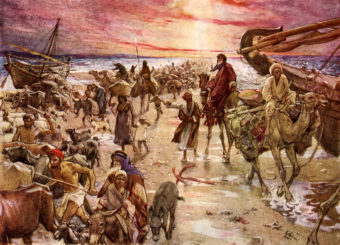
The Passage of the Red Sea, illustration by William Hole (1846-1917). Exodus 14:16: "but lift thou up thy rod, and stretch out thine hand over the sea, and divide it: and the children of Israel shall go on dry ground through the midst of the sea." Corbis Images
The Passage of the Red Sea, illustration by William Hole (1846-1917). Exodus 14:16: “but lift thou up thy rod, and stretch out thine hand over the sea, and divide it: and the children of Israel shall go on dry ground through the midst of the sea.” (Corbis Images)

Why is this Passover different from any other? Because the story that the Jewish holiday commemorates — the exodus of the ancient Israelites from slavery in Egypt to freedom — resonates more strongly than ever in a world embroiled in a refugee crisis that encompasses approximately 60 million people, the highest number ever recorded, according to United Nations statistics.

So when Jews retell that story at the first night’s traditional festive Seder, “these are not ancient, crumbling dusty issues that don’t have relevance today,” says Rabbi Eric Greenberg, a spokesman for the Multifaith Alliance for Syrian Refugees. “We can see this is actually happening now to many people, including the Syrian refugees.”

It’s a connection that resonates for Shadi Martini, 44, himself a Muslim Syrian refugee who now lives in Farmington Hills, Mich. A hospital manager in Syria, he had to start over after leaving in 2012. In the U.S., he began supplying humanitarian and medical supplies to those in need in Syria.

“We worked with everyone who offered help, and some NGOs were from Israel, and that was a big surprise,” says Martini, who is currently senior Syria adviser for the Multifaith Alliance. In Syria, which is in ongoing conflict with Israel and today has only a tiny Jewish population, he had no exposure to Jews. It was also a surprise to learn that welcoming and coming to the aid of the stranger “was a pillar of the Jewish faith,” he says.

The connections between the journey of the ancient Israelites and of refugees today are being emphasized in online readings from American Jewish World Service, whose mission is to end poverty and promote human rights in the developing world, and HIAS, formerly known as the Hebrew Immigrant Aid Society, a nonprofit that focuses on protecting and aiding refugees around the world.

Since the Seder is famous for promoting discussion, including the four questions, it was natural to ask four questions for 2016.

Why should we add readings? Because the stories of today’s refugees echo the long history of Jewish stories of being expelled throughout history, says Ruth Messinger, president of AJWS. That history includes being forced from Spain in 1492 and from Nazi Europe in the 1930s. All these instances, past and present, have to do with “individuals and groups asserting their rights to be and live where they are” and remind us of times and places “where the government is saying we will deprive you of the rights that other people in this country have.” When the Haggadah, the text that is read at the Seder, instructs us to remember that we were strangers in a strange land, she says, that means it is “our responsibility” to reach out to refugees in need.

What are the modern-day plagues? The Haggadah lists the 10 plagues visited upon Egypt as the Pharaoh refuses again and again to let the Israelites go. To provide insight into the what displacement means today, the HIAS supplement lists “10 Plagues Facing Refugees in the U.S. and Worldwide.” The list — which includes violence, dangerous journeys, poverty, lack of access to education, anti-refugee legislation and loss of family — is accompanied by facts and figures.

Have we done enough? Another seder favorite is the song Dayenu, whose refrain proclaims that any single one of the miracles that led, step by step, to the exodus would have been dayenu — Hebrew for “enough.” “It’s a great lyric” that speaks of gratitude and appreciation, says Messinger. The AJWS version provides a different twist, which acknowledges that in addition to appreciating what is being done, there is still more work ahead. One verse goes, in part:

If the world responds only to the cries of the wounded, but does not stay to help them heal…
It will not be enough.

However, if we sustain our support until stability, peace and independence have been attained…Dayenu! Then it will be enough.

Why is there a pair of Nikes on your doorstep? In a new ritual, HIAS asks Seder participants “to place a pair of shoes on the doorstep of your home to acknowledge that none of us is free until all of us are free and to pledge to stand in support of welcoming those who do not have a place to call home.” This acknowledges that “we have stood in the shoes of refugees, and as we’re celebrating our freedom we are committing to stand with today’s refugees, and take a stand,” says Rabbi Jennie Rosenn, vice president of community engagement at HIAS. You can choose your own moment to place shoes at the door, but one possibility is at the Haggadah passage that reads, “My father was a wandering Aramean.” This suggests “the essence of the Jewish experience: a rootless people who have fled persecution time and time again,” says the HIAS supplement. “When we recite these words, we acknowledge that we have stood in the shoes of the refugee.”

Copyright 2016 NPR. To see more, visit http://www.npr.org/.

Savoonga harvests second whale of the season

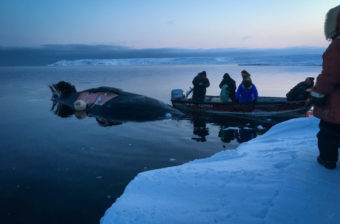
Savoonga’s second whale of the season, harpooned by whaling captain Carl Pelowook Jr. (Photo courtesy of Brianne Gologergen)

A whaling crew from Savoonga landed its second bowhead of the season recently. The St. Lawrence Island community has been working nonstop to haul the whale out of the icy waters, harvest its meat, and distribute it around the village.
For the past few weeks, whaling crews have been camped out on the southwest side of St. Lawrence Island. Elvin Noongwook was on the crew that landed Savoonga’s first whale in 1972.

Sitting around his kitchen table, the elder said they’ve been going to the same spot ever since.

“We call the whaling camp ‘Powooliak.’” Noongwook explained. “That’s where we’re doing whaling now in (the) springtime.”

Whale being separated out to distribute throughout the community of Savoonga. (Photo courtesy of Brianne Gologergen)

On March 27 of this year, Carl Pelowook, Jr., landed the first whale of the season and the earliest in Savoonga’s whaling history. Warmer ocean temperatures and stronger winds from the north make it easier for whalers to start their hunts earlier.

On April 5, Pelowook and his crew, which includes Michael Kralik and Nathaniel O’Connor, harpooned their second bowhead. With the help of eight other boats, they hauled the whale up to shore and got to work.

Elvin Noongwook says nothing goes to waste.

“We take everything from the head to the flukes, baleen and the meat.”

The work is nonstop. A steady stream of snowmachiners travel back and forth between camp for days, delivering processed whale and swapping out tired workers with well-rested ones.

Brianne Gologergen is a health aide at Savoonga’s clinic. She made the trip out to camp to watch it all unfold.

Gologergen said along with the days it takes to harvest a whale, it’s also pretty costly for the community to travel the 38 miles to camp.

“There’s the fuel for the boat, grub for camp for a couple of weeks, (and) fuel for your snow machine,” Gologergen explained.

But, she said, the taste of the fresh whale makes it all worth it.

“It was so yummy,” Gologergen said.

Even after the meat makes it into people’s mouths, the work doesn’t let up. George Noongwook is Elvin Noongwook’s cousin. He was also on Savoonga’s first whaling crew and now acts as the community’s commissioner on the Alaska Eskimo Whaling Commission.

He says prep for the whaling season starts thousands of miles from home.

“In order for us to go whaling, we first need to go to Washington, D.C.,” Noongwook explained.

Noongwook said there’s a lot of politicking needed to make sure Alaska’s 11 whaling communities can feed themselves throughout the year.

People pulling the whale out of the icy waters on the south side of St. Lawrence Island. (Photo courtesy of Brianne Gologergen)

“It takes a lot of coordination,” he said, adding “it takes a lot of people to work together to achieve that goal… it’s a lot of work, a lot of legwork.”

The Alaska Eskimo Whaling Commission meets four times each year. Their work helps inform the International Whaling Commission, or IWC, which meets every six years to set worldwide whaling quotas.

Noongwook said it’s a complicated process and not without its problems.

“Oftentimes, our quota is used as a political football for whaling nations and non-whaling nations,” Noongwook explained.

That’s exactly what happened in 1978 when the IWC failed to pass a whaling quota. Noongwook says those were dark days for Savoonga.

So after the IWC re-established the quota, he said he makes sure the community follows all IWC protocols and fills out all the right paperwork.

“We just have to keep plugging away if we want to survive,” Noongwook said.

Like the whale harvest itself, Noongwook said his work as a commissioner it’s tiring and time-consuming, but he said he’ll keep at it to keep the tradition alive.

Gene Tagaban leads Dillingham training on stopping cycle of violence

Gene Tagaban helped conduct the Compass training in Dillingham in mid-March. (Photo courtesy of Gene Tagaban)

The Alaska Network on Domestic Violence and Sexual Assault helped organize the training, which was taught by Gene Tagaban, a Tacoma, Washington resident originally from Juneau.

Tagaban said the class is meant to help stop the cycles of violence that are prevalent in many Alaska communities.

“It’s about teaching men to be mentors, and getting men involved to stop the violence, domestic abuse, the suicides, the hurts, the pain,” he said. “For so many years, women have been at the forefront of this movement, of wellness, of health. And as men, we need to be standing right beside the women together, to stop the violence, to stop this epidemic that’s going through Alaska.”

Compass is part of the Alaska Men Choose Respect effort. Participants talked about how to start conversations and lead healthy lives, both in their own homes and in the community.

Tagaban said the group discussed several topics, including respect for self and others, communication and conflict resolution.

“Ultimately, what does it mean to become a man, but even higher than that: what does it mean to become a human being,” he said. “… it’s about learning how to express ourselves in that way and share our stories, tell our stories, learning about where our stories came from. And learning about even, not only our empowerment but the pains, the hurts, the trauma and healing from that. It is about healing. But it’s about men working together to bring that healing together.”

Throughout the gathering, participants shared their own stories and learned how to facilitate those sorts of discussions. After the training, Tagaban hopes they’ll take what they’ve learned back out into the community, whether that’s doing presentations in schools or living a good life and leading by example.

“And I hope that they’ll go out and live a good life, a life of awareness, a life of empowerment, so that in their circles that they can influence those in a good way,” he said. “And maybe some of them will use it to start making presentations, talking about these things, and starting the conversations… that they’ll maybe go to schools and start talking about things, or just in the neighborhoods, in the stores that people would just see them living that powerful life that good life, and then passing it on in their own families, and teaching in their own families, or the schools.”

Franciscan Leaders Charged With Protecting Friar They Knew Had Molested Children

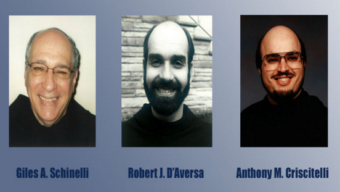
Giles A. Schinelli, Robert J. D'Aversa and Anthony M. Criscitelli were charged with conspiracy and child endangerment for allowing a friar who was a known sexual predator to continue working with children. Office Of The Pennsylvania Attorney General
Giles A. Schinelli, Robert J. D’Aversa and Anthony M. Criscitelli were charged with conspiracy and child endangerment for allowing a friar who was a known sexual predator to continue working with children.
Office Of The Pennsylvania Attorney General

Prosecutors in Pennsylvania have charged three former leaders of the Franciscan religious order with conspiracy and child endangerment for allowing a friar who was a known sexual predator to work in a high school. The prosecutors say the friar had molested more than 80 children.

Giles Schinelli, 73, Robert D’Aversa, 69, and Anthony M. Criscitelli, 61, were successively in charge of the Franciscan Friars, Third Order Regulars, Province of the Immaculate Conception in western Pennsylvania from 1986 to 2010.

The three friars allegedly hid allegations of abuse against a member of their order, Brother Stephen Baker, who eventually pleaded guilty to molesting three boys in 2007 and served part of a 10-year sentence before killing himself at a monastery in 2013.

After his suicide, more than 100 abuse claims were filed by former students of Bishop McCort High School in Johnstown, Pa., where Baker worked from 1992 to 2000, the Associated Press reports. Millions of dollars in damages have been paid out.

“These men knew there was a child predator in their organization. Yet they continued to put him in positions where he had countless opportunities to prey upon children,” Kane said when she addressed the media Tuesday to announce the charges. “Their silence resulted in immeasurable pain and suffering for so many victims. These men turned a blind eye to the innocent children they were trusted to protect.”

A Pennsylvania ground jury grand jury issued the following findings regarding the three church leaders’ roles in the abuse:

  • Schinelli, the minister provincial from 1986 to 1994, sent Baker for a psychological evaluation and was told Baker was not to have one-on-one contact with children, but nonetheless later assigned him to Bishop McCort, where he had regular contact with children.
  • D’Aversa, the minister provincial from 1994 to 2002, allegedly failed to notify school officials and law enforcement of the reason that Baker was removed from the school in 2000. That removal followed what D’Aversa believed was a new, credible allegation of child sexual abuse, according to the grand jury. D’Aversa later appointed Baker as vocations director of the T.O.R.
  • Criscitelli, the minister provincial from 2002 to 2010, further allowed Baker access to children by allowing him to work at a shopping mall. He also knew Baker required “safety plans” advising no contact with minors, yet Criscitelli signed such plans while residing in Minnesota. Meanwhile, Baker lived unsupervised in Pennsylvania. He also lived at one time with another accused child predator.

The three former Franciscan officials live out of state and are expected to be arraigned in the coming days.

The charges come from the same statewide grand jury that released a 147-page report two weeks ago alleging the Diocese of Altoona-Johnstown engaged in a widespread cover-up of sexual abuse by more than 50 priests and other church leaders. The Pittsburgh Post-Gazette says that the report resulted in no criminal charges of sexual assault “due to what prosecutors said were the time constraints of the statute of limitations,” but that there was enough evidence to charge the three priests in connection with the cover-up.

Copyright 2016 NPR. To see more, visit http://www.npr.org/.
Site notifications
Update notification options
Subscribe to notifications