Spirit

Juneau man shares a painful memory from driving trucks in Iraq

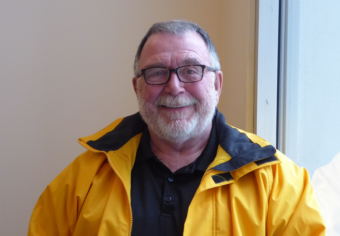
Richard Marshall at KTOO on Friday, May 19, 2017.
Richard Marshall at KTOO on Friday, May 19. (Photo by Quinton Chandler/KTOO)

Richard Marshall is a 66-year-old Vietnam veteran. He’s a Juneau resident and was a civilian contractor for the U.S. military in Iraq. He signed up to drive fuel trucks through combat zones because he wanted to help.

During his first year in Iraq, Marshall drove 96 combat missions. In 2004 on Good Friday, he narrowly avoided a deadly attack. I asked him to share his memory of that day and he explained how it changed his life. This interview has been edited for length and clarity.


“Everyday we would line up and they would hand out keys and according to which key to which truck you got, you would be assigned a convoy commander and you’d form up into a group and leave.

“I was living in a tent with a bunch of guys that I got very close to. So when we would go up to sort of hang around the place where they handed out the keys, we’d routinely walk up together. That morning, they’d awakened us very early in the morning. All of the roads had been shut down for a couple of days. The threat was so high, the danger was so bad, the combat was so furious that they wouldn’t let anybody leave any of the camp. We were (sitting) around waiting for them to line us up and I got up to go get a bottle of water. As I was getting a bottle of water from an area … they called for us to come line up. So we did and it just happened that I ended up a couple of spaces ahead of this group of guys that was behind me. That couple of spaces put me as the last man in the first convoy that day.

“It was just horrible, we got shot at from the minute we left the gate and we got beat up and shot and blown up until we made it to Taji which is halfway to Baghdad. Finally got out of Taji and got south into Baghdad and we were able to supply enough fuel to keep the medevac birds going – that’s about all we could do at that point.

Marshall and his fellow drivers waiting to settle in for the night at Al Taqaddum Air Base in West Central Iraq after unloading a shipment of fuel.
Marshall, middle, and his fellow drivers wait to settle in for the night at Al Taqaddum Air Base in West Central Iraq after unloading a fuel shipment in 2004. (Photo courtesy Richard Marshall)

“The following morning, they allowed that second group to leave. … The group of guys that I lived with were all in that convoy. That was the group that got hit with anti-aircraft guns. They pretty well wiped out the convoy. The convoy commander lost an eye; I think we lost seven — there were seven drivers killed, there were several injured. Three or four soldiers killed that day. Basically everybody … all my friends were killed that day.

“So the fickleness is that even though I had it tough getting out of the gate that day and we had a tough time, had it not been for that bottle of water, that silly bottle of water, I would’ve been with them. So … that’s part of the reason why I stayed.”

Now, do you still feel survivor’s guilt?

“Oh sure, yeah, I don’t think — I don’t think that ever goes away. My response, my way of dealing with it, is to try and feel — feel very lucky every day. It’s tough to talk about, but in truth, I just don’t feel like I have the — I don’t have the right to feel bad about anything.

“I’m sorry. In other words, now when I’m working, when I’m doing anything — I mean my gosh, any of those guys — on my worst, worst day, every one of them would love to have that day. I’m just blessed, that’s all. I’m very blessed.”


Richard Marshall and his wife Teresa on Fish Creek Trail on Douglas in 2015. (Photo courtesy Richard Marshall)

Richard Marshall left Iraq at the end of 2007 and returned in 2010. After a short break, he moved on to work in Afghanistan for two and a half years.

Today he is semi-retired and works for Juneau Docks and Harbors in his spare time. He and his wife Teresa just celebrated their 32nd wedding anniversary and plan to build a retirement home in Haines. Marshall said his biggest regret is spending so many years away from his wife.

High school seniors take spotlight in Juneau elementary schools

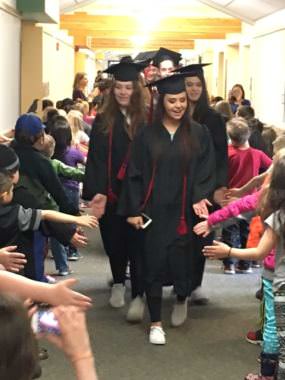
Juneau-Douglas seniors walk through Harborview Elementary School on Friday.
Juneau-Douglas seniors walk through Harborview Elementary School on Friday. (Photo courtesy Juneau School District)

The Juneau-Douglas High School seniors are eating a barbecue lunch after visiting Gastineau and Harborview Elementary schools this morning. The seniors donned their caps and gowns and took a victory lap through the schools. The walkthroughs are supposed to inspire the school district’s younger kids to graduate.

Rena Nauer and Sierra Ezrre were eating lunch together but this morning they paraded through different schools. Nauer visited the kids at Gastineau.

“They (were) excited and I went to school there so it was kind of cool getting to do it as a senior and going back,” Nauer said.

She thinks the walk was a good idea because it was fun and it might have a positive impact on the younger kids.

“It’s probably, like, cool getting to see the older kids, like, realizing that’s where you’re going to want to be when you’re older and be, like, ‘Oh my God, that’s going to be me soon,’” she said. “So maybe they’re just, like, looking forward to it.”

Rena Nauer, left, and Sierra Ezree in the Juneau-Douglas High School Commons on Friday.
Rena Nauer, left, and Sierra Ezzre in the Juneau-Douglas High School Commons on Friday. Photo by Quinton Chandler/KTOO)

Sierra Ezzre visited Harborview – also her old school. She agrees with Nauer because she admired older kids when she was in elementary school.

“Yeah, I definitely looked up to them. Like, I thought they were so cool when I was little,” Ezzre said. “So, for us to go do that, I think that’s really important to them because I feel like quite a few of them look up to us.”

The girls just cut to the heart of the reason for this new tradition. JDHS Assistant Principal Kim McNamara said Juneau educators plan to keep doing this every year to make sure the younger kids remember what graduation looks like.

“The Gastineau kids had their yearbooks ready, they were asking all of the seniors to sign their yearbooks,” McNamara said. “The Harborview kids were equally enthusiastic, lining the halls, giving high-fives, cheering. It was really inspiring.”

Juneau schools first considered doing this last year after they learned other school districts were doing it in the Lower 48. They didn’t get a chance to do it in Juneau until now.
Juneau-Douglas seniors walk to Harborview Elementary School on Friday, May 26, 2017.
Juneau-Douglas Assistant Principal Kim McNamara leads the school’s seniors to Harborview Elementary School on Friday. (Photo courtesy Juneau School District)

McNamara said these walkthroughs were also meaningful for the seniors.

“Especially the ones that went back to their elementary school,” she said. “It was really meaningful for them to walk through the halls, think back to their experiences as a younger child, and see some of their teachers and be able to connect with them again.”

She said it was a chance for the seniors to reflect on where they came from as they take their final steps out of high school into their next chapter.

The Juneau-Douglas seniors weren’t the only ones who held walkthroughs. Thunder Mountain High School seniors held a similar one at Riverbend Elementary School on Friday.

JDHS, TMHS and Yaakoosge Daakahidi are all holding their graduation ceremonies Sunday.

Local organizations to host three Memorial Day ceremonies in Juneau

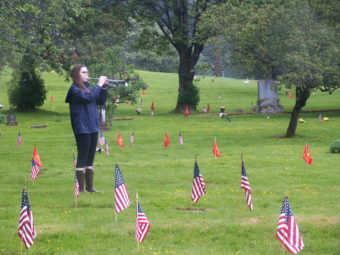
The playing of Taps concludes Memorial Day observances at Evergreen Cemetary.
A musician plays taps to conclude the Memorial Day observance at Evergreen Cemetery in 2016. (Photo by Matt Miller/KTOO)

Flags will fly at half-staff Monday morning in recognition of Memorial Day. The holiday recognizes people who have died in military service.

In a White House proclamation, President Donald Trump designated 11 a.m. local time to unite in prayer for permanent peace and asked all Americans to observe a national moment of remembrance at 3 p.m. local time.
The proclamation begins:

“Memorial Day is our Nation’s solemn reminder that freedom is never free. It is a moment of collective reflection on the noble sacrifices of those who gave the last measure of devotion in service of our ideals and in the defense of our Nation. On this ceremonious day, we remember the fallen, we pray for a lasting peace among nations, and we honor these guardians of our inalienable rights.”

It notes this year is the 100 year anniversary of the United States entering World War I, in which more than 4.7 million Americans served and more than 100,000 died.

Gov. Bill Walker also made Memorial Day remarks in a statement.

“As we gather with family and friends to enjoy another beautiful Alaska weekend, let us not forget the brave men and women who have made the ultimate sacrifice to protect our nation, and the freedoms we hold so dear. Memorial Day is a time to pay tribute to and remember those who died defending freedom, and recognize the current members of our Armed Forces who stand at the ready every day. Donna and I wish all Alaskans a safe and happy Memorial Day weekend, and urge citizens across the state to pause on Monday to remember why Memorial Day was established.”

Here in Juneau, there are three Memorial Day ceremonies.

The Veterans of Foreign Wars Taku Post 5559 is hosting an observance that begins at 11 a.m. at Evergreen Cemetery in downtown Juneau.

At the same time, the American Legion Auke Bay Post 25 has a ceremony at Alaskan Memorial Park in the Mendenhall Valley. It will be followed by a noon open house and chili feed at its post near Mile 13 of Glacier Highway.

And Alaska Native veterans are hosting a ceremony at 11:30 a.m. at Southeast Alaska Native Veterans Memorial Park downtown. The event will move into Elizabeth Peratrovich Hall for lunch and additional events.

Federal, state and local government offices are closed for the holiday.

Juneau high school soccer teams play to help injured player

A Thunder Mountain soccer player tries to move past two Juneau-Douglas players.
The Thunder Mountain and Juneau-Douglas girls soccer teams dedicated a regular season conference game and fundraiser to Hunter Rathbone, a Thunder Mountain player who is partially paralyzed. (Photo by Quinton Chandler/KTOO)

It’s the second half of an intense game. Dozens of fans are shouting encouragement from the bleachers and sidelines to support the Thunder Mountain Falcons and the Juneau-Douglas High School Crimson Bears.

Each year, Thunder Mountain and Juneau-Douglas’ soccer teams turn one or two games into a cancer awareness fundraiser. The fundraisers started in 2012 and were inspired by Juneau-Douglas soccer player Dorothy Brent, who died from cancer last year.

This year the Falcons and Bears girls teams dedicated the fundraiser to Hunter Rathbone.

“I love my team,” Rathbone said. “It really warms my heart that they would put all that effort … all that together for me … that’s like no words, that’s the coolest thing someone’s ever done for me.”

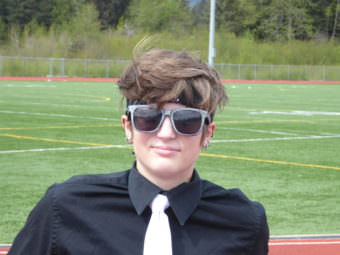
Rathbone, 16, identifies as a boy. He sits in a wheelchair, wearing sunglasses to protect his eyes. He’s a Falcons player who was hurt in a previous game and has lost most of the feeling in his legs. Speaking after the game, Rathbone said the injury happened while trying to score a goal during a game in Ketchikan.

“There was an opponent next to me … behind me,” Rathbone said. “They accidentally kicked my feet up from underneath me, and it caused me to fall backwards onto my back and then it slammed my head to the ground.”

Hunter Rathbone at the Thunder Mountain High School Turf Field on Wednesday.
Hunter Rathbone at the Thunder Mountain High School Turf Field on Wednesday. (Photo by Quinton Chandler/KTOO)

After the fall, he remembers his coaches helping him back to the bench.

Rathbone had a spinal and head concussion, he said.

“I knew something was off from the beginning because the turf looked white and then I had extreme sensitivity to the light,” he said. “I couldn’t keep my eyes open because it was really bright.”

His legs went numb. His thighs, calves and feet felt like “they were catching on fire.”

Rathbone was flown to a hospital in Seattle. After five days of tests and scans, doctors decided he wasn’t just concussed, he said. The doctors diagnosed him with conversion disorder.

“I could’ve lost my sense of taste, smell and eyesight. Losing your feeling in your legs is the most common,” he said.

At the end of the fundraiser game, the Bears are the clear winners on the field.

But as the Falcons’ coaches give their girls a word of encouragement and send them off for the ritual end-of-game handshake, it’s soon evident the final score isn’t the only measure of a team’s success.

Rathbone said his team played great and he’s proud of them.

His recovery is going to be hard work. He goes to school every day in his wheelchair and is in physical and occupational therapy. It’s exhausting, he said.

“They are telling me that I’m going to get some mobility back … but after standing, some basic movements, after that is basically how hard I work is how far I’m going to make my recovery,” Rathbone said.

He describes himself as an active person and said the thought of getting out of his chair is his biggest motivation.

“To be able to get back on the field, hike, bike, longboard, snowboard … all my activities that I love to do,” he said.

One day he hopes to be back in the Falcon’s huddle.

The fundraiser for Hunter Rathbone raised $1,450, a Falcons soccer coach said.

From gangs to a grad: A former inmate celebrates finishing college

This month, 30-year-old Marcos Galindo graduated with a bachelor’s degree in social science with a concentration in political science.

Now, he’s working on a master’s of public administration and wants a Ph.D. in Chicano studies – a choice weighted by his early life on the streets and in the prisons of California.

“Especially in the gang culture of California, it’s a lot of false propaganda about what it means to be one’s brother’s keeper, what it means to be para la raza — being Mexicano and being Chicano,” Galindo said.

Feeding into that “propaganda” landed him in prison, he said.

“I want to know the historical accuracy of what it means to be my brother’s keeper, and I want to know the true meaning of what it means to be Chicano,” Galindo said.

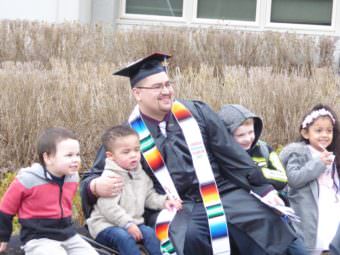
Marcos Galindo and his son Lucian after the UAS graduation ceremony on May 7, 2017. at the Charles Gamble Jr. -Donald Sperl Joint Use Facility.
Marcos Galindo and his son, Lucian, after a University of Alaska Southeast graduation ceremony May 7, 2017. (Photo by Quinton Chandler/KTOO)

Galindo’s story starts in California. He said he came from a broken home and like a lot of kids from broken homes, he started partying and acting wild in his teens.

He was arrested for fighting and was sent to juvenile hall where he said race determined everything.

“Since I’m Mexican, and you can see it just by looking at my features, I was accepted by the Mexicans pretty quick,” he said. “You become a product of your environment, so I lost that free love, party life, party, everybody happy; I became a cholo, I became a gangster. I got cliqued up as soon as I got out and got jumped in at 13.”

He used his new status to vent the anger he was holding in.

“I loved it. I loved the fast lifestyle; I loved people being afraid of me; I loved the fast money; I loved packing a gun; I loved all of that,” Galindo said.

But of course, that put him in prison where he ended up doing someone a favor.

“When I was doing my time there, fighting my case, I ended up getting celled up with a … they called him a ‘big homie,’” Galindo said. “Which is an individual that’s cliqued up with O.C., with organized crime, which is no longer street gangs, this is prison gangs — this is big deal stuff.”

That favor increased Galindo’s time from 18 months to five years.

He was released at 25 but ended up going back pretty quick.

“So, I got thrown up in the hole and then I seen the individuals who are running the show, right? These big time players in the O.C., of the organization I was part of and they were all heroin addicts. They were all old 60-year-old, 50-year-old heroin addicts.”

Then Galindo ran into his brother, who is serving life in prison for murder.

“He was like, ‘I’m never going to be able to hold my daughter again. I’m never going to be able to hold a woman again. I’m never going to be able to enjoy an In-N-Out cheeseburger,’” Galindo recalled. “‘All these things because I killed for a corner of a street that’s not mine. It’s a corner of a street that we’ve been fighting over since the ’40s and none of us own it.’”

That was it. Galindo’s mom invited him to come to Juneau; he came.

He landed two jobs and started making good money.

But someone called Galindo a racial slur and he beat the guy up and was arrested.

Authorities “threw the book” at him, he said, when his criminal history came up.

“Kudos to Juneau for that, trying to nip this stuff in the bud,” Galindo said.

He was sent to Lemon Creek Correctional Center where he joined the Flying University, a program that brought University of Alaska Southeast courses in philosophy and literature to prison inmates. UAS students on the outside also came. The plan was for the students and the inmates to learn from each other. It evolved into a prison re-entry program.

Galindo loved it.

He also learned he was a father while in prison and he rekindled his faith.

Those three things: school, faith and family, pushed him to change a second time.

“I was like, ‘This is it.’ There’s no more chance. If I ever go back to prison, it’s going to be … It must’ve been my destiny because I don’t want this lifestyle and I’m going to do everything in my power to make sure I never, ever, ever go back,” he said. “So I started school and I graduated with my bachelor’s in three years.”

Galindo is one of three Flying University alumni who graduated this month. Another former inmate, Nathan Block, earned a bachelor’s degree with an emphasis in literature and minors in philosophy and Tlingit.

Thomas Spitzfaden, a regular student who took classes in Lemon Creek with the inmates, graduated with a bachelor’s in social science.

Anthropology was his primary and he had concentrations in psychology and political science.

There are three other Flying University students taking classes at UAS, Galindo said.

He thinks education is a powerful weapon and a cure for many of society’s problems, including the high rate of former felons who go back to prison.

Shishmaref’s new “language nest” immerses toddlers in Inupiaq

Shishmaref’s Inupiaq language nest has officially opened its doors to its first group of young students.

Hattie Keller, now the newly appointed Inupiaq Director for Kawerak, says they have hired two staff members to teach a group of zero-to-three year olds at Shishmaref’s language nest.

“Well, I’m overseeing right now the language nest in Shishmaref, and we have a linguist, Morris Kiyutelluk, and we have an Inupiaq immersion teacher, so she’s learning and teaching, it’s Felicia Nayokpuk in Shishmaref. Right now, we have four students, and we just got our childcare exemption license, so we can see these four students without our childcare license at the moment,” explained Keller, “And this way, we can have them in the building for the next couple weeks and see where we need to go.”

For these four young children, Keller mentions that the daily routine at the nest involves repetition to help the students remember various words in the Inupiaq language.

“We made paper airplanes, and we say tinnun, so me and the kids were going around the classroom flying our paper tinnun (airplanes), and after like twenty minutes of saying tinnun, I’m like ‘Where’s your tinnun?’ and then they would find their tinnun, it was right there, their airplanes,” Keller continued, “And then we also sing songs with them: Head, Shoulders, Knees and Toes (in Inupiaq).”

According to Keller, after this introductory group’s two weeks of learning is up, the nest building will be repaired, and then more students will be brought into the language program sometime later this summer.

Besides expanding the Shishmaref language nest, Keller and Shawn Arnold, the Superintendent of Nome Public Schools, are discussing the possibility of incorporating Inupiaq language into NPS’ curriculum in the future.

Site notifications
Update notification options
Subscribe to notifications