Spirit

Local athletes hope to represent Juneau at Native Youth Olympics

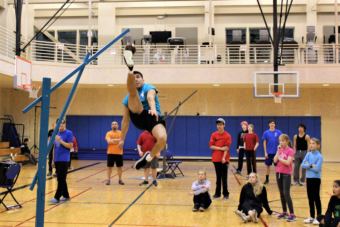
Kyle Worl demonstrates the One Foot High Kick, and event in the Native Youth Olympics. (Photo by Adelyn Baxter/KTOO)

Every year, hundreds of students from around the state gather in Anchorage for the Native Youth Olympics. But Juneau hasn’t sent a team in more than 30 years.

Recently, athletes gathered in a gym on the University of Alaska Southeast campus to test their skills.

For the Alaskan high kick, one of the main events in the Native Youth Olympics, athletes position themselves one by one beneath a small, furry ball hanging from a pole about 5 feet off the ground, squatting on one foot while holding the other with their hand.

Each athlete pushes off suddenly, kicking one foot into the air above their head while still holding the other, in a kind of pretzel-handstand.

Their foot meets the furry ball, leaving it swinging as they fall back to the ground.

The statewide competition tests strength, agility and, in some cases, pain endurance.

For the first time since 1983, Juneau is putting together a team.

Athletes compete in the Eskimo Stick Pull. (Photo by Adelyn Baxter/KTOO)

Kyle Worl is the coach and leader behind the effort.

“The long term goal is to introduce NYO as a sport in the high school at the same level as any other sport where students can take part in this year after year,” Worl said. “And they can travel to state regionals, just like other events.”

Worl has been visiting Juneau high schools and recruiting students since the fall.

About a dozen of them practice twice a week at each school, mastering the events they hope to compete in at the state competition in April.

The games began in 1972 and are open to all high school students. One boy and one girl from each team compete in each event.

The games test skills that were key to survival for Alaska Natives.

Many events reflect subsistence hunting practices, like the Eskimo Stick Pull, the favorite of Juneau-Douglas High School senior Derrick Roberts. The game involves two opponents seated across from each other trying to pull a stick from the other’s grip. Roberts is undefeated so far.

“The event relates to pulling a seal up from the water after you harpooned it,” Roberts said. “I guess I’d be really good at helping people pull up seals.”

Sportsmanship is central to the games, because working together was traditionally critical to survival.

Worl said it’s part of what drew him to Native Youth Olympics.

“The games in a sense are very individualistic, since you’re competing against yourself,” he said. “But they’re done in a community setting so you have all the other athletes around you and they’re there to help you and support you.”

Worl didn’t get into Native sports until he was a senior in high school, but now he competes with other adults every year.

The World Eskimo-Indian Olympics are every summer and the international Arctic Winter Games take place in March. He routinely medals and holds a world record for an event similar to the high kick.

This winter, he’ll demonstrate several Native games at the National Museum of the American Indian in Washington, D.C.

Thunder Mountain High School senior Josh Sheakley attempts the Alaskan High Kick at a community event at UAS. (Photo by Adelyn Baxter/KTOO)

“I don’t think I would be as involved with my community if I didn’t get into Native games,” Worl said. “I don’t think I would be as concerned with my health and my fitness and that’s something that Native games has given me, is that motivation to stay in shape, to always challenge myself, to build my personal bests in each game.”

Kyle’s uncle Ricardo Worl was Juneau’s coach back in the 1980s. He said the games offer an alternative to typical high school sports. But, there’s more to it.

“The other important reason to have Native Youth Olympics in the schools, even though it’s open to non-Natives, is for the Native kids and for that Native identity,” he said. “It’s athletic, it’s positive, and it’s actually kind of cool.”

Tryouts for the team are March 30-31.

Worl hopes to bring between 10 and 20 high school students to Anchorage, so he plans to step up recruitment after winter break.

They’ll also look for ways to pay for the trip.

The team will fundraise and search for local sponsors. The Sealaska Heritage Institute already is helping out.

Watch a video showcasing the different events:

Group of Alaskans go to Russia to visit birthplace of St. Herman

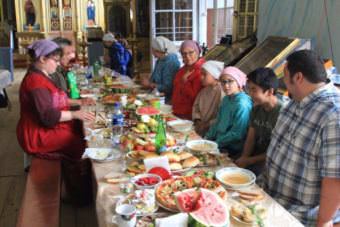
Sitting down for a meal in Russia (Photo courtesy Father Dimitrii Kultinov)

Recently, some Alaskans made the long trip to Russia to see the home of a beloved orthodox saint.

At the end of August, a group of about 16 people from all over Alaska went to Russia.

This trip wasn’t a normal vacation, but a sanctioned pilgrimage by the Russian Orthodox Diocese of Alaska.

They traveled through at least 12 time zones to reach the Russian community of Kadom, which was the home and birthplace of St. Herman of Alaska. One of the younger members of the trip was Triston Simeonoff. When he arrived in the rural town, he was struck by how familiar it seemed.
“In the town that we were in, Kadom. It made me feel it was still at home. It was just like Ahkiok. Dirt roads, kids running around freely, riding their bikes, playing outside.”

One purpose of the journey was to share stories of St. Herman and Alaska with locals.

The saint came to the Kodiak Archipelago in the late 1700s and lived out his life there.

For Walter Simenoff, Triston’s father, being able to go to St. Herman’s birthplace and tell people about his life was special.

“It was very emotional to see people that just heard about St. Herman over there.”

Going to the community that shaped such an important figure in Simenoff’s life made St. Herman seem more real.

“When you see it with your own eyes where he was from you can believe he is a saint now and it all fills the space where you were wondering about.”

The group also had another charge, to deliver four holy relics to Russia.

The relics consisted of the remains of St. Herman.

Father John Dunlop, a Russian Orthodox priest from Kodiak, was entrusted to transport them. He kept the relics on his body near his heart throughout the trip until they were safely delivered.

Dunlop felt a sense of purpose throughout the journey.

“I think it was a real sense of mission that we were uh bringing a piece of Alaska and a piece of history and even St. Herman himself, back to he had left. Almost like a homecoming.”

The group didn’t just bring holy relics to Russia. They also brought a lot of smoked salmon to present as gifts, which they ran out of pretty quickly.

The entire journey lasted about two weeks.

Father Dunlop hopes another trip can happen next year.

He also said there was some discussion of hosting a group from Russia in Kodiak.

Metlakatla celebrates traditions on Founder’s Day

A small crowd gathered outside a two-steeple white church. It was early in the day, but the sun was already beating down, glinting off of the lone headstone that stands beside the church. There lies Christian missionary William Duncan, a controversial and key figure in the story of this Southeast community’s history.

“No matter what anyone may think of him, William Duncan did what he thought was best for us,” David Robert Boxley said.

Boxley lives in Metlakatla, and explained to the crowd the origins of the town’s founder.

Mr. Duncan, as he is known, strove to convert the Tsimshian community to Christianity. In 1887 Duncan arrived at Annette Island with about 800 Tsimshians from British Columbia and founded what is now Metlakatla Indian Community, about 15 miles south of Ketchikan. That arrival is marked on August 7 and celebrated as Founder’s Day.
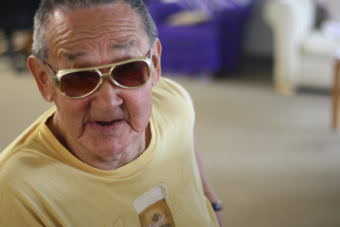
During the wreath-laying ceremony at Duncan’s grave, Boxley read remarks off his cell phone, alternating between English and s’malgyax, Metlakatla’s indigenous language.

“[s’malgyax] He loved us. And he worked hard to show us a good way to live,” he said.

Boxley asked for a moment of reflection and prayer. Those in attendance bowed their heads as a wreath was laid next to the headstone. Boxley is a renowned artist and co-chair of the Haayk Foundation, a non-profit aimed at preserving the s’malgyax language. The foundation was hosting and co-sponsoring the Founder’s Day feast later that evening.

“Have a wonderful Founder’s Day, and we’re gonna get back to work,” he said. Thank you.”

The day is filled with religious significance. In this small town, the line between the duties of elected officials and dedication to the Christian faith is blurred. About 50 people convened at the Metlakatla longhouse for a community church service. Mayor Audrey Hudson spoke.

“It’s very important that our children understand the word of the Lord and they grow to know that this is the norm and this is how it should be,” she said.

There are many schools of thought on how the role of missionaries like Duncan affected Native Alaskan culture. Despite the historical suppression of many Tsimshian customs, the last 30 years has seen an increase in Tsimshian cultural pride.

The interior of the longhouse is itself evidence of the ongoing cultural revival in Metlakatla. The floor and ceiling are all made of gleaming cedar. Artwork and handmade artifacts lined the walls.

Founder’s Day is about more than the town’s beginning, though. It serves as a homecoming of sorts for those who were raised in Metlakatla.

“My son did a good job,” said David A. Boxley.

He’s David Robert’s father. The senior Boxley was raised in Metlakatla. He lives in Seattle now but comes back every year for Founder’s Day.

The father-and-son team have carved many totem poles together and the elder Boxley’s carving work is on display at institutes and museums all over the country. He gestured to a pole just down the street.

“My son and I did that totem pole right there for all the women who started the children’s dance groups years ago,” he said.

He talked excitedly about the schedule of events for the day, including a parade, foot races and dance performances.

“It’s like 4th of July anywhere else, you know,” he said.

There are even fireworks.

Standing beside William Duncan’s grave, Boxley said he thinks the missionary changed the Tsimshian community for the better.

“It’s really important,” he said. “You know, our culture, our tribe. When this man came among our people, [he] changed our future. Absolutely changed our future. And his history, since he was 30 years old, is our history.”

Hundreds of Metlakatlans headed toward town. Around the street corner and into the ball field came the parade procession. A little girl dressed as Disney princess Moana sat on top of a paper-mâché canoe. Representatives from the Tsimshian tribes followed, dressed in traditional regalia and beating taught, tan drums.

Kimberly Wellington is part of the Wellington Clan. She said they are descended from Arthur Wellington Clah, the man who taught William Duncan to speak s’malgyax.

Wellington and her two sons were wearing matching purple shirts with her family’s crest and s’malgyax words emblazoned on the front.

“The saying on the top means ‘love one another,’ which was my grandmother’s favorite saying, and so this is in honor of her,” she said.

Many, many people milling around the ballfield were wearing these matching shirts. Wellington said making T-shirts has become a Founder’s Day tradition for the Wellington clan.

“Every year we do some sort of design with some sort of remembrance — for somebody within the family,” she said.

On the 130th anniversary of Metlakatla’s founding, it’s clear that Tsimshian residents are intent on keeping traditions alive – even newer ones that call for matching T-shirts.


Community centers in Dillingham provide places of welcome for the old and young

Paul “Elvis” Chythlook dons a pair of gold chrome shades at the piano bench. He plays for the community in the Dillingham Senior Center regularly, gospel and traditional tunes he knows by heart. (Photo by Zoey Laird/KDLG)

In downtown Dillingham, both the senior center and the Christian youth center are places to find food and fellowship with others.
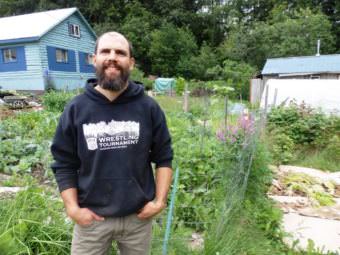
Paul Chythlook plays gospel piano at the Dillingham Senior Center, and afterwards I feel like I’ve been to church.

People call Chythlook “Elvis” for his baritone impersonation of the King.

Blind in one eye and arthritic, the 71-years-old plays by ear from a mental catalog of classics, barreling from Presley’s “Don’t Leave Me Now” to the hymn “Crying in the Chapel.” I request to hear the latter again.

Chythlook’s audience leans in, listening to the lyrics, all about coming together in fellowship.

“Elvis” rocks a pair of gold chrome shades and pounds out songs he’s played all his life. Across the keyboard, I make eye contact with a man I don’t know. We can’t help but smile.

Mischaell Romo, 4, lives in the same building as the Dillingham Christian Youth Center. She’s familiar with many of the youth who spend time there, and she’s always looking for someone to draw, paint, or color with. (Photo by Zoey Laird/KDLG)

High school night at the Dillingham Christian Youth Center looks like a roomful of siblings relaxing at home.

“We’re closer to being a family at the youth center than my own family is sometimes,” Noah Theurer, 17, said. The Theurers moved to Dillingham this summer, and Noah’s a regular at the youth center now. “We all pray together, we eat together, laugh together, you know it’s the whole nine yards of being a family.”

Jasmine and Tyler Romo run the non-profit organization and raise their kids in the same building.

Tonight, they work in the kitchen, while a game of foosball, music and young voices fill the center.

Their children, Mischaell, 4, and Giuseppe, 1, are doted on like everyone’s little brother and sister.

“My brothers and sisters, I haven’t seen them in a couple years,” Frank Nicholson said, shuffling cards and waiting for the lunch bell.

He visits with folks at the senior center more than some members of his family.

Philip Andrew joins us at the card table. “Old timer,” Nicholson said, “tell your life story.” Andrew guffaws, clearly used to the teasing, and takes a seat.

The two men are neighbors and good friends. I comment on a hole in Andrew’s shirt that’s comically positioned right over his belly button. He pats his stomach and grins.

“Every time I go over to his house he’s feeding his face,” Nicholson jabs. “Take a steam, feeding his face again.” Nicholson and I burst into laughter. “Typical day around here,” he says.

An elder told Ida Noonkesser “that if you treat people the way you want to be treated … you’ll have a bigger family.”

She didn’t understand at first, but now she’s the director of the Dillingham Senior Center, and has “a big whole family” aside from her biological one.

Noonkesser’s worked here for 17 years and she says, “It gives me joy to come to work Monday through Friday, because I get to spend time with the elders.”

She takes comfort in their friendship when she doesn’t see her parents or her 97-year-old grandmother as frequently.

“I can always feel the love from them,” Noonkesser said.

Many of the elders speak Yup’ik, Noonkesser’s first language, and “they have wisdom and give out advice.”

She likes to imagine they are all her adopted grandparents, and enjoys feeding them every day.

In the morning she cooks a meal with her staff, and when the lunch bell sounds at noon, she communes with her makeshift family of elders in the cafeteria.

Dillingham Senior Center director Ida Noonkesser stands before a board of memories. Photos of community elders are displayed from years past. Noonkesser was recently recognized for 17 years of service at the center. (Photo by Zoey Laird/KDLG)

Similarly, at the Dillingham Christian Youth Center, the “ideal result of coming together is sharing joy,” Jasmine Romo said.

Kids ages 10 to 18 are hosted on a foundation of faith, of “God’s love” and “bearing each other’s burdens.”

Young people like Sara Fuller, 17, assist the Romos at the center’s coffee corner, which serves beverages to the wider community for donations.

Behind the customer counter, Fuller refers to her cross necklace, saying she believes in “good lattes and God.” More seriously, she says “this youth center has changed lives.”

I ask her how, and she tells me about friends, who instead of sitting around at home, are finally eager to be somewhere after school.

“They’re getting out there and getting to know new people and having fun,” Fuller says, and I suspect she’ll be spending lots of time here in the coming school year.

Anastasia Heyano is in Fuller’s graduating class at the Dillingham High School, and she’s usually the youngest in the senior center at any given time.

She corrects me when I ask her what she likes about working with old people. “Elders,” she says, “have stories to tell and they’re really smart. Some of them have been everywhere.”

Heyano didn’t plan to work at the senior center this summer, but now she says, “I like it a lot … they’re funny, they’re chill, I mean, there’s no drama around them or anything.”

Her uncle “John John” Heyano is a regular, and he fist bumps her on his way to the cafeteria.

After lunch, I catch him chatting at the card table. When I ask him what he thinks of the senior center, he reminiscences about a time when more people got together to “just enjoy each other,”  like the elders do here.

John John is right. Simple, present minded togetherness like this doesn’t exist in most places and for most people. Maybe that’s why it feels so rare and wonderful.

Little Mischaell Romo hands me a brush and invites me to paint.

The youth center is quiet before the usual rush of kids at 3 p.m.

I sit alongside Mischaell and we paint a princess who wears shorts, a T-shirt and a crown. When she’s finished, I suggest that our princess needs a mantra.

Mischaell asks me what a mantra is, and I explain it’s something you say over and over because you believe it.

She decides I should choose one. I pull a lyric from “You Gotta Be” by Des’ree.

The song came into my mind all week, walking between the two centers and meeting kind Dillingham people, old and young. I paint the words and speak them as they appear on the page.

“Love will save the day,” I say. Mischaell follows the line of my brush with her eyes and repeats our mantra aloud. “Love will save the day.”

2 Haines food entrepreneurs are finalists in Southeast business contest

Two Haines entrepreneurs are finalists in a regional business competition. The Path to Prosperity program offers support to small businesses and startups in Southeast Alaska. The contest is a partnership between Spruce Root Inc. and The Nature Conservancy. This year, Path to Prosperity is focused on local food.

“Right now we are prepping for our upcoming lunch hour,” said Sarah Jaymot on a recent weekday morning. “So we’re making sure all our specials are in order. We’ve got a yellow curry and a kale pesto turkey melt and we also have a blind date which is featuring arugula from Foundroot.”

Jaymot owns Sarah J’s Espresso Shoppe. She’s served up mouth-watering breakfast, lunch and coffee to hungry people in Haines for several years now. But her love for food started earlier than that.

“I think I’ve been attracted to food and coffee my whole life,” Jaymot said. “And I think the inspiration started with my grandmothers. I had a fully Italian grandmother, I was the only grandkid allowed in the kitchen because I would do her dishes. But yeah, she kind of taught me to love food and love feeding people. And that cooking is a love language.”

Sarah Jaymot owns Sarah J’s Espresso Shoppe.
Sarah Jaymot owns Sarah J’s Espresso Shoppe. (Photo courtesy Kiana Donat)

Jaymot turned her passion into her profession about nine years ago, when she bought a restaurant called The Local Catch. A couple years later, she opened Sarah J’s.

The business has grown and seen a lot of success. But there is one major obstacle limiting its growth: space.

“The current space is a 23-foot food trailer that has back storage in a 10-by-10 [foot] shed,” Jaymot said. “So storage is a huge issue. We are busier than our menu and our food trailer allow us to be at times, which slows down our efficiency.”

Jaymot applied for the Path to Prosperity competition because she’s ready to take the next step and build a bigger, sit-down café.

The other Haines Path to Prosperity finalist is Andrew Cardella.

“There’s mostly annual veggies in here, a big strawberry patch here, apple trees,” Cardella describes the bounty of his backyard garden.

His business is still in the idea stage.

“My idea is to enable anyone who wants to garden to be able to garden,” Cardella said. “I feel like there are a lot of people who are interested but don’t know how to get started or maybe don’t know anything about growing food at all…my idea is to get them set up.”

Cardella wants to take away the obstacles people face when trying to create their own gardens.

He started gardening about five years ago with a plot at the community garden.

“I didn’t really know anything, then got this house and still didn’t know anything,” Cardella said. “Then had one failed season and learned a lot pretty quick.”

Andrew Cardella has expanded his backyard garden over the past four years. Now he wants to help other people build their own gardens.
Andrew Cardella has expanded his backyard garden over the past four years. Now he wants to help other people build their own gardens. (Photo by Emily Files)

In his application to Path to Prosperity, Cardella calls the potential business Perma Food-Scaping.

If his dream does become a reality, Cardella hopes he can help Haines become less reliant on food barged in from the Lower 48.

“You know, [more local gardens will] limit how much veggies we have to ship up here and the huge, huge carbon footprint that’s used for importing these foods from down south,” Cardella said. “And then in addition to that, all the plastic that’s used, when you go to a shop and buy a bundle of spinach, and you put it in a plastic bag, and then they put that plastic bag in another plastic bag…if you had just gone out to your yard and picked the same amount of spinach, it’s going to be so much healthier, it’s going to be so much better for you, and it’s not going to use all that plastic in the process.”

Growing local food economies is one of the main reasons Path to Prosperity narrowed its focus to food-related businesses this year. In a press release, contest organizers point out that 95 percent of the food Alaskans consume is imported.

The other finalists this year include a kombucha business in Craig, a food co-op in Sitka and a farm in Juneau.

All twelve Path to Prosperity finalists will participate in a business boot camp in Juneau this fall. Then, two winners will receive up to $25,000 for consulting or technical assistance. Those prizes will be announced in February.

Haines’ Port Chilkoot Distillery and Fairweather Ski Works are both previous Path to Prosperity winners. Last year’s winners were a Juneau kelp food business and Klawock coffee roaster.

Oprah’s visit to Alaska leaves lasting impact on fans

Media mogul Oprah Winfrey set foot in Sitka on Wednesday. She was ferried there on a Holland America cruise ship, with stops in Juneau and Ketchikan. Hundreds of loyal fans on board were seeking adventure, inspiration, and, if they were lucky, a chance to chat with the queen of daytime television.

And after a long day’s hike.. Cheers to ya? #lovinalaska

A post shared by Oprah (@oprah) on

Rumors that she was coming to Sitka floated around for weeks. News reports from Juneau confirmed her arrival, as did her Instagram account. In a video uploaded Monday, she sings, “Getting ready to hike the Mount Roberts Trail, here in Alaska!”

Oprah declared 2017 her “Year of Adventure” and launched a series of cruises – one to Alaska, where she had never been before. On her itinerary for Sitka was a visit to Fortress of the Bear, the Alaska Raptor Center, and watching the New Archangel Dancers at Harrigan Centennial Hall.

Holland America partnered with O, The Oprah Magazine, to offer four “Adventure of Your Life” cruises in 2018 through Alaska and the Caribbean.
Holland America partnered with O, The Oprah Magazine, to offer four “Adventure of Your Life” cruises in 2018 through Alaska and the Caribbean. (Photo by Cameron Clark/KCAW)

Many of her cruise ship passengers were hoping to catch a glimpse. Classie Hoyle is a former alderwoman from Annapolis, Maryland, and she’s been watching Oprah’s career ascend for decades.

“She’s certainly a role model and I’m — what, 20 years older than she?” Hoyle said.

The seven-day cruise departed Seattle on Saturday and was organized by O, the Oprah Magazine. Activities take inspiration straight from the magazine’s pages. There are yoga classes, an onboard book club, motivational talks and gifts – every night. “Not a car,” Hoyle jokes, referring to a 2004 episode of the Oprah Winfrey Show where every audience member got a Pontiac G6.

The swag on the cruise is more modest: a visor, a pen and a journal specifically for this trip. Oprah is big on reflection and on her faith. She was raised a Baptist and after years of physical and sexual abuse, and ran away from home when she was 13.

Even now, as one of the wealthiest people in the world, Hoyle said Oprah told a cruise ship audience that she still gets on her knees every night to pray. “Regardless of how much she goes out and parties, that is something she always does, which was shocking to me. You wouldn’t think a billionaire … but she says, every night she prays.”

Outside Harrigan, there’s still no sign of Oprah. Bus after bus of her fans arrive, sporting gear with a giant “O” logo. Part of the appeal of Oprah is that she’s built a massive empire around personal growth. People are inspired by her because she inspires them.

“I’m getting from this trip, that I will take with me, is I felt Oprah for the first time in the last 25 years,” said Coco Hunt. “You can read her. You can see her. But being in her presence, her essence, really flowed in the room. Everyone was captivated. You could hear a pin drop.”

Hunt is from San Diego, California. Her grandfather used to ask her, “What are you hunting for?” to which she replied, “I’m hunting to see what else I can do to leave a footprint on this Earth.”

Suddenly grabbing my hand, she tells me that I have a purpose, too.

Hunt: You have a voice. You have a voice. It’s important that you’re here and you have something for the universe. Isn’t that amazing? That you have an assignment?

KCAW: What are you? Are you a teacher?

Hunt: No, I’m just a person! That’s holding your hand. You’re the one that’s special.

KCAW: Well, thank you!

Hunt: Yes!

KCAW: You’re very special too.

It isn’t Oprah, but getting motivation from a true disciple of hers is the next best thing.

I walk away beaming and find a gaggle of young fans – Haley Silva, Faith Holst, Kayden Plummer – who have received the disappointing news that Oprah left town. “Maybe she’s eating something?” Holst asks. “Maybe she got a corn dog!” says Plummer. Silva wanted her autograph.

Several tour guides confirm that Oprah cancelled all her plans and around 2:50 p.m., went straight to her private jet from the ship, overwhelmed by all the attention she’d been receiving aboard. Ultimately, Oprah came and went without a trace. But what she does share of herself tends to linger long after she leaves.

Oprah Winfrey disembarks the Eurodam in Sitka on Wednesday, July 19, 2017. She flew out on her private jet shortly after. (Photo by KCAW)
Site notifications
Update notification options
Subscribe to notifications