Spirit

Knopp remembered as ‘one-of-a-kind leader’ in Alaska

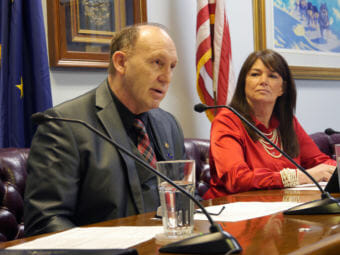
Rep. Gary Knopp, R-Soldotna, speaks during a House Minority press availability, April 6, 2017. (Photo by Skip Gray/360 North)
Rep. Gary Knopp, R-Soldotna, speaks during a House Minority press availability in April 2017.  (Photo by Skip Gray/360 North)

Updated at 4:55 p.m. 

State Rep. Gary Knopp, who died in a plane crash on Friday, became a pivotal legislator during his two terms in the legislature. He was remembered by friends and former legislative colleagues as plainspoken and friendly.

Knopp was a Republican who decided not to vote for a Republican House speaker other than himself. This directly led to a coalition that includes Democrats, Republicans and independents forming the majority caucus in the House.

House Speaker Bryce Edgmon, a Dillingham independent, said Knopp was a close friend.

“Gary was a one-of-a-kind person, a one-of-a-kind leader in Alaska and he will be sorely missed by all of us in the Legislature, who at the end of the day really are one big family.” Edgmon said, adding that he was still in shock over Knopp’s death.

Knopp was an oil industry contractor who served on the Kenai Peninsula Borough Assembly before he was elected to the House in 2016. He represented Kenai and Soldotna in the chamber.

Edgmon said Knopp was one of the more authentic people he’s met in politics, with an unmatched independent streak.

Edgmon said flying was important to Knopp, and that they had talked about Knopp flying himself to the Northwest Arctic region for hunting trips. Edgmon said Knopp made bold decisions in deciding where to fly to and in how he conducted himself in life.

“He took risks,” Edgmon said. “He was not afraid to get out in front of things.”

Knopp served in the all-Republican minority for two years. But he left the caucus after the 2018 election, citing the fact that Wasilla Rep. David Eastman hadn’t committed to supporting the caucus.

Knopp was criticized for going back on his word of voting for a Republican House speaker. Knopp said he fulfilled a commitment of voting for a Republican by voting for himself for speaker. He came up a vote short, before Edgmon was elected speaker.

Knopp’s district overlapped with half of Republican Sen. Peter Micciche’s. Micciche knew Knopp for decades, in both business and politics. He described Knopp as a regular guy, and his loss as devastating.

“It doesn’t matter how any individuals may feel about the way Gary served. The reality of it is, he did what he thought was right, whether you agreed with him or not,” Micciche said.

Knopp was running for re-election against two Republican challengers and his death could be pivotal in determining who controls the House next year. His two challengers,  Ron Gillham and Kelly Wolf, have said they want to join a primarily Republican caucus. The current majority has three votes more than is needed to hold most of the seats. Independent James Baisden also is running for the seat.

The day before he died, in an interview with Alaska Public Media and KTOO, Knopp described his approach to government. He said compromise was necessary. 

“I never make promises, just because, you don’t know what you can do,” he said. “I mean, you’re only one of a lot of people down there.”

Knopp said the Legislature shouldn’t swing too far right or left. 

“It’s not about a party thing, and it shouldn’t be about a party thing. It should be about the House functioning,” he said. “And I’m a firm believer that that coalition — that bipartisan coalition — we’re philosophically opposed on some issues, but there’s a lot of issues we aligned on. I thought we performed extremely well under the circumstances.”

On the House Finance committee, he opposed Republican Gov. Mike Dunleavy’s budget proposal last year. He described the potential impact of cutting a quarter of education spending or transferring oil property taxes from municipalities to the state in terms of lost Kenai Peninsula jobs.

Knopp is survived by his wife Helen.

Native Village of Eklutna will decide what to do with Captain Cook statue in downtown Anchorage

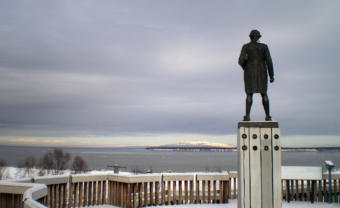
The statue of Captain James Cook at Resolution Park in Anchorage, Alaska. (Photo courtesy James Brooks/Flickr)

Following calls on social media for the statue of Captain James Cook to be removed from downtown Anchorage, Mayor Ethan Berkowitz has asked the Native Village of Eklutna to decide what to do with the statue.

In a joint letter Tuesday, Berkowitz and tribal president Aaron Leggett said “the statue is but one symbol among many that fail to fully and fairly recognize Anchorage’s First People.”

“Consequently, as part of the government-to-government relationship between the Municipality of Anchorage and the Native Village of Eklutna, we seek to establish a process that respects the crucial role and sovereign authority of local tribes as we more fully and fairly portray Alaska’s past,” the letter said.

The Native Village of Eklutna is the only tribal government within the boundaries of the Municipality of Anchorage. It became federally recognized in 1982.

Leggett said he would prefer to augment the monument at Resolution Park to include an accurate history of Cook’s time in Alaska and the history of the Dena’ina people. But he said it’s a decision for the village’s council to make later this summer.

“I don’t want to be the one saying it will never be taken down, but I think there needs to be a lot more discussion before we move forward,” Leggett said.

Leggett said this is the most significant recognition from an Anchorage official of the village being a sovereign government. That recognition, and the formation of government-to-government relations between the village and Alaska’s largest city, is something he’s been working on for 15 years.

Leggett called the recognition “huge.”

“This is a formal statement on behalf of the mayor that really does honor our sovereignty and looks at us as the true partner and governmental institution in our city,” he said.

Cook, a famed British explorer, was in the Anchorage area for short period in May and June of 1778; he and his crew were the first Europeans to reach Prince William Sound and Cook Inlet. His visit is remembered in the oral tradition of the Dena’ina people.
The statue in downtown Anchorage was given to the city by oil company British Petroleum in 1976. It is a replica of a statue in Whitby, England, which is a sister city of Anchorage.

Calls for the Cook statue’s removal in Anchorage come as statues of historical figures who were involved in colonization or the slave trade are being taken down and vandalized worldwide, viewed in a more critical light during the current global reckoning on racial equality.

Leggett said the Cook statue could be removed, or the outcome could be as simple as turning it around, so its back faces Cook Inlet. He said he’s humbled that so many have taken interest in the statue.

His personal goal is to use this as a way to educate people. Leggett, a special exhibits curator at the Anchorage Museum, said he sees Cook as a complex person whose maritime achievements are impressive. But Leggett said he also sees Cook as a colonialist.

That education could be changing the plaque on the statue to reflect the history of Indigenous people, as well as adding other educational materials at Resolution Park.

“It creates an opportunity for my people to tell a portion of our story because of Cook’s celebrity; the natural draw,” Leggett said. “Most people in the world know who Captain Cook is.”

This story was originally published by the Anchorage Daily News and is republished here with permission.

Native Youth Olympics goes virtual for annual statewide competition

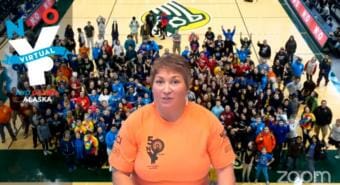
Head official Nicole Johnston hosts the 2020 Native Youth Olympics awards ceremony virtually this year. (Screenshot from Facebook Live)

The Native Youth Olympics brings together student athletes from across the state each year to celebrate Alaska Native culture through competitive events. 

Organizers canceled this year’s games due to the COVID-19 pandemic, but they found a way to continue the annual tournament that’s rooted in sportsmanship and survival.

Instead of meeting at the Alaska Airlines Center in Anchorage this year, teams sent in videos of athletes competing in their events. Coaches submitted score cards and judges reviewed the submissions. The winners were announced Friday during a virtual awards ceremony.

“We had over 50 athletes from over 20 communities compete from as far north as Nunamiut, as far west as Nome and as far south as Unalaska and Juneau,” said head official Nicole Johnston on Facebook Live. “Nearly every region in the state was represented.”

Johnston said athletes competed outside on beaches and driveways, inside community centers and from their living rooms. 

Juneau athlete Ezra Elisoff, a junior at Thunder Mountain High School, placed first among boys in the Alaskan High Kick with a height of 84 inches. 

The event requires balance and strength as athletes try to kick a small seal skin ball dangling from a string above them. 

“The thing is, you don’t really need fancy equipment,” Elisoff said. “All you need is just a kicking ball and a nice place to yourself.” 

Juneau’s 2018 Native Youth Olympics team at the statewide competition in Anchorage. (Photo courtesy of Kyle Worl)

Several other Juneau athletes placed in other events. Elisoff and his teammates trained after school throughout the school year.

Though he said it was disappointing to have the in-person event canceled, he’s just glad he got to compete — even if he won’t get to celebrate his victory with his team.

Competitors in Native Youth Olympics build each other up throughout the event. Elisoff said in other sports — like high school wrestling — you don’t see that. 

“It’s different because you’re encouraged to help others and you’re encouraged to encourage each other and cheer each other on because that’s kind of what kept our ancestors alive, you know, all those years ago,” he said. “So I’m kind of proud to say that this is part of my culture.”

Native games extend outside of Alaska. Youth and adults regularly compete in similar events against athletes from as far away as Greenland. 

In March, the Arctic Winter Games in Whitehorse, Canada were abruptly canceled for the first time since 1970 due to health concerns. 

The annual World Eskimo-Indian Olympics, which take place in Fairbanks in July, have also been canceled. Organizers say they hope to be able to hold an online celebration.

The results of this year’s virtual Native Youth Olympics will be posted on citc.org.

See Ezra Elisoff’s winning kick here:

Byron Mallott: ‘My friend, we also have lived life fully, made a few contributions’

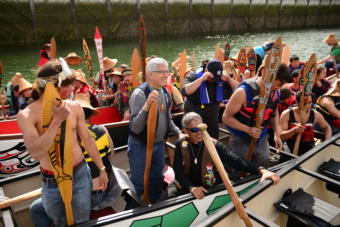
Then-Lt. Gov. Byron Mallott participates in the canoe landing ceremonies that unofficially kick off Celebration in Juneau on June 5, 2018.
Then-Lt. Gov. Byron Mallott participates in the canoe landing ceremonies that unofficially kick off Celebration in Juneau on June 5, 2018. (Photo courtesy Office of the Governor)

When Byron Mallott died on May 8, 2020, memories and condolences from leaders poured in across the state and beyond.

Mallott was most recently known as Alaska’s lieutenant governor, but his greatest legacy was likely shaping generations of Alaska Natives through political and corporate leadership.
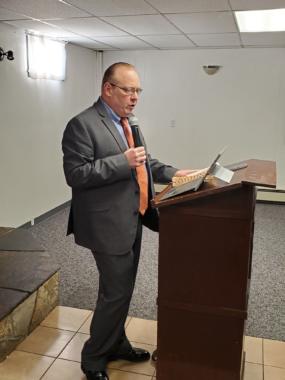
Byron Mallott was born in Yakutat on April 6, 1943. He was Tlingit of the Raven moiety and a clan leader of the Kwaashk’i Ḵwáan.

In an interview on the KTOO-TV program “Conversations” in 1985, Mallott briefly recounted being sent away to Pius X Mission, a Catholic boarding school in Skagway.

“From the time we were 13 years old, we were essentially summer visitors at home,” he said.

The boarding school system was a government-backed effort to scrub indigenous people of their culture and force assimilation. His former chief of staff as lieutenant governor, Claire Richardson, remembers Mallott saying he had a stutter in those days.

“And he told me that he developed that stutter while attending boarding school as a child. And so he learned to think of what he was going to say ahead of time, as if there was a teleprompter in his head,” Richardson said. “Byron had the uncanny ability to speak eloquently and passionately without the use of notes or cue cards.”

His son Anthony Mallott said his dad was the class president, but got expelled after sticking up for another student.

Mallott ended up at Sheldon Jackson School in Sitka, where he graduated high school. His son said thinking of those days, playing basketball and making friends, always made his dad smile.

Then-Lt. Gov. Byron Mallott and Department of Fish and Game Commissioner Sam Cotton play basketball against Natasha Singh from the Tanana Chiefs Council in Grayling on June 26, 2018.
Then-Lt. Gov. Byron Mallott and Department of Fish and Game Commissioner Sam Cotton play basketball with Natasha Singh from the Tanana Chiefs Council in Grayling on June 26, 2018. (Photo by David Lienemann/Office of the Governor)

Mallott highlighted those relationships in a different light in his 1985 interview.

“You began to build a network of acquaintances and friends, principally Native, because those were Native schools largely, from throughout the region,” he said.

After high school, he went to Western Washington University in Bellingham. But he didn’t finish college because his father, the longtime mayor of Yakutat, died. He went home to help his mother, and successfully ran for mayor himself when he was 22 years old.

“You just kind of grow up with a sense that, if there are things happening in the community, if there are issues, you know, somehow, you ought to be involved,” Mallott said. “I mean, that was always there for us and I think everything else was a natural progression of that kind of family attitude.”

Mallott didn’t finish his term, because he took what he called a “low-level staff” job in the state agency that eventually became the Division of Community and Regional Affairs. It required a lot of travel and meeting a lot of local officials, which is how he met two other foundational figures who helped unite Alaska Natives around a statewide political identity: Emil Notti and Willie Hensley.

Byron Mallott, left, and Willie Hensley pose for a photo at Three Saints Bay on Kodiak Island in August 2019.
Byron Mallott, left, and Willie Hensley pose for a photo at Three Saints Bay on Kodiak Island in August 2019. The longtime friends first met in October 1966 when the Alaska Federation of Natives was first organizing. (Photo by James Umiivik Hensley)

“We’ve actually known each other for almost 55 years,” said Hensley. He’s one of the founders of the Alaska Federation of Natives, which successfully lobbied Congress for the Alaska Native Claims Settlement Act.

(Left) Now-Lt. Gov Byron Mallot, Willie Hensley and Roy Huhndorf testify before Congress. (Photo courtesy Willie Hensley)
From left to right: Byron Mallot, Willie Hensley and Roy Huhndorf testify before Congress. (Photo courtesy Willie Hensley)

“We met in 1966 when we were first organizing the Alaska Federation of Natives. … And when we were organizing AFN, we all kind of announced ourselves. And of course, we’re all there representing some of the different tribes around. And he said he represented the state of Alaska, and we kicked him out!” Hensley said laughing. “‘Cause, we didn’t want the state to know what our strategy was, right? On this — what was going to be the battle of the century over who owned Alaska.”

Hensley said they later let Mallott in, but as a representative of the Five Chiefs of the Yakutat.

ANCSA’s passage in 1971 established Native corporations. Mallott became a founding board member of Southeast Alaska’s regional corporation, Sealaska, and its top executive in the 1980s.

In 1985, Sealaska was the biggest of the Native corporations. He explained how creating the corporations served as more than a one-time payout.

“The benefits of the claims settlement act shouldn’t benefit just a single generation of Native people. That there ought to be a way to maintain the corpus — the land and the money — in mechanisms that would allow them to be used to flow, the continuing benefits of ANCSA, through succeeding generations. That the accident of history shouldn’t determine who participated in ANCSA.”

Hensley said there is a specific piece of ANCSA that was very contentious but has since led to the pooling and sharing of billions of dollars among Native corporations. Hensley said Mallott was instrumental in negotiating this revenue sharing part of the law, sometimes referred to as 7(i).

Mallott oversaw the creation and growth of a Sealaska shareholders’ permanent fund and a corporate investment portfolio worth over $100 million, according to an old professional biography on file at the Alaska Permanent Fund Corp.

Mallott was appointed to relatively new permanent fund corporation  in 1982. He retired from the Sealaska executive position in 1992, but stayed on the board until 2014. He became the Permanent Fund Corp.’s top executive in 1995. He had a stint in the ’90s as the mayor of Juneau, too.

More recently, Mallott ran for governor. He won the Alaska Democratic Party’s nomination in 2010 and 2014. He didn’t win, but became lieutenant governor in the second run by merging his campaign with independent candidate Bill Walker.

Alaska Gov. Bill Walker and Lt. Gov. Byron Mallott join hands after their inauguration on Dec. 1, 2014, at Centennial Hall in Juneau.
Alaska Gov. Bill Walker and Lt. Gov. Byron Mallott join hands after their inauguration on Dec. 1, 2014, at Centennial Hall in Juneau. Walker and Mallott, who ran for office on an independent “Unity Ticket,” spoke about unity and togetherness in their inaugural addresses. (Creative Commons photo by James Brooks)

Mallott’s message at the time was that joining Walker’s nonpartisan campaign was what was right for Alaska. Four years later, he resigned abruptly after making what Walker called inappropriate comments.

Claire Richardson, his chief of staff, said the circumstances of his resignation shouldn’t overshadow his life. She said, there’s a lesson in taking immediate responsibility for your actions.

“To know that there are men who make mistakes, and the ones who actually own up to it are the ones that I think we can look at and remember not just that moment, but the 50 years of public service and the good that he did for so many people” she said.

Mallott died after a heart attack on May 8, 2020.

Just the day before, Hensley had been texting Mallott about mourning another friend.

“And Byron’s response was, ‘My friend, we also have lived life fully, made a few contributions and are still going strong! I hope that is a good thing.’ … And now he’s gone. It’s so sad.”

Gov. Mike Dunleavy ordered U.S. and Alaska flags to half-staff for a week, through sunset Friday, May 15.

He is survived by his wife Antoinette, four siblings, five children and their families.

Mallott’s family doesn’t have plans for memorial services yet because of the pandemic. Anthony Mallott said his father would have wanted fun and memory-filled events in Yakutat, Juneau and Anchorage. The family has set up a memorial fund in his name through the Juneau Community Foundation. Mallott’s family said condolences may be sent to the home address, 102 Cordova Street in Juneau.

The faithful may now gather in person, but many congregations in Alaska are keeping it virtual

Pastor Undra Parker delivers a sermon to an empty church on March 29. The sermon was recorded and shared on a variety of streaming services. (Photo courtesy of Shiloh Missionary Baptist Church)

A state mandate allowing churches and other houses of worship to reopen went into effect two weeks ago — but with limitations. Congregants must observe social distancing during services, and capacity has been limited to 20.

Despite the relaxed regulation, few churches have opened for in-person services.
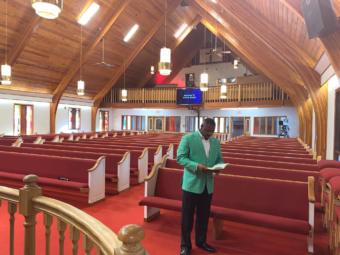
Brad Schrack is the pastor at Antioch United Pentecostal Church of Anchorage, one of the few churches that have managed to open since state mandates allowed in-person services. He preached to just over a dozen congregants at a service on Sunday, the first time in months they’d got together in person.

“What I felt when everybody was there was just more of a relief,” he said. “Finally there was some normalcy.”

At the service, also streamed through Facebook Live, he joked that there’s no more falling asleep since now he can see everybody in the room.

Schrack said it was still difficult to get used to the restrictions. Tables and pews were removed, and hand-shaking or hugging wasn’t allowed. Cloth pews were replaced by hard plastic chairs that are easier to wipe down.

Brad Schrack, the pastor at Antioch United Pentecostal Church, was one of the few churches around Anchorage to hold in-person services on Sunday, May 3. (Photo courtesy of Kaylynn Schrack)

Schrack said he wasn’t trying to make a political statement by opening, but it just felt right.

“It wasn’t an overt thing: ‘Hey we just gotta, you know, there’s pressure to do it.’ But there is a sense of, ‘Wait a minute, this is essential in my life, and it’s essential to people that come to our church’s life.’ And that’s what a lot of them said. It’s just good to be back home,” he said.

He said he’s worried about what’s going to happen to people who are isolated in their homes. He’s heard of rising rates of depression and domestic abuse, and thinks that in-person church services offer an antidote to that. While he acknowledges the risk, Schrack, who has Type 2 diabetes, said there’s risks in everything.

“Putting myself in the house doesn’t protect me from a heart attack,” he said.

But, he said, he’s still following all the state’s rules.

“As long as the government goes by the data, as they said, and only really tightens things back up if, you know, the health care system begins to get stressed, then I’ll be good with that,” he said.

But not every church thinks it’s time to open. Antioch is a small church — at most, it has about 20 congregants. That’s the maximum number mandated by the state and the city’s guidelines.

Larger churches have to make a different calculation.

“The biggest concern is space,” said Shane Paulsen, an administrative pastor at Anchorage’s Cornerstone Church.

With a congregation of several hundred, he said, the church decided it wasn’t feasible to meet state guidelines so that everyone who wanted could attend.

“What do you do with all the kids? What are the options there? There’s so many parameters to take into account with that. We would have to have probably a service every day of the week to be able to comply with the standards set,” he said.

Paulsen said that there’s also new social dynamics that church leadership isn’t comfortable with.

“Some people are gonna be hypersensitive to all this. Some people are gonna be like, ‘I’m done with this. Let’s go for it,’” he said.

Anchorage’s largest churches, by and large, are saying that they’re keeping their doors shut to in-person services for now, and it’s not entirely sure when that will change. There are just too many factors to take into account, they said.

It’s a painful decision to have to make, and few have more on the line than the Muslim community, which is currently in the middle of its month-long celebration of Ramadan, the holiest month of the Islamic calendar.

Youssef Barbour is the spokesperson for the Islamic Community Center of Anchorage Alaska. He said that it’s particularly difficult, because normally Ramadan is a time that Muslims refrain from pleasures like smoking and sexual contact during the daily fast. Community helps people get through the month.

“It’s very intense or heavy in social activities getting together. And because we, you know, this peer support or this support where everybody’s doing it together, it makes it easier,” he said.

Celebrations, like the nightly iftar feast, are now done just with nuclear families, as are the daily prayers, some of which last over an hour.

“It’s really hard if you’re just by yourself, because you’ll find an excuse not to do it. But if you know that you’re going to go there, and there will be people,” he said.

But, just like other religious groups, the Islamic community is finding some silver linings in staying at home. Barbour said his 9-year-old daughter is more interested than ever in following the daytime fasting traditions her parents are observing.

“She’s sleeping as much as she can during the day so that she can minimize the amount of time she actually has to go through the hunger,” he said.


Alaska’s faith leaders are moving their services online — and learning more about their congregants

Pastor Undra Parker delivers a sermon to an empty church on Sunday, March 29. The sermon was recorded and shared on a variety of streaming services. (Photo courtesy of Shiloh Missionary Baptist Church)

When Undra Parker, the pastor at Shiloh Missionary Baptist Church in Anchorage, made the switch to online services, he said it felt different. Normally, in black churches, there’s a lot of interaction with the sermon.

“There’s a lot of ‘amens,’ ‘save us,’ ‘do it,’ ‘preach,’ — that talk-back you get,” Parker said. “And it’s a little different when you don’t have that.”

Now, Parker is preaching to a mostly empty church, save for the few staff members needed to produce the online service, which is streamed through Facebook Live and other platforms.

It’s hard not being able to see the reactions of congregants, not being able to hear the voice of the choir and not shaking hands at the end of service, he said.

Matt Schultz, at the First Presbyterian Church of Anchorage, also said he’s struggling to adapt to the new online sermons.

“It’s strange, man, because I like to make a lot of jokes, and you pause for laughter and there’s no laughter. Even on the good jokes, there’s no laughter — and that’s kind of funny,” he said.

But Parker, Schultz and others have also been adapting quickly to the changed worship landscape. They’re even learning to appreciate it.

“You know, it’s not bad,” said Schultz. “It’s just new, and you learn in the comments what people like. People are very, very free to criticize your work via email. You can get a lot of feedback that way.”

Rev. Undra Parker at an empty Shiloh Missionary Baptist Church on Sunday, March 29. He says he’s struggled with not being able to connect, but that it’s important to convey the right message. “(It’s) a great time for the church to be the lead and be the light. We need to be the forefront of hunkering down, particularly in the state of Alaska,” he said. (Photo courtesy of Shiloh Missionary Baptist Church)

Part of the trick has been learning new ways to engage with congregants digitally.

Rabbi Abram Goodstein of Congregation Beth Sholom said he realized that, in some ways, digital interaction can be more intimate than in-person sermons. For example, in the Mi Shebeirach prayer of healing or in the Mourner’s Kaddish, instead of asking people to say the names of their loved ones aloud, Goodstein said he has them post in the live comments.

“I see names pop up on the comments. People want to say the names they’re thinking of, and everyone can see it. So, it’s an exciting format to show a person who you are thinking of who needs healing, or a loved one who you knew who’s passed away,” he said.

The new format is also helping Goodstein fine-tune his own sermons using the digital analytics.

“In Facebook Live, people can react with buttons,” he said. “When it’s over, I can see when the most reactions happen, giving me an idea of what’s most popular about my worship service in a really incredible way.”

The technology is used in other ways as well. Churches around the state are seeing check-ins from places they didn’t even expect — and from people who might be turning to faith now with a particular intensity.

The ChangePoint Alaska church has seen its web viewership roughly double — from 2,000 to 4,000 — even though they’ve had an active webcasting service for years. They’ve seen viewers tune in from states across the country, and from as far away as Central America and Europe. They’ve been communicating with missionary partners in Italy and hearing dire news about the virus, as well as with former members who just pop into livestreams and chat rooms.

While these streams have existed for years, the church is also experimenting with new adaptations.  One of the ideas is a daily prayer streamed over Facebook. The church is calling the 7 p.m. meetings “The COVID-1900.”

“We’re getting together for prayer, and we’re trying to pray in response to the things we’re learning about daily and that people are experiencing daily,” says Michael Warren, ChangePoint’s community and care pastor.

Pastor Scott Merriner delivers a “COVID-1900” prayer in front of Providence Hospital, a location he says he chose because it is on the “front lines” of the crisis (Photo courtesy of ChangePoint Alaska)

It’s especially important — and challenging — to keep elderly members of the congregation involved. Not only are people over 65 at higher risk of the effects of COVID-19, but they also tend to be less proficient technologically.

Tony Schultz at the Anchorage Lutheran Church said his staff identified the need to keep elderly members involved early on — and quickly found a solution.

“One of our members who provides the camera work for anything that we do is able to make DVDs. We have some people close by that we drop (them) off into their mailbox, and let them know it’s there,” he said. “Others, we’re mailing.”

There are plenty of ways to connect the global pandemic to scriptural lessons. Religious leaders said they’re tying sermons to themes of trials of faith, the unity of the community and keeping hope in hard times.

They’re also trying to be leaders in conveying practical messages from public health officials. While some churches in other parts of the country made headlines by defying public health mandates against large gatherings, most faith institutions around Alaska said they’re in lockstep with the recommendations.

“We are a faith community, so we do honor and still trust in God. But we use wisdom and we heed the mandates, the recommendations, the advisories, all of the things that will come down from our local, state and national officials to hunker down and to heed the six-foot distance,” said Parker, of Shiloh Missionary Baptist.

Religious institutions are getting as creative as they can in conveying those messages to their audiences.

In Fairbanks, the Unitarian Universalist Fellowship of Fairbanks produced a video with lyrics like: “There’s lots of stuff to watch online while keeping safe from sinus ills/ In this case it is better to enjoy Netflix minus chills.” The two performers hold a six-foot-long rod to make sure they’re keeping proper social distance.

But the humor underlies what, in many cases, are serious emotional and spiritual questions brought to light in a time of crisis. While many church leaders said they’ve seen more resilience than hope, and more offers to help neighbors than requests for assistance, they know that faith institutions play a special role in addressing deep spiritual concerns.

“I think when people are facing trouble, it’s a time when people are particularly open to spiritual kinds of things, because it makes them ask those kinds of questions,” said Warren, of ChangePoint, “As a church, we want to be ready to answer those questions in a clear and a winsome way, so that people have hope and they’ve got a vision that they can hang onto as we go through this.”


Site notifications
Update notification options
Subscribe to notifications