Spirit

‘She needs a lot of work’: Museum of the North staff begin work on ‘Into the Wild’ Bus

UA Museum of the North Director Pat Druckenmiller checks out Bus 142 last week with Colin Howard, left, and Aaron Warkinton, right, who work for Pennsylvania-based B.R. Howard Conservation. (Photo by Tim Ellis/KUAC)

Preliminary work began last week on a project to create a museum exhibit featuring the old bus where the central character in the book and movie “Into the Wild” spent his last days. The rusty relic was airlifted out of a remote spot off the Stampede Trail last year and brought back to Fairbanks, where it had been used decades ago as a city transit bus. And now, University of Alaska Museum of the North staff are planning a new outdoor exhibit that will tell the story of how Bus 142 became an American cultural icon.

Colin Howard and another artifact-conservation expert are conferring with Museum of the North staff about the fragile condition of Bus 142 project before the conservators head back to Pennsylvania, where their art- and artifact-conservation company is based.

“It provides a whole bunch of challenges,” Howard said. “I mean, she’s really dirty, and she needs a lot of work.”

Museum of the North Senior Collections Manager Angela Linn explains conservation work needed to stabilize the floor of the bus and other parts of its interior. (Photo by Tim Ellis/KUAC)

He and his colleague, Aaron Warkinton, met with museum staff last Friday after spending a couple of days examining the old rig as part of their assessment on what’s needed to keep it from further deteriorating, and make it presentable to the public.

“So, we don’t want to make it brand-new,” Howard said. “I don’t want to make it look like it was just repainted. It carries a significant story for multiple decades, and we want to keep that story going.”

Those stories are told in part through the rust and chipping paint typically found on a 75-year-old vehicle, especially one that’s been sitting exposed to the elements at a remote site near Denali National Park since it was hauled back into there in 1961. The bus served as a shelter for hunters and hikers, including Christopher McCandless, the hapless wanderer profiled in Jon Krakauer’s account titled “Into the Wild.”

“So we just want to stabilize it, make sure that the corrosion is no longer active,” Howard said. “We want to stabilize flaking paint that’s coming off. There’s stories inside that are falling off the walls, literally.”

Those are the stories told through graffiti that’s been scrawled all over the bus and its few remaining windows. Many were left as an homage to the memory of McCandless, whose body was found in the bus on Sept. 6, 1992 by some moose hunters.

Many of those who reached the bus left messages addressed to McCandless and their fellow "pilgrims." (Photo courtesy Tim Ellis/KUAC)
Many of those who reached the bus left messages addressed to McCandless and their fellow “pilgrims.” (Photo courtesy Tim Ellis/KUAC)

One of the scrawls reads, quote, “Godspeed Chris, and say hi to my mom from me!”

Another reads: “Thanx 4 the inspiration!”

Yet another simply says “He was here!”

“There’s Japanese kanji in there. Russian – people from all over the world have journeyed out there to interact with that relic,” Warkinton said. He says the graffiti attest to the universal appeal of the story of McCandless, a tragic figure who after graduating from college decided to escape society and its materialism and instead find the meaning of life. A search that led him deep in to the wilds of Alaska.

“I think he touched on something that a lot of people struggle with,” he said. “Like I’d mentioned earlier, about dealing with the modern world – it can be so overwhelming!”

Angela Linn, a senior collections manager at the Museum of the North, agrees.

“[You] know this is a story that really resonates with millions of people around the world,” she said. “And whether it’s because of the mystique of Alaska, whether they really identify with Chris McCandless and the transition he maybe was going through himself. That, [you] know, people see that in themselves.”

Linn, who’s managing the project, said that’s one of the main reasons why Museum of the North officials believe it’s important to preserve the bus and share its stories with the public.

“We think it’s really important to spend the money and the time and the great amount of effort to bring all those stories together,” she said. “And that’s part of what our job is in museums, is to get people to connect those dots within themselves.”

Linn said it has cost about $7,000 so far for Howard’s firm to assess the work needed on the bus and estimate how much it’ll cost to do it. The money was raised through online crowdfunding. And she’s hoping to raise additional money with crowdfunding help from Friends of Bus 142, an online group founded by McCandless’s sister, Carine.

Linn says much of the consulting and planning for the exhibit is being done by a 25-member interpretive team, which includes university faculty and members of the community.

She said if all goes well, the exhibit could be opened in 2023.

How a troubled Anchorage strip club became a Baptist church

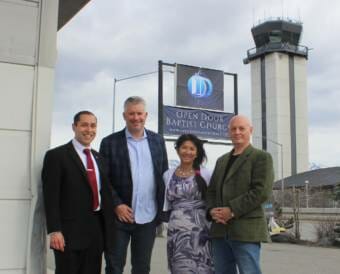
From left to right Pastor Kenny Menendez, Realtor Nate Baer, Property Developer Linda Dunegan, and Realtor Mike Gailey pictured on May 2, 2021 (Lex Treinen/Alaska Public Media)

There’s a word that comes up often if you ask the real estate agents, the building owner and the pastor how they turned the Fantasies on 5th strip club near downtown Anchorage into a church: providential.

Realtor Mike Gailey, who conceived of the idea, said that as the project blossomed from pipe dream to reality, things fell into place seamlessly like they were meant to be. As more people joined the project, each seemed to have their own story of redemption tied to the boxy building across from Merrill Field.

“Everybody at some point or others sort of succumbed to this sense of providence and guidance that just was undeniable,” he said.

It began a bit more than a year ago. Gailey was approached by the owner of Fantasies, which was forced to close after a lawsuit over unpaid wages and trouble with a liquor license. After seeing the club shuttered for two years, she wanted to sell.

“My initial thought was, this ought to be a church,” he said.

It was an unusual thought, but he said the building provided the necessary space and got a lot of traffic going by on the Glenn Highway that could make for easy advertising. More than that, Gailey saw a story that could resonate with city residents.

“It was kind of a redemption story. And I knew churches, Christians, they love that story,” he said.

Perhaps — but the owner said she’d had a similar thought of converting to a church, without any luck.

“‘I even stopped by a couple of the bigger ones. But I don’t think I got past the receptionist,’ she said,” Gailey recalled.

The COVID-19 pandemic, which hit right around then, didn’t help. Gailey found himself begging for an extension from the owner to find someone to fill the property. She gave him an extra week and suggested Gailey talk to a developer who’d previously expressed interest to help fill it. Gailey recalled the owner described the woman as “hard-ass,” with a military background.

“She won’t pay you a commission. But that’s your problem, deal with it,’ ” he said the owner told him.

Gailey did some research on the woman and discovered an improbable series of coincidences about their lives. They both were ex-military, each had spent time in Vietnam, and they even knew the same Vietnamese doctor there. Incredibly, Gailey realized that they had met 10 years ago at a random dinner party in Hanoi.

“By that time, the coincidences were so statistically improbable, so outrageously providential, really,” he said.

The woman was Linda Dunegan. After some cajoling, she agreed to meet Gailey at the building. It was dark except for the flashlights of their phones. The dusty floors were filled with stripper poles and catwalks still decorated for Halloween from the day it closed over two years ago. Dunegan turned to her realtor to reveal a secret connection she had to the place.

The inside of Fantasies on 5th before it became a Baptist Church (Photo courtesy of Mike Gailey)

“I said, ‘Do you know why I want to buy this place? It’s because my mother was a stripper,’” Dunegan told him.

Dunegan’s mother, an immigrant from Vietnam, had danced at clubs around Anchorage. She’s not sure, but thinks her mother may have worked at Fantasies. Dunegan, who moved out of Vietnam as a child in the 70s, said she sometimes felt shame as a child about her mother’s work. She said the project to convert the club is a work of healing.

“It was very hard for me to see those strip poles,” she said. “It was really hard for me, because I had condemnation in my heart from my mom. So I think the redemption story is not for the public. It was for me and for my mom.”

She decided to purchase the building. But her realtor, Nate Baer, needed some convincing.

“I was like, ‘Well, you have the traffic count. You have the stages, you have the poles, you have everything. But you know, for a church — it just wouldn’t work out,’” he said.

But Dunegan was persistent.

“Through my experience working with Linda, I always say ‘Gosh, I don’t think that can work out.’ She’s like, ‘Well, why not?’” he said. “And you know, she’ll push and push and push and a lot of times, things somehow just work out.”

Open Door Baptist Church in May, 2021 (Lex Treinen/Alaska Public Media)

But there was still the issue of finding a pastor and a congregation during the pandemic.

Meanwhile, hundreds of miles away in Oregon, Kenny Menendez was living a normal, middle-class life, working his day job and serving as a deacon at his church on Sundays.

“I lived a comfortable, successful life. I worked at an aerospace industry, doing purchasing there for the company. And, you know, I had everything going for me,” he said.

But when the COVID-19 pandemic hit, he and his family had time to reflect.

“We had to decide as a family what was important to us, and to us, what was important is church in general,” he said.

A few weeks later, Menendez, his wife, and young kids were on a plane to Alaska with their whole life in tow. It felt right, Menendez said.

“It is a fast change of life, but you know, the things that are impossible for man are possible with God. And the Bible also says that without faith, it’s impossible to please Him. So we took that leap of faith, so to speak,” he said.

He arrived and had already started regular Bible studies when he got a call from Linda Dunegan. Her building was looking for a church to fill the space and Menendez agreed it was the right place.

The main stage is now clean and bright with laminate floors and dark finished cross beams and a well-lit dais for the pastor.

The inside of Open Door Baptist Church. (Linda Dunegan)

For Menendez and his wife, who plays piano for the church, the move to Anchorage seems providential, just like the rest of the story.

It’s a redemption story for all of Anchorage, he said, that he hopes will be realized as the church grows.

Indigenous creators hope to share history, cultural art forms through first-ever Tlingit opera

The first-ever Tlingit opera will be based on the book “Russians in Tlingit America” by Nora Marks and Richard Dauenhauer. (Courtesy: Sealaska Heritage Institute.)

The first Tlingit opera in production is about the Tlingit-Russian wars at the start of the 19th century. The opera is still in the early development stages but the creators say it’s bound to be an epic production.

Sealaska Heritage Institute recently announced the opera’s development which will be based on the true story of the Tlingit-Russian wars in 1802 and 1804.

Ed Littlefield, the opera’s composer, said one word has been used to describe the story so far.

“We have been throwing out the word ‘epic,’ you know, in a lot of our conversations and that story, that real life story that happens, you know, in Lingít Aaní, in our backyard,” Littlefield said. “You know, it is a very important one. And either way it could have gone would affect, you know, the area for years to come.”

The story of those battles have been told by generations of Tlingit. But even while the source material is written, it’s too soon to say exactly what the opera will be like in detail. The creators hope to show audiences Tlingit song, dance and art in its many forms.

“It’s already built-in up and down, you know, there’s triumphs, there’s sacrifice. There’s explosions, literally, there’s explosions,” Littlefield said.

The idea for the opera started with Rosita Worl, president of Sealaska Heritage Institute. Several years ago, she was doing research on the Tlingit-Russian Wars.

“And in my mind, I could actually just see the scenes, you know,” Worl said.

Worl imagined vivid details of a battle on the beach. Like the beating of the drums, the Tlingit women wailing war cries and even the foggy weather.

“I was thinking this would be awesome to, you know, to see this visually,” she said. “And also, I wanted to hear the sounds, you know, that were ongoing, you know, with the scene.”

Worl asked Vera Starbard to write the opera. Starbard said she hopes that audiences can learn about the sophistication of different Tlingit art forms.

“There’s this dominant narrative in American culture that said Indigenous anything is less than, is more simplistic, is savage,” Starbard said. “I mean, we’ve literally grown up with that narrative, as a country. And yet, we’ve been doing Performing Arts pieces for thousands of years, and have really emphasized what we might call production value.”

Starbard said she also hopes that audiences will learn the lessons from the history itself.

“What it says about how coordination and working together as many different autonomous groups made her a successful campaign against what could be seen as a much more powerful force in just sheer numbers and literal gunpowder.”

The opera will be a collaboration between Sealaska Heritage Institute and Perseverance Theatre. Leslie Ishii is the artistic director at Perseverance Theatre.

She said the opera’s development is a years-long process.

“It’s an interesting way to produce and a great opportunity to decolonize our spaces, continue to re-indigenize and in this case, re-Tlingitize, our spaces as well.”

The first-ever Tlingit opera doesn’t have a set release date yet.

But Littlefield, said as the opera evolves, he hopes the story is shared around the state and hopefully the world.

Editor’s note: Vera Starbard is on the Board of Directors for KTOO.

After a year of pandemic isolation, Anchorage Muslims return to mosque for Ramadan

Youssef Barbour, a doctor in Anchorage and spokesperson for the Islamic Community Center of Anchorage Alaska at an evening prayer service on Tuesday, April 13, 2021. (Lex Treinen/Alaska Public Media)

The crescent moon appeared in the night sky on Monday, kicking off the holy month of Ramadan for Muslims around the world, including in Alaska.

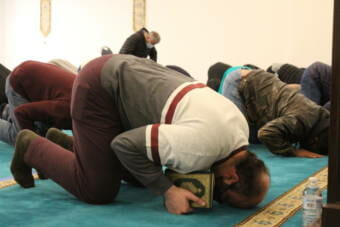
At Alaska’s largest mosque, the Islamic Community Center in South Anchorage, about 50 of the faithful gathered for Tuesday evening prayers. Blue painter’s tape on the turquoise carpet marked safe social distances between men, who diligently wore masks during prayers and prostrations. Women entered from a different door and stayed in a separate area on the balcony throughout the service.

While in past years, Ramadan services centered around the breaking of the fast with a meal, this year evening prayers are the main event due to concerns about COVID-19.

“Last year, we didn’t even have the prayer, there was no activity at all. Everybody did it at home. So this year, at least we are doing that night prayer together,” said Dr. Youssef Barbour, a spokesman for center.

Men gather in the sanctuary for the evening prayer, or Ishra, which takes place every day at 9 p.m. Wearing a yellow robe at the front of the room, the Hafez, the reciter of the Quran, speaks into a microphone at the front of the service and has memorized the 600 pages of Islam’s holy book. (Lex Treinen/Alaska Public Media)

The service starts at 9 p.m. with a recitation of general prayers covering a variety of topics.

“Basically for guidance for forgiveness, for removal of debt, of sorrow, of sadness, all these kinds of emotions, the bad emotion to kind of be removed and lifted, be lifted, and just replaced by good emotions,” said Barbour.

This year, he said, the prayer for healing and recovery was especially poignant after a pandemic that hit Alaska hard.

Every few minutes, congregants knelt and prostrated themselves, touching their foreheads to a floor decorated with rows of intricate arabesque. The building was completed about five years ago to serve the several thousand Muslims who live in Anchorage, according to center estimates.

After the recitation of prayers, the service turns to the recitation of the Quran, an optional addition to the nightly prayer. Barbour said having the prayer service in person helps encourage congregants to study the Quran.

Worshipper Adil Raja reads the Quran after the 9 p.m. service. Raja said he tries to read through a chapter every evening after the service. (Lex Treinen/Alaska Public Media)

“It’s like peer pressure because at home you might just feel lazy, ‘I’ll do it later’ — until it’s too late. And then you want to go to bed,” Barbour said.

The Muslim holy book has 30 chapters, and the mosque tries to get through a chapter each evening. The reciter of the Quran, the Hafez, stands facing the front of the building along with the rest of the congregation.

Without a professional imam, the Hafez sometimes forgets a word or two and gets prompting from audience members following along.

The services end around 10:15 p.m. Congregants slip out the building to get some sleep before the next prayer at 5 a.m.

The tradition will continue for four more weeks until the celebration of breaking of the final fast, called Eid al-Fitr. During a normal year, it can draw 700 people to the mosque, Barbour said.

This year, he expects the end of Ramadan to be smaller, but said being able to gather in person is still a lot better than celebrating from home.

‘Apart but together,’ Juneau’s Choir from Cars gives singers a chance to perform again

Every Saturday afternoon, traffic backs up outside of the Holy Trinity Episcopal Church in downtown Juneau. Cars wedge into improbably small parking spots, up on sidewalks or wherever they can find a spot close enough to be in range of the church. 

Everyone who signs up gets a quick crash course in the tech. They get a microphone and headphones and told to tune their car stereos to 107.1. Volunteers pass out sheet music.

It’s called Choir from Cars and the guy who’s responsible for piecing it together is Bruce Simonson. He’s the classic archetype of choir director with wild Beethoven-like hair, which he is constantly tucking behind his ears. He sings all the parts. 

Bruce Simonson talks to singers during his Choir from Cars on Saturday, March 6, 2021, in Juneau, Alaska. (Photo by Rashah McChesney/KTOO)

Simonson is a longtime choir director in Juneau. He said this Choir from Cars thing wasn’t his idea. He saw some people doing it in the Lower 48 and thought it could be replicated in Juneau. 

“By singing from your car, you’re safe. You’re in your own bubble, you’re not sharing any air with other singers,” he said. 

He started gathering equipment in October and launched the choir in January. And, there’s a lot of stuff going into organizing this whole thing. Inside the church, audio producer/volunteer Tim Fullam stands in a tangle of cables at a mixing board. It’s his job to mix the levels and record the performance. 

For the singers in their cars, the experience is pretty simple.

Simonson stands on the sidewalk with a music stand in front of him and leads the group. 

“I’m out here and I’m actually singing at the top of my lungs,” he said. 

For people walking by, it’s a pretty odd sight. You can’t really hear people singing from their cars, so he’s just kind of alone out there just singing to the streets. 

But even isolated and alone in their cars, Simonson said something magical happens. 

“The first time you do it and you haven’t been singing for like a year in a group, it’s really emotional. What’s interesting is the first 20 minutes and you get kind of verklempt — if you want to use that word,” he said. “But then people kind of forget about how weird it is, what we’re really doing here. … In 20 minutes it starts to feel about like a regular choir rehearsal, just people are spread out a little more and not rubbing elbows with each other. People are cracking jokes and it’s just like … it’s a good thing.” 

Singers read music and sing along with each other from the safety of their cars on Saturday, March 6, 2021, in Juneau, Alaska. The new Choir from Cars group meets every Saturday afternoon to practice and sing together outside of the Holy Trinity Episcopal Church. (Photo by Rashah McChesney/KTOO)

The songs are a mix of choral and folk music. And, right now they’re working through an arrangement of David Bowie’s “Life on Mars.”

It’s not easy, but Bobbi Mitchell and her friend Susan Loomis are into it. 

“It’s so much fun! And it’s really bizarre,” Mitchell said. 

The two parked right in front of the church. A labradoodle, Duke, bounced around in the back seat. 

They’ve both been coming for a few weeks. When they heard about the choir through friends and social media they immediately joined. 

“It’s the choir, I so miss it,” Mitchell said. 

“We desperately love singing. We miss being able to sing in the choir,” Loomis said. “There’s nothing like the sound of voices singing together.”

Tom Fullam monitors the audio coming in from dozens of cars and at least 30 microphones during a Choir from Cars meeting on Saturday, March 6, 2021 in Juneau, Alaska. (Photo by Rashah McChesney/KTOO)
Tim Fullam monitors the audio coming in from dozens of cars and at least 30 microphones during a Choir from Cars meeting on Saturday, March 6, 2021 in Juneau, Alaska. (Photo by Rashah McChesney/KTOO)

There’s another woman who lives nearby who gets her gear and joins in from her living room. Another stands on the sidewalk across the street and sings from there. 

And, for an hour and a half, if you tune in — it sounds like any other choir rehearsal with just a few more technical problems. 

And at the end instead of clapping — everyone honks their horns.

For now, Simonson said they’re meeting every Saturday at 1 p.m. until they can all start meeting in person again. 

Correction: A photo caption misspelled Tim Fullam’s name. 

We asked Dr. Anne Zink and other Alaskans what’s bringing inspiration this winter. Here’s what they said.

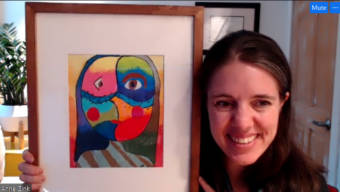
Dr. Anne Zink holds a self portrait drawn by her daughter in fourth grade (Screenshot via Zoom)

It’s the darkest part of winter in a very dark year marked with loss, anxiety, economic worries, political upheaval and isolation. We’ve been asking Alaskans where they find inspiration, hope and comfort on their bleakest days. Many of them said they turned to art — music, literature, film and spiritual texts — to help get through it.

Here are their answers.

Dr. Anne Zink – Chief Medical Officer of Alaska

Her Choice: Her daughter’s fourth grade self-portrait

Alaska’s Chief Medical Officer Dr. Anne Zink is known for her expansive grasp and no-nonsense delivery of facts about the coronavirus as she guided Alaska’s pandemic response.

But she’s also a visual arts disciple. She studied fine art as an undergraduate, even designing a course on the chemistry of printmaking. To her, art and science have always gone hand-in-hand.

“They’ve always been just the yin and yang of the same thing. I couldn’t have one without the other,” she said.

The piece she chose, a painting done by her daughter in fourth grade showing a colorful “Picasso-esque” face, hangs right by her home office.

Listen to Part 1 of this series, featuring Dr. Zink and Anchorage Mayor Austin Quinn-Davidson:

“The eyes are different. The eyebrows are different. The colors are different, depending on which side of the face you look at, and I’ve always valued that: Seeing a challenge from multiple perspectives, not just seeing it from one perspective,” she said.

The left eye in the painting looks inward at an impossible angle toward the center of the face, while the right eye gazes straight ahead. Zink compares it to her work navigating complex challenges during the pandemic, which take both knowledge of scientific data and an understanding of social dynamics for issues such as a statewide mask mandate.

For all the value modern science has, including a vaccine, medicine is about a lot more than the black-and-white equation of having a disease and finding the cure, she said.

“Medicine is not that dichotomous. It is the art of medicine. And it is nuanced. And it is subtle,” she said.

Julie Decker – Director of Anchorage Museum

Her choice: Documentary film “Spaceship Earth”

Anchorage Museum Director Julie Decker said her salve for 2020 was a documentary film that came out in May.

“Spaceship Earth” follows an experiment performed on Earth in the early 1990s to test the feasibility of colonizing another planet. Eight people lock themselves inside a closed environment called Biosphere 2 for two years. To survive, they learn to garden vegetables and bake bread. Decker said that there are obvious parallels to the quarantining many Alaskans experienced in 2020. Unsurprisingly, things get tense among Spaceship Earth’s residents after a few months.

“What happens when people live in isolation with each other, or from each other?” she said. “I think it’s a fascinating psychological experiment.”

But Decker said the Biosphere 2 complex resonated with her beyond the obvious COVID quarantine parallels. The long days at home during the pandemic got her thinking more and more about another existential crisis: global warming. She said the film’s ambitious project got her to think big, even while stuck in a house that felt small.

“Through the pandemic, I felt that hunger for vision, for big thinking. We are living through a moment of deep personal, professional, global change,” she said. “Where are we going to let it take us?”

There was one last piece of the film that stood out to her: A cameo appearance by former Trump advisor Steve Bannon. A young Bannon, fresh out of a Wall Street job, appears in the film to salvage the Biosphere 2 project after the completion of the two-year experiment, touting the virtues of sustainable ecological living.

“It’s another parallel, in a way, to our moment, because politics has dominated this year as well,” she said. “How strange our world is.”

Celeste Hodge Growden – President of Alaska Black Caucus

Her choice: The Bible’s Romans 8:28.

Alaska Black Caucus President Celeste Hodge Growden chose an older work of art — much older. It was a verse written two thousand years ago, Romans 8:28: “In Him know that all things work together for good to those who love God, to those who are called according to His purpose.”

Pastor Undra Parker at Shiloh Missionary Baptist Church in March 2020. Celeste Hodge Growden said she first heard the verse from Romans 8:28 from Parker at her longtime church. (Shiloh Missionary Baptist Church)

Growden’s organization, the Alaska Black Caucus, was reorganized at the end of 2019. When George Floyd was killed by police officers in Minneapolis in May 2020, sparking worldwide protests against racism, the verse reminded her that her work was part of a larger plan.

Without this verse, nothing makes sense. And you know, you crumble, you get offended, you get angry, you don’t understand things,” she said.

Listen to Part 2 of this series, featuring Celeste Hodge Growden, Samuel Johns, and Julie Decker:

Growden said while 2020 has helped awaken many to systemic racism in the U.S., it hasn’t been an easy year for her. She grieved the loss of her mother, who died late in 2019. And she’s received threats and hate mail because of her positions on issues such as police body cameras. Remembering Romans 8:28’s words about following her purpose has kept her centered.

“It’s nothing that you planned,” she said. “But it’s everything that God planned.”

Samuel Johns – Activist, social worker, artist

His choice: Video Ghengis Khan – Extra Credit

Activist, social worker and musician Samuel Johns also found direction for his Indigenous healing work from world history. But his inspiration came from an unorthodox source: a cartoon history of Mongol Emperor Genghis Khan.

“If anyone said, ‘Man, one day, you’re gonna be in quarantine and you’re gonna fall in love with the Mongol Empire,’ I’d be like, ‘That sounds like the most wacky shit I ever heard,” Johns said.

Alaska Native organizer and activist Samuel Johns protests during a speech by Gov. Mike Dunleavy at the 2019 Alaska Federation of Natives Conference at the Carlson Center in Fairbanks. (Zachariah Hughes/Alaska Public Media)

The video is from a channel called Extra Credit that he started watching to help his kids with history lessons. He acknowledged that while Genghis Khan has often been typecast as a heartless murderer, when he learned more about his story, Johns started to see admirable parts of how the Mongol empire ruled.

“They fought wars, and they defeated armies, but they let the people keep the language and eat. They kept their scholars, they kept their teachers, and they made sure that their books were protected,” he said.

Khan also instituted policies to keep everyone fed and made sure portions of all war booty were reserved for widows and children.

Those lessons struck deep for Johns as he pondered the legacy of colonialism during this summer of racial reckoning.

“I’ve grown up in a disproportionate place, where there was a lot of alcoholism, there was a lot of domestic abuse, there was a lot of things that I could not save people from,” he said.

Hearing the story of one of the world history’s most powerful rulers helped him imagine a world where he had a bit more control over his life, in a world not governed by white colonizers.

“The fact that Genghis Khan was able to create his own laws for his own people — that’s what I want for my people,” he said.

Austin Quinn-Davidson – Acting Anchorage Mayor

Her choice: Brandi Carlile live performances

Anchorage’s Acting Mayor Austin Quinn Davidson said the music of Brandi Carlile was an escape from the realities of the pandemic.

Anchorage Assembly Chair Austin Quinn-Davidson in her Turnagain neighborhood on Oct. 22. Quinn-Davidson became the interim mayor of Anchorage, following Mayor Berkowitz’s resignation on Oct. 23. (Jeff Chen/Alaska Public Media)

Quinn-Davidson said she’s fallen back on the music of singer-songwriter Brandi Carlile at several points since unexpectedly taking the helm of Alaska’s largest city. Her wife bought her tickets to a virtual concert earlier this year.

“Halfway through, I found myself kind of lost in the moment, and just singing along and thinking about all these memories I had about, you know, being at a music festival, and the open air, and it being warm,” she said.

Quinn-Davidson and Carlile both come from small rural areas, are roughly the same age, and both married to women. Feeling connected to someone through concerts at home was powerful through the loneliness of work — or when isolating after testing positive for COVID-19.

“She brings such honesty and authenticity to her music, and she tells the story of hard parts of life,” Quinn-Davidson said.

Those messages hit home this year. The lyrics to 2018 song “Most of All” — “But most of all/He taught me to forgive/How to keep a cool head/How to love the one you’re with” — reminded her of lessons she’s learned.

“Music is a tool to remember that ultimately, what it’s about is kindness, and love, and treating people with respect,” Quinn-Davidson said.

And when she finds herself the target of political vitriol, listening to Carlile reminds her we all share a lot more of the human experience than we sometimes remember. And it reminds her things will pass.

“In the context of 2020, and the pandemic, and all of these challenges — those are cyclical, too. We will get out of this … eventually,” she said.


If you’d like to share something that’s helped you get through the pandemic and why — or someone you’d like to hear from in our series — send an email to news@alaskapublic.org.

Site notifications
Update notification options
Subscribe to notifications