The Chilkat Valley News has been in publication since Jan. 3, 1966 and is Haines, Alaska's independent Newspaper of Record. KTOO collaborates with partners across the state to cover important news and to share stories with our audiences.
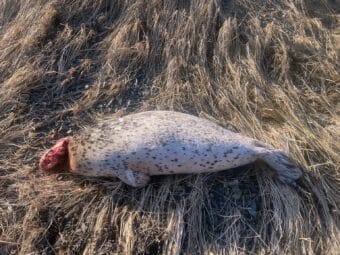
A dead harbor seal on Friday, Nov. 22, 2024, near Letnikof Cove in Haines, Alaska. (Rashah McChesney/Chilkat Valley News)
A recently dead harbor seal at Letnikof Cove is missing its head. Well, most of it. The skull bones are still there and intact.
The phenomenon has appeared a few times throughout the state. The National Oceanic and Atmospheric Administration’s regional stranding coordinator said they have not quite figured out what is killing the seals, or getting to them after they’ve died.
“We have seen it before. I just don’t know what’s going on,” Mandy Keogh, said. “We often see scavengers go in for the eyes, or if there’s an opening or a hole somewhere. But we’ve seen it a few times where it’s a pretty clean skull but the rest of the body looks intact. Somebody, probably a scavenger, probably cleaned off the meat.”
She speculated that it might be one specific type of scavenger.
What happened post-mortem is only part of the mystery. The other part: what killed the animal in the first place?
“The rest of the body seems to be in good condition,” Keogh said of the Letnikof Cove seal after viewing photos of the carcass. Typically, this is when citizen science and reports can help. Keogh said anytime someone sees a marine mammal in distress, federal scientists encourage them to report it to a 24-hour hotline (877) 925-7773.
“Dead animal, live animal, entangled. Any marine mammal. Even if you’re not sure and you think there’s an animal in distress, a marine mammal, you call that hotline,” she said.
They’ll ask questions about location and the type of animal. Keogh said taking lots of pictures is helpful too — particularly with something that gives an idea of the scale of the animal.
“Dogs are good, people will send us that. They’ll say ‘my dog’s in the photo and it weighs 70 pounds.’ But it’s better if there’s something that we can use for length. So if it’s like a shoe or a glove or something you have with you and if we have an idea of what that length is, then we can extrapolate. Especially with harbor seals, the time of year and the length might give us an indication of whether it’s an adult, a juvenile, or this year’s pup,” she said.
The ideal is that NOAA could send a volunteer or response team out to handle each reported stranding or death.
“We often collect skin for genetics, which helps us understand the population and things like that, and then to take more measurements and look for other things that might give us an indication of cause of death.”
But some of the remote parts of Alaska, Haines included, no points of contact or a stranding organization that do that work, though occasionally state Fish and Game staff will step in and help.
Keogh said tracking these types of deaths helps scientists keep an eye out for unusual cases or an emerging threat. The response to a stranding often depends on whether there are volunteers in the region who can do a site visit. They collect samples, like viral swabs, to look for diseases, especially with fresh dead animals because that means they’re not too decomposed.
“It’s likely that the sample is of a quality that if we can, if it’s going to have a virus there, it’s detectable. We do collect often for avian influenza and other pathogens that might be of interest and look to see just for prevalence.”
The spread of avian influenza, or avian flu, is something many scientists track because as it spread around the world, questions have been raised about how it spreads to other animals and potentially humans.
A teen in British Columbia recently tested positive for an avian flu infection, which officials in Canada believe may be the first human case caught in the country.
So far, in Alaska, there are no known cases of humans catching the virus and very few cases of the flu spreading beyond birds.
Still, Keogh said it’s best to avoid handling a dead or dying marine mammal.
“Especially if it’s a dead animal. Something caused it to die and we don’t know at that time what that was,” she said.
And, Keogh said the more people who know, the more likely it is they could find an explanation for the unusual deaths like the seal at Letnikof Cove.
“It’s a mystery to me, but maybe there’s other folks or there is someone with traditional knowledge who has a better understanding of what’s going on, and I’m just not familiar with it,” he said.
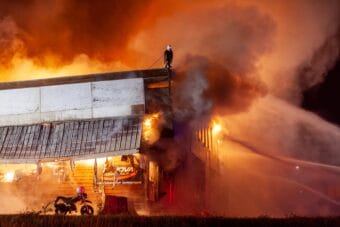
Haines Police’s Michael Fullerton (left) listens to Mike Ward as the two watch four of Ward’s stores burn down on Saturday, Oct. 5, 2024, in Haines, Alaska. (Rashah McChesney/Chilkat Valley News)
Editor’s note: A story following up on this one was published on Sunday afternoon and can be found here.
A small crowd gathered Saturday night watching as a fire ate through the building that houses Haines’ Quick Shop, Outfitter Liquor, Outfitter Sporting Goods, Mike’s Bikes & Boards, and four apartments.
No one reported any injuries and, at first, it seemed as though Haines Volunteer Firefighters were going to be able to contain flames.
But as the fire got larger and more involved, the crowd swelled. Dozens sat in the small boat harbor parking lot or along Front Street, watching as the fire grew massive and the building started to collapse in on itself.
A Haines volunteer firefighter works on a massive blaze on Saturday, Oct. 5, 2024 in Haines, Alaska. (Rashah Mcchesney/Chilkat)
The trouble started just before 9:30 p.m. while Dan Mahoney was working at the front counter of the convenience store when a man living in an apartment above the shops came downstairs to alert him about a fire.
[I] smelled smoke right after,” he said.
Mahoney said he called 911 and then his boss Mike Ward, though he had some trouble getting through to the latter.
“I was out sleeping,” said Ward as he paced up and down the sidewalk watching his businesses burn late Saturday. “I hauled a**”
This isn’t the first time the building has caught fire. Ward said it also burned in 1994, but that fire was relatively small and he was only closed for a few hours at that time.
Ward said he has insurance.
Haines fire chief Brian Clay talks to another firefighter on Saturday, Oct. 5, 2024, in Haines, Alaska. (Rashah McChesney/CVN)
“I have good insurance. I’ve got business interrupt insurance – if I shut down I’ll get money,” he said.” “I’ve never had to use it. But it looks like I’m going to have to this time. “
But even with insurance, Ward said sometimes things are hard to replace.
“On the drive to town, I was thinking about my inventory file,” he said. “I don’t keep a backup off site.”
That could make it tricky to account for everything for insurance purposes.
“I’ve got a million dollars in inventory there,” he said. “I wasn’t ready for this. I feel like I’m losing part of my life here.”
In addition to Ward’s business losses, there were two families and two men living in apartments above the shops.
By all reports at the scene of the fire, they all got out safely – but it’s not clear how much warning they had or what they were able to get out of their homes.
Haines Borough police officer Michael Fullerton helps with crowd control as firefighters battle a fire at the building that houses the Quickshop convenience store, a liquor store, and outdoor store and a handful of apartments on Saturday, Oct. 5, 2024, in Haines, Alaska. (Rashah McChesney/Chilkat Valley News)
Haines police officer Michael Fullerton was off-duty but called in to help out with the fire. He spent his time reminding onlookers to keep back far enough from the flames to avoid potential injury. In addition to the toxic smoke billowing off of the building, there was a very real potential for an explosion given the fire’s proximity to a several hundred gallon diesel tank and the volume of ammunition inside of the sports shop.
He said he was told that all tenants had been accounted for and were being helped by the Salvation Army.
Four businesses and four apartments in a building owned by Mike Ward burn on Saturday, Oct. 5, 2024, in Haines Alaska. It’s not yet clear exactly how the fire started but Ward and others on the scene said it appeared to have been set in one of the apartments. (Rashah McChesney/Chilkat Valley News)
“Local resources have already been secured for the evening as far as putting people who are displaced like in hotels,” Fullerton said.
He praised firefighters for making “extraordinary efforts to secure and save the building.”
As he spoke, a call went out for help from the Klehini Valley Volunteer Fire Department in Mosquito Lake some half an hour away.
“The whole valley will assist when necessary,” he said. “It’s unusual. I’ve never, in my nine years of being here, been aware that there has been a situation like that to require that kind of assistance.”
Fullerton said investigators would be digging into what happened to spark the fire.
“We’ll be investigating this fire until we’re satisfied that this is a normal fire,” he said. “Until we’re certain of that.”
On the day Sam Wright, Hans Munich and Tanya Hutchins disappeared in the Fairweather Range, Haines pilot Drake Olson was doing much-needed maintenance on one of the three airplanes in his hangar.
The plane, his fastest one, was in pieces on July 20 when he got a call from Munich and Hutchins, who own Coastal Air Service in Yakutat. They were on their way back from Seattle when their flight from Juneau got canceled.
They called Olson who said he couldn’t help them – but then thought of Wright, his neighbor.
“I arranged it,” Olson said, sighing heavily.
“Everybody was busy. It’s the heat of the summer, all the air carriers are busy,” Olson said. So I called Sam and he said ‘no’ because he had to go to a wedding. And then he called back and he said ‘you know, I should go,’ and I said ‘Yeah, I think you should go.’ That was stupid of me.”
It was settled. Wright flew his distinctive 1948 Beechcraft Bonanza to Juneau, and picked up Munich and Hutchins. It’s not a backcountry plane.
“That was his, you know, his commuter,” Olson said. It’s fast and sleek.”
He landed in Juneau and picked the Yakutat couple up.
“I got a picture from Tanya [Hutchins] from the backseat of Sam’s Bonanza as they were departing Juneau,” Olson said.
A few hours later he got a call from Yakutat – long after the trio should have landed, as the flight generally takes less than an hour.
“It was the guy who was actually waiting for Hans and Tanya in Yakutat and .. actually saw the signal stop in the Fairweathers,” Olson said. “He called me and said – like – there’s no airplane here and it’s weird, but the signal stopped in the Fairweathers.”
Olson scrambled to get up into the air, but he was working on a part of it that takes a lot of precision adjustment – think of the serpentine belt in your car – so, it took a few hours to get his plane back together.
“I put it together hurriedly. Thoroughly, but hurriedly,” he said. “I think I left around 7 [p.m.] and I was out until after 10. I was so tired and fatigued that I was like ‘I’m a bloody hazard out here. I’ve got to go home.”
The disappearance of two deeply experienced Southeast Alaska pilots, and Hutchins, touched off a weeks-long search for any trace of the missing plane.
And it left Olson searching for answers. He described Wright and Munich as mentors and some of the few backcountry pilots he relied on for knowledge and friendship in Southeast Alaska.
“These are the closest people that I have there and in my little corner of the world,” he said. “It’s just like, in my current world, that was my inner circle. Like, poof. Gone. Just gone.”
The search
The initial call about an overdue plane came into the Coast Guard just before 6 p.m. on July 20.
Coast Guard spokesperson Shannon Kearney said the agency put out a marine broadcast and sent out the cutter Reef Shark that night. They launched a helicopter from Sitka, and a C130 from Kodiak. The Alaska State Troopers and Alaska Rescue Coordination Center got involved, as did the Civil Air Patrol.
The flight tracking stopped at about 10,000 feet in a specific location near Mount Crillon at the southern end of the Fairweather Mountain Range. So official and unofficial searchers combed the area.
But, just under three days later, the Coast Guard called off the official search. That left people like Olson, Haines pilot Mike Mackowiak, Clayton Jones, and others from Alaska Seaplanes and Temsco helicopters to continue the search on their own.
When pressed, Olson can’t remember everyone but he remembers seeing a lot of people out looking, including: a pilot from Gustavus, another who flies for Alaska Seaplanes but was using his own personal plane, another in a Super Cub from Juneau.
Others went up and photographed the area in high resolution so the photos could be examined for what tired eyes may have missed.
And as the days dragged on and people returned to their busy summer lives and schedules, Olson said they would still pitch in where they could.
Like Randy Kiesel from Ward Air who would send pictures when he flew by the region.
“Cause there was weather and we were always wondering when we could go out there and not get skunked by clouds,” Olson said.
The trio were well-respected, so that explains some of the private effort, but Olson and others also said there’s something of a code in the tight-knit aviation community.
“It doesn’t matter if it’s somebody I don’t even like at all. It’s like, you go. There’s human life involved, something bad has happened, we’ve got to find them. End of story. I would want that for myself,” he said.
Especially early on when there was no sighting of the plane and some, like Olson, wondered if the data showing the plane had stopped suddenly at 10,000 feet was incorrect. Perhaps the plane had landed somewhere else and Wright, Munich and Hutchins survived or needed help.
“Even though the [tracking] data showed that they hit the mountain, there was no evidence,” Olson said. “So, you go, is the data wrong? What’s going on here?”
Confusion and speculation
But while the private search unfolded, publicly there was a lot of speculation about what had happened to the plane – fueled in part by how journalists reported on the situation.
Both Olson and Mike Wright, Sam Wright’s son, said they were frustrated by the way the news reporting impacted people connected to the missing and the private search.
Multiple media outlets, including the Chilkat Valley News, reported on the ongoing search and the point at which the Coast Guard called off its search for the plane.
It relied on interviews with a Coast Guard communications person, the Alaska head of the National Transportation Safety Board, and a report from the Civil Air Patrol which found an “area of disturbance.”
The story initially indicated that the Coast Guard called off its search for the plane based solely on the presumption that the crash site had been found.
“They got the whole community of Juneau and Haines in an elevated state with their misinformation and lack of follow-through,” Wright said.
The story was later quietly corrected to say that the discovery of a potential crash site was “one of the factors,” that prompted the suspension. But there was no indication in the story that a correction had happened until a week later.
In response to questions about community criticism of valuing speed over accuracy, Anchorage Daily News Editor David Hulen wrote in an email that the paper takes accuracy seriously and takes care to quickly fix errors when they learn about them.
“In this case, we initially reported that the apparent discovery of the crash site prompted the suspension of the search. The next day, the Coast Guard reached out and said it was one of multiple factors. We updated the piece to reflect that. What we failed to do was add a note or correction to the article saying it had been updated and that the earlier information had been corrected,” he said.
Both Wright and Olson said the piece caused a lot of confusion among people following the search or who knew any of the three people aboard who were missing.
“The impact that it has is that people, when people have lost anything – a person or a possession – there’s a lot of hope and when hope starts to get fulfilled falsely then it creates a second wave of tragedy when they find out that it was an untruth,” Wright said.
Wright and Olson said they had to tell people over and over again that the plane had not been found and that people were still out there, flying in the Fairweathers, searching for it.
“They’ve got to relive this moment multiple times,” Wright said.
Olson said private searchers lost an entire day trying to verify what was being labeled as the probable crash site, something which ultimately proved to be inaccurate.
A comprehensive account of what happened isn’t expected from the National Transportation Safety Board for some time. But, the agency released a preliminary report in mid-August.
It shows Wright’s plane leaving Juneau around 1:45 p.m. and heading northwest for about 70 miles before turning southwest and heading into the park for another 30 miles. Just after 2:20 p.m., the signal abruptly stops on the side of East Crillon mountain. The plane was flying more than 160 miles per hour.
The report details that a private search of the accident site revealed portions of the plane wreckage on the eastern side of East Crillon Mountain at just over 6,000 feet, some 4,500 feet below where the plane is believed to have crashed into the mountain.
That private searcher was Drake Olson.
Drake Olson on an unnamed glacier between Haines and Skagway. Olson has carved out a unique niche in Southeast Alaska ferrying adventurers into the little-traveled mountains around Haines. (Lex Treinen/Chilkat Valley News)
Finding the plane
On the morning of Aug. 5, when Olson found the wreckage of the missing plane, he woke up early – around 4:30 a.m. He made himself a coffee and headed to his hangar at the Haines airport to prep one of his Cessnas.
“The idea was the morning light, with no clouds, it was a different angle of light,” he said. “Maybe I’d pick up a reflection in that different light.”
He was up in the air at about 6:30 a.m. and out near Mount Crillon to search within an hour. He looked for a while, but – it just didn’t feel right.
“I was so fatigued,” he said. “I didn’t have my … you have to have this gunslinger attitude – your flight swagger – when you fly anywhere around here,” he said. “I felt like a child. I was out there like ‘wow. This is gnarly.’”
So, he descended and landed on a nearby beach. He walked in the warm sand, ate some food and took a nap.
“I looked my airplane over cause I hadn’t flown it in awhile. I did a few little tweaks because it was running a little hot. And, god, we were much better after that,” he said. “We were totally relaxed and in sync. We were like peas and carrots. We were right with the world.”
He climbed inside, took off and started climbing. Zig-zagging back and forth, first over Mount La Perouse, a 10,700ish foot peak nearby.
“The whole thing changed,” he said. “After that rest I was like – f*** – lots of people, professionals and everybody, amateurs have looked and looked and looked and really? This is how it ends? Like, not a shred, really? Because, this is it for me, I think. I’m about over this.”
With that attitude – and the idea that he may never return to searching again – he really started to catalog his surroundings.
“My eyes have never painted this area as thoroughly,” he said. “I’m seeing more of this area than I have ever seen. I’m back and forth and back and forth and back and forth.”
He practiced a few approaches in spots he thought he could land on La Perouse and Mount Crillon – learning the lay of the land, then just low power floating.
“I just kept working my way up, up, up, up, until I was at that kind of crash altitude,” he said.
The place where Wright’s plane stopped broadcasting a signal is right around 10,000 feet. It’s a place he had returned to over and over again. A place people had flown dozens of times looking but never seeing.
And in that angled morning light, Olson saw a flash.
“That reflection, right down below but you’re really right up against the mountain and looking down it,” he said.
Initially it was hard to keep track of it. He could only see a flash for a second at a time as he was flying in circles, then it would be gone.
“It was like a mystery every time. Every time I circled, I wasn’t sure I was going to see it again” he said.
He started descending in his circle. A long slow series of spirals, keeping an eye out for that flash every time. And finally, he got close enough to see the crumpled, polished aluminum.
He pushed a button, marking the GPS coordinates, flew back up and headed toward Gustavus. He got cell phone reception over the Brady Glacier and called flight service and told them to call Eric Main, a helicopter pilot at Temsco.
He also called Mike Wright, Sam’s son. The signal was bad – but Olson said he managed to get across that he’d found the wreckage.
Eric Main, the Juneau-based manager at Temsco Helicopters, got into the air that afternoon in an Airbus350 to verify it.
The helicopter has a distinct advantage in this situation because the spot of the accident site is very essentially on the side of a mountain and something of a bowl. Olson has to maintain some kind of airspeed, so he can only get so low.
Main in his helicopter can hover. He said he could have landed, but to do that they’d have had to have prior permission from the National Park Service.
So he hovered within 10 to 20 feet looking at pieces of debris and taking pictures.
“We started finding pieces that were obviously aircraft aluminum of that color,” he said. “We found some a bit later that had markings that more or less identified that it was that aircraft.”
Olson said when he found the wreckage, he fell apart emotionally.
“There it was. It happened. Everything else was just speculation,” he said.
In that moment, Olson said he was finally able to let go of Wright, Munich and Hutchins. Or, at least, the idea that they might still be alive and need help.
“We don’t let go until we know,” he said. “That’s why, you know, that’s why there’s all these – like families are always – if they’ve lost somebody they just go through crazy attempts to get verification. You want to know because otherwise they might be alive.”
In that crumpled piece of aluminum, Olson saw the finality of what had happened.
“Like, all this data was correct. This is bad. This is done,” he said. “It’s a bad scene, but they’re not anywhere else. There’s closure for sure for everybody. But, it’s – there’s also a huge void. My god, these guys were upper echelon pilots and Tanya, too, was – you know – just all good, good people.”
A Juneau Animal Rescue employee takes dogs out for a walk on Thursday, Jan. 18, 2024. (Clarise Larson/KTOO)
The Centers for Disease Control’s new regulations for bringing dogs into the United States went into effect on August 1.
Back in May, the agency announced there would be changes for dogs crossing the border on August 1, including forms signed by a veterinarian and proof of rabies vaccination. But before those regulations went into effect, the agency released an update for bringing dogs into the United States to try and simplify the new rules.
The organization said its updated rules “incorporated the feedback received from the public, industry partners, and various countries on the dog importation rule.”
“I didn’t know [the update] was coming,” said Alaska’s State Veterinarian Sarah Coburn. “[The CDC] elected to simplify those requirements for dogs from low risk countries for canine rabies.”
The newly updated rules
The CDC categorizes countries as either high risk or low risk.
“They’ve had some restrictions for what they consider high risk countries,” Coburn said. “It’s based on prevalence control programs that they do or don’t have in that particular country.”
While rabies is found in several wildlife species in the United States (including bats, foxes, raccoons, and skunks), the U.S. has been free of dog rabies since 2007. The agency’s importation regulations aim to prevent the reintroduction of this type of rabies.
“Canada, has a similar control program and prevention program and vaccine requirements, that allows our country to be in what they would consider a low risk country….For our purposes here in Alaska – Canada and the U.S. have the same status,” Coburn said.
Dogs need to be at least six months old and in good health, as well as an import form filled out from their owner as opposed to the form filled out by a veterinarian as was the case before this latest update.
“The vaccine requirements are much simplified, they don’t even officially have a vaccine requirement listed now,” Coburn said.
Dogs, however, are required to have a microchip.
“So basically, if a universal microchip scanner will scan the chip, it’s fine. They don’t have to be revaccinated. You don’t have to re-chip the dogs, is my understanding. And previous to [the update] they were going to be asking for a USDA endorsed rabies vaccine as proof that the dog was vaccinated in the US, they removed that requirement,” she said.
Confusion over the new policy
The policy has not only been confusing to some, it’s been frustrating to many, including Alaska’s Congressional Delegation. In a recent press release Sen. Lisa Murkowski, R-Alaska, said “this rule does not work for Alaskans who travel with their pets. Many Alaskans go through Canada to get to the Lower 48 with their pups in tow, and this rule will add unnecessary expense and complication for travelers.”
Murkowski along with Sen. Dan Sullivan, and U.S. Representative Mary Peltola sent the CDC a letter just a day after the agency announced the latest update. It outlines how the rules fail to account for Alaska’s unique geography and sled dog culture, and details the negative impacts the rule will have on the state.
CDC spokesperson David Daigle stated in an email that he has not seen the delegation’s letter but said “We’ve been working with various partners – including the public, industry partners, and various countries – to ensure as smooth a transition as possible. We will continue to do so now that the rule is in effect. We recommend travelers plan ahead to ensure their dog meets all the requirements to enter the U.S.”
Alaska is not alone when it comes to challenging the CDCs new rule.
The nonprofit Sportsmen’s Alliance Foundation – an Ohio based organization with a mission to protect and defend America’s wildlife conservation programs and the pursuits, put out a press release on July 29, saying that prohibiting dogs under six-months of age and dogs without microchips from entering the country violates the Public Health Service Act and the Administrative Procedure Act. The organization threatened to sue if the rule is not delayed and withdrawn.
“There are a number of problems with the rules. We have members who hunt with dogs, all over the North American continent that includes Americans, who often will go to Canada to hunt and or engage in field trials,” said Vice President of Government and Special Affairs Ted Adkins.
He said a lot of people residing in the U.S. purchase puppies from Canadian breeders.
“All of that is immediately problematic because of this new CDC rule. [We have] folks who hunt birds with dogs. They duck hunt with a dog or they might have hounds that they use for bears. Or mountain lion hunting or coon hunting. Or they might have beagles that they utilize for rabbit hunting, they might have fox hounds they use for fox hunting,” he said.
He argues that the CDC’s new rules are too broad, particularly for northern border crossings because Canada doesn’t have a rabies problem. This also impacts working dogs like cattle dogs, sled dogs, etc. The first six months are important for their development.
“The initial socialization that the puppy needs to engage in with its new family, its new owner and the training that needs to occur before that puppy is six months old, is critical. Everybody knows this. Instead of understanding that reality, CDC just says ‘Now, here’s our new rule, we’re going to ban all puppies less than six months old,’” he said. “It’s not going to happen.”
Adkins also takes issue with the way this rule was implemented.
“The problem with this one is they issued a final rule back in May…Since that time, they have now issued a couple of press releases, which suggests that everything they spoke about in the final rule is not going to be the final rule. They’ve issued these press releases, and they’re like ‘Well, it turns out, we’re just going to require this one form.’ Now, it’s not a big deal. After everybody complained about the final rule, there was a lot of confusion,” he said. “Well, all that’s done is exacerbated that confusion.”
When asked about the Sportsmen’s Alliance Foundation position, the CDC declined to comment.
Meanwhile Alaska’s state veterinarian’s office said its requirements for entering have not changed.
“We still require a rabies vaccine,” Coburn said. “That’s been in place for many, many, many years, and also a health certificate within the 30 days prior to coming into the state.”
A small plane carrying three passengers from Juneau to Yakutat disappeared over the weekend, launching a search and rescue effort that has so far yielded more questions than answers.
Samuel “Sam” Wright, a seasoned pilot from Haines with decades of experience navigating southeast, took off from Juneau on Saturday. On board with him were Hans Munich and Tanya Hutchins, a couple returning home to Yakutat after a trip. Munich is also a longtime pilot. He and Hutchins run a charter flight business.
The initial alarm was raised when the aircraft, a 1948 Beechcraft Bonanza, failed to arrive at its destination. Coast Guard spokesperson Shannon Kearney said the agency got a call about an overdue plane at 5:40 p.m. on Saturday. The agency put out a marine broadcast just after 6 p.m. and sent out the U.S. Coast Guard Cutter Reef Shark about half an hour later.
Soon they launched a MH-60T helicopter from Sitka and C-130 from Kodiak and partnered with Alaska State Troopers and the Alaska Rescue Coordination Center to search for the plane. Searchers scoured the Fairweather Mountain Range, focusing their efforts near Mount Crillon at the southern end, where the plane’s radar signal stopped abruptly.
“The flight tracking stops around 10,000 feet,” said Coast Guard public affairs officer Mike Salerno. “I can tell you that at that altitude the search assets have been encountering a lot of cloud coverage.”
The search extended into its third day Monday, and at one point the Civil Air Patrol reported finding something – but the Coast Guard was unable to verify that and ultimately decided to suspend the search by that evening, according to Salerno.
“It’s a very mountainous area,” Salerno said, “and the altitude combined with cloud cover is impacting visual searching.”
In the tight-knit aviation community, the news has been devastating – particularly in Southeast Alaska’s remote communities which often rely on planes and ferries to get around, and to get work done.
“Hans and Tanya have been instrumental to the bear research program for the past 15 years,” said Fish and Game bear research biologist Anthony Crupi. “Their friendship and contribution to brown bear conservation will be sorely missed.”
Haines Rafting Company owner and manager Andy Hedden said he has also been working with Hans and Tanya for the past 15 years. Their business provided bush flights for his rafting groups arriving in Dry Bay on the Alsek River.
“Hans was one of the best pilots I’ve ever seen. He was a hard worker and took meticulous care of his aircraft,” Hedden said. “He was as trustworthy a pilot as they come. Tanya was the friendly voice that took reservations and kept us informed when the flights took off. The two of them provided flight service for a number of lodges, fishermen and adventures. They will be sorely missed.”
In Haines friends and family said Wright is known not just for his piloting skills, but for his warm demeanor, jokes, and for being a familiar face at Fort Seward, where he was the cannoneer for ceremonial events – everything from the Lighting of the Fort, marking the beginning of the holiday season, to the Fourth of July bloomer blast, where people in town take bets on how far a pair of underwear will fly when he’d shoot it out of the cannon.
“He’s a heck of a nice guy. We’re all going to miss him,” said Terry Pardee, a longtime friend and who frequently flew with Wright.
Bill Thomas, another close friend who had also shared many flights with Wright, recalled their experiences fondly.
“He was a good friend,” Thomas said.
Thomas, who was a member of the state legislature from 2005-2013, said he got to know Wright because the pilot worked for Wings Airways and flew him back and forth to Juneau often. He joked that it felt like Wright was his personal jet service.
“Pretty much. We always laughed about that. He’d leave in the morning, and I’d like that and he’d be back at night,” he said.
Thomas was an airplane mechanic crew chief in Vietnam and said he felt safe flying with Wright.
“I enjoyed flying with Sam because he took care of his planes,” Thomas said. “He did an honest preflight, I would call it, and he knew what to look for.”
As the search dragged on and in the aftermath of its suspension, Wright’s partner Annette Smith, said the community has rallied around the families and friends of those on board.
“Haines is a wonderful community for people gathering together when there is a problem and tragedy and I really am very grateful for that,” Smith said.
Wright’s son is in town, and Smith said her sister is coming. And despite the suspension of the official search there is still lingering hope among Wright’s loved ones that he may yet make it home. Smith said her ideal resolution would be to find the wreckage and retrieve him.
“But the practicality of that – I’m a very practical person – practicality is elusive,” she said.
She said Wright’s family and Munich’s family are talking about continuing to search on their own.
“We’ll decide what to do after that, it’s kind of a one step at a time kind of thing,” she said.
But, she said, Wright and Munich were seasoned pilots, so they would understand the decision-making.
“Sam’s been flying since he was a teenager,” she said. “They know what they’re up against.”
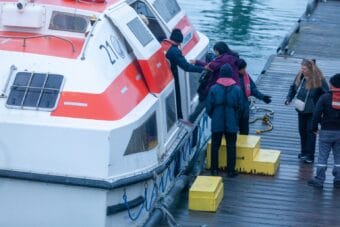
Passengers are loaded onto a craft to be taken to a nearby cruise ship on Wednesday, in Haines. About 150 people, primarily cruise ship passengers who had disembarked in Skagway, were trapped by a landslide in Canada and then bussed several hundred miles to Haines to rejoin their cruises. (Rashah McChesney/Chilkat Valley News)
Updated at 11:45 a.m.
At 4 a.m. Wednesday, just as the sun was starting to cast long blue shadows over downtown Haines – four massive Holland America tour buses motored into the parking lot of the Port Chilkoot Cruise Ship Dock.
Some 150 people climbed down the stairs and slowly made their way down the dock – a handful stopping to photograph themselves in front of the Haines sign before climbing onto tender boats – basically water shuttles – bound for the nearby Holland America Koningsdam.
While many of the passengers were visibly tired, others like Australians Arthur and Sharon Green, were joking and laughing.
“We didn’t expect to make it here,” Arthur said. “We got a bonus tour.”
The crowd was primarily cruise ship passengers who disembarked in Skagway on Tuesday and were riding on the popular White Pass and Yukon Route Railway when a landslide overtook the tracks and then the roadway between markers 80 to 86 of the Klondike Highway. A 50-mile stretch of the South Klondike Highway from Fraser to Carcross has since been closed, according to Yukon Protective Services.
Both the U.S. border station and Canadian customs closed the Skagway Port of Entry after the slide, according to a Nixle alert sent out at 5:30 p.m. on Tuesday. That effectively blocked the passengers from returning to Alaska or reboarding the Holland America and Princess cruise ships they’re touring on.
Passengers headed down Haines’ cruise ship dock toward a nearby Holland America cruise ship on Wednesday, in Haines, Alaska. About 150 people, primarily cruise ship passengers who had disembarked in Skagway, were trapped by a landslide in Canada and then bussed several hundred miles to Haines to rejoin their cruises. (Rashah McChesney/Chilkat Valley News)
Laurie Wilcox and Michelle Plasschaert of the Quad Cities in Iowa and Illinois and Dennis Hurd of Vancouver described the slide blocking first the train, then the buses they’d boarded in an attempt to get back to Skagway.
“It came running down the road,” Hurd said, his voice trailing off. “It was good that … we had a good bus driver.”
Cruise line management, port staff and others arranged an unusual solution to the problem and turned the group around and began the sixish-hour, several-hundred-mile drive to Haines.
“It’s pretty unprecedented,” said Cruise Lines Agencies of Alaska port manager Leslie Ross who – along with Haines harbor master Shawn Bell – met the group on the dock on Wednesday morning.
Ross worked to coordinate with Canadian and U.S. border officials to keep the Dalton Cache-Pleasant Camp border crossing near Haines open so the passengers could get through and rejoin their ships.
The Greens, who are headed to Glacier Bay next, said this is their first cruise.
“It’s been a great day,” Sharon said, enthusiastically. “We’ve had a rock slide. We’ve had mud over the train.”
The Greens said they took the train to Carcross but on the trip back a slide had taken out the tracks. So they loaded onto buses and continued on toward Skagway, but then the landslide blocked the road.
“So the bus took us back to Carcross,” she said. “The lovely women there fed us everything they could find.”
“Yeah at about 9 o’clock at night,” Arthur chimed in, laughing.
“It was wonderful,” Sharon added. She looked over at her husband, “Then, where’d we go? Crazy Horse? Red Horse?”
“Whitehorse,” he said.
The drive was dark, so they didn’t see much of Canada. Sharon said she was able to sleep but Arthur didn’t.
“I kept the driver awake,” he said, with a laugh.
Original story
The details are still being worked out, but cruise line officials say about 150 passengers from the Holland America Koningsdam and a Princess cruise ship are en route to Haines to rejoin their tours after being trapped in Canada.
The passengers were riding on the White Pass and Yukon Route Railway when a massive rockslide overtook the tracks and then the roadway between markers 80 to 86 of the Klondike Highway, effectively cutting them off from returning to Skagway on Tuesday afternoon.
A 50-mile stretch of the South Klondike Highway from Fraser to Carcross has since been closed, according to Yukon Protective Services. Both the U.S. border station and Canadian customs closed the Skagway Port of Entry after the slide, according to a Nixle alert sent out at 5:30 p.m. on Tuesday.
The passengers were transferred to buses and – in an unusual solution to the problem – began the several hundred mile drive to Haines.
“It’s pretty unprecedented,” said Cruise Lines Agencies of Alaska port manager Leslie Ross.
Ross said the cruise ships are headed to Haines to retrieve their passengers from the borough’s dock.
She was working to coordinate with Canadian and U.S. border officials to keep the borders open around 10 p.m. on Tuesday, then said she was headed to bed to catch a few hours of sleep before the crowd arrives in town.