Chilkat Valley News

The Chilkat Valley News has been in publication since Jan. 3, 1966 and is Haines, Alaska's independent Newspaper of Record. KTOO collaborates with partners across the state to cover important news and to share stories with our audiences.
Coast Guard calls off search for trio who went missing flying from Juneau to Yakutat

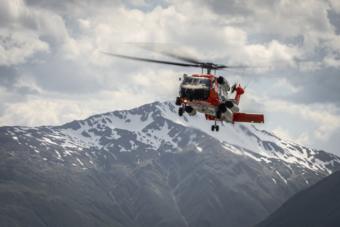
A U.S. Coast Guard HH60 Jayhawk helicopter flies over Juneau, Alaska, on Saturday, Oct. 2, 2021. (Photo by Mikko Wilson/KTOO)

Update 9 p.m.:

The Coast Guard and partner agencies that have been looking for a missing plane bound for Yakutat called off the search late Monday evening.

The plane, owned by longtime Haines pilot Sam Wright and carrying Yakutat couple Hans Munich and Tanya Hutchins, stopped emitting its radar signal near Mount Crillon at the southern end of the Fairweather Mountain Range.

The three left Juneau on Saturday and were reported overdue that evening. Both Wright and Munich are pilots with decades of experience flying in Southeast Alaska.

Coast Guard public affairs officer Mike Salerno said if the agency got more information, it could resume its search.

“The decision to suspend is never easy,” he said. “Our condolences are with the family members of the passengers on board.”

Original story:

A Haines man and a couple flying from Juneau to Yakutat are missing after their plane never arrived at its destination.

Coast Guard public affairs officer Mike Salerno said the owner and operator of the missing 1948 Beechcraft Bonanza is Samuel “Sam” Wright of Haines. Wright was flying two passengers Hans Munich and Tanya Hutchins to their home in Yakutat on Saturday but the plane never made it.

Munich and Hutchins own Coastal Air Service – formerly Yakutat Coastal Airlines – where Munich has been flying for decades. Wright is also an experienced pilot with decades of flying in Southeast Alaska.

The Coast Guard, Alaska Rescue Coordination Center, Civil Air Patrol and Alaska State Troopers are entering their third day of searching for signs of the missing plane in the Fairweather Mountain Range.

“A Coast Guard helicopter from Air Station Sitka, Coast Guard HC-130 from Air Station Kodiak, and also Coast Guard Cutter Reef Shark were all dispatched to the scene on Saturday evening when we received the alert,” Salerno said. “Then Sunday and today’s efforts have included searches from aircraft … MH-60T helicopters, HC-130s and as well as AC-130s from the Air Force and also search assets from the Civil Air Patrol.”

The plane stopped emitting its radar signal near Mount Crillon, which is at the southern end of the range, according to the Coast Guard.

“[It’s] where we saw the FlightAware tracks end,” Salerno said. “We’ve also been in contact with the FAA, the National Transportation Safety Board as well to try to leverage as many resources as we can to try to narrow down the search area.”

Narrowing down the search area isn’t the only problem searchers are running into.

“It’s a very mountainous area, the flight tracking stops at around 10,000 feet which also makes it a difficult search area for some of our search assets, especially with the cloud coverage,” Salerno said. “I can tell you that at that altitude the search assets have been encountering a lot of cloud coverage.”

Weather conditions for the search region are expected to deteriorate. According to the National Weather Service showers showers and heavy rain are expected to move into the region, reducing visibility and bringing wind gusts and lower cloud ceilings Monday evening.

“The weather is a factor, but it isn’t the only factor,” Salerno said. “The altitude combined with the cloud cover is impacting visual searching.”

Searchers are also listening for the plane’s emergency beacon, he said.

As of about 5 p.m. Monday evening, the search was ongoing according to a Coast Guard social media page.

But, it’s not clear how much longer they’ll keep looking, that’s a discussion crews are having now. Salerno said a lot of things go into that decision-making process including the weather, the location of the search area and how large it is.

“Also, we never discount the will to live of any individual,” he said.

Correction: A previous version of this story contained a typo indicating that the Coast Guard was operating an AC-130. That plane comes from the Air Force, the Coast Guard is instead operating HC-130s. Both are being used in the search.  

KHNS reporter Alain D’Epresmenil contributed to this story

A Yakutat-bound charter flight is missing after leaving Juneau on Saturday

Coast Guard helicopter
An aircrew aboard an MH-60 Jayhawk helicopter makes an approach on their return to Coast Guard Air Station Kodiak, June 5, 2019. (Public domain photo by Petty Officer 1st Class Bradley Pigage/U.S. Coast Guard)

Updated July 21 at 7:00 p.m.

Coast Guard staff are searching for a missing charter flight that left Juneau on Saturday bound for Yakutat but never reached its destination.

There were three people on board, but Coast Guard public affairs officer Mike Salerno said they do not know anything more about them. The missing plane is a Beechcraft Bonanza, according to a Coast Guard social media post.

Coast Guard spokesperson Shannon Kearney said the initial call about an overdue plane came in at 5:40 p.m. on Saturday. The agency issued a marine broadcast just after 6 p.m. and sent out the U.S. Coast Guard Cutter Reef Shark about half an hour later.

Later, they launched a MH-60T helicopter from Sitka and C130 from Kodiak and have partnered with Alaska State Troopers and the Alaska Rescue Coordination Center to search for the plane.

The agency is searching near the Fairweather Mountain Range. According to a dispatch from Alaska State Troopers, they got a report that the plane went missing near Mount Crillon, which is at the southern end of the range.

Salerno asked that people flying between Juneau and Yakutat who see something out of the ordinary contact the Coast Guard.

This is a breaking news story. Check back for updates.

Bill Thomas to drop out of race for House District 3

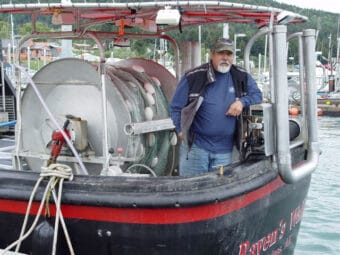
(Chilkat Valley News file photo)

Haines Republican Bill Thomas is signaling that he will withdraw from the race for House District 3, though he has not formally done it yet.

Thomas, 77,  is a lifelong Chilkat Valley resident and served as an Alaska State House member from 2005 to 2012. He registered as a candidate for the seat on May 29.

But after just over two weeks on the ballot, Thomas told friends and supporters that campaigning takes up a lot of time and it interferes with the commercial fishing season. In a recent Juneau Empire interview, Thomas said his boat is having a lot of mechanical issues delaying his ability to start fishing.

The Alaska Public Offices Commission still has him listed on its website as a candidate, as does the state’s Division of Elections. Election’s Program Manager Brian Jackson confirmed Thomas’ withdrawal, saying that he spoke to Thomas by phone.

But Jackson said his office has not yet received the official paperwork from Thomas to withdraw from the Aug. 20 primary. Candidates have until June 29 to do so.

Thomas’ opponent, incumbent Democrat Andi Story, will join the two other unopposed Juneau candidates, Sen. Jesse Keihl and Rep Sara Hannan.
Thomas refused an interview request, but Story says she still has a lot of work to do.

“I wish Bill [Thomas] well in the future. He is a valuable member of the community,” she said.

Story, 65, said she is working on scheduling a visit to Haines to meet people and get to know them.

This story originally appeared in the Chilkat Valley News and is republished here with permission.

Stranded Beerfest travelers scramble to rebook after LeConte ferry breakdown

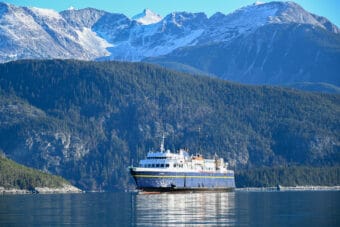
The LeConte in 2023. (Lex Treinen/Chilkat Valley News)

The ferry LeConte broke down over the weekend, leaving some of the thousands who came to Haines for Beerfest stranded.

People will have an easier time getting back to other Southeast Alaska communities if they’re not traveling with a vehicle. The earliest available booking to get a car southbound on a state ferry is July 2, according to the Alaska Marine Highway System’s online booking platform.

That leaves people like Piper Haney, a social worker from Juneau who is moving back to the capital city from Anchorage, with few options. Right now, her plan is to take a seaplane back to Juneau on Monday.

“I think tomorrow I will be in Juneau and all of my stuff will be in Haines,” she said.

Engine trouble

The LeConte will be out of commission until at least Wednesday due to a cooling system problem in its starboard main engine, according to Department of Transportation spokesperson Sam Dapcevich.

“The crew will be inspecting the system over the next few days to see if there’s a blockage,” he wrote in an email.

Dapcevich said the state tried reaching out to Allen Marine and Goldbelt — two other ferry operators that have service contracts and could take passengers southbound from Haines.

“They currently don’t have vessels or crew available to pick up passenger traffic,” he said.

In Haines, local travel operators have been working to accommodate the surge of passengers and bookings after the LeConte was canceled. The visitor center will be shuttling people to the ferry terminal, Tourism Director Rebecca Hylton said anyone who needs a ride there on Sunday should be at the visitor center by 5 p.m.

But they cannot help with cars.

“Most people, of course, are stuck here,” said Alaska Fjordlines owner Alison Jacobson.

Fjordlines operates a 65’ catamaran that travels between Skagway, Haines and Juneau. The company added a 2 p.m. sailing on Sunday when Jacobson learned of the canceled ferry.

“It was full by 8 or 9 o’clock [Saturday] night,” she said.

Jacobson said she cannot take everyone who may need to leave town. The LeConte is designed to carry 225 passengers.

“We can take 50,” Jacobson said. “That’s a lot of people who won’t be able to get out.”

Juneau resident Daniel Trenchard nabbed one of the seats on the Fjordlines sailing. Word of the cancellation started to spread just as Beerfest was letting out at 5 p.m. – many revelers had been sampling beer and partying for hours at that point.

Trenchard, who is working in Ketchikan this summer, was one of hundreds of people on the street. He was sitting in line at Peterson’s Pretzels waiting for food when he found out the ferry had been canceled.

“So I have a flight on Monday at 2 p.m. to Ketchikan to get back to work. I had to get back to Juneau so I could get back,” he said.

He and his friends quickly conferred and then booked tickets back to Juneau on the Fjordlines sailing. He said he hoped news spread to other revelers quickly, too, as there are so few seats available.

“I hope the people who need to know find out early enough,” he said. “Good luck to them.”

Haines ferry terminal staff put up a sign on Saturday, May 25, 2024, announcing the cancellation of the only state ferry scheduled to leave town on Sunday after a busy Beerfest weekend in Haines, Alaska. (Rashah McChesney/Chilkat Valley News)

Chaotic attempts to rebook

Word of the cancellation spread just as Beerfest was letting out at 5 p.m. – many revelers had been sampling beer and partying for hours at that point.

Alaska Marine Highway System staff at the Haines terminal did not answer phone calls on Saturday but posted a sign on the terminal window saying the LeConte would be out of service from May 26-28.

Chaz Lakip said he’s already been rebooked by the state once – from a canceled Goldbelt ship to the LeConte, due to staffing issues. He didn’t hear until mid-morning Sunday that the LeConte, too, had been canceled.

“Seems like we have the technology to send a mass email to everyone on the manifest as soon as they knew instead of individually calling everyone?” he said.

Haney, the social worker on her way to Juneau, said she’d heard a rumor during the day’s festivities – but hoped the person was joking.

“It wasn’t even on my radar that it was an issue until 11 p.m. last night,” she said on Sunday morning.

Attempts to book a state ferry out of town online automatically route users to a July 2 sailing of the Hubbard. But by phone, staff at the ferry terminal said they still have walk-on spots available for earlier sailings.

Those spots must be booked by calling the terminal at 907-766-2111 directly, they said.

But while Haines ferry terminal staff are calling and emailing people, Haney said she has not heard from anyone as of Sunday afternoon. She drove out to the ferry terminal, but she wasn’t able to rebook there, either. She said staff told her they would call her.

“They said they had a big list in front of them, and they were just calling people in the order they booked to tell them it was canceled and reschedule them,” Haney said.

Haney, whose car is packed with all of her belongings, said she hopes she can get it on a ferry earlier than July. For now, she is trying to sort out where to leave it.

“I don’t know anyone super well here where I could call and say ‘hey, could I park my car here for two months?’” she said. “I’m hoping the ferry system is going to call me eventually.”

She is also considering leaving it at the ferry terminal.

“I don’t know where else I would leave it,” she said. “But that seems kind of heinous.”

Haney said she’ll spend Sunday evening picking through her car to figure out what to bring to Juneau on the plane and what to leave behind.

DOT spokesperson Sam Dapcevich floated the idea of the LeConte doing an added run just to pick up stranded vehicles when it comes back online. And several people, including Haney said they hope that actually happens.

“It doesn’t have to be tomorrow, but within a week would be good for me,” she said.

This story originally appeared in the Chilkat Valley News and is republished here with permission.

‘Mad scientist’: Haines luthier carves out top-quality guitars with local materials

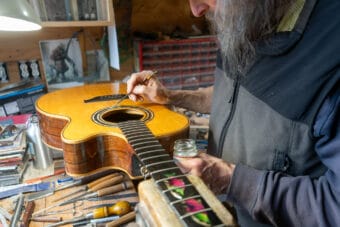
Luthier Rob Goldberg lacquers a guitar he made for Burl Sheldon on April 5, 2024. (Lex Treinen/Chilkat Valley News)

All that exists is the tip of his chisel and a piece of wood.

The rain battering outside the window, a dog whimpering at the door, a portable radio, and a fire crackling in the corner — all of it might as well be silent.

The dozens of tools on the sawdust covered work bench — lathes, chisels, sanders, scissors, wrenches and paint brushes — all of them are invisible.

At least they are for luthier Rob Goldberg, who is carving the braces that hold together the sound boards of his world-class custom instruments in his Mud Bay workshop.

“The only thing that exists is that edge and the wood that it’s moving through,” said Goldberg. “You can’t be thinking about what you’re going to have for dinner or thinking about your girlfriend or thinking about anything else.”

That attention to detail and artistry has brought Goldberg praise from musicians around the country who have had the chance to strum one of the 65 guitars he’s produced in his decades as a luthier. Goldberg learned the craft in Massachusetts under Bill Cumpiano. He ran his own shop for four years in the Berkshires before closing down in 1980. He was on hiatus until 2008, when he was settled in Haines. His first guitar was made using wood he harvested from Letnikof.

Now, guitar making — along with painting — are his main crafts, despite the challenges of doing it from the isolated town. He works late into the night from his modest shop covered with tools and mementos from his decades of practicing the art.

“He is the official mad scientist — you look that up in the dictionary and that’s Rob,” said Richard Gilewitz, a Florida-based finger-picker who plays a Goldberg guitar. “He looks like a character out of Lord of the Rings.”

The instruments sell from a starting price of $6,000 — not cheap, but affordable compared to other custom guitars, Goldberg said. And each of them is a work of art customized for the person playing it. Goldberg will talk to musicians sometimes for hours to figure out everything from the ideal shape of the guitar to make it ergonomic, the type of wood to be used so that its characteristics match their style, and the motifs on the elaborate inlays of glass or abalone.
“Based on what people are getting for custom-made guitars, his are a bargain.” said Tony Tengs, a musician who grew up in Haines. “He puts a lot of  soul into them and he’s an artist.”

The custom difference

Tony Tengs plays a set for the Alaska Folk Festival on April 14, 2024 in Juneau, Alaska. Tengs used a guitar made for him by Haines luthier Rob Goldberg. (Rashah McChesney/Chilkat Valley News)

Musicians like Tengs say Goldberg’s guitars sound better than even top notch, brand name guitars like Taylor and Martin.

Goldberg said that’s largely because of the care he takes carving the bracing. Instead of flat, straight pieces of wood that hold the top of a guitar like two-by-fours, Goldberg carves the bracing into elegant curves thicker where the tension is highest and lighter where the strings aren’t pulling against the soundboard. That saves weight and allows the instruments to sing.

“The lighter you can make the bracing the more it will sing, but too light and strings will pull it apart,” he said. “There’s a lot of art and craft that goes into sculpting these.”

Wood used for the soundboards and bodies of the guitar can also have a big impact on the sound.

In 2010, Goldberg saw the need for a resonant guitar to match local musician Burl Sheldon’s deep, strong voice. He settled on a large-bodied guitar he designed with a custom template with a rosewood soundboard, a hard and stable wood that could take Sheldon’s physically powerful playing style.

“It reflects back all the high harmonics, so a rosewood sounds really crisp and clean,” said Goldberg.

On the other hand, for a newcomer to guitar like Juneau musician Marian Call, Goldberg chose a more forgiving curly maple.

For Call’s guitar, Goldberg added several other touches. He said during a phone conversation, Call mentioned the discomfort that playing guitars can give her.

“She said, ‘Every guitar I’ve ever held feels like a bad bra just cuts into my side.’ And I said, oh, I can take care of that,” said Goldberg.

His solution: a beveled edge on the back top of the guitar, which will hopefully solve the problem.

Goldberg also puts days-worth of time into the inlays and aesthetics of the guitar. For Call, he chose a sea-green gingko leaf design he found online bordered in copper. The rosette around the sound hole has 124 pieces — four pieces for each leaf. There’s other lines of alternating black and white wood pressed around the sound hole too.

“You just have to have a lot of patience to carry through something like that,” he said.

For Call, who grew up in the Pacific Northwest collecting abalone and sea glass, he decided to add one more custom touch: a pale green lacquering over the top to harken back to her oceanside upbringing.

“It just sort of matches her personality too,” he said.

The designs can sometimes be eye-catching, covering up the entire fretboard with brilliant glass or abalone.

A guitar he designed for Washington-based musician Tracy Spring, silvery formline figures dance up and down the neck from the first fret to the last. The guitar catches the attention of guitar builders from around the country at an annual guitar-making festival she and Goldberg attend, Spring said.

“He said he was gonna blind the first two rows of the audience,” said Spring, “It gets a lot of attention at the guitar festival because it’s full of builders and hot shot players.”

Challenges of Alaska

Rob Goldberg points to a mold he used to make Burl Sheldon’s guitar on April 5 2024 at his shop on Mud Bay Road. (Lex Treinen/Chilkat Valley News)

Hanging from the wall of Goldberg’s shop are two unfinished sound boards with intricate inlays and jarring cracks down the middle. They’re casualties from the ever-changing humidity, which presents one of the biggest challenges to Goldberg’s operation.

A hygrometer hangs near the entrance of the shop. Goldberg regularly looks up at it to make sure it’s sitting somewhere between 30 and 40. A dehumidifier hums behind him. Today, the humidity in the shop is a steady 32.

In October when the temperature drops, the humidity can drop suddenly from near 100 to 10%. If Goldberg’s not there at that moment of that transition to turn off the dehumidifier and plug in the humidifier, his months of work could be lost.

“I’ve ended up making new soundboards on a couple guitars because they’ve cracked,” he said. “It’s really frustrating.”

There’s also the issue of getting the guitars out of town. Goldberg is ultra-particular about his packing, first placing it in a fiberglass case he orders from Amazon. (Previously, he used a supplier in Virginia, but the cost of shipping it became more than the cost of the case itself, forcing him to rely on the free shipping of Amazon Prime).

Goldberg puts the case in a box with padding in between, and puts that inside a bicycle box before shipping.

Wood for sound boards at Rob Goldberg’s shop pictured April 5, 2024. (Lex Treinen/Chilkat Valley News)

On the other hand, he has some advantages of working in Haines — namely the wood. Upstairs above his shop he has hundreds of soundboards made from the hefty Sitka spruce he’s shipped in from Hoonah and Angoon.

He harvests spruce several feet wide and cuts them into wedges that he saws into thin, even sheets before letting them dry.

Building a single guitar can take upwards of 200 hours of labor, so the hundreds of soundboards are far too many for Godlberg to use in his own lifetime. He said he sells the soundboards for cheap to guitar makers around the country.

Plus, he’s got other projects. He recently was commissioned for a large triptych painting for the corporate headquarters of the Chenega Corporation in Texas.

Despite his other passions, he said guitar making holds a special place in his heart.

“Paintings are nice to look at. But I’ve never seen one that could get a room full of people up and dancing,” said Goldberg.

This story originally appeared in the Chilkat Valley News and is republished here with permission.

Glacier pilot Drake Olson finds his flow state

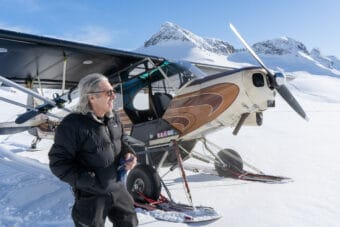
Drake Olson on an unnamed glacier between Haines and Skagway. Olson has carved out a unique niche in Southeast Alaska ferrying adventurers into the little-traveled mountains around Haines. (Lex Treinen/Chilkat Valley News)

“I don’t really know where we are going,” said Drake Olson on a recent joyride shortly after takeoff from the Haines airport in his 1979 Piper Super Cub. “It’s all just one big feel out.”

It’s a clear blue day with only a few clouds at the edge of the skyline, but Olson is intently focused on the instruments in front of him. He keeps a steady conversation going, but it’s clear his mind is on the task in front of him as he reacts to minute pressure and wind differences as the plane gains elevation.

The plane wobbles slightly. He comments on the cold air burbling off the Ferebee Glacier, and the shifting storm patterns that are transitioning from south to north during the morning, making the air “confused.”

“If you’re thinking straight, you’re always feeling, sensing, watching,” says the 68-year-old. “All of us — no matter what you’re doing — you’re trying to get in that state of flow where you’re focused and there’s no noise.”

Olson finds that flow state when he’s fulfilling a childhood dream of flying.

His passion has helped him carve out a unique niche in the Southeast Alaska flying community ferrying climbers, skiers and paddlers to remote sites in the vast and varied mountain ranges around the Chilkat Valley and beyond. Olson’s natural inclination — developed for years as a professional race car driver in his 20s — has kept him and his clients safe since 1997 when he started Fly Drake, his charter flying service that he continues to operate today.

One of his specialties is glacier landings, in which pilots must not only deal with wind and weather, but also the changing ice forms like crevasses on the surface.

“There’s not a lot of demand — it’s pretty niche,” said Doug Riemer, a longtime pilot who runs Nordic Air in Petersburg.

Olson’s service has allowed him to pioneer recreational access around the Chilkat Valley, where helicopter flying is restricted to narrow corridors in the Upper Valley. Olson has developed a reputation among hardcore adventurers for his skill, humor and folk philosophy.

“He knows the area so well and he’s at one with the land out there. You feel comfortable when you’re flying with him,” said Ryland Bell, a professional snowboarder who lives in the Chilkat Valley.

Olson during a recent flight over the Takshanuks. “If you’re thinking straight, you’re always feeling, sensing, watching,” he said. (Lex Treinen/Chilkat Valley News)

A childhood dream interrupted

Olson dreamed of following the footsteps of his father, a pilot who flew reconnaissance planes for the Navy.

“Ever since I had consciousness, it’s been airplanes. Airplanes were so cool as a kid,” said Olson.

But his dad, who was mostly emotionally distant, was focused on sports cars, horses and beer, discouraged the younger Olson, who had a heart murmur that would have excluded him from the service. The family kept horses and lived on a farm in Connecticut.

Despite his hope to fly, Olson got his first taste for engines as a race car driver. He started on an amateur circuit as a young man. He showed a natural ability to find efficient lines around a race track. Soon, he was traveling around the country in a tattered pickup truck he used as a camper to sleep in. The 1983 rig is still parked in his hangar at the Haines Airport, with 375,000 miles on the odometer.

“I lived like a dog,” he said.

With his talent, he soon had engine builders and dealers lined up to get him to drive their cars.

He had success in international racing, notching big wins even as a relatively unknown upstart.

But before long, the realities of the sport caught up to him. A GT prototype he was driving left the ground because of an air disturbance, and he got in a serious crash.

“I was lucky to survive,” he said. He continued to race for three more years after that, but felt rattled by the crash, and felt commodified by sponsors.

He started dabbling in flying and soon met Paul Swanstrom whom he flew with to Haines. (Swanstrom declined to comment on this story.) He flew around Alaska for the next two weeks. He had a vision of what ski planes could do in a country like Alaska.

“I said ‘This is it’,” said Olson.

He returned south and bought a Cessna 180, which he still flies. Within a few years, he had moved to Haines and started working as a pilot. In 1997, he decided to open what became known as Fly Drake.

Fly Drake takes off

From his hangar at the Haines Airport, Olson runs the business by himself, waking up early in the morning to do maintenance.

It hasn’t been easy. Olson is no fan of the paperwork and maintenance that is required of the job when he’d rather be flying. He lives a modest life, driving a 1987 VW sedan and chopping cords wood to heat his shop and home.

He’s learned some hard lessons through some close calls.

A change in lighting during the day can make a safe flight turn precarious. Winds can shift in minutes, and weather can appear out of nowhere.

“I always feel like I’m one little problem away from disaster,” he said.

For glacier landings, a relatively common occurrence is attempting a landing on snow that isn’t hard enough to support a plane landing. Olson has had trips where he and his crew have had to dig for hours to build a ramp out of a pit in the snow.

Through it all, he’s learned to trust himself, and to not get caught in the excitement.
“You learn to leave your ego in a drawer,” he said.

He pointed to a duo of internationally known snowboarders, Vincent De Le Rue and Sam Anthamatten, who visited a few years ago with a handful of spots mapped out. When he flew out there, there was mostly bare rock and ice, not the fluted snow spines that most riders seek. He realized that the famous snowboarders didn’t know the area well enough to pinpoint the right spots on a map. He ended up suggesting another area full of powder-covered spines that he’d seen earlier. (Anthematten and De Le Rue did not respond to messages to confirm the details of this story.)

“You realize the customer is not always right, in fact the customer is often wrong,” he said.
His reputation and the niche he’s carved out has earned him modest renown for his appearances in high profile ski films, including the 2014 Teton Gravity Research film “Deeper.” The film features Jeremy Jones, an internationally-known snowboarder, pioneering multi-day trips in remote areas of Southeast Alaska.

Olson said for the film, he and Jones were able to find what became known as the “spine institute” in the Fairweather Mountains, a magnificent array of snow spines coming down the mountain, that the athletes considered some of the best conditions they’d ever encountered for boarding. For the crew, it felt like a pioneering way of accessing the mountains using planes instead of helicopters.

“It was magic. It was magic for me. It was magic for them,” said Olson. Still, the conditions were fleeting. Olson said the conditions there haven’t been the same since.

Ryland Bell is featured in the film, and had been flying with Olson for years. He said he always feels safe flying with Olson, even while the latter appears relaxed, joking with the passengers and playing music through the headsets.

“So many other pilots are very serious and don’t want to shoot the shit too much,” said Bell. “To a certain extent the vibe I get from them is they’re nervous.”

Bell recalled one trip where his climbing partner had been dropped off by Olson a few days before, only to realize they didn’t have a second sleeping bag. A few days later during a short break in the weather, Olson was able to land and drop off more gear. The weather window was short, and the crew scrambled to get everything unloaded as a wall of dark storm clouds rolled towards them. Olson jumped into the cockpit and headed straight for the clouds.

“He just disappears into the wall — it’s full ‘Hidalgo’ — a sandstorm over the desert,” said Bell referring to the 2004 film about a horseback adventure competition set in Arabia.
Olson, for his part, still has his doubts about whether the risks are worth it.

“You’ve got to really want it. Sometimes I wonder if I really want it that bad,” he said.

For now, the thrill of finding his flow state is too strong to resist.

This story originally appeared in the Chilkat Valley News and is republished here with permission.

Site notifications
Update notification options
Subscribe to notifications