
Chilkat Valley News

The Chilkat Valley News has been in publication since Jan. 3, 1966 and is Haines, Alaska's independent Newspaper of Record. KTOO collaborates with partners across the state to cover important news and to share stories with our audiences.
Haines visitor center turns to social media influencers. Will it pay off?

Influencer Danielle Marie Lister during a recent trip to Haines paid for by the Visitor Center. (Photo courtesy of Danielle Marie Lister/Haines Tourism Department)

Let me take you to one of my favorite places in Alaska that you’ve probably never heard of,”  says Danielle Marie Lister in a recent Instagram video.

Lister wears black bibs, a purple down jacket, and thick white boots as she skips along the Haines Highway below the snow-covered Three Guardsmen Mountain along with soft guitar music.

The one-minute long video includes shots of bald eagles on the Chilkat River, the slow waves of Portage Cove, and steam rising from a hot tub outside a yurt pressed against the Takshanuk Mountains.

“I always love the contrast of the small quiet town and its epic landscape,” Lister tells her 198,000 followers. “There’s something poetic about it. We are so lucky to have Haines as our Alaska neighbors and look forward to coming back in the summer.”

Lister’s enthusiasm for Haines may be real, but it’s also part of her job. Lister was recently hired by the Haines tourism office to produce photos and videos to promote Haines at a cost of about $3,000, according to tourism director Reba Hylton.

In other words, the borough hired a social media influencer.

“It’s a huge and relatively inexpensive and effective way to meet our target audience,” said Hylton.

Social media influencers have become prominent ways brands promote their products over the past decade or more as more users have flocked to platforms like Facebook, TikTok and Instagram. The market for influencers was valued at $16.5 billion in 2022, according to a report from Allied Market Research.

Haines’ efforts represent just a sliver of that. Since taking over as tourism director in the spring, Hylton has paid three influencers to come to Haines — for a total of about $7,000 out of a discretionary advertising budget of $154,000. Hylton said Lister’s audience fit in well with the tourism office’s goals of attracting more wintertime travelers, as well as targeting Yukoners.

Lister brought snowmachines, her partner (a professional photographer) and two friends to Haines with her. The visitor center paid for her accommodations as well as direct payments in exchange for at least three stories, a carousel image, and two reels.

Aside from being able to share the content over social media, the tourism office also gets rights to 50 photos and more than 10 videos that will help with future marketing campaigns.

Jillian Simpson, director of the Alaska Travel Industry Association, said Hylton’s strategy seems promising.

“It’s definitely standard and considered even best practice to use influencer marketing as part of its overall marketing strategy,” said Simpson. “Particularly it’s really helpful when it comes to travel.”

Despite that, few communities appear to be actively reaching out to influencers. The Alaska Travel Industry Association sometimes coordinates with visitor centers in places like Juneau, Soldotna, and Sitka if a vetted influencer is coming through. Those offices will sometimes compensate influencers for a meal or some local activities, but not at the same level that Haines has done.

The Alaska Travel Industry Association has used influencers since 2017, including six last year. This year, it hired an influencer for the upcoming Arctic Winter Games in the Matanuska-Susitna Borough. The association helps coordinate trips to regions around the state.

“We definitely want to be spreading the wealth to make sure each region gets represented,” said Simpson.

Hylton said she’s okay being a pioneer in the market, especially considering Haines’ unique status on the road system, but off the well-beaten cruise ship path of other Southeast Alaska communities. She said there’s fierce competition to attract independent travelers, and influencers are one way to get a leg up.

“I feel like we’re leading the charge on this,” said Hylton. “I do feel confident we’re headed in the right direction.”

Still, Simpson and Hylton acknowledged that it’s hard to measure the exact impact of influencers. Hylton said posts from Lister and the two others she’s hired have had a wide reach based on engagement data, but it’s unclear how many of those have transferred to actual increased visits.

“That’s the golden question out there that nobody can answer,” Hylton said.

Hylton said her office receives dozens of solicitations from influencers looking for freebies from the borough, but very few are worth pursuing.

“I won’t hire just anyone. I need to make sure it’s the right demographic for our audience,” she said.

Hylton pointed to encouraging signs her strategy is working. During the Bald Eagle Festival in November, Hylton said hotels and rental cars were booked out. Winterfest events also reported strong turnout during a year of rebuilding events that had been canceled during the COVID pandemic. Hylton said community feedback about the content, which is posted on the Visit Haines social media channels, has been positive.

Still, some are skeptical of the idea. Social media influencers speak to a narrow audience: their followers, who tend to be younger and connected online.

“I have no data for this but I can only think that politically and socially, individuals reach a specific narrow group, even if it’s millions of people, and I would like to see us work more to get more families,” said Carol Tuynman, a member of the Tourism Advisory Board.

Tuynman said she’d like to see more focus on hiring local PR experts to promote the community.

Influencers’ specific audience can also work to their advantage. Aside from Lister, Hylton has also hired Christine Kesteloo, a cruise ship traveler. Under the handle DutchWorld_Americangirl, Kesteloo has 887,000 followers on TikTok.

Hylton said Kesteloo’s audience was ideal for targeting cruise ship passengers who stop over in Skagway and are considering a day trip to Haines. Hylton said she’s known Kesteloo for years and got a “bargain deal” of about $1,000. Kesteloo jet-boated up the Chilkat River and saw bears along the Chilkoot.

Kesteloo, who has spent most of her last 12 years on cruise ships traveling around the world, said her videos of Haines have drawn positive responses.

“A lot of people enjoyed seeing there are other options once you get to Skagway,” she said.

Kesteloo pointed to a group trip of 120 people she had planned to accompany her on a special cruise tour in Alaska this summer. Already, three participants have sent her direct messages asking if they can come along with her on a private day trip from Skagway to Haines.

“It really made an impact on people,” said Kesteloo.

This story originally appeared in the Chilkat Valley News and is republished here with permission.

Outdoor and cultural-center programming fuels Klukwan school enrollment jump

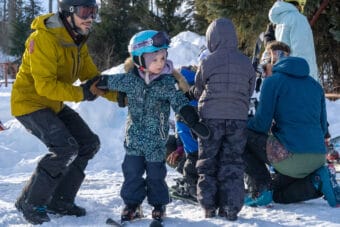
Kids from Klukwan School get towed up the hill on Powdah Mountain during ski school, which happens twice a week. (Lex Treinen/Chilkat Valley News)

School can be a hard thing for kids to be excited about, but Keyana Willard loves every day at Klukwan School.

“The school is really nice. There’s no bullies. Everyone’s so nice to each other,” she said.

The eighth grader is standing at the base of a downhill ski slope at 35 Mile of the Haines Highway waiting for a snowmachine to bring her up the hill as a part of the twice-a-week ski school that Klukwan has been running for the last three years. The entire school dons ski gear, loads up in a bus and heads 15 miles up the road, where they meet a handful of parent volunteers at Powdah Mountain.

They’ll spend the next three hours zipping up the slopes being towed by a rope attached to a snow machine, and then carving down the groomed hills.

The ski school is one of the outdoor and cultural activities the school has been focused on in the past few years. Students also get the chance to join biologists to learn the subtleties of identifying lynx tracks in the snow, help elders process salmon during fall salmon camp, and get daily Lingít lessons at school by teacher Justina Hotch.

For Willard’s classmate Tia Grant, the outdoors and cultural programming was a big draw. She lives in Haines, but wanted to learn Lingít.

“It’s very fun because we get to do lots of activities. Doing our cultural stuff in the wilderness. We get to practice tracking and stuff,” said Grant.

Just a few years ago, the school was at risk of closing. In 2016, the school cut staff to just one teacher. In 2021, enrollment dropped to just eight students — below the 10-student threshold at which the state fully funds a school. The superintendent of the Chatham School District died unexpectedly in December of 2021.

The new superintendent, Ralph Watkins, said boosting enrollment became a big focus.
“That was our number one priority,” he said.

Watkins said this year, the district put out an “advertising blitz” in the fall, and hosted an open house for interested families. In the fall, there were about 15 kids enrolled. After winter break, the school’s enrollment had nearly doubled to around 25.

Parents and students cite a variety of reasons for choosing Klukwan School, but the small size, focus on Lingit culture, and outdoor programming are frequently cited. Head teacher Justina Hotch said that teaching Lingít has been a challenge, but rewarding. Hotch grew up in New Mexico and learned Lingit after marrying into Klukwan. She now teaches daily classes for elementary students.

Justina Hotch plays a Tlinigt matching game with Jen Marschke’s class on Tuesday, Feb. 6. (Lex Treinen/Chilkat Valley News)

At one session, students sat in a circle on the elementary classroom floor as Hotch laid out flashcards on the carpet for a matching game. Students took turns picking two cards each, with phrases like “xat seiwa.átʼ” (I am cold) or “Ai éet yaan. Uwaháa” (I am hungry) to try to find matches. Afterwards, they gathered in the lunchroom for a quick game of “Yéil, yéil, ch’áak’” (duck duck goose).

Hotch said it’s been a challenge to teach Lingít without a Native speaker, but she has heard positive feedback from parents. Ideally, she said, the class would be taught by a native speaker of the language, but Lingít speakers are in high demand. The class is funded by a district grant.

Lunchtime meals can be filled with culturally important foods and experiential learning. After grabbing fresh-cooked meals from the kitchen, students have the option of wandering over to the hydroponic garden to pick oregano, chives, cilantro or parsley to add to their plates, which some days include salmon, herring eggs or moose that students helped cut.

Recently, they harvested basil from the hydroponic garden to make garlic basil pesto.
The focus on traditional foods comes at a cost. Using them means the school doesn’t get funding and certification from USDA, so the foods have to be cooked fresh and paid for from other sources. Currently, it’s funded by the local tribe, the Chilkat Indian Village.

“If we go back to the USDA food program, we won’t be able to pay for or regularly serve the fresh-caught salmon we get from local fishermen, or the moose meat from moose camp,” she said. “It’s a challenge but we need to figure out where we can get the funding for the future because those funds are going to run out.”

Samson Duffy-Webb picks oregano from the hydroponic garden during lunch. (Lex Treinen/Chilkat Valley News)

Administrators are hoping the positive energy at the school can continue, but they are facing some systemic challenges. For one, there appears to be little chance of a sizeable increase in school funding from the state. Most state money comes from a per-student formula, which hasn’t been keeping up with inflation for years. Because the school isn’t located within the city, it can’t receive funding from the borough government, unlike the Haines School where the borough allocated $200,000 last year.

The local tribe has stepped up in a big way in recent years, funding a staff position, preschool, transportation, library, mental health support and food for the school in part with federal money from COVID relief, which has been drying up. The tribe and district have been able to find new grant funding sources for some of the programming, but it’s taken a constant effort.

Watkins, the superintendent, said that the preschool program represents a big investment in the future. The school has seven kids this year with a capacity for 10. Watkins said there is already a waiting list for next year. Having a preschool available has attracted some parents from as far away as Mud Bay.

Zephyr Sincerny’s four-and-a-half year old daughter Aven comes to Klukwan School from Haines twice a week on Tuesdays and Thursdays.

A van picks her up from the Chilkoot Indian Association building in Haines to bring her to Klukwan at 8 a.m. Sincerny said having a tight knit school where kids interact with different age groups was part of the attraction, as are the field trips and cultural programs.

He said he’s not sure what Aven will do next year, but he’s been impressed with Klukwan School so far, despite the transportation challenges.

Zephyr Sincerny helps daughter Aven during ski school, which Aven attends twice a week from Haines. (Lex Treinen/Chilkat Valley News)

“There’s some really positive things that are going on and a lot of potential at the Klukwan School that we’re excited about,” he said.

Watkins said that’s the part of the point of the preschool — to expose parents and students to Klukwan School in the hopes that they will enroll as students. He said he expects five students who are in preschool this year to enroll next year.

“If there is an answer (to school enrollment) — that’s the answer. That’s how you’re gonna grow your school,” he said.

This story originally appeared in the Chilkat Valley News and is republished here with permission.

‘We’re way behind’: EV charging station in Haines could bring tourists, help locals

EV owner Hannah Reeves with her Hyundai Ionic. Despite some glitches, Reeves said she doesn’t think she’ll buy a gas vehicle again. (Photo by Lex Treinen/Chilkat Valley News)

Shelby Flemming has an electric car, but it’s not doing her much good this winter.

She lives on Mosquito Lake Road and owns a 2015 Nissan Leaf that has a 70 mile range  — but only when it’s warm.

Using the heater in colder weather, it doesn’t have the range to get to her work in Haines and back on one charge, and there is no public charging station in town.

A $1.4 million grant from the federal government to the Chilkoot Indian Association (CIA) could change that as soon as this summer, and potentially save Flemming a lot of money next year. If she can charge her car while in town for work, she won’t have to rely on her gas guzzler, with gas hovering between $5 and $6 per gallon.

“I’m super excited about that. I hope it happens quickly,” said Flemming.

Details of the charging station are still being worked out, but EV owners, advocates, and tourism officials are thrilled at the possibility of Haines’ first public charging station. A station would open up the possibility of EV-owning Yukoners making the trip down without having to borrow a car, potentially opening up the “Golden Circle” to EV owners. There are free, rapid charging stations every hundred miles or so in the Yukon, and five of them in Skagway. Haines — so far  — has been the missing link.

“It’s gonna be great to be connected in that regard,” said Haines tourism director Reba Hylton. “We’re way behind.”

The federal government recently announced $623 million in grants for a nationwide effort to boost EV charging infrastructure that included the CIA grant.

Tribal administrator Harriet Brouillette said she’d been hearing about the need in Haines for a charging station. When the federal government opened up the grant application, it jumped at the chance, especially with Haines being an EV charging desert.

“We have an opportunity to provide the community with the EV charging station at a reasonable cost, so it just makes sense for us to take this step,” she said.

The $1.4 million award includes money to purchase property for the charging station. One idea, Brouilette said, is to develop a space into a small “economic hub” where food trucks and other small businesses could park trailers.

Brouillette said if the tribe is able to act quickly, it could start building late this spring.

Brittany Dunbar with CIA said the goal is to have four direct-current fast-charging plugs at the site, which can charge a car up to 80% battery in as little as 30 minutes. But the tribe is still looking into how much those chargers would cost and whether current electricity supply could accommodate fast charging. An alternative is a 220-volt charging station which can charge a car in a few hours. Dunbar said the tribe is still reeling a bit from the news of the grant award.

“I was pretty excited and shocked, but now is the fun part of figuring it all out,” said Dunbar.

CIA officials said the charging wouldn’t be free, but EV owners in Haines say the cost to run an EV per mile is about a tenth of what the price of gas is.

“I did the math and my Toyota Landcruiser was like 30 cents a mile. The (Nissan) Leaf was 4 cents,” said Haines resident Darsie Culbeck.

Culbeck, who sits on the Haines Economic Development Council board of directors, said he thinks a public charging station would be a big boost for tourism in the area. He pointed to a friend in Haines Junction who has an EV and doesn’t visit Haines because of the lack of a charging station.

There’s no official state registry of electric vehicles in Haines, but Mayor Tom Morphet said 17 people have applied for a rebate for owning an EV from AP&T, the local power company. AP&T president Jason Custer would not corroborate those numbers.

Local usership seems to be growing, in no small part due to the enthusiasm of Bart Henderson. Henderson said he’s owned about a half dozen EVs, and has resold more than 10 in Haines.

He currently owns a Chevy Bolt and a Kia Soul. Working with a friend in Juneau, Henderson imports the cars basically at cost to Haines, where he lets people test drive his own cars.

“My theory is once you drive a real electric car, you get back in a gas car and it seems so clunky and old,” he said.

Still, cold is a concern to battery life, as Hannah Reeves recently discovered during a trip to Haines Junction. The family stopped at the cultural center to charge their Hyundai Ionic, but only for about a half hour, which wasn’t enough time to get them all the way back in the cold weather. They found themselves stranded in the pass. Her husband hitchhiked back to Haines and picked up their Ford F350 diesel and towed it home.

Still, she said, she didn’t have any regrets about the car. It works great to commute from her home at Mosquito Lake and back, and having a charging station in town could make it even better.

“I don’t think I want to go back at all to a standard vehicle. It’s amazing, it’s all-wheel-drive, the handling is way better than anything else I’ve ever driven,” she said.

Klukwan church returned to tribe after century of Presbyterian ownership

Lani Hotch points to photos on the Klukwan church wall of her family. (Lex Treinen/Chilkat Valley News)

On a recent Sunday, about a dozen parishioners sit on wooden pews at the Klukwan church listening to a sermon.

With a grand piano accompanying them, they sing along to “Count your blessings” and “These are the days of Elijah.” And, as they listen, a few parishioners sew animal hide.

On the surface, little has changed about the church services in years. The community staple — originally known as the Klukwan Presbyterian Church — has been holding regular Sunday services for nearly a century.

But one thing about the church has changed: its owner.

Last November, a national denomination of the Presbyterian Church transferred the deed to the Klukwan tribe, as part of the denomination’s effort to reconcile past abuses by clergy members and teachers against Alaska Native people.

Tribal and church leaders said it was an important step towards self-determination for the Chilkat Indian Village, the federally recognized tribe in Klukwan.

“It just kinda hits you dead center – the church is ours,” said Jones Hotch, a longtime church member and a member of the Klukwan tribal council.

The idea was first floated years ago under then-pastor Jami Campbell after she witnessed a statewide apology made by the Presbyterian Church at the Alaska Federation of Natives conference in 2016.

Campbell has since moved away from Klukwan but returned for the Oct. 8 ceremony.

“Being part of healing is a pretty amazing thing,” she said in a phone interview from Washington state, where she now lives. “They’ve gained some of their power back.”

Starting with an apology

Lani Hotch, another longtime church member and culture bearer in Klukwan, said some of her earliest memories are with the church. While she spent her early years in Haines, Hotch remembered coming to services with her grandmother, Jennie Warren, who wore a navy blue dress with white polka dots on Sundays. They walked over the wooden sidewalks to the wooden building, Warren in her black leather shoes with modest heels, keeping a strict eye on the rambunctious children.

Hotch said she loved the services and the connection it brought to her family and the history of the region. Her great grandfather James Katchkanuk had purchased the cast iron bell in 1903. She continued to attend church through adulthood.

Campbell said she quickly felt the importance of the church after she was recruited as pastor of Klukwan Church at the end of 2017. She served a brief volunteer stint cleaning the Jilkaat Kwaan Heritage Center earlier in the year and some church members asked if she would be interested in the pastorship. She decided to make the move with her partner in September of 2017.

Campbell tried to integrate into the community as quickly as she could, but the darker sides of the church’s history in Alaska gnawed at her. She remembered seeing a document at the Jilkaat Kwaan Heritage Center to prove they were no longer Indigenous. It required a signature from five non-Native Alaskans to prove they were “civilized.”

The Presbyterian Church was a major force in several regions in Alaska, including in the Chilkat Valley. The church was particularly active in missionary boarding schools, taking Alaska Native children away from their families to boarding school and prohibiting local languages as part of a “civilizing” mission. Among the most prominent Presbyterians was Rev. Sheldon Jackson, who established a system of boarding schools across the state.

Lani Hotch passes a jar of chowder to pastor Al Giddings, who recently took over pastorship of Klukwan Church. (Lex Treinen photo/Chilkat Valley News)

Shortly after taking up the ministry in Klukwan, Campbell stumbled across a YouTube video of an apology from the Presbyterian USA denomination of the church for abuses at boarding schools in Alaska. The speech was delivered by Rev. Curtis Karns at the Alaska Federation of Natives conference in Fairbanks in 2016.

“To those individuals who were physically, sexually and emotionally abused as students of the Indian boarding schools in which the (Presbyterian Church USA) was involved, we offer you our most sincere apology. You did nothing wrong; you were and are the victims of evil acts that cannot under any circumstances be justified or excused,” Karns told the AFN convention, according to an Anchorage Daily News account at the time.

The discovery had a deep effect on Campbell, who decided the Klukwan church should make its own apology. In May of 2019, she gave a speech to the congregants at the Klukwan heritage center based on the Presbyterian USA apology from 2016.

“To those individuals who were physically, sexually, and emotionally abused and mistreated as a result of assimilation practices, we apologize,” Campbell told congregants.

The ceremony wasn’t publicized at the time.

“They decided they wanted it to be intimate,” said Campbell. “They decided not to inform local media at the time so it could be a personal, genuine moment.”

Jones Hotch remembers being moved by the speech.

“Pastor Jami was very real. I stood up and I said ‘I accept it.'” he said. “It was really something to hear and see in person.”

Campbell said she felt like it was a milestone for the church’s role in the community. She said she’s had people who weren’t even at the ceremony come up to her and recite portions of it word for word.

Still, she said there were members who weren’t supportive and who argued the church shouldn’t be apologizing for sharing the word of God.

Lani Hotch, a longtime church member and culture bearer, said it was bittersweet for her.

“It was great there was an apology after the fact, but in my heart, I had already moved on,” she said.

Hotch had completed a Klukwan Healing Robe, a Chilkat weaving project in 2001 that marked a focal point in throwing off cultural oppression and embracing Tlingit heritage for the community.

The text of Campbell’s apology to Klukwan still hangs on the wall of the church.

Words and deeds

Shortly after the apology, Campbell started hearing about a movement within the Presbyterian USA denomination of returning church lands to Indigenous peoples. She wondered if the church would be willing to do the same for Klukwan church.

The property where it sat, about halfway between the banks of the Chilkat River and the Haines Highway, was the sole piece of land still owned by non-tribal members in Klukwan. Campbell reached out to Presbyterian USA over email.

“Would you please consider gifting the Klukwan, Alaska church building to the Chilkat Tlingit people of Klukwan?” she wrote. “This transaction can easily be done by donating, gifting or selling for $1 to the Chilkat Indian Village.”

Within a week, she had a phone call.

“I didn’t even know there was a church there,” said Dean Strong, the clerk for the Northwest Presbytery at the time.

Strong combed through records Presbyterian USA kept in New York state to find the property. It was hardly a question of whether to return the property, Strong said.

“Once we found out about it, we were happy to have the Native American tribe own it. It was their property, their community center,” he said. “We’ve been trying to do this with all our churches on all our native properties and reservations.”

Getting it through the tribal council took a bit longer, but not for lack of support. Jones Hotch said there were minor technical issues and one of the tribal council members, Tony Strong, died.

“Just normal paperwork, I think the biggest problem was formatting the letter for the borough,” he said.

By 2022, the council had approved the transfer and the church became part of the tribal land.

Unfortunately, COVID concerns were still present in the village, and the tribe decided to delay a formal ceremony until Oct. 8 of this year.

The event was held at the church. Congregants brought local foods and heard speeches.

“Not too many empty seats that day,” said Pat Warren, a church elder. “There was fish and side dishes – it was a festive time.”

A series of people spoke about the meaning of the deed transfer, for the tribe and the church.

Campbell spoke as well, emphasizing that it allows the people of Klukwan to choose how they honor their faith.

Pastor Jami Campbell in October, 2023 with Kath Hotch (left) and Joann Elsie Spud (right). (Photo courtesy of Jami Campbell)

Klukwan tribal administrator Brian Willard and tribal council president Kim Strong spoke about the history of the church and the significance of the transfer.

“It was just very warm, very celebratory and very reflective and an excitement of moving forward,” said Al Giddings, who was also welcomed as the new pastor of the church during the ceremony.

Former pastor Campbell said it was a celebration “but not necessarily people jumping around hooping and hollering,” said Campbell. “It’s the kind of celebration of recognizing broken things coming back together.”

Campbell said making the trip back to see the culmination of years of effort was emotional.

“Being part of healing is a pretty amazing thing,” she said. “The village worked so hard for healing to sustain their culture and their way of life. Now the church isn’t standing in the way, it’s an ally for them.”

Church members like Lani Hotch echoed the sentiment.

“I think it’s made a difference to take ownership and to have that autonomy that we should have always had – it’s just natural,” she said.

Practically, there are small but significant differences. Hotch said the church can now choose which denomination to have preaching.

Right now, Giddings’ services are non-denominational. And, the tribe has been able to take over insurance and has paid for some repairs to the building.

Hotch pointed to a silver lining of history that despite the abuses by the church, many of the most influential Alaska Native leaders have come from it, including civil rights leader Elizabeth Peratrovich, influential pastor and elder Rev. Walter Soboleff, and William Paul, the first Alaska Native legislator.

Now that the Klukwan church is back in tribal hands, she said, the village will keep growing new leaders, and hopefully put the abuses behind.

Millions of dollars worth of property in downtown Haines went up for sale overnight

Red plywood signs were nailed up around multiple business and residential buildings on Friday. The owner of the buildings, Chris Thorgesen, declined to comment on why he decided to sell more than $3 million worth of property. (Lex Treinin/Chilkat Valley News)

More than $3.5 million worth of Haines real estate -— most of it in the downtown area — went up for sale last week, surprising business owners and public officials who worried about what the sale might mean for the vibrancy of the city center.

The properties include Alpenglow Pizza, Thor’s Gym and Eagles Nest Apartments, and are owned by Chris Thorgesen, who purchased most of them about 10 years ago.

“It’s obviously a concern,” said mayor-elect Tom Morphet. “Chris single-handedly kind of revitalized downtown.”

Business owners said they learned of the sale when bright red plywood signs were nailed to the street-facing walls.
Amy Kane, who owns The Bookstore downtown, called the news “startling.”

“Having reliable rent has been one of the few stable components of running a business over the last few years,” she said. “To find out by driving by the building was unfortunate. The lack of information opens a chasm of speculation and worry.”

Nolan Woodard, who has run Alpenglow Pizza since April, said he also heard about it from Thorgesen’s assistant, who came in to let Woodard know the building would be sold.

Woodard said he was interested in buying the building, but hasn’t heard from Thorgesen. Woodard said his biggest concern was the uncertainty about getting a new owner if he’s not able to come to an agreement to buy the place himself.

“I’m more worried about somebody buying it and becoming too involved with my business,” said Woodard. “I have a very specific goal in mind for what I’m trying to do with my business and I’ve been fortunate enough with Chris that he doesn’t really bother me.”

Jeanie Beck, who owns La Loft, in the LAB building that went for sale Friday, said she was also concerned about the future. She said her family was already looking for other communities to live in.

“We have no idea what the next buyer will do. I just know what Chris has done for our community. It’s been a really good thing,” she said.

Rumors have swirled about the reasons for Thorgesen’s decision. Thorgesen declined to comment on the sales. Woodard said he heard the reason was related to Thorgesen’s focus on a property he owns in Healy, Wood River Lodge. Others speculated that property tax assessments may have played into the decision. The assessed value of the properties Thorgesen has listed for sale has risen about $200,000 from 2022 to 2023, from $3.4 million to about $3.6 million, based on borough records. Others said results from the recent borough election may have played into Thorgesen’s decision.

Morphet, the newly elected mayor who will assume office at the end of the month, said he was trying to determine if there was a way the borough could work with Thorgesen. Morphet said he visited Thorgesen immediately after hearing about the sales, but Thorgesen thus far has declined to discuss them.

“If it’s a business decision that’s one thing, but if it’s a political decision, then I’d like to speak with him about what we can do,” said Morphet. “We need to have a vital downtown – it’s critical for our future.”

“I don’t think anyone should assume anything until we have something official and on the record from Chris Thorgesen,” said Morphet.

Thorgesen arrived in Haines in 2013 from Salida, Colorado to work as a chiropractor. Within a few years, he started buying prominent downtown buildings that had been sitting empty. Thorgesen denied it was part of a “grand plan” to make a profit.

“I don’t like seeing ‘For sale’ signs going unchecked, especially on Main Street or Beach Road,” he told CVN in 2017. “I don’t like to see buildings empty or hear that people on cruise ships say there’s nothing here to see or do here.”

On Friday, Thorgesen posted signs on the Haisler Building, where Chilkat Valley News has its office, the LAB Building where Haines Packing and La Loft retail stores are, and the Parts Place, which Thorgesen owns. An apartment building on Union Street was also listed for sale. He did not list the Three Northmen Tasting Room, which he also owns and is located downtown.

Other buildings in the downtown area were already listed for sale, including the Pioneer Bar and Bamboo Room, Gina’s Place, and the Haines Inn.

This story originally appeared in the Chilkat Valley News and is republished here with permission.

Grieving father builds observation deck to remember Haines landslide victim

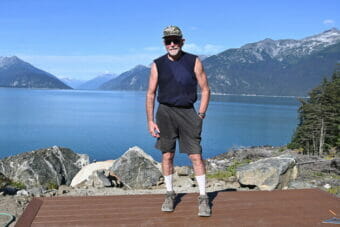
Randy Simmons on the Beach Road platform he built to remember his son David, who died in the 2020 landslide. (Nakeshia Diop/Chilkat Valley News)

Looking at Mount Riley, the scar left behind by the December 2020 landslide is still easy to see. The streak of brown running down the mountain tells of the loss of two residents, Jenae Larson and David Simmons, and destruction of the home where they lived.

As the years have gone by, foliage has started to sprout from the area, but the land has remained vacant. Recently one man has been quietly building a small wooden platform on the side of Beach Road.

The man is Randy Simmons, David Simmons’ father. He comes to Haines from Chico, California a couple times a year to remember his son.

“It’s like my second hometown.” he said.

Simmons most recently came to Haines on Aug. 23, and since then he has been working on building a memorial for his son. On Beach Road, where David’s house once stood, now stands an observation deck that overlooks Portage Cove and the Halutu Ridge.

Simmons said he spoke with his son on the phone an hour before the slide.

“He was working on his computer, looking out the window toward Full Moon Cove,” said Simmons.

Now, Simmons is able to stand at the same spot and take in the beauty of the view while paying respect to his departed loved one.

“If you knew David, you are welcome to drop by to talk to him and appreciate the view offered by this site,” said Simmons. However, since the land is his private property, he said the deck will eventually be roped off with limited access to prevent tourists from camping out on the memorial site.

Jenae Larson (left) and David Simmons (right) died in the Haines landslide on Wednesday, Dec. 2, 2020. (courtesy photos)

Roger Schnabel and other neighbors and people who knew David chipped in to help Simmons. Schnabel helped excavate the pad and built an access ramp to the deck. He said he knew David through his wife Nancy, when David asked to borrow a couple of their rifles to go hunting.

“I can’t imagine what Randy and his family are going through, one can’t help but be compassionate,” said Schnabel.

David Simmons and Jeanae Larson also have a memorial table with benches on Picture Point, and Haines Little League is planning on dedicating and renaming its field to David Simmons Memorial Little League Field.

Site notifications
Update notification options
Subscribe to notifications