KCAW - Sitka

KCAW is our partner station in Sitka. KTOO collaborates with partners across the state to cover important news and to share stories with our audiences.

With an unexpected ship, Thursday will be Sitka’s biggest day of the summer cruise season

Sitka began closing Lincoln Street to traffic in 2022, when 383,000 passengers visited the town. 2024 brought Sitka’s first 10,000-passenger day, which many agreed was not optimal. (Tash Kimmell/KCAW)

There will be three ships in port on Thursday in Sitka — rather than two — with a total passenger capacity of 9,300.

The latecomer is the Nieuw Amsterdam, which notified Sitka’s port director about a week ago that it was making an unscheduled call. Combined, the three ships have several thousand crew, many of whom catch a shuttle for the seven-mile ride into town. That could raise the actual number of visitors into five figures.

Mayor Steven Eisenbeisz apologized for what is likely to be a wild start to the visitor season.

“So the goal going forward is to not have 9,000,” he said. “A week ago, it wasn’t. This port call was added very late in the agenda. So Thursday will be busy. What a way to kick off the season.”

Eisenbeisz made the announcement at an informal meeting between Sitka’s two governments, which happens a couple of times a year.

Sitka officials at the meeting were wary of a possible citizen initiative that would limit summertime cruise visitation to less than half of last year’s record season. The mayor cautioned the Tribal Council that recent efforts by city hall to establish a Parks & Recreation program, assume responsibility for maintenance of the schools and the Performing Arts Center, and to take over management of the school swimming pool, would all be jeopardized by limiting cruise ship calls.

Eisenbeisz described a simple trade-off: increased tourism or local amenities.

“I think that’s a choice that community can make,” he said. “The other side of not having buses on your streets, is not having a parks & rec program too.”

Tribal Council member Lillian Feldpausch, however, thought the argument was overstated.

“What is it going to take to be able to run at minimum some of these programs?” she asked. “Because that’s kind of like holding people hostage to say, ‘You don’t have these, you know, we don’t get the funding for these, say goodbye.’

Eisenbeisz said it was not his intention to hold anyone hostage, and that more work needed to be done on tourism. Rather than impose a season limit, he believed Sitka could better manage a daily limit, and one day a week with no ships at all.

Municipal administrator John Leach said the city was investigating a regional strategy to manage cruise traffic, because if Sitka enforced a day with no ships, the cruise lines would go to other towns, and possibly increase congestion there. He wanted a solution that didn’t involve the courts or a ballot initiative.

“Because when it goes to the ballot box, there’s, there’s legal implications on either side pro or against,” he said, ” and it’s going to affect another community.”

As for the cruise passengers, no one disputes that their arrival will be both an economic and culinary boost. A new food truck offering Hawaiian doughnuts is parked downtown, along with another specializing in Cuban food.

“Welcome back to all the food trucks as well,” the mayor said. “I’m pretty excited about that.”

Sitka’s housing crunch hits tribal citizens hardest, study says

Baranof Island Housing Authority, which constructed this four-plex in the Kaasda He’en Shanaa’x, is hoping to solicit ideas and input from community members on how to expand affordable housing in Sitka. (Robert Woolsey/KCAW)

Tribal citizens in Sitka are being squeezed out of Sitka’s housing market, and some are leaving town, according to a new study commissioned by Baranof Island Housing Authority, with support from Sitka Tribe of Alaska. Now, they are hoping the data – and community input –  will guide them towards solutions.

Cliff Richter is the Executive Director of the housing authority. He said the last tribal housing needs assessment was conducted about five years ago.

“Our data was getting a little stale,” Richter said.

Sitka Tribe and the housing authority collected responses from over 300 Alaska Native or Indigenous households in Sitka and nearly 200 households of Sitka Tribe of Alaska tribal citizens outside of Sitka. The survey found that Native residents in Sitka are more likely to rent instead of own, live in older housing such as mobile homes, and rely on friends or family for shelter. The survey also found that tribal citizens are leaving Sitka at a higher rate than other residents.

Robin Sherman is the Communications Director for Sitka Tribe of Alaska.

“An astounding number of the people who responded said that they were really interested in living in Sitka, but lack of housing, you know, or affordable housing was a big barrier,” Sherman said.

Richter said the survey data has already influenced decision-making at the housing authority, which is now prioritizing higher-density housing and smaller lots in planning a new subdivision on Herb Didrickson Drive. They have other ideas on strategies to expand affordable housing, like weatherization and replacing mobile homes, but Richter said the next step is to involve the community in establishing priorities and solutions. While the survey focused on tribal housing needs, Richter said the issue – and the solutions – are community-wide.

“We’re seeing this as information that’s going to benefit the entire community,” he said.

Baranof Island Housing Authority, Sitka Tribe of Alaska, and the City and Borough of Sitka will co-host a community meeting tonight (4-11-24) to share potential strategies for expanding affordable housing in Sitka and solicit ideas from community members. The event takes place at 6 p.m. at the Sheet’ká  Kwáan Naa Kahídi and is open to the entire Sitka community. You can read the full tribal housing needs assessment here.

Environmental DNA offers scientists a look at salmon’s past and future

Salmon lie on the deck of a commercial fishing boat. With refinements to eDNA tracking methods, researchers can now collect data about what fish were present in an area up to two days after the fish have left the area. (Meredith Redick/KCAW)

Scientists have many ways to track fish populations – but they usually require seeing the fish. Now, researchers at the National Oceanic and Atmospheric Administration are refining a method to collect data about what fish were present in an area — up to two days after those fish have moved on.

Diana Baetscher is a research geneticist at NOAA’s Alaska Fisheries Science Center in Juneau.  She said that when fish swim, they shed scales, slime, and other tiny fragments into the water. Those fragments contain DNA – and they can provide a breadcrumb trail for scientists looking to learn about fish populations.

“eDNA is environmental DNA,” Baetscher said. “It’s sort of a really simple concept. At its heart, it’s the fact that all organisms shed DNA or genetic material into the environment, and that can be water or air or soil.”

Baetscher said collecting environmental DNA is less time-intensive than some other methods. Scientists can scoop up seawater and test it to get a picture of what species of fish have recently passed through.

“eDNA has sort of grown as this way of trying to shortcut some of the amount of time that goes into those other ways of counting fish,” she said.

Baetscher is the author of a paper published on March 12 that will help scientists better interpret the data in those scoops of seawater. She says that while the signs can stay in the water for up to 48 hours after fish leave an area, that signal might be affected by factors such as tide and water temperature.

“So you know, if you have a really strong current downstream of a whole bunch of fish, do you see that signal changing because the current is changing, or the wind is changing, or the tide is changing? So, you know, we actually need to study the movement of the eDNA separate from the fish to be able to then use that to understand something about fish.”

Baetscher looked to net pens full of hatchery chum salmon in Juneau’s Amalga Harbor for a dense, consistent source of eDNA. She found that the signal left by the chum salmon was strongest at the water’s surface, and it disappeared faster during outgoing tides. Baetscher said this study was just one step towards making eDNA a more useful tool. In the meantime, eDNA is already being used to expand where scientists can track fish — like for Arctic fish communities under sea ice.

A figure from the March 12 paper shows that eDNA signs get weaker with distance from the net pens, and that the effect is stronger during an outgoing tide.

“Another that we’re really excited about is looking at changing species distributions in the subarctic and the Arctic,” she said. “What do those fish communities look like, and how much are they changing year over year and throughout a calendar year?”

Baetscher hopes the data collected by filtering water under the sea ice will give researchers a snapshot of fish communities that they otherwise would be unable to access.

40 years in the making, Angoon hydroelectric project wins $27M in federal funding

The Thayer Creek Hydro project would use a 40-foot high dam to impound water over an area of 7 acres. (Kootznoowoo, Inc. image)

A hydroelectric project on Admiralty Island over 40 years in the making has won federal funding for construction.

Alaska Senators Murkowski and Sullivan announced on Tuesday that almost $27 million from the bipartisan infrastructure bill is headed toward the community of Angoon for the construction of a run-of-river hydro plant on Thayer Creek.

The plans for a hydroelectric project in Angoon go all the way back to the passage of the Alaska National Interest Lands Conservation Act in 1980, and the creation of the Admiralty Island National Monument on the ancestral lands of the Angoon Lingít. Angoon’s village corporation, Kootznoowoo Inc., was subsequently granted the right to develop Thayer Creek, but no funding came with it. Angoon’s 500 residents have relied on diesel generation ever since, paying somewhere between four and eight times more for electricity than the national average.

Over the years, Kootznoowoo has pulled together other grants to design Thayer Creek until finally, last year, the corporation received a special use permit from the U.S. Forest Service to build it.

But the millions of dollars needed to construct the project were still not there. The passage of the bipartisan infrastructure law in 2021 included $1 billion for energy improvements in rural areas — called ERA — and this looked like Kootnoowoo’s chance.

Kootznoowoo’s director of natural resources, Jon Wunrow, spoke to KCAW last August.

“This is really the first, and potentially the only funding of this size, specifically for rural areas to do renewable energy,” Wunrow said. “So it’s kind of got Thayer written all over it. We’re hopeful.”

Funding brings Thayer Creek project close to final amount needed for construction

In an email to KCAW, Kootznoowoo’s Jon Wunrow explains that the new funding brings Thayer Creek very close to full funding:

“The overall project cost for Thayer Hydro is currently estimated to be $33,650,000,” Wundrow’s email said. “We have secured other funding from the Alaska Energy Authority and Denali Commission, that brings the funding gap to $500,000 — $1.5 million, depending on a pending proposal we have in the works.”

Thayer Lake is a run-of-river project — that is, there won’t be a huge dam built and reservoir created. It will produce 850 kilowatts of power, roughly three-times Angoon’s current needs. Wundrow said that will allow Angoon “to usher in an era of electric motors: electric cars, electric boats, and heat pumps.”

The project will be operated by the Inside Passage Electric Cooperative.

The funding announced for Angoon is part of  $125 million package of ERA infrastructure money for clean energy projects in four other areas in Alaska: Chignik Bay, the Northwest Arctic Borough, the Yukon River and Old Harbor.

Alaska received the largest share of ERA funding in the infrastructure bill. In a news release, Sen. Lisa Murkowski thanked Secretary of Energy Jennifer Granholm for “choosing more projects and awarding more funding to Alaska than any other state. These investments will create jobs, reduce emissions, and increase the use of renewable resources while decreasing electricity bills.”

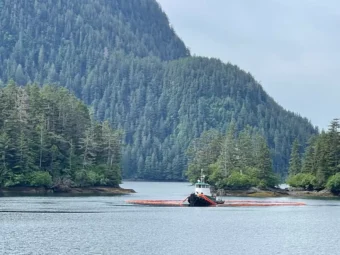
2 dead, 3 rescued after boating accident north of Sitka

Two people are dead after a boat capsized near Sitka on Tuesday night. Three others survived.

A helicopter from Air Station Sitka responded to the scene at 5:15 p.m. Tuesday near Chichagof Island, north of Sitka, according to a Coast Guard news release.

Three people were rescued from the water by about 5:50 p.m. The Coast Guard cutters Douglas Denman and Kukui, along with an HC-130 aircraft from Air Station Kodiak, also responded Tuesday night, tracked the vessel’s drift, and searched the surrounding area for two people who remained missing.

A team from the Sitka Fire Department arrived early Wednesday afternoon with a state trooper and used an underwater drone to find the bodies of the two victims in the cabin of the vessel, the release said. Recovery operations will begin when conditions improve.

Weather in the area was reported at 8-10 knot winds, with 9-foot seas and below-freezing temperatures.

The three people recovered from the water were flown to medical personnel waiting at the Sitka airport.

This story will be updated.

State’s high court rules against Sitka Tribe of Alaska’s herring claim

Herring eggs. (Katherine Rose/KCAW)

After over a year of consideration, the Alaska Supreme Court has sided with the state in a lawsuit over the management of the Sac Roe Herring fishery in Sitka. The five-justice panel upheld a 2021 ruling by a Superior Court judge who denied a claim by the Sitka Tribe of Alaska that Department of Fish & Game managers had violated the state constitution.

The Sitka Tribe of Alaska first sued the state in 2018, alleging that the commercial fishery management put herring stocks and traditional harvesting in jeopardy. After winning on statutory and regulatory claims, the Tribe argued that the Alaska Department of Fish and Game had a constitutional obligation to provide the “best available information” which it failed to do when it did not provide an independent scientific report to the Alaska Board of Fisheries. The report recommended a number of improvements for the method the department uses to estimate fish in Sitka Sound. The state countered that the report was highly technical and would not have been directly relevant for the Board of Fish in its decision making.

In 2021, Juneau Superior Court Judge Daniel Schally determined that the state hadn’t broken any constitutional rules by not providing the report, as there was no requirement in the “sustained yield clause” of the state’s constitution for the state to provide the “best available information.” The Tribe appealed the decision before the Supreme Court in December of 2022.

In a 23-page opinion issued on Dec. 29, the Court upheld Judge Schally’s decision to deny Sitka Tribe of Alaska’s constitutional claim. Law already requires agencies to provide all “relevant information” in resource management issues, and by not releasing the report to the Board of Fish, the Court said the Department of Fish and Game was exercising its own discretion.  The Court also denied Sitka Tribe of Alaska’s request for a preliminary injunction under the “public interest,” and upheld Judge Schally’s decision to deny the Tribe’s attorney fees for its earlier claims. The Court determined that neither the state nor the Tribe had “bested” the other since both achieved victories in the case. Determining the prevailing party in a case, the Supreme Court wrote, is at the Court’s discretion.

In a press release, Tribal Council Chair Lawrence “Woody” Widmark responded to the ruling, saying, “While we are disappointed that the Supreme Court did not agree that the Alaska Constitution requires the state to use the best available information in fisheries management, the Tribe’s litigation still resulted in substantial improvements in management of the commercial sac roe herring fishery in Sitka Sound.”

“And while we will not receive attorney fees, we do not regret using our resources to defend the Tribe’s sovereignty over natural resources in our traditional territory,” he continued. “Our people have stewarded and protected the yaaw (herring) since time immemorial, and we will continue to do so.”

In a press release from the Alaska Department of Law, Attorney General Treg Taylor applauded the Court’s decision, “supporting the Department of Fish and Game’s work to provide the Alaska Board of Fisheries with guidance that is helpful and well-grounded in science, so that our fisheries will continue to produce for generations to come.”

And ADF&G commissioner Doug Vincent Lang wrote that the department takes its constitutional mandate to manage ‘consistent with sustained yield principle’ as its cornerstone. “It’s refreshing to see the courts recognize us for those efforts,” Vincent-Lang said.

Alaska’s newest Supreme Court Justice Jude Pate, who is from Sitka and is a former public defender and tribal attorney, was not on the court when the case was argued a year ago.

Site notifications
Update notification options
Subscribe to notifications