KCAW - Sitka

KCAW is our partner station in Sitka. KTOO collaborates with partners across the state to cover important news and to share stories with our audiences.
UPDATE: Coast Guard suspends search for missing mariners near Hoonah

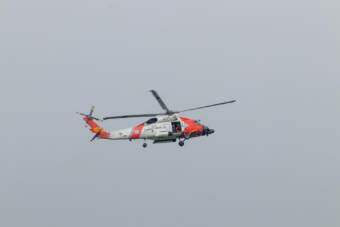
A U.S. Coast Guard HH60 Jayhawk helicopter flies over Juneau, Alaska, on Saturday, Oct. 2, 2021. (Photo by Mikko Wilson/KTOO)

Update, 10 a.m. Tuesday:

The U.S. Coast Guard has suspended its search for five missing mariners after their fishing boat capsized near Point Couverden.

The Coast Guard received a mayday call shortly after midnight on December 1 from the Wind Walker, a 52-foot seiner based in Sitka. The crew reported that their boat was overturning. Attempts by the Coast Guard to gather additional information from the crew over the radio failed. Soon after, an emergency position-indicating radio beacon registered to the Wind Walker was detected just south of Point Couverden, in Icy Strait.

For 24 hours, the Coast Guard searched over 108 nautical miles for the missing crew to no avail. Chief Warrant Officer James Koon is a search and rescue mission coordinator for the Coast Guard in Southeast Alaska. In a statement issued on Monday afternoon (Dec 2), he wrote, “We stand in sorrow and solidarity with the friends and family of the people we were not able to find over the past 24 hours.” The Coast Guard did not release the names of the passengers on the vessel, but confirmed to KCAW that next of kin have been notified.

While the Coast Guard has suspended the search for now, it could pick up again pending new information. Anyone with new information about this situation is requested to contact Coast Guard headquarters in Juneau at 907-463-2980.

Initial report:

The U.S. Coast Guard has released no new information regarding the search for a seiner which reportedly capsized in heavy weather near Hoonah early Sunday morning.

The Coast Guard received a mayday call shortly after midnight on Dec. 1 from the Wind Walker, a 52-foot seiner based in Sitka, when the crew reported that their boat was overturning.

Attempts by the Coast Guard to gather additional information from the crew over the radio failed. Soon after, an emergency position-indicating radio beacon registered to the Wind Walker was detected just south of Point Couverden, in Icy Strait.

This type of device – called an EPIRB – is attached to the cabin of a boat, and releases automatically when submerged.

The state ferry Hubbard was in the vicinity and overheard the mayday, and diverted to Wind Walker’s last reported location to begin the search. A helicopter from Air Station Sitka and a 45-foot medium-response boat from Coast Guard Station Juneau arrived and joined the Hubbard, as did the Coast Guard cutter Healy.

The Coast Guard believes five crew were on board the Wind Walker when it capsized. Reports on social media claiming that some of the victims had been found were incorrect: So far, only seven survival suits and two strobe lights have been located in the water in the search area.

Local weather conditions in Icy Strait early Sunday morning included heavy snow, 45 to 60 mile-per-hour winds, and 6-foot seas.

Sitkan and fisheries advocate Tad Fujioka found dead in apparent bear mauling

Tad Fujioka was chair of the Seafood Producer’s Cooperative. Searchers found his body on Wednesday morning (10-30-24) north of Sitka in Nakwasina Sound, near where he had cached a partial deer carcass two days earlier. (Bethany Goodrich photo)

The call that Tad Fujioka was overdue could not have come at a worse time. On the evening of Oct. 29, Sitka and the outer coast of Southeast were being lashed by a windstorm, with some gusts in excess of 50 miles per hour.

Nevertheless, Fire Chief Craig Warren says Air Station Sitka launched a helicopter equipped with infrared to search an area about ten miles north of Sitka in Nakwasina Sound.

“The Coast Guard did fly the night of the report, and kind of looked around the area,” said Warren. “It was dense forest, they couldn’t see much through the FLIR. And then the next morning, we deployed teams out of the Fire Department before 8:00 a.m. The first team was on the ground there about 8:30 dropped in by the Coast Guard.”

Fujioka was believed to be returning to an area where he had shot a deer on Monday in much better weather, and had cached part of the carcass.

Warren says the department organized 25 members into three teams for the ground search, plus two Alaska State Wildlife troopers, and the state biologist.

The Coast Guard flew two of the teams to a high point above the area where Fujioka was believed to be hunting, and another team was landed on the beach. His body was found by a ground team at about 11:30 in the morning, not far from where he had cached the deer. Wounds indicated that Fujioka had died from a bear mauling.

The shock reverberated quickly around Sitka. Norm Pillen is the President of Seafood Producers Cooperative, where Fujioka was board chair.

“He was very involved,” said Pillen, “Our hearts go out to his family. It’s just … [I] can’t even imagine. It’s a huge loss to them, to the community, to the fishing industry and to SPC. We’ll miss him.”

Fujioka came late to fishing. Before becoming a troller aboard his boat, the Sakura, he worked in Sitka’s municipal engineering department. He brought precision and an attention to detail in fisheries allocation issues that made him a powerful advocate at Alaska Board of Fisheries meetings.

The next meeting scheduled for this January in Ketchikan. Pillen says Fujioka’s absence will be felt.

“He really could dive deep, and had tremendous ability for recall and digging into things and pulling out information that he needed,” said Pillen, “and we really appreciated that about him. It’s going to be a huge hit for the industry to not have him involved.”

Fujioka’s outside-the-box thinking wasn’t limited to fisheries. He was a long-time member of the Sitka Fish & Game Advisory Committee, which in 2021 was reckoning with an extraordinary number of brown bears killed by authorities or residents in Sitka that year, fourteen in all. Overhauling Sitka’s entire trash pick-up system didn’t seem a practical solution, nor did shooting every bear that came into town, as some on the Committee suggested.

Fujioka’s analytical mind and understanding of bear behavior led him to suggest something small-scale and possibly effective, if it’s ever tried.

“What if you looked at it from the other way, and we had some booby trapped garbage cans out there, maybe it would only take one or two bad experiences for a bear to associate that big black thing with an unfavorable experience,” Fujioka told fellow committee members..

The bear that likely killed Fujioka was a brown bear sow with two cubs. She was seen by the Coast Guard helicopter in the area near where Fujioka’s remains were found, but ground searchers did not encounter her. Fish & Game biologist Steve Bethune accompanied searchers on Wednesday. He characterizes the incident as a defensive attack – rather than predatory – and says the sow had almost certainly claimed the deer carcass and was defending her food supply.

Bethune said some efforts were made Wednesday afternoon to locate the bear on the ground, without success.

Tad Fujioka was 50 years old. His death remains under investigation by Alaska Wildlife Troopers.

Why Sitka lost almost everything else when it lost the internet

smartphone
An iPhone. (Photo by Renee Gross/KBBI)

The last time Sitka’s undersea fiber optic cable broke in 2017, the resulting outage lasted 12 days, but didn’t seem nearly as apocalyptic as the latest event.

We didn’t see stories about the social and psychological impact of the outage in 2016; business leaders didn’t put out a survey on its economic impact.

That’s because it wasn’t an outage in 2017 – it was a partial outage. The undersea fiber optic cable to Sitka was somewhat novel eight years ago, and the technological infrastructure it would replace was still in play. Everything worked, albeit a bit more slowly.

Not so when Sitka’s fiber optic link broke this time. At 11 a.m. on Aug. 29, Sitkans found themselves without internet, cell service or texting and unable to use credit cards. Even some landlines – depending on the type of phone – didn’t work.

“It’s a consequence of the fact that everything is sort of reliant on the internet these days,” said Joe Kane, director of Broadband and Spectrum Policy for the Information Technology and Innovation Foundation. “Your wireless phone services. Those are getting signals from towers. But then the towers themselves are connected via wired backhaul into the backbone of the internet. Not just these undersea cables, like the one in Sitka, but also the ones that go all the way across the oceans, all around the world. And so any sort of weak link in that chain getting cut means that you lose sort of everything on the other side of it.”

The Information Technology and Innovation Foundation is a nonprofit think tank in Washington, D.C. It has a staff of about 40 people who, among other things, track the massive federal investment in delivering broadband to everyone in the country.

Kane suggested there are things we could learn from Sitka’s outage.

“Sitka experienced a microcosm of the overall vulnerabilities that we could see with undersea cables if there were more widespread outages,” he said. “So I do think it’s maybe highlighting the importance of securing them.”

Kane described a tension between fiber optic cable and satellite technology. Fiber optic can be significantly faster than satellites, but that’s changing. An earlier generation of communications satellites were in high Earth orbit, had limited bandwidth, and were slower. Now, Starlink has put thousands of satellites in low-Earth orbit, and as Sitkans quickly discovered, the speed difference was noticeable, but by no means a deal-breaker.

Kane believes that the best policy is to maintain both systems.

“There are satellite options now, and there are alternative cable options so that you don’t end up with only one point of failure,” said Kane. “But I do think that’s something where we should be looking:  towards more resiliency and maybe more redundancy. A lot of times people talk about fiber as being future proof, but I think maybe we’re learning that it’s not Alaska proof.”

GCI is heavily invested in undersea cable, and is well toward completion of an 800 mile cable linking the communities of the Aleutian chain. In a response to an email from KCAW, GCI corporate communications manager Josh Edge wrote, “Like all telecommunications networks, fiber is subject to outages, but it has long since proven itself as the most reliable middle-mile network technology available.”

According to Edge, fiber optic has been the backbone of GCI’s network for 25 years.

“Fiber is unique in its ability to deliver orders of magnitude more capacity as technology and customer needs evolve,” he wrote in the email.

The United States is spending $42 billion on universal broadband for its citizens, with much likely to be dedicated to terrestrial infrastructure like fiber optic cable – even though GCI relied on a combination of microwave and satellite technology to maintain a minimal level of service while the cable was repaired.

Kane has no argument with universal broadband as policy, but as a practical matter, Sitka’s experience demonstrates that fiber optic cable doesn’t make sense everywhere.

“I did a back of the envelope calculation the other day,” said Kane. “If you took all the federal money that had been spent on trying to build broadband to Alaska, you could buy every household in the state a Starlink terminal and give them free service on it for multiple years.”

Sitka tourism documentary ‘Cruise Boom’ to debut on PBS

Summer tourists in Sitka, seen in the documentary “Cruise Boom.” (Courtesy ArtChange, Inc.)

Sitka-based filmmaker Ellen Frankenstein’s latest documentary, “Cruise Boom,” premieres nationwide Saturday on PBS.

The national debut culminates years of work on the part of Frankenstein and her co-director Atman Mehta, who explored both the potential benefits and downsides of cruise tourism’s explosive growth in Sitka.

Frankenstein and Mehta began filming “Cruise Boom” in 2021, as Sitka transitioned from the 2020 pandemic summer of zero cruise passengers. The Southeast Alaska town began a startling rebound to nearly 600,000 passengers in 2023 – roughly three times more than a typical summer prior to the pandemic.

“Cruise Boom,” however, is not a scathing indictment of the industry. Frankenstein wants the audience to think broadly about what’s unfolding, as communities react to the surging numbers.

“It is a really complex issue we try to cover in a very impressionistic film, because tourism, as we know, is super complex,” Frankenstein said. “Everybody loves to travel. We all love experiencing new places. The economic side is so amazing, because we have new food trucks in town, new businesses and all these good things. But globally, you can’t miss it in the news that over-tourism, or the saturation of tourism, is affecting places. And there’s pushback from Barcelona to Bali, there’s an upcoming vote in Juneau about ship-free Saturdays. So it’s just this interesting conversation that is not just pertinent to Sitka. So when people respond to this film elsewhere, they’re seeing it kind of as a case study.”

Frankenstein and Mehta intend the film to stimulate conversation. In fact, there are several scenes in the movie that are just conversation – Sitkans discussing how to confront, and possibly manage, the rapid growth.

No one is blind to the obvious benefits, as new businesses emerge downtown, and the municipal budget swells with increased sales tax revenues. But there are hazards, too.

In an excerpt from the film, four anonymous Sitkans discuss the future of their city:

“I’m either a fifth or sixth-generation Sitkan, and in order for myself, my family, friends, to continue to be able to live here, there has to be an economic means for us to work and make money.”

“I don’t want us to be a destination. I value our community, because we’re a community. You know, the pulp mill sustained the community for years, but had excesses in how much it logged and how fast it logged in the environment. Cruise ships is a similar thing.”

“If we’re going to help shape tourism, we really have to be active and engaged stakeholders. That means talking to the cruise ship lines. It means asking the hard questions.”

“The story is unfolding right now. So we can’t tell the ending because it’s happening right now.”

Frankenstein and Mehta shot the film over a couple of years, so Frankenstein describes it now as history, although Sitka is far from settled into the new volume of passengers. They released rough cuts early in the process, and have shown the final film several times, most recently for a group of graduate environmental-policy students from Johns Hopkins University.

Frankenstein says the screening prompted an intense conversation about solutions.

“When there’s something like this that happened to Sitka in another place, who is responsible to help manage it and see how it all works out?” asked Frankenstein. “And we had this discussion: Is it the responsibility of the city and the government? Is it citizens? Is it tourists? Do we expect tourists to be more responsible in the way they travel?”

For Alaskans who live in tourism destinations, “Cruise Boom” is a kind of mirror. The film is set in Sitka, but the same questions are being asked in many of the state’s other coastal communities.

“We’ve also had community screenings in places like Skagway and Cordova and Homer in the state, and Juneau, and it’s been great,” Frankenstein said. “People have this discussion about their relationship to tourism and what they value in their communities?”

“Cruise Boom” will be available to stream on the PBS website or app beginning Saturday. The film will air on KTOO 360TV at 7 p.m. Sunday, then be broadcast on the PBS television network nationwide – including Alaska’s PBS stations – starting Tuesday. To learn about other ways to view the film, visit the Artchange, Inc. website.

KCAW’s Darryl Rehkopf contributed to this story.

Repair ship working to mend cable break that took Sitka offline

The Cable Innovator at work in Salisbury Sound 25 miles north of Sitka Monday morning. (Martin Becker photo)

A cable repair ship is mending a broken fiber optic cable that took Sitka offline in late August, but it could be close to a week until repairs are finished.

The British-flagged Cable Innovator arrived at the site of the break over the weekend.

“So when a break like this occurs, GCI is part of a professional service group that allows for these repair ships to become available in the rare event that we have a break,” said Jenifer Nelson in an interview with KCAW on Monday (9-9-24). Nelson is the senior director of rural affairs for GCI, Sitka’s primary internet and cellular service provider.

“The fiber repair shift then mobilized to get to Sitka and it arrived on site over the weekend,” Nelson said. “The crew aboard the Cable Innovator is actively engaged in efforts to repair the damaged fiber optic cable right now, so they are on site, actively working.”

The break occurred in a stretch of fiber optic cable between Sitka and Angoon in Salisbury Sound. Rumors that a cruise ship was involved in the break remain unsubstantiated. Nelson said the cause of the problem is still unknown.

“It’s rare for a fiber optic cable to break. There can be lots of reasons that this can happen, and we are just unsure at this time as to what the exact cause of the break was,” Nelson said.

Nelson said the repairs should be completed by the end of the week. Meanwhile, the company has restored basic internet and cell service using what Nelson describes as a combination of satellite and microwave technology, though Sitkans continue to report mixed results.

Nelson says GCI is offering a month of free credit to all customers affected, and apologizes for the inconvenience that limited internet has caused Sitkans. The credit will be automatically applied to customers’ bills.

Ship en route to repair Sitka’s damaged fiber optic cable

The cable ship Cable Innovator docked in Port Angeles, Wash. in May 2022 (Creative Commons/DeVos Max)

A British-flagged cable-laying ship is sailing from Canada to Southeast Alaska to repair a damaged undersea fiber optic cable that has disrupted telecommunications and internet in Sitka since last Thursday.

Alaska telecom firm GCI says the Cable Innovator stopped at Victoria, British Columbia to load materials for the repair job. It should arrive by the end of the week.

GCI has confirmed no other details about the incident – neither the location of the break nor how it may have occurred. Information circulating on social media in Sitka about the involvement of a cruise ship is unsubstantiated.

GCI says it cannot be more specific about the incident until the Cable Innovator is on scene, and repairs are underway.

The Cable Innovator’s progress to Sitka can be tracked on the VesselFinder website.

Site notifications
Update notification options
Subscribe to notifications